Late Spring (1949)

latespring1Late Spring is a film that I found in some ways more rewarding than Tokyo Story, another acclaimed classic from Yasujiro Ozu. Both films share a few of his trademarks. They are home dramas with basic, everyday plots, termed Shomin-geki. Also exhibited are a stationary camera and low camera angles that Ozu often used to focus on his characters while sitting. In this way, he invented the quintessentially Japanese viewpoint known as the “tatami shot.” We see it most certainly in Late Spring as the daughter Noriko interacts with her widowed father or when they have friends over in their home. It may look somewhat similar to Tokyo Story, but it does differ in subject matter.

Late Spring is a film about fathers and daughters. Marriage and divorce. All the things that make up a life that remain the same whether you’re in modern America or post-war Japan. Noriko is a pretty young woman who is devoted to her aging father through thick and thin. He likes having her around and she likes being there for him.

It’s the culture, namely aunts and friends, who tell Norkio that she must get married. She’s 27 years old, and she needs to find a husband before it’s too late. Her father won’t be around forever. She’ll need to make a new life for herself. But Noriko is content with not listening to the voices trying to sway her. Only when her father talks to her about marriage does she finally begin to listen. He makes conversation about getting remarried and encourages her to think about an arranged marriage that her aunt has waiting for her.

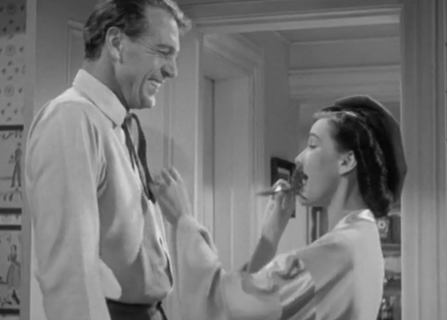
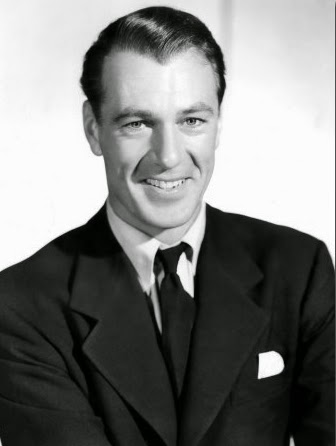
We never meet this man who supposedly looks like Gary Cooper, but Noriko seems to genuinely like him. And yet there still is something that isn’t quite right. In Japan there is great importance in “reading the air,” and it seems like some of the characters in Ozu’s film fail at this or they see only what they want to see.

latespring3In the end, Noriko gets married and it should be no surprise because it was what was ultimately expected of her. Her father, on the other hand, acknowledges to a friend that he had no intention of getting remarried, it was only to prompt Noriko. Professor Somiya took on a great sacrifice in the eyes of society and goes home alone.

This is a bittersweet tale that is surprisingly funny on many occasions, but it is also topped off with human tragedy. Not death or dying, but something potentially worse in loneliness and discontentment. It is only a thought, but it seems like Noriko and her father would have both been happy with the status quo. However, their sensibilities and society said otherwise, so they acted as they were expected to. From this simple drama comes one of the most powerful films on father-daughter relationships ever.

I must admit, at first, I really was not fond of Chishu Ryu’s character, but over the course of the story, he grew on me. As for Setsuko Hara, she is an amazing example of kindness and servility, but also the undisputed muse of Yasujiro Ozu.  Late Spring also plays off the conflict between the old and new not to mention the traditional Japan and western culture. It’s not a blatant presence, but the allusion to Coca-Cola and Gary Cooper reminds us that this is a post-war Japan still recuperating from an awful war. That’s the backdrop of this film and its part of what makes Ozu’s human drama all the more striking. Despite, where it is situated in the historical context, Late Spring is a timeless film giving calculated insight into human relationships.

4.5/5 Stars
Review: The Pride of the Yankees (1942)

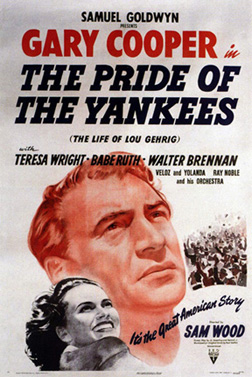
b9d42-prideofthe3Before superheroes headlined any Marvel or DC blockbuster, it was real life heroes that audiences wanted to see. No pastime was quite as popular as baseball and in that era Lou Gehrig was one of the titans along with Babe Ruth and the rest of the Yankees. You see this film is less of a biography (It certainly is not completely accurate), and more of a visual eulogy to a contemporary hero. The prologue explains as much:

“This is the story of a hero of the peaceful paths of everyday life. It is the story of a gentle young man who, in the full flower of his great fame, was a lesson in simplicity and modesty to the youth of America. He faced death with that same valor and fortitude that has been displayed by thousands of young Americans on the far-flung fields of battle. He left behind him a memory of courage and devotion that will ever be an inspiration to all men. This is the story of Lou Gehrig” ~ Damon Runyon

As a modern viewer, I am just happy I can recognize baseball names like Miller Huggins, Joe McCarthy, Bill Dickey, Tony Lazzeri, and of course, Babe Ruth. When audiences went out to see this film starring Gary Cooper and Teresa Wright back in the day, they were practically living it. World War II had already heated up and one of the great American heroes had died the previous year. Lou Gehrig was all those things in the prologue and more making it hard to get it all into a film.
Like any other superhero, he has an origin story beginning with his childhood in Manhattan, living with his poor German immigrant parents. His domineering mother convinces him to go to Columbia for engineering, but he soon ends up in the big leagues because of his tremendous skill with a bat. He is often a shy and even awkward young man, but he loves his parents and he can sure play ball. It’s that last point that gains him a lot of respect after a less than graceful start as “Tanglefoot.”
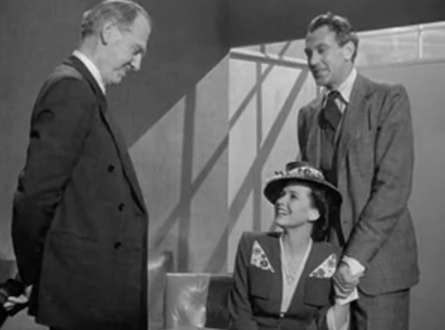
He soon becomes a lethal one-two punch with Babe Ruth, after initially being dismissed as the rookie and a boob. Journalist Sam Blake (Walter Brennan) has a major influence in Gehrig’s life and never loses faith in the young man’s abilities. He also does Lou a favor by introducing him to an attractive young Chicago socialite named Eleanor Twitchell (Teresa Wright), who finds Gehrig quite ridiculous at first. Soon, however, a budding romance begins with the often reserved Gehrig falling for the vibrant and vivacious young Eleanor. He gets engaged, married, hits two home runs for a little boy, and wins a world series. A lot of his other exploits are laid out for us too and the trophies and accolades start stacking up. All of this happens during the happy times when Gehrig is on top of the world, first with Murder Row and then The Bronx Bombers.
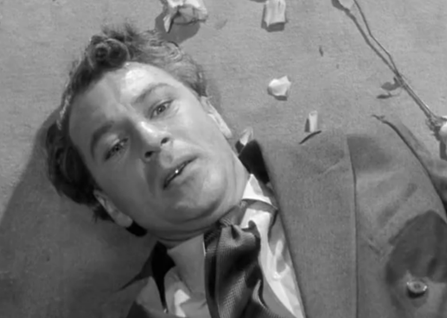
But all fairy tales must come to an end, and Lou Gehrig’s is especially tragic. He plays an, at that time, unheard of 2,000 consecutive games, but he also falls into a rapid decline. Eleanor looks on helplessly as her husband begins to deteriorate in front of her eyes, and the fans know something is not right. Gehrig gets examined and learns he has ALS, but very little is known about it. Much less can be done to treat it.
His final appearance at Yankee Stadium came on Lou Gehrig Day in 1939. That day he gave his “Luckiest Man Speech,” and he walked off the field for good. Gary Cooper delivers the partially revised dialogue with a calm and clear delivery that seems to truly epitomize Gehrig. Although he is playing the man, it is almost as if he is giving a eulogy.
That’s a fitting ending because we do not need to see the suffering or the death. What we remember is the wonderfully full life he led. Perhaps this film had more cultural relevance back in 1942, but I would argue that it is still a stirring, heart-wrenching film. You have a small heart if you cannot find a place in it for this one.
Although he was not too good at baseball, in the other sequences Cooper seems like the perfect man to embody Gehrig. He is distinctly American, strong, quiet and he also has a pleasant charm with a comical streak in him. The look on his face when he realizes his weakness tears the heart. Teresa Wright had many fine performances early on in her career, but I will step out on a limb and say that this is probably the best one. She has so much spirit and at the same time, she is funny with a noticeable tenderness. She is the perfect wife and a wonderful actress to embody Eleanor Gehrig.
In a society that places so much interest in make-believe superheroes, I don’t mind taking some time to acknowledge a real one. We were the lucky ones Lou, thanks. Let anyone and everyone who does the Ice Bucket Challenge know who you are. You deserve to be remembered. Always.
4.5/5 Stars

The Best Films of Gary Cooper

1. High Noon
2. The Pride of the Yankees
3. Mr. Deeds Goes to Town
4. Ball of Fire
5. Sergeant York
6. Meet John Doe
7. Beau Geste
8. Friendly Persuasion
9. The Westerner
10. Man of the West
11. Morocco
12. The Virginian
13. The Lives of a Bengal Lancer
14. Love in the Afternoon
15. A Farewell to Arms
16. Design for Living

Sergeant York (1941)

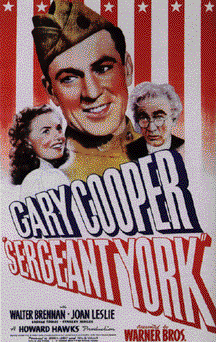
Starring a wonderful cast including Gary Cooper, Walter Brennan, and Joan Leslie with director Howard Hawks, this is a feel-good film. Alvin C. York (Cooper) lives in a small town in Tennessee where he works hard but also drinks a lot. Over time however he becomes a devout Christian and falls for a girl named Gracie (Leslie). He is hoping to get married and own a piece of bottom farm land. World War I begins and after a great conflict inside of himself, Alvin decides to go fight. While there he proves his valor, helping to capture 132 German soldiers almost single-handed.  He returns home a great hero and is reunited with his family and Gracie. Despite being a great war picture, this is also a very nice biography of a simple yet religious man who tried to live his life to the best of his abilities.

4/5 Stars

High Noon (1952)

14bd7-high_noon_posterThis may not be the greatest film of all time, but it is certainly one of the greatest westerns gifted to us so generously by Fred Zinnemann. It tells a very simple story, yet it is, in fact, so powerful simply, because of the hero it depicts. In its time it also served as a condemning allegory of the finger pointing going on in Hollywood.
*May Contain Spoilers

The film tells the story of Marshall Will Kane, who is willing to face his foes even when no one else will help him. Gary Cooper plays the newlywed lawman, who must flee town or face the killer coming on the noon train. He resolves to do just that, despite the pleas of his loving wife (Grace Kelly). The sheriff scrambles against the clock to get help. However, no one is brave enough to face the enemy with him. Even with the odds against him, he faces them in a showdown. Cooper is outgunned, but not outmatched — heroically prevailing.

This film is so powerful, because it is full of human emotions, and it feels so real since the events unfold almost in real time. The somber ballad, sung by Tex Ritter, also helps to create the mood right from the opening credits. In fact, I must admit that multiple times I have found myself humming or crooning the words, but then again I suppose it makes sense since the song is woven into the very fabric of the film.

The score by Dimitri Tiomkin utilizes the tune throughout to complement the images of the town. In that respect, “Do Not Forsake Me, Oh My Darlin'” is not just a song, but an important piece of this story. It is easy to forget the supporting players since Cooper often steals the show. Nevertheless, there’s Lloyd Bridges, Grace Kelly, Katy Jurado, Thomas Mitchell, Lon Chaney Jr.,  Harry Morgan, and even a young Lee  Van Cleef. Many have pasts with Kane that we cannot expect to fully know. All we can understand is the here and now that causes a person to weigh their options, and either follow or go against their conscience. Kane and then his bride both did what they thought was right even when others would not follow suit.

It struck me how simple the story is, and yet on the other side, it is a complex allegory that critiques humanity. Will Kane is a man, who helped make the town what it is, but when trouble comes and the odds are bad no one is willing to help him. Besides the obvious positives like a good story and a heroic protagonist, this film stands out because it feels so human. Here we are as an audience watching the events unfold almost minute for minute. Then we see the various town folk and their fear of getting involved, and to make matters worse a lot of them are Kane’s very good friends. It makes us question what we would have done in their position. Because some of them were obviously good people, who were scared to be involved. Of course, during this time McCarthyism was prevalent and it is suggested that this film alluded to that. However, whatever you think it is still unquestionable that High Noon is a powerful film, a love story, and at its simplest a classic western.

5/5 Stars


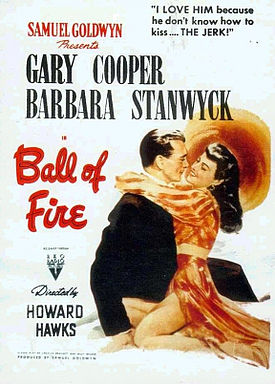
Ball of Fire (1941)

a5490-ball_of_fire_movie_posterStarring Gary Cooper and Barbara Stanwyck, the film revolves around a young man (Cooper) and seven older intellectuals compiling a Encyclopedia who get involved with a burlesque dancer (Stanwyck). They are interested in her constant use of slang and she is happy to use them as a cover to avoid the cops while she waits for her gangster boyfriend. However, things take a turn when the young man falls for her and proposes. Little does he know they are being used until they unknowingly transport her back to the gangster. He feels betrayed and she realizes her love for the corny intellectual. Although they are held by the gangster’s thugs, the intellectuals join their wits to overcome their foe. In the nick of time they stop the marriage and the true loves get back together. Howard Hawks directs a nice combination of humor and romance. The story by Billy Wilder, is Snow White and the Seven Dwarfs with some major twists.

4.5/5 Stars

Mr. Deeds Goes to Town (1936)

Starring Gary Cooper and Jean Arthur with director Frank Capra, this film follows a man from a small town who is left $2 million by a dead relative. Longfellow Deeds is thrust into a life in New York where everyone wants his attention in order to get money and support. However, this man they took for a stooge has common sense and grows fed up with them all. The only person he talks to is Arthur’s character who is actually a reporter. While she writes damaging articles, they slowly begin to fall for each other. He finds out what she did and eventually decides to give his money away. Fortune hunters try to claim he is crazy and they bring their case to court. Initially Deeds does not defend himself, but when his love speaks on his behalf he changes his mind and fights for his cause. Capra was wonderful at making the feel good films about the common man. Here he does it once again in a precursor to Mr. Smith Goes to Washington and Meet John Doe.

4.5/5 Stars

Meet John Doe (1941)

Starring Gary Cooper and Barbara Stanwyck with direction by Frank Capra, the film begins with a news woman (Stanwyck) creating a made up story about John Doe, a man willing to commit suicide to protest big government. In order to keep the story going, they take a man off the street to effectively be John Doe. At first John (Cooper) and his friend the Colonel (Walter Brennan) are attracted by the chance to work. However, slowly he seems to become John Doe and the whole nation is seemingly behind him with Stanwyck’s character falling for his image as well. A political machine tries to discredit him and prove he never was John Doe. Now all along John decides to go through the suicide to prove his point to all. The political machine tries to stop him and Stanwyck finally does saying they can still keep the ideals of John Doe alive. Sharing some similarities with Mr. Smith, this film is one of those feel good films.

4/5 Stars

The Pride of the Yankees (1942)


Starring Gary Cooper as Lou Gehrig and Teresa Wright as his wife, this movie honors Gehrig’s life after a tragic death from ALS. From the time he was a boy, Lou could play ball but his immigrant mother wants him to become an engineer. The quiet, young man goes to Columbia and plays some ball. There he is seen by the Yankees who agree to sign him. Despite her disapproval at first his mom becomes his biggest fan. With the Yankees Lou seems slightly out of place being an introvert. Pretty soon he meets Eleanor Twitchell (Wright) however and then gains a spot as the starting first baseman. The two of them fall in love and get married as Gehrig flourishes in the shadow of Babe Ruth. With his career still going strong, Gehrig becomes captain and plays 2,000 straight games. It cruelly comes to an end when he begins feeling weak and is diagnosed with ALS. His career is over and yet in his farewell speech Gehrig gratefully considers himself the luckiest man on the face of the earth. He walked out of the limelight and died soon after, dearly missed. This is one of those truly moving films.

“I consider myself the luckiest man on the face of the earth.” You just cannot make up stuff like that. Here’s to you Lou!

4.5/5 Stars