A Christmas Tale (2008)

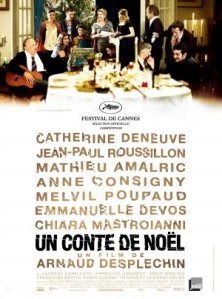
achristmastaleposterThe initial inclination for seeing Arnaud Desplechin’s sprawling family drama was the presence of the estimable Catherine Deneuve. And she’s truly wonderful giving a shining, nuanced performance that makes the audience respect her, sympathize with her, and even dislike her a little bit. But the same goes for her entire family. The best word to describe them is messy. Dysfunctional is too sterile. Messy fits what they are. If you think your family is bad around the holidays, the Vuillards have a lot of their own issues to cull through.

The inciting incident sends a shock wave through their already crumbling family unit. Their matriarch has been diagnosed with bone marrow cancer and must make the difficult decision of whether or not to risk treatment or go without. But Deneuve carries herself with that same quietly assured beauty that she’s had even since the days of Umbrellas of Cherbourg. In this capacity, she makes A Christmas Tale, far from a tearful, sobfest. She’s strong, distant, and you might even venture to say fearless.

And because of her strength, this story is not only about her own plight – it’s easy to downplay it because she is so resilient – but it frames the rest of the interconnecting relationships. It began when her first son passed away. The children who followed included Elizabeth (Anne Cosigny) who became the oldest and grew up to be a successful playwright. Junon’s middle child Henri (Mathieu Amalric) can best be described as the black sheep while the youngest, Ivan, was caught in the midst of the familial turmoil.

Because the issues go back at least five years before Junon gets her life-altering news. It was five years ago that Elizabeth paid Henri’s way out of an extended prison sentence (for a reason that is never explained) with the stipulation that she never has to see her brother again. Not at family gatherings, not for anything. And she gets her way for a time.

But with Junon’s news she and her husband Abel (Jean-Paul Roussillon) realize this is a crucial time to get their family back together because, above all, their matriarch needs a donor and due to her unique genetic makeup, a family member is her best bet.

Underlying these overt issues are numerous tensions that go beyond sibling grudges and sickness. Elizabeth’s own relationships have been fraught with unhappiness and her son Paul has been struggling through a bout of depression. Ivan and his wife (Chiarra Mastroianni) are seemingly happy with two young boys of her own. But old secrets about unrequited love get dredged up and Sylvia is looking for answers of her own. Although it’s a side note, it’s striking that Chiarra Mastroianni is Deneuve’s real-life daughter and in her eyes, I see the spitting image of her father, the icon, Marcello Mastroianni.

There’s also a lot of truth and honesty buried within A Christma Tale and in most competitions, it would win for the most melancholy of yuletide offerings. However, it’s important to note that its darkness is balanced out with romance, comedy, and a decent dose of apathy as well.

Still, the most troubling thing about A Christmas Tale is not the fact that it is extremely transparent, but the reality that the themes of Christmas have no bearing on its plot. We leave these characters different than they were before but whether they are better for it is up for debate.

The sentimentality of a It’s Wonderful Life crescendo would be overdone and fake in this context but some sort of reevaluation still seems necessary. Because without faith in anything — faith in their family is ludicrous — their world looks utterly hopeless. The two little grandsons wait in front of the nativity staying up to get a glimpse at Jesus (perhaps mistaken for Santa Claus) and their father calmly states they should go to bed because he’s never existed anyways. And there’s nothing inherently wrong with holding such beliefs.

Even the fact that Junon and her grown son Henri attend midnight mass is an interesting development. But during this season emblematic of hope and joy, it seems like the Vuillard’s can have very little of either one. Henri can be his mother’s savior for a time by extending her life for 1.7 years or whatever the probabilities suggest. But then what?

It’s this reason and not the family drama that ultimately makes A Christmas Tale a downer holiday story. Its denouement feels rather like a dead end more than fresh beginnings. Because Nietzche and coin flips are not the most satisfying ways to decipher the incomprehensibility of life – especially with death looming large during the holidays.

But that’s only one man’s opinion. That’s not to downplay all that is candid about this film in any way. If you are intrigued by the interpersonal relationships and entanglements of a family  — may be a lot like yours and mine — this film is an elightening exposé.

3.5/5 Stars
Black Girl (1966)

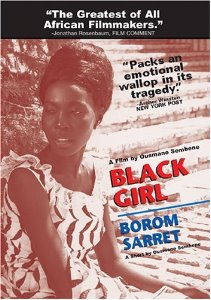
LaNoiredeDVDWhat’s fascinating about this film is how it manages to give voice to those who are normally silenced and even in her subservience this narrative powerfully lends agency to a young Senegalese woman’s perspective. Because even when she is silent and words are not coming out of her mouth and her status ultimately makes her powerless, the very fact that her mind is constantly thinking, her eyes observing and so on mean something. Inherently there’s a great empowerment found there even if it’s only known by her and seen by the outside observer peering into her life. That’s part of her. We are given a view into what she sees. We can begin to understand her helplessness and isolation. Where she came from and the life she left behind. Giving up the master narrative of the entitled and shown the flip side of the world for once.
And the fact that this viewpoint comes from an African filmmaker casts the film in an even more profound light because just as this character is from one of the marginalized castes, the same could be said for the director Sembane Ousmane. My knowledge of African filmmaking is admittedly poor and that’s precisely the point. For me, this film is an entry point, a representation, a portrait of a lineage that I know very little about and that makes Black Girl extremely exciting. Because if this picture found its way to me, there’s a chance that it can represent something to others as well–namely the import that African cinema can have on the world at large if given half a chance.

With this picture, Ousmane makes a visual statement using the medium of film to offer yet another, broader perspective to the patchwork of world cinema that can be decidedly bland and monochromatic at times. Here is a story that even in its simplicity guarantees that more voices will be heard and at the very least more perspectives will be empathized with.

Diouanna is at best a servant and exotic sideshow attraction for party guests and at worst a prisoner who gets her job as a live-in nanny and de facto housekeeper rather like a slave off an auction block. Sadly, it doesn’t feel that much different. There’s a little more free will involved but that’s what humble circumstances can do. She has a choice but not much of one.

She looks at France as an extravagant promise land and a job is a gift of providence that she will gladly take. Still, once she arrives on the Riviera she soon becomes disillusioned. It’s hard not to blame her given the circumstances. She no longer is able to mind kids as she knows best and rarely is allowed to explore the beautiful country she lives in–if at all.

She doesn’t want the husband’s money or the patronizing kindness of the wife which demands every amount of deference and even most of her freedoms. It’s the high position that takes on the role of savior and expects a certain response whether it is fully deserved or not. That is what hangs in the balance of Black Gir signified by the ceremonial mask that Diouanna gifts her benefactors at the outset of her employment.

First relinquished as a gift and taken as an exotic souvenir exhibited on the wall for all to see–a symbol of charity, generosity, and simultaneously colonialism. But soon, as Diouana grows discontent she realizes she doesn’t want this. She will willingly give up this “lavish lifestyle” and whatever perks come with it to retain her identity. That’s too great a price to pay as she realizes and this job isn’t worth the toll. Her cultural identity and the identity represented by this film are vitally important. Because they represent yet another member of humanity.

4/5 Stars

The Soft Skin (1964)

the-soft-skin-1There might be an initial predilection to call The Soft Skin Francois Truffaut’s most conventional film to date, but for me, it shows at this fairly early point in his career he seems to have grasped the main tenets of traditional filmmaking. Because his first films are full of life, energy, and idiosyncratic verve that easily charm their audience but here we see a film that in most ways looks like other classic works, well constructed and still quite engaging. Because within this very framework Truffaut is able to play around with issues that in themselves are still quite compelling. Love, intimacy, infidelity, and the like. Even with familiar names like Truffaut and Raoul Coutard, it feels very un-Nouvelle Vague. And that’s okay.
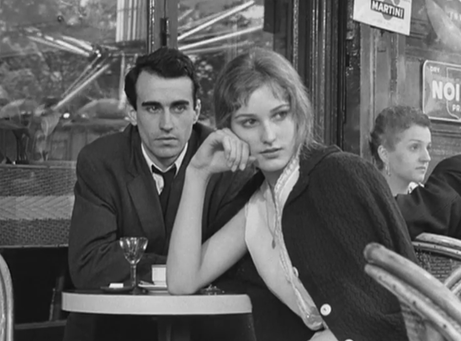
We often expect comedy from Truffaut as he shows in many of his other films but here everything is fairly reserved and understated dictated by our gentlemanly protagonist Pierre (Jean Desailly) and accentuated by most everyone else. They are not inserted into the story line to make light of issues but to actually grapple with these real life circumstances in ways that feel quite candid in their humanness.

Furthermore, Truffaut’s films are often, cinematically speaking, very self-aware but aside from a brief foray into a documentary on Andre Gide, our characters seem very much absorbed in their own world with the problems at hand and Truffaut seems to realize that. As audience members, we too become implicit accomplices to this tryst and that’s where the story comes into being.

Pierre is a managing editor of a prominent publication with a lovely wife and sweet little girl. He’s well off and travels across France in high demand at lectures and cultural galas. People want his autograph.

But in a moment he meets someone. Truffaut allows them to interact and pass each other by without anything happening. That’s the key. As I imagine it is with real life, moments go by and it’s in those passing moments that things begin to unfold. Pierre is taken by the stewardess (Francoise Dorleac) he now sees in the elevator and then invites her for a drink awkwardly. It begins there. He’s clumsy about it but his respectability and candidness probably attract the girl.

The title, of course, implies the very physical nature at the core of an affair. It’s the touch, the feel, the intimacy that is longed for. But it runs awry because that very thing that is craved becomes muddied by deception and infidelity that threatens to tear relationships apart. Not just with spouses and friends but the very people who are caught up in the throes of the affair. There’s the necessity to keep them hidden, skip out on them at a moment’s notice so as to not raise suspicion.

Everything is clouded and nothing is pleasurable anymore. There’s a moral repugnance that often goes with the territory. Of course, the one individual that we might do well to feel the sorriest for is the one we rarely see, the third party who is deceived, in this case, Pierre’s wife.

Still, Pierre is so sincere and Nicole much the same that it’s somehow easy to feel sorry for them as well as Franca. As Nicole notes to Pierre, “you made a real mess of things” partially because he’s having trouble leaving his wife after 15 years and he still wishes to see his little girl Sabine every day. He’s not much good at the whole affair business. Whether it’s leaving his wife or staying with the girl he’s found.

Perhaps the most poignant scene comes with Nicole on the balcony confiding in Pierre because we understand what she’s trying to hint at. And we don’t see Pierre but you can guess where his thoughts are at that very moment. In not so many words she is saying this thing they have won’t work anymore and that’s the end of it — at least in the way he envisioned it all, with marriage, a home, etc. It cannot exist.

And of course he has no recourse but to return to his wife and beg her forgiveness and it seems like a road worth the risk but in his unassertiveness, Pierre puts it off just long enough for it to be too late. There’s no getting it back. Because infidelity, no matter the strain, can be thoroughly insidious undermining trust and planting seeds of doubt and bitterness. That is rocky soil to maintain a relationship on and in cases like this, it can only end in tragedy. It’s true that The Soft Skin blows us out of the water in the end but what makes us stay is the great care it takes in getting there.

4/5 Stars

Review: Pickpocket (1959)

pickpocket-1Pickpocket is an intricately staged, truly intimate character study from the inimitable Robert Bresson solidifying itself as one of his greatest works. As was his practice, Bresson took Martin LaSalle, a non-actor to be his leading protagonist.
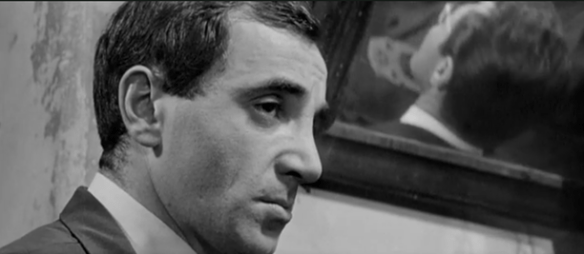
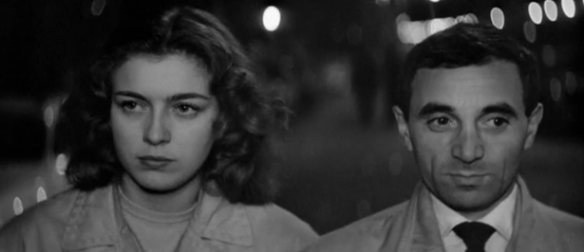
The Uruguayan-French actor sports gaunt, rather severe features, thick eyebrows, a sauntering gait and a slumped posture. However, there’s also some facial similarity to Henry Fonda there, except LaSalle is even more “normal” if you want to go that far. He seems altogether unextraordinary and still Bresson manages to tell an engaging story with such an unassuming star–not through emotions but the inverse–a complete lack of emotions replaced instead by actions.

Aside from being a vagrant who lives in a dilapidated flat, Michel is a cynic who holds a bit of a superman complex. In fact, he’s not far off from Raskolnikov in Crime & Punishment. The difference being his crimes are more mundane. The outcome is less pronounced. But he too achieves a kind of redemption.

With such a life as he leads, not working, with hardly any friends, or anything to do aside from betting on the horses, Michel fills his idle hours learning what it is to be a pickpocket. It becomes his livelihood as he joins forces with some accomplices, honing his trade, and gleaning inspiration from the life of pickpocket socialite extraordinaire George Barrington. Except Michel seems nothing like this man. He’s no adventurer or colorful personality. He watches the world with passionless eyes, lacking purpose, and hardly talking to anyone. When he does, it’s generally brusque. He’s not looking to make friends–aside from his “buddy” Jacques. He hardly even visits his sickly mother even when she’s lying on her deathbed.

But that’s what makes his nearby neighbor Jeanne (Marika Green) all the more fascinating because she brings something out of him. It just takes him a long time to realize it. I cannot get it out of my head that Marika Green shares some striking resemblance to Natalie Portman. This notion shot into my head the first time I ever viewed Pickpocket. It serves no real obvious purpose but to suggest her stunning beauty and maybe even that there’s a modernness to her or better yet a timelessness behind her eyes that’s full of some sort of inexplicable power. Maybe Natalie Portman has that same quality as well. It’s difficult to say.

It’s striking that many of the scenes in Pickpocket are almost silent, lacking scoring and often even dialogue, and yet they’re choreographed like the most elaborate dance. Instead of feet, though, hands are involved. The dexterous hands and limber fingers of pickpockets.  And his eyes rove as much as his prying fingers.

There are similarities here with Sam Fuller’s Pickup on Southstreet except in this case the life of a pickpocket, this life of second class crime is the extent of his existence. There are no gangsters, plots, or big implications pointing to Cold Wars and Communists. But if they share anything it’s their equally impressive understanding of economical filmmaking with the innate ability to tell rich, impactful stories in a highly condensed amount of time.

Michel’s life is pitifully mundane in a sense and yet within that context, he’s still able to find hope and that’s the beauty of what Bresson suggests here through the simple functions of sound and image. He evokes a great deal.

It was not the final words of Pickpocket that struck me but rather the image that we are left with. There stands Michel incarcerated in prison. It seemed inevitable. Because supermen do not exist, at least not in the way that he supposed. And yet in the same breath, when he shed that philosophy he found something better.

He caresses Jeanne through the bars, kisses her face. Yes, he’s still trapped, stuck in such a horrible spot without his freedom. But the utter irony of it all in this one moment, before a very abrupt conclusion, Michel is finally free–finally saved by the graces of love and it took a prison cell to teach him as much.  His life was propelled by inaction highlighted by contained moments of theft and deception. Therefore, it’s in this final instance that Michel finally shows some amount of goodness and affection bursting forth. His life no longer seems to be defined by being a pickpocket. For once, it’s defined by something else–by someone else.

Whereas Raskolnikov realized that he needed Sonya to resurrect him much like Christ resurrected Lazarus, Michel comes to a similar conclusion here though he only believed in God for three minutes. Still, in a sense, he has been redeemed and now there’s a certain amount of hope in his life going forward. The straight and narrow is a tough road to traverse but Michel might find it yet.

“Oh, Jeanne, to reach you at last, what a path I had to take.”

4.5/5 Stars

Shoot the Piano Player (1960)

shoot-the-piano-player-1

Shoot The Piano Player begins thrillingly with a car chase. The man being pursued flees down a street corner, his assailants disappear into the night, and he subsequently bounces off a streetlight like an idiot. The man who brings him back up on his feet proceeds to regale him with stories about how he met his wife before walking off, never to be seen again.

In fact, none of these characters are our main protagonists but it perfectly encapsulates the glories of Francois Truffaut’s stroke of genius in this early emblematic film of the New Wave.  It’s a petty crime story with a comical streak. The two tough guys aren’t tough guys at all but with their hats and pipes they look like a pair of Monsieur Hulot doppelgangers or something. That is until they pull out a gun. But even then, they’re hardly thugs.

Listed out as simple plot summary, it has certain flourishes fit for a Hitchcock thriller. A man on the run. Lurking criminals, kidnapping, murder, romance, humor, but there’s no doubt, even with this being only his second feature, that this is very much Truffaut.

It’s all a wonderful front for Truffaut’s own explorations. And the bottom line is not simply homage to film-noir and the Master of Suspense but more broadly all his fascinations of men, women, love, and everything that intrigues him about putting a mirror up to humanity–cinema itself. However, as the director long suggested, he preferred film to reality because he could orchestrate it, make it to his liking, with touches of humor and tragedy.

This pseudo-storyline starts with Charlie who placidly knocks out honky tonk for the public’s enjoyment. It’s hard to know if he’s content or simply biding his time. The latter seems more likely. Except when his big brother Chico busts into the joint with a couple of hoods on his tail, in some small way it brings everything rushing back on Charlie.

shoot-the-piano-player-2

It’s not much but the ensuing events have him wrapped up in his own bit of intrigue as he navigates his romantic inclinations and every other thing that is thrown his way.  A Hollywood reference point would certainly be Out of the Past and similarly sinks back into a flashback. But here it is used in a way that’s completely jarring, hardly convenient for those seeking comprehension. And Truffaut’s character utilizes voiceover as well but this is not the laconic, cynical speak of film-noir, instead the nervous inner monologue of a timid piano player.

His sometime bedmate and the housekeeper for his kid brother is Clarisse. Meanwhile, the waitress at his work Lena has his heart going pitter patter, not quite a Hitchcock blonde but a woman who is willing to get involved with his drama. But there was also another important woman in Charlie’s life: His wife.

It’s from these three women in their relationships with Charlie and all the other male characters that some very blatant realities become evident. There’s a conscious separation of the woman into parts whether it is her heart or her body. In one sense, the aforementioned women are strong characters. Meanwhile, the men are all fairly passive, their main outlets include objectifying, ogling, even ridiculing their female counterparts.

At least Charlie’s candid about it but he’s still part of the problem. In many ways, in looking at the women as the tragic figures often used by men as a cinematic object, Truffaut could very easily be wrestling with his own issues of love and romance. What does that actually mean? What causes people to marry? What causes them to love and fall out of love, break up and come back together or even commit themselves to death?

All that can be found within this film although it is obviously veiled by scenes masquerading as crime and comedy. The crowning joke of them all is really a kind of tragedy. Amid the strangest turn of events, Charlie or Edouard (as we now know he is called) is resigned to play behind his piano once more.

The final moments at the snowcapped cabin are madcap and still almost surreal with some stunning sequences captured vividly by iconic New Wave cinematographer Raoul Coutard. In breaking so cleanly with his initial effort of The 400 Blows, Truffaut simultaneously positioned himself as a very special filmmaker. He’s beholden to drama, comedy, crime, and romance, but most of all, he’s beholden to the magic of the silver screen.

4.5/5 Stars

Review: Vivre sa Vie (1962)

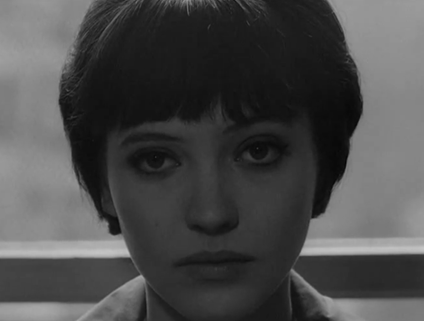
vivre-sa-vieThe opening credits of Vivre sa Vie commence with the opening note “dedicated to B-movies” and indeed many of Jean-Luc Godard’s best films could make the same claim. They’re smalltime stories about little people living rather pathetic lives if you wish to be brutally honest. This isn’t Hollywood.

Opening titles aside, we meet our main characters from behind, their backs to the camera in the throes of a minor spat. It acts as the subject for the first of the director’s 12 tableaux that make up the film rather like chapters in a book following the life of our heroine Nana (Anna Karina). Next, comes pinball games, Nana’s occupation as a Record Shop attendant and other mundane moments.

The passage of time caused me to forget that Nana goes to a screening of The Passion of Joan of Arc. Her own life witnessed in the eyes of Joan–a heroine that she easily empathizes with for her own amount of suffering and pain. It’s difficult to decipher who Nana feels more connected to, Joan of Arc or the actress Maria Falconetti herself. Because the truth is, Nana too was trying to make it as an actress, even being featured in a film or a play or something or other. It didn’t work out.

As the story evolves, we gradually begin to see her plight more clearly. It comes slowly at first before fully establishing itself. She goes down the rabbit whole quite by chance, taking on a very different occupation. It’s pitiful really, she looks more like a frightened rabbit than a woman of the street.

Her aspirations of catching the eye of some director are instead channeled towards Raoul, the pimp who gets her started and shows her the ropes of the trade. In some ways, it feels like he owns her, and yet Nana still strives to lead her own life. One of the moments she gives the illusion of happiness is in all places a pool hall as the jukebox grooves away and she shimmies with it. But in this moment as with so many others, it seems as if she’s constantly under the gaze of men. She’s constantly trying to earn their affection and in some sense earn her own worth. Whether or not they give it is another matter and that’s the great tragedy of Nana’s life.

In some of the film’s final interludes, she finds time to wax philosophical with an old thinker on a number of topics from personal responsibility to issues of free will. He further asserts that the more one talks, the less the words mean. Perhaps Godard took that to mean form over dialogue.

At times it’s as if Godard’s camera is constantly on a swiveling axis or even a pendulum, focusing on a figure and swinging back and forth between it’s two subjects. No cuts are necessary and it’s oddly compelling.

Look at his work hastily here and it could be misinterpreted as shoddy and that could be but more likely is the fact that Godard was always thumbing his nose at convention. He was never beholden to classical Hollywood but he did have heroes. The likes of Sam Fuller, Fritz Lang, and Nicholas Ray. Men with their own aesthetics and Godard was forging his own path. Only someone like Godard would have the audacity of having us watch the entire transcription of a letter. Why? Because he wanted to.

Vivre sa Vie did not ignite the Nouvelle Vague but in many ways, it stoked the flames and Godard perhaps unwittingly gave nod to another landmark film from his compatriot Francois Truffaut, Jules et Jim, which finds its way up on a movie marquee.

Perhaps what’s easiest to take away from Godard’s work here with longtime collaborator Raoul Coutard is that he’s constantly messing with our classical cinematic sensibilities. The way he cuts (or doesn’t), the way he interrupts sound, the way he moves between intertitles and so on. It’s still his and it still disrupts the status quo that we are used to even as seasoned viewers of visual content.

For some, it can come off as tiresome, even pretentious but it’s undoubtedly Godard and highlighting the entire narrative is the quietly yet still evocative performance of Anna Karina. Her doe eyes speak volumes by themselves.  They truly were the power couple of the French New Wave. He being the audacious artist, she his inspired muse. However, it begs the question, if there is any stock in the parallelism between film and reality. Nana/Anna being controlled by the men in her life or was it truly her life to live?

4.5/5 Stars

Cleo from 5 to 7 (1962)

cleo-from-5-to-7It’s a joy to watch Agnes Varda dance. Or, more precisely, it’s a joy to watch her camera dance. Because that’s exactly what it does. Her film opens in color, catching our attention, vibrant and alive as the credits roll and a young woman (Corinne Marchand) gets her fortune read by an old lady. She’s worried about her fate. We can gather that much and this is her way of coping. Superstition and tarot cards but she’s trying and the results are not quite to her fancy.
And from that point on Varda’s camera continues to move dynamically but her film quickly turns to black and white as if to say something. Our main heroine, this young, attractive singer named Cleo has sunk into a sense of despondency. For the next two hours, she must wait it out to hear the news from her doctor. The news being whether or not she has been stricken with cancer. And if cancer then recovery or even….death. This is her existential crisis.

In the following moments, the camera falls back as an observer even donning her point of view from time to time and that’s the true enjoyment of this film. There are stakes laid out right from beginning and those remain in the back of our minds but it’s really about how we get there. How she gets there.

Cleo walks the streets of Paris browsing shop windows for hats, taking cab rides through the city, patronizing local establishments, resting at her flat with her assistant, and even calling on friends.

It becomes obvious that Cleo needs other people in her life whether she knows it or not. There’s an importance in solititude when she gets to examine the passing world and take in the serenity of running water in a park on a peaceful afternoon. But it’s the people that bring some color to her life. True, she does note that everyone spoils me, no one loves me, undoubtedly bemoaning the quick house call by her lover, the doting of her houskeeper, and the comical buffoonery of her pianist and lyricist duo.

But she also calls on her friend Dorothee who models by day in a sculptor’s studio taking in the bustling Parisian streets with all sorts of people but more importantly time for all sorts of conversation both superficial and sincere. They visit the local cinema and are treated to a silent comedy short (starring Nouvelle Vague power couple Jean-Luc Godard and Anna Karina). As the girl’s boyfriend rightly ascertains comedy is good for the soul. It can help alleviate a world of hurt.

Cleo’s final confidante comes quite by chance. A soldier on leave from Algeria as it turns out. He’s at first forward, then didactic, and finally utterly sincere. He’s perhaps just the type of person Cleo was looking for without even realizing it — someone who is perfectly obliging with conversation when she feels completely taciturn. Theirs is a quick friendship as he agrees to go with her to the hospital for the impending news and she, in turn, looks to see him off to the train station as he goes back from whence he came.

And does the film’s conclusion suffice? Not particularly. It’s abrupt and unsatisfying after all that prolonged wait but curiously Cleo seems at peace. Perhaps that is enough. What this film does impeccably is capture a moment as if it was pure and true and utterly authentic. It takes real world issues and a real world setting, synthesizing them into a fictional storyline that still functions as the every day would.

This is the world of the Cold War, war in Algeria, Edith Piaf in the hospital, Elmer Gantry, Bridget Bardot, and French pop music. It’s all melded together, bits and pieces, and moments and ideas and snapshots into a thoroughly engaging piece that becomes a sort of rumination on life and death and all those things that complicate living. If it all sounds like a jumbled mess of words it is and instead of trying to comprehend it by any amount of diction you should do yourself an immense favor and see Agnes Varda’s Cleo from 5 to 7 for yourself. If you are disappointed then I am truly sorry for you. Because it’s a wonderful film.

4.5/5 Stars

An Autumn Afternoon (1962)

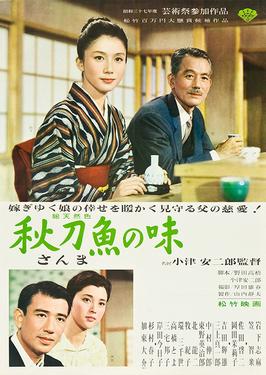
an_autumn_afternoon_filmposterThere’s something overwhelmingly soothing about Ozu, simultaneously slowing my pulse and calming my nerves. Yes, An Autumn Afternoon stands as his final film. Yes, he would sadly pass away the following year. But there’s a comfort to watching his films unfold — even his last one. The drama is everyday and somehow disarming and pleasant. We often take for granted that Ozu was not planning to end here. This was not supposed to be his last film. It just happened that way.

However, that is the way that the world turns and with such of an outcome we get one final candid view of the director at work — his confident and streamlined aesthetic that at this point is instantly recognizable. It’s not simply about content, though his film examines many of his usual preoccupations of years gone by. It’s really about the form.

His palette is by this point assured and at the same time vibrant and free. Everything is in its precise place, the colors bright and cheerful — a certain amount of authenticity married with simple visuals that take impeccable staging, facades, and a static camera to tell his narrative in a very particular way.

And he’s willing to break the rules of perspective that have forever been textbook Hollywood law and yet the way he does it is hardly off-putting. In fact, it’s rather reassuring. His figures always looking at us directly, carrying on conversations, sharing in pleasantries or even chortling together over some small trifle. And we get to be fully a part of that both the trivialities and the drama.

Still, I am constantly being drawn to different things around the edges of the screen. Distracted in a good way by various bottles placed throughout the frame, bowls placed in front of our figures, or Suntory logos that hang overhead. Important, certainly not, but still they mesmerize me for some unexplainable reason.

And I have long gotten over any amount of impatience in the pacing of Ozu. Shots of empty rooms. Seemingly pointless conversations. Eating and drinking. It’s all palatable. It’s more about savoring every little moment for what it is. Because that’s what Ozu was truly a master at capturing. So many people behind a camera can capture high drama with enough action, intrigue, and scandal. But it takes a fairly fearless individual to put a microscope (or a movie camera for that matter) up to the banality of life. Yet it’s the true irony, that it’s precisely in those places we kind find so much truth pertinent to our own existences.  Yes, it’s true.

Meals with friends. Family conversations. Husbands. Wives. Fathers. Daughters. Brothers. And so on. It’s no surprise that these are all things that Ozu looked at before and if he had continued making films he would have undoubtedly continued. The same social mores and familial relationships that while uniquely Japanese, still share enough with the rest of humanity to be oddly universal.

In this case, his favorite protagonist (Chishu Ryu) is a widower who lives with his grown daughter and son. It’s his buddies who chide him to let his daughter go so she can get married before she’s an old maid. And while in previous iterations Ozu looked deeply at the heartbreak, the emotional effects are slight. The daughter is relatively happy. The father is wistful but still resolved to live his life. The ever-changing aspects of life are felt but hardly earth-shattering. Instead, mankind is forced to continually wax and wane with the times. There is a time for a laughter, a time for tears, a time for work, a time for play, and so on.

Although the father-daughter relationship is the nucleus the film boasts a surprising depth of character. There are coworkers, old war acquaintances, former teachers, and the brother and sister-in-law. In fact, the venerable Mariko Okada is always one of my favorites in Ozu’s films and she picks up where she left off in Late Autumn with a certain spunkiness and vivacity.

If this must be our exit point from Ozu’s work, it’s a relatively easy place to leave. It’s a beautiful, warm portrait of modernity. Two old war buddies can assert that maybe it was for the best that the Allies won the war. A husband can really want a pair of golf clubs, though he doesn’t have the money to buy them. Old men can gather around a table for a party and joke about their old teachers. It’s a delectable slice of life.

4.5/5 Stars

Sophie Scholl: The Final Days (2005)

sophieschollSophie Scholl: The Final Days is a film that people need to see or at the very least people need to know the story being told. For those who don’t know, Sophie Scholl was a twenty-something college student. That’s not altogether extraordinary. But her circumstances and what she did in the midst of them were remarkable.
It’s easy to assume that life under Nazi authority wouldn’t be so bad for Aryans, nationals, or the general public. But it just takes looking at a story like Sophie Scholl’s and her older brother Hans and that assumption quickly falls apart. Because their lives reflect an alternative to the master narrative, the kind of counter example that is often visible if you look hard enough.

You see, these two young people in solidarity with numerous others took a stand against the oppressive Nazi regime calling for passive resistance, the cessation of violence, and championing the ultimate worth of all people–even Jews and the disabled.

That was a radical departure and utter blasphemy in the face of the stringent rhetoric of the Nazi party. But so were the heady words that The White Rose movement was circulating in those incredibly perilous, heavily policed and censored days and they knew full well the risks that they were taking. Yet they did it anyway, typing up hundreds of anti-Nazi pamphlets to be mailed and further distributed across their university campus.

The film takes a very direct approach to its narrative spending little to no time in building up its character’s backstory instead, throwing us headlong into their business with the printing and dissemination of their message. The film is immediately filled with a palpable tension but it does make you question where the film can go from here as it manages to reach such an unnerving state early on.

In truth, The Final Days spends most of its time in interrogation rooms and prison cells. It’s a stripped down storyline that nevertheless rings with truth and exudes an unassailable depth that says something of the characters at its core. They are remarkable human beings. Bold, brave, resilient, all those things, and yet they were only a group of young college students. Here is a woman younger than me who under tremendous duress and pressure of an astronomical nature, nevertheless showed tremendous poise, resolve, and true strength of character.

Julia Jentsch gives a phenomenal performance as the eponymous heroine in both its composure and restrained strength, never faltering and very rarely succumbing to any amount of emotion until the final moments. And even then she maintains a resolute spirit that seems content even unto death.  Some people are born older and so it seems with Sophie Scholl. Thus, let no one look down on you because you are young because if Sophie’s life is any indication at all you can do so much with this life even in youth.

But the film also becomes a bit of an ideological battle as Sophie spends hour after hour being grilled, belittled, and berated by Gestapo Investigator Robert Mohr. Initially, it all starts with an attempt of catching Scholl in her lie and yet she’s so self-assured in her answers, it’s very difficult to trip her up. And even when they get beyond the beginning hurdles of interrogation they duel on deeper topics altogether from law to freedom of speech, to spirituality.

In her prison cell, when she’s not conversing with her fellow prisoner, Sophie prays to God as she puts it, “stammering to him” but she also holds unswervingly to her faith, maintaining an undeniable reverence for her God and a firm belief that every individual is made in the image of God. That she too is made in his image. Therefore no one has any right to pass divine judgment or dictate whether someone lives or dies. Certainly, the Nazis are no different.

In one striking discourse, Mohr grills Sophie with the following question, “Why do you risk so much for false ideas?” She answers matter of factly. It’s because of her conscious and going further still it’s because every life is precious. A 21-year-old girl was able to grasp what the Nazis were too poisoned, narrow-minded, and proud to see. The inherent worth found in every human being.

That’s why the court scene in Sophie Scholl will incense most viewers and it should. The man who presides over the show trial is a vindictive man seething with indignation against these insignificant, worthless traitors as he sees them. But he’s so utterly blinded. He has no legitimate right to pass any sort of judgment on them. They are so much more honorable than he could ever be. And yet he holds the ultimate authority in this regime and they do not.

To the very end, The Final Days proved to be one of the most taxing films I have watched in some time but even in its endings, it finds hope and stories worth telling. That in itself makes it a wonderful film to discover.

4/5 Stars

Note: This post was originally written on February 28th and scheduled to be released next month but it seemed like a story necessary for this particular point in time.


Veronika Voss (1982)

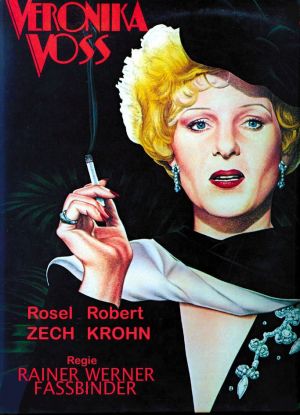
veronikavossYou get a sense that if they had ever met, Norma Desmond and Veronika Voss might have been good friends. Either that or they would have hated each other’s guts. And the reason for that is quite clear. They share so many similarities. Both are fading stars, prima donnas, who used to be big shots and now not so much and that seems to scare them so much so that they try and cover their insecurities with delusions of grandeur. Having to look at your near reflection would be utterly unnerving.

In the case of Rainer Werner Fassbinder’s penultimate film, the tale of Veronika Voss actually finds inspiration in a real-life figure. It’s often true that you cannot make something like this up. You can play with the truth and stretch it a bit but still, there’s at least a kernel of reality here. The source of the story is the UFA actress Sybille Schmitz a star who came under fire for her continued work in the German film industry during the Nazi regime along with a disclosed love affair with Joseph Goebbels. That in itself made her a somewhat controversial legend. That and her tragic demise…

But rather like his forefather Billy Wilder, it seems like Fassbinder too was interested in teasing out a bit of the comedy and bitter tragedy of such a bygone star. Someone who used to be big and must begin to acknowledge the fact that they are no longer what they once were. Except very rarely are they willing to acknowledge their shortcomings. There lies the tension in Sunset Boulevard and Veronika Voss.

Voss, as played by Rosel Zech, is perpetually out of breath, preoccupied with lighting and shadow, the perfect environments to showcase her looks. Nervously trying to hold onto the last shreds of her waning fame. Now she’s scrimping to get just one role a far cry from her commanding star power when she worked with her one-time husband and screenwriter.

She’s rather incredulous when she meets Robert Krohn (Hilmar Thate) a bland sports journalist who doesn’t have the slightest idea who the great Veronika Voss is. Imagine that. It’s hard to know if that’s actually something to be surprised about or if it simply dictates the sign of the times. In 1955 Voss is an apparent nobody, a has-been. She simply has not accepted the reality.

Robert has a girlfriend and they seem generally happy but still, he begins a bit of an amorous romance with Voss. However, he also gazes into the deep recesses of her personal life which are currently dictated by the controlling and manipulative Dr. Katz. The lady doctor constantly keeps the dwindling star medicated and helpless, sucking dry all her assets in the process.

The film ends calamitously but its pale tones almost make us forget the drama. Instead, all conflict gives way to a distinct wistfulness. Popping pills and alcohol are a lethal combination (Fassbinder’s own death is a testament to that), but there’s something so debilitating about human greed and treachery. It’s positively lecherous, sucking the lifeblood out of all adjoining entities.

Going back to the Norma Desmond and Veronika Voss parallels, there’s no doubt that both are thoroughly tragic figures. It shows how fickle humanity can be. We’re so quick to love someone when they provide some sort of agency or pleasure but lose that allure and you’re kicked to the curb. That’s the way things often work — the sad inner workings of the world.

Fassbinder always has a knack for framing his sequences given his background in the theater and numerous scenes are shot through windows, windshields, and the like. Also noticeable are the quick transitions and wipes cutting from scene to scene like films of old. Voss also utilizes a fascinating layered sound developing an auditory collage of dialogue, score, and diegetic music. Featured tunes like Johnny Horton’s Battle of New Orleans and Tennessee Ernie’s Ford’s brooding Sixteen Tons serve a double purpose. They lend a specific time stamp to the alert viewer, while the country sounds simultaneously feel strikingly at odds with this world that we are introduced to.

But one last time the parallels become obvious, this time between the director and his subject. There’s a sense that he knew all too well what it was like to be someone like Veronika Voss. Famous beyond your years and in the same breath so utterly tragic. And both their lives, the adapted truth and the reality, arrived at much the same devastating ending. As surely as sparks fly, Man seems born to trouble.

4/5 Stars