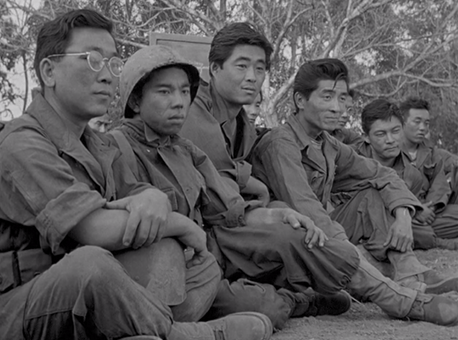
 WWII is always a fascinating touchstone of history because it has some many intricate facets extending from the Pacific to the European Theater to the American Home Front and so on, each bringing with it unique stories of everyday individuals doing extraordinary things. One of the best-kept secrets is the 442nd Infantry Division later joined with the 100th and effectively making the first all Japanese-American fighting unit which served over in Italy and France.
But perhaps the most striking thing about this band of men was the inherent hypocrisy they unwittingly pointed out within America’s own society. As their loved ones sat enclosed in tar paper barracks and barbed wire fences within internment camps, these courageous lads went off to prove their allegiance to their country. Reflecting the very freedoms and liberty that America was founded on, in spite of the injustices that were thrown their way.
But really instead of simply reflecting the bad, Go for Broke! is a far more empowering story and Robert Pirosh’s film does a stellar job at showcasing these men with a great deal of respect. He had previously shown an aptitude for realistic war films like Battleground, and joining forces with Van Johnson once more, he delivers another authentic picture.
Going so far to fill out the rank and file of the film with real 442nd veterans, Go for Broke! begins with a newly promoted officer born and bred in Texas. At first, he shows a slight distaste in being called upon to lead a unit of Japanese, partly due to the fact that he was torn away from his buddies, the other simply a result of his own narrow-mindedness.
After all, he becomes the stand-in for the prototypical viewer and as his character slowly begins to evolve as they go through boot camp, then Italy, then France, the impact on the viewer is duly noted. Thus, although he proves to be an important figure, it should not be forgotten that in many ways the 442nd is front and center.
Among the men we get to know are the level-headed Sam (Lane Nakano) who has a girl waiting for him back in the states while his family remains interned as public aliens. Tommy is the runt of the group, a funny sort of fellow, who makes the ultimate sacrifice when he gives his beloved pig to a starving family. There’s the bespectacled college boy who was in the process of becoming an architect and the defiant Chick (George Miki), ready to fight with whoever crosses him. Far from being stiff, these men lend a certain realism to the film that elevates it to that of a fascinating historical artifact.
There are some wonderfully humorous moments that diffuse the conflict of cultural identity. The recruits of the 442nd walk up the gangplank as the soldier in charge struggles to read off their family names and as each man passes by he responds with a very basic anglicized name. George W. and Thomas H. In another moment an angry Van Johnson looks over at his second in command Oharra during a patrol to inquire what a Japanese word means. Without skipping a beat the man quickly apologizes, “Sorry sir, I don’t speak Japanese.” Only later as these soldiers become his loyal comrades does he learn what “Backatare” means. It becomes a film where soldiers from California and Texas can poke fun at each other, but that’s only because mutual respect builds between the 36th and 442nd.
Lt. Grayson reveals his final transformation when he enters into an altercation with his old pal Cully who has a heavy dose of bigotry. By the end of the film, the man’s still not exactly a saint, but his eyes are opened at least a little bit. And in the end, the 442nd comes to the aid of their brethren. The film concludes with one of their greatest triumphs, rescuing the lost battalion pinned down by the enemy on all sides. The casualty tolls were high, but in such moments the Japanese-Americans proved their grit and determination right alongside all the other fighting men. This is the film they deserved and the type of recognition that they deserve even today. It’s a shame that more stories like Go For Broke! have not been told, but it makes this one all the more important.
3.5/5 Stars
 Citizen Kane is so often lauded for the simple fact that never before had a director had so much creative control on a project and exercised it in such an unprecedented fashion, especially given the state of affairs in the Hollywood studio system. It’s an enigma, a stunning debut and really an astounding miracle where all things aligned for an instant of so-called perfection.
 At first glance The Trial is a bare-boned parable, feeling gaunt and cavernous with empty sets and even emptier words. Everyone Josef meets talks him in circles, tirelessly — never leading to any significant conclusion, only the next diversion in his journey.
 If The Trial is a hodgepodge of talent, with the presence of Americans Orson Welles and Anthony Perkins, international sirens Jeanne Moreau, Elsa Martinelli and Romy Schneider, with European backing and source material from Kafka, then it is a thoroughly intriguing marriage all the same. This film is perhaps the greatest adaptation of the work of Kafka and not due necessarily to its faithfulness to its source material, but because it displays an unmistakably Wellesian vision. The cyclical nature of the legal system pales in comparison with the fascination that comes with watching the continual creativity that is projected up on the screen — this is a hollow dream of a film.
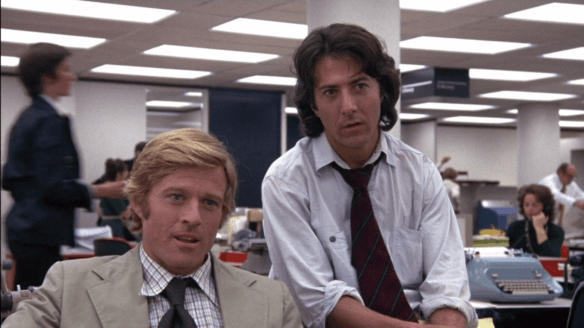 You couldn’t hope to come up with a better story than this. Pure movie fodder if there ever was and the most astounding thing is that it was essentially fact — spawned from a William Goldman script tirelessly culled from testimonials and the eponymous source material. All the President’s Men opens at the Watergate Hotel, where the most cataclysmic scandal of all time begins to split at the seams.
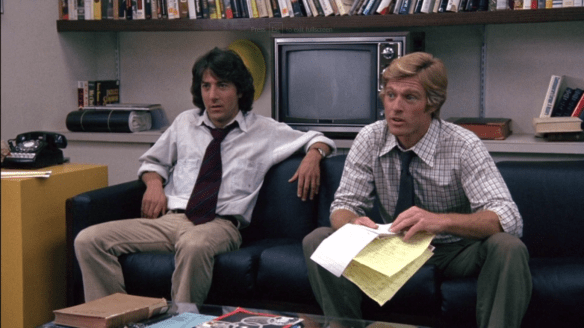 But it only takes a few breakthroughs to make the story stick. The first comes from a reticent bookkeeper (Jane Alexander) and like so many others she’s conflicted, but she’s finally willing to divulge a few valuable pieces of information. And as cryptic as everything is, Woodward and Bernstein use their investigative chops to pick up the pieces.
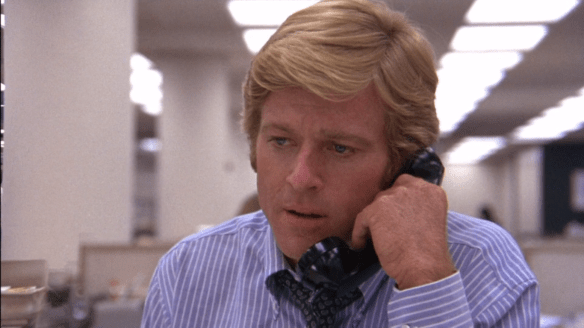 Gordon Willis’s work behind the camera adds a great amount of depth to crucial scenes most notably when Woodward enters his fateful phone conversation with Kenneth H. Dahlberg. All he’s doing is talking on the telephone, but in a shot rather like an inverse of his famed Godfather opening, Willis uses one long zoom shot — slow and methodical — to highlight the build-up of the sequence. It’s hardly noticeable, but it only helps to heighten the impact.
 The opening notes of Joan Jett hollering “Bad Reputation” made me grow wistfully nostalgic for Freaks & Geeks reruns. The hope budded that maybe 10 Things I Hate About You would be the same tour de force narrative brimming with the same type of candor. It is not. Not at all. But that’s okay. It has its own amount of charms that forgive the obvious chinks in the armor of this very loose adaptation.
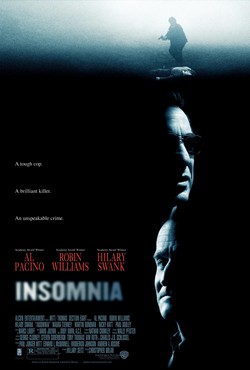 “You and I share a secret. We know how easy it is to kill somebody.” – Robin Williams as Walter Finch
 This was not the film I expected from the outset, and oftentimes that’s a far more gratifying experience. Nostalgia was expected and this film certainly has it, even to the point of casting the legendary funny man and cultural icon Don Knotts in the integral role as the television repairman.
 One of Jean-Luc Godard’s strengths is his capability of feigning pretentiousness, while still simultaneously articulating humor. His film opens with its first of many inter-titles, “A film adrift in the cosmos,” followed by the equally poignant “A film found in a dump.”
 Conflagrations engulf cars and human bodies while above the din comes the piercing screams of a woman bemoaning the loss of her Hermes handbag. We cannot take this anyway but humorous because it once again is yet another moment of utter insanity.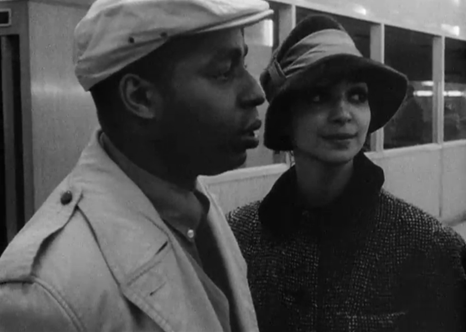


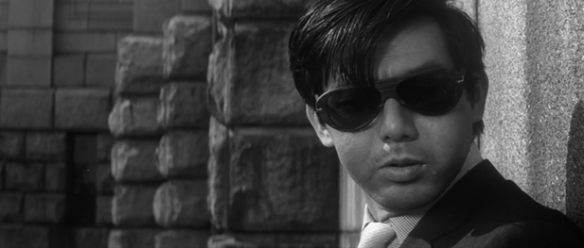 Branded to Kill is the stuff of legend inasmuch as director Seijun Suzuki offered up this wonderfully wacky, perverse, dynamic film and was subsequently dumped by his studio. At Nikkatsu they accused Suzuki of crafting an oeuvre that made “no sense and no money.” And if we watch it with the eyes of a rational, money-grubbing business mind, there’s a point to be made. Because this film is ridiculous on so many accounts, absurd in plot and action, starring an unlikely cult hero — a silky smooth hit man with prominent cheekbones and a hyper-sexualized penchant for steamed rice.
 Phase two follows Goro as he flaunts his tireless inventiveness as a hit man. Hiding inside a cigarette lighter advertisement and shooting his target through an adjoining water pipe for good measure. Then the femme fatale Misako slinks into his life and after a botched job, his life is in jeopardy, an unlikely adversary being his wife. She rightly characterizes them as beasts and their home life is pure chaos.
 By now we have the total dissolution of the character we have known as he begins to sink into an all-out state of sniveling paranoia. He finally meets the mysterious number 1 and far from being a tense showdown, it turns into a rather pitiful scenario. They go arm and arm to the toilet, not allowing each other out of sight as number 1 decides how to finish off his hapless foe.The final showdown comes and it’s all we could ask for. Brutal, perplexing and above all undeniably unique – accented with the brushstrokes of an utterly creative mind.
 4 Star Films