Review: Rio Bravo (1959)

howard_hawksrio_bravo_trailer_39

During the 1930s and 40s, Howard Hawks was an unstoppable force of nature churning out a string of classics year after year: Only Angels Have Wings, His Girl Friday, Sergeant York, Balls of Fire, To Have and Have Not, The Big Sleep, and Red River. All these titles stand as a collective testament to his prowess.

Over a decade later, Rio Bravo is a film that reflects something of the mastery Howard Hawks still held as a filmmaker making his way through every interlude with impeccable skill. It showcases his ability to string together scenes in a perfect rhythm, balancing humor with tension, romance with conflict, and making the western into a thoroughly entertaining experience once more. To say Rio Bravo is Hawks’ greatest films is not too far off the truth. He makes it so easy, the way he constantly tracks with his characters in space — often just talking — sometimes serious others times not, and it’s all so fluid, natural, and fun. It’s what makes the film, that’s over two hours, run seamlessly like the sweetest of liqueurs.

The script courtesy of Leigh Bracket and Jules Furthman is a bounty of inspiration and amusement. One such moment includes the perfect meet-cute between John T. Chance (John Wayne) and Feathers (Angie Dickinson) when she catches him in a compromising position with a pair of red bloomers. From that point on their dynamic is constantly churning with energy.

Dimitri Tiomkin’s score takes some cues from his earlier work Red River (also with Hawks) including the addition of the hauntingly sorrowful notes of “El Deguello.” With such talent as Dean Martin and Ricky Nelson, it also makes the prospect of a song a rich opportunity and Hawks finds ways to weave a musical aside into his film, showcasing the especially memorable tune, “My Rifle, My Pony, and Me.”

Howard_Hawks'Rio_Bravo_trailer_(31).jpg

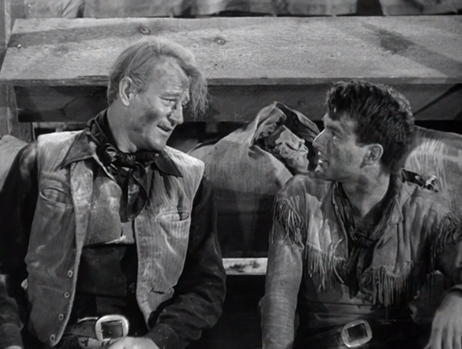
Meanwhile, Hawks builds on this almost cartoonish mythology of the West where every person of interest lives life with a nickname spending as much time jawing and bickering as they do gunslinging. A great deal of that vibrancy is provided by the actors themselves with John Wayne as our anchor. Walter Brennan and Ward Bond prove to be his wizened counterparts while Dean Martin, as well as newcomers Ricky Nelson and Angie Dickinson, hold their own against the old vets.  It’s great fun to watch Dickinson spar with Wayne and Nelson lends his matinee idol looks to a laconic role as young gun “Colorado.” In an inspired bit of casting, Dean Martin plays a drunk and Brennan takes up his post in the jailhouse as a crotchety old man. It all fits nicely together.

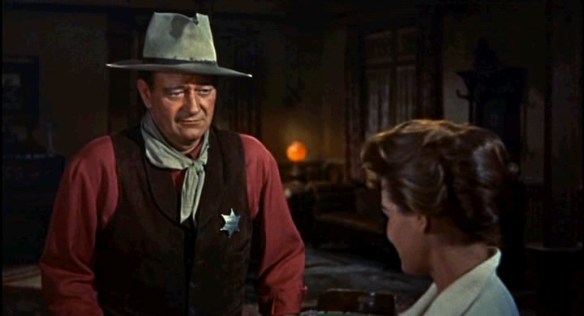
But the question many engaged viewers might ask is whether or not Rio Bravo is a response to the earlier western High Noon. The concise answer is “yes” but that probably is not enough. It’s up to the viewer to discern which example is more truthful and honest in its portrayal of humanity. And High Noon certainly is a somber portrait full of doubt and inner turmoil. However, Rio Bravo is probably just as compelling because of its relational dynamics. John Chance is the sheriff, and as sheriff, he has a certain obligation to uphold the law. That means keeping murderer Joe Burdette (Claude Akins) behind bars. He’s the no-nonsense harbinger of justice that we expect and because he’s John Wayne he’s also tough as nails.
howard_hawksrio_bravo_trailer_26

But that’s what makes the first scene of the film so crucial. It’s notable because it begins with no dialogue, opening up on the town drunk in a saloon that also gets a visit from sheriff John T. Chance. Whether it’s an act of charity or disdain Chance saves El Borrachon’s self-respect only to get bashed over the head in return.

However, this moment is vital in how it sets up Chance’s character. Yes, he maintains a rough even grouchy exterior but looking closer, you see something else. He holds onto his friendships pretty tightly, namely old reliable Stumpy (Brennan) who he bickers with like an old married couple. Then his pal Wheeler (Bond) who comes into the bottled up Texas town with a load of supplies.

And they’re not the only ones. Chance looks to turn away a woman who’s got her face plastered on wanted posters, but slowly shows an affinity towards her. He certainly would not admit it at first but he ultimately does care for her deeply. Also, one of his most faithful allies is the spirited hotel owner Carlos (Pedro Gonzalez-Gonzalez) who is always ready to come to the sheriff’s aid while simultaneously talking his ear off.

Lastly, we go back to the Borrachon who was once Chance’s deputy but lost his sobriety in pursuit of a girl. Honestly, many people would not blame Chance for giving up on this man as a lost cause, and at several junctures, it looks like he has. But the bottom line is that he never does and in his own ornery way, he sticks by his old compadre — never deserting him or doubting him in crucial moments.

Thus, when we put High Noon up against Rio Bravo it’s not a weak sheriff versus a stalwart sheriff in the conventional sense as Hawks and Wayne might have supposed. However, what makes Chance strong are the people he surrounds himself with. In a way, when he is weak, then he is strong because he’s surrounded by people who are faithful and beholden to him. Yes, he’s still John Wayne and he’s one deadly man to cross, but he’s a lot more lethal with friends guarding his back. And that’s a testament to the people he surrounds himself with and also the ones who gravitate towards him. You get the sense that these are not fickle relationships — even in the cinematic sense. The characters can spend as much time ribbing each other as they do toting a gun through town. And perhaps the most telling part is that as an audience we grow to cherish these characters in a similar way. They’re fun to spend time with and that makes Rio Bravo a true gem.

5/5 Stars

Review: Red River (1948)

redriver1Any conversation on quintessential American Westerns certainly has to at least consider Red River. It has genre mainstay John Wayne in one of his most stirring performances, a moody precursor to The Searchers. It boasts the debut of the often criminally under-appreciated method actor Monty Clift. Moreover, it’s cinematic space is filled out by a colorful array of prominent Western stock players. You have the always ornery Walter Brennan, pudgy Noah Beery Jr., Harey Carey Jr., Hank Worden, and numerous others. For a second you can even forget that this isn’t a John Ford film, but instead, the story is placed in the ever-adept hands of Howard Hawks, who knows how to craft compelling stories no matter the genre he’s working in.

In 1851, before Tom Dunson (Wayne) settles on a new plot of land near the Rio Grande and begins to raise his cattle with the brand of the Red River D, he loses the love of his life to an Indian raid, while also picking up an orphaned boy in the aftermath. That young man, Matt Garth (Clift), would become like Dunson’s adopted son and his right-hand man when it comes to running his ranch. The rest of Red River is essentially a road film that chronicles the first cattle drive along the Chisolm Trail. It’s bound to be a gritty, sweaty, and undoubtedly smelly road ahead as Wayne and Clift take the reins on this journey. The intrigue comes with power dynamics because when you put two or more people in a confined space sparks are bound to fly at some point.

redriver2When Dunson begins the massive journey to sell his cattle in Missouri, many wranglers sign on for prospects ahead, but they don’t quite know the degree of hardship that they will face. Soon enough, a stampede leaves one man dead and the company without one of their chuck wagons of provisions. Dunson is a hard taskmaster, who expects his hired hands to finish their job. Morale in the band begins to sink from lack of food and fierce downpours that leave most everyone dejected and distraught.

Then, when Dunson prepares to hang two deserters to make an example out of them, Matt must finally step in. He’s always the subservient one, always backing Dunson with his gun, but for the first time in his life, he crosses the will of his mentor. All the wranglers are quick to continue the journey as they change course for Abilene Kansans and the prospect of the railroad. But Garth leaves a brooding Dunson behind, vowing to kill Matt if it’s the last thing he does. It’s this act of the story which brings to mind the Biblical vendetta of Esau as he pursues his kin for stealing his birthright.

red river 6Garth and his contingent do end up getting to Abilene and are met with open arms by the kindly Mr. Melville, however, perhaps, more importantly, Matt falls in love with a fiery beauty (Joanne Dru) and must leave her behind. Days later Tess Millay also meets Tom Dunson, the man she has heard so much about, and he’s far from being dissuaded from his mission.

Thus, the expected showdown comes with Dunson riding into town with his hired guns, the alarm being sounded, and Garth waiting for him. Dunson draws and Garth will not. It’s a fitting moment, but Howard Hawks develops it in a fabulous way. He fills it with tension and ultimately a hint of humor. The addition of Joanne Dru shifts the power dynamic and she says what everyone else is thinking while angrily packing a pistol.

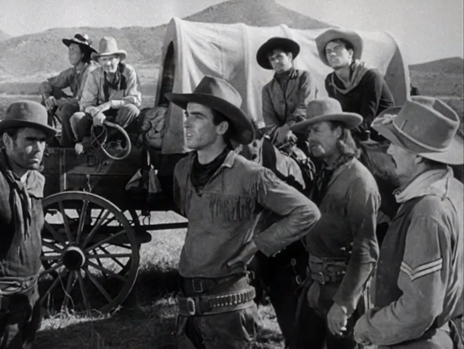
redriver4Because if Red River was story alone, it would not be the preeminent Western that it is, and I think I made that mistake before. Hawks is a master at using all his actors to perfection in not simply the climactic moments, but also the lulls. With such a substantial ensemble, even the way he positions all his players in the scene holds importance. His scenes are continually interesting from talk of Walter Brennan’s false teeth to complaints about the abysmal quality of the coffee.

My only qualm with the film is the rather shoddy transitions, and so I am interested in getting a look at the theatrical cut with narration from Brennan. John Ford famously quipped that he never knew that Wayne could act until this film, and it’s true that he gives a darkly vengeful performance. But in many ways, Clift proves himself as a worthy co-star. There’s always a tightness, a lilt to his voice, that signals an earnestness and vulnerability. It starts coming out in this film right when he knows that he’s no longer going to follow Dunson. It took two starkly different actors to make the narrative work as well as it did, and Hawks added yet another classic to his catalog. On a side note, the music of Dimitri Tiomkin was noticeable, because the refrains can be heard verbatim in Rio Bravo. If something’s good why change it, right?

4.5/5 Stars

Hangmen Also Die! (1943)

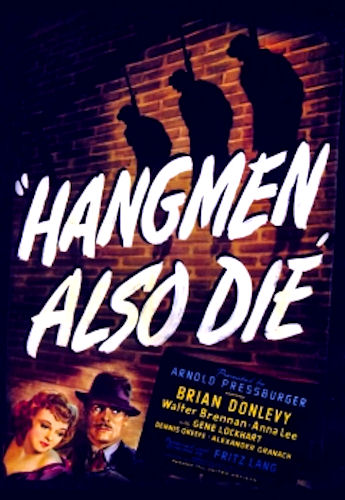
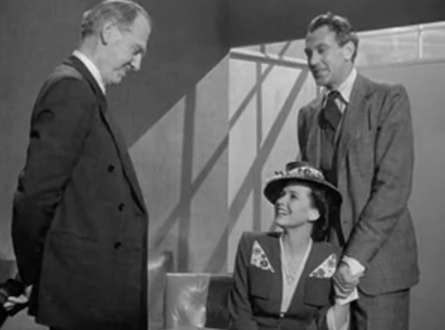
Hangmen_Also_Die_1943There are some fine pieces of intrigue in this modest WWII period film from Fritz Lang. The plot is based off real events in Czechoslovakia surrounding the assassination of Nazi Holocaust proponent Reinhold Heydrich. Mascha (Anna Lee) finds herself admidst a web of trouble when she helps a member of the underground after he commits the killing. But the Nazis are soon hounding her and it brings danger to her father’s household (Walter Brennan) . Ultimately she is forced to choose where her greatest allegiance stands.The film features Gene Lockhart playing the Nazi collaborator Czaka. Perhaps this film is not all that realistic and the casting is not perfect (although I did enjoy seeing Anna Lee in a leading role). At the time it came out this movie functioned as an anti-Nazi film and it still packs a decent punch from that perspective. It deserves some acknowledgement at the very least.

3.5/5 Stars

Review: The Pride of the Yankees (1942)

b9d42-prideofthe3Before superheroes headlined any Marvel or DC blockbuster, it was real life heroes that audiences wanted to see. No pastime was quite as popular as baseball and in that era Lou Gehrig was one of the titans along with Babe Ruth and the rest of the Yankees. You see this film is less of a biography (It certainly is not completely accurate), and more of a visual eulogy to a contemporary hero. The prologue explains as much:

“This is the story of a hero of the peaceful paths of everyday life. It is the story of a gentle young man who, in the full flower of his great fame, was a lesson in simplicity and modesty to the youth of America. He faced death with that same valor and fortitude that has been displayed by thousands of young Americans on the far-flung fields of battle. He left behind him a memory of courage and devotion that will ever be an inspiration to all men. This is the story of Lou Gehrig” ~ Damon Runyon

As a modern viewer, I am just happy I can recognize baseball names like Miller Huggins, Joe McCarthy, Bill Dickey, Tony Lazzeri, and of course, Babe Ruth. When audiences went out to see this film starring Gary Cooper and Teresa Wright back in the day, they were practically living it. World War II had already heated up and one of the great American heroes had died the previous year. Lou Gehrig was all those things in the prologue and more making it hard to get it all into a film.
Like any other superhero, he has an origin story beginning with his childhood in Manhattan, living with his poor German immigrant parents. His domineering mother convinces him to go to Columbia for engineering, but he soon ends up in the big leagues because of his tremendous skill with a bat. He is often a shy and even awkward young man, but he loves his parents and he can sure play ball. It’s that last point that gains him a lot of respect after a less than graceful start as “Tanglefoot.”
He soon becomes a lethal one-two punch with Babe Ruth, after initially being dismissed as the rookie and a boob. Journalist Sam Blake (Walter Brennan) has a major influence in Gehrig’s life and never loses faith in the young man’s abilities. He also does Lou a favor by introducing him to an attractive young Chicago socialite named Eleanor Twitchell (Teresa Wright), who finds Gehrig quite ridiculous at first. Soon, however, a budding romance begins with the often reserved Gehrig falling for the vibrant and vivacious young Eleanor. He gets engaged, married, hits two home runs for a little boy, and wins a world series. A lot of his other exploits are laid out for us too and the trophies and accolades start stacking up. All of this happens during the happy times when Gehrig is on top of the world, first with Murder Row and then The Bronx Bombers.
But all fairy tales must come to an end, and Lou Gehrig’s is especially tragic. He plays an, at that time, unheard of 2,000 consecutive games, but he also falls into a rapid decline. Eleanor looks on helplessly as her husband begins to deteriorate in front of her eyes, and the fans know something is not right. Gehrig gets examined and learns he has ALS, but very little is known about it. Much less can be done to treat it.
His final appearance at Yankee Stadium came on Lou Gehrig Day in 1939. That day he gave his “Luckiest Man Speech,” and he walked off the field for good. Gary Cooper delivers the partially revised dialogue with a calm and clear delivery that seems to truly epitomize Gehrig. Although he is playing the man, it is almost as if he is giving a eulogy.
That’s a fitting ending because we do not need to see the suffering or the death. What we remember is the wonderfully full life he led. Perhaps this film had more cultural relevance back in 1942, but I would argue that it is still a stirring, heart-wrenching film. You have a small heart if you cannot find a place in it for this one.
Although he was not too good at baseball, in the other sequences Cooper seems like the perfect man to embody Gehrig. He is distinctly American, strong, quiet and he also has a pleasant charm with a comical streak in him. The look on his face when he realizes his weakness tears the heart. Teresa Wright had many fine performances early on in her career, but I will step out on a limb and say that this is probably the best one. She has so much spirit and at the same time, she is funny with a noticeable tenderness. She is the perfect wife and a wonderful actress to embody Eleanor Gehrig.
In a society that places so much interest in make-believe superheroes, I don’t mind taking some time to acknowledge a real one. We were the lucky ones Lou, thanks. Let anyone and everyone who does the Ice Bucket Challenge know who you are. You deserve to be remembered. Always.
4.5/5 Stars

To Have and Have Not (1944)

1b537-to_have_and_have_not_1944_film_posterStarring Humphrey Bogart, Lauren Bacall, Walter Brennan, Hoagy Carmichael, and with director Howard Hawks, this film is very reminiscent of Casablanca. On the small Vichy-controlled island of Martinique, a hardened seaman spends his days steering his boat and his nights at the local hotel. The French resistance stir up his life by asking for his help but he refuses. Everything changes however when he meets a mysterious young woman (Bacall). Their playful banter eventually leads them to a mutual affection. Wanting to help his new found girl get home, Harry Morgan finally does agree to help the French and in the process he shows his true colors. Cementing Bogey and Bacall as a star couple, and immortalizing a certain line about how to whistle, this film is a good one. It has everything you come to expect with Bogart and it gives you something special in Bacall.

4/5 Stars

In honor of Lauren Bacall

Rio Bravo (1959)

25267-riobravoposterStarring John Wayne, Dean Martin, Ricky Nelson, and Angie Dickinson with direction by Howard Hawks, Rio Bravo is a great western. A sheriff (Wayne) is faced with a difficult task. He must hold a prisoner in jail while the man’s buddies stake out all around town. His only help is the town drunk (Martin) and a crippled old man (Brennan). To make matters more complicated he takes interest in the new girl in town (Dickinson) and to top it off an old friend is shot (Ward Bond). Despite the odds and adversary, the sheriff stays tough and keeps the prisoner. Furthermore, the deputies all prove their value, including a young sharpshooter (Nelson). With a great cast and storyline, this movie is well worth watching. Howard Hawks does it again teaming up with John Wayne in the western genre.

Most any western with John Wayne is easily watchable, but this film boasts a extraordinary cast including some mainstays of the genre including Brennan and Ward Bond. However, you also have some other stars that you do not associate with westerns. Namely Dean Martin, Angie Dickinson, and Ricky Nelson. Each one delivers a fun, likable, and even moving performance.

This western has been allegedly labeled as an answer to High Noon since that tale was supposed to be an allegory for the McCarthy era in Hollywood. That aside the western elements are certainly good and it is an entertaining set piece.

All of this is great, but any film can have this. Rio Bravo has great little sequences interspersed through the action that make you chuckle or really appreciate the characters. It is hard not to like John Wayne because he is larger than life. Here the rest of the cast also is good even down to lesser supporting players. The names are great too! John T. Chance, Dude, Feathers, Colorada, and of course good ol’ Stumpy.

5/5 Stars


Red River (1948)

9ff5e-394px-redriverposter48In one of Howard Hawk’s best westerns, John Wayne plays a rough and callous cattle rancher who adopts an orphaned boy as his son. Wayne attains his dream of a ranch and yet if he wants to survive he must drive his herd somewhere to make a profit. Despite the hardships, the fanatical Wayne will not turn back or budge on his convictions. As often happens, a conflict builds between Wayne and his son (Montgomery Clift), ending in Clift taking charge of the herd. The young cow herder succeeds in leading the cattle and yet his step-father is now bent on revenge. In the final showdown the two men face off one against the other. However, by the end their true feelings are revealed and they are reconciled. Overall this is a good western with a supporting cast including Walter Brennan and Noah Beery Jr.

4.5/5 Stars

My Darling Clementine (1946)

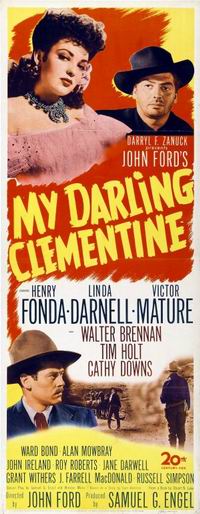
Directed by John Ford and starring a cast including Henry Fonda, Linda Darnell, Victor Mature, Walter Brennan, and Ward Bond, the film retells the story of the gunfight at the O.K. Coral. Wyatt Earp (Fonda) is herding cattle with his brothers near the town of Tombstone. However, his youngest brother is killed and the cattle are stolen. From that point on Earp becomes Marshall and encounters a gruff old man with his sons, a fiery song girl, the complex Doc Holiday, and Doc’s former lover Clementine. As Marshall, Earp has his share of conflicts but the town slowly begins to improve under his supervision. However, the Clanton’s lash out and thus starts the legendary gunfight at the O.K. Coral. This is a classic western, with a host of good characters, memorable scenery, and Henry Fonda in a solid leading performance as the larger-than-life Earp. Although this may not one of my favorites in the genre, John Ford proved once again that he knew how to make a classic western.

4/5 Stars

Sergeant York (1941)

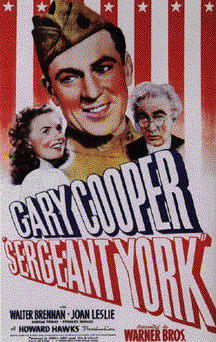
Starring a wonderful cast including Gary Cooper, Walter Brennan, and Joan Leslie with director Howard Hawks, this is a feel-good film. Alvin C. York (Cooper) lives in a small town in Tennessee where he works hard but also drinks a lot. Over time however he becomes a devout Christian and falls for a girl named Gracie (Leslie). He is hoping to get married and own a piece of bottom farm land. World War I begins and after a great conflict inside of himself, Alvin decides to go fight. While there he proves his valor, helping to capture 132 German soldiers almost single-handed.  He returns home a great hero and is reunited with his family and Gracie. Despite being a great war picture, this is also a very nice biography of a simple yet religious man who tried to live his life to the best of his abilities.

4/5 Stars

Meet John Doe (1941)

Starring Gary Cooper and Barbara Stanwyck with direction by Frank Capra, the film begins with a news woman (Stanwyck) creating a made up story about John Doe, a man willing to commit suicide to protest big government. In order to keep the story going, they take a man off the street to effectively be John Doe. At first John (Cooper) and his friend the Colonel (Walter Brennan) are attracted by the chance to work. However, slowly he seems to become John Doe and the whole nation is seemingly behind him with Stanwyck’s character falling for his image as well. A political machine tries to discredit him and prove he never was John Doe. Now all along John decides to go through the suicide to prove his point to all. The political machine tries to stop him and Stanwyck finally does saying they can still keep the ideals of John Doe alive. Sharing some similarities with Mr. Smith, this film is one of those feel good films.

4/5 Stars