Unknown's avatar

About 4 Star Films

I am a film critic and historian preserving a love of good movies. Check out my blog, 4 Star Films, and follow me on Twitter @FourStarFilmFan or Letterboxd. Thank you for reading!

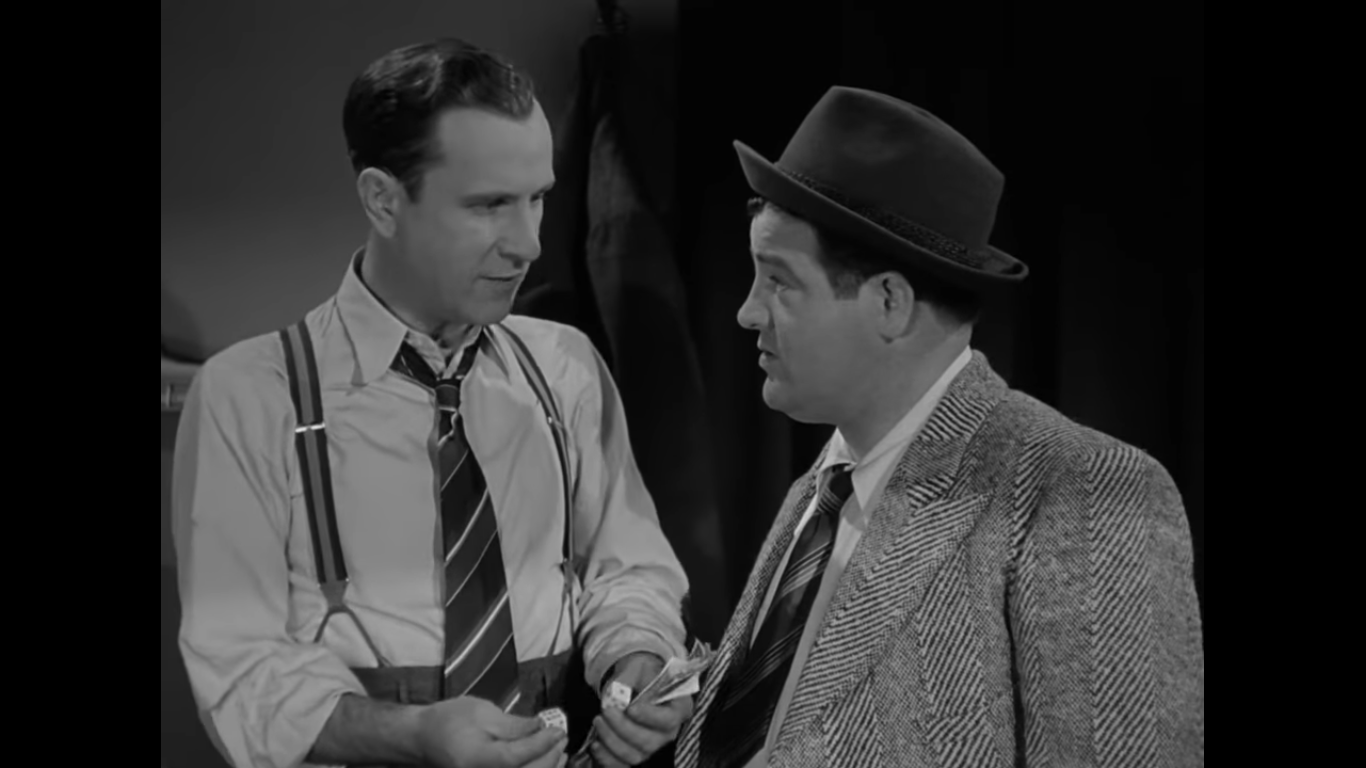
Abbott and Costello Films: Buck Privates, Hold That Ghost, Who Done It?

Buck Privates (1941)

Service comedies almost feel like a rite of passage for comedy teams, and it’s no different with this early success from Abbott and Costello. Against their hijinks, there’s a blatantly obvious love triangle (Lee Bowman, Jane Frazee, and Alan Curtis) meant to lend some balance to the drama. It feels reminiscent of what studios tried to do by domesticating all the Marx Brothers’ later works with “plot.”

The Andrew Sisters — at the height of their powers — also sing a couple of their best toe-tappers including “Boogie Woogie Bugle Boy” and “Bounce Me Brother, With a Solid Four.” There’s a certain amount of buoyant jingoism about them. This is a staple of their appeal.

Still, it’s strange to think Pearl Harbor had not yet occurred when the film was shot. The country was on the cusp of something but not yet plunged into the abyss of World War. For now, Abbott and Costello can live their charmed comedic life.

This is the picture that transitioned them from the vaudevillian circuit and really made them lucrative movie stars. It’s all about the bits from playing craps to army physicals and a bumbling drill regimen as only Abbott and Costello could pull it off. They do have a mark and easy rival who goes from police officer to hulking company officer (Nat Pendleton), but just as often the comic tension is borne out of their own self-made antagonism.

Costello is always a hapless victim and Abbott always has a way of either berating his ineptitude or egging him on. This was the crux of their not-so-secret formula. Again, like the Marx Brothers, it’s not like they were an overnight success trying to come up with their personas as they went along. They already feel like a well-oiled machine we can thoroughly enjoy without any reservations.

3.5/5 Stars

Hold That Ghost (1941)

Hold That Ghost finds Abbott and Costello perfectly in rhythm. First, they’re bumbling waiters at a fancy restaurant. Then, they’re gas station attendants and in both places, they find themselves unwittingly linked with a local gangster named Moose, who’s tangled up with a blackmailer and the D.A.

All of this is a set-up because the majority of the picture takes place in a haunted house. Even if the studio added these earlier scenes to capitalize on the musical success of Buck Privates, it does feel like the perfect entree.

Our hapless heroes are piled into a jalopy full of a menagerie of mostly second-rate character players and then dropped off in front of a dark and haunted tavern. There’s a ridiculously handsome professor with his head buried in his work, and the pouting blonde just waiting for him to notice. The third member is a jovial radio actress who’s more than game to make Lou’s acquaintance. I was gleeful when the cast took to the floor of the haunted manor for some after-dinner dancing with some raucous choreography courtesy of our portly twinkle toes.

The dark and stormy night elicits all the typical scares especially because Costello is the king of the yellowbellies (and for good reason). Because while his partner chides him for being a lily-liver, gangsters commit murders, detectives show up unannounced out of nowhere only to disappear, and of course, there are the ghosts.

The way Costello sounds off like a little kid taps into his shtick at its best. He’s known for being hoodwinked and demonstrative in some of their most well-known skits (ie. Who’s on First?), but the dynamic works when he’s totally nettled his straight man with his utter idiocy. One can only work with the ire of the other. The same goes for any of the sleights of hand or deception gags they pull.

They work on this spectrum of perceived intelligence. Costello sees things and protests. We know he’s speaking the truth, but to any objective outsider (in this case Abbott), he’s being unreasonable.

Like Stan Laurel, he’s a bit of a charmed character, and the world in all its many lunacies is observable only to him. His hat is swiped from his head, a bedroom turns into a gambling joint, and dead bodies fall on the floor only to disappear into thin air.

The ongoing candle gag only works due to this same principle predicated on timing. Abbott’s out of view and yet standing just off stage so he comes back into frame at the most inopportune (or opportune) time for the visual gag to take. Abbott and Costello pretty much built a career on this, and why not? I find it delightful even after all these years.

4/5 Stars

Who Done It? (1942)

It wouldn’t be an Abbott and Costello picture without them taking some menial job ripe with some humor to show off their usual conflicting ineptitude. They display perfectly out-of-sync, synchronicity if you will. You have to be working together to be so visually discordant.

Costello’s behind a cafe counter cutting a piece of cheese — Linberger cheese — and he’s about to suffocate from the smell. The customer’s grousing for his food and Abbott’s barking after his pal, who has no recourse to bring out a gas mask…

Again this feels like the appetizer whetting our appetite for coming attractions as Costello keeps on getting fleeced by a kid bellhop. But they’re on to better things because our boys are aspiring radio talents moonlighting as soda jerks.

They meet another professorial fellow, who might be their inroad to a career in radio murder mysteries. However, when the network president (Thomas Gomez) gets murdered mid-program, they have a chance to prove just how good they are at solving crimes. Most of the movie takes place in these stationary interiors, inside the radio set, and yet the boys tumble all over the place as per usual.

What sets the movie a cut above some of the other A & C pictures comes with the supporting cast. Who Done It is bolstered by some well-remembered talent of the era falling into their readily available parts.

Patric Knowles and Louise Albritton are well and fine as the prospective young lovers caught in the drama after losing the good colonel. Mary Wickes brings her ever-wry wit to play up her own fledgling romance with Costello.

William Gargan and Bendix can be called upon in a pinch to lampoon their typically hardboiled cops plucked from just about any noir you’ve ever seen. There’s Jerome Cowan in another role. This familiarity helps carry the lulls when our heroes aren’t front and center.

All the rest of the time they’re hard at work filling us with belly laughs. There’s a familiar-sound “watts and volt” bit. Then, with a killer on the loose, Costello gets beset by transcription machines, stage acrobats, and sound effects; it feels like a comedic jungle gym with so many possibilities for his elastic talents. I’ve rarely considered halitosis so funny.

But just about everything is superseded by the finale kicked off by the anxiety-inducing phone gag I knew in another iteration during my childhood. Every person and his brother is able to patch through their calls in an instant — the world over — and yet the operator tells poor Lou his line is busy.

It doesn’t matter if he has thousands of dollars on the line or if there’s still a murderer to be apprehended. Because he constantly reminds us these pictures are about the means, not the ends. This one’s a lively ride hyping up the melodrama and leaning into chaotic bits of slapstick in all the best ways.

4/5 Stars

Classic Movie Beginner’s Guide: Abbott and Costello

We continue our informal odyssey for up-and-coming classic film fans by acknowledging one of Classic Hollywood’s most beloved comic duos. True, they started out on the vaudeville circuit, had their own radio show, and ran a series of television programs, but it was in the movies where Abbott and Costello became huge stars.

Their patented routines between the portly comic (Costello) and his straight-man (Abbott) laid the groundwork for some of the most famous bits of all-time, not least among them “Who’s on First?” If you haven’t heard of the bit, it’s just possible you’ve been living under a cultural rock. But we are here to rectify that. Here are four films to get to know Bud Abbott and Lou Costello.

Buck Privates (1941)

Their first picture together was One Night in The Tropics and there were a boatload of service comedies to follow, but Buck Privates was the one that put them on the map. The Abbott and Costello personas had already been carefully tooled on the burlesque circuit and with musical accompaniment by the Andrew Sisters, the picture was a stirring success.

Who Done It? (1942) - Turner Classic Movies

Who Done It? (1942)

The duo’s comedy was best applied to established genres that they can mess around with. If you’re partial to haunted house films, Hold That Ghost (1942), is a fine place to start, but this subsequent title uses the backdrop of a real-life radio drama murder to give the boys ample space to good off, and they do some of their finest work!

The Naughty Nineties (1945)

It’s inevitable. It’s necessary to include the picture with the most recognized version of their famed “Who’s on First?” skit. If you don’t take anything else away from their period riverboat picture, then this number is a must-see. It’s comedy history being documented for all posterity right in front of our eyes.

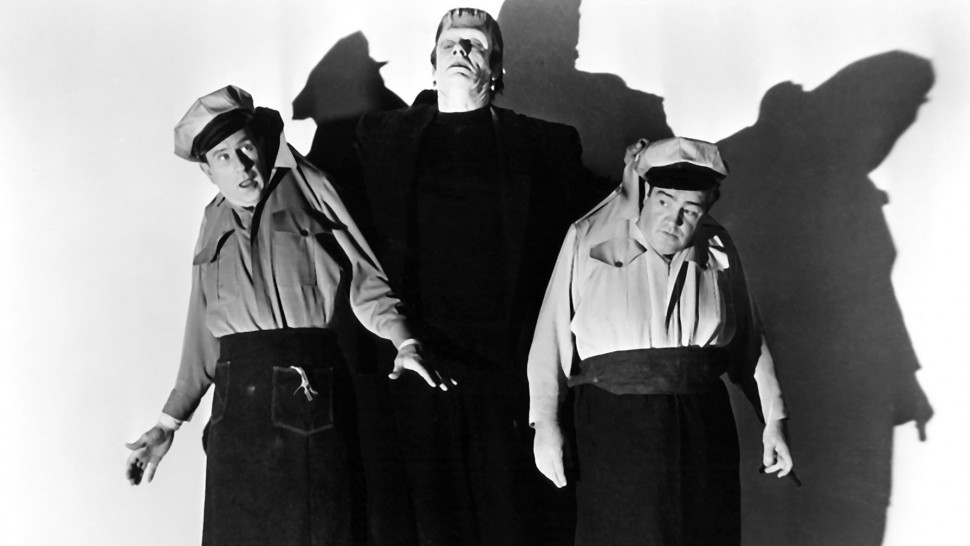
Abbott and Costello Meet Frankenstein (1948)

If you’re cynical you could say the studios were running out of ideas of how to advertise the boys at Universal. However, sticking them with such iconic figures as Dracula, Frankenstein’s Monster, and The Wolf Man seems like a fairly inspired choice. The blend of goofy comedy and horror tropes is more than enough to place it among Abbott and Costello’s most popular pictures.

Favorite Films of 2022

It was another strange year at the cinemas, but there was a lot to appreciate.

Here’s a list of some films I enjoyed in 2022 and you might too. I’ll probably be releasing some other capsule reviews at the beginning of the new year. Let me know what you think!

No Bears

Of late I’ve been considering the films that leave an inexorable impact on me. Certainly, they entertain and compel us in some fashion as a viewer, but oftentimes the best, most daring projects utilize the medium of film in some unprecedented way – using its limitations and reflexivities to birth something new and meaningful into the world. I can think of few recent films fitting this category better than No Bears.

German director Werner Herzog always likened the filmmaker to a resourceful vagabond able to pick locks and prepared to spend a night in jail if it means getting the right shot. At least in his estimation, there’s such a thing as good trouble. Director Jafar Panahi takes this to his own extreme as he’s had his own well-documented run-ins with his home country of Iran, which has previously forbidden him from shooting movies. Given Panahi’s mentorship with the revered Abbas Kiarostami, it’s difficult not to draw a line between their work. In something like Close-Up (1990) we are dealing with the almost imperceptible dividing lines between filmed fiction and reality – that which is staged and fanciful and what we might term documentary. 

It does seem like Panahi is somehow dabbling in a fiction willed into reality. But it’s more unnerving than we can imagine even if he’s well aware of the ground he’s treading. His “fictionalized” version of himself struggles to direct a movie remotely across the border in Turkey, while he must remain in the country, dealing with woeful internet connections and kerfuffles with the local populous. We recognize a world around him divvied up and made insufferable by boundaries, borders, rules, and traditions so much so that words and reason seem arbitrary and even religious rites and oaths lack any kind of inerrancy.

He’s currently under arrest by the Iranian government and the dark irony is bracingly apparent. There’s both a bravery and a brazen cavalierness to it all. No Bears contends with both the cultural hypocrisies and the ethics of such a tradition as moviemaking. Sometimes things aren’t meant to be captured and held captive by a camera. Sometimes the camera captures nothing – only the innocuous and the quotidian – still, that doesn’t stop it from being feared. 

Decision to Leave

Decision to Leave is a transfixing tale meditating on the voyeuristic nature of both love and murder. But it’s not just about these themes; it’s about how romance and murder are cut together and potentially become inseparable within this indecipherable realm of the police procedural. It’s certainly not a film without precedent when it comes to the subject matter. It focuses on a detective (Hae il Park) investigating a crime with his primary suspect being the Chinese wife (Tang Wei) of a Korean businessman — a man who recently died in a climbing accident.

It works in the same spirals as Hithcock’s Vertigo as we watch the detective become more infatuated with this enigmatic cipher of a lady. His vocational obligations of interrogation and surveillance fluidly become a personal obsession. It walks this nervy tightrope between bleak romantic drama and dark noir while utilizing exquisite cuts between the past and the present with a precision fluidity bringing to mind something like Antonioni’s Passenger. We are obviously in able hands as our protagonist struggles to stabilize after being sent reeling by the effects of this mesmerizing woman.

Director Park Chan-wook taps into a great many elements that have made fatal noir romances a lasting pillar of crime cinema including entries like Memories of Murder and even Gone Girl. But I became particularly fascinated with how it dealt with this cross-cultural relationship. Somehow Tang Wei perfectly modulates her performance between the innocent heroine and perceived aggressor, and the space is muddied by all the ambiguities that come with interactions totally lost in translation. It weaves together a genuinely tragic romance on an emotional plane full of pathos with a mystery thriller ratcheted up by immense tension.

But there’s also a poeticism to the movie going beyond mere visual aesthetics. These motifs probably deserve further consideration – I’m thinking especially of the juxtaposition of imagery between the mountain and the sea – even as the film itself has much to offer a ready audience. The subsequent ending exhibits the fated doom deeply entrenched in the noir tradition. Otherwise, on a broader scale, Korean cinema continues to offer the world stage numerous dark, surreptitious delights. This entry just happens to be a canny hybrid of all of Park Chan-wook’s earlier predilections ready for consumption.

Aftersun 

You will not find anything spurious or mean-spirited here. In its place is a tableau built out of an intricate array of personal observations. Charlotte Wells has effectively harnessed one of the most powerful attributes of film: its capacity to capture time in a bottle both refracted through our memories and the frames of celluloid space. Many of us are familiar with home movies. Our fathers may have captured them or we gathered our friends together to make some two-bit swashbucklers (even Speilberg’s Fabelmans is deeply indebted to them).

But I was also reminded of this year’s 3 Minutes A Lengthening. Because Wells has dealt with time in a similar manner. In honing in on a moment — this seemingly mundane weekend between a father and his daughter — the director has collapsed a relationship down to its essence in a way most of us can intuitively understand. For many of us, time has probably gotten away with us, and we look back on childhood with warmth if not a glassy-eyed longing. 

Paul Mescal leads the father-daughter tandem with a kind of composure that feels ageless and still constantly unfathomable. He is a man caught between fatherhood and a life he seemingly lost as he navigates his own insecurities through meditation and Tai Chi. What makes it work is how present he seems in the moment. He’s not a perfect father by any means, but he seems like a genuine one – he desires to be available to his daughter. However, the bountiful shared history only works if he has an able foil, and Frankie Corio has a lucid precociousness we see in all the finest child stars – exuding naturalism directors can only dream of.

Because her point of view is so crucial to this piece. Rather like a mundane Fallen Idol (1948), it is through her eyes that we must both mediate between past memories and the present. We appreciate her childlike gaze and also the ruminations of her older avatar. In truth, we are all navigating this in between amidst the past and present, the living and the dead. It might seem drastic but surely this is what movies are for – allowing us to grapple with these very things in the most poetic way possible.  
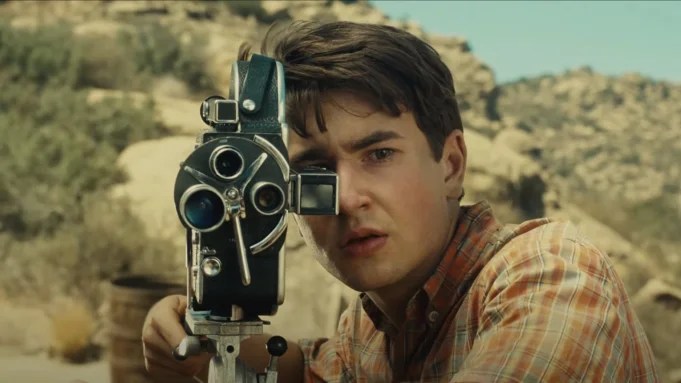
The Fabelmans 

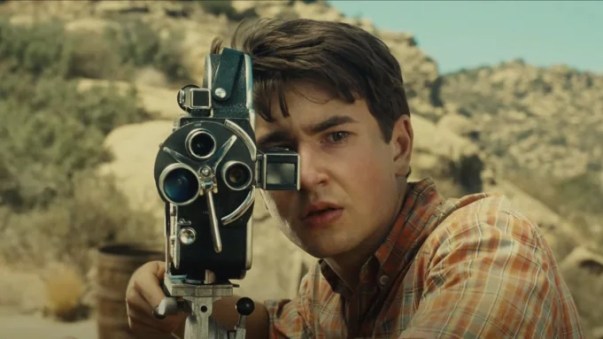
It’s easy for films about a filmmaker’s own experiences to come off a bit narcissistic, but what better way is there to write what you know? In the case of Steven Spielberg, he feels like a generally beloved figure and so this act of self-reflection feels as much like a gift to the audience as it is a visual autobiography. In other words, I doubt many will begrudge him for taking the opportunity. Many have pointed out that Spielberg’s films always have some semblance of divorce and fractured families at their core.

Upon watching The Fabelmans, my mind drifted to the interview Speilberg did with James Lipton for the Actor’s Studio. Lipton connected how in Close Encounters of a Third Kind, humanity communicates with the aliens by making music on their computers – subconsciously Spielberg seems to be tapping into his childhood: His father the kind, pragmatic computer scientist, his mother the free-spirited artist. An entire oeuvre of movies would not exist without their influence and Michelle Wiliams and Paul Dano bring them to us with tender aplomb.

Late-period Spielberg has given us great period pieces like Lincoln and Bridge of Spies. For me, these lack the immediacy of his earlier works, and yet, again, I hardly begrudge him because there’s still a wide-eyed joy to each new project. He hasn’t lost that fervor and that’s even more evident when tackling his own family, though he’s now a more seamless technician than ever. In recreating many of his real childhood films, we recognize all the seeds of ingenuity, and it’s possible to see the invention plucked out of necessity.

Whether it’s crashing trains or school bullies, movies gave Spielberg a conduit to take control and gain mastery over what he could not fully comprehend. He’s warned, “Art will give you crowns in heaven and laurels on earth, but it can also leave you lonely.” It’s a heady portent even as he watches his parents’ relationship disintegrate in front of his eyes and through celluloid (It felt like a far more heart-wrenching version of Antonioni’s Blow-Up).

Still, for any cinephiles or budding directors, it’s easy to see this man (or boy) as a kindred spirit. It’s like a code – carbon dating his childhood by the movies he watches – and sure enough, we see him enthralled by John Ford’s The Man Who Shot Liberty Valance (1962). What’s more, in an inspired piece of casting, the old master makes a cameo. It depicts another piece of mythology deeply steeped in Spielbergian lore. As they say, the rest was history. Jaws, E.T., Indy, Jurassic Park, Schindler’s List and so many more. What a lineage to celebrate. I feel like I know him better than ever before because he has done something far from self-aggrandizing; he has let us in with a level of profound transparency.

Banshees of Inisherin 

I recall watching a documentary called Godspeed about an American priest who was transplanted to Ireland as his new parish. It was a culture shock because outside of the hustle and bustle of the big city or even comfortable western suburbia, he was forced to live a very different sort of life – one of very close proximity. They always say you can’t pick your family, but in a tiny society like this, you can’t well pick your friends either. That story focused on how such a lifestyle forces you to be known by those around you.

Somehow Martin McDonough deals in some dark inverse of this. What if the person you know most in the world – the one you call your dearest companion and drinking buddy – now wants nothing to do with ya’? What are you supposed to do and how do you react in these circumstances? Banshees of Inisherin is a fable and a character study relying mightily on the written wit of McDonaugh’s bleak quill, and the quibbling, deeply heartfelt performances of Colin Farrell and Brendan Gleeson.

The panoramas of Ireland are right out of a storybook like we expect them, but this is a harsh, acerbic tale, which also happens to be astutely funny. I’ve not always been a ready audience for the Irishman’s work, but somehow I appreciated this far more than I expected. Sometimes being kind is far more potent than leaving a creative legacy – sometimes that is the legacy – and yet McDonough doesn’t stop there. He leaves his feuding rivals to their own devices. And we are left to pick up the pieces (including a ghastly array of severed fingers).

My own first name is Irish Gaelic and with that comes a modicum amount of pride. It feels alive and pulsing with all sorts of history I cannot begin to articulate. Because McDonough and the majority of his cast have Ireland in their blood, somehow it adds profound layers to this story. It’s as if they understand the intimacy and pain of this landscape in almost unknowable ways. Their world is full of rich lineage and a fierce sense of identity which is as much about community as it is about strife and civil discord. It really does feel like a constant battle. 

Guillermo Del Toro’s Pinocchio

It plays like the anti-Disney version of Pinocchio, and it’s more than vindicated in its creative choices. There’s nothing sanitized or streamlined about any of its contours and though I have not seen the Robert Zemeckis version, the source material does seem to fit Del Toro more intuitively. It feels like it can be an earthier more generous version of the tale without saccharine sentiment. The beloved story is placed against the backdrop of 1930s fascism and this measured creative decision evokes something of Jojo Rabbit if not Fellini’s Amarcord, even as Pinocchio is generally a narrative of childish disobedience and ultimate redemption.

Pinocchio is created by Gepetto out of the tragedy of the war and although he’s a beloved creation, he’s a seemingly horrid little boy. To be a fully animated, living, breathing human being is to know the fallibility of the human frame and the depths of death and tragedy. It’s no coincidence Gepetto spends much of the movie toiling away to rebuild the crucifix for the local church. Here is a symbol of the need for absolution even as Pinocchio’s ever-growing nose is a glaring reminder of how often he falters.  

As a child, I abhorred, not the Disney film, but Carlo Collodi’s original children’s book because Pinocchio is such a reprehensible tyke. Del Torro gets that right and his world is fanciful, but not while totally disregarding danger and ugliness. Because this is what the world of fairy tales was made for beyond tangible history and Mussolini. Fantasy sets up parameters for a space outside of our own that nevertheless deals with the most unspeakable and difficult issues that children know to be true so that within this context of safety, they might come to terms with them.

While there’s a talking cricket (Ewan MacGregor), a scowling monkey (Cate Blanchett), half-dead bunnies, and a warty behemoth of a leviathan, what really speaks to us are themes of friendship, fatherhood, and ultimately, sacrifice. As best as I can understand, this is the eucatastrophe Tolkien speaks about where all sad things become untrue. 

Hit The Road

Hit The Road is probably the most genuinely funny movie I’ve seen and part of this is because of the dubious undercurrent. This unease goes unspoken for much of the story, but we recognize it’s there as something that has precipitated this entire journey. I found myself giggling all the way through because each of these characters feels so fully realized with all the quirks and idiosyncrasies we can appreciate even as they feel perfectly calibrated to gripe and annoy one another to no end.

The grousing father with his cast. A chatterbox son who elicits headaches. A mother with maternal instincts constantly worrying about her kids. And an older brother holding onto angst about his future. It’s true these are the markers of a family on a long road trip. But while it’s convenient to provide a comp like Little Miss Sunshine, Panahi is of his own mind and goes off toward a destination of his own design. 

 Rarely do I feel this genuine sense of danger while watching modern films, but whether it’s Tom Cruise’s stellar real-world feats in Top Gun or the societal backdrop of Hit The Road’s Iran, there’s a sense of unease – as if this film in its very conception is a marvelous act of daring expression. Later, the little boy recounts a scene out of the Batman movie where the Scarecrow uses “fear gas.” He’s disregarded by the adults because he doesn’t realize the real weight of his older brother going away.

Again, so much of this is ambiguous and these choices are important. There’s also the decision to shoot another crucial scene from a pronounced distance so our main players feel like mere comic specks on the canvass, but the humor is never far removed from heartbreak. I can’t get the image of the mother driving and singing at the top of her lungs with a forced smile on her face because it’s her only armor against tears. This movie melds both emotions so exquisitely; all that’s left is to marvel at the impact and be totally disarmed. 

Saint Omer

There’s a necessity to Saint Omer’s opening sequences following a literature professor (Kayije Kagame) as she recounts to her class France’s post-war history of shaming female collaborators by shaving their heads for all to see. She makes particular mention of Marguerite Duras’s writing of Hiroshima, Mon Amour – how the author was able to turn these memories of ignominy into a kind of “state of grace.” These moments might feel like a digression, but as the story builds, they become the groundwork for the entire narrative placed before us by director Alice Diop.

Saint Omer has to be one of the most moving courtroom dramas I’ve witnessed in some time. It forgoes using the courtroom premise to build a contentious ever twisting thriller. Movies like this are often won in their grandstanding moments on the stand. Here there’s a completely different approach; this is mostly an understated character piece. 

A French-Sengalese mother and grad student (Guslagie Malanga) is up on the stand for abandoning her 15-month-old baby. Her child eventually washed up on the beach dead. Given the gruesome circumstances, she offers measured, unblinking responses to every line of questioning. Her top almost blends into the wood paneling behind her. We watch as both her shortcomings and her tragedy are laid bare before us and slowly churned through by the pragmatic nature of the courts. The results are imprinted with all sorts of responses, both explicit and implicit, coming from witnesses, judges, jurors, and most stirringly the defendant’s lawyer. “We are all chimera,” she says.

As the proceedings march on, Rama, our literature professor and entry point, grows increasingly affected. She too is Sengalese, also in an interracial relationship, and she identifies deeply with this woman on trial, both for her relational shortcomings and the little indignities she faces. Nina Simone’s “Little Girl Blue” feels like the perfect summation for me in ways that can barely be articulated. This movie is slow, even plodding to my sensibilities, and yet I’m still trying to come to terms with it.

After Yang

Kogonada’s Columbus was a revelatory experience for me because not only did his exquisite work with The Criterion Collection translate to a gorgeous visual aesthetic, he seemed to make the movie I always wanted but had yet to receive. John Cho headlined a picture, and it was a movie about substantive issues. After Yang is a moving follow-up as the director takes a short story and turns it into grounds for how we consider issues of family and grief by way of Yasujiro Ozu.

In his future, Kogonada has created a definition of family in this multicultural world of ours, represented not by rigid uniformity but by vibrant individualism still bonded together by the human qualities of parenthood and care. I know it well and watching After Yang there’s an immediate kinship of a daughter who is grafted into this family like trees brought together by nature. It is natural, and it’s the way we’re often given to explain what adoption looks like. 

Although After Yang is ostensibly about a young girl coping with her feelings after her family’s beloved robot shuts down, again, like Columbus, Kogonada is able to explore so much more. Her father (Colin Farrell) is able to reach back into the android’s memories and recognize his own shortcomings, which also come with startling epiphanies. It might be a mundane conversation they share over tea out of a Werner Herzog documentary or the wide-eyed wonder in which this technosapien (Justin Min) interfaces with the world.

Ironically, media often considers tales where it is the technology pulling us out of our rooted place in our world and society, if not totally undermining it altogether. But perhaps it also has the capacity to bring us closer, whether it’s to our spouses or our children. After Yang is ultimately a hopeful exploration and one worth further consideration. Science fiction such as this requires a resolute belief in the beautiful necessity of human relationships. I want more of it. 

Apollo 10 and ½: A Space Age Childhood

Ever since the early days, Richard Linklater has been intrigued by the capabilities of rotoscoped forms of animation. It certainly gives Apollo 10 and ½ a very distinct visual aesthetic. But what makes the film truly gratifying are the wafts of nostalgia visible throughout its frames. Backed by a Wonder Years-style voiceover from Jack Black, we’re able to fall back into the ’60s of Linklater’s childhood while being inundated with all the pop cultural touchstones and everyday realities that came with life in 1969. NASA and the upcoming moon landing seem to be on everyone’s minds even as siblings and families concern themselves with school or the new records to add to their personal collections (be it The Monkees or Herb Alpert’s Whipped Cream). 

I’m a sucker for these trips down memory lane, and not just because I like to wear rose-colored glasses. It has to do more with mimesis and getting to see a fully embodied representation of a time and era I can never know firsthand because I never lived through its banalities as well as its major cultural events. In fact, the rotoscope images accentuate this aura by giving us footage, TV shows, and even record albums we’ve seen before as secondhand artifacts, and still somehow through this animated mediation, they are rejuvenated before our eyes.

Linklater has always been noted for his interest in the mundane, in conversation, and in the depiction of passages in time. These are some of the joys of Apollo 10 and ½, but it’s also given to the flights of fancy that boyish imagination and space exploration seem to condone. We’ve seen many similar meditations from filmmakers even in 2022 alone. Rarely have they seemed totally self-indulgent. Somehow this is another one that feels real, honest, and intimate. 

EO

There’s no way for EO to be viewed outside the cultural purview of Robert Bresson’s 1966 Au Hasard Balthazar, another tale about a donkey who bears the burdens of life. It occurs to me there are two kinds of people who undertake such a project. You’re either so full of the brash vainglory of youth, you have no fear or deference to your forefathers. The other option is you’re so along in years, you need not worry about what others think. You go ahead and make the movie anyway because Balthazar was a poignant film well worth paying homage to. 

At 82, Czech director Jerzy Skolimowski fits firmly into the latter category, and I’m so thankful we have this film from him. The longer it goes, the more entrancing it becomes with the four-legged EO as our ready conduit of both the anthropological world around him and also the tranquil, sometimes utter bleakness of nature. The comic inflections of social structures, soccer pitches, and what have you, feel adjacent to some of the great comedies of some of his Czech New Wave brethren. I’m thinking of Fireman’s Ball or even Closely Watched Trains, and yet this is a film made decades later.

He does feel like the last of a catalytic generation and while there is some melancholy that comes with this, it’s also a stirring testament to the labyrinthian journeying that comes with filmmaking. Somehow this donkey represents the road traveled quite well, and it’s far from a Balthazar redux. Skolimowski has enough experience and humanity to make EO stand on his own feet in deeply moving ways.  
Blogathon: Discovering Classic Movies

This is my entry in The Discovering Classic Cinema Blogathon. Thank you for having me Maddy.

The beauty of the classic film community is that everyone has their own unique, sometimes labyrinthian journey to become a classic movie aficionado. I’ve already spoken previously at length about how a family vacation and the AFI’s greatest movie list were some of the catalysts for me, but I can highlight those again briefly.

Tongue in cheek, I often call my own initiation into classic film appreciation, 2010: A Film Odyssey. 

It does feel like a bit of serendipity the way everything came together like so. When I first found the AFI 10th anniversary list of greatest movies, the newest iteration was about 3 years old. It came to me at the perfect time. The aforementioned family vacation across Middle America piqued my interest in America’s cinematic heritage. Though I was a novice with only 12 classic films to my name, I was eager to learn more. I just needed guidance.

Although I never had cable growing up, I was introduced to TCM for the first time on vacation with films like 12 Angry Men, To Kill a Mockingbird, and It’s a Mad…World. Visits to Mt. Rushmore and Devil’s Tower, also made me curious when my elders mentioned films like North by Northwest and Close Encounters of a Third Kind.

Other classics I had gleaned across my first years of life included the following:

  • Snow White
  • A Streetcar Named Desire
  • Singin in The Rain
  • Rear Window
  • The Sound of Music
  • Star Wars
  • Raiders of The Lost Ark

Although streaming didn’t blow up until a few years later, the resource of my local library, the internet, and these lists, meant I had the tools needed to light the fire under me. And I tore through a lot of America’s greatest films with voracious abandon. It was the perfect climate for my adventure, and I did much of it while sitting on the family couch regaled with some of the best productions Hollywood had to offer.

I still remember the first times I got to see High Noon and Some Like it Hot or The Philadelphia Story and Sullivan’s Travels. Even American Graffiti. It was a visual education, and with each new viewing experience, I dutifully opened up one of my spiral notebooks and jotted down a page worth of thoughts on each movie. I ended up with 5 or 6 handwritten notebooks filled with reviews from about 2010-2013 that I still have.

About that time, I started getting into blogging — dipping my toes into the pool of the blogosphere, and I also started familiarizing myself with international cinema thanks to further encouragement from a literature teacher. Conveniently, much of the Criterion Collection was housed on Hulu for free at the time.

It was another progression in my journey as I left the shores of the U.S. behind to travel the globe to the corners of Japan where Kurosawa and Ozu lived or the vibrant post-war humanism of De Sica or the brash invention of Godard and Truffaut. I was well on my way, and the journey keeps on snaking ever onward. 

So AFI was my ready-made gateway. This initial launching pad has allowed me to venture into all the lovely nooks and crannies of the movies available to the curious explorer. At that time, I had no opinions of my own nor did I see what was missing or what might be shortcomings of such a subjective list. I was just excited.

That’s part of the recurring joy we all get to experience and that’s part of the reason I love watching classic films and learning from others all the time because there’s always so much to discover! While there’s the immeasurable joy of returning to one of these earlier classics, now like old friends, my interests keep spurring me onward in ever-new directions to find new actors and movements and to fill out blindspots I’m curious to cover.

I’m still in my 20s, but I’d like to believe my film odyssey that started inauspiciously now over 10 years ago — this journey won’t end until I shuffle off this mortal coil. I look forward to the road ahead with all my fellow classic film aficionados. If I can be of humble service to others, please let me know.

Otherwise, I look forward to continuing on this road less traveled together! Let’s celebrate the canonical greats and venture to find unheralded classics for each other. I look forward to hearing the stories of others. Thank you all for being a part of this journey!

A Kiss Before Dying (1956): Technicolor Noir

A Kiss Before Dying signals its intent with a score befitting a light musical or frothy romantic comedy headlined by youthful heartthrob Robert Wagner. For the uninitiated, the story is based on Ira Levin’s novel and remains all but prepared to plunge into the depths of deceitful drama. This happy pretense only remains for an instant.

The first scene of Gerd Oswald’s picture is between two people we would come to know quite well. Joanne Woodward is turned away from the camera and the handsome profile of Robert Wagner is on full display. They share an intimate conversation as she bawls, and he tries to comfort her. The word “pregnant” was a trigger in 1950s society and so much of the dialogue dances around, but the point gets across clearly enough.

This young woman has gotten pregnant, and she’s not married to her young man. They’re still in school. If you’ll allow me the first of many comparisons, Bud Corliss (Wagner) feels like a less conflicted take on Monty Clift’s protagonist in A Place in the Sun. As a sociopath and a man of ambition, he is an even fiercer aberration of the Horatio Alger archetype. He has no intention of remaining with this girl even as he continues to soothe and placate her.

It’s true that premeditated collegiate crime feels so involved in the 1950s. There’s no worldwide web so Bud nabs a book from the school library on toxicology and sneaks into the chemist supply room to mix a deadly cocktail for his girl. His objectives are explicitly clear.

Mary Astor is almost unrecognizable a generation after her greatest successes as Bud’s mother, but she’s still got spunk. Jeffrey Hunter feels a bit out of place in the picture. It’s true his holding court with a pipe throughout the entire movie is not the most believable bit of business for him. If I’m getting my dates right here he is the same year he was cast as young Martin Pawley in The Searchers.

Whether it’s purely bad casting or the fact he gets shoehorned into a convenient role as a college lecturer and part-time police detective, it’s a shame he was not set up for greater success. Regardless of his handsome face, he usually displays an incisive earnestness propelling him into more interesting territory. It plays rather like the inverse of Wagner’s turn here since Wagner pushes past his outward appearance to give us a brooding performance full of palpable malice.

If there is an element of A Place in the Sun in the movie, then the pessimistic adolescent worldview, specifically in the classroom, feels reminiscent of Rebel Without a Cause‘s Griffith Observatory scene. In a brief classroom discussion of man, reconciling predestination and free will and theological determinism, there’s this same sense of young people having no idea what to make of the philosophy they’re being force-fed. At their worst, they totally disregard its bearing on their lives.

Then, Joanne Woodward’s unceremoniously tossed from the picture. One wonders if it’s her early exit or the fact that it was an early film credit that made her rate the performance lowly.

Regardless, the most obvious touchstone going forward is a bit of Psycho. The intrepid sister (Virginia Leith) of the deceased starts by joining forces with a man to get to the bottom of the death, though she lacks the plucky fire we might easily attribute to Vera Miles.

As a fairly curious filmgoer, I’m always drawn to performers I’ve never been familiar with before. My own viewing habits have a way of fastening onto new faces that intrigue me — often those who I’m unfamiliar with — but they carry the screen in an impressionable manner. Even in a picture like Violent Saturday, Leith turned an eye with a performance that stood out. Here it’s generally amicable but never electrifying.

The film also has two moments that might be considered dramatic “setpieces,” and they both feel generally corny. They lack the Hitchcockian ingenuity, the unrivaled commitment to the vibrant theatricality of Douglas Sirk, or the impassioned emotion of Nicholas Ray. It really is a shame because otherwise, buoyed by a gorgeous palette, the movie suggests all sorts of kinetic energy.

A lot of it flows directly from Wagner, who is delightful front to back as a conniving devil. I only wish there might have been more of Astor and George Macready and that Hunter and Leith were put to better use. The same might be said of Woodward who was on the road to bigger and better things.

We’ve seen this story done better in so many other forms. I’ve listed many of them off quite shamelessly all throughout my discussion; here is part of the core issue. How can you begin to compare A Kiss Before Dying with all these bona fide classics? How do you even begin to compare it with its source material? Instead, if we allow ourselves to remain present, and invested in the individual experience, A Kiss Before Dying is a tantalizing Technicolor noir.

3.5/5 Stars

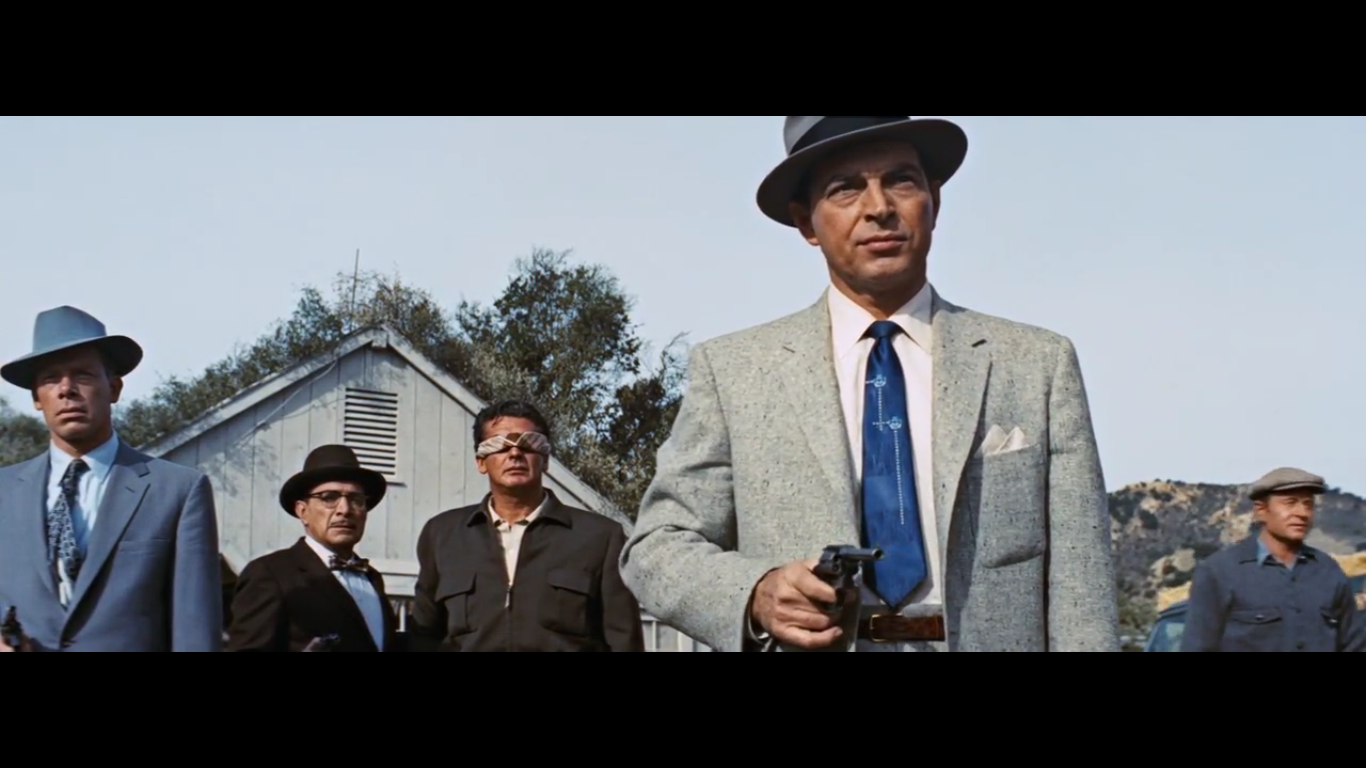
Violent Saturday (1955): Richard Fleischer Heist Movie

“It’s so stupid and pointless to be alive in the morning and dead in the afternoon.”

There’s a lovely contradiction in crafting a De Luxe noir in Cinemascope. It’s visually luscious and still shot on the kind of cheapo budget Richard Fleischer was able to make sing early in his career. This fits its ambitions as a bit of a genre hybrid.

The town of Bradenville is butted up against the mountains with a prominent mining industry. They also happen to represent everything that’s good and decent about an American town in the 1950s. Stephen McNally appears to be one of their ilk, just returned to town on business by bus. He chats up the desk clerk at the hotel and settles into his room.

However, anyone with any familiarity with McNally, knows he must have an angle. True to form, he will shortly be joined by two accomplices as they plan out their robbery of the local bank. The train goes hurtling down the tracks toward town with Lee Marvin and J. Carroll Naish.

It’s a visual cue that feels rather reminiscent of Bad Day at Black Rock, and in some general sense, the comparison is not too far off base. For one, we have the return of both Marvin and Ernest Borgnine. The former is a sickly thug in gray, who doesn’t go anywhere without his inhaler, while still burning with that typical sadism. Borgnine, for his part, has a rather twee role as the patriarch of an Amish family. It’s true the crucial element of the plot revolves around these three criminals convening in the hotel to case the local bank and lay out their plans to break in.

However, there’s also this sprawling, rather unnerving gravitas to the whole scenario. The story introduces a number of key figures throughout the town, and it does a fine job of building out the world from there to make it feel alive and expansive beyond just a handful of main players.

Bespectacled Mr. Reeves at the bank (Tommy Noonan) holds down a reliable job. Like much of the local male population, Nurse Linda Sherman (Virginia Leith) has his heart all aflutter. It doesn’t matter much what she’s doing. Sylvia Sidney is a librarian who has fallen on hard times with the bank threatening her with punitive action.

Victor Mature is a family man who helps run the copper mines alongside the company manager (Richard Egan), who has a troubled marriage. He spends more time with a bottle than with his wife. She in turn can be found on the golf course with a dashing gigolo (Brad Dexter). It seems ridiculously easy for such a patchwork to feel convoluted and yet it rarely loses itself.

Because the pieces always feel attached and deeply entwined in the town’s buried indiscretions. And I’m not just speaking of the clandestine heist. You have the moment when a thief and a peeping tom out walking his dog meet on the street late at night outing one another.

In another scene, the local siren and the equally alluring wife have it out over the man who now lies in sleepy inebriation on the couch of his gorgeous mansion. These mini-conflicts aren’t the point of the movie in so many terms, but they leave an impression adding up to a kind of tableau that’s ripe with all sorts of sordid bits of drama. It’s a world where children get into fights in the streets and small-town love feels tainted.

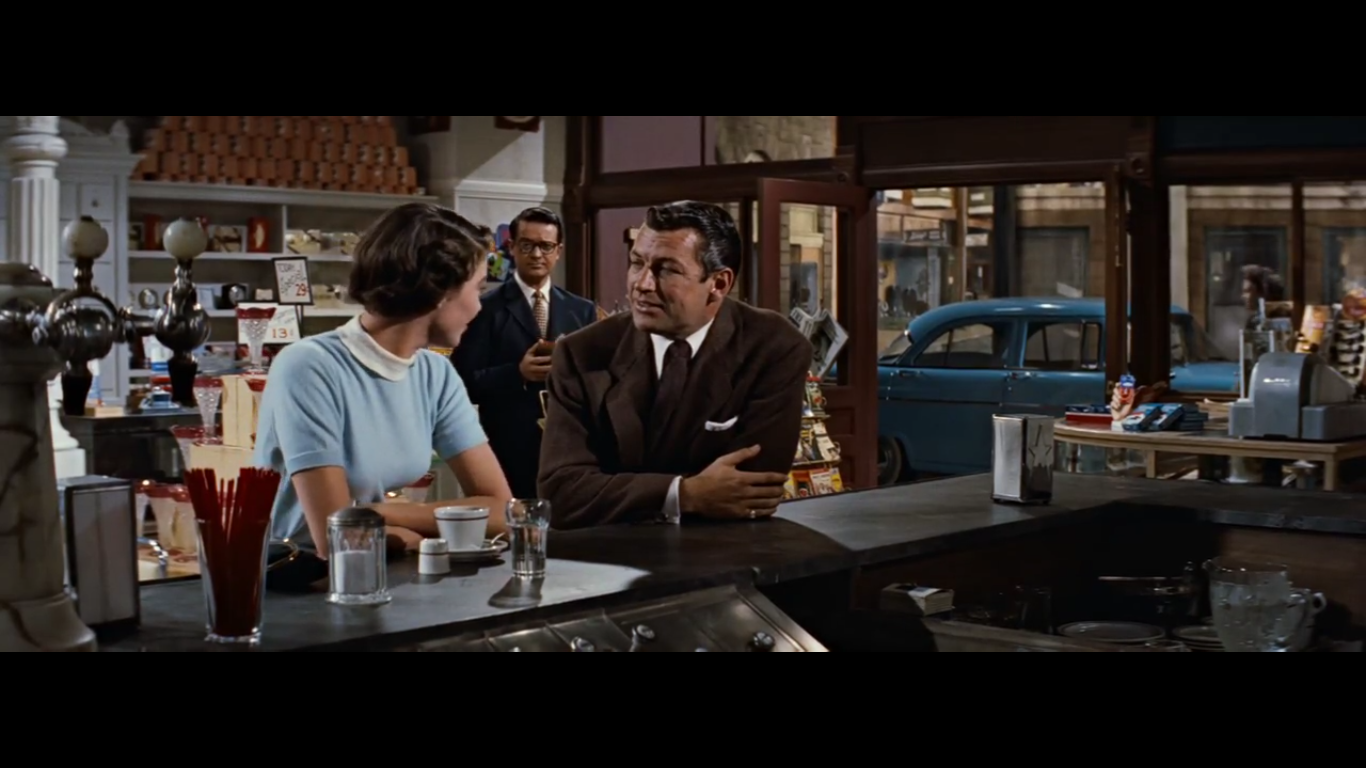
In one of its most sublime moments it takes a drugstore, that beacon of Middle America you often see represented in pictures like The Best Years of Our Lives and It’s a Wonderful Life. They’re a local watering hole of sorts and in this film, it serves to tie all the movie’s various strands together in one moment of choreographed synthesis.

From thenceforward we see it all unfold. The tension is a bit like watching all the plates spinning and not wanting them to fall while at the same time realizing a bank robbery is about to take place. The moment arrives and it gives off all the alarms. However, there are other moments built into it. Take how one of the bank robbers — the bookish one — hands a feisty kid a piece of candy, and it quiets him down. He performed the same act on a train with a group of Amish. These are the types of touches allowing you to recognize the humanity and something beyond the mere cookie-cutter objectives of a movie script.

It’s a horrible thing to realize lives we’ve come to understand if not totally appreciate are not sacred. They too can be snuffed out like any of us. Nor does it desist with the violence. In its day, it was probably deemed graphic. Whether or not that remains entirely true now, Violent Saturday is another one of the old movies that actually lives up to its name as much as can be expected.

Victor Mature and the meek Amish patriarch played by Borgnine must hold their own against the three bank robbers after being locked away in a barn silo. In a different time and place, they might throw out the key that the bandits needed and then they would go their separate ways. However, the very sinews of the characters whether its their religious sentiments or moral fibers, make it imperative that they stand up against this evil even if it’s not the devil himself and only a group of man overtaken by avarice and human corruption. In some small way, they redeem or at least preserve the American ideal. They are projected as heroes to the awe of the neighborhood kids.

The only perceivable letdown with the picture might be the way it wraps up. In some sense, it gives us more than we need in terms of denouement. In others, it leaves us guessing, but even in this, there’s something apropos about the movie sinking back into this status quo of post-war America. It gives the illusion of everything being patched back together like all those folks in the hospital, but you never know what future threats will present themselves. Until then, some men get to live as heroes and others have to grieve irreplaceable losses. It doesn’t seem fair.

4/5 Stars

The Long Haul (1956): Diana Dors and Victor Mature

Although it was distributed by Columbia, The Long Haul is a bit unique from your typical Hollywood offerings. Victor Mature is an American G.I., who settled in England with his English wife following the end of the war. He has a cross-cultural marriage in a post-war landscape and since this is a British production, you have an American as the outsider.

While Victor Mature often comes off as a pretty face, even a plastic one, movies like The Long Haul offer him something to work with, and he gives it an earnest turn. There’s also some audience identification for the sole fact he is one of us (I’m speaking as an American), and if you’ve ever lived anywhere where you felt out of place, it’s easy enough to relate.

The Long Haul is also subtly a movie of family favors. Even as his bride is hesitant to leave her home country for the purported prosperity of America, she gets Harry a job with her uncle’s trucking company. There aren’t many prospects and it’s tough work, but he doesn’t have much choice if only to placate his wife.

It also turns out to be a dirty business, run more like a black market operation than a legitimate business and those with the most brazen tenacity are the ones who get ahead. Right at the center of the racket is Joe Easy (Patrick Allen).

As far as characters go, he’s probably the most intriguing with his lascivious, take-no-prisoners mentality. Again, he’s a heavy not unlike what we’re accustomed to seeing. Still, it’s up to the performer to make something out of it, and Allen has a brutal kind of conviction that makes him a worthy adversary. He’s not the kind of man you want to cross.

Harry does it unwittingly and finds himself thrown out of the man’s office in the presence of his sympathetic moll (Diana Dors). She’s with Joe, and also finagled a job for her brother — he’s off a stint in prison.

Sans the interludes of out-and-out melodrama and complementary scoring, there’s a lot to enjoy about the world in a noirish sense. We watch Mature as he is handcuffed, trapped in a life and a world he cannot get out of, and he finds himself doing a deal with the devil.

He tries to do the right thing, but the prevailing forces against him all seem corrupt. At the very least, the most powerful cogs are handled by the most devious hands. Over the course of the movie, he vies for the affections of the blonde draped in furs. She’s treated like a tramp, and Dors, while not given a whole lot that’s novel, tries her best to make the part a bit more fragile. She does garner some sympathy caught between all the loveless shows of affection.

Although it’s probably the weakest of the lot, it comes out of a solid tradition including They Drive By Night, Thieves Highway, and even Wages of Fear. The Long Haul of course offers its own British flair (if not exactly Liverpudlian).

The beginning of the end comes when he agrees to take one final load. They are racing against the clock whether it be creditors or the police, and they are forced to take the road less traveled. Their giant cache of furs rumbles through the woods, the rocky passages until it’s finally derailed in a stream. As the wheels come off, we’ve reached a tipping point. The uneasy alliance between Harry and Joe is terminated for good.

Depending on how you look at it, Harry is either aided or hampered by a conscience. Despite all the chaos, there is light at the end of the tunnel. He has a taxi with Lynn headed to the coast. They can catch a boat to America and begin a new life. But he’s not a selfish man. His heartstrings still tug at him — no matter the state of his home life — he feels compelled to be there for his son. The beautiful blonde watches her own plans crumble around her.

While Mature’s protagonist maintains his own private sense of integrity, it’s crucial in adhering to the tenets of noir. Heartbreak is the only answer, and there’s a dour question mark for an ending. While it’s nothing spectacular nor particularly original, there is some enjoyment gleaned from Mature and Dors being cast as tragic companions. In a cutthroat world, it just wasn’t meant to be.

3.5/5 Stars

Yield to The Night (1957): J. Lee Thompson and Diana Dors

“For the night is already at hand and it is well to yield to the night.”

There’s immediate traction to Yield to The Night’s opening visuals. We look on at pigeons scuttling about, outdoor waterfalls, and Diana Dors’s heels clicking across an open plaza. Of course, we don’t know it’s her.

J. Lee Thompson’s introduction is almost Hitchcockian in how he utilizes the feet as a kind of synecdoche for the whole body distilling the action down to its most basic form. Because soon enough those feet make their way to an apartment belonging to a fashionable woman about to go inside.

In the chaotic sequence that follows, she gets shot in the back as Dors makes plenty sure her victim is dead in her tracks. Her first closeup almost crushes her face or closer still her face overwhelms the screen and she stares down at her handiwork. She’s just murdered a lady in the street. Riddling her in the back with bullets. There’s no doubt that she’s dead as the frenzied onlookers rush to the scene.

What makes the moment so effective is how purposeful it is from the outset, punctuated by this terrifying act of violence. However, what makes it even more startling is the fact we have no context. Is Dors good or evil? Is she on the side of justice or lawlessness?

Surely she has a reason for what she did. We half expect a flashback right about now — this seems like an opportune place if not the most original. Instead, we get the credits and the story keeps on moving forward.

Hilton’s in prison, but whether it’s a sign of the British civility in the prison system or only a result of the movie mills, there’s something rather congenial about the whole set-up. It’s not exactly Buckingham Palace or Balmoral for that matter, and there are bars like any prison, but the wardens, lawyers, and priests who all cycle through seem like generally decent people.

Hollywood alternatives like Caged or even I Want to Live! in one form or another feel like harsher, less forgiving films. The tone of Yield to the Night functions out of its own dissonance. As a fitting development, Mary’s story materializes in fragments, and it actually becomes a fairly absorbing way in which to take in the narrative.

The presumptive flashback actually comes a few minutes later than expected. Mary Hilton formerly worked in a beauty shop. One evening she encounters a particularly jovial client at a club. He’s at the piano when she sees him. His name is Jim, and he gives her the pet name “Christmas Rose.” She became madly devoted to him even as his own demons and self-destructive habits find him dallying with other women.

His primary romantic partner is a rich socialite named Lucy, who remains faceless and nearly unseen throughout the entire movie. For not having an overt showcase, she certainly holds a major sway over the picture as she effectively dominates and cripples Mary and Jim’s relationship. Mary loves him madly, but he can never be tied down to her, preferring the benefits the other woman affords him.

The ensuing bout of voiceover is a bit much, but there’s a pleasant gossamer quality in Dors’s readings — the lightness in her voice — somehow it juxtaposes with her place as a murderess, and in some small way, it humanizes her.

Back in the present, she receives a number of visitors. Her kid brother, a genial lad who is looking to lift her spirits joins their quibbling mother for the visitation. She’s trying to come to terms with how the girl she strove to raise the right way could end up like this.

Mary also gets called on by her husband Fred. He comes faithfully, leaving work to come check on her.  Suddenly it becomes plainly evident the reason they are separated is on account of Mary. He seems like another decent sort of chap, too decent in a way. He bores her and so there is a defined distance between them. It’s depressing to witness.

Finally, there is Mrs. Bligh, who feels like yet another embodiment of all the benevolent souls.  She’s a kindly old lady, a lover of flowers, and a prison reformer. What she also provides is a social conscience. Strangely, all this goodwill from both the attendants and visitors only emphasizes the disconnect between the warmth of all these people and the punishment at the other end of the hallway.

But the final stroke has to be how the movie foregoes any form of serpentine plotting and focuses in on an individual life in torment. It becomes a far more intimate meditation. Mary is caught in a debilitating cycle of unrequited love, watching her man destroy himself for another woman, and it tears her apart. She’s powerless to save him. The only flaw in the picture might be the suspension of disbelief, that is, how likely would someone rebuff Dors for someone else, albeit someone with higher social standing?

Otherwise, as we bide our time alongside of her in the confines of her cell, constant light streaming in, and guards playing chess, we are introduced to her every monotony. It builds a level of sympathy you can attain no other way. Dors is known as a great glamour girl — Britain’s answer to Marilyn Monroe — and yet when we see her stripped of all pretense, it’s a startling and impressive showcase of vulnerability.

In her own words, the actress acknowledged it was “the first time I ever had a chance to play such a part. I was very thankful to Lee J. Thompson for having faith in me. Until then everybody thought I was just a joke, and certainly not an actress to be taken seriously, even though I knew within myself I was capable of playing other roles.”

She exhibited emphatically she was far more than a pretty face by delivering some emotional resonance as well. One is reminded of the telling exchange with the Preacher.

“This day I shall be with thee in paradise. I think those are the most beautiful words in the Bible.”

“If you believe them.”

It sums up her entire experience. He is a man of faith and he burgeons with hope — hope for her, even in death — in spite of her shortcomings in this life. But her conception of the world doesn’t allow her to believe this. All she has is the melancholy and the pain stockpiled from her romantic heartache. Her outlook more than fits the shabby interiors of the film. It’s a dreary world to be privy to, and it’s just as depressing leaving it behind. Yielding is not in her nature. It doesn’t come easy to many of us.

4/5 Stars

The Burglar (1957): Dan Duryea and Jayne Mansfield

The Burglar is instantly established with a pleasing visual geography. In fact, this kind of pervasively engaging visual landscape is constantly being reinforced, and in his first feature, director Paul Wendkos shows off his perceptive eye. Though he was a workhorse in television, it does lead one to wonder how an industry can so easily canonize certain names and so easily forget others.

But let me take a moment to laud the talents of Dan Duryea. He is such a fantastic bulwark to build a film around. He’s never one to garner prestigious fare, but all the pictures he was allowed to anchor have a certain predetermined grittiness to them that makes them feel inherently watchable. By now he’s older and not as sturdy as he used to be. But that face and his demeanor are still very much the same.

Jayne Mansfield had yet to reach meteoric stardom when the film was first made, although it was re-released a couple years later to make a profit off her newfound celebrity. What a stark and thrilling contrast it is to her usual bombshell image in the likes of A Girl Can’t Help It and Rock Hunter. It feels reminiscent of Marilyn Monroe in Don’t Bother to Knock or maybe Niagara.

When glam girls are allowed to be something more than just a pretty face, it can be remarkable because we see them less and less as objects and more like human beings. Their emotions touch us, and they feel real with problems and issues in drab black and white as opposed to luscious shades of Technicolor.

The Burglar is conceived in such a depressing world. It opens with a Newsreel about Sister Sarah a pseudo-religious figure who lives lavishly thanks to the goodwill of some of her faithful benefactors. This subject in itself feels worthy of more dissection, but it’s really only an opener.

We realize of course this is all pertinent exposition. Nat Harbin (Duryea) and his cronies plan to get within the iron gates of her mansion and run off with as much as they can. However, they know they only have 15 minutes to pull the job while Sister Sarah watches her favorite news broadcast. That’s not much time barring any further complications…

It’s such a sweltering opening full of tension and real dramatic heat. Surely, the movie cannot maintain this kind of fervid criminal activity for the rest of the movie. Of course, it can’t and part of this is the function of the story.

They get the loot but now they must wait it out — we watch their nerves and relationships unravel around them — as the authorities begin their search. Except it feels less and less like your typical police procedural. It has more going for it — partially thanks to David Goodis’s script.

The pieces don’t all fit together seamlessly. They sort of bump up against one another and slide into place. It’s not always taut, cogent, or particularly pithy, but there’s an inbred existentialism and weariness dancing around the corners; it’s difficult to shake.

This melds quite well with the grungy, sweaty cinematography that feels suitable for the burgeoning TV market. At one time it can be both claustrophobic and artful in its construction of mise en scene. It’s the antithesis of decadence, but that doesn’t mean the frame isn’t packed with intriguing visual landscapes.

Martha Vickers also gets her second noteworthy femme fatale role a decade after The Big Sleep — too bad she couldn’t be bequeathed more of them. She had a knack, and it’s no different in The Burglar, although she doesn’t show up until well into the movie.

Simultaneously, the manhunt continues and Nat finds himself being tailed by a shadowy stalker who seems to have a far more private interest in what they are doing. If neither one of these threats comes to fruition, then the gang will probably end up imploding out of mutual distaste. Though they work together out of necessity, they also come to loathe each other’s guts, especially in such close proximity under constant duress.

Duryea is protective of Mansfield, but it’s more of an obligation than affection. He’s made a vow now buried in their past somewhere. He sends her off to Atlantic City for her own safety, but as the movie bowls over, he has no recourse to follow her there, regardless of the danger he brings in his wake.

Coney Island-like atmosphere provides a wonderful visual contradiction to play off the criminal elements that hold the impending tinge of noir-filled doom. It uses the shrieks and ghoulish attractions of a carnival show like many of its great noir predecessors — Brighton Rock, Lady from Shanghai, Woman on the Run, and Strangers on The Train all spring to mind. It certainly deserves at least a mention in this company.

Duryea and Mansfield make full use of the place going from the boardwalk to a house of horrors to a water show, and as the benches clear out and they’re left alone in the cavernous space, it signs the end of the story with one fatalistic final act. Of course, it feels like a foregone conclusion. These pictures rarely end another way. The inevitable catches up with them.

But what I will remember indelibly are some of the individual shots. The Burglar has some of the most epic perspective shots I can recall in recent memory. They punctuate the film like many of the close-ups, and we are left with something so resolutely impactful. It feels like a flawed diamond in the rough. It’s the kind of unwonted gem you won’t soon forget even as the blemishes slowly fade away.

3.5/5 Stars

The Sound of Fury – Try and Get Me (1950)

The Sound of Fury opens with a kind of portent. A demonstrative street preacher yells out at the pedestrians walking by to “Prepare to meet thy God and Repent of their sins.” He pretty much gets trampled with all his pamphlets ending up on the ground in a sea of humanity. It’s really not all that important why it happens, but it does show the indifference and the frenzy that so easily overtakes the masses.

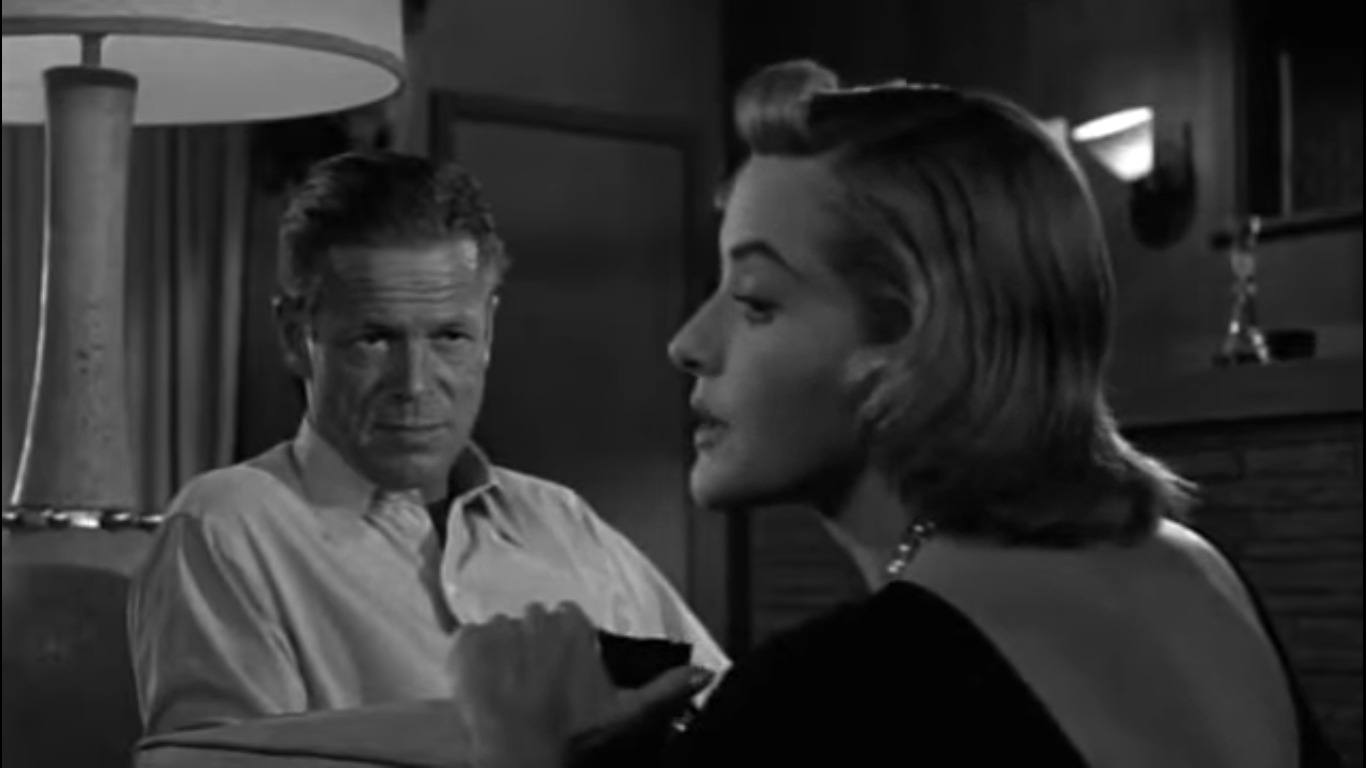
Howard Tyler (Frank Lovejoy) is a man down on his luck with a wife and son to provide for and no job. Life has hit the skids. At home, his demure wife (Kathleen Ryan) pleads with him to find work because every day she’s begging for groceries, and trying to make ends meet. With her pregnancy and a little boy always asking his Pop for stuff, it’s enough to make a guy despondent. He feels totally useless.

It’s in moments like these where honest living seems to give you zilch, only heartbreak, and it’s easy enough for decent men to get enticed by evil. It starts innocently enough, and it’s all for the sake of a buck as Tyler gets seduced by the sirens of noir.

I use this metaphorically because what really does it is a meeting in a bowling alley. He goes there to drown his sorrows. Instead, he meets a confident man finishing up a frame named Jerry Slocum. Slocum’s swimming in dough with fine threads and not a care in the world. Howard looks at his life with envy.

Years before Michael Jackson, Lloyd Bridges proves himself to be a smooth criminal. You probably already can see where this is going without it being spelled out. However, in order to make it explicit, Howard signs on as a getaway driver. He keeps the motor running as Jerry cleans out the cashboxes of local gas stations.

Suddenly, they’re both implicated in a life of crime. At this point, there is no salvaging their lives, as they submerge deeper and deeper. They go so far as to kidnap the son of an influential man. This is far bigger than Howard ever dared to imagine, but he cannot get out — not now.

The Sound of Fury looks to integrate a few more characters. Initially, we don’t know how they fit exactly. It’s a dinner party. A man and his wife. They have a house guest and then his editor (Art Smith) from the newspaper drops by. He’s trying to get his top columnist to look into some local robberies. They hold a discourse on the destruction of public health, sensationalism, and social responsibility of the press. It all feels a bit didactic if altogether well-meaning. It also has no power to save Howard.

The kidnappers send out a ransom note and wait. For Jerry, he plays it cool. It comes naturally as he reunites with his best girl (Adele Jergens), an opportunistic blonde who has dreams of leaving her crummy life behind for the exoticism of Havana. She doesn’t care how Jerry bankrolls it; she’s just impressed that he can. They’re like fire and ice constantly scorching each other and making up just as ferociously.

Lovejoy is coupled up with the other girl (Katherine Locke) in the back seat. If not for the fact that he’s already married, they might be a decent match because they both have a similar propriety and quiet humility. Alas, it can never be. Not only because of his family life but they’re also embroiled in a crime that cannot be easily brushed off. There’s no turning back.

When they pull up to a club with the girls it’s almost like watching a film through funhouse mirrors or something with contorted angles distorting the floorshow and all the gaiety on the floor. It’s totally unnerving. This is just the beginning as Lovejoy’s character falls to pieces. He’s not made for this life of duplicity. It unhinges him as he implicates himself and the film begins to run on this wild energy that will see it through to the end.

It’s the final moments of the film where it stakes its entire reputation as we face an onslaught on so many fronts: visual, emotional, and psychological. We watch the masses descend on the courthouse to gawk, condemn and belittle the criminals after they are brought in. There is no quelling the tide of the momentum and from thenceforward the movie gets carried away by the mob.

Evoking the same ardent energy of Fritz Lang’s Fury (adapted from the same source material), it’s a bit like a modern storming of the bastille. The culprits fly through the jail like apes and howling banshees, and the feeble attempts by the police to maintain any semblance of law and order are quickly snuffed out.

Many generations later, The Sound of Fury feels like one of the most obvious pleas against the swells of McCarthyism in the company of more notable indictments like High Noon or even Invasion of the Body-Snatchers. It’s not merely about the narrative speaking volumes, but the resulting effect on many of its cast members. Cy Endfield was soon forced to flee to England, and he would finish the rest of his career abroad.

The great character actor Art Smith — memorable in everything from Ride the Pink Horse to In a Lonely Place would watch a reliable career go down the tubes. Lloyd Bridges was also affected although he was able to find some relief by cooperating with HUAC. So while they weren’t lynched, it was men like these who were given a damning choice.

They could name names or hold fast and commit career suicide, receiving all the ignominy that came with such a choice. Neither could they stop the tide of fury leading to blacklisting and self-exile, and worst still, they probably more than saw the writing on the wall. There’s nothing more terrifying. You see the malevolent forces at work, and you’re powerless to do anything about them.

The parallels between the movie and real life hardly point-for-point between two killers and accused communist sympathizers. What’s relevant is the wide-ranging reaction top-to-bottom, be it fear or this kind of embittered, hate-filled retribution. Suddenly there is no place for civil discourse. Emotions, which are not inherently bad, begin to boil over and dominate the social spheres.

I’m not an authority on the Red Scare or McCarthyism, nor did I ever experience the full brunt of the Cold War, but even as the issues change and the times with them, at our core, human nature always seems to adhere to the same patterns. True, we are predisposed toward avarice and turpitude, but even our battle cries for justice fall far short.

The fact that the movie was released under two titles and never truly caught on or that Endfield is not more of a household name feels like a cruel sign of the times. Watching it now, from its opening images of a fire and brimstone street preacher to the devastating final acts of violence, it’s sure to rattle the cage. Hopefully, now, we’re better able to appreciate it, and heed its warnings on the state of humanity.

3.5/5 Stars