Jane Eyre (1943)

Jane-Eyre-1943-1Are you always drawn to the loveless and unfriended? ~ Edward Rochester
When it’s deserved. ~ Jane Eyre

I can still recall visiting the Bronte Parsonage, marveling at the fact that these sisters were able to have such a lasting impact on the world of literature — a world so often dominated by men at that time — and I simultaneously rued the fact that I had yet to crack open any of their works. Now several years down the road, I still have not opened up Wuthering Heights or Jane Eyre by Emily and Charlotte Bronte and so I can only come into this 20th-century adaptation with certain expectations.

I realize that no film can wholly represent every page of a novel — especially of great length — because in a practical sense it’s simply not theatrically possible. But my hope is that at the very least this version of Jane Eyre maintains the essence of the source material and if nothing else I can revel in the fact that it is a thoroughly engrossing film from director Robert Stevenson.

It feels like some sort of intriguing marriage between Orson Welles’ Mercury Theatre and the recent craze of gothic fiction adaptations — the most noted of course being Hitchcock’s Rebecca only a few years prior — that by some strange happenstance had input from Aldous Huxley. Here we have the ever timid beauty Joan Fontaine starring once more, this time opposite Welles. But the story starts at a much earlier point in the life of Jane Eyre.

Her life is a desolate and horrible affair as we soon find out, due in part to a caustic culture that uses their religion to ostracize others instead of bringing them into the fold of society.

In fact, most of those who hold a Christian belief system are puritanical and more problematic still, hard-hearted. Ironically, there’s no room for grace in the Christian faith that they practice. Foremost among this crowd is Mr. Brocklehurst (Henry Daniel) who runs the Lowood Institution for Girls.

It’s in this very issue revealed early on where the film finds much of its substance. Because thematically all throughout the narrative the audience is forced to grapple with various characters who are subjugated to the fringes of society and for various reasons are labeled as outcasts.

This is how Jane is seen first by her unfeeling aunt (Agnes Moorehead), then by the narrow-minded reverend. They seem absolutely incapable of compassion sitting atop their high horses of proclaimed humility and charity. In reality, they have very little of either to offer. A few do show her kindness including Dr. Rivers (John Sutton) and the cook Bessie (Sarah Allgood) but such behavior is the exception and not the norm.

Still, Jane the very person who has been relegated to a wretched and lesser state is for that very reason ready and willing to reach out to those around her who are treated likewise. The very fact that she has been marginalized allows her to see it in others and be compelled to move toward them when others move away.  She cares deeply for the outsider.

The most galvanizing experience involves her closest friend as a young girl (played by a child who still is very unmistakably Elizabeth Taylor). Then as she grows up and chooses to move away from the oppression of her surrogate home, it is the role of a governess in a gothic manor that once more allows her the opportunity to extend her graces to others. First in the form of the precocious ballerina extraordinaire (Margaret O’Brien) and then the brusque but obviously tortured man of the house (Orson Welles).

She sees in him something that runs deeper than the surface. He’s far from a bad man. In fact, she grows to love and cherish him because she sees the good that dwells in his conflicted soul. Burdened as he is with guilt and a past that still haunts him to the present moment. The film exhibits a bit of a love triangle as Rochester invites many guests to his estate among them the well-to-do Blanche Ingram (Hillary Brooke).

But the film pulling from its source material goes a step further still.  It digs into the dark recesses, involving itself with the less than pleasant realities, namely an unseen person who hangs over the storyline like a specter. In those very designs, whether they are simply employing the rhythms of Bronte’s book or not, there’s another evident parallel there with the 1940 adaptation of du Maurier’s Rebecca.

Gothic tones matched with an impending sense of foreboding with the demure Fontaine similarly relating the action through voiceover even reading verbatim off the page as if from a diary. And once again it works. While there is no Mrs. Danvers, Welles has the same Shakespearian gravitas of an Olivier that accentuates the very modesty of many of Fontaine’s performances. Their exchanges reflect the sensibilities of the time but furthermore help draw up the very differences of their characters. However, as much as that juxtaposition would seem to draw them apart it even more passionately brings them together.

Some might find this rendition of Jane Eyre too stark, too much of a studio production, even too abrupt, but with Welles and Fontaine opposite each other, it’s a frequently enjoyable gothic romance. As much as gothic romances can possibly be enjoyable.

4/5 Stars

Road House (1948)

Road House 1“Doesn’t it ever enter a man’s head that a woman can do without him?” ~ Ida Lupino as Lily Stevens
Jefty’s is quite the joint. Bowling, drinks, floorshows. In a one-horse town, it’s the place to go especially when the establishment’s proprietor (Richard Widmark) brings in the alluring nightclub singer Lily Stevens (Ida Lupino) to liven up the bar. Although he hired her without much forethought following a trip to Chicago, Jefty’s convinced this girl is really something although his faithful right-hand man Pete Morgan (Cornel Wilde) has her pegged from the start.  Smoking and playing solitaire. It sums up her life. It’s true.

They don’t exactly hit it off because he thinks he already knows what type of girl she is and she’s not too happy about getting pushed out of this gig. But ultimately she stays, the general public starts coming in droves, Jefty’s happy, and Pete does his best to keep away from her. But she does exactly the opposite. She appreciates Jefty but really has eyes for Pete and she pursues him.

What the film hinges on is really a love diamond with Ida Lupino and Cornel Wilde at the points. She is the object of desire for Jefty who thinks he could finally tie the knot with a girl. He’s in love no question. But Pete warms to Lily as well and is the one looking to go away with her. There also must be some necessary credit given to Celeste Holm for her performance although she has the most thankless role as Susie, the cashier at the Road House who also has obvious feelings for Pete.

But everything is thrown for a loop when Jefty comes back from a week long hunting trip with big news to spring on Pete. He’s gotten a marriage license. He’s going to ask Lily to marry him. However, over that same week, Pete and Lily have gotten closer than ever. Obviously, when the truth comes out the old friends have it out and the two lovers look to leave town.

The whole film thus far, Jefty has been a bit of a loose cannon but a generally nice guy. Except on a dime, things turn. Soon Pete is being detained for some cash missing from the company’s safe that his old friend claims is missing. It’s Pete’s words (with Lily’s) against Jefty’s with the police in the middle. It seems like a small deal but in a whirlwind sequence of events, Pete is brought to court and convicted of grand larceny. However, in a diabolical turn of events, Jefty becomes Pete’s savior as well as his master following a talk with the judge who agrees to put the convicted man on probation at the Road House. It’s just like old times, the gang all back together again except this time Jefty has Pete in a bind. One false move, one thing that he doesn’t like and Pete goes back to fulfilling his prison sentence. Jefty’s got him on a string and everyone knows it.

It’s in these moments where the remnants of the maniacal cackle of Tommy Udo from Kiss of Death begin to rear their ugly mug. And the next hunting trip Jefty plans with everyone included fills liked forced fun. No one’s having it and Lily and her love look to take one final chance to run away because any life is better than a life under Jefty’s thumb. What follows is a race for the woods and the Canadian border with Susie fleeing after them pursued by the crazed man packing a gun a bit like A Dangerous Game. It’s bound to be a deadly finale. Someone has to lose.

Cornel Wilde always feels too much like cardboard or plastic, whichever you prefer especially when put up against Ida Lupino and Richard Widmark. The latter pair is more at home in the worlds of film noir, Lupino being both alluring and assertive, boasting a gravelly voice perfect for rasping out “One for my Baby (and One More for the Road)” that is enhanced by her smoking habits.

Meanwhile, Widmark always had a handle on the sleazy and embittered characters who were in one moment grinning and in another seething with a cunning anger. There’s a volatile polarity that he taps into that makes most every character he plays enjoyable as we slowly watch their evil tendencies overwhelm any good that is in them (or vice versa). He also likes hitting the sauce. Cigarettes and booze have always been a hallmark with noir and so it is with this film. So if you’re looking for a good time and a bit of uncompromising filmmaking, look no further than the Road House.

3.5/5 Stars

Casablanca (1942): 75th Anniversary Review

Casablanca,_Trailer_Screenshot.JPG

When someone inquires if I consider Casablanca one of my favorite movies, I don’t quite know how to respond. Yes, I do love this film passionately but I feel as if Casablanca is more deeply America’s favorite classic movie. It is not for me to call my own and I will gladly share a joint appreciation for it. Because it’s a film for all of us. As it should be. It’s the perfect articulation and expression of that former Hollywood that existed during the studio age as brought to us by Michael Curtiz.

When we are finally allowed to enter into Rick’s Cafe Americain, it almost feels like hallowed ground. It’s a mythical place that never existed in reality and yet feels so immersive to us as an audience. Curtiz moves through the space with such intent that it makes us completely involved with every person his camera settles on. This is a picture for romantics and sentimentalists to be sure but it caters to those with a cynical edge too. It suggests a deceitful world of pickpockets, unscrupulous officials, and of course, Nazis.

The political tides of the times are reflected in that cinematic bastion of a man Rick Blaine (Bogart). His foreign policy is that he sticks his neck out for no one. But that’s only on the surface. That’s the beauty of the character. There’s a sensitivity and a sacrificial nature that wells up deep inside him, hidden from view. Tortured and embittered as he is, that is not the last word.

There’s also an undeniable undercurrent to the film. Yes, this is not reality. As enveloping as it is, this is wholly a Warner Bros. aesthetic but moreover there’s a sense that the emotions that deluge over Casablanca are very real.

Aside from Bogart and the lovely, incomparable Ingrid Bergman, our cast is made up of a plethora of emigres, men and women, who fled the Nazis for this reason or that. Whether they were Jewish or had different political affiliations or just couldn’t bear to live under such an oppressive regime.

Director Michael Curtiz was originally from Hungary and in him, we find someone who totally understood the plight of those fleeing and the context of the moment where Casablanca was only a pitstop for America. Because take the picture out of its context and something would be lost. Firmly plant it in the era and you have blessed the production with something enduringly special.

Furthermore, in the scene where Lazlo (Paul Henreid) calls on the band to play “La Marseillaise” to drown out the German’s proud merrimaking it ceases to be a mere scene in a film but becomes an event that swells with real emotions. You can see it in the very body language, the tears in the eyes, and the fervor that comes over everyone. Madeleine Lebeau (the film’s last surviving cast member who passed away last year) singing defiantly, with the tears freely flowing. No longer acting but pure feelings incarnate.

When so many other minority characters make me cringe in pictures of the 30s and 40s, Sam, the piano man (Dooley Wilson), remarkably rarely does. That’s because he’s endowed with a certain autonomy attributed to him in part by Blaine. They are partners, friends, and they watch out for each other.

His singing holds the love story together. Like many of the film’s greatest faces, he’s not a mere sideshow attraction. There’s a necessity to his characterization that adds another dimension to the world that has been conjured up on the Warner Bros. lot. What would Casablanca be without Dooley Wilson, Peter Lorre, Sydney Greenstreet, S. Z. Sazall, Curt Bois, Leonid Kinskey, Marcel Dalio, John Qualen, etc.? It would lose so much color — so much definition.

Another joy of the picture after you see it too many times to count is the continued relish of the script, waiting for your favorite lines only to be taken with new quips that you never picked up on before. For me, most lines of this nature come from the wonderfully amoral and yet completely personable Captain Renault (Claude Rains). But there’s also so much going on around the edges of the frame. One of my favorites involves the young woman who fled from Bulgaria with her husband. The young lady is played by Jack Warner’s step-daughter Joy Page.

Here we see a relationship that mirrors that of Rick and Elsa in a way that only becomes apparent later on. Because she is a woman desperate to get to America with her impoverished husband. He is trying to win money gambling but it’s a desperate even futile situation.

She loves him so much, she is willing to try and use her own beauty and the influence of another man, Inspector Renault to help the man she truly loves. There’s so much subtext to the scene written with the production codes in mind and the sincerity is immediately evident even if some of the import can be lost on us. The same can be said for the foreshadowing.

Part of what makes the picture’s final act work is the fact that Lazlo is such a decent human being. He loves his wife so much, he’s willing to have Blaine take her to safety by using the Letters of Transit if need be. Thus, this dichotomy is set up and Rick must make a decision. He must do the thinking for both of them but that request from Lazlo saves Rick’s reputation no matter the decision that he makes. We know that either might be right. Even though deep in our hearts, there’s only one denouement we want.

Did I even need to write this review? Certainly not but it’s more for my sake than anyone else’s. Casablanca is a dear friend of mine and after 75 years it still comes up smelling like roses. Its themes are timeless in the sense that it allows romance to be its guiding light while still tempering it with the disillusionment and licentiousness that often is so prevalent in this world of ours. That makes its bittersweet interludes ring with a certain deep-seated truth that never comes off as fake. It’s as evocative and witty now as it was in 1942. Perhaps even more so.

5/5 Stars

The Big Steal (1949)

the big steal 1.png

Granted you have star power but it’s easy to assume that The Big Steal will be a no name picture. A minor triumph at best. Not so! This film fares far better than countless of its bigger competitors.

It proves to be a winking romp full of bedroom brawls, car chases, and twists and turns every which way that send us whipping through Mexico. Equally important to the pace of the action is the levity of the script from Daniel Mainwaring (under a pseudonym) that gives our stars something to do and they do it effortlessly.

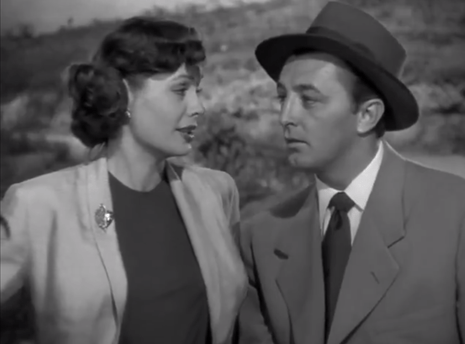
Robert Mitchum and Jane Greer (partnered again after the undisputed classic Out of the Past) meet as the two obvious foreigners in a sea of locals as Mitchum is getting accosted by a street vendor to buy a parrot. He’s one of those foreigners coming off as a buffoon navigating other cultures and the languages that go with them. Though I can’t ride him too hard as one of those blundering Americans myself. Still, his Spanish is mediocre at best and she is aghast at his cultural insensitivity. So right there you have the needed romantic tension and things only get better going forward.

Because their association doesn’t end there. Of course, it doesn’t. Duke Halladay is out to nab the man named Fiske (Patric Knowles) who absconded with some of his hard earned cash and Joan had a similar job pulled on her — the man of questionable integrity also just happened to be her boyfriend.

The unlikely partnership is formed after Mitchum leaps for the running board of the other man’s fleeing vehicle and winds up dragging Greer in front of the Inspector General to explain the public disturbance.

The Inspector General (Ramon Novarro) happens to be a budding pupil in English as his second in command (Don Alvarado) attended the University of California which while being convenient for the story also manages to make our Mexican characters into actual individuals who are endowed with an animated quality all their own.

If the main chase is our leading couple trying to track down Fiske, who gives them the slip on multiple occasions then the scenario simply gets more convoluted as Duke’s superior (William Bendix) is tailing him. They have some unfinished business to attend to because Blake believes the other man took part in a theft of his own. Thus, The Big Steal is just that. Even the soft-spoken John Qualen (probably best remembered for Casablanca) gets in on the party and flaunts a bit of a villainous side.

Some of the finer moments are the lighter ones. There’s the ongoing patter of the dialogue firing off between Mitchum and Greer which couldn’t be better and it comes from the days where a guy could call a dame “Chaquita” and it’d stick. But the beauty of their relationship is Greer with that quizzical look of hers can dish it right back in Mitchum’s direction.

Likewise, during a winding car chase, the same character can quite seriously exclaim “Watch out for the cow” only to turn right around and create a livestock blockade of his own. Or because we are in rural Mexico cars can get stuck behind a caravan of hay wagons ambling along leisurely. They have no respect for the drama at stake. On another note, I’m flabbergasted that the cars involved survived at all with the dubious amount of off-roading they managed. I guess in the 1940s they built things to last.

There’s one hilarious roadblock in particular where Jane Greer uses her Spanish and Mitchum’s obliviousness to tell a local road worker (Pascual Garcia Pena) that they are madly in love and running away from her disapproving father. They must get through at all costs and it just so happens that Captain Blake is right behind him and receives a fine welcoming committee.

But the key is that the film ends not on the downward plunge but on the upswing as our two lovebirds observe the local mating rituals and give it their own twist. What a great picture and sure, it’s no Out of the Past but no one needs it to be. We already have one of those and The Big Steal is a leisure ride of its own making.

Set this against a backdrop beyond the Mexico border, a spliced together version of on location atmospherics and studio shots, and you are blessed with the wonderful patchwork of authenticity and artificiality that old Hollywood was known for in the 40s and 50s.

What’s more fascinating is that The Big Steal at least in this form might never have been. Robert Mitchum was hot off his notorious jailtime term because of marijuana possession, an event that undoubtedly solidified his reputation as an antihero. Meanwhile, not too happy with Jane Greer, RKO studio head and temperamental mogul Howard Hughes gave her this role out of spite.

How could a picture this small be any good with a leading man saddled with bad publicity? I cannot speak to contemporary audiences but today The Big Steal plays quite well. We have our stars and screenwriter to thank as well as a young up and coming director named Don Siegel who started out as a montage man and transitioned into B-pictures.

What makes him a wonderful worksmith is how he always seems to have a pulse on the action and he turns situations into truly dynamic entertainment even when it’s on a small scale. He didn’t need a big budget to still make a rip-roaring good time. The Big Steal is a stellar testament to what the Classic Hollywood studios were capable of with meager means. It’s an absorbing effort.

4/5 Stars

Reign of Terror/The Black Book (1949)

reign terror 1.png

Depending on where you look Anthony Mann’s 1949 film comes under two different titles that are both equally apt. Reign of Terror denotes its roots in the French Revolution of the 1790s that saw the ousting of King Louis XVI and Marie Antoinette while putting Maximilien Robespierre at the helm of one of the most ghastly mobs known to man.

Any lover of history can call most everything in this picture into question but that’s almost beyond the point. This is not a tale that claims historical accuracy but a story of claustrophobic intensity that takes an era and builds an intriguing and gritty little drama out of all the sordid, twisted details. Perhaps more importantly than that it begins to draw parallels to the contemporary moment and that’s where the second title comes in.

The black book is the object that causes men to kill and lie and deceive one another because within its pages dwells great power to dictate the outcome of this kingdom on the precipice of something new. Whether or not that proves to be an optimistic direction very much depends on who gains access to said book. Robespierre (Richard Basehart) has lost it, the chief of the secret police Fouche (Arnold Moss) is intent on acquiring it for his own, as is a ring of staunch patriots looking to pilot their beloved nation back toward stability. That is only the main narrative thread. It seems like little coincidence that a black book shares great similarity to a blacklist.

In the 1950s, whether a concrete document existed hardly mattered because having your name added to this industry list was enough. Though not the same as being sent to the guillotine, for an actor or director it was tantamount to the death of a career as many found themselves out of work for years afterward.

While High Noon is often noted as one of the most high-profile blacklist allegories, The Black Book might be one of the most striking since it dares to find a point of reference between volatile and bloody history many years prior and the current reality. There’s nothing subtle about it.

Thus, whatever you want to label it, Reign of Terror or The Black Book, it proves to be a fascinating amalgamation of historical drama, film noir, and political allegory. Somehow it manages to be a low budget epic combining some wonderful talents that go beyond just Anthony Mann but to producer Walter Wanger, legendary cinematographer John Alton, and set designer William Cameron Menzies.

On the whole, it’s an unsentimental portrait comprised of severe low angle close-ups and shadows that spell film noir forwards and backward. It’s deliciously atmospheric, brooding with darkness and matched by ferocious stylized violence that sizzles in every moment of conflict. The sequences in front of the guillotine against the backdrop of the masses even conjure up the frames of Dreyer’s Passion of Joan of Arc and it’s true that this picture ironically recycled sets from Joan of Arc from the year prior.

Looking at film from the perspective of a historian, one of the greatest enjoyments comes when I am able to view content that has a similar theme running through it whether a specific director, actor, genre, or subject. In a flurry of activity, I’ve been able to derive a greater appreciation for the talents of Robert Cummings in particular.

Though this might sound reductive, much in the way that Joel McCrea is called the poor man’s Gary Cooper, Cummings just might be the poor man’s Jimmy Stewart and I say that because he has the same type of everyman quality that’s easy to latch onto.

Although I could never see Stewart pulling off a period role like this and though not entirely authentic, Cummings is a fine protagonist navigating the back alleyways and roads of deception and treachery that dictate the life of a citizen of the New Republic. Even when he does something that might be suspect there’s inherent trust the audience attributes to him.

Meanwhile, stunning Arlene Dahl looks ravishing in period costume but she also becomes a multifaceted companion of Charles D’Aubigny (Cummings) and one of his only points of contact who proves reliable and resourceful. Otherwise, the picture is crammed full of all sorts of characters with varying allegiances and intentions, not to mention cameos from such figures as the Marquis de Lafayette and Napoleon.

If it’s not quite like the blacklist then you figure out how very easily it could be. The film takes so many about faces and turns by the denouement it’s hard to know who is in the right or wrong or more important yet who ended up on the right side of history — the ones who wrote the victor’s narrative — because oftentimes they are the ones who go down as the heroes. Whether that is true or not is up for considerable debate.

4/5 Stars

Hellzapoppin (1941)

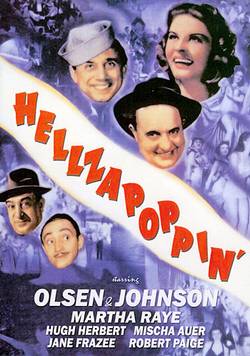
Hellzapoppin_movie.jpgIt essentially begins with a fourth wall break. That’s all you need to know. Because that gives you exactly an idea of what you’re in for with Hellzapoppin’ or rather it gives you no idea whatsoever what you’re in for but really they’re one in the same. I’ve seen the movie and I still don’t quite know what it was.
If you wanted to put labels on it, I think it would be relatively safe to say that this is a comedy. In some small way, it transplants the feel if not the entire success of Ole Oleson and Chic Johnson’s Broadway hit of the same name. And Hellzapoppin’ was a big hit. It only makes sense that Hollywood would want to try and commoditize it.

But fearful of such a fearless anything goes endeavor the studio got cold feet and wanted some “substance” too. And not to be outdone the film’s two stars gave them a plot, ironically, about Ole and Chic finding a plot for the movie they’re in. So there you have it. Problem solved and everyone’s happy. The two nutcases go from an opening routine in hell with a steady barrage of gags to a mediocre plotline at a stately mansion still strung out with a line of gags and it wears its movie within a movie reality right on its sleeve, brazen enough to bring in its director and plucky screenwriter (none other than the always imposing Elisha Cook Jr.). So it’s as close to an “Anything Goes” musical as you can actually get. Yes, you heard that right. Cole Porter eat your heart out.

Anyhow, it’s a testament to the front half of the film, it’s so wonky and zany with wall to wall gags, non-sequiturs, and bits that by the film’s latter half it just cannot maintain that same frenetic pace. And how can you blame it? It does absolutely, insane, inane, and absurd things in the course of an hour or so.

To begin with, it’s barely functioning as a story or if it is a story only for the purposes of its fourth-wall breaks, sight gags, stupid puns, slapstick, and general stretching of all narrative conventions for the sake of some guffaws. But it also happens to be absolutely uproarious in nearly all the right ways — a sheer delight of pure nuttiness.

It’s a comedy disguised as a musical on top of a romance all wrapped up in a metanarrative that will make you scratch your head again and again. You’ll have no idea what you’re watching. You’ll question if the real-life director (not the one in the film) went through a midlife crisis, or if the scriptwriter (again, not the one in the film) was on something, or the projectionist (also not the one in the film played by Shemp Howard) accidentally spliced together multiple reels from different movies right before the film was sent for mass production.

As such, there are no comparisons to be made. Nothing comes close. Maybe Night at the Opera (1935) is the closest I can come– somehow matched with the fourth wall breaking of Rocky and Bullwinkle serials and the metaness of some of Community’s most self-aware episodes. Unfortunately, that’s the best I can do.

When you keep throwing mud up against a wall hoping it sticks comedically speaking, making funny faces, having random people walk in front of the camera, talking to people behind said camera, inserting a storyline to give the pretense of narrative, using every kind of prop imaginable, all while taking some allotted time for song and dance and random asides, this is what you get. Nothing more. Nothing less. That’s all I can say. Because there’s no possible way to even begin to describe what this is.  It’s Hellzapoppin. That’s what. Just watch it. Unless you’re Stinky Miller. Then, go home. Your mother’s calling you (wink, wink)…

3.5/5 Stars

Odd Man Out (1947)

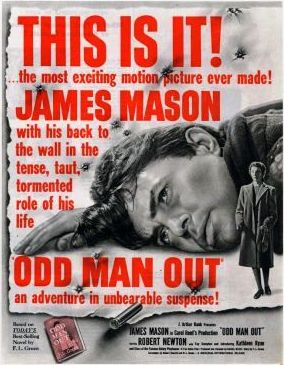
Odd-man-out-posterIn my profession, there is neither good nor bad. There is innocence and guilt. That’s all. ~ Denis O’Dea as the Police Inspector
What Carol Reed did so impeccably with The Third Man and here in Odd Man Out is developing a very specific atmosphere. He made the worlds of Vienna and in this case, the unnamed avenues of Northern Ireland come alive not simply by developing the setting in such a way that’s full of character and intrigue but still managing to craft a compelling story within that very same framework. It sets the stage for numerous vivid individuals to come alive because all the contours are colored in and filled out for the audience to enjoy.

Particularly in Odd Man Out, you can visualize Reed taking a certain historical moment and broadening its scope. Because his story, based off a novel by FL Green, is really about the IRA in Ireland who some would call patriots and most would call terrorists. Even some of their fellow people. Still, the majority would shower them with indifference but that’s where the narrative finds its footing. It opens with the following interlude:

“This story is told against a background of political unrest in a city of Northern Ireland. It is not concerned with the struggle between the law and an illegal organisation, but only with the conflict in the hearts of the people when they become unexpectedly involved.”

In this sense, a highly charged situation is pulled from its cultural subtext and Reed masterfully focuses on the universal aspects of the human experience that are found there. James Mason gives one of the most stirring performances of his career both vulnerable and strangely reserved. For much of the film he takes a back seat, almost working on the fringes of the storyline and yet it works quite well. I suppose in some ways, like Harry Lime, a couple years later, even when he’s not in the frame he’s of paramount importance because his name is on everyone’s lips.

The reason is this. Following his release from prison, Johnny has begun the planning stages of a bank heist in broad daylight. It’s never stated very explicitly but the assumption si that they need some capital to bankroll their cause. Still, Johnny and three buddies hold up the joint. But on the way back to the getaway car Johnny gets detained by a guard and a discharging gun leaves both men mortally wounded.

The whole film hinges on the aftermath of this even and the fact that this is a heist film is quickly forgotten because it surpasses the basic parameters of a crime movie destined for grander aspirations altogether. Look at it more closely and again and again Odd Man Out reiterates the fact that this is really about all people. Because any given conflict will always and forever elicit some sort of response from any single person. That’s how we are wired and one conflict will cause a ripple of interpersonal conflicts in any person who becomes involved. That’s where this film is coming from.

It’s such a classic menagerie of figures each with their own distinctiveness. Moments where they reveal even a very little bit about who they are. Whether it’s the old crone who invites the fugitives into her parlor only to call the cops of them. Maybe it’s a cabbie or a bar owner or a vagabond obsessed with birds who lives with a delusional painter. The story takes us through the bar halls, the streets, private homes, trams, carriages, churches, and wherever else the general public spends their waking hours. Much of Dublin’s Abbey Theater was called upon to star in the film and they certainly are a colorful lot.

At first, it was off-putting that the film sunk into almost hallucinatory territory as Johnny drifts in between delirium, visions, and bits and pieces of memories that all come to the fore as he struggles with his excruciating pain. The hourglass is slowly winding down. But his faithful love Kathleen (Kathleen Ryan) is resolutely looking to save him from the clutches of the police and anyone else who might want to do him harm.

In one particularly stirring moment, Johnny can be heard recounting a few jumbled tidbits from 1 Corinthians 13:

When I was a child, I spoke as a child, I thought as a child, I understood as a child. But when I became a man, I put away childish things. Though I speak with the tongues of men and of angels, and have not charity, I am become as sounding brass or a tinkling cymbal. Though I have the gift of prophecy, and understand all mysteries and all knowledge, and though I have all faith, so that I could remove mountains, and have not charity, I am nothing.

Meanwhile, Kathleen is seeking counsel with Father Tom and she seems to come to much the same conclusion. She opts for love over his religion because that is what she feels pulsing through her with all its overwhelming strength. Her faith is in her love. Nothing else.

It all culminates in a deadly finale. We could not expect anything less still that does not make the film’s conclusion any less jarring. Even today it’s a surprisingly candid denouement. There are no two ways about it. No ambiguity left. We know what fate befalls someone such as Johnny. This is a tragic human drama after all.

So in some scenes, it indubitably has twinges of film noir. Visually it’s indisputably noirish, atmospheric not only in lighting but with the additions of elements from pelting rain to falling snow. Still, the philosophy that runs through its frames feels far different than your typical hardboiled cynicism. There’s something else working here and that’s just a bit of what sets Odd Man Out apart from its various contemporaries. Johnny and Kathleen represent something slightly different. Still, it does beg the question, can their love (or charity) be their ultimate redemption?

Religious hard lining or legalism is hardly the answer and you could never possibly accuse someone like Father Tom of such a crime anyways. He seems a far more humble individual than that but that does put Kathleen’s decision as well as Johnny’s citing of the good book into some question as well. How far can you go in saying that love can be your salvation or does their need to be something further still? I guess you could say that’s the inner conflict in the hearts of many of these people who get involved: Love, charity, and innocence versus guilt.

4.5/5 Stars

The Farmer’s Daughter (1947)

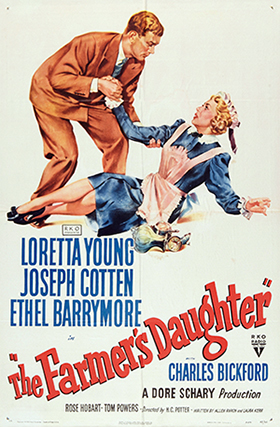
The_Farmer's_Daughter_(1947_film).jpgWhatever our criticisms of the previous generations, there’s still something within me that sees something uniquely compelling about films of old. Hollywood in the 30s and 40s could sugar coat, they could oversell the drama, but there was also a general decency that pervaded many of those films.

The cynical edge of dirty politics and corruption was given credence but more often than not, all that was good would win out in the end. Is it realism? Certainly not. Is is dated? Probably so. But there’s something overwhelmingly pleasant about a film like The Farmer’s Daughter for the very reasons mentioned above.

Our heroine is intelligent, plucky, and sincere. She’s from good Scandinavian stock which not only explains her vitality but informs a bit of her work ethic and her constant handle on what is right and true. That’s something we could always use more of today. A bit more of those core values sprinkled into our upbringings. It’s not informed by pride, or entitlement, selfishness or greed. It cares about what is good for all people and looks to be honest in all circumstances. To her credit, Loretta Young embodies all those qualities with a profound earnestness.

Katrin (Young) makes her way into the spotlight after acquiring a position as a maid for a local political dynasty after losing her hard-won funds for nursing school to a local swindler.  Still, in the home of Agatha Morley (Ethel Barrymore) and her son the promising young senator Glenn Morley (Joseph Cotten), Katrin soon makes a strong first impression.

She proves to be a gifted woman not only in doing housework but also in ice skating, with Swedish massages, making glogg, and much more. She’s also politically astute and though she lacks education her practical upbringing allows her to see every individual in practical terms. She bases none of her opinions on hearsay, ad campaigns, or newspaper spreads. Her thoughts come from what she’s heard first hand and what officials have done in the past. She’s also an impeccable judge of character.

The most obvious tension running through the film is the fact that Glenn is slowly growing attached to Katrin for the very reasons mentioned previously. Although he already has a bit of a fling with a local reporter who is smitten with him. But the real problems come into being when a seat opens up in the house and the incumbent’s choose to back an unscrupulous career politician.

Katrin sees right through him and openly grills him at a town hall meeting. Now the opposition is calling on this young woman to be their candidate and she agrees to run against her employers. She’s crossing political lines because she constantly exercises her freedom to do as she sees fit. That is her prerogative after all. Glenn in one sense is incensed by her decision but he’s also madly in love with her and he has to make a choice.

A raucous screwball finale turns out to be surprisingly gratifying given the sentimentality and political drama that provide most of the film’s makeup. The comedy is also bolstered by the generally open-minded and wryly amused Ethel Barrymore who looks at all the unfoldings in front of her with a bit of a glint in her eye. Meanwhile, Charles Bickford’s gruff charm as the valet Mr. Clancy serves as the perfect foil for Katrin’s affability. Because he’s really a good man as well.

The Farmer’s Daughter might turn some modern viewers off for a purported simplistic view–a film of overt goodness where the woman ends up with the man who in turn allows her to succeed. But what is wrong with a good Joseph Cotten and an effervescent Loretta Young? A dose now and then can hardly be considered harmful.

What struck me was a timeless statement that Mrs. Morley teases out of the crooked Mr. Finley. He’s opposed to things that don’t meet his definition of “100% Americanism” and it’s a very narrow view. Namely whites, no foreign-born, and the right kind of religion. Ironically, 70 years later we are still guarding against such poisoned intentions. Because if anything, Katrin represents in a small way a great deal of what makes America great. Let us not forget that.

3.5/5 Stars


The Third Man (1949): Out of the Rubble

the third man 1Like the fella says, in Italy for 30 years under the Borgias they had warfare, terror, murder, and bloodshed, but they produced Michelangelo, Leonardo da Vinci, and the Renaissance. In Switzerland they had brotherly love – they had 500 years of democracy and peace, and what did that produce? The cuckoo clock. 
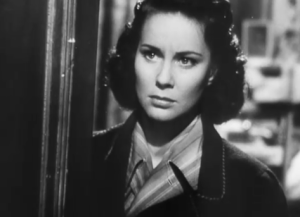
Great films ring anew each time you see them. Or in this case, they twang with the oddly disconcerting strains of zither strings. The Third Man is such a film that continually asserts itself as one of the golden classics of the 1940s. But we must set the scene.

There’s an image of a great city–a formerly great city–blown up, diced up, and quartered. The first syllable of dialogue glibly carrying a twinge of irony lays the groundwork for the entire plot really. This is Post-war Vienna. It’s where the blown out buildings strewn with rubble can exist with the elegant remnants of royal dynasties. A land of black marketeering and shifty-eyed collaboration between wartime allies. It’s deception and ambiguity to the nth degree not only evident in the people but the very social structure they find themselves in. Everyone’s got an angle, a secret to hide, and a reason to hide it. There’s a consistently fine line between right and wrong and the storyline is ripe with incongruities and dissonance that, if nothing else, are disconcerting.

It struck me that this is the original Chinatown except it doesn’t simply act as a mere metaphor. We actually get enveloped in the atmospheric Vienesse world that feels invariably gaunt and hollow. It’s a world that’s flipped upside down and with the hapless American western pulp novelist Holly Martins (Joseph Cotten) as our guide, we become just as mixed up as he does.

He’s come to the town for the prospects of a job offered by an old school chum Harry Lime. But Harry’s not there to meet him. In fact, Harry’s not anywhere. He’s dead. But everything is clouded with that same ambiguity. The military police led by Inspector Calloway (Trevor Howard) and his right hand man (Bernard Lee) are still investigating Lime’s prior dealings on the black market in tainted penicillin. Meanwhile, Martins obviously goes blundering around trying to learn anything he can because these men are obviously incompetent. He scouts around for eyewitnesses and several of Lime’s acquaintances. Most of all he’s taken with Harry’s gal Anna (Valli) who is also torn apart by the death of her Harry. They bond over that although Holly soon becomes infatuated with her as she remains in love with a man who is gone forever.

This is the disorienting world that we are thrown into by Graham Green and director Carol Reed. Where heaven is down and hell is up. Ferris Wheels ever turning, rotating through their cycles. Dutch angles giving every figure a contorted view. We never see anyone for their face value and we can never assume anything. Because there’s always something lurking in the shadows.

the third man 2Joseph Cotten is surprisingly compelling as the poor, unfortunate stiff and it’s hard not to feel sorry for him in his ignorance because we can relate with him. Alida Valli is striking as the aloof beauty who nevertheless has an unswerving affection for her former love that remains the only joyous thing in her current existence. Then, of course, there’s Orson Welles as the charismatic myth of a man–arguably the most intriguing supporting character there ever was even if it’s mostly thanks to the legend created by those who knew him.

Meanwhile, Carol Reed’s film is stylish and simultaneously dingy around the edges another gritty entry in the annals of film noir with some of the most beautifully pronounced shadows in the history of film. The final setpiece through the dank cavernous underworld of the Viennese sewers is a fitting place for the Third Man’s climatic moments to play out. It epitomizes all that has been going on above ground so far.

Then in a strikingly Deja Vu moment, the story ends much as it began in the exact same place with the exact same people but now there is so much more tension underlying each character. Feelings now buried in the dirt.

And in his final shot, Reed is fearless. He plays a game with the audience, giving them their final shot but instead of bringing it to a rapid conclusion he lets the gravity of the situation sink in before it’s gone in a fit of wistful melancholy. It ends as all films noir should with one man dead, another man smoking a cigarette, and the girl walking off with neither of them. It’s about as bleak as you can get but then again we’ve already spent the entire film getting accustomed to this lifestyle. This is only a day in the life of a city like Vienna. This is what life is in a post-war zone.

5/5 Stars

Note: I will say that I rewatched the film on Netflix and I would vehemently dissuade others from doing the same (at least if they’ve never seen The Third Man before). Because one major change they made that you would hardly even think about is adding subtitles in some crucial moments. When I saw the film multiple times before the lack of subtitles only added to my general sense of confusion in the face of ambiguities, much like Holly Martins faces himself. Subtitles take some of that away from us as an audience. In this case, the subtitles are tantamount to colorizing black & white movies or resorting to pan and scan. They can easily ruin the experience.

The Wolf Man (1941)

The-wolfman.jpgEven a man who is pure in heart, and says his prayers by night; May become a wolf when the wolfbane blooms and the autumn moon is bright.

Universal had an impressive catalogue of horror films during the 30s and 40s that integrated gothic and science fiction themes into stories such as Frankenstein, Dracula, and The Invisible Man. The Wolf Man can be considered part of that same dynasty and it established Lon Chaney Jr. much like Boris Karloff and Bela Lugosi before him, as a horror film staple. He was the Wolf Man as Karloff was Frankenstein’s Monster and Lugosi was Dracula. That’s how it worked.

What makes many of these films compelling is how they take myth and ground it in a believable reality. Fact and fiction becomes homogenized in a sense and such a world is a wonderful place to draw out horror. Because it can be supernatural, otherwordly, and frightening but it also hits close to home since there is a shred of truth always visible.

In this case, the film opens with the prodigal son, the lumbering, good-natured Larry Talbot (Lon Chaney Jr.) returning to the estate of his well to do father Sir John (Claude Rains). There’s some mention of a dead brother and a hunting accident–some tragic events. This is what brought Larry home and he seems to have patched things up well enough with his dad. As they say, time heals all wounds and it’s easy enough to dismiss it with that.

Anyways, life seems generally good. He’s getting acclimated with the quaint town of Lianwilly and he conveniently spies a girl working in her father’s shop across the way, the pretty ingenue Gwen Conliffe (Evelyn Ankers) who happens to be already engaged. But that doesn’t stop her from wanting to spend time with him because he really is a giant teddy bear with nary a violent bone in his body.

This is the preexisting world that the story develops only to be thrown off its axis by a telling event. It’s the origin of Larry’s troubles and they begin with a visit to a gypsy caravan, ending with him incurring a bite from a killer wolf. But the implications are much more ominous and deep-seated than that.

Because the trauma begins to eat away at him and his father though the local doctor sees his change of state as merely a psychological issue. Something he can be cured of. He’s only misguided–a little wrong in the head. They fail to see the full manifestations of his new sickness which transform him and lead him off into the night seeking after victims.

But if The Wolfman was simply an excuse to see a beast, it’s hard to gather that the film would have resonated with anyone then or now. In fact, this film is very much comparable to the superhero films we are so accustomed to now. The great installments are made that way by compelling characters and solid storytelling.

Curt Siodmak the brother of famed film noir director Robert Siodmak must be commended on his script which in a mere 70 minutes develops a streamlined story line full of a certain moodiness. To his credit, he helped lay the foundation for a whole legend that has become the standard archetype for any narratives involving werewolves.

The very fact the little poem uttered throughout the film is practically omnipresent, conjured up by so many individuals, works as a fitting harbinger of things to come. Meanwhile, the gypsies played by (Bela Lugosi) in an unfortunately relegated role and Maria Ouspenska, while pigeon-holed takes on the role of mystical soothsayers with ease. Throw in silver bullets, silver-headed walking sticks, and pentagrams and you have all the necessary touchstones (except full moons). Apparently that comes later.

Furthermore, the general atmosphere, time lapse effects, and painstaking makeup work of Jack Pierce all contribute to the heady brew. Perhaps because it is precisely these things that will make some disdain the horror genre with scorn that actually imbue a B-picture such as this a surprisingly engaging aura. It’s very much a part of the mythology that has been built around these monster movies and while meeting our expectations in a sense, that’s only a small, albeit integral part of this story.

Because, everything must ultimately return back to Lon Chaney’s performance as the genial giant Larry Talbot. He’s the complete antithesis of a monster. It’s not what he wants to be and he proves to have such a strong capacity for love. He keeps short accounts and he has a tremendous urge to protect others from harm. It’s innate in him. That’s what makes his ghastly transformation so devastating. Literally no one sees it coming (except Maleva) and you can attribute that to pure ignorance or you could go out on a limb and say it’s because Larry comes off as a genuinely good human being. By the film’s conclusion we feel truly sorry for him and that’s the key

But if we dare take the metaphor further still, I suppose we could say that his curse was a physical manifestation–reflecting the animalistic evil that can be inside of any person.  The stuff that’s churning inside of our being at any given time. That cauldron of dark desires bubbling up. That’s what makes the dividing line between the physical and psychological so interesting in The Wolf Man. Normally they exist in separate spheres but in some ways this film makes them one in the same.

4/5 Stars