 If you know what you want in life be sure of it and you can’t miss. I found that out early. ~ Lawrence Tierney as Sam Wilde
Reno was always a Hollywood euphemism. What it stood for, of course, was divorce, a dirty word given the sensibilities of the 40s and the 50s. But then again, being the dirty, licentious, pernicious movement that it was, divorce is a perfect starting point for film-noir. That’s where we first meet Helen Brent (Claire Trevor) as she walks down the front steps of the courthouse.
She’s free of her former husband and about to leave her current residence to be closer to her sister back in San Francisco. She also has a wealthy beau on tap who seems to fit her well-to-do, refined nature. In fact, Claire Trevor is different than perhaps we’ve ever known her before, tempered and proper from the higher echelons of society — hardly a femme fatale — so it seems.
Except that’s not quite the case. Put her in contact with a certain type of man, a man of brute aggression and unfettered jealousy and she’s bound to get into trouble. It happens rather haphazardly as Sam Wilde stiff arms his way into her life. Because, the fact is, that is how he does everything. Their meet-cute happens over a craps table of all places. No words are spoken. They give each other the eyes. He is just off a fit of rage and she is looking to return home. So in the end, they wind up together, drawn to each other.
But she is spoken for, and not to be impeded by anything Sam easily shifts his sights on Helen’s younger foster sister Georgia (Audrey Long) who actually holds the wealth in the family after receiving a great inheritance. That suits Sam just fine as he closes in on this new prize. Georgia in her innocence is taken by this new man. Meanwhile, Helen at the same time abhors this man pursuing her sister and still madly desires him in some twisted way. Their affair is as passionate as ever.
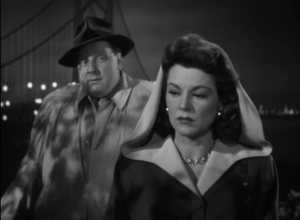 However, evil always looks to catch up with the guilty party and a private investigator is poking around in all the places he can to find the culprit behind an egregious crime. Walter Slezak’s Albert Arnett is a witty sleazeball with the lowest scruples imaginable when money is concerned. But he also happens to be decent at his occupation bringing him to San Francisco in pursuit of answers.
Sam is assisted by his faithful accomplice Marty (Elisha Cook Jr.) showcasing his ability with playing crooked pushovers. In the meantime, Helen finds herself losing her fiancee in the drama while being blackmailed by the shady Arnett.
There’s now nothing buffering Helen from the explosive evil in her drawing room. Her sister’s life is torn apart and Helen and Sam must have it out once and for all. They’re too deadly — too volatile for their own good — as everything around them begins to unravel and implode. We expect nothing less in the end.
For being a lesser star, Lawrence Tierney undoubtedly made a killing off his fist-throwing brusque tough guy roles. He’s no turnip, as he puts it, and if there ever was a homme fatale — a deadly male — he most certainly would be the gold standard…
“I find more bitter than death the woman whose heart is snares and nets and he who falls beneath her spell has need of God’s mercy.” This is a bit of poetic observation from Slezak but there’s also a tremendous resonance to what he says quoting straight from the Bible’s wisdom literature. But perhaps this wisdom also goes both ways since it’s not just the woman who is fallen and corrupted but most certainly her male counterpart. Humans were not Created to Kill but over time they have been Born to Kill and Born to Die too. There’s a difference and that really is the tragic lot of humanity as we know it. Vanity of vanities everything is vanity.
This is without question Robert Wise’s toughest, deadliest, grittiest picture. He never made a film with more vices or more despicable characters. Imagine, a character who kills for no good reason at all. Just because someone gave him the cold shoulder. It really scrapes the darkest recesses of the barrel. The way of the transgressor is hard. More’s the pity. More’s the pity. It’s cynical too.
3.5/5 Stars
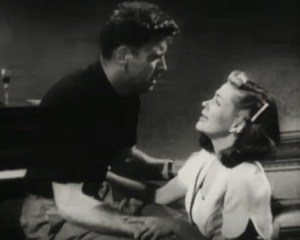 Aesthetically, Robert Siodmak’s roots in German Expressionism are crucial to the formation of the film-noir world as we know it today and Criss Cross has to be one of the most diverting additions to his repertoire. Once more he’s paired with his star from The Killers (1946) Burt Lancaster with another raging score from Miklos Rozsa and yet again there is a heist involved. However, whereas the film inspired by Hemingway’s original story was a story about a washed-up boxer — a humble Citizen Kane if you will — with some criminal elements mixed in, Criss Cross is all thriller. It represents the subset of film-noir that is the heist film, but it would hardly be film-noir without something going terribly wrong. This event is integral to the plotting as is the love triangle that becomes the main axis of the ensuing action.
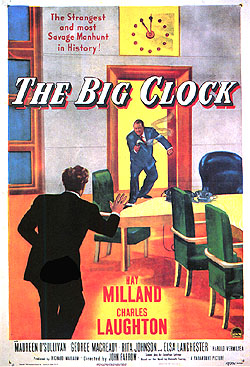 With its rather dreary title aside, The Big Clock is actually an enjoyable thriller that works like well-oiled clockwork. It’s true that oftentimes the most relatable noir heroes are not the hardboiled detectives, although they might be tougher and grittier, it’s the hapless everymen who we can more easily empathize with. Bogart, Powell, and Mitchum are great but sometimes it’s equally enjoyable to have someone who doesn’t quite fit the elusive parameters that we unwittingly draw up for film-noir. Ray Milland is a handsome actor and he was at home in both screwball comedies (Easy Living) and biting drama (The Lost Weekend). He’s not quite what you would describe as a prototypical noir hero.
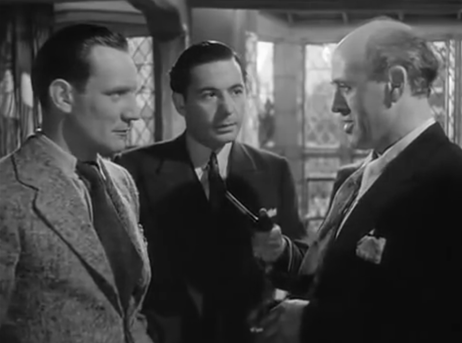 Green for Danger gives murder mysteries a good name because it is drawn up excellently but also with a degree of charm and that should not be taken too lightly or maybe it should. But either way, there’s no doubt that director Sidney Gilliat’s tale based off of a novel by Christianna Brand is quality entertainment.
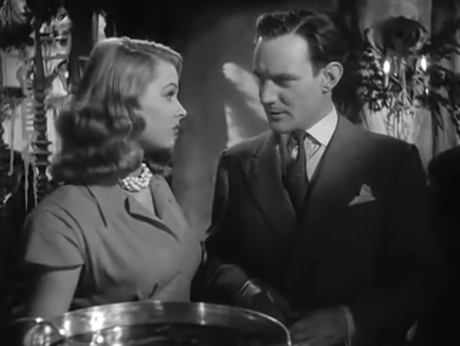 He comes in and steals the film but he does have some enjoyable castmates to work off of. Dr. Barnes (Trevor Howard) the anesthesiologist and the suave surgeon Mr. Eden (Leo Genn) are both in love with the same girl and understandably so. The attractive Nurse Freddi (Sally Gray) is a real prize but only one among a taut nursing staff including the fragile Nurse Sanson and the always lively Nurse Woods (Megs Jenkins). Before the Inspector arrives on the scene they are the true backbone of the storyline and it’s confirmed early on that the murderer comes from within their ranks. The age-old puzzle is left, to decipher who the culprit is and for what nefarious purpose.
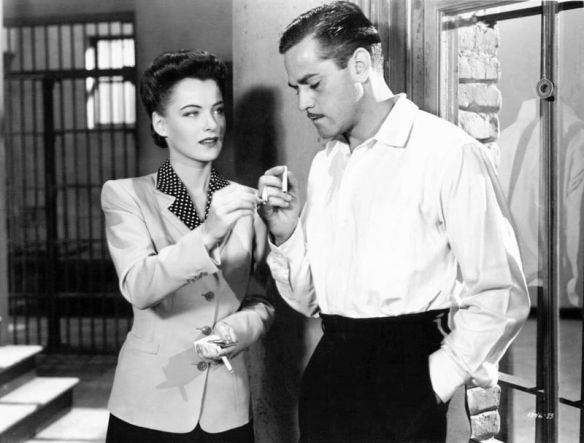 Robert Siodmak might not be the foremost of lauded directors, but it’s indisputable that film noir as a genre, a movement, a style, whatever you want to call it, would be a lot less interesting without him.
 The strands of our lives are woven together and neither time nor the world can break them.
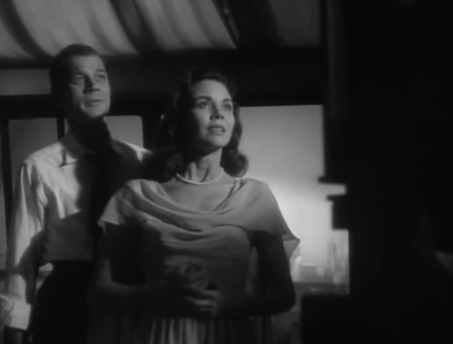 But it’s a chance encounter with a young girl named Jennie (Jennifer Jones) that gives Eben the type of inspiration that every artist dreams of because it’s precisely this spontaneous spark of joyous energy he needs to add something vibrant to his own life. In her constantly evolving role, Jennifer Jones exudes an effervescence, a certain radiance in body and spirit that lights up the screen in embodying this apparition of a girl.
 I find that despite his pedigree Joseph Cotten still comes off as an underrated actor and with each film I see him, I enjoy him immensely. Maybe for those very qualities. He’s not altogether handsome but he has a pleasant face. His voice isn’t the most formidable or debonair but it does have character. The supporting players lend some Irish flair to the cast and it’s striking that everyone from Ethel Barrymore to Lilian Gish glows with a certain hope. There is no obvious antagonistic force in this film. Eben Adams found his inspiration — the muse of a lifetime — and that passion is enough to lay the foundations of a film.
 Soldiers returning home from war is a recurring theme in films such as The Best Years of Our Lives and Act of Violence and given the circumstances it makes sense. This was the reality. Men returning home from war as heroes. But even heroes have to re-acclimate to the world they left behind.
 With Dashiell Hammett’s The Maltese Falcon making a splash just the year before and giving a big leg up to its star Humphrey Bogart as well as its director John Huston, it’s no surprise that another such film would be in the works to capitalize on the success. This time it was based on Hammett’s novel The Glass Key and it would actually be a remake of a previous film from the 30s starring George Raft.
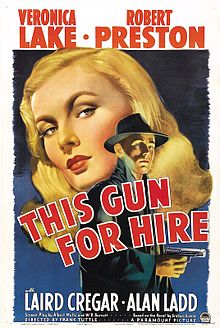 Alan Ladd and Veronica Lake found themselves partnered together on numerous occasions partially out of convenience (at 5’6 and 4’11 they were a perfect height match) but also there’s a genuine chemistry between them. And it all came into being with This Gun for Hire an economical film-noir where Ladd wasn’t even one of the top-billed stars.
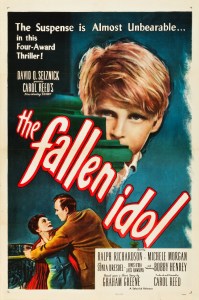 Fallen Idol is a fascinating film for how it develops inner turmoil. It’s earnestly interested in the point of view of a child and as such, it functions on multiple levels –that of both kids and adults. Philippe’s (Bobby Henrey) home is the embassy as his father is a French ambassador who is always away on the job. So Phil’s a little boy who is perpetually in the care of servants. Namely the authoritarian Mrs. Baines (Sonia Dresdel) and her good-natured husband (Ralph Richardson).
 4 Star Films