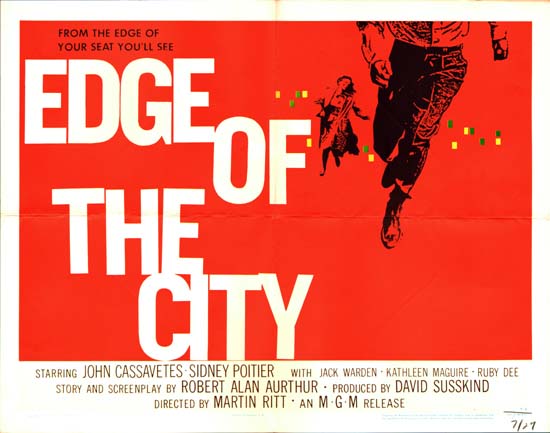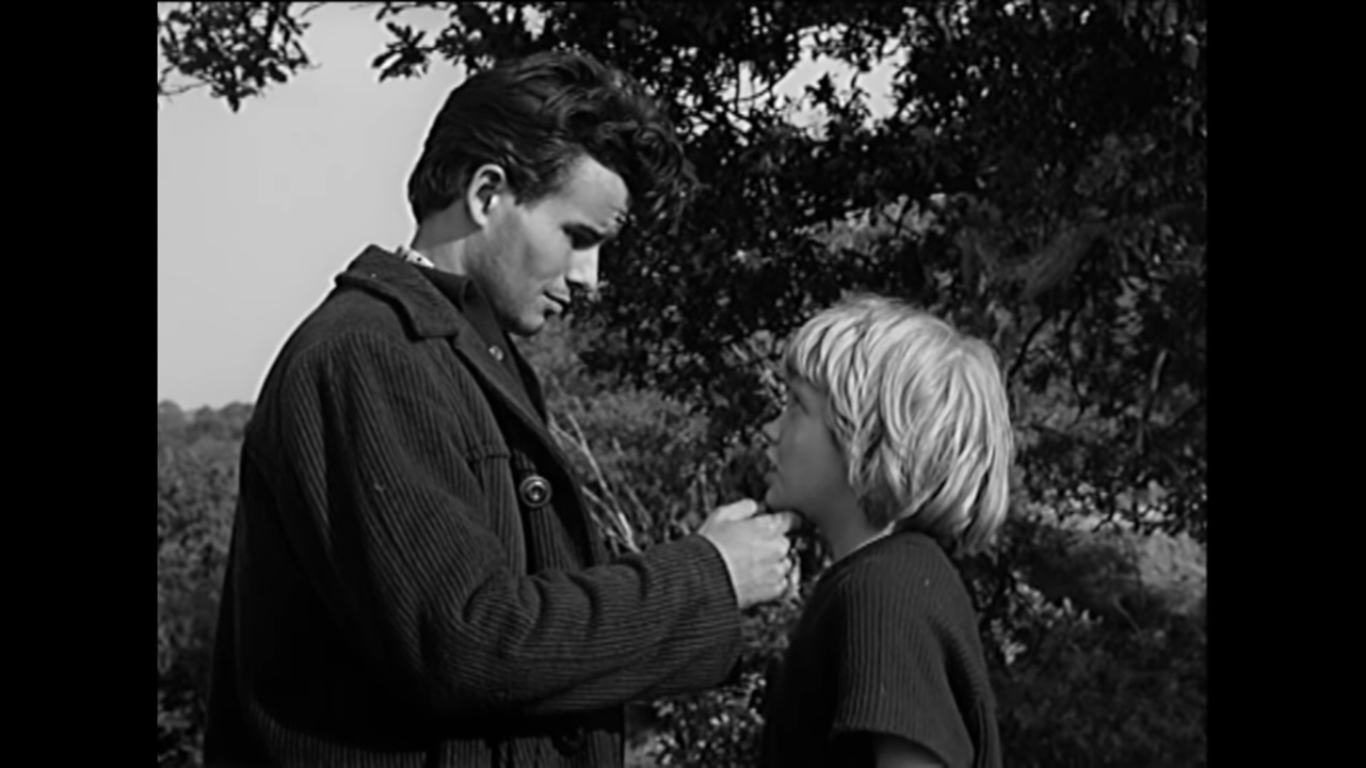
Edge of The City (1957)

Edge of The City boasts a self-important opening, with a raging score and noirish mood-lightning, especially considering all it shows is John Cassavetes going into work. Even if it is all mood, there’s arguably no better conduit for the time being than Cassavettes. This was a few years before his directorial career kicked off in earnest with Shadows, but it’s as if he oozes unease and discontentment.

He’s not in the same vein as Brando or Clift; each man deservedly stands on his own and Cassavetes was no fan of “The Method,” but he had an innate capacity to present characters with emotions incarnate, whether through the most tangible of fears or tormenting, ever-volatile demons.

He too was totally engaged with the act of crafting characters. He seems to give himself over to them, and thus, later on, behind the camera he offered his fellow actors so much freedom. I imagine it’s both terrifying and invigorating being in Cassavetes’s care, like a thrilling tightrope walk in the best of hands.

For now, he’s in the studio system, but he gets to team with people who arguably appreciated the craft as much as him in a scenario that relies on its main trifecta to create a substantive storyline. At the very least, we’re in for some fine character moments.

Axel North (Cassavetes) finds himself knee-deep in the life of docks where longshoremen make a hard day’s wage with their hands and the sweat of their brows. He gets a gig when a gruff stranger (Jack Warden) vouches for him after he mentions a mutual acquaintance. However, this is hardly an act of pure altruism. He’s a shrewd customer and looks to skim off the top of the newcomer’s pay.

In fact, the most noirish aspect aside from the New York stockyards is a veiled past that doesn’t have the decency to leave him be. Because an itinerant like Axel has to be running away from something; he can’t afford to complain. If Charlie is a symbol of the biting survival-of-the-fittest mentality on the docks, then Tommy Tyler (Sidney Poitier) is the friend you’re always looking to have in your corner.

Poitier’s blessed with a sharp wit in the role, and he feels like the comeback kid, always bright-eyed and ready with the retort. But it also always comes out of a place of camaraderie. He takes Axel under his wing. No matter his color or creed, Tommy knows this world far better than his new buddy. As he maps out the social order, there are the bigs and the lower forms (and probably more than a few loners).

Somehow Cassavetes comes off almost boyish and demure in his first starring role, more so than I’ve ever seen him. It just goes that his normal picture of pent-up intensity took on many forms over the course of his career.

In his film directorial debut, Martin Ritt introduces the kind of themes that would stick with him for the rest of his career. He was passionate about honest character studies focused on people with convictions and conflicts — some good and some bad. How do you begin to categorize Hud, Tommy, or Norma Rae? The catch-all answer is their joint humanity, tainted or not. There’s an inner truth to them imbued by the performers.

In some ways, Edge of The City feels more unprecedented and significant than Stanley Kramer’s Defiant Ones for the sole reason that it’s far more mundane. Its interracial friendship is formed not over an arduous, embittered game of survival, but in the salt mines and urban jungle of the common working man. Axel and Tommy live life together. It normalizes them.

Because one of the greatest joys of the movie comes with depicting the daily activities occurring outside the typical 9 to 5 grind. There are playgrounds overrun with kids, and apartments filled up with mundane rhythms, from cooking dinner to conversations with spouses and friends.

What’s more, the primary female characters as portrayed by Ruby Dee and Kathleen Maguire are intelligent, well-informed human beings. Tommy and Lucy are happily married, and they set Axel up with their friend Ellen, spending evenings together going dancing or bowling. It injects an air of levity onto an otherwise dour canvas.

Still, there are tough conversations too after the laughs have subsided. We hardly expect space for this kind of pragmatic discourse, especially in 1957, and yet here we are. The most noteworthy thing to come out of the inevitable devastation is Ruby Dee’s final stand. For much of the movie, she plays the affectionate wife, who nevertheless has thoughts and opinions of her own. In one shining moment, she showcases her resolute strength even as she decries the madness around her.

It calls for some outward response breaking the code of the docks for the sake of compassion and vindication in the face of heartless human tragedy. Because Martin Ritt studied under Elia Kazan, this might as well be his version of On The Waterfront. It evolves into a tale of collective responsibility where inaction is one of the worst forms of culpability (and also one of the easiest to fall prey to).

In the final hours, Cassavetes becomes his version of Brando’s Terry Malloy and Warden fills in for his 12 Angry Men castmate Lee J. Cobb. Here battles, if not fought with baling hooks, are settled with fists. Finally, Axel casts off his fear and his apathy to stand for something meaningful. So while this is not a wholly original sequence, at the very least, it’s ingraned with a level of moral resonance.

With the birth of the black power movement and blaxploitation in the ensuing decades, Sidney Poitier did not just go out of fashion, he became an easy target. He was a sellout and a relic from a bygone age. It seems time has proved just how uncharitable this is especially when you have the misfortune of becoming acquainted with the likes of Stepin Fetchit and Willie Best.

Sidney Poitier is an inimitable trailblazer, and it’s sorely unfair to place the onus of black representation on one man. Thankfully, he’s had a few others to carry the mantle though progress has been incremental at best. Hopefully, his heirs will keep coming thick and fast, articulating the vast, complex circumferences of the black experience.

However, my final thought is only this. All I could think about after the movie was how he single-handedly built a sub-genre: the interracial buddy film. He could count the likes of John Cassavetes and Tony Curtis among his onscreen friends. Not many men can say that.

3.5/5 Stars

Blackboard Jungle (1955)

Billy Haley and The Comet’s “Rock Around The Clock” is often touted as the first rock n’ roll tune. I won’t get sucked into that discussion for the time being, but whatever we want to call it, there’s this sense of youth culture — teenagers as a demographic — coming into bloom.

Future generations would harness the music of the contemporaneous adolescent culture to greater effect. In Richard Brook’s Blackboard Jungle, it feels a bit more one-note and generally unattached to the marketing and main message of the picture. They haven’t quite harnessed its power. Because like the gangster pictures of old — or even The Wild One and Rebel Without a Cause — this is meant to be another cautionary tale about delinquent youth. In its day, it was no doubt considered dangerous and indecent.

There’s some of that, but an honest assessment would acknowledge how tame most of it feels now. It’s the 50s take on the teenager problem through the eyes of a Hollywood still neutered by the production codes. However, that’s not to say there is nothing to be relished about the movie or gleaned from the depiction of cultural anxieties.

I’ll let you be the judge of whether or not Glenn Ford does an adequate job at playing a teacher. It’s certainly not a western and although there are tinges of an urban jungle, it’s not quite your prototypical city noir. To his credit, in spite of his usual intensity, his scenes with Anne Francis, in particular, do reveal a certain sensitivity. He uses his brawn on a number of occasions; he has a foot in that world, and yet there’s some sense he is a gentleman and an aspiring family man.

Still, his life as a new recruit to North Manual Trades High School feels a bit like baptism by fire. Despite its gruff and no-nonsense administrators as represented by such ready veterans as John Hoyt and Emile Meyer, there’s no question the all-boys, multiethnic melting pot of a school has a major discipline problem.

One wry teacher who’s been around the block calls it the “garbage can” of the education system. And he’s resigned himself to taking out the trash. Nothing more. As such, in preparation for the first day of school, there’s an uneasiness in the air. Even as Mr. Dadier (Ford) desires to reach his class, there’s a sense that battle lines are being drawn up: you have students on one side and teachers forming a rear guard. One new recruit, a bookish Richard Kiley comments, it’s like being back on the beach at Salerno doing the war. In other words, this mission is not for the faint of heart.

The world and the atmosphere around the school evoke so much. One of the primary pleasures of the picture comes with actually familiarizing ourselves with this rank and file replete with familiar faces like the Louis Calherns, Kileys, and even an odd Richard Deacon or Jamie Farr here or there. We can only experience the power dynamics and the underlying conflict thanks to the range of characters.

I have very little practical hands-on knowledge about New York geography, but there is this sense that the high school featured here could exist not too far away from the courtroom in 12 Angry Men. If the morality on what to do with punks and malcontents doesn’t entirely overlap, then the visual landscape feels like a shared space.

But enough delaying tactics. We must acknowledge the emblematic youth at the heart of Blackboard Jungle. Gregory Miller (Sidney Poitier) is cool and disaffected. Dadier ushers him out of the washroom during a mid-period smoke break. He’s made his stance toward education plain. Though he’s a more complex case than his opening introduction might suggest. Most people are.

Artie (Vic Morrow) thrives as the gang’s primary leader, at least in the fact he’s good for a derisive comment and stirring up his cronies in rebellion against the establishment. Boys like Miller’s have intelligence and some semblance of passion.  Artie’s got nothing of the sort. He has a future career of hoodlumism all sketched out.

It’s not a radical hypothesis, but watching Sidney Poitier here, it’s easy to surmise that if he had been white, he would have been lauded as a cult icon on par with Brando or Dean. However, to his credit, he takes the part in a direction commensurate with his specific talents. While Morrow at times feels like the typical street thug, Poitier eschews many of these conventions over time.

Considering the opening preamble and where the movie goes, it’s intriguing to consider the implications. It does preach a message of racial tolerance — that certain people aren’t too far gone and teens are humans too — but there does seem to be an easy fix. You have to pin the blame on the black sheep. They are the ones souring everything. It has nothing to do with skin color, but perhaps the pains, the fears, and the psychological duress of youth.

One of the most powerfully symbolic moments is not any fistfight or savage skirmish. It happens in a classroom where the boys, urged by Artie, bust a teacher’s collection of jazz records. Kiley’s reaction is hardly devastation. He’s more so shellshocked and resigned to bewilderment. What would come over them to do such a reckless thing? They get no utility out of it. It’s merely an act of spite, a way to wreak havoc and target other people so they become inured to it.

Creativity or beauty of any kind, anything that doesn’t conform to teenage masculinity, even flaunted sexuality gets quelled and totally crushed into the ground. There need not be a better summation. Otherwise, there are few revelations in the movie and the finale is tense if not altogether authentic, brimming perilously with self-serving melodrama.

In this facet alone, it seems time has not been kind to The Blackboard Jungle. At the very least, it’s because a myriad of similarly-minded movies were built out of its image — on its shoulders even. If you’ve seen Stand and Deliver or even Poitier’s later success, To Sir, With Love, it makes the work here feel outmoded, if not altogether negligible.

However, after everything else burns off, there’s a particular appreciation for Poitier. If Morrow deservedly filled the space of a punk antihero, then Poitier derives a nuance out of his role that seems unprecedented, and he would keep on presenting such seismic and extraordinary performances to the American screen. Even in his relative youth, I’m always in awe of his intuitive stage presence.

Far from simply offering a convenient context for the movie and its student-teacher factions, Ford’s character reaches out to Poitier because he is the leader that others follow. In 1950s America this seems like an almost startling statement. Here is a black man being acknowledged as capable of leading the masses. But when you watch Poitier, it doesn’t seem implausible by any means because he plays it so assuredly.

Thus, Blackboard Jungle might as well remain as a time capsule of 1950s sensibilities, beatnik-era slang, burgeoning rock n’ roll culture, and most importantly of all, a showcase for one of the movie industry’s incomparable talents. Yes, I’m talking about Jameel Farrah.

3.5/5 Stars

Cry The Beloved Country (1951)

As an American, the history of Apartheid is still something I feel relatively ignorant of even as I must confess to still be learning constantly about our own history of segregation in the U.S. This is part of what makes me marvel at Cry The Beloved Country, which really is one of a kind — a bit of a gem plucked out of the 1950s.

Because the talents are innumerable, a young Sidney Poitier on the rise and Canada Lee in what would turn out to be his final screen role. I haven’t seen many of them, but this might be his best. Because although there is plenty of time to speak of Poitier for any number of movies, well worth our time and consideration, this particular film is carried first and foremost by Lee.

It impresses upon us a certain dignity of spirit. He’s a priest named Kumalo, stately and compassionate in all aspects. His eyes bear the same melancholy of a man who has been forced live under the weight of many hardships. It also makes us yearn that his stage efforts might have been captured for posterity as he famously worked with a theatrical wunderkind in Orson Welles and built up quite a career for himself. Alas, this was not to be.

One must confess that the reason for his starring turn was partially out of necessity. American, now deep in the throes of the Red Scare, was no friend to him or anyone who purportedly had Communist connections, whether real or imagined. The fact that he was black definitely didn’t help matters (Just ask Paul Robeson).

Meanwhile, Sidney Poitier was on the entirely opposite end of his career: Now in his early 20s and coming from the stage to navigate the strictures of Hollywood set before him. He’s so young, but he holds a civility and a stature that make him feel fully present and somehow wise beyond his years. This would be a trend throughout his lifetime.

If it’s not evident already, Alan Paton’s 1948 novel is totally engaged with the contemporary issues of South Africa, ranging from systemic racism to pervasive poverty. If they are contextualized to this culture, surely we aren’t ignorant enough to believe they have no bearing on our own historical background.

So here we are in South Africa offered an auspicious film by Zoltan Korda meant to be about something of real consequence — to speak of the ills and indiscretions of society — when we purposely build structures of oppression. The production is steeped in its share of legends, the most famous one being Korda pronouncing Lee and Poitier as his manservants so he could get them into the country to film. If nothing else, it adds not only to the aura but also the concrete reality of what is in front of us.

For a black man, Johannesburg feels very much like the valley of the shadow of death. When Reverend Stephen Kumalo (Lee) receives a letter, it sends word that his sister is ill. His mission is twofold: support his ailing sibling and track down his son Absalom.

In many ways, Cry, The Beloved Country is a journey film as one man pursues answers and then restitution for a life. I wouldn’t say all the performances feel natural, but at the center of the drama Lee and Poitier act as a bit of an anchor for the entire movie. We have them to cling to. And even if the local, untrained performers leave something to be desired in terms of emotional resonance, the milieu around them speaks volumes.

There is an austere veracity that’s innate to on-location shooting. You could not possibly achieve this kind of atmosphere any other way. The overall degradation and the poverty are palpable in most every frame filled with the blocks of shantytowns.

It also willfully engages with issues of black-on-white crime. In a society whose social structures and racial castes are tenuous at best, these are perilous waters to breach. The newspaper headlines detailing a botched robbery are made far worse by their immediacy.

The man killed was an idealistic reformer envisioning a world of greater equality and stability for the black community. This show of brutality against someone sympathetic to their plight is poor P.R. nor does it placate his crusty old father (Charles Carson), who never believed much in his crusading, to begin with. For people of his age and estate, white is white, black is black, and never the twain shall meet. It’s not to say evolution is not possible…Between the frail sympathies of his wife (Joyce Carey), looking at his late son’s writings, and a fateful encounter, there’s still room for ample growth.

However, this crime also has bearing on Stephen as well. Because his boy Absalom is one of the men implicated in the killing. It’s a father’s worst nightmare, and he’s powerless to prevent it. Here two fathers are juxtaposed while coping with two strains of unfathomable grief.

Soon court dates are set, and there’s a trial for the murder of young Jarvis and the impending deliberations.  Although all the elements are there, the plotting and execution never add up to anything that feels more than intermittently affecting. It’s the kind of film I like the idea of it and what it stands for rather than what it actually culminates to onscreen.

Make no mistake. Cry, the Beloved Country feels like imperative viewing if we want to understand what empathy is in the face of our own limitations and human biases. To my knowledge, it’s nearly an unprecedented historical documentation granting center stage to black actors who deserved more acclaim. And thus, our attention must consider and appreciate the performances.

For Poitier, in a fledgling career, there would be still so much ahead of him. For Canada Lee, an unfairly forgotten talent now, it was the end. He would go the way of his buddy John Garfield and many others, perishing no thanks to the toxic industry around him. Cry, The Beloved Country is not a great movie, but it’s an understated one, brimming with solemnity, and sometimes we would do well to have this posture. We can mourn our own sins, the sins perpetrated against us, and the sobering reality that the world is not as it should be.

3/5 Stars

Note: This review was originally written before the passing of Sidney Poitier on January 6, 2022

Tiger Bay (1959)

Horst Bucholtz has always held a soft spot in my heart. There are several very simple reasons. My father’s favorite movie might be The Magnificent Seven, and I grew up watching this young raffish upstart join forces with Yul Brynner and Steve McQueen against the forces that be. Then, years later, there he was again as an old man in La Vita è Bella. Somehow it served the movie and my own history with him well, to see him this way. A mere 5 years later he would be gone.

Of course, Tiger Bay, if you’ve never been acquainted with it before, is the picture that really put him on the map, at least for English-speaking audiences. And it’s easy to see why. He was advertised once upon a time as Germany’s James Dean, and if the comparison makes a modicum of sense at all it has to do with how masculinity can be at one time violent and then sensitive. There would be no other way for him to hold the movie together with Hayley Mills so well. More on that in a moment.

I must take a moment to acknowledge my growing esteem for J. Lee Thompson in recent days because although I am a fan of Cape Fear and not so big an admirer of The Guns of Navarone, it was earlier in his career where he showed his capability with material like Yield to the Night and here in Tiger Bay. The world is easy to place, especially in England with a working-class port town acting as a window to the world. One of the men fresh off one of these ships is the youthful sailor Bronislav Korchinsky, who looks to be reunited with his lover.

Hayley Mills makes her screen debut moments later as a feisty tomboyish pipsqueak ready to roughhouse with all the other street rats. She gleams with a delightful impudence, those large searching eyes of her projecting curiosity and at times rebellion. Her aunt is always scolding her and she always scampers around bumping into neighbors on the stairs or eavesdropping on conversations she has no business in.

One of them is between Korchinsky and his girlfriend Anya. But the scene before us is hardly bliss. It comes seething with angst and vindictive daggers you feel like would hardly have been in vogue across the pond at the same time — at least in mainstream Hollywood. As the woman scoffs at the money he sent home and lets him have it in their native tongue, it becomes apparent this kind of gritty vitriol might only seep into an American noir picture.

In fact, if there is any immediate reference point, it’s possible to find Tiger Bay reminiscent of The Window. However, in this case, Gillie Evans (Mills) is not so much a “kid who’s cried wolf” as a serial annoyance no rational-minded adult looks to take seriously. Still, she’s an eyewitness to what looks to be a shooting. A woman’s dead and the man is on the lam. What’s more, in the moment of initial tumult they crossed paths as he streaked away, and she nicked the evidence to bring back to her aunt’s apartment. For her, this entire scene feels like a novel curiosity, but she thinks little of the consequences in the moment.

Instead, she dodges the inspector’s gentle interrogations (John Mills) before rushing off to drop into church service late, taking up her spot in the choir while still packing the purloined pistol.

It’s fitting that in one moment they seem to be singing a hymn out of Psalm 23 and suddenly the spiritual journey through the valley of the shadow of death becomes all too real. There stands a familiar face in the crowded pews and suddenly her self-assured nonchalance drops off in the middle of her solo. There’s the man!

It feels like a showdown set up for Hitchcockian dread as the church clears out and she’s left to fend for her own against the crazed young man. This can only end poorly. And yet Tiger Bay works because the villain in this equation is not a horrible human being. There are moments he could press his advantage, whether it’s pushing her to her death or doing away with her with the gun, but this is not his character.

In fact, in its best and brightest moments, Buckholtz and young Mills become the welcomed nucleus of the movie, at first as wary adversaries and then companions and finally friends capable of playacting in the morning light. For a few moments, they are able to shed all the worries of the world and enjoy being in one another’s company.

In the latter half, it takes on a different tilt altogether as a little girl, now beholden to her new friend, looks to buy him time as he looks to sneak off on a ship out to sea. We have ticking clocks and stakes, all those storytelling tricks of the trade, but the core of the entire story is the relational capital that we build. It becomes a new, far more compelling kind of movie. Because now a child must live in the ambiguity of the moment and how are they to decipher the difference between right and wrong and what those terms even mean?

The ending feels a bit prolonged and drawn out for its own good though it’s kept afloat by this underlying relational tension. A man’s life hangs in the balance as Mills drags his real-life daughter out to sea to identify the purported killer before he can get away for good.

John Mills feels generally flat and uninteresting if a mostly benevolent authority representing a prevailing moralism. Otherwise, this picture has much to offer and a colorful perspective on the world circa 1959.

Suddenly, British society, cinematography notwithstanding, doesn’t look quite so monochrome. Because of course, it wasn’t. It’s a world of Polish immigrants, vibrant Calypso music on the street corners, and foreign sailors who are not totally subservient to the British powers. It’s a reminder that ports really can be windows to the world even as they can also bring disparate people together.

3.5/5 Stars

Scaramouche (1952)

Like many of the archetypal tales of literature or film, Scaramouche is a story of the aristocrats warring against the common man or closer still the common man throwing off the shackles placed upon him by his oppressor.

The dynamic is spelled out in an early scene as that ill-fated debutante (Nina Foch) enlists the help from behind parlor room doors of her dear cousin, the Marquis de Maynes (Mel Ferrer), to find the infernal insubordinate “Marcus Brutus.” The vagrant had the unthinkable gall to litter her very own palace with his pamphlets.

It’s easy to get distracted by the period elegance leftover from the MGM of the late 30s and 40s. The movie wears its opulence well and thankfully there’s a worthy story to prop it up and give it the heartbeat of humor and substance. Although we are on the eve of The French Revolution, this acts as merely a backdrop. As is usually the case, the story is made far more personal.

This could very easily be the story of a rebellious pamphleteer and his loyal compatriot sticking it to the bourgeoisie. However, the young upstart Philippe (Richard Anderson) is killed by the sword at the hands of the lethal Marquis, and now his companion Andre Moreau (Stewart Granger) vows to seek revenge. In fact, his story from thenceforward is driven by an all-consuming personal vendetta.

Janet Leigh, on her part, is a virginal beauty brimming with a poised elegance. She’s crucial to this story as the queen’s ward and a chosen companion for the Marquis. However, kismet means she also shares a fondness for Andre after a chance encounter by the roadside. Suddenly our two men are tied perilously close together.  Still, there must be time for amusement.

Stewart Granger takes to the part with ease, and it plays to his finest attributes as a leading man. But he’s also able to have a bit of fun donning the visage of Scaramouche the masked jester, a perfect disguise and also a way to cast himself in the likeness of all the great vagabond heroes of Hollywood lore, whether they be Robin Hood or Francois Villon.

Eleanor Parker is vivid and fierce with fiery red hair and passionate jealousies befitting a person of her ilk. She bursts on the screen with an untameable beauty trampling after her love on stage, with all manner of blunt instruments, and malice in her heart. However, he’s the one who plucks her out of the arms of matrimony only to receive her continual ire and consternation in return. It’s only one of the fires lit under the movie.

The bursting palette of the picture and its sense of comic pageantry onstage cannot help but elicit comparisons to Kiss Me Kate. The adaptation of Taming of the Shrew was a musical, yes, but also directed by the very same George Sidney.

Sidney himself felt this material was ready-made for musical treatment. I’m not too familiar with Granger’s singing prowess, but I’m rather partial to how the story develops and part of that might be the dearth of modern swashbucklers. There’s something so invigorating about them even to this day, and the spectacle of the film fails to disappoint. And if Sidney was at all disappointed by the results, he only had to wait a year to get his musical.

What becomes apparent about Scaramouche is how it ably fluctuates between two tones to fit its two divergent worlds. At one time, Andre finds himself dabbling in the royal courts as a traitor and wanted man, sharing covert rendezvous with the pure-hearted Aline de Gavrillac (Leigh). Then, in subsequent moments, he’s the larger-than-life theater vagabond caught up in a perpetual game of stagebound slapstick and ferocious cat and mouse with his most favored acting partner.

However, he also has time to take on a new hobby as he endeavors to become a master swordsman, man enough to take on the Marquis. When the time comes, he takes the troupe to the big stage and bright lights of Paris though he maintains his ulterior motives.

In the name of his good friend, he takes up the mantle of the common man in the national assembly. He handily whittles down the list of deputies who all insult his character for the chance at a duel. Of course, there’s only one name he waits to cross swords against — and it’s the one name he has yet to face.

You see, the two women in his life conspire to keep them apart and, for the time being, keep Andre safe. Alas, they cannot stave off the confrontation forever; it’s an inevitable development. They meet at the theater of all places.

The final rousing show of swordplay has to be one of the finest displays I’ve witnessed in some time. Between Granger’s moderate background and Ferrer’s grace as a dancer, they make the choreography pulse-pounding and totally enthralling while their venue brings in a novel element.

All the spectators rush around as haphazard collateral damage as they thrust and parry their way across the balcony, down the steps, into the first-floor theater seats, and then finally up on the stage. It’s not just a sword fight; it feels like a whole movement with a beginning, middle, and end that plays out in front of us.

It ends with almost an anticlimax and a twist that initially seems to take away from the story, although it just might add one more feather in the movie’s cap. The only matter left to parse through is probably the most important or at least the most troubling. Which leading lady shall our leading man choose? Although they come from two different strata of society, they both boast an embarrassment of riches. In the end, he takes Janet Leigh.

It’s easily forgivable and Eleanor Parker gets the last laugh on him, not to mention a new man on her arm, all but waiting in the wings to tear France a new one. Who needs a strapping vagabond swordsman, when she winds up with one of the greatest military minds of all time? This touch of conclusive irony summarizes Scaramouche at its very best. It manages to harness the drama while never losing its romantic sense of adventure and unadulterated good humor.

4/5 Stars

Anne of The Indies (1951)

“What should it trouble a man to gain the whole world but lose his soul” – Herbert Marshall

There’s not a finer prospect I can think of than a Jacques Tourneur-helmed swashbuckler starring Jean Peters as a swarthy pirate who terrorizes the high seas. At this point in her career, Peters had yet to garner a starring role. Pictures like Pickup on South Street and Niagara were still in her future, but she more than proves her salt, taking to the role ferociously. The best part is that regardless of its humble running time, this is the kind of material an actor can really sink their teeth into.

Her Captain Providence proves fierce and stout-hearted in a sea of growling seafarers. Despite being one of the few women on the landscape, she’s a domineering captain of the ship who wears her sea legs well; there’s a believable pitilessness about her.

It’s the only way one survives such a climate. In their opening takeover of a ship from the British fleet, we get a perfect showcase for their merciless treatment of any foe. It primes our expectations going forward.

However, there is one uncharacteristic move our protagonist makes by pardoning a man they find shackled in the brig. He is a Frenchman (Louis Jourdan). Her right hand man is distrustful of such a rogue, but the enigmatic fellow becomes an addition to the crew after appealing to the captain’s judgment.

If she has anything close to a resident conscience, it would be the jaded doctor (Herbert Marshall), who cares for the crew’s ailments while also keeping her apprised of the words of scripture and what scrupulous men might do. This is very much the war playing out within the character. She tries to maintain her mastery of the sea while also grappling with love, opening herself up, and risking an admission of weakness.

For instance, femininity is not something to be flaunted, but Jourdan’s La Rochelle manages to coax it out of her. Like other wenches, she’s fallen for a man. He effectively comes between her and the only mentor she’s ever known.

Thomas Gomez takes on the larger-than-life task of Black Beard. He is both mentor and partial antagonist worthy of all the scurvy legends and tall tales that have been spun about him over the years. He’s armed with an agreeable bluster full of throaty good humor but also the edge of prickly menace. It makes him more threatening as the story progresses because he doesn’t forget a grudge easily.

Their initial fight is everything we could ask for in a rousing duel between a pair of boisterous daredevils. However, if this is what they do in a jocund company, you can only imagine what it will look like when animosity is stirred up between them.

Debra Paget is hardly a flash in the pan and for all the solid pictures she was a part of, more often than not it seems like she’s given very little to do. Once again she shows up as a pretty albeit sympathetic face. In this picture, she’s a fitting contract to Anne, if little else. She was rarely allowed anything more substantial.

It’s easy enough to summarize the latter half of the picture as a game of successive feints and parries back and forth with several lovely offensive thrusts from both sides. They’ll see it through to the end hell or high water, cannonballs raining down, masts crashing, fires burning all over. If it’s not obvious already, there can only be one victor in the fight to the death and the total subjugation of the sea.

The ending is another twist of romanticism. To me, it does twinge with the feelings of a cop-out, but it brings back Black Beard to fight it out with his old yard arm. They were meant to meet one final time. Except for this time, his old accomplice has been stricken with a momentary conscience. She takes her furious grit and puts it to use in one final stand of sacrificial defiance. Still, the famed pirate goes out much the way she came in as a titan among men.

There are few things I abhor more than a bloated picture where the scenery and the running time get away from the filmmakers. While Tourneur’s not anti-epic, he takes shorter, more compact material and still manages to give it the scale and import of much larger pictures. He did it with horror, westerns, and certainly swashbucklers like this one. Because genre pictures have the auspicious opportunity to offer their spectators atmosphere — all kinds of atmosphere — and we see it in spades with Tourneur. This surely is one of his finest attributes as a director.

Part of me still marvels that they actually made a movie like this in the early 1950s. But that quickly dissipates in lieu of a total appreciation for what this cast and crew are able to conjure up onscreen. It’s like they had the key to rousing swashbucklers that we’ve all pretty much forgotten. For a picture that very few people seem to remember today, Anne of the Indies is a good time, and a novel one at that.

3.5/5 Stars

The Wrong Man (1956): Henry Fonda The Most Sympathetic of Victims

Screenshot 2020-08-03 at 7.40.08 PM

I never grew up watching reruns of Alfred Hitchcock Presents, but there’s kind of a ubiquitous aura about them. The man himself — the entirety of his portly physique — comes out of the shadows into a family’s living room to narrate some ghastly or unseemly crime with a droll sense of humor. The show ran from 1955 to 1965 becoming a wildly popular cultural touchstone, and it’s easy to see how The Wrong Man (1956) might have fit into this lineage.

Hitchcock was normally a walking cameo, providing a wink-wink to the audience as he pulled the strings from behind the camera. Here he is also a spokesperson assuring his audience every word of the following story is true though it plays stranger than fiction.

What becomes immediately apparent is the New York milieu. It’s unadorned and if it’s themes and star bring to mind Sidney Lumet’s 12 Angry Men with Henry Fonda, then the world itself has the kind of simple humanity of Paddy Chayefsky. And this is a Hitchcock movie, mind you, but the cinematography by Robert Burks is gorgeous in its stark black & white tones. It helps to maintain this suggested sense of concrete realism.

We open on the bustling Stork Club — it’s a real place — and there “Manny” Balestero (Fonda) plays bass as part of the house band. He’s not rich by any means, but he makes an honest wage going home to his wife (Vera Miles) after the dancing is done. Their life together is humble but full of love and decency. They raise two rambunctious boys, and he promises to give them music lessons.

His life is preoccupied with the kind of familial responsibilities we all understand. His wife has some dental work that needs to be done — it’s expensive so he needs to check on their insurance policy — and he plans to check in on his mother. It’s rather unextraordinary. But this is what makes it unusual.

While Manny only looks to check on his wife’s insurance policy, Hitchcock frames it like a bank robbery. Except the gun coming out of his pocket is the paper policy. The teller walks away, her face racked with concern as she consorts with her superior. A holdup hasn’t been committed, and yet it sure feels like it. In a stunning shot, the superior peers past her shoulder and catches sight of Manny perfectly oblivious. It’s the beginning of trouble.

Soon Manny is I.D.’d. He’s not trying to hide anything. Some policemen (including Harold J. Stone) show up on his doorstep to take him in for questioning. They assuage any concerns he might have: “It’s nothing for an innocent man to worry about. It’s the fella who’s done something wrong who has something to worry about.” And so he goes along with their line of interrogation because he naively believes in the veracity of justice.

What becomes more apparent is the fallibility of eyewitness testimony and the coincidence found in circumstantial evidence. I am reminded of the work done by the likes of Elizabeth Loftus and of confirmation bias. Of how misleading information often molds responses. Two ladies pick Manny out of a lineup which doesn’t bode well. Then, whether or not it’s uncanny, his handwriting also looks close enough to an incriminating stick-up note.

However, more so than any of the implications on law and the criminal justice system, The Wrong Man is such a powerful exemplification of Hitchcock’s directorial talents. It’s devilishly simple on the exterior, and yet he does so much to make us totally cognizant of Fonda’s condition. It goes beyond mere osmosis. Thanks to Hitchcock, we live Fonda’s point of view.

When he’s first approached, then, again, when he finds himself actually booked and imprisoned, Hitchcock does something deceptively simple — taking on Fonda’s eyes. He looks around the confines of the space — to the sink in the corner, up at the ceiling, and we are there with him. We forget about a camera — that there is visual trickery going on — and we fall into Manny’s predicament sitting right there by his side.

We recognize the shame of being imprisoned — to be robbed of your dignity even if you manage to be exonerated. He’s taken through all the paces of justice in all its drab mundanity. It takes all the sheen out of law and order; this isn’t Elliot Ness or Perry Mason. This is common, everyday people grinding through their daily lives.

Manny watches as they do their jobs around him with a kind of detached efficiency. He has no idea what he’s caught up in nor does he think about trying to speak up on his behalf. The machine is moving too fast, and he’s already reticent. Could it be it’s hopeless? Instead, as he’s handcuffed, he watches the footfalls of his fellow prisoners being led to the van. What’s he supposed to do? Worst of all, he isn’t able to notify his wife, and he always calls her if he’s out late. He’s that kind of man.

the wrong man

The resulting storyline involves a valiant lawyer (Anthony Quayle), who agrees to take his case. However, every possible alibi proves a dead-end. Manny’s wife, once the image of so much jovial warmth, has become delusional in the lead up to his trial. She can’t take the strain.

Finally, we are in the throes of the court proceedings. Manny holds his rosary under his desk and later the cross hangs suspended up above him. It’s hard to take it any other way but that of a symbol: here is a man being falsely accused crucified for something he did not do. Like I Confess, this is not only a tale of a man put on trial unjustly, it’s the tribulations of a devout man of faith.

True to form, The Wrong Man also reflects the most perceptive and honest of courtrooms. As Manny sits there, his fate in the balance, he glances around to see all the various side conversations going on — for other people the proceedings only hold mild curiosity — but again, Hitchcock has made us totally empathize with Manny.

After his mother implores him to pray to God, he prepares for work as per usual, but then takes a moment to heed her advice. Looking at the picture of Jesus on the wall, he begins to whisper his prayers under his breath. The visuals start to superimpose. There is Manny — that is Henry Fonda’s face — and the mug of the wanted man comes into view and meets him in the middle of the screen. All of sudden, he’s got a bit of luck. It’s the fortuitous key to the whole horrid mess. Christians would believe this is Providence.

The ending hardly matters nor does the fact that it is a “true story.” It’s the impression the movie leaves on us casting the greatest shadow. Hank Fonda is the most sympathetic of victims. However, it’s Alfred Hitchcock who intuitively understands how to augment his plight by making it viscerally resonate frame after frame. Without the bells and whistles he grew accustomed to, he shows he’s still capable of making a superior film.

4/5 Stars

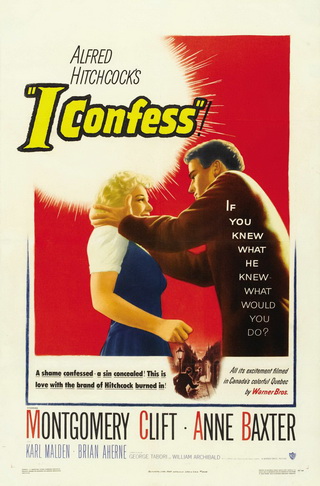
I Confess (1953): What Would Hitch Do?

I_confess_poster

Religion doesn’t always play a prominent role in the films of Alfred Hitchock — he could possibly be considered a lapsed Catholic — but I Confess is his most overt exploration of moral and religious convictions. Although one could make the argument that he’s most interested in the mechanisms created by the moral conundrum since his priest becomes another innocent man accused. Nonetheless, the story speaks for itself.

It opens in quintessential Hitchock fashion as signage seems to indicate a route and then moments later a murder is announced with a body sprawled out on the floor. A man walks down the street briskly in the cosset of a priest. If nothing else, it suggests a man of the cloth might soon be implicated.

Father Michael Logan (Montgomery Clift), who will soon become of primary importance, is in the church when he is met by Otto Keller (O.E. Hasse), who works in the local parish with his wife. The Father has always been good to him, his friend even, and now he has a confession.

The confessional becomes such a powerful dramatic element: It’s been used to stirring effect in everything from Leon Morin, Priest to the more recent Calvary. In I Confess it conveniently sets up Hitchcock’s core dilemma. The flustered European immigrant confesses to the murder of a man named Vilette. Priests, of course, take a vow of confidentiality. Thus, the picture is not entirely a mystery. This is laid in the audience’s lap before we know what exactly to do with it.

Everything must become far more complicated. It involves the Father’s past relationship with the now married Ruth Grandfort (Anne Baxter). That was many years ago, although Logan remains above reproach.

Still, the police inspector (Karl Malden) needles him and cannot understand why he will not be more compliant. After all, he was supposed to meet Vilette the morning after his death, and he was seen with the young woman on the street corner, the day after. It’s true enough, but he will not divulge more regardless of how it looks.

Flashbacks clog up the story’s midriff even as it becomes imperative to inform the narrative. Because before he ever took his vows, they were in love. He went off to war and she was left despondent, receiving small comfort from her employer and future husband: Pierre.

Not all the performances feel altogether pristine or polished but as with the environment, this is a bit of added authentic charm. The more readily-remembered Hollywood actors feel mostly like dressing compared to Father Logan — Malden’s obdurateness might be the exception. Still, this is not altogether problematic and while the picture’s not exactly taut, it does feel psychologically distressing. Clift is made to suffer in silence.

We often forget, with the lustrous Technicolor glories of the Paramount years and pictures from Rear Window to Marnie, that Hitchcock was comfortable with smaller scale and black & white. Quebec is a very unique locale, but it effectively serves his plot and the evocation of provincial character quite well.

Although Hitchcock was never one to see eye to eye with so-called “Method actors,” I think of Clift and Paul Newman in particular, there’s no argument that he allows Monty to shine even sets him up for a nuanced but ultimately towering performance. There’s a quiet magnitude imbued by his stoicism in front of the camera.

He literally becomes a Christ figure and it’s no mere coincidence that Hitchcock shoots looking down past a sculpture of a man carrying the cross as Logan himself walks below on the street. Or for that matter, how often do you see a crucifix so prominently featured in a courtroom? It’s because this courtroom drama has a priest on the stand. The whole movie is playing out through what he will and will not do. His convictions dictate what will happen.

It’s the district attorney (Brian Aherne) who has the undesirable job of getting a conviction by doing his job to the best of his abilities. This means cross-examining a mutual friend (Baxter) as well as the man of the cloth. Is he in a sense, Pontius Pilate? Because even if Father Logan comes out of the trial alive, the media attention and the aspersions on his character can never be undone. He will be faced with public ignominy.

He’s also made to walk the gauntlet so many times; Hitchcock blesses Clift with some phenomenal close-ups and allows the camera to take on his protagonist’s point of view multiple times. He’s not the only one, but one can hardly forget the very final scene in the Chateau Frontenac Hotel: The Father goes in to confront the man who was going to let him take the rap for a murder he did not commit.

The man has a gun. He’s holding himself up and by now he’s desperate already, having killed at least one other person. The room couldn’t seem larger and still, with a kind of peerless conviction, Clift’s hero makes the long walk prepared to sacrifice himself yet again.

Ultimately, he is vindicated; there is a sense of justice, but what a terrifying portrait it is. For those without major religious convictions, it might feel absurd. I must admit it seems almost inconceivable a priest cannot alert the police about a murderer. Surely, even the Bible talks about there being a season for everything, and a time for every purpose under Heaven. Still, Hitchcock even made a point in an interview:

“We Catholics know that a priest cannot disclose the secret of the confessional, but the Protestants, the atheists, and the agnostics all say, ‘Ridiculous! No man would remain silent and sacrifice his life for such a thing.”

It should be noted, in a Hitchcock film, it usually seems like a time to kill and a time for hate because what better way to explore our moral makeup and the forums of human justice? In the end, Father Logan holds fast and is exculpated. If not only by earthly powers, then higher powers too. I’m still left to wonder what Hitchcock would have said in the confessional if he was faced with it.

You can tell a lot about a man from his fears as well as his vices. What stands out about the picture is how it never feels undermined by jokes. It feels as sincere as the man at its core. For some, it might be a turnoff. For others, it will make you appreciate the director even more. He willingly enters into the realm of the pious, albeit through the lens of murder.

3.5/5 Stars

The Last Hunt (1956) and The Killing Fields

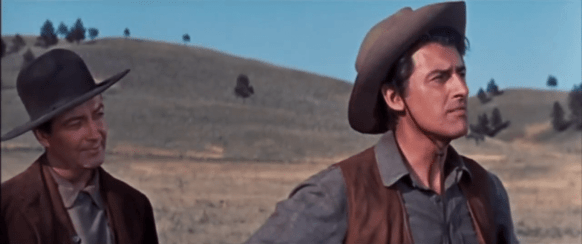
The Last Hunt considers an era that is no more. Once America’s Great Plains ran rampant with herds of bison numbering up to 60,000,000 based on the estimation of this movie. The initial premise of Richard Brooks’ western intrigues for the sole fact that this is a slice of history that doesn’t get much screen time in the cinematic west and, thus, it offers a framework for some potentially pointed commentary.

The onus for the circumstances is placed on both hunters and American Indians for recklessly slaughtering the population down to a mere 3,000. With the benefit of hindsight, it seems much of the blame must be cast on the white men. But this is something to get into later. 

For now, it should be briefly mentioned the movie has a great deal of footage shot in the famed Custer State Park spread out across the Badlands, and if you’ve never had the opportunity to go there, I would certainly recommend it, if only for the chance to see some bison. 

I’ve gotten the exhilarating opportunity to see bison several times in my life and let us just say, there’s nothing quite like it as far as putting you in touch with the sheer majesty of nature. To look at one of those creatures in close proximity, even from the relative safety of an automobile, is breathtaking. It gives one an even deeper appreciation for both the magnitude and the inner turmoil The Last Hunt attempts to grapple with. 

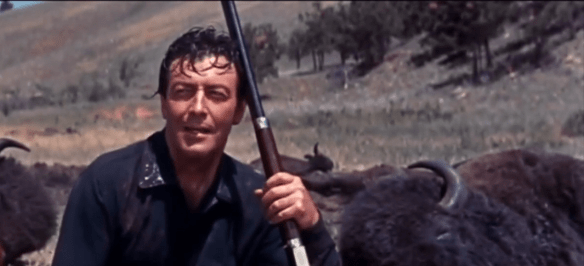
Sandy McKenzie (Stewart Granger) for one, is a big-time hunter who wants to wash his hands clean of the profession. He’s intent on taking one last job and moving on. However,  it’s one of his colleagues, the bloody-thirsty Charlie Gilson (Robert Taylor), who derives an unseemly amount of pleasure out of his vocation. He stays matter-of-factly, “Killing, fighting, war, that’s the natural state of things” and he wholeheartedly believes it. This mentality bleeds into all facets of his life. 

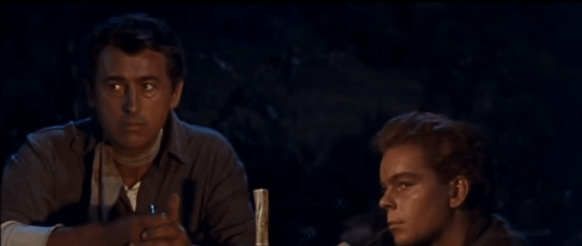
For one thing, he despises Indians. They’re hardly better than the big-time game he bags, and he’s quick to deride the genial half-breed who joins their company (Russ Tamblyn). Sandy is just as quick to welcome the boy on, and it’s yet another uneasy wedge between the two hunters. 

Screenshot 2020-07-19 at 5.36.42 PM
Watching the bison drop instantly to the ground as dead weight is in itself a bit perturbing and feels unnatural. Be forewarned, The Last Hunt is not for the squeamish because there is nothing simulated about the hunting throughout the film, actually performed by government sharpshooters who thinned out the bison population. Why it is done this way I’m not quite sure.

Likewise, watching Taylor blast away at the giant beasts until he’s decimated a whole pack for their skins, and then a moment layer cutting away to what feels like a bison killing field leaves a startling impression. The baby bison are left parent-less and a majestic white buffalo — believed to be medicine for the natives — is unceremoniously struck down. 

But this is only a backdrop or even a representation of what is going in the hearts & minds of the two characters as they chafe against one another. The movie would not work without both of their points of view. Charlie continues to exercise his almighty power of life and death over the beasts, relishing every minute, because killing is the only real proof you’re alive. His words, not mine.  Sandy could care less — having his own personal crisis of conscience — even as he extends a courteousness to his fellow man, no matter their creed. 

 Lloyd Nolan, who might best be remembered for character parts in the 30s and 40s, to my recollection puts together one of the most colorful portrayals of his career. His cackling “Woodfoot” holds a foolhardy appreciation for life and the rush of the hunt. It’s a lark to him, but he’s also good at what he does. The resplendent green plains laden with sheets of pine trees capture the sense of rip-roaring adventure out on the trail as the raucous pegleg tears across the territory with a giddy sense of abandon. 

Over time he settles into a good-natured sagacity even as he provides nighttime accordion playing to lighten the mood. He’s a bit of insulation between the men around him while offering the young boy neighborly advice. He softens and becomes more decent as Charlie becomes more and more stricken with his crazed obsession. 

the last hunt

Because there are only a handful of primary characters, each one has a very specific personality put on display and each earns their keep in the movie. The one exception seems to be Debra Padget, no fault of her own. She is an extremely alluring albeit absent beauty. Charlie desires her lustily, despite his bigotry, while Sandy becomes her de facto protectorate. I feel sorry for her because with the part she has to play — as the captured Indian maiden with child — she can’t win. Obviously, there’s a vague sense of her being a love interest, but in a male-dominated arena, she doesn’t have much import, unfortunately.

 Though the picture doesn’t have the best track record with American Indians — this is often the case with westerns circa 1956 — The Last Hunt does make a valiant attempt at some kinds of off-handed commentary. When talking about their customs, Charlie says, “Indians they don’t have religion.” Woodfoot replies with a cynical response of his own, “Indian religion is just the same as ours, except they don’t pass the hat after they pray.”

There’s another moment worth mentioning as a kind of mutual appreciation builds between Sandy and Padget’s nameless Indian girl. He acknowledges that he learned how to ride and learned about life from natives, so he holds them in the highest esteem. Proximity breeds this kind of empathy. 

She comes back around with her own version (by taking care of a toddling infant who is not her own child). She learned babies belong to all people, a sympathetic pearl of wisdom gained from Christian missionaries. It’s in this space where they form a kind of shared understanding built on mutual respect. 

But there comes a point of no return. For Sandy, he goes into town to sell their skins for a hefty sum, but he’s also resolved to get some of the buffalo stench off of him. He’s ashamed and the whole outpost points to his ignominy. Soon he’s brawling over the beasts to the chorus of rowdy honky-tonk and bodies flying over and under the bar.

 Charlie fairs little better as he goes into a continued fit of paranoid delusion leading him toward a chasm of madness. He believes his partner is looking to double-cross him, and he’s prepared to track him down and kill him if he has to (or anyone else who might get in his way). For all his disreputable malevolence, Robert Taylor is undoubtedly the film’s standout totally committing to his demented role. Granger is a necessary foil, but he and most everyone else must play cool and understated only smoldering under Nilson’s provocations. 

Truthfully, the ending feels woefully anticlimactic, or at least ill-gotten, failing to follow the trajectory that the story looked to be paying off. Still, up until this point The Last Hunt has a nervy tenacity in its best moments that might well leave a lasting impression on a willing audience. It remains a contentious indictment of America’s dubious indiscretions even as it also helps to unwittingly propagate a few more. Sometimes the good comes with the bad. 

3/5 Stars

Westward The Women (1951): A Fuller, Richer Kind of Western

westward the women

My only qualm with Westward The Women might be the title itself because otherwise, it’s a striking movie that should rightfully be heralded as a supremely significant western for the story it chooses to tell. At the very least, the title does make it evident that this is a story with women at the forefront — after all, the journey west was just as much theirs as anyone else’s. They just needed someone in a position of influence to enable them.

John McIntire is the visionary who can see what his land would become if subdued by men who could settle down with wives and make it into a suitable country. He’s already got the land. He’s already got the hands to work it. He just needs the women.

But he needs a man with the grit and horse sense to make it a reality because the closest females are thousands of miles away from his pristine California valley. Buck Wyatt (Robert Taylor) is the man for the job with a plethora of experience when it comes to being a wagon master. This task seems nearly unthinkable, and he takes it mainly for the money. He doesn’t necessarily believe they can make it. He hasn’t met the women yet.

As if to confirm his expectations, most of them are city folk and have neither fired guns nor ridden horses. They already have a few strikes against them. He’s hardly impressed, propped up in the corner with his hat tipped back contemptuously. During the vetting process, Mr. Whitman takes on the recruits with a far more benevolent eye.

They run the gamut from the imposing Hope Emerson to ladies with sullied reputations (among them Denise Darcel). The fact that an Italian widow and her young son sign aboard must also make us pause for a moment.

Because Westward the Women isn’t merely a story about heroic women — it is certainly this. However, since it was originally conceived by Frank Capra (who wrote the story and planned to direct), it’s an immigrant tale, albeit between Chicago and California.

Screenshot 2020-07-18 at 7.29.12 AM

While Robert Taylor is rightfully acerbic and disaffected for the part, he also has a strict sense of equity extending to both genders. Although he has a crew of veteran men working with him, he’s not going to take any of their guff or fooling around, and he’s prepared to kill to maintain order. It’s supremely harsh but then again, he seems to understand something few others do: This is a life or death scenario.

There are the torrential downpours that nearly wash them away, the treacherous terrain crushes a couple of their wagons to pieces, and, of course, there’s the threat of Indian raids. Worst of all is the internal division inside the company. Buck knows they will never survive if they can’t stick together.

The trail requires the supreme sacrifice of many who give their lives in service to the journey. It’s never easy but more than anyone else, the women’s resolve is firm. They will make it to their destination even if it kills them. Moment by moment, we learn more about the depth of their character.

The movie is a western that cuts against the grain — of both the 1850s and the 1950s —  engaged in telling a story predominantly about women featuring a Japanese character who feels at least a little bit more substantial than a sideshow attraction. His existence at all feels unheard of for depictions of either era.

I wish more directors and westerns had seen fit to have characters like Henry Nakamura (also featured prominently in Go For Broke!). While he might not be a totally integral piece, he adds yet another perspective to the movie and provides a kind of empathetic echo chamber for Robert Taylor (ie. When you’re wrong big boss, I’ll tell you).

There’s also the long-running gag with Ito’s Japanese creating an unspoken irony between what he says in his native tongue and what he expresses to Wyatt. When they finally happen upon the grave of Wyatt’s dead buddy (and with it a cache of rum), Ito voices his surprise, then says “Good ol’ Quackenbush.” His translation is liberal, to say the least!

Still, one of the most unforgettable interludes comes with reading off the roll call of those who were lost in the latest raid. It moved me immensely. Most of these women we don’t know by name, but they leave an insurmountable impact on the story representing so much of the human spirit and the dignity held aloft by the film. They feel, rightfully so, like a hallowed list of heroes.

And again, over any prevailing plot points, it’s the specific touches that will be remembered going forward. With the trail getting unstable ahead, the women are beseeched to lighten their loads and begrudgingly ditch all their worldly possessions at the roadside. It becomes a graveyard of discarded belongings as they roll ever onward.

westward the women

Then, there’s a little dog being carried along in a bucket under the birth of the wagon or the impression of a wayward wagon wheel left behind in the middle of the desert in their wake. They stop for nothing.

Finally, they get to The Promised Land, with fresh springs of running water, but before they go over the hill, Buck vows to gather together garments so they can look their best for their future husbands. There’s a kind of mounting expectation on all sides. It’s something supremely special they all get to take part in and we are privy to it as well.

When Taylor speaks to the men, he entreats them, “These are good women, great women, make sure you treat them right because God help you if you don’t.” He’s grown to esteem them just as his audience has. Thankfully, these men will too.

When the sexes finally get together, it feels a bit like a western cotillion and the ending is fittingly idyllic as they create a kind of rural utopia built on the bedrock of matrimony, decency, and hard work.

John Ford was always the purveyor of civilization making its way across the West, but we must remember Capra also had a stake in representing the American Dream. As the actual director of this film, William Wellman does a fine job capturing the adventure with the trials and tribulations of a wagon train, highlighted by numerous standout performances garnering an abiding admiration for all these folks.

Westward The Women is sadly the exception to the rules governing the western genre, but what a treasure it is to have as a kind of hagiography to the pioneering ladies who weathered immense hardship to pursue their dreams. Whether fact or fiction, the portrayals feel revolutionary, and what a joy it is to find such bountiful parts for people as diverse as Hope Emerson and Henry Nakamura. They suggest a fuller, richer western landscape than we’re in a habit of seeing.

4/5 Stars