True Confession (1937) Carole Lombard, Fibber Extraordinaire

true confession

“Must we submit to this three-ringed circus in the guise of drama?” – Porter Hall

Carole Lombard is a comedienne of unequivocal talents. My guess is that it lies in that extra special dial she had. Yes, she was a Hollywood glamour girl and stylist of the 1930s — married to the King of Hollywood himself — but she also was totally at ease being absurdly silly. She would become frenzied and unhinged in a manner that feels rather groundbreaking for her generation. She was a very special performer.

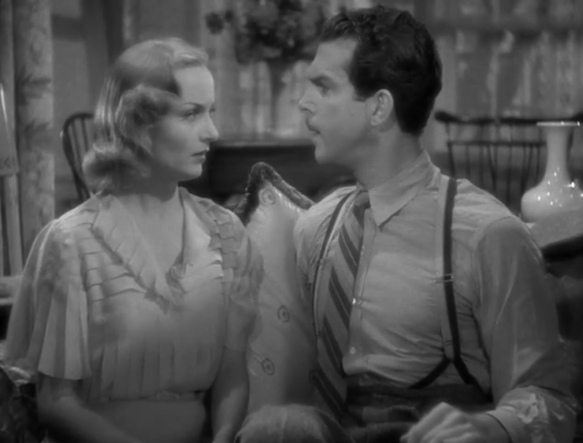
True Confession deserves to be acknowledged as a truly satisfying screwball for how it uses Lombard’s talents. Because, you see, her Helen Bartlett is a woman plagued by tall tales. Her fibs take on outrageous proportions. She’s the girl who cries wolf. Quite literally, tongue in cheek. We see it in full effect early on where she tells a string of increasingly wacky fibs to keep a man from impounding her typewriter.

However, the movie wouldn’t stand up if not for her husband. Ken Bartlett (Fred MacMurray) is tirelessly honest which, in the lawyering racket, isn’t always the most lucrative. He won’t represent anyone who’s guilty and that includes the referral of their local butcher who swiped some hams.

But he has that aching desire to exert his manhood and be the sole breadwinner of the house. He wouldn’t dream of having his wife work. No, she spends her days plinking away at the typewriter trying to finish her latest story. She’s got the personality but perhaps not the prose to be a successful writer.

So she conspires with her best friend Daisy (Una Merkel) over what she might do. Her plan is to take a job as a secretary. What of it that she’s never done shorthand or that her husband will have a fit? These are small potatoes and so she takes the job. Unfortunately, sleazy Mr. Krayler is a serial philanderer and as she skips and back peddles to avoid his advances, Helen realizes she has to get out of the secretarial racket.

This might very well be the end of it. But True Confession is forever altered by what happens next. Depending on the outcome it would end up a mystery drama. Thankfully for us, it remains a comedy.

Because she returns to the office to pick up a forgotten handbag only to find the dead weight of Krayler sprawled on the carpet. Soon the police are on the scene — their bald, hoodwinked leader (Edgar Kennedy) suspects her instantly. After all, she has motive. Soon they’ve drummed up a whole story supposin’ how she fled the crime scene.

But we know she is innocent so if the wheels of justice are actually just, there shouldn’t be a problem. A happy ending is easy enough to foresee. Instead, proceedings get strung out. Helen ends in prison suspected of murder and there’s an ensuing trial in front of a judge. Her husband is going to defend her.

Here’s the real screwball wrinkle. Wait for it. She decides to plead guilty. It’s the biggest lie she’s ever told, but if it pays off, then her hubby will be the talk of the town in the courts with a fledgling career to boot. She wants to give him his biggest stage to prove his acumen even if she has to risk perjury to do it. If it doesn’t work, well, the movie never really makes us consider the alternative.

We’ve alluded to the majority of the players, but one would be remiss not to mention two more. Porter Hall is one of the mainstays of Classic Hollywood entertainment and here he turns in a fine performance as a bellicose prosecutor on the prowl.

Then, who can forget John Barrymore hitting the eccentric heights of his career (and also the skids)? Because “The Great Profile” and titan of the great acting family, was now more of a caricature.

As Charley Jasper, he’s giggling maniacally with his ready collection of balloons, his hair rather unkempt, like a mad professor in the courtroom. Why is he here anyway? Why does the story need him? It seems quite thin. I would never dare spoil this little untouched secret.

Instead, the floorshow takes center stage. Mr. and Mrs. Barlett reenact events for the courtroom crowd in a highly irregular manner, but there is something giddy and glib watching Lombard and Macmurray break into playacting in the middle of the trial. It won’t let us forget for a moment this is a comedy, and it stays true to its roots.

I have to admit there’s an unsettling irony in the comedy’s main conceit: a white woman fighting to plead not guilty for a murder that everyone assumes she committed (though she hasn’t). Of course, there’s a historical precedent in antiquity for a woman’s testimony would not be taken.

Even watching something recently like Just Mercy, a different kind of courtroom drama in tone and content, it’s a reminder of how many people, whether black or marginalized in some way, find themselves in much the same predicament, and in their cases, there’s rarely a screwball plotline to conveniently spring them out of their misfortunes.

Social critiques aside, True Confessions is an underrated screwball gem, and it does itself a service thanks to Lombard and Kennedy, Merkel, and Barrymore. However, in our current context, as we seek a renewed sense of justice in the civil space, it must also give us pause.

3.5/5 Stars

Notes: This post was originally written in June 2020

Noises Off… (1991): From Stage to Screen

`????

In the olden days, a stage production — or shall we say “the theater” — was blessed with a certain cultural cachet not extended to moving pictures. While this dichotomy hasn’t totally eroded, given the directions movies have gone, Noises Off…is buoyed by the stage for another reason.

Rarely have I witnessed something that totally blurs the line between performance and reality in such a self-reflexive manner. Noises Off… began as a highly successful play about a stage production going off the rails due to inadequate rehearsal times and the backstage histrionics of an amorous cast of characters. In other words, the original form fits the function.

Just by merit of the medium of film, it cannot be as intimate as the stage nor is it performance art in quite the same manner, though the director tries to stretch out sequences as long as they will contort to maintain the pace.

But the stage, because it is live, requires actors who are able to keep up with the utter mayhem of the material like trained athletes. Both the controlled and wildly chaotic nature interpolate into one storyline. So you obviously lose some of that instant spontaneity acquired by no other means.

If anyone knows that fact it’s Peter Bogdanovich, an avowed theater aficionado. He doesn’t let the story sag; it’s always zooming along, and it still manages something almost palpable. The trick is not fiddling too much with the concept nor trying to contort it in some grandiloquent way to fit the cinema.

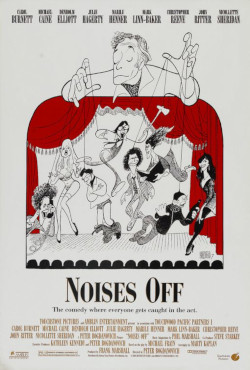
The structure of the story itself is just as crucial in developing this cumulative impact. The Three Act Structure begins with the frantic rehearsal hours before they are set to perform. The long-suffering director (Michael Caine,) who might be on the edge of a nervous breakdown, is running out of time and dealing with temperamental actors asking for motivations or just absent-mindedly showing up late to set. He’s also romancing his leading lady (Nicolette Sheridan). The issues are there for comedic effect, but we have yet to reach impact — that requires a theater full of people.

Next, we follow the show from behind the curtain. The preparations are frantic, actors are missing, and the backstage crew, Julie Haggerty and Mark Linn-Baker, run around like two stage chickens with their heads cut off. It doesn’t change when the performance begins either because the whole story is based on timing — cues and a bustling scenario with slamming doors and traded props. It’s everything we’ve already seen, albeit from the inside out, ignited by male feuds (John Ritter gives Christopher Reeve a bloody nose) and private lover’s quarrels filled with bitter malice.

The show from the cheap seats is the worst (or best) of all as this mounting discontentment disrupts the foregone storyline with all kinds of private barbs and acts of pettiness played out on the stage. The key is how the fictional audience eats it all up because each absurd miscue feels like the next great flashpoint of brilliant comedy. It’s the height of farce.

One of my few reference points is Hellzapoppin’ even as the earlier film was often about the endless possibilities of non sequiturs. What they have in common is this almost Vaudevillian sense of gags and payoffs — where each character has a shtick that can be called upon at any given moment. This isn’t method acting so objects don a different meaning as tokens to carry out gags, and Noises Off… brings them to a fever pitch. Sardines and telephones, flowers and bottles of bourbon. A pickaxe bandied about by all, each carrying varying attentions.

They effectively blend the space where two planes of existence bleed into one because these same tokens are exchanged and traded both on the stage and behind the stage. I joined the fictional audience in laughter even more heartily because, in many ways, we get to see the interworking of the beast in all its comedic underpinnings.

If we’re observant and stay with them, we see where the story has gone off the rails and the “unscripted” chaos that exerts itself on the storyline. The so-called “audience” snarks at each snafu because it’s a hilarious faux pas — the pratfalls are even better because they are “real.” And here you have the joy of Noises Off where it brings out these double-meanings or double realities and fictions.

We get the benefit of being both an audience member and a backstage observer. Because we know that all this world’s a stage and all these people merely players. Like Hamlet, it is only a play within a play, but it broaches into our space with startling verve and a raucous sense of precision.

I am reminded of the security guard; he sits in the wings watching all the madness quizzically with a raised eyebrow. What a crucial insert he proves to be because comedy is so much about the reactions to the stimuli. He reminds us how zany all this fracas is just in case we need a point of reference — a threshold to ground us back in reality.

Since they cannot help being in a cinematic space, the cast is tip-top including some faces I’m often quick to forget about and others who I miss dearly. John Ritter and Christopher Reeve are a joy even if this is hardly remembered compared to their greatest exploits. Carol Burnett is a comedic jewel. Bless her. Marilu Henner brings back all those fine memories of Taxi reruns. Denholm Elliot had such a long and illustrious career, but a doddering part such as this made me appreciate him even more.

The transition from stage to screen would not work as whole-heartedly without its cast, and I love them all in spite of their doltishness. In fact, it’s probably precisely because of this the movie works. Noises Off...would have been quite the sight to behold on stage, but it doesn’t lose all its merits in the hands of Bogdanovich, who makes it still a worthwhile and totally jocular experience. My primary barometer was my own personal reservoir of laughter. I couldn’t control it, and that speaks volumes enough for me.

3.5/5 Stars

My Favorite Year (1982): Dying is Easy, Comedy is Hard.

my favorite year

This is my entry in CMBA’s Fall Blogathon Laughter is The Best Medicine!

In the old days, if you wanted to see actors, you’d go to the stage. Hollywood was the place for movie stars. Lucille Fay LeSueur was given a new name (and a new birth date) only to become one of the most luminary stars of all time: Joan Crawford. Publicity columns were milked for all they were worth and scandals hushed up in equal measure. Archibald Leach donned the much more becoming pseudonym Cary Grant. In fact, he famously said, “Everyone wants to be Cary Grant. Even I want to be Cary Grant.”

Allan Swann (Peter O’Toole) is a creation born of the same dream factory. He is a larger-than-life figure with a fictitious biography and a stage name befitting a gargantuan figure such as himself. He’s entered the twilight years, fading away, and still living off the laurels of his illustrious career. It allows him to maintain mythical stature in the present.

However, he’s allowed himself to become a carousing idol, who’s let himself go. He used to be big. Or maybe it’s the pictures that got small. Because in 1954 everyone is watching TV.

Is this too much like Peter O’Toole already? Although he’s cast more in the image of Errol Flynn or maybe a John Barrymore. Lest anyone misconstrue something, Peter O’Toole was an actor first and a personality second, though he is admittedly an indelible one on par with some of his most prominent predecessors.

My Favorite Year is the kind of movie that plants its flag with nostalgia and if you don’t like it, it’s not going to win you over. For everyone else, there’s time enough to drift back into yesteryear for an hour and a half. It’s altogether contented with its sentimental sense of antiquity be it Buicks or Milton Berle. Because in 1982 and certainly now, there’s a romantic patina about the times. Far from realism, it is most importantly an affectionate send-up.

It imagines a story at the crossroads of the newfound TV generation and the swashbuckling serials of old. When television, as a medium, was still in its infancy and live — more like the theater and radio than film — and you had personalities that existed in people’s living rooms. Comedy Calvacade could be any of a number of shows that were popular at the time most obviously Sid Caesars’ Your Show of Shows.

This is a writer’s room at 30 Rock decades before Liz Lemon. Two of its resident denizens are Alice and Herb. She acts as his comic mouthpiece. Their target is always that eminent tower of jello, Cy Benson, who more than deserves their continual ribbing. Lowest on the staffing totem pole is Benjy Stone and, fittingly, he becomes our willing surrogate.

He’s living the dream in the middle of all the magic, picking up the lunchtime bear claws, and romancing the pretty production hand K.C. (Jessica Harper), who rebuffs all his grandiose come-ons. But he’s not one to give up easily. It’s at the heart of his character.

He wouldn’t be working here rubbing noses with the likes of resident prima donna King Kaiser (Joseph Bologna) or program stalwart Leo Silver (musical legend Adolph Green). You have to believe in the power of entertainment to be there on the ground floor of such an operation.

Thus, when the iconic screen icon Allan Swann agrees to guest on the latest episode of Comedy Calvacade, it seems like the perfect task for Benjy. The bet he has going with Sy makes it personal. He will act as attache — the notorious talent’s constant companion — making sure he makes it to rehearsals and telecasts in one piece.

Swann famously evokes another actor when he says, “Dying is easy, comedy is hard.” Regardless, this is a part made for O’Toole to fill up and make his own, bringing his Shakespearian bravado and genial wit to a world that otherwise feels twee and conventional. He positively bursts forth with all sorts of magnanimous energy.

The triumphant return of Swann is befitting his reputation. He takes his young guardian under his wing, as it were, returning to the old haunts like the Stork Club. It doesn’t matter that he once got thrown out of the place. He’s shameless enough to grab his old table and pick out the prettiest girl in the place. However, he still finds time for the public, graciously dancing with the lady (Gloria Stuart) enchanted by his romanticism.

It’s this kind of urbanity that sweeps Benjy off his feet as well, informing his own lackluster attempts to woo K.C. And yet over a humble dinner of Chinese takeout in the projection room, there is a chemistry in the air. Watching them watch O’Toole in what very easily could be a scene plucked out of Robin Hood, there’s a light in their eyes. We can sense the suspension of disbelief and the kind of awe movies could engender in a different, simpler time.

There are the travails of Brooklyn where Benjy takes America’s great hero to meet his unequivocally Jewish family (along with his Filipino step-father Rookie Carocca). It has all the trappings of an awkward evening and yet somehow it’s yet another showcase of people forming connections — of a man coming off the screen and being allowed to be among the hard-working people who love him.

That’s not to say there are no instances where we see the man’s faults laid bare. As a man always good for a quote he says, “You can depend on Allan Swann. He will always let you down.”

In the final act, it threatens to be true as the actor plays out his worse narrative. He is a man notorious for going AWOL at a moment’s notice. Still, while he’s not impervious to scandal or drunkenness, womanizing, or any number of shortcomings, there’s an inherent decency he carries about himself.

my favorite year

His greatest shortcoming is fear. He’s crippled by stage fright — being thrust into the arena of live television where his image cannot be monitored — even as he’s too fearful to speak to his estranged young daughter. Really, he’s a shell of a man. Could it be that the mills of Hollywood were lying all the time? For all these years, he was merely an imposter, done up to be extraordinary.

The live taping is best seen without comment. Just know Allan makes his triumphal entry onto the stage, and it’s a cathartic moment; he is allowed his audience and he lives up to their expectations in the most sincere ways. Many of us know the fictions of Hollywood. Benjy Stone is hardly oblivious to them, and yet for a sparkling minute, they are realized for anyone who was ever enraptured by the silver screen, not least among them Allan Swann.

The reason this was Benjy’s favorite year is obvious. He met his boyhood hero. Not only that but for a few fleeting moments the myth became real and the man was alive and in his life as not simply an idol but also a friend. He lept off the screen and he was real and charming and human, but moreover, he made us believe in the dreams of our childhood for the briefest of moments.

Watching him swoop down from the balcony — cutlass in hand — to vanquish the enemy, affords us the fairy tale ending and deservedly so. What a lovely performance it is for O’Toole, and he turns out in spades.

4/5 Stars

The Stunt Man (1980): The Show Must Go On!

the stunt man

From its initiation in the opening shots, The Stunt Man is built out of a comic serendipity allowing it to execute its own sense of narrative rhythm. It leans into coincidence, cinematic logic, and what really necessitates reality. Consequently, all these themes lay the bedrock for what the film is as it blithely blends genre into a fluid creature with a penchant toward action, drama, romance, and the darkest most absurd sense of humor.

For a little bit of backdrop, Richard Benjamin was slated to direct the film in the early 1970s. Before him, two very telling directors were considered. The first was Francois Truffaut who made Day for Night (1973), a film that shares many of the same thematic elements as The Stunt Man. They both enter a full-fledged dialogue with the medium of film itself and the creative process behind it. At one time, Arthur Penn was also tapped. This seems uncanny as he would later helm Night Moves (1975) another movie involving a subplot of stuntmen flying planes and the like.

All said and done, this production was labyrinthian even by Hollywood standards. Filmed in 1978, it was finally released in 1980 at the dawn of a new decade. But given the subject matter, it somehow feels like a fitting representation of the industry.

The Stunt Man, after all, is quite simple before it gets crazy. A fugitive (Steve Railsback) flees from the police utilizing his agility and Vietnam training to evade capture. Cameron breaks himself free from his handcuffs and then tries to blend into the beach scene at a nearby tourist trap in La Jolla. The ethereal theme music hums along, “Reality is your to define” and “What good are dreams in a world where nothing is at it seems.” The lyrics prove to be a portent.

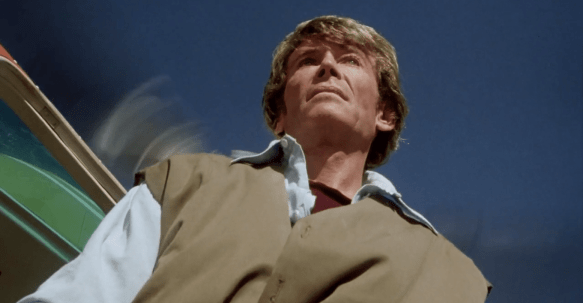
Because they also just happen to be filming a movie — a WWI period piece led by the incomparable Eli Cross (Peter O’Toole) — and it’s drawn quite the crowd. The use of blood capsules at once leaves the audience gasping with horror and then the next cheering with adulation. It’s the magic of the movies in bodily form.

Where a woman peels off her facade to become someone else — a stunning leading lady (Barbara Hershey) for the scraggly-haired young man to carry off to safety like a knight in shining armor. However, the masses aren’t privy to some of the drama behind the scenes. A stunt man was tragically killed trying to get a crucial shot.

So the fugitive becomes a convenient figure, and Eli quickly pulls him into his production in a calculated move of madness. With the local police breathing down his neck about his filming schedule, he covers up the setback, keeping the ship aloft by turning the wanted man into their perished stunt man. It serves them both, and so they agree to the ludicrous alliance.

Thus, The Stunt Man takes the themes of Truffaut’s Day for Night to preposterous ends by cultivating this illusion of a patched-together reality played out on screen. Spurred on by a maniacal director, it creates a whole plot out of a dead man who is replaced by a stand-in.

the stunt man peter o'toole heliocopter

As he fluctuates between his chopper or his levitating crane, Eli blithely proclaims, “If God could do the tricks that we can do, he’d be a happy man.” It’s true there’s something powerful and deceptive about him. If he’s not the devil’s incarnate in a helicopter, then he might have at least made a deal with the fallen angel. He is symbolic of the director as madman — someone who likes spontaneity — and he will go to great lengths to preserve his art.

To the degree possible, the picture goes through the paces of an action movie and there are stakes, just not what we normally expect. Because there are payoffs and yet we know in some self-reflexive way they are all an illusion, more so than usual. What’s not false is the threat of death.

If Truffaut was fascinated in the artifice — this sense of relishing the reflection to life itself — then The Stunt Man gives it a sick twist. Where fiction and reality are like death-defying bedfellows. We rarely know when scenes are going horribly awry or strictly according to plan.

There’s this razor-thin line between stunt and sleights of hand and then disaster. Hence the reason this fugitive got his gig in the first place. It’s utter lunacy, and yet it’s a bit like watching a car wreck. Who’s going to turn away? We want to be wowed. And yet Cameron’s life hangs in the balance. He feels trapped inside the madness and Eli’s not about to let him escape.

Initially, he is taken in out of necessity and eventually disillusioned by the monster, even as he is driven toward his fateful conclusion. It’s inevitable. In none too many words, the show must go on, and Cross will go to the greatest lengths to make darn sure that it does. The script calls for it.

The ultimate joke is how it slaloms so fluidly between the heights of chaotic drama to this kind of absurd humor, sinking back into an uneasy equilibrium once the darkest devolutions have boiled over. This is what’s the most unsettling.

How the movie can be feel-good and joyous with a stunt man and leading lady embracing in a triumphant moment of euphoria. Likewise, the irascible, gargantuan personality of the director still comes off as strangely charismatic (thanks to O’Toole), but it drips with the delusional insanity of something like Apocalypse Now. In other words, you cannot marvel at the movie without shuddering and laughing rather uneasily at what movie magic entails.

Because The Stunt Man is not just about the art of being a stand-in and doing the impossible. It functions as an extension of the moviemaking process in its most harrowing iterations. We have to be a little mad. First, to make something like this, and then to sit in the dark and let it affect us so forcibly. Regardless, it’s an evocative and deeply unnerving ride. But isn’t that what we go to the movies for?

3.5/5 Stars

Something Wild (1986): Happy is a Yuppie Word

SomethingWildPoster

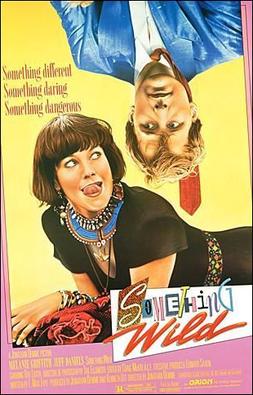
One of my favorite bands penned a song called “Happy is a Yuppie Word.” I never spent much time dwelling on the meaning of the statement, but as I grow older, it somehow takes on more pertinent meaning. If I remember correctly, Bob Dylan gave an interview with Rolling Stone magazine where he said essentially the same thing. In fact, I wouldn’t be at all surprised if the song took its cues from one of America’s foremost bards. I start here because Something Wild comes at us ready to bulldoze the Yuppie conventions we come to attribute with the 80s and 90s. That is Happiness as this quantifiable qualifier for the richness of one’s life.

Look at Charlie Driggs (Jeff Daniels). He’s the picture of middle-class success and respectability. He’s rising up in a formidable firm. He’s always reasonably dressed in a suit and tie. He has his pager on hand for important reminders. And yet there are inklings of chinks in his armor. After all, he is human.

He still wears his wedding ring, but his home life isn’t quite as idyllic as he would like the world to believe. Likewise, sitting at a perfectly conventional cafe, he has an urge to do something really, incredibly outrageous! He steps out without paying his check!

Except no one seems to notice…aside from one pair of perceptive eyes. They belong to the one person who will change his life forever. Meet Lulu (Melanie Brooks). Her look is unmistakable with a Luise Brooks-inspired bob and sunglasses — an air of self-assured confidence. She could rat him out. Instead, she offers to take him for a little ride.

From here on out Something Wild becomes a road comedy-screwball hurricane propelled by a giddy soundtrack and Lulu’s total rejection of Charlie’s middle-class monotony. They go careening down streets and racing down the highways and byways blasting The Troggs “Wild Thing.” What follows are scenarios replete with shenanigans, handcuffs, amorousness, and more unpaid checks.

And yet if Lulu comes off as a glitzy, laissez-faire call girl, she slowly begins to show more of herself, including her real name: Audrey. She proves herself to be far more three-dimensional and far more of an innocent human being. She takes Charlie to visit her mother where they masquerade as a married couple in front of mom. But there is no malintent. The charade is purely out of a desire to please the good-natured woman. Then, Audrey brings him to her high school reunion — celebrating the spirit of ’76 — complete with performances by The Feelies.

If anything, these series of scenes hint at where the film might be going as it slowly sheds its craziest inclinations. In fact, the film takes its major tonal shift with the introduction of Ray Liotta as Ray Sinclair — Audrey’s former love. But there’s more. Previously the movie was frisky with a dollop of lunacy. Now Something Wild stands poised to takes a bitter turn.

We suspect it from the moment Liotta enters. He’s handsome and charismatic, but there’s an instant menace to him — behind his eyes and his cajoling tone — the way he handles the part in a kind of underhanded way. Reference to his prison sentence gives a bit more heft to his reputation. But it really comes to a head when he robs a gas station.

Of course, Lulu and Charlie did much the same before. This isn’t to totally absolve them, but Ray’s brutal brand of reality plays in stark contrast to the carefree mad-dash infractions Daniels and Griffin were accustomed to before.

This is a stone-cold crime with consequences, and there’s no longer anything left to laugh at. Crime, all of the sudden, isn’t a lark; it’s something callous. And with its ugliness, all the leisure and fun is siphoned out of the picture. It’s given up its roots in pure, zany screwball to be something else — less warm and fluffy in conception.

Charlie gets shoved around, beaten up and bloodied, and Ray ultimately goes off with Audrey — to take her back as his own — threatening that he’d better stay away if he knows what’s good for him.

Even though my education in Demme is brief, my inclination is a desire for him to go toward the film’s initial tone. Because it’s the idiosyncratic touches that function best for me. They do not alienate my sensibilities. For instance, Charlie proves himself to be the most conspicuous trailer when it comes to the art of the tail.

He sets up on a street corner with a new wardrobe across from Ray and Audrey’s hotel room. For me, it’s scenes like these where Demme really shines; he has a sense of geography and how to use it to build a full-bodied world around our characters. He captures his hero in his car snoozing or peering out from behind a pair of binoculars.

But the church behind him, the store across the way, even the folks lounging at the pool make this feel like vibrant pieces of humanity albeit in a fairly relaxed town. He uses this same motif later when they finally have their fated confrontation at a genial family restaurant. The only reason Charlie gets enough gumption to actually face Ray and Audrey has to do with the reassurance that some local policemen are sitting at the table just across the way. These are the quotidian joys of the film at its very best.

However, this is a story that never quite rests on what is easy or comfortable. Because in itself this would be the antithesis of what it is looking to shoot down in the form of yuppie culture and all its signifiers. There must be another fanatical reverse in fortune. It’s genuinely terrifying. Far from spoiling it, I will leave you to it so that you might experience it for yourself.

Instead, my mind goes to this. For how merciless and scummy Liotta feels throughout the picture, Demme extends him the ultimate courtesy. The climactic moments are unnerving in a way. I hope I haven’t said too much already.

But in a single moment, Liotta is allowed to look into the camera his eyes full of surprise — a sign of weakness for the first time — and that one shot nearly single-handedly makes us feel sorry for him. It’s a hard sell, but we’re almost there: Having compassion on a seemingly irredeemable man.

The movie settles into a new normal. The moral, if we can call it that, seems obvious. To grab life by the horns — with warmth and spontaneity — within some framework of reason. Something Wild lives up to its name even tonally as it seesaws around. It wasn’t quite what I expected or what I might have wanted, but this could easily play in its favor for someone else.

Demme still shows himself to be a genuinely humane director. He likes people and with comic verve and music, he’s capable of whipping up something quite enjoyable. What is more, he shows himself willing to go somewhere else with characters.

I am slowly learning more and more about his oeuvre, but Something Wild suddenly makes a film like Silence of the Lambs feel less and less like an outlier. The jump is not too far to make, and we come to understand his movies even a little bit better. If you humanize a gangster, could it be the next step is to connect us with a serial killer? Wild Thing, indeed.

But I started out by talking about Bob Dylan, and it’s as good a place to end as any. Happy is a Yuppie word. It’s something fleeting — momentarily attainable — and then stripped away from us.

Dylan suggests a change in paradigm: between blessed and unblessed. Could it be that Charlie would agree? Because whatever assails Audrey and him, they are no longer dictated by the world’s measures of happiness. They can live by a new standard — a standard that is not dispositional or material. It’s based on us and whether or not we are prepared to search out the joys and blessings of life no matter the turmoil. That’s something wild. It can flip your world upside down.

3.5/5 Stars

Parenthood (1989): It’s a Mess and That’s Okay

Parenthood_(film)_posterThere’s something apropos about baseball having such a central spot in the storyline of Parenthood because this is a movie wrapped up in the American experience from a very particular era. Yes, the euphoric joys and manifold stressors of parenting are in some form universal, but Ron Howard’s ode to the art of childrearing is also wonderfully indicative of its time.
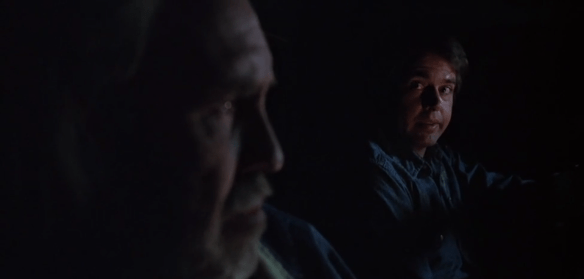
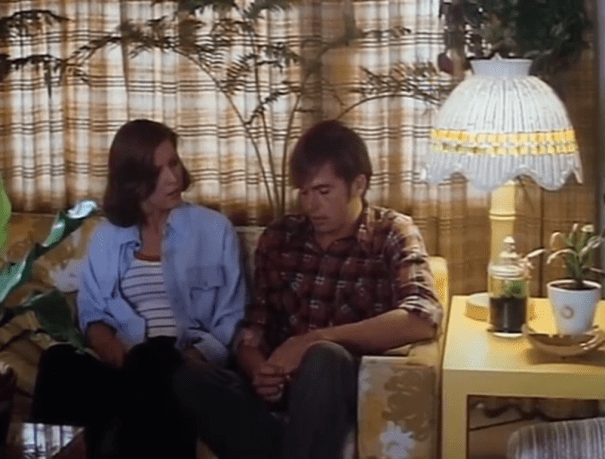
What is more relatable than wrangling the whole family to go to a ball game together?  Gil (Steve Martin) and Helen (Mary Steenburgen) Buckman corral their family together, gathering all the stuff, and making sure the little ones don’t get run over by oncoming traffic as Randy Newman drawls his theme song. Piling into the family van and loading up to head home is a process unto itself. In one way, it’s a treat and an ordeal all rolled into one. A lot like parenting.

In fact, with its subject matter considered, this is not your prototypical Ron Howard movie, and by that I mean it feels more overtly personal in nature. Certainly, Clint Howard gets his usual cameo, but the story speaks more about experiences — experiences of the worries and the joys that overtake you.

They become a focal point of this story as the adults try to navigate life together with three kids and a large extended family.  To a lesser degree, Little League baseball also becomes an integral part of life with Gil coaching his son Kevin’s team. It’s a different indicator of life as his boy is constantly made fearful of messing up.

He’s hardly the next Ozzie Smith or Ryne Sandberg. And when you’re a kid, the respect of your peers makes or breaks everything. You don’t want to be the one to let your team down. Could this all be part of the issues Kevin has according to his teachers?

However, as the roving ensemble is introduced with a patchwork of interrelated stories stitched together, you begin to appreciate the problems visible everywhere. This is imperative. They are part of what makes us human, and the full-bodied cast is what makes the relational dynamics sing.

Helen Buckman (Dianne Wiest) is a single mother just trying to get close to her kids with a distant son (Joaquin Phoenix) who won’t talk to her and a daughter (Martha Plimpton) who’s gone and got shacked up with a real airhead (Keanu Reeves). It’s like her life is crumbling all around her, and she must learn to hold it together, the best she knows how. This is her life.

Nathan Huffner (Rick Moranis) and his wife Susan (Harley Jane Kozak) are raising their daughter to be some sort of savant and her IQ runs circles around her cousins. She’s also simultaneously missing out on all the joys of being a kid. Her mother becomes overwhelmed by their strict parenting regimen, and it begins to leave a toll on their marriage. It’s so very easy to forget your priorities — how you ever fell in love in the first place.

Then, there’s the rather cantankerous Jason Robards. He’s fond of his youngest child Larry (Tom Hulce), the black sheep of the family because he’s lively and fun. Even dad is surprised when his boy returns home with a young son named Cool and a raging gambling problem; it’s got him in bad with some dangerous thugs.

Can you imagine the family dinners that these people have? There’s so much going on and yet they’re probably not all that far removed from our own family holidays. At least the spirit is there — something we can latch onto — and probably relate to.

However, it’s the party scenes allowing Steve Martin to showcase his comic chops as he takes on his cowboy persona to captivate all the kids and earn their appreciation while upholding his son’s reputation. It’s an emotional high in the bipolar ride you go through as a parent. Like any parents, they dream their little darlings will be valedictorians, and other times they fear that they might just as easily turn into a shooter. Often reality strikes a middle ground.

It’s far from flawless in its narrative, but that’s the point. It gets so bad Martin is going batty lashing out at his wife and everyone else. His son’s emotional anxieties have him worried. He’s stressed by a workplace that feels totally opportunistic and callous. Now, his wife’s supposed to have a baby and the news feels more like a burden than a gift.

If life doesn’t radically change, then perspectives certainly do. Robards and Martin have a surprisingly poignant conversation while sitting in the Little League dugout. Father talks to son about how there is no end zone in life. Your children and the people around you are there for good. And you’ll love them no matter what. It’s one significant moment of sentiment among many others.

In this way, Parenthood confidently modulates between drama and pathos, humor and romance, then circling back again. If little has changed from the beginning to end, then certainly their perspective evolves. It has something to do with embracing this beautiful chaos of life. Enjoying the ride as opposed to fearing every jolt of turbulence.  Sometimes the simplest wisdom can be the most profound if you let it.

Grandma says she’s always appreciated the rollercoaster to going round and round on a merry-go-round. Parenthood is the rollercoaster and that’s a compliment. It feels alive and idiosyncratic in a way one does not usually attribute to Ron Howard’s more recent work. It’s a refreshing take and probably a high point of his directorial career. I am not a parent myself, but I can only imagine how its observations would take on new resonance after becoming one.

3.5/5 Stars

Melvin and Howard (1980): A “Good” Samaritan and A Millionaire

Screenshot 2020-05-16 at 71643 AM

The opening sequence of Melvin and Howard takes on more and more meaning the longer the movie goes on. It’s very simple, really. We open up with some joyrider on his motorbike tearing through the desert, taking on every jump through the arid wasteland with reckless abandon.

As one might suspect, his foolhardy stunt bites him in the butt; he winds up in a spill, leaving him incapacitated in the middle of nowhere. It’s night and pitch dark now. Thankfully, there is a good samaritan who picks him up. As he gets closer and pulls the injured man into his car, we get a better look at him. He’s a scruffy-looking man well-advanced in years.

Here we have the inauspicious introduction of Melvin and Howard. Melvin (Paul Le Mat) is really a nobody, but he does have a sense of decency, picking up this old man without any pretense or sense of knowing who he is. Because Howard (Jason Robards), is Howard Hughes — the eccentric, aviating millionaire.

They talk and share something genuine between two people. Howard’s resistant at first. He doesn’t want to take part in Melvin’s friendly chatter nor does he go much for singing songs. Melvin nevertheless obliges with the tune he mailed into a music label for. They took his lyrics and supplied a tune. The outcome birthed a new Christmas classic, “Souped-Up Santa’s Sleigh.” Howard’s exterior cracks briefly as he relents and proceeds to hum a few bars of “Bye Bye Blackbird” in response.

The scene doesn’t look like much, but it plays extraordinarily well. Then, just like that, they part ways. At the request of Howard, Melvin drops him off out back of a hotel — the old man still hobbling and beat up. But he’s adamant this is where he wants to be, so Melvin relents.

We think this is just the beginning, and it is, yet we never see Hughes (or Robards) again (well, almost). But it’s this moment of initial connection and humanity that not only informs the rest of the story but sets the tone for Jonathan Demme’s free-flowing biography of a little guy.

If you want to think about it in such terms, it’s an off-center Howard Hughes biopic where the central character is a man named Melvin, who reflects a different cross-section of society. It’s the kind of story you wouldn’t think would get the Hollywood treatment and yet here it is, and the director gives it the kind of love and affection necessary to make it feel lived-in and sincere.

Here is a man who lives in a trailer. His wife Lynda (Mary Steenburgen) is a sweet woman and together they have a darling daughter who only sees the best in her folks even if their flaws are forever visible.

These are the flaws that keep the life of the Dummars in a constant state of disruption. Whether it’s money troubles, due to Melvin’s spendthrift philosophy, or Lynda’s working of the seedy nightclub circuit, there’s a great deal of dysfunction in their family life. But at their core is a near-oblivious simplicity and so even as their life is a bumpy ordeal, there’s something endearing them — making us wish the best for them.

He’s visibly repulsed by her work — he doesn’t want her flaunting herself in front of strangers. His home life is humble, but he gladly sits in front of the TV with his daughter feasting on pop tarts and bacon. Lynda never seems to dislike Melvin; she just knows it’s not possible to rely on him. So, over the course of the picture, they get divorced, then remarried, complete with one of those throw-em-together hotel wedding ceremonies for $39.

Screenshot 2020-05-16 at 64801 AM

If it’s not evident already, Melvin & Howard is a film that seems continually preoccupied with the desert backroads and small-towns of America. Where the country music is ubiquitous and people live simple, unadorned lives. Where Melvin’s chances to earn the mantle of milkman of the month get threatened or the car gets repossessed.

But there’s also an itinerant element — to pick up and go in search of new lives and new fortunes — and because the film chooses to stay with Melvin, the story itself takes on this antsy quality. Never being fully satisfied to dwell in one place. However, far from giving off a superficial impression, it winds up coloring a world with all sorts of genuine nooks and crannies.

It’s not a charmed life, but he meets it with continual candor. The reunited family gets by losing themselves in TV game show episodes of Easy Street, which become a kind of communal event for everyone. Lynda fulfills a dream by getting on the show as a contestant and feverishly tap-dancing her way through the Rolling Stones’ “Satisfaction” to the prize of $10,000!

Still, the family splinters again. Melvin picks up and moves to Utah after marrying a Mormon girl. They set up shop in a gas station. The so-called focal point of Melvin’s life feels squeezed into the end of this movie, not that it’s shoehorned into the story by any means, but it shows how his life adds up to something more than the media frenzy that soon overtakes him.

Because he was the man who had the unsubstantiated will of the late Howard Hughes dropped on his gas station desk naming him as 1/16 beneficiaries of Hughes’s fortunes. That added up to approximately $156 million! In the aftermath, he found himself brought into court to testify as his story was heavily disputed. It does sound absolutely ludicrous. 

How this seemingly unextraordinary individual could find himself at the center of something so grand and earth-shattering is a real-life farce. However, what lingers is the import of the first scene. Demme does well to return there if only briefly, to remind us what this frenzy was about.

Lest we feel slighted that this movie wasn’t really about Melvin and Howard at all (or at least mostly Melvin), in some way it says as much about Howard Hughes’ life by leaving out all the trumped-up treatment. It’s the romantic in me, but I would like to believe that even our momentary interactions with one another can be blessed.

It is possible to touch someone else, adding even a little bit of goodness into their lives. It’s this kind of goodwill to strangers that can stay with them for a lifetime, whether or not they include us in their wills or not. Who knows, you might be entertaining angels unawares, or misanthropic millionaires, for that matter.

4/5 Stars

Citizens Band (1977): Radio Waves in Everywhere America

Screenshot 2020-05-16 at 93028 PM

“How can such a small mind have such a big antenna?” – Paul Le Mat is Spider

Citizens Band (also known as Handle With Care) is not about music. Instead, it documents the increasing craze during the 1970s for person-to-person radio communication. Initially utilized for emergency messages, the radio waves soon got gummed up by social calls, with every Tom, Dick, and Harry looking to get a piece of the action.

It’s illustrated in the early sequences when Spider (Paul Le Mat) picks up a message from “Chrome Angel,” (Charles Napier) who gets pinned under his 18 wheeler in a rainstorm. It’s partially due to his own negligence on the road (He got distracted by some saucy call signs). Regardless, Spider is quick to search out help for him only to get disrupted by local nuisances like the self-proclaimed “Hustler,” a bratty kid who likes to brag about his exploits. He has a blatant disregard for FCC regulations.

It turns out our trucker isn’t much of a victim. In fact, we find out his broken arm is the least of his troubles because he’s run into the same problems as Edmond O’Brien in The Bigamist: he’s been holding court with two women. Well, three. Recently he’s been getting friendly with a local lady of the night named “Hot Coffee” who uses the radio waves to drum up business.

Screenshot 2020-05-16 at 93821 PM

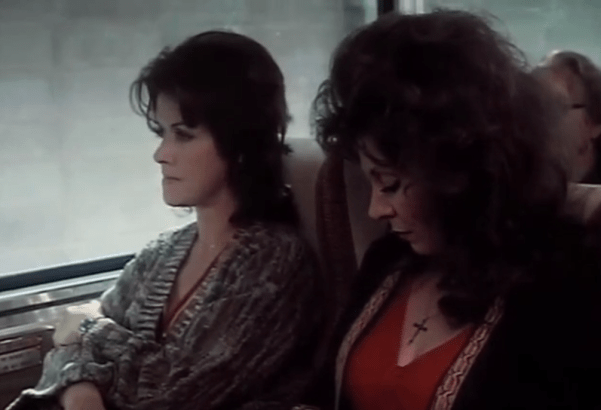
The only reason he gets found out is through a bizarre piece of comic happenstance. They meet on a bus. There’s the bodacious “Dallas Angel” (Ann Wedgeworth) and the more pragmatic “Portland Angel,” (Marcia Rodd), and after they get over crying about their misfortunes, they laugh, and conspire to make him pay. One bit of malevolence involves releasing his load of cattle out of his trailer hitch. There’s enough here for a raucous subplot.

Back at his home base, “Spider,” aka Blaine Lovejoy, holds down the fort as an emergency radio relay CB station with his buddy Cochise. Lovejoy lives with his father (Robert Blossoms) and struggles through his contentious relationship with his brother (Bruce McGill), the local P.E. teacher. It runs deeper. Both share a complicated relationship with the local crush Pam (Candy Clark).

Their Pops is a near-cataonic figure who is shocked back to life daily by the whizz of the radio waves and his call sign “Papa Thermodyne.” For a brief instant, he’s returned to his glory days trading words with some of his buddies. It pulls him out of his haze and the sorry existence he’s resigned himself to.

The inclusion of both Le Mat and Clark results in an unofficial American Graffiti reunion, though they hardly shared any scenes in the previous film. Even if it is set in a generation later, Citizens Band somehow maintains a similar affection for radios and automobiles. They often act as the conduits for youthful entertainment, love, and the various dalliances and diversions making life what it is each and every day.

A callow teen named “Warlock” chats up the seductive Electra over the car’s radio. Joe Cocker’s “You Are So Beautiful” briefly plays in another sequence. You also get the sense the radios allow people to live double lives, facilitating something more than what they’re usually allowed to be in the everyday.

Much of the movie’s sense of fun revolves around “Spider” laying down the letter of the law. He resorts to patrolling the neighborhood, honing in on signals before raiding the homes and putting the perpetrators out of comission indefinitely.

If it provides any indication, Citizen Band relies on a fairly lax and casual narrative with the breadth of the ensemble bringing to mind Robert Altman without the same comic barb. On its own, Jonathan Demme’s movie settles into an absurd rhythm somehow befitting backcountry, everywhere America.

“Spider” continues on his righteous crusade to rid the waves of needless vermin. His nemeses include a ragtag laundry list of whiny pipsqueaks, self-righteous bible thumpers, paranoid anti-communists, and old ladies droning on about dreary childhood stories.

Thanks to this untethered interest in all the various quirks of the community, which subsequently become some of the films most enthusiastic vignettes, it’s never quite able to pin down its more emotionally dramatic sequences.

Screenshot 2020-05-16 at 102916 PM

This involves the strained relationship between brothers or even Pam’s conflicted, on-and-off romance with Spider. Certainly, there’s more story here and there could have been greater motivation, to empathize and understand them on a personal level. This is generally absent or at least not fleshed out substantively.

But there is enough in the way of world-building, humor, and genuine characterizations by the lead performers to make it feel worthwhile, if not totally sketched out. And because the cast is protean in nature, it’s pleasant enough to follow their lead through the ebb and flow.

Finally, all the cast assembles for one sole purpose. They drive out to the outskirts of town, during another rainstorm, to perform a search and rescue mission to find a vanished Papa Thermodyne. Somehow it turns out an ending to fit the world we’ve come to experience thus far. Everyone gets their individual shoutout.

Citizens Band (or Handle with Care) is a slight film, but with the pieces it has in place and the extent of its subject matter, this is actually a worthy compliment. There’s a warmth and weirdness permeating its frames that, while engaging, also suggests the lingering specters of living in a small town. It’s both the joys and idiosyncrasies. The dark riffs of conflict, and the unifying humanity — all of us flying under the same colors.

Even at this early juncture in his career, Demme seems particularly well-attuned to this aspect of his ensemble. The best part is that he would continue down this same road with future efforts.

3.5/5 Stars

Jean-Paul Belmondo: Up To His Ears, Le Magnifique, The Professional

Because of his meteoric ascension in Breathless, patterning his insouciant hoodlum on the Hollywood image of Bogart, Jean-Paul Belmondo is easily identified with his predecessor. He was a tough guy — gladly so — and he offered up a long line of memorable performances over a stellar career.

Pierrot Le Fou (Godard) and Le Doulos (Melville) quickly spring to mind, but then you only have to look at something like Leon Morin, Priest, where he plays the eponymous clergyman, to recognize the range he was capable of.

In honor of his career, we wanted to highlight three of his later action films. They are not his most acclaimed pictures, but they are defined by his legacy so it seems fitting to acknowledge them.

Up To His Ears (1965)

Up to His Ears is cut out of the same cloth as Philippe de Broca’s prior film with Belmondo from the year before: That Man from Rio. It’s a globetrotting picture all across the orient with madcap chase sequences and quite a few attempts at Bond-like intrigue.

Overall, it bends more toward dated gags and goofy antics than out-and-out thrills, and it seems mostly content with this. When they flee an onslaught of Chinese gangsters, Belmondo and company sneak down into a pillbox, down to an underground tunnel, and on and on. There always seems to be a fortuitous out for them.

If their good fortune and the fact they aren’t completely annihilated seems farfetched, then you don’t understand the ambitions of the film. It’s all sendup. Belmondo seems to be enjoying himself, and his adventures lead to a desert island with Ursula Andress. He can’t believe his luck.

Obviously, the movie cannot quite muster the same glory as That Man from Rio, but Belmondo is still a great action hero able to play the crazy comedic moments and still move through space with vim and vigor. It ain’t Godard, and that’s not necessarily a bad thing.

3/5 Stars

Le Magnifique (1973)

Also known as Our Man in Acapulco, and its dashing hero, Bob Saint-Clar (Jean-Paul Belmondo) feels like an amalgamation of ’70s era Bond (Moore and Connery) with a lot of Get Smart thrown in for taste.

Philippe de Broca’s at the helm again offering up some of the most self-reflexive parodies of the hypermasculine, suave international spy genre. It pulls out all the comic book scenarios — with dastardly villains et al. — and the resolutions, seeing our hero always prevail. He must live to fight another day.

Broca himself readily contributed to this spy phenomenon during the ’60s with Belmondo to boot. However, it’s so over-the-top to the point of being offputting. Then, we realize our secret agent is being dreamed up by a hack writer, named Francois (also Belmondo) on a strict deadline!

Suddenly it breathes new life into the premise with a renewed perspective, and these long-trod pulp-bound conventions become only part of the gimmick and, hence, only part of its appeal. Not to be outdone, he’s taken the English sociology student (Jacqueline Bisset), who lives across the way and dreamt her into his story as the beautiful Tatiana. His supervillain is none other than his own pompous editor (Vittorio Caprioli).

We’ve followed his story umpteen times before. Although he writes pulp trash for a rapt audience of many, his active imagination all but compensates for a fairly nondescript private life. He’s got a bit of Walter Mitty in him. In the most fated of meet-cutes, Christine (Bisset) accidentally picks up one of his works and finds herself instantly inspired for her college thesis.

Soon she’s dropping by to blow through whole shelves of his novels. And then the idealized man dreamed up on the page, must take a stand in his own life. For what it is — plagued by many of the shortcomings of its genre and the era — I can’t help but appreciate Le Magnifique.

It mostly comes down to Belmondo’s dual role and his rapport with Bisset. Again, they’re having palpable fun taking it over the top, and like any great screen icon, Belmondo gets the girl — twice.

3.5/5 Stars

The Professional (1981)

It feels like your prototypical dated ’80s blockbuster replete with gratuitous violence, a rogue’s gallery of heavies with all the other corny ingredients mixed in together. Belmondo is an agent, undercover in an African country, prepared to assassinate their leader only to be drugged and sent to a labor camp.

He escapes and ultimately returns to France as a kind of rogue operative on the lam. His former superiors want to do away with him, but he’s always one step ahead. He’s not going to be eliminated that easily.

Although it’s not a Bond movie, there are pretty girls, and he seems to know them all intimately all while slinking around to preserve his own skin and complete his objective. Belmondo is undeniable, handling everything from fisticuffs, stunts, and seduction with his usual roguish charisma. He never takes himself too seriously. It’s as if he’s in on the joke of it all and enjoying himself in each individual moment.

The final car chase changes my whole verdict of the picture because it really does take my breath away. It’s yet another showcase for Belmondo the consummate action hero, effectively taking the film by the horns and really living and breathing the part.

While the score isn’t prototypical Ennio Morricone, it gained a new life and legacy in The Professional. He receives what might be termed the briefest of homages as the film’s main leitmotif comes to life between crosscut closeups of its hero and villain a la Leone. It’s like a mini showdown transposed to the world of French secret agents.

There is so much of Bourne here beyond the car chase, and it comes down to the inexplicable predicament of the protagonist. He is thrown into a world that is not right-side-up, and his only choice is holding fast to what he knows. He’s smart and cunning, making a real go of it.

But sometimes the world in all its order and pragmatism doesn’t make a shred of sense. At least, to the very last minute, Belmondo looks cool doing his job. In a movie like this, surely that’s all that matters. Adieu, Jean-Paul. Thank you for what you gave us.

3.5/5 Stars

Our Man in Havana (1959) and Vacuums in The Atomic Age

our man in havana alec guinness vacuum

Because of the renewed partnership of Grahame Greene and director Carol Reed, it’s difficult not to feel an inclination to compare Our Man in Havana with The Third Man from a decade prior. If you wanted to go out on a limb, you could make the case the earlier film beget this film, at least in a cultural sense.

A post-war world divvied up between Allied powers has evolved into a Cold War with a constant chafing between crumbling imperialist footholds, rising revolutionaries, and the tustling of Western and Soviet superpowers out to establish their doctrines.

Our Man in Havana does not make any bold claims about its purposes. In fact, the movie even begins with a small caveat. Fidel Castro has already taken over Cuba — he even visited the on-location shoot — but it’s made clear this story took place before the Revolution. It’s not that those were more stable times or even simpler, but they were on the cusp of one of Cuba’s most cataclysmic changes.

Because even months after filming was complete, Castro would make his fateful decision to side with the Soviets, therefore pitting himself against the Americans (and probably the British) setting up the confrontation over the Cuban Missile Crisis in 1962.

Again, Our Man in Havana makes no claims at this kind of scope. Nevertheless, it’s important when we consider the implications of a story as ludicrous as this one. First off, Alec Guinness is the quintessential British vacuum cleaner salesman in Havana, Cuba.

He feels hopelessly out of place in this world on the edge of great cultural change. Jim Wormold is no earth-shattering, transatlantic figure even as his best friend is a fellow transplant, Dr. Hasselbacher (Burl Ives). Our protagonist’s chipper teenage daughter Milly (Jo Morrow) calls him “invincibly ignorant” and hardly in a critical sense. He’s not offended by the words either. Noting he’s never been a good Catholic. However, there’s something striking about her words pulled directly from Greene’s story.

Maybe it has to do with this kind of naivete — his good-natured, child-like perspective on the world — because the comedy flows from a man like him being embroiled in the international espionage of the Cold War. After all, it was an event in itself that was played off as a conflict between a religious and an areligious society. What it showed more conclusively were our universals blindspots and the shortcomings on either side.

Our Man in Havana purposefully establishes its world with a raised-eyebrow lampooning of the snooty British secret service represented by such equitable British gentlemen as Noel Coward and Ralph Richardson. They take to their roles splendidly.

In their care, the lowly Wormold, who never had a thought of espionage in any form, has become a vital part of the British spy network. As a result, Guinness becomes part secret agent, part science fiction writer, as he dreams up fanciful bits of intel to feed his stodgy superiors.

He even provides schematics and some of his most ingenious drawings inspired by The Hoover. Coincidentally, this was a plot partially recycled in a Hogan’s Heroes episode. To be fair, vacuums being mistakenly passed off as a superweapon is a memorable trope.

our man in havana maureen o'hara

The crucial pieces begin with Wormold. To be clear he doesn’t have an ounce of malintent in his body.  He knows no other way to assuage these chaps, and he wants to make them happy so he obliges as best as he knows how. The joke is how everything becomes blown out of proportion. Soon he’s joined by his own personal secretary (the always lovely Maureen O’Hara) and a radio operator named Rudy.

At the same time, a local tyrant, Captain Segura (Ernie Kovacs feels slightly miscast in the part), has taken a particular interest in the vacuum salesman. First, because of some of his known associates and then because of his pretty daughter. He does his best to make her acquaintance.

As an outright thriller, it would be hopeless to expect Our Man in Havana to replicate the comparable successes of The Third Man, although this is probably the closest Carol Reed ever got. However, it also proves to be a forerunner or at least an early entry in the Bond-ignited spy film craze. Its comic sensibilities anchored by the always dry, forever congenial hapless wit of Alec Guinness are what make it stick.

One line delivered as dry as a Bond martini makes the claim that the new superweapon “Will make the H bomb conventional.” After all, who was ever afraid of something that suddenly loses all of its novelty? It becomes mundane. It’s lines like these that progressively make the farce feel all the more absurd, and with the passage of time, more incongruous and intriguing. Because as alluded to before, the Cold War was still very much in a state of flux in the Caribbean petri dish of Cuba. Soon it would be a battleground of the proxy wars for generations.

Likewise, Wormold’s fabrications are given credence by people in power such that white lies become established reality, incurring all these bizarre real-world consequences, sending him spinning in all directions. In one sequence he’s joined by Ms. Severn (O’Hara) as they look to reach out to one of his “contacts” — a local bellydancer. Guinness mucks it up as per usual only to bubblewrap his “agent” so they can take her out the back window and help her escape the authorities.

Then, you have such disparate situational hijinks as vacuum-cleaning conventions bookended by sudden murder. It reaches such a dizzying inflection point, there is no recourse but to fess up. Wormold is prepared for the consequences. The final joke comes in the utter lunacy of the conclusion. Powers that be would never dare admit how horribly they’ve botched the situation. That would never do!

In the end, since the flavor of Vienna and Cuba have their own particular sense of milieu and culture, I rarely found myself reverting back to The Third Man. There was one moment of commonality, however, right near the end of the movie. Once more it’s a funeral sequence. It’s a different sort of funeral where the factions, cross-sections, and localities are tangled and aligned in such a curious way.

And Guinness gets a postscript of sorts, returning to the British Isles wary of what he will return home to. His ever-vivacious daughter points out the window asking about the formidable castle down below; he notes the Tower of London and slumps down in his chair — a reminder of coming attractions. That’s where the crown stashes its most incorrigible traitors.

What makes The Spy Who Came In From The Cold such a standout Cold War film is how utterly merciless it is in its conclusions. There is no other way to look at it. Our Man from Havana vies for the completely opposite approach with an equally telling result.

We leave our hero in the cheeriest of outcomes only to question the state of the world and the structures around him. Really, they’re one and the same — leading the audience to question — whether through unsentimental drama or out-and-out farce, how are we supposed to make sense of the atomic age? It’s utterly nonsensical.

4/5 Stars