Ali: Fear Eats the Soul (1974)

alifear4Werner Rainer Fassbinder is one of those artists known for his tumultuous personal and political life, and yet with all the dialogue swirling around his backstory and untimely death, there is no doubt that he sent a charge through the film community that is still being acknowledged today. The New German Cinema of the 1970s breathed new life into an industry and created a massive impact. Part of the fact is that Fassbinder’s work hearkens back to his forefathers while constructing a space within the medium that was all his own. That’s what the great filmmakers do. They take what has already been done, grab hold of some inspiration, and run with it into some new uncharted territory.

In the case of Ali: Fear Eats the Soul, he takes the work of 1950s melodrama master Douglas Sirk and transposes it to his contemporary Germany. His particular inspiration is All That Heaven Allows, which revolves around the shocking romance between a respectable woman and her younger suitor. That in itself makes for a juicy piece of drama, but Fassbinder expands on that by adding a racial component. Always fascinated by topics of race, Fassbinder looks at an elderly German lady (Brigitte Mire), who begins to form a bond with a much younger Moroccan laborer named Ali (El Hedi ben Salem).

alifear3What begins as a small gesture, soon enough actually develops into something more, because once they sit down to coffee, they realize they actually appreciate each other’s company. Although I don’t understand German, the subtitles make it clear that Ali’s German is rather rudimentary, and yet that matters little to Emmi. She just enjoys having someone to talk to.

Emmi works as a maid and her husband is deceased and her children are grown up. She’s lonely. Ali has a group of friends from his homeland, but he feels like he’s treated less than human in Germany. Emmi’s different than your average German, but then again, her first husband was a Pole during the Nazi regime, so she’s no stranger to going against the grain. To her, it’s not a big deal. It’s just gets blown up by family and the tenants around her. Her nosy neighbors are quick to gossip and they all have a heavy case of discrimination. In fact, the unlikely couple is surrounded by narrow-minds sitting atop old bodies. A prime example is the local grocer, who ignores Ali, before changing his tune since he wants Emmi’s business.  But even Emmi’s children are not pleased. You can understand being surprised and a bit dismayed, but once a television set is kicked in, there’s automatically more to it. It’s not simply anger in it being such a rash decision, but the fact that Ali is a foreigner (and much younger). And yet all these separate issues are so closely intertwined it becomes an interesting situation. More often than not it’s the pervading bigotry that is the most noticeable.

alifear5Although the issue of age plays a role too, because at times Emmi looks out of place with Ali’s friends, and the same goes for Ali among her friends. It even leads him to a one night stand with the sultry bar owner (Barbara Valentin).  But Emmi is a very forgiving soul and in her, Ali finds grace. I’m not sure if I concur with all the conclusions that Fassbinder draws, but I can respect his stands on race. In fact, when Ali alludes to the catastrophe in Munich during the Olympics in ’72, such a current events make this prejudice toward Arabs all too real. It was a real pertinent issue and it still is to this day.

As for Fassbinder, he certainly knows how to work around his sets. The composition of his scenes is simple, but vibrant in mise-en-scene. He certainly has a touch of Sirk, being a little less luxurious, but still as bright. The closest modern example I think of is Wes Anderson as far as utilizing interesting color schemes and symmetry to frame shots. Also, there are quite a few times where Fassbinder maintains a shot for seconds on end. In such moments, it feels like we’re looking at a painting in a Fassbinder gallery. And it is exactly that. Art with an emotional depth from one of the foremost German masters.

4.5/5 Stars

Captain America: Civil War (2016)

Captain_America_Civil_War_posterIn spite of being a jaded viewer at this point, the Russo Brothers (Arrested Development and Community) and the screenwriting duo of Christopher Markus and Stephen McFeely (The Narnia Franchise) proved still capable when it comes to keeping the Marvel Franchise afloat and, nay, helping it to flourish like few franchises ever have.  The pair of directing and writing duos who brought us Captain America: Winter Solider were able to add another link in the armor, and Marvel has remained stalwart. There are moments of misguided drama, times when the fight sequences become monotonous rather than momentous, but Marvel always does well to keep their funny bone intact.
As with any superhero movie Civil War calls for a suspension of disbelief, but it also becomes a balancing act, because for any movie to truly resonate with a mass audience its characters must feel human in some way shape or form. Where their powers and superhuman abilities must be on display for all those awaiting a popcorn thriller, but still restrained enough to keep them relatable.

In this case, Captain America (Chris Evans) is swayed by the love of a friend he’s known for over 70 years. Bucky Barnes is once more in the middle of a manhunt, and yet Cap has faith in his old friend. But it’s exactly that kind of loyalty that lands him on the wrong side of the law. Meanwhile, our other force of nature Tony Stark (Robert Downey Jr.) rehashes the tragic death of his parents and tough times with Pepper Potts leave him conflicted. He’s ready to concede to the United Nation’s demands to put the Avengers in check and that’s where he breaks with his former ally. When the two undisputed leaders of the Avengers become polarized that forms the dividing line between factions and the whole film becomes fascinating as the sides are slowly drawn up. As an audience, we are forced to make a choice. It’s either the true blue Steve Rogers or the wonderfully snarky Tony Stark or perhaps we watch as an impartial observer. But, nevertheless, a mental decision must be made.

And it’s not only a balancing act of super versus human qualities, but the sheer size and scope of the cast could easily be a hindrance. Equality of screen time or at least moments in the spotlight for everyone are key, and the film generally does that capably enough. Marvel revels in the callbacks and Civil War is no different. In this installment alone we have the pleasure of seeing numerous returning players sans Hulk. In fact, the most entertaining fight sequence involves everyone duking it out, and the fact that it feels almost like play fighting rather than full-fledged combat is of little consequence.

But the new additions are also noteworthy including the likes of  Black Panther (Chadwick Boseman) and yet another Spiderman. Credit due to Tom Holland for in some ways making Peter Parker into an invariably entertaining persona, who feels different than his predecessors. There are a few others in smaller roles of note including the likes of William Hurt, Martin Freeman, and even Jim Rash.

By this point, we have long grown tired of villains rising up from outer space harnessing some unfathomable amount of power. The antagonists that are truly compelling are those who are closer to home, more realistic, and sometimes even within our own ranks. Built into this film’s title is that type of conflict, between former friends, between people who used to be close or would be on the same side given any other circumstances. But Civil War ups the ante not by getting bigger and grander necessarily. It’s the fact that it gets more personal that makes it work surprisingly well.

Daniel Bruhl is a delightful actor, and he does well to play what some might call a villain and others might simply label a pained, vengeful man. That’s oftentimes far more interesting.

It’s overstuffed with players, many who are admittedly wonderful acting talents. Its editing and cinematography is at times overly frenetic and mind-numbing. While Civil War is the expected superhero extravaganza, there are dour, more mature interludes that are difficult not to appreciate. If Marvel has not completely kept me enraptured, due to so many subsequent films, they still have me coming back and if I’m any indication, there will be many far more ardent fans than me who will truly enjoy what this film has to offer.

4/5 Stars

The Exterminating Angel (1962)

exterminating1In a sense, I’m scared to be confronted with Bunuel’s films more often than not, because even to this day they are surprisingly subversive. But with The Exterminating Angel, there is a different sort of apprehension to be faced altogether. It is a fascinating film because it shows the descent of humanistic man into the depths of his primordial nature. However, it builds off the cruelest and most interesting practical joke ever conceived. It’s played on a group of people within the confines of the frame and the audience watching in equal measures.

Of all places, it starts at a dinner party where good etiquette, manners, the upper class, and culture all collide. Luis Bunuel seems to have a preoccupation in placing his subjects around a table because really there is nothing more human than sharing a meal together. Although, he finds ways to make it interesting and in this case wickedly absurd. The table becomes an arena for gossip, loaded barbs, harbored feelings, and ruffled feathers.

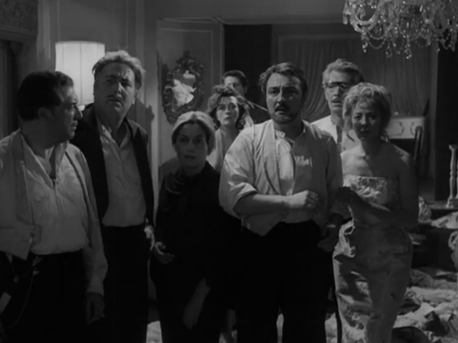
It’s quick to enter an almost surreal state as all the guests are unable to leave the confines of the room. We take things for granted so easily, but in their world leaving the room is not a given, even if it seems so straightforward to us. Some force is keeping them where they are, although we never see it or hear any mention of it. Our only inference is that there is some outside force holding them there. They are literally haunted by specters with a shroud hanging over them — an Angel of Death if you will.

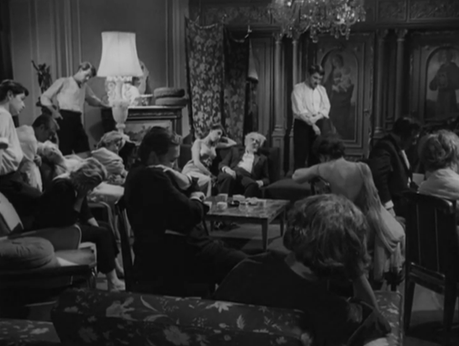
exterminating2This prolonged period of isolation lends itself to the degradation of all pretenses. The animalistic tendencies replace all shreds of decency. All the dirty little secrets that lurk under the surface then begin to rear their ugly heads. Honestly, it’s hard to keep them at bay in such close proximity, for prolonged periods of time, because people see the real you. It becomes hard to hold your tongue, to keep those biting words from slipping out, especially when fatigue and hunger sets in. As many of the men and women begin to falter, the good doctor represents all things rational and seemingly honorable. But when he is cast aside it reflects an end of human dignity. These individuals who were once so high, have fallen such great heights. Lambs get taken to slaughter and pipes are busted just for even the smallest taste of water.

It strikes me that this film is literally a picture of hell. No, it’s not the fire and brimstone picture we are accustomed to, but instead, it is a hell created by the individuals themselves, feeding off their own evil and pride, and accentuated by their prolonged purposelessness. Just think, it takes a woman named Leticia (Silvia Pinal), to break all her companions out of this cycle they have become stuck in. She realizes the utterly pointless loop they are caught in and breaks them out of it with a few powerful pieces of induction. Also, could there be some symbolism in her nickname “Valkyrie” (The chooser of the living and the slain)? I think so.

exterminating3They leave the room just as easily as they entered it. It happens so unremarkably in fact that some might feel duped, and I would not blame them. Why did we watch this group of socialites remain in a room for an hour and a half if they could have gotten out this easily? But if you ask this question you miss out on the whole mind-bending aspect of Bunuel’s main conceit. We cannot fully understand; we can only marvel at the fact that something that we take for granted like leaving a room, doesn’t work so simply. Do I understand it, certainly not, but it makes for an amazingly powerful and frightening study of human nature. This is also a film that does not let off. In fact, although we finish one cycle, it looks like another one is about to begin with a few clergy trapped for another inexplicable reason in their cathedral with many parishioners. Outside a riot forms as another herd of lambs makes its way to the chapel. It’s as depressing as it is funny in some unnerving sort of way. Not only has Bunuel played a joke on his characters, but his audience as well. This time I didn’t mind all that much.

4.5/5 Stars

Journey to Italy (1954)

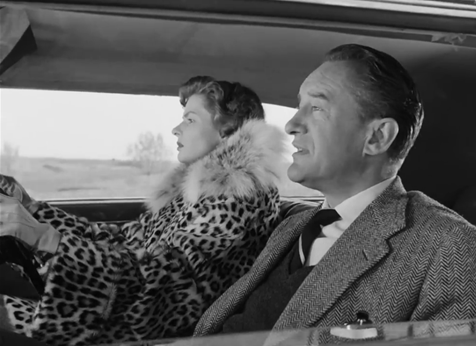
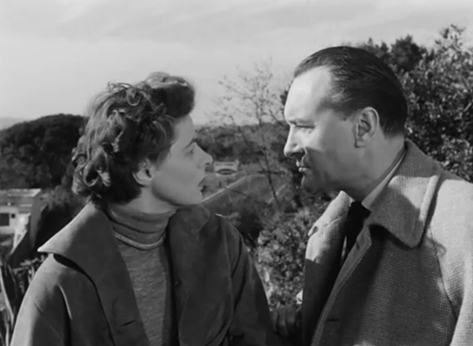
journeytoitaly1Journey to Italy is the splintering of a relationship where the slivers of bitterness begin to wedge themselves under the skin. It’s like slow, painful, nagging torture. Roberto Rossellini’s noted romance film feels like the antithesis of Roman Holiday. It avoids the other film’s bustling streets for more secluded getaways. It leaves behind fairytale romance and fun, for the bitter onset of marriage and middle-age. It seems hardly exciting, mostly driving and sitting, drinking and eating. Rather droll to say the least. And yet this in itself is juxtaposed with lively impassioned tunes and historic pieces of architecture and sculpture snuggled up against the Italian countryside. Because it is a goldmine of culture whether you look at Pompey or the remnants of the Greeks and Romans. There is a glorious history here and yet it makes for a rather meandering backdrop for our two stars Ingrid Bergman and George Sanders. Again, Bergman especially was a big name (and at the time Rosselini’s lover) and though usually a supporting player Sanders was usually held in high regard. They feel like the exact inverses of Gregory Peck and Audrey Hepburn, in a way that’s rather intriguing.

journeytoitaly2Yet again, as an audience, we do feel like tourists taking in the sights, but this time we’re riding along with a couple who don’t know what to do when they’re alone together. They don’t know what one is to say or how one is to act, because, in all honesty, they haven’t tried too hard. We don’t get much of their backstory, but they are certainly well-off because he takes his work seriously and it shows. But he hasn’t taken his marriage all that seriously and that shows too. His wife is more like his partner in this business endeavor they have going. She keeps up appearances, and he can offer her a lot in return, but hardly love.

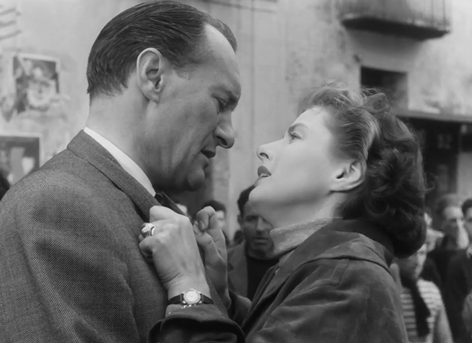
It struck me that is a film about a faltering relationship and here is a couple that seems to be apart as much as they are together.They think that the best thing they can do is stay away from each other because no damage can be done that way. There’s jealousy, pettiness, biting sarcasm, all ready and waiting to be unleashed. Alex fosters a liking for a young Italian girl, and although Katherine doesn’t know all the details, she suspects as much from him. To combat Sander’s snide tone that can cut to the quick, Bergman counters with a thick layer of sulking.

journeytoitaly3Thus, I’m not sure about the denouement of this film. Will they stay together or get the divorce that they both seem to have come to terms with? It seems like they might possibly make things work, or is that just the work of the romantic Italian countryside around them? Because no passionate embrace can alleviate and completely overshadow their myriad of problems. They are unable to communicate on a meaningful level, and they treat each other rather poorly more often than not.

In fact, this film is an interesting study, but there is a lack of investment in these characters. After all, it’s only a quick snapshot that gives us a feel for a relationship. I’m probably partial to the similar feeling Before Midnight (2013) because we are already given two films beforehand to truly grow invested in the characters and their story. But there’s no doubt that Rosselini’s film with Bergman and Sanders is well worth the journey.

4/5 Stars

The Silence (1963)

thesilence4Mention of God and spirituality, faith and healing, feel completely unrelated to a film that’s seemingly devoid of all of those things. And yet if we place this Ingmar Bergman film alongside his two previous efforts Through a Glass Darkly and Winter Light, The Silence has just as much to say about such topics. The irony of this film is that it says a lot by saying the inverse–nothing. As the title implies, the two sisters who are the focal point of this film speak nothing of God or any kind of faith. God too is silent. No miraculous sign takes place to salvage this storyline. It is what it is, and yet Bergman again works so powerfully once more– even if it’s not quite his intention.

Ester (Ingrid Thulin) is the practical, rational sister, who is also very sick. In fact, it is her health that interrupts their vacation so that they wind up in a hotel in a foreign land. Anna (Gunnel Lindblom) is her sister, the sensuous one who is not afraid to flaunt her body. There’s also a boy, the 10-year-old Johan, who is along for this adventure as well. At first, I assumed that Ester was his mother, but it turns out he’s Anna’s son. It makes for another interesting dynamic because although she can be very touchy-feely with her boy to the point it almost feels uncomfortable, she does not show him a lot of affection. More often she’s aloof or tells him to go off and play somewhere alone.

thesilence1Things are even worse with Ester because for some reason we don’t really know, they have a strained relationship. You get the sense that they both disapprove of each other for different reasons. Ester’s too restrained. Anna’s too provocative. Their vices come in different forms as well. As Johan entertains himself throughout the hotel, shooting his pop gun, meeting some little people and a friendly old porter, his mother and aunt try and medicate themselves.

Ester combats her illness and bedridden state with cigarettes and alcohol, which probably only help in numbing her senses and blackening her lungs. Anna puts on her most tantalizing outfit and goes out on the town, ready for some quick and easy sex to gratify herself. Again, both sisters dwell on completely different ends of the spectrum, but they really seem to end up in the same place. There is no space or need for a God or spirituality in their lives because they’ve filled the void with other things.

thesilence2Meanwhile, Johan seems like a normal little boy, who is looking for affection and yet he doesn’t seem to get it, at least not typically. His mother and aunt might truly desire to connect with him at least sometimes, but more often than not it feels like he’s just left to fall through the cracks. He’s easily forgotten.

The sisters part ways after a confrontation where Ester comes in on Anna with her lover. They lay it all out with brutal honesty and the next morning Anna takes Johan with her on the train. Ester cannot bear to be left this way, and as spasms begin to overtake her, she acknowledges a great many of her fears. She’s not ready for death. Anna rides off with little interest in her sister and no doubt, little interest in thoughts of death.

When The Silence came out, it was, no doubt, risque for its frank depiction of sexuality and yet the way Bergman looks at such a  topic, suggests that it is not a superficial perspective. What any type of behavior does, really, is to provide a fuller, broader picture of the human who acts it out. Anna and Ester undoubtedly have their insecurities, fears, and desires. We see them acting out on those desires often, and we see their insecurities come out when they fight with each other. It’s yet another fascinating dissection of life, although it looks vastly different than its two predecessors. Bergman’s Persona a few years down the line also seemingly builds on the study of this film, even utilizing a similar dynamic. That’s not to say that The Silence is not worth a look in its own right. It takes on the subject of “faith,” ironically enough, by showing a complete absence of it.

4/5 Stars

Winter Light (1963)

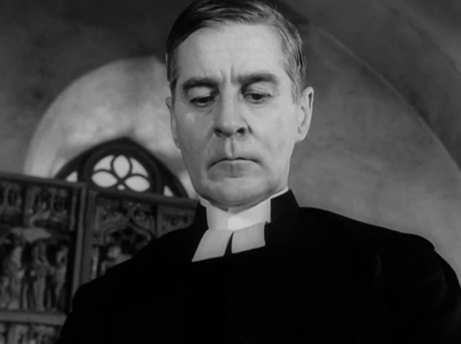
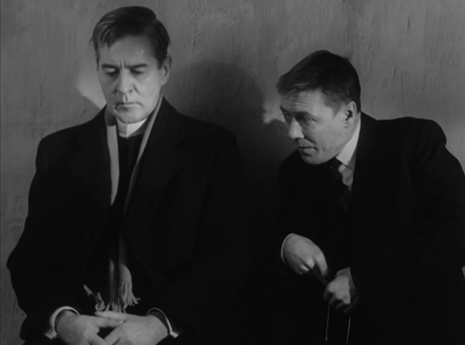
winterlight1In the second leg of Ingmar Bergman’s Faith Trilogy, he gets right to the core of all matters of faith. He takes an up close and personal look at a man of the cloth named Tomas (Gunnar Bjorstrand), who shepherds a small congregation in a rural Swedish town. Such is the life of a clergyman, as with any life, where there are rough patches and emotional highs that rejuvenate you, but mostly rough patches. In fact, he is going through such a spell when the film begins. We survey his humble little chapel, and there are only a few scattered members of the community present. Half seem disinterested and Tomas himself speaks words of spiritual truth and yet it seems like he is only going through the motions. Does he actually believe these benedictions and words that he is proclaiming? I’m not sure he even knows for sure.

He’s been withstanding a winter period of his life personified by the icy weather engulfing his humble city on a hill. It reflects his own heart and mind which are going through a season of extraordinary indifference. On top of that, he’s fighting a bad case of the flu, and he is discontent in God’s silence. Where is God? Why is He not more present in his life?  Why does he not more clearly reveal himself? Is there any power left in prayer? They are honest questions from a man struggling with faith, and it’s the epitome of an existential crisis. Bergman seems to be churning up all the thoughts creeping up in his own mind, and it’s very human — extremely honest.

Tomas has little in the realm of advice or comfort to offer his parishioners. For instance, when the depressed fishermen Jonas (Max Von Sydow) comes to the pastor after contemplating suicide, given the state of the world in the nuclear age, Tomas has little to say, because in order to encourage others you have to be encouraged. There’s nothing that can be done if the well you’re running on goes dry. You cannot sustain yourself that way. About all he is able to offer are a few downward glances because there’s no conviction left in him.

winterlight2On a personal note, Tomas lost his beloved wife and now he deflects the affections of local teacher Marta, who herself does not believe in God, but still, she loves Tomas dearly. In a deeply heartfelt letter, she confesses her true feelings for him, and he responds with very little acknowledgment. He cannot bear the townsfolk talking about them, and he still misses his wife dearly. It doesn’t help when he gets tragic news about Jonas.

Winter Light never reaches a clear conclusion, because life is hardly ever like that. In fact, there is an underlying irony that becomes apparent in this story. After Tomas lashes out against Marta and tells her to let him be, it becomes all too clear that Marta, though she does not believe in God, is in a sense, living a better life. They are both lost in the throes of winter still, but she at least has the capacity for love and vulnerability. Tomas’s apathy seems to be a far greater plight since he feels trapped in a labyrinth of idiotic trivialities, as he puts it.

winterlight4The sexton Algot brings up an interesting point about the suffering of Christ. His physical suffering must have been immense, but how much greater must he have suffered when everyone deserted him. The disciples didn’t understand a thing he said, Peter denied him, everyone else deserted him, and he was even forsaken by God. It suggests the importance of our interactions with one another. In the days of our lives, it becomes so easy to continue constantly in the endless cycle of life. Never getting outside of it and relating to our fellow man. Falling into apathy and indifference, which is especially easy when tough times hit.

Bergman does it again, delivering a film full of philosophical depth and questions that force the viewer to ruminate over their own condition, whatever their background or beliefs might be. Sven Nykvist’s photography is beautifully austere once more, and it adds a certain visual depth to the director’s trilogy. It’s stark, pure, and piercing with gorgeous shades of black and white.

4.5/5 Stars

Strike (1925)

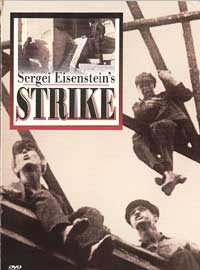
Strike_(film)Strike deserves a place alongside Battleship Potemkin and Man with a Movie Camera in a trifecta of films from the Soviet Union that while reflecting political agendas most certainly influenced film as a medium. Honestly, it’s a film that’s hard to pin down exactly. It’s the debut of a man named Sergei Eisenstein, who at this point had very little experience, although he would gain renown in later years. It’s a film to glorify the state that commissioned it by depicting events before the state was ever founded. Is this a comedy, solely propaganda, or a social drama?

It’s a film commenced with a quote by Lenin and broken into sections like, Reason to strike, The strike draws out, and Extermination. And yet words or plot summary is not enough, especially with a filmmaker like Eisenstein. How do you describe the impact of a man hanging himself? How do you explain the hordes of people fleeing the police? Wives and children suffering without food and provision, because the men of the house are striking. It’s a mass protest certainly, but when you break it down to the individuals, that’s where you begin to see the real pain.

Maybe I’m forgetting something, but I’d almost rather watch Strike than Eisenstein’s undisputed masterpiece Battleship Potemkin. In some ways, I found this strike and uprising more exciting and vibrant. In itself, the Odessa Steps is an amazing sequence and literally textbook stuff, but this film feels more fun thanks to a lighter initial tone. The common men are throwing the baddies out of town. There are spies with the greatest code names, pocket watch cameras, and antagonists who are great big caricatures.

Instead of feet on steps, it’s hands with fire hoses that become the focal point of the retribution. By the end, it feels like we’ve been manipulated by a wicked sense of humor. We have slowly been descending deeper and deeper into chaos. People running. A cow getting slaughtered. Carnage. Eisenstein effectively plays with the emotions and it’s not without impact. Although the last chapter is somber, Strike feels very accessible for a silent film. There’s a lot to be seen here and like Man with a Movie Camera or Battleship Potemkin, it’s much more than propaganda. I’m not communist and the ways of Lenin and Stalin have generally gone out of fashion as far as I know. However, the work of Eisenstein has remained pertinent, and his inventiveness and investment in the film-making craft are immense. At a basic level, he knows how to elicit emotions persuasively and that is a powerful aspect of film.

4/5 Stars

Broken Blossoms (1919)

brokenblossomsBroken Blossoms or The Yellow Man and the Girl. How do you deal with such a film coming from modern sensibilities of race and romance? It actually turned out to be easier than you would think, but not altogether straightforward. D.W. Griffith is no stranger to racial controversy in his films. because his archetypal Birth of Nation (1915) is known as much for its influence as it is for its depictions of African-Americans and the KKK.

For Broken Blossoms, he places the microscope on Asians and in this case a “Yellow Man” or “Chink” named Cheng. It’s not necessarily a good start, but it’s important to realize the lens and the times this film comes out of. Those terms are offensive and seemingly insensitive to us, but back in the teens, those terms were commonplace. Thus, if we put that aside for a second, it becomes important to look at actual depictions and objectives.

Cheng (Richard Barthelmess), who was indeed portrayed by a white actor, is characterized as a peaceful and kind individual looking to live in harmony with his fellow man. Bruising boxer and abusive father, Battling Burrows, is our obvious antagonist and the complete opposite of Cheng. It’s not simply a clash of race, but of temperaments, and kindness versus hate. The First Lady of Cinema Lillian Gish plays Burrow’s long-suffering daughter Lucy to perfection. I cannot remember the last time I had so much pity for a single character because with every close-up or piece of body language, Gish seems to suggest her horrible plight. She is so sweetly demure and yet so much tragedy is placed in her path.  As an audience, we cannot help but have compassion for her like Cheng. Her father constantly expects her to perform housekeeping duties and beats her whenever he pleases. In a sense, Cheng is her savior, but Burrows isn’t too happy about that.  The idea that there could be any type of love between his daughter and this “Chink” is out of the question.

brokenblossoms1I suppose in a sense this is a love story and we want both these characters to be happy. One inter-title says of Cheng: “The beauty that all Limehouse missed smote him in the heart.” It’s a beautiful line and suggests the wonderful connection that these two seem to have. Although the dream loses a little of its charm when Gish’s character calls her suitor “Chinky.” It was in this moment where I stopped feeling sorry for simply Gish, but also her character. She seems like a girl like Mayella from To Kill a Mockingbird, who is bred with racism and yet she becomes so lonely in the process. All the abuse leaves her empty and searching for something. In that case, her only outlet was wrongly-accused mockingbird, Tom Robinson. In this case, it’s Cheng, the only person who seems to see Lucy Burrows differently.

I cannot speak for others but I can forgive Broken Blossoms for some of it’s more unfortunate moments and I’m sure Birth of a Nation would require a lot more dialogue. There are certainly numerous outdated, rudimentary views here from Southern-bred director D.W. Griffith. But I think if we look at the bigger picture, this is a film that attempts to point out evil and bring to light a little beauty even if it comes from an Asian and a defenseless young girl. I not sure what to make of it. Can we call it a clear-cut interracial love story? Maybe, but perhaps that’s not the biggest issue. This is a film that tries to move its audiences by evoking emotion and deriving pity for its protagonists. It’s a far more intimate portrait than Griffith had done before. On that level, Broken Blossom succeeds.

4/5 Stars

The Conformist (1970)

conformist3 I had never seen anything from Bernardo Bertolucci, but a few of his other films that came to mind were Last Tango in Paris and 1900. I was expecting some mix of The Godfather and Le Samourai set in Italy during the 1930s. In all honesty, those were the meager reference point I was going into this film with. In some respects, it felt like my first time with The Leopard or The Battle of Algiers, because I thoroughly enjoyed the films, but the history and backstory really eluded me. Not knowing the ins and outs, what was fictitious or what was reality, I was forced to strip it down. So even if I could not track with everything, I could appreciate it as a piece of cinema trying to paint a picture of a certain time and place.

That’s what Bernardo Bertolucci and his cinematographer Vittorio Storaro do so well, and it turns The Conformist into a visual delight. It can stand on that merit alone, depicting gray facades that are only an outer shell for beautifully stylish interiors, flooded with light and infused with colors and textures. The drawing rooms are luxurious and Paris and Rome become the perfect backdrop for a world that vacillates between the bleak and the decadent. It’s the clean modernization of this fascist society intermingled with the ways of old. Storaro on his part, even makes leaves compelling and a man walking down the street becomes fascinating with dutch angles and contorted perspectives. That’s just the visual side of this film.

conformist1The Conformist, at its core, is a character study of one man, Marcello Clerici (Jean-Louis Trintignant), who is trying to find normalcy in a 1930s Italian world that is dictated by fascism. He’s a member of the secret police, who is assigned to knock off a political dissident seeking asylum in France. The target turns out to be one of his former professors so that in itself begins a personal conflict. There is a constant clashing of the state and duty with family and kinship. But within this main objective which drives the entire story and eventually takes Marcello from Rome to Paris, there is also a lot of personal baggage to be parsed through.

Although Marcello is pursuing the professor with his comrade Manganiello, a barrage of flashbacks cast some light on the rest of his life. It develops the framework for this man, what he does, and why he does it. His mother lives in their crumbling family mansion contenting herself with the companionship of her Japanese chauffeur “Tree.” Marcello’s father is locked away in an asylum. That is his family of origin and even going back to his childhood, he was traumatized and sexually abused. Now, in the present, he tries to conduct a normal lifestyle with his fiancee Giulia (Stefania Sandrelli), but when he goes to confession on her prompting, we realize how hardened he has become. His family does not seem all that important to him and religion is little more than a social structure.

conformist5And when he finally travels to Paris with Giulia, to meet with his old professor and complete his objective, that task gets complicated when he sees Anna (Dominique Sanda). Whether they know each other from before or not is ambiguous, but what’s not ambiguous are his advances towards her. It’s another weird, twisted dynamic because she knows that he is a fascist, and Marcello knows he will soon enough have to kill her husband. His wife and Quadri’s wife get along quite well. There is no animosity there, just like there seems to be no visible animosity between Marcello and his former teacher.

Murder should not enter this equation just as adultery doesn’t seem logical. Marcello even has his doubts, but again relationships, love, and family all take a back seat to the cause, just as he takes a back seat and lets everything run their course. But he cannot maintain his perfect veneer forever. There has to be a breaking point somewhere and so there is. With the fall of Mussolini, no one wants a conformist and Marcello is stuck in this gray area.

In The Godfather, since they are in America, at least they have some corrupted notion of family and religious faith. They accept capitalism although they work outside of it at times. But in The Conformist, although Marcello likes the idea of family, he really does not desire it. He falls for another woman in lieu of his wife, and yet that woman is of little concern to him when it comes to the agenda of the state. He looks for normalcy and maybe he gets it in a sense, but underneath it lies so much pain, dirt, and corruption. Just look at Marcello. He’s a repressed, misogynistic, faithless, fascist conformist. We expect him to be like Le Samourai, and he can’t even pull a trigger with confidence. He’s a pitiful, messed-up man who has been riddled with fascism. It didn’t kill him, but it might as well have.

4.5/5 Stars

The Blue Angel (1930)

blueangel1The Blue Angel is the name of a nightclub and it turns out to be a very fateful nightclub indeed. It just takes us a while to figure out why. Although Josef Von Sternberg’s film is known, rightly so, for making a star out of Marlene Dietrich — in the first of their 6 collaborations — this early German sound film is nevertheless about the decline and fall of Emil Janning’s character. Immanuel Rath begins as a professor at the local college, and although his pupils are unruly, he commands the utmost respect. He sees it as his prerogative, and he is quick to bring order and discipline to these young lads. But boys will be boys and they become corrupted by the beautiful cabaret singer Lola-Lola (Marlene Dietrich). One evening the professor drops into the seedy joint to look out for some of his troublemakers and talk with the proprietor. Of course, he unwittingly ends up meeting the gorgeous girl backstage and returns the following evening with a seemingly very flimsy excuse.

Ironically, his boys are not the only one who take a liking to her. The once restrained and reserved man of learning begins to change. He becomes a man obsessed and infatuated beyond the point of logic. But what does he care? He enjoys being in Lola’s company and the idea of a marriage proposal makes complete sense in the reverie that he is swimming in. So they do get married. The professor leaves all the common sense behind and goes on the road traveling with his wife and their promoter.

blueangel2But by this point, he is a sorry figure, so pitiful and bedraggled in every way. He reluctantly parades himself in front of audiences as a clown just to make some money for him and his wife. It is, of course, inevitable that he return back to his old stomping ground, and it does eventually happen. He reluctantly goes onstage and it is difficult to watch this final chapter. Lola is no longer his. He’s completely ruined. Completely destroyed. Oh how far the man has fallen, as he winds up keeled over on top of his former desk in the gymnasium.

I think I enjoyed Emil Janning’s in The Last Laugh more and yet to its credit The Blue Angel does not cop out in the end. It has a tragic trajectory that in some ways feels like a precursor to such noir as Scarlet Street and Nightmare Alley. It’s understandable how Dietrich became a star because stars have the capability of drawing your attention. Janning’s gives a wonderful performance certainly, but the allure of Dietrich is too much to discount. She steals the show just like she steals the Professor’s heart. We’re just “Falling in Love Again and we Can’t Help It.”

4/5 Stars