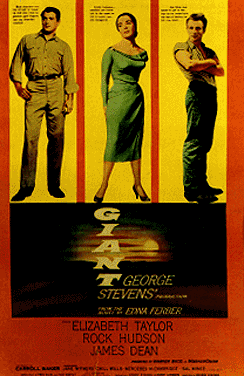
Giant (1956)

This is an epic film that stars Elizabeth Taylor, Rock Hudson, and James Dean, with direction by George Stevens. It shows the ongoing conflict between a rancher (Hudson) and his former hired hand who becomes rich off oil (Dean). As Jett Rink (Dean) exclaims, he becomes even richer than the rancher Bic Benedict (Hudson) ever dreamed. The relationship escalates when Rink makes a rude remark to Leslie Benedict (Taylor), and some punches are traded. From this point on the three main characters slowly grow older and the Benedicts have children. In his final screen appearance, Dean’s character is suppose to give a speech at a large banquet. However he is so drunk he falls flat on his face a complete wreck. Giant was ahead of his time by giving commentary about the race relations with Mexicans. It also took young actors and progressively made them look older, something that was quite unusual. Although this was Dean’s final movie I think it can be said he came full circle. He began as a youth in East of Eden and by the end of Giant he was a old man.

4.5/5 Stars

A Place in the Sun (1951)

In this film starring Montgomery Clift, Elizabeth Taylor, and Shelley Winters, with George Stevens directing, a young man (Clift) tries to rise up in his uncle’s company. He is poorly-educated yet ambitious and he slowly moves up in the Eastman business. While he works George begins to fall for a modest girl (Winters) who also works in the assembly. They slowly begin to show romantic feelings for each other because they face the same hardships. With a new found postition George begins to interact with people of higher social status. Although he feels out of place there, he meets the beautiful and rich Angela (Taylor) who he begins to fall in love with. As he begins to get more involved with Angela, he learns that his former love interest is pregnant and therefore wishes to marry him. Faced with a dilemma, George makes a decision that will ruin him forever, whether he goes through with it or not. A hard-hitting drama, and an adaptation of “An American Tragedy” by Theodore Dreiser, the latter half is the best part, including the chilling finale.

4/5 Stars

Argo (2012)

339c3-argo2012posterDirected and starring Ben Affleck, this historical thriller is based on the real events revolving around the Iranian Hostage Crisis that erupted in 1979. After a brief interlude, we are thrown right into the fray outside the U.S. Embassy in Tehran where nationalists are protesting vehemently. They break in and it becomes frantic insides as files must be burned and help must be found.

 Soon they are overrun and 69 hostages are taken, however, six Americans were able to escape and then seek refuge with the Canadian ambassador. From that point on the CIA must figure out how to get them out as they monitor the tense situation from home. All ideas seem doomed to failure, and soon an ex-filtration specialist named Tony Mendez (Affleck) is brought in. He has one wild idea, but it is the only one with a chance. 

With the help of a Hollywood makeup artist and film producer, he begins to create a fake movie so he can get the six out as part of a movie crew scoping out exotic locations. With this daring plan in mind the sci-fi film Argo is born, and Mendez heads to Iran. He must race against the clock because the Revolutionaries are near to discovering that some Americans are missing. Furthermore, his plan leaves the refugees skeptical and scared. Mendez is able to get them all on board as part of the film crew, and he preps them with fake Canadian identities, passports, and rapid-fire interrogations. Everyone is tense as they get ready for the day of departure because so many things could go wrong. The CIA shuts down the operation, but Mendez is adamant to keep on as planned. 

Despite some setbacks, interrogation, and near catastrophes, they miraculously make it to their flight and after one last tense moment, they enter airspace, officially safe, mission complete, and able to drink alcoholic beverages again. The six return to the U.S. amidst much fanfare and Tony Mendez returned an unsung hero. 

I found this film entertaining, tense, and fascinating. This is a part of American and international history that is seemingly glossed over and it needs to be known. I felt the film created an atmosphere that reflected the 1970s very well whether it was news broadcasts, sponsor spots for the Love Boat, mentions of John Wayne, or allusions to such films as Network, Kramer vs. Kramer, Star Wars, and Planet of the Apes. 

I know films like Argo can never be completely accurate, but it is amazing how close so many of the actors looked to their real-life counterparts. Furthermore, I did not feel I was being fed one side of the story. As with any international situation, both Iran and the U.S. were at fault. Ultimately, there was a happy resolution on January 21, 1981, and Mendez finally gained recognition.
 
4.5/5 Stars

Cleo from 5 to 7 (1962)

This Left-Bank French film starring Corinne Marchand, follows a young singer in a real time as she waits to get back the results which will prove if she has cancer or not. The film has a unique color opening where the superstitious Cleo has her future foretold. The rest of the film follows her as she anxiously waits on her results. To pass the time she buys a new hat, rides in a taxi through Paris with her housekeeper, and also goes to a café. Returning to her flat, we see how privileged and spoiled Cleo is, first being visited by her busy boyfriend and then her joking composters. However, all the while she is constantly being reminded of what she is waiting for and what her fate might be. Cleo then meets with a friend who models and they drive through Paris together. Finally, she ends up at a park and in a quiet spot she becomes involved with a talkative soldier on leave from Algeria. They eventually take the bus to the hospital and she frantically tires to hear her results. Then, abruptly everything is okay and Cleo or Florence as we now know her, can continue living her life in relative peace. This film has many aspects of the New Wave with its often Chic Parisian atmosphere and a camera that constantly seems to be on the move. A memorable moment includes the silent picture starring Jean Luc Godard with Anna Karina.

4.5/5 Stars

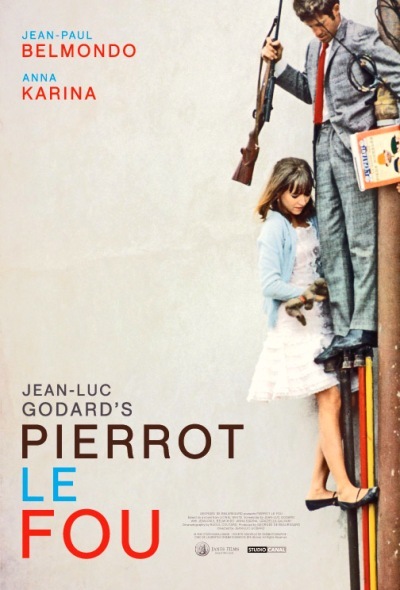
Pierrot Le Fou (1965)

Directed by Jean-Luc Godard and starring Jean Paul Belmondo and Anna Karina, this film is chock full of poetic musings, literary allusions, pop culture images, and so on. Belmondo is a Frenchman who is unhappy with his life and marriage. When a young woman he is already acquainted with comes to watch his child, they eventually elope together. Ferdinand goes with Marianne to her apartment only to find a corpse and they must flee the scene from two gangsters. Now on the run, the two lovebirds are intent on living life and making their own Hollywood inspired movie that they can both star in. Their aspirations lead them to live a wild life on the move, but finally they settle down for a awhile in the French Riviera. Ferdinand is content with a quiet life of philosophizing but Marianne is discontent with this life right out of a Robert Louis Stevenson novel. They finally move on and stop at a night club where they face one of their pursuers. After some mishaps Ferdinand and his girl get separated. Finally they are reunited only to have Marianne turn on “Pierrot” for her real boyfriend. The final moments are filled with gunfire, a suitcase full of money, blue paint, and dynamite. You could say that everything blew up in Ferdinand’s face, and you would be quite correct.

4/5 Stars

Band of Outsiders (1964)

Directed by Jean-Luc Godard, this film follows a young woman who meets two  crooks in an English language class. Through narration we learn that she told them about a cache of money she knows of and so they get her to help them swipe it. They both fight for her affection and ultimately the thug Arthur wins out. Despite Odile’s apprehension at taking the money from her aunt’s home, they continue to get the plan ready. Arthur’s uncle now wants in and then the plan changes again because the owner of the money is gone a day earlier. From this point everything begins to go wrong and after a horrible botched attempt the three culprits flee the scene with little to show for their caper. Arthur makes up an excuse to return and Odile and Franz drive off but they return when trouble seems imminent. Back at the house Arthur is confronted by his uncle and there is more bloodshed. Afterwards Odile and Franz again flee heading to South America while the narrator promises a sequel in the near future. This film unabashedly proclaims to be Nouvelle wave even going so far as having it printed on a store banner. Again, Godard combines his love of American pulp fiction and artistic experimentation to create yet another tragic tale. The film gives a nod to Hollywood crime films and also features several famous sequences. Some high points include the moment of silence, the spontaneous dance in the café, and of course the run through the Louvre. In my mind, Pulp Fiction owes at least something to Godard right here.

 

4/5 Stars

Contempt (1963)

Directed by Jean Luc Godard and starring an international cast including Brigitte Bardot, Michel Piccoli, Jack Palance, and Fritz Lang, this film within a film is Godard’s personal examination of the cinematic world. It opens with the shooting of a scene only to have the camera turn to face on the audience. Then begins a story where a screenwriter married to a beautiful woman is called upon to write a new screenplay for an adaption of the Odyssey. The producer is a vain and loud mouthed American who quickly has his eyes on the producer’s wife. Other members in this production are the real life legendary director Fritz Lang as well as the producer’s personal female assistant. Things begin to turn for the writer after he leaves his wife with the American playboy. She begins to become distant and she finally acknowledges that she no longer loves him. One of the famous extended sequences focuses on the argument they have inside their residence. In the course of the scene their relationship begins to crumble and finally goes beyond repair. This turn of events is very obviously paralleled in the Odyssey by Odysseus and Penelope. In the end the wife leaves with the producer and screenwriter is left in Italy to help finish up the film alone. Little does he know what has happened. Fellini’s 8 ½ may be a greater film about a filmmaker and his art, but I think “Contempt” is important because Godard focuses a great deal on the conflict between the commercial films of Hollywood and the art films of Europe. His film is more about each individual person who together make a film production possible, and he brings it to the screen with one of his best casts.

4.5/5 Stars

Vivre Sa Vie (1962)

ef6de-vivresavieposterDirected by Jean-Luc Godard and starring Anna Karina, this French film shot like a documentary begins up close and personal in the life of a 22 year old woman named Nana. In 12 separate scenes we slowly are given a view into her life. She goes from leaving her husband, trying to get into the movies, and then finally begins prostituting herself for easy money. All the while this beautiful young lady struggles with men. Here interactions sometimes leave her somber and other times light-hearted. Through it all she tries to live her life the way she sees fit. She might be playing pinball, working in a record shop, viewing a movie, or attempting to pick someone up. She is so alluring in a quiet sort of way and as observers we begin to feel pity for her more than anything. In the end tragedy strikes and all of a sudden it is no longer her life to live. This film had moments where it became talkie however the narrative divided into 12 sequences and the constantly swiveling camera were major attributes. Furthermore, this film appears as if it will be an in depth character study and yet by the time it abruptly ends we hardly know much of anything about Nana besides what is on the outside. In real life Anna Karina would be Godard’s wife for a time and he used her in many of his works.

4.5/5 Stars

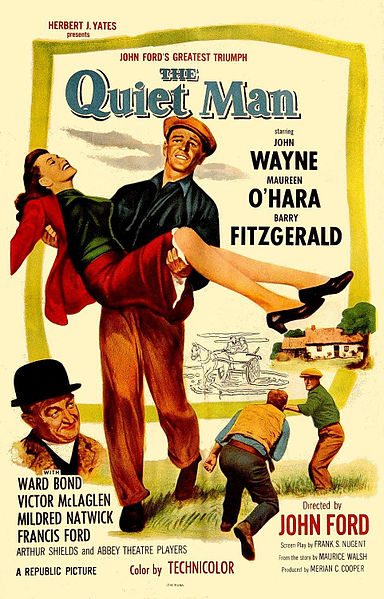
The Quiet Man (1952)

Starring John Wayne and Maureen O’Hara with director John Ford, the film follows an ex-American boxer as he returns to his roots in Ireland. Soon he is befriended by the proper yet kindly folk in the quaint town. Also, a beautiful red-haired girl catches his eye one day. Fireworks start between the American and the proud brother, so he will not condone the courtship or marriage of his sister. Finally, Wayne does gain his wife but she is unhappy without her dowry and she believes her husband is a coward since he will not fight for it. Little does she know the past he tried to escape, but once he gets it off his chest, he does fight. Through the exciting event both men grow fond of each other and the town gets a kick out of the entertainment. O’Hara and the rest of the cast including Barry Fitzgerlad are wonderful as the Irish folk, all playing off the Quiet Man.

5/5 Stars

Cool Hand Luke (1967)

92bba-cool_hand_luke_posterIn one of his most memorable performances, Paul Newman is Luke Jackson a man put on a chain gang for cutting the heads off parking meters while drunk. Despite the weary and monotonous regiment, Luke will not be cowed and he always keeps his positive demeanor.

Originally the newcomer, Luke quickly earns the respect of everyone including Dragline (George Kennedy), whether he is boxing, eating 50 hard-boiled eggs, or bluffing his way through a card game. Even though he is never quite successful, Luke never stops trying to escape either. His numerous clever attempts lead the Captain (Strother Martin) to utter his famous words about their “failure to communicate.” After multiple escape attempts Luke gets beaten, berated, and tortured.

However, he proves that you can never destroy his spirit no matter how hard yo try and so the ending is inconsequential. So ultimately “Cool Hand Luke” is a winner and a likable one at that.

It is necessary to acknowledge this solid ensemble cast including the likes of Dennis Hopper, Wayne Rogers, Ralph Waite, and of course Joan Van Fleet. Furthermore, there is seemingly no film that better depicts the dirt, grime, heat, and humidity that comes from working in a southern chain gang. The cinematography makes even the audience uncomfortable and a shower seems all but necessary.

Although the focus is often on the indefatigable character of Luke it became evident that this is often a taxing and difficult film to watch especially in the second half. In many ways Luke is the savior of these men in the chain gang and he sacrifices a lot of himself so that they might have some hope. Thus, this film is not just about the highs but the lows as well and Paul Newman plays every moment adeptly with the coolness that Luke Jackson embodies.

5/5 Stars