How Green Was My Valley (1941)

Starring a cast including Roddy McDowell, Walter Pidgeon, Maureen O’Hara, and Donald Crisp, with director John Ford, the film is told from the eyes of a young boy (McDowell) from a Welsh mining family. Huw has five older brothers, an older sister, and two strong but goodhearted parents. As times get tougher, he sees one brother get married and two others leave for America. Huw faces his own struggles recuperating from an injury and surviving his schooling. Along the way he is aided by the kindly preacher (Pidgeon). However, soon he sees his family torn apart even more when his sister is unhappily married off, a brother is killed, and two others lose their jobs. Then, finally when his sister returns, the town folk start a scandal, and Mr. Morgan becomes trapped in the mine. It does end on a good not and the family stays resilient. This film is full of adversity but more importantly it has warmth and good people. The camera work is excellent and the Welsh singing is memorable.

4.5/5 Stars

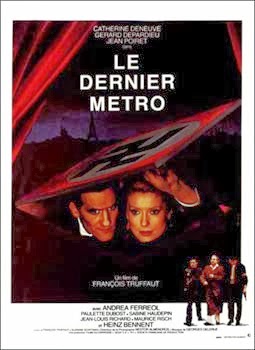
The Last Metro (1980)

Directed by Francois Truffaut and starring Catherine Denueve and Gerard Depardieu, the film opens with the very French-sounding love song “Mon amant de Sant Jean” playing over the credits. We find ourselves in occupied France during WWII where a little theater is struggling to stay open. The  famed Jewish director Lucas Steiner has been forced to flee from the Nazis although in reality he is actually hiding in the cellar of the theater. In his absence his wife Marion has taken up his role of running the theater while also continuing to act. Early on we are introduced to the young actor Bernard who is chosen to play one of the new roles in the upcoming production. At the same time Marion must try and acquire the permit to stay open from a man whom she despises, the art critic Daxiat, who has anti-Semitic beliefs. They do stay open however, and with the director’s notes of Lucas they prepare their show and open to great success. Many of the French come to their shows as an escape before they take the Last Metro home. However, at their performance Daxiat gives them a harsh review and it angers Bernard. His actions ultimately jeopardize the theater and as a result his relations with Marion become strained. As if that were not enough some Gestapo come to the theater searching for Lucas and they must rush to hide him. Needless to say the film ends on a positive note but the film is not so much about resistance against the Nazis compared to the struggles of a theater to survive. Denueve gives a moving performance and although this is not Truffaut’s best, it is admirable. As the audience, not only do we watch a movie, but we watch the play within the movie and then the drama behind the play, so Truffaut  takes us a little deeper.

4/5 Stars

Hiroshima Mon Amour (1959)

72bd9-hiroshima_mon_amour_1959This film is not only a seemingly early form of the French New Wave, it also has many qualities of a documentary, and it is certainly an international film. The film opens with a one night stand between a French actress and a Japanese architect who rendezvous one night in Hiroshima. In the short time they spend together, she reflects on her memories of the city that was not too long ago devastated by the atomic bomb. He often rejects her recollections but nevertheless, he cannot bear for her to leave and he continues to pursue her. Eventually in the course of their time together she relates her days back in the town of Nevers in France. During the occupation, she had a beau who was German and was eventually killed. The events and aftermath haunted her even many years later. They spend some of their time together walking the streets of Hiroshima and with their time running out they vow to remember each other by Hiroshima and Nevers respectively because their real names are never mentioned. This film begins very much like a documentary on Hiroshima but very quickly it turns into a character study focusing on ideas of love, memory, and personal identity. This film is more about art and expression and it uses quick flashbacks to replicate the past with voice-overs bringing the audience back to the present. That being said it should be treated as such because it truly is a masterpiece from Alain Resnais.

4.5/5 Stars

The Grapes of Wrath (1940)

472a2-wrathposters141I must admit this film directed by John Ford and starring Henry Fonda, surprised me in a positive way. This movie seemed like it could potentially be another Citizen Kane  (a movie so inflated with praised that it becomes a letdown when actually viewed). However, The Grapes of Wrath  in fact has a fairly good story adapted loosely from John Steinbeck’s novel. You come out of it feeling the strength of the Joads as well as the inhumanity they face traveling from the Dust Bowl in Oklahoma to California. Still, there is hope that they will endure it all in the end. Fonda gives a solid performance as the plain-speaking, young man Tom Joad. Jane Darwell also gives a very moving performance as his Ma . Some may say this movie has its slow parts but it also has some very good moments that reflect genuine humanity.

4/5 Stars

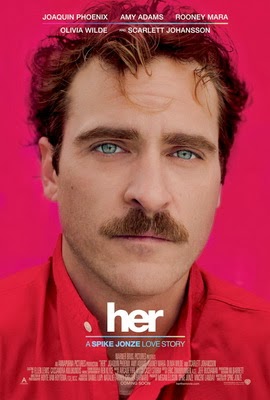
Her (2013)

e69ce-her2013posterHer is a film that examines hyper-technological culture through a lens that has been around for centuries: romance.  In a not so distant future Los Angeles, Theodore Twombly is a craftsman of greeting cards. The only difference is he dictates personal messages, which are then transcribed by computers to be given to loved ones. He himself is going through a rough patch in life after a breakup with his wife and it has left him taciturn and distant.
Then one day he purchases the new OS or Operating System. Samantha, as she is called, is a very high level of artificial intelligence (Siri on steroids), who is able to openly communicate, do tasks, and even show emotion to some extent. Even though she does not actually have a tangible body (unless you count Theodore’s phone), he still finds a way to become enchanted by her. Not only can she check his emails, but Samantha also has access to vast amounts of data that allow her to evolve with Theodore, and she soon becomes his closest confidant and companion. Her desire to constantly discover the world invigorates Theodore, who is constantly used to the same technological, yet monotonous existence. Ironically, he develops his deepest relationship with Samantha, because she reflects how lonely technology has made him. 
Real human interaction seems foreign and awkward, whether it is with his estranged wife, work friends, or a blind date. For that matter sexual relations have also been perverted and, in a sense, trivialized by technology. Theodore’s complicated relationship with Samantha brings these and many other realities to light. 
Samantha can never truly be Reality. She can never have physical contact. This causes Theodore to put greater focus on the other aspects about her. Yes, she is not a normal human, but her knowledge on everything and her curiosity opens up numerous beautiful avenues for them to explore together. It could be love letters, the music she is composing, or even the sensation of ambling down a street. 
Ultimately, there is a downside to technology because despite being in an advanced future it cannot fully emulate the human experience and as Theodore painfully discovers there are terrible complications in relation to Samantha. 
This can be a difficult film, a strange film, and at times even a crass film, but for the most part Spike Jonze gives us a very thought-provoking piece that is pertinent to this social media and technologically saturated culture that is also our everyday reality. The world shown to us is washed out in its pastel shades, and yet it does not seem too far removed from us. 
It certainly brings up some interesting dilemmas about Her, whoever she may be. How do you reconcile technology whether computers, phones, video games, etc. with the human interactions that still make up (or should make up) most of our existence? For Theodore, Samantha leaves him with wonderment for life and an inquisitiveness which allows him to unplug a little and truly live in the present. 
Joaquin Phoenix gives a wonderfully nuanced performance, but everyone really wants to see, or rather, hear Scarlett Johansson as Samantha. Others who take on smaller but crucial roles are Amy Adams, Rooney Mara, Chris Pratt, and Olivia Wilde. Her is invariably melancholic but undoubtedly powerful stuff all the same.
 
4.5/5 Stars

Rome, Open City (1945)

Directed by Roberto Rossellini this Italian neorealist film depicts the harsh realities of life in Rome during WWII during Nazi occupation. We are given an inside look at the bravery and everyday lives of these people. We become familiar with a fugitive engineer and resistance leader. He gains assistance from a kindly and collected priest who also runs a church. Their stories intertwine with a widowed woman who is just about to be remarried, a beautiful girlfriend, and a Gestapo office who is intent on stopping the resistance. After one tragic event everything continues on a downward spiral. The fugitive Manfredi and the priest, are both betrayed. Don Pietro must look on as the other man is brutally tortured to the point of death. Next, the Gestapo try to use the priest’s own beliefs against him and yet he will not yield either. He too then faces a fate just as horrible. This film at times was brutally realistic and it is perhaps one of the most moving films I have seen. We do not normally think of the struggles of Italians during WWII since Mussolini was allied with Hitler, however much like the French or even Germans, they faced tremendous danger and hardship. Furthermore, it humanized the Italians in my mind a great deal. This is the first film of the war trilogy that I have seen and now I want to see the other two. As you can see I’m still a little fuzzy on my Italian history and I would love to learn more.

5/5 Stars

The Leopard (1963)

Directed by Luchino Visconti and starring a stellar cast including Burt Lancaster, Alain Delon, and Claudia Cardinale, this Italian film revolves around a Prince and Patriarch during a period of social change in Italy in the 1860s. 

His Excellency the Prince of Salina (Lancaster) is a highly respected noble, who lives with his family on a large estate in Sicily. In his own life, the Prince is annoyed with his marriage and perturbed about the company his nephew Tancredi (Delon) is keeping. However, a revolution led by a man named Garibaldi means great change for the nation and finally following the lead of his nephew, who joins the rebel redshirts, the Prince sides with the new way and supports the plebiscites that are set up. His nephew falls for the beautiful daughter (Cardinale) of an aristocrat, and despite the fact that his own daughter has an eye on Tancredi, Don Fabrizo fully supports the marriage knowing it is good for the family. Because of his title and the respect he has garnered, the Prince is offered a position as a senator in the new government. But he courteously turns it down feeling he is too old and too attached to the old ways. Tancredi and Angelica are to be engaged and they are presented together at an extravagant ball. Over the course of the evening, Don Fabrizo has time to talk, dance with the young beauty Angelica, and reflect on his own life. As the lavish evening begins to dwindle the Leopard walks off to clear his head. 

In some respects, I saw this as an Italian equivalent to Gone with the Wind, and I could see some precursors to The Godfather here because the Italians portrayed are very religious and chivalrous people who can also be ruthless. However, I think it is fair to say that The Leopard is its own film entirely, and it should be taken as such. Tancredi and Angelica are no Rhett and Scarlett and the Prince is not the Godfather. They are their own unique characters. In my personal opinion, I would recommend the Italian version because that is the way the director meant it to be seen and Lancaster’s normal voice seems out of place in the film. Some may say that this detracts from his performance, but I think his presence and acting ability show through even if he is dubbed.

4.5/5 Stars

Le Cercle Rouge (1970)

LecerclerougeDirected by Jean-Pierre Melville and starring a cast including Alain Delon and Yves Montand, this crime film hearkens back to heist films such as The Asphalt Jungle, back in the 1950s.

In a cold open, two storylines are introduced. One man, Vogel, is in custody and is handcuffed to a policeman as they board a train. At the same time, a man named Corey is let out of prison, on good behavior, and he is tipped off on a possible heist job. In both cases, we have little background information to go on. Then, Corey pops in unexpectedly on an old mob boss and forcibly “borrows” some money from the man, who has also stolen his girl. He buys a new car and throws off a couple of thugs who were sent after him. As the morning dawns, the captive on the train makes a daring escape and flees into the nearby forest. Soon roadblocks are set and the manhunt begins. He desperately gets into an open car trunk to hide, ironically it is the same car of the man, who was recently released.

However, he was noticed and Corey tells him to get out of his hiding place.  Vogel is tense but his cool and collected acquaintance helps him sneak through a checkpoint noting that Paris is his best chance of escape. Corey is chased down once again by Rico’s henchmen, but Vogel sneaks out and comes to his aid. They head to Paris and find a sharpshooter to case the jewelry store and help them with their plan. The police detective is still searching for his quarry, and he tries to enlist the help of a crooked club owner. Meanwhile, the plans are made, and the heist is pulled off with great precision and efficiency. They get away with the jewels smoothly enough. However, the marksman settles to take no part of the plunder, and their initial buyer falls through. Relatively quickly there is a new person interested, so Corey takes the goods to him. Only too late Vogel comes to warn him, and just like that, they must flee the premises with police all around.

Much like Le Samourai, this film gives off an extremely cool vibe, and it makes it all the more enjoyable to watch. Alain Delon is such a smooth operator, and whether it is the way he dresses, talks, smokes, or pulls off the heist, it cannot be easily dismissed. However, the other main players give serious and nuanced performances of their own, which cannot be overlooked. Melville makes all of his scenes so interesting, through the setup and the fashion in which his characters go through the world of the film. His characters act in the mode of behavior that they believe is correct and most are rather taciturn and guarded. I cannot decide if I like Le Samourai or Le Cercle Rouge better, but it must be said they are in a special class of crime films.

4.5/5 Stars

Two for the Road (1967)

Starring Audrey Hepburn and Albert Finney,this romantic comedy gives a more realistic view of love and marriage. Mark and Joanna have been married about 10 years now and despite their wealth they seem unhappy. The non-linear story relates how they both met each other while vacationing in France. They were young, energetic  and in love. The film also covers their travels across France with Mark’s former girlfriend, her analytic husband, and their spoiled daughter. Then, we learn Mark finally got work as an architect. However  now with a small daughter, the marriage is dragging and they both have their own affairs. Despite the loss of their original passion, the couple realizes they are in love so Mark quits his job so they can start anew in Rome. This film gives off a sunny 60s vibe with a playful score by Henry Mancini, bright colors, French scenery  and of course love. I always enjoy Audrey Hepburn but I also felt Finney did an excellent job playing opposite of her. Most importantly  director Stanley Donen may have made a Hollywood style romance, but he made it more recognizably human than most. It does not simply examine the passion alone because there are many aspects of this big, messy experience called love.

4/5 Stars

No Country for Old Men (2007)

fa50f-no_country_for_old_men_posterStarring Tommy Lee Jones, Javier Bardem, and Josh Brolin, with the Coen Brothers directing, the film opens with a voice-over as a sheriff reminisces about an unrepentant killer he put away.  The year is 1980 in Texas and we watch as a ruthless killer (Bardem) is arrested and then breaks free. At the same time a hunter (Brolin) happens upon a bloody scene that has to do with a cache of drugs. After he searches around Llewlyn finds $2 million and tires to get away with it. All too soon he is being tracked by the psychopathic killer to various hotels. They have one bloody confrontation and after fleeing once more into Mexico, Llewelyn decides to drop the money off with his wife. However, pretty soon he is dead and the sheriff must find this killer who is on the loose. The hit man is not quite done and finishes off some business before getting into a car accident that forces him to flee. The film ends as the now retired sheriff talks with his wife, leaving the film’s ending open. This film is very violent and Bardem’s character is so noticeable because he has absolutely no humanity in him. In these bleak events there is not much hope, so if you want a fluffy film you will not find it here.

4.5/5 Stars