In a Lonely Place (1950) – Film-Noir

Starring Humphrey Bogart and Gloria Grahame with direction by Nicholas Ray, the film is about a struggling screenwriter with a hot temper. Dixon Steele (Bogart) has not written a good script in a while but then one evening he has an enthusiastic young woman explain a novel he is supposed to adapt since he has not read it. Everything goes seemingly normal however the next morning she is dead and Steele is the main suspect. The police investigate, including Steele’s detective friend, but a neighbor gives an alibi which seems to save Steele. Soon Grahame begins to fall in love with him and vice versa. However, she soon realizes his violent side and second guesses Steele’s innocence since he has such a violent history. Although they are to be married it is broken off when he finds out she was going to leave. Only then does Grahame find out he was indeed innocent but the damage is already done and their relationship cannot be saved. This is a pretty good film noir with powerful characters.

4.5/5 Stars

The Treasure of The Sierra Madre (1948)

4d2bb-treasuremadrePutting Humphrey Bogart in his element once again, The Treasure of The Sierra Madre is another wonderful adventure film. Directed by John Huston, it tells the story of three men who join together in their search for an elusive treasure in Mexico. At the beginning, they are in good spirits eager to become wealthy. However, when they finally strike it rich they find it is not all it is cracked up to be . The situation escalates and they become paranoid of each other. Finally, Bogart’s character Dobbs is pushed over the edge and commits a malicious act out of desperation. Seemingly as an act of karma, he meets with another form of justice. However, it seems that by the end no one actually wins. A surprisingly good film, Sierra Madre takes your usual treasure hunt and realistically depicts man’s greed which often can overpower everything else. Bogart was supported nicely by Walter Huston (the father of the director) and Tim Holt.

5/5 Stars

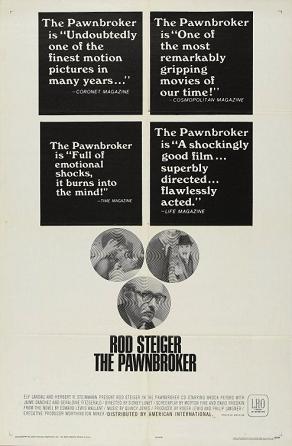
The Pawnbroker (1964)

Starring Rod Steiger with support from Jaime Sanchez and direction by Sidney Lumet, the film chronicles the present life of a Holocaust survivor turned pawnbroker. Sol Nazerman is a man who keeps to himself and he is callous to everyone who enters the doors of his shop. Under the surface, it is evident that the reason for his demeanor are his constant tormenting memories of the death camp as well as the loved ones he lost. In present day Haarlem Sol feels fear for the first time in a long while when he learns his shop is being used as a front for illegal activities. The energetic Ortiz (Sanchez) who eventually got fed up with his boss, shows his loyalty in the end. Despite his specters, Sol seemingly feels humanity after such a long time of being cut off from the world. Steiger gives a stunning performance and although sometimes it seems confused, I think this is an important film to see.

4/5 Stars

The Maltese Falcon (1941) – Film-Noir

4ef67-falconmThis archetypal film-noir directed by John Huston, stars Humphrey Bogart as the detective Sam Spade. After an initial conversation with a mysterious woman, that same night two men end up dead. As Spade tries to understand what is going on, it puts him in contact with a paranoid little man and another man who is trailing him. All of them have something to do with a black bird and the situation gets more complicated when Spade meets the fat man. Rather surprisingly Spade ends up with the falcon but of course there has to be a twist. Soon enough the truth comes out of Brigid O’Shaughnessy and Spade coldly does his work. This film has great characters played by Mary Astor, Peter Lorre, Sidney Greenstreet, Ward Bond, and Elisha Cook Jr. The directing is good as well as the cinematography. This is the film that finally made Bogart a star and he would never look back.

5/5 Stars

Bonnie and Clyde (1967)

b1a0c-bonnie_and_clydeStarring Warren Beatty and Faye Dunaway, with director Arthur Penn, the film chronicles the crime life of a group of notorious gangsters during the 1930s. Clyde Barrow (Beatty), a small time thief meets the beautiful young girl Bonnie Parker (Dunaway) and together they begin robbing banks. Soon they enlist the help of a dim-witted mechanic C.W., and then Clyde’s brother joins the fray bringing along his wife. They have a string of successes and they become infamous nationwide. Soon they begin to bicker among themselves and the police start to buckle down. In a shootout Buck is shot dead and Bonnie, Clyde, and C.W. just barely escape. However, their actions eventually do catch up with them and thus ends the story of these two figures depicted as anti-heroes. This film is significant because it was influenced by the French New Wave but it in turn ushered in a new era of American film . It has a unique combination of comedy, romance, violence, and of course banjo music.

5/5 Stars

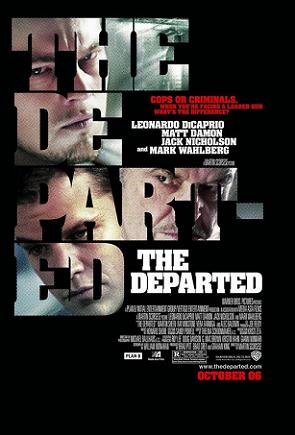
The Departed (2006)

Directed by Martin Scorsese and starring an all-star cast including Matt Damon, Leonardo DiCapprio, Jack Nicholson, and many others, this is a crime thriller with an interesting concept. The plot has to do with two young men who were in the Massachusetts Police Academy. One is tailored by the Irish mobster Frank Costello to become a mole within the police. The other is called upon to infiltrate the mob before he graduates. Thus begins their dangerous assignments as each tires to find the rat in the other organization while also working to stay out of reproach. Costigan is able to get close to the vile Costello while Sullivan is part of the Special Investigation Unit and also begins a relationship with a psychologist. They must secretly keep contact with the other side but it becomes increasingly treacherous with one encounter leading to a chase and another in the death of a police captain. The heat is on as both men try and reveal the other mole. During a cocaine pick up Costello is traced to the spot and a chaotic shootout ensues. Everything seems calm again and yet Constello’s mole is still around and bent on erasing Costigan from record. They agree to meet on a roof top and from that point on the film moves so rapidly it is almost impossible to take in what happens. Everything seems confused and corrupted but ultimately it does not pay to be a rat. This film has a lot of coarse language and violence but in Scorsese’s hands it is still an intriguing film to watch.

4.5/5 Stars

Amelie (2001)

Amelie is one of those films that you will either love it or you won’t because the fact is, it marches to the beat of a different drum. It is a unique, whimsical Parisian world full of a quirky cast of characters headed by Audrey Tatou. 

The ever present narrator opens the film by relating Amelie’s childhood as a young girl who was forced to occupy her time with fantasy and her imagination. Soon we are introduced to this quirky little girl and all the other figures who take up space in her life. She was isolated and her mother died when she was very young leaving her to live with her father. When she is older, Amelie moves on and begins to work in a café. Then in 1997 the death of Princess Di and a bit of fate cause her to devote her life to bringing happiness to other people. She plays matchmaker, reunites an old man with boyhood treasures, guides a blind man through the city, spurs her father to travel through use of his beloved gnome, gives renewed hope to a widowed landlady, and puts an abusive grocer back in his place. Amid her many good deeds Amelie makes friends with as solitary and brittle painter as well as Lucien, the kindly assistant at the corner grocery. Most importantly Amelie begins to realize she is falling for an unknown man after she accidentally retrieves a scrapbook of his. She tries to deliver it back to him anonymously and it becomes a wild goose chase all across Paris, full of arrows, flyers, notes, and rendezvous. However, her shyness makes it difficult for her to approach him, but with a little prodding she finally goes after Nino Quincampoix and he finally meets his mysterious girl. 

This film had me in stitches at times,  attempting to catch up at times, and completely mesmerized in other moments. This film has wonderful characters and such an idiosyncratic, and often abrupt way of telling their story. It was a change of pace that I enjoyed and I believe that Amelie is an enjoyable albeit eccentric romantic comedy.

4.5/5 Stars


Notorious (1946) – Alfred Hitchcock

dc86a-notorious_posterPairing Cary Grant with Ingrid Bergman along with Hitchcock directing, Notorious tells a story of spies in South America after World War II. Bergman is the daughter of a former Nazi so she is enlisted by a T.R. Devlin (Grant) to spy on other Nazis in South America. Pretty soon Bergman has been accepted and is married to one of the men (Claude Rains). Bitter and cold, Devlin shows no pity for her plight. However, during a party an important discovery is made that puts her in danger. To make matters worse, she is now sick and the others are suspicious. Showing his true loyalty, Devlin comes to her aid before she is harmed and brings her to safety.

To some extent we feel for Claude Rains who will be terminated if it ever comes out he married a spy and that pity is a credit to his portrayal. This film also seems to speak well of Grant as an actor since he plays so against type here. Hitchcock memorable used the key in the film to move the plot forward effectively. Aside from that a couple of sequences stand out to me. The first occurs when Grant enters a room and then we have the POV of Bergman’s heroine. She is lying in bed and drunk so as he gets closer he appears up side down in the frame. Then, there is the famous kissing sequence that all happens simultaneously while Grant is on the phone. The final one I recall is the tracking shot at the party that closes in on the key hidden in Bergman’s hand. Hitchcock practically shoves it in our faces so we know its importance. I think these moments reflect the great direction and showmanship of Hitch.

Partially for this reason Notorious is undoubtedly one of Hitchcock’s best films with a truly stellar cast of characters. If Casablanca was the beginning of the story then this seems to be the perfect sequel. You have a WWII related plot, Bergman, Rains and Cary Grant to stand in for Bogart after all. But that is a topic for another post in the future!

5/5 Stars

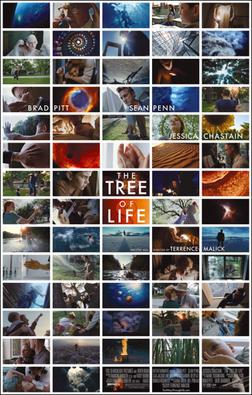
The Tree of Life (2011)

9f8e8-thetreeoflifeposterDirected by Terence Malick and starring Brad Pitt, Jessica Chastain, and Sean Penn, this film is a grand and audacious piece of cinema that intertwines images of the creation of the world with the life of a young boy in 1950s Texas. 

When I say daring, I mean that you will either find it fascinating or very, very dull. There does not seem to be much middle ground here. The film begins with a biblical allusion to Job and depicts a flickering golden light. Over these images are whispered words urging the listener to follow either grace or nature in life. 

Then, both Mr. and Mrs. O’Brien (Jessica Chastain and Brad Pitt) find out separately that one of the sons has died, and the reason is not explained. In the present, one of their sons (Sean Penn) who is now an architect contemplates his life while trying to get through his day. Then, we witness the breathtaking formation of creation, with the creation of the planets, sea, and life itself.
Back in 1950s Waco Texas, a young couple has had their first baby boy, and then two more follow in the ensuing years. Most of their life is focused on the conflict inside of the young boys, Jack. He must struggle with a mother who is gentle and loving, and a father who is authoritarian and even abusive. After one friend dies and another is burned, Jack begins to grow more disillusioned with the world and his parents. During a summer, their father goes away and during that same time, Jack becomes even more rebellious. Then their father is in trouble of losing his job, and he questions how he has lived his life to deserve such a fate. Back in the present, Jack has a fantastical vision seeing his younger self, as well as his family and others walking on the beach and the film, ends soon after. 

The closest movie that I can think of with the same thought-provoking intentions as The Tree of Life is probably 2001: A Space Odyssey. However, I think I surprisingly appreciated Tree of Life a little more, because it focused more on the human aspect instead of the fact that humans are insignificant and primitive in the realm of outer space. Furthermore, the ending of this film somehow seemed reminiscent of La Dolce Vita, since both had rather cryptic conclusions taking place on expansive beaches.
 
4.5/5 Stars

Suspicion (1941) – Alfred Hitchcock

Starring Cary Grant and Joan Fontaine with director Alfred Hitchcock, the film follows a young English woman who marries a charming man. However, he has gained notoriety for gambling and he also has a mysterious side. After telling his wife he is done gambling, he goes to find a job. Through a series of conversations however Fontaine’s character discovers her husband has been keeping things from her. Because of the tragic death of her husband’s good friend and other suspicious events, Fontaine begins to grow paranoid. She fears for her life as she is alone with her husband. In the final dramatic scene her situation takes a great twist. Although not Hitchcock’s best, in this film he does play with our minds as we too are constantly suspicious. Grant and Fontaine both give very commendable performances.

4/5 Stars