Lifeboat (1944) – Alfred Hitchcock

Directed by Alfred Hitchcock and starring Tallulah Bankhead, the film follows the passengers of a liner who escape in a lifeboat after the ship is sunk. Together they try and survive in order to make it back to civilization. Along the way they must make many difficult decisions. This includes saving the life of a German who sank their boat as well as amputating a man’s leg. Through it all there is ongoing conflict among the people who would normally be genial. However, their circumstances are by no means ordinary. By the end they are so desperate and crazed they seemingly turn against some and fall in love with others. This technical challenge of such a small setting did not disable Hitchcock’s storytelling ability. Written by John Steinbeck, the film’s story is an interesting view of humanity during World War II. This movie also includes Hitchcock’s most ingenious cameo of any of his films.

4/5 Stars

Shadow of a Doubt (1943) – Alfred Hitchcock

08054-original_movie_poster_for_the_film_shadow_of_a_doubtIn one of Hitchcock’s earlier American films starring Joseph Cotten and Teresa Wright, Uncle Charlie comes to visit his niece namesake “Charlie” and the rest of the family. Initially the whole family seems to be in a funk until they find Charlie (Cotten) is coming to visit them in Santa Rosa. However, what they do not know is that he is a wanted murderer. Over time “Charlie” (Wright) becomes suspicious of her uncle and finally comes across the truth. Her uncle figures out what she knows and decides he must get rid of her. Living in constant peril, “Charlie” finally is forced to face him. In the ensuing struggle she fights madly for her life. With the constant discomfort and suspense, Hitchcock proves how powerful thrillers can be even in the home. Cotten and Wright both do a very good job in this film. Supposedly this was Hitchcock’s favorite among his own films. I think it certainly one of the best of his lesser known movies.

5/5 Stars

The Virgin Spring (1960)

19cfc-jungfrukc3a4llanDirected by Ingmar Bergman and adapted from a Swedish ballad, this film revolves around a Christian Medieval family. Their only child is a beautiful, care free girl who they cherish. They sned her off to church with a maid servant. Along the way the two of them must pass through the forest. The girl leaves her servant behind to rest and then she goes on, meeting some herdsman on her way. She shows them hospitality by sharing her food, but the two men brutally rape and kill her. Ironically, that night they seek shelter with the girl’s family unknowingly. By accident the parents discover what became of their daughter and they must then decide what action to take. Bergman’s films certainly bring up questions about morals, religious faith, and evil. None of the characters were perfect but instead human, because they all make mistakes and must ask for God’s forgiveness

4/5 Stars

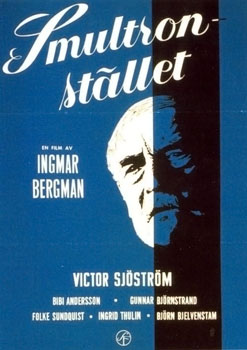
Wild Strawberries (1957)

Directed by Ingmar Bergman and starring Victor Sjostrom, the film follows an elderly doctor who travels by car to receive an honorary degree. Over the course of the day the old man has strange dreams and he also reminisces about his summers as a child with his family. He travels with his daughter in law and along the way they pick up energetic young people, deal with an unhappy married pair, stop at a gas station, and visit the old man’s lonely mother. The days events force him to face his past and realize his various faults. He also recognizes soon enough he will die. However, he finally comes to terms with it all and as a result he treats his daughter in law, son, and housekeeper differently. As with many Bergman films, this one is thought provoking. Some of the dream sequences were a bit odd but many of the characters and scenes were enjoyable.

 
5/5 Stars

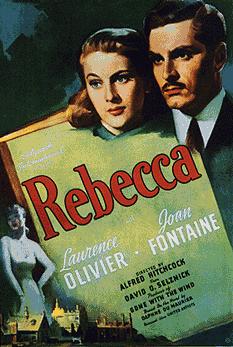
Rebecca (1940) – Alfred Hitchcock

This film directed by Alfred Hitchcock and starring Laurence Olivier with Joan Fontaine, was adapted from the Daphne du Maurier novel of the same name. The story begins in Monte Carlo where Max De Winter (Olivier) and a young woman (Fontaine) have a chance meeting as she is working for an older lady. Soon she learns that his previous wife died the year before. Fairly soon the two of them are attracted to each other and Max has plans of marriage and returning to his Manderley. However, back home the fairy tale is over and the new Mrs. De Winter is constantly tormented by the housekeeper Mrs. Danvers. Pretty soon Max himself seems to have changed. Confused Mrs. De Winter must learn what happened to Rebecca, the lady who was so enchanting. When she actually finds out the truth it is almost too much to bear. Like many Hitchcock films this one is certainly worth watching and it was actually his first American film. Olivier, Fontaine, George Sanders, and Judith Anderson all have very good performances.

4.5/5 Stars

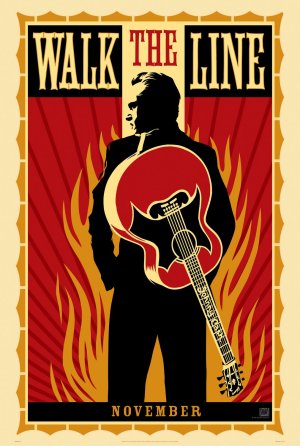
Walk the Line (2005)

Walk_the_lineStarring Joaquin Phoenix and Reese Witherspoon, this biopic opens with Johnny Cash recalling his past as he gets ready to perform at Folsom prison. JR is the son of an abusive share cropper and his brother Jack dies when he is just a boy. He goes off to Korea and comes back with a few songs under his belt. Cash marries his girlfriend and they move to Memphis where Cash tries to get work. On a whim he tries to form a gospel band to audition at Sun Records. Initially it goes poorly until Cash begins to Sing Folsom Prison Blues. Soon Johnny Cash and The Tennessee Two are signed and touring with many different artists. There Cash meets the likes of Jerry Lee Lewis, Elvis Presley and of course June Carter. Cash begins to fall for the recently divorced Carter but she rejects his initial advances leading Cash to go to drinking and drugs. They part ways but then later on they begin to tour again. His music is a success but his relationship with June causes his marriage to go down the tubes. He continues to takes more pills. This is the low point in his career but June gives him a second chance. They perform together at Folsom in 1968 and then after one rejection of marriage, June finally accepts while they are performing a duet. The two of them continue to perform and raise a family together. Phoenix was commendable as Cash and Witherspoon’s vivacious performance gave life to this film. One things is for sure, johnny Cash had a hard life that was full of mistakes. That’s what made his music so good. It was often personal and most importantly human. Because humans make mistakes. Thank you Man in Black for giving us what you did. 4/5 Stars

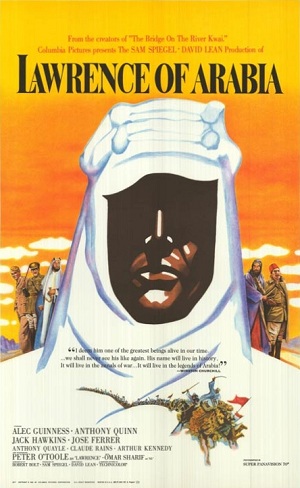
Lawrence of Arabia (1962)


A film of truly epic proportions, in length, scenery, and brilliance, Lawrence of Arabia is essential cinema. Peter O’Toole delivers a stellar performance as T.E. Lawrence, a British soldier during World War I. The movie begins with his death from a motorcycle crash, which gives an early glimpse of the character.

Then, a flashback goes to his time in Arabia where his task was to unite the Arab tribes, and lead them in rebellion against the enemy so the British might win. Against the better judgment of his commanding officer, a Mr. Dryden of the Arab Bureau suggests Lawrence be sent to assess the possibility of an Arab revolt against the Turks. Lawrence heads with his guide to pay a visit to Prince Faisal. However, his guide is shot by another man and Lawrence resolves to make the journey alone. Their paths cross again in the camp of Faisal. There Lawrence interests the Prince because his ideas are far different from his commanding officer.

Showcasing his audaciousness Lawrence suggests a bold attack on Acaba which would allow the British to bring in supplies. He leads a group of men across the brutal desert knowing that this will be less expected. Sheriff Ali (Omar Sharif) doubts it will work and disapproves that Lawrence takes two young outcasts as his servants. It is later during the journey that Lawrence truly wins over the other men, including Ali, because he is relentless, even going back for a lost straggler. With some luck, Lawrence is able to gain the help of Auda Abu Tayi, but it is not without tension. Ultimately, his forces are able to take out the Turks, and Lawrence heads back to Cairo to relay his progress. However, on the way back he must struggle with the loss of a servant and the guilt of executing a man.

Lawrence is sent back to Arabia and there he leads his forces in guerrilla operations against the Turkish railroads. His exploits are documented by an American newsman, and by this point, he has become a mythical hero among his followers. However, after going to scout a town the seemingly invincible Lawrence is ultimately flogged and tortured, leaving him a broken shell of a man. He insists on leaving Arabia but his new commander, General Allenby orders him back for one final push towards Damascus.

This final mission sees a change in Lawrence, who has hired killers and missionaries to help him in his siege. Against the better judgment of Sherif Ali, Lawrence leads a massacre of Turks as they move onward. He takes Damascus, but his fragmented counsel of Arabs are unable to unite, and the city is given back to the English. Major Lawrence is promoted once more to Colonel, and then gets shipped home because his services are no longer necessary.

This is one of those films you want to see on the big screen because the scenery and cinematography is just that impressive by itself. David Lean had a skill at making epics, and this is perhaps his masterpiece. The desert is often stark and desolate, and yet striking in the same instance. The expanse of space that is viewed in a single shot is often mind-blowing. A human being on the horizon is hardly a speck, and the ever-present camels are hardly any more substantial. To complement these grand images is an equally magnificent score by Maurice Jarre, complete with overture and all. The cast must be mentioned too with such supporting stars as Omar Sharif, Anthony Quinn, Alec Guinness, Claude Rains, Jack Hawkins, and Anthony Quayle.

Then, of course, there is the man who played Lawrence. As portrayed so wonderfully by Peter O’Toole, Lawrence is an intelligent and, at times, arrogant man, who can be odd, distant, audacious, and also unscrupulous. That being said, he was an extraordinary man who was a mover and a leader of men. A very unique, at times controversial, and long unheralded man, who contributed to the war effort in a far different way.  In many ways, he was an adopted brother to the Arabs, and their country was also his. He was “Lawrence of Arabia.”

5/5 Stars

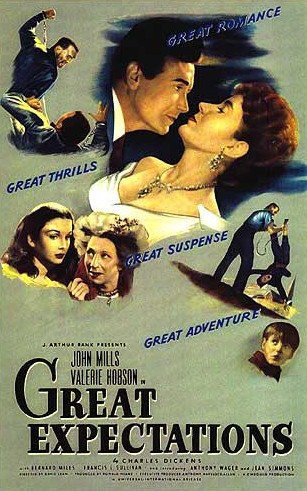
Great Expectations (1946)

ad366-great_expectationsWith director David Lean, and starring John Mills as Pip, the film begins with Pip as a young boy. Upon meeting a fugitive, Pip show him kindness and the man promises he will return the favor. A year or so later Pip begins to go to the home of an eccentric, rich widow to call on her. There he meets the lady’s adopted daughter Estelle and he falls for her. Now an adult, Pip learns he has a mysterious beneficiary who is paying for him to move to London to be a Gentleman. There he interacts with Mr. Wemmick, the attorney of Mr. Jaggers, and also Herbert Pocket (Alec Guinness). Then, someone shows up on his doorstep and changes his world. Soon he is orchestrating an escape for his friend, saying goodbye to the cold Estelle, and showing his displeasure for the elderly Ms. Havisham. However, in the end he learns a happy truth and reunites with Estelle. This moody, Dickens adaption actually has an optimistic side which is a nice change.

5/5 Stars

Mr. Smith Goes to Washington (1939)

84a24-mrsmithgoestowashingtonposterAs both a political drama and feel good movie, this film cemented James Stewart as an acting powerhouse. Furthermore, despite its age, it acts as a timeless reminder of the evils of political machines. It makes us root for the underdog, and it is distinctively American. Here is a cast and a story that seemingly could never be equaled, but what this film really had going for it was an idealistic outlook. I can, myself, often be a cynical person, and still Mr. Smith never fails to make me acknowledge the numerous attributes that make our country great, whether it is through montage, monuments, music, and of course Jefferson Smith himself. 

In one of his best performances, Jimmy Stewart is an idealistic, naive boy’s troop leader named Jefferson Smith. The starry-eyed Smith trusts that our nation is founded on some very noble principles that should be fought for tirelessly in government and in society. Above all, he is a likable fellow, who earnestly believes in the merits of this country, and he is beloved by boys all across the state. Now, this all sounds fine and dandy, but it would never have come across on the screen if it had not been for Stewart. He emanates this awkward and innocent energy that puts life into the idealistic creation of Jefferson Smith. 

When the film opens, everything is in turmoil when a senator suddenly dies and a replacement is needed fast. Believing Smith will be a pawn, a powerful man named Taylor (Ed Arnold) gets Smith a seat in the nation’s Senate. There he joins the respected Senator and old family acquaintance, Joe Paine (Claude Rains), who is also a cog in Taylor’s machine. However, although he is out of place in Washington, the patriotic Smith does his best to be worthy of his position. He realizes that the press will not give him a break, and the other Senators do not take him seriously.

So, on the urging of Paine, he decides to come up with a bill for a boys camp back in his home state. He requires the help of the world-weary secretary Saunders (Jean Arthur) to get his bill done. Initially, she is disgusted by his naivete, but as she grows to know him, she realizes he is only going to get himself hurt. His action to propose a bill soon find him face to face with the political machine that elected him. Taylor also has stakes on the piece of land where the boy’s camp would be, and he wants it for a dam. 

Smith finds himself being accused of using his position for his personal gain, and pretty soon he is before a committee with false evidence piling up against him. With all odds and seemingly everyone else against him as well, Smith makes one last monumental effort. Thanks to the help and guidance of Saunders, Smith fights to plead his case through a filibuster.

Fatigued by many hours of giving impassioned speeches and reciting the Constitution, Smith finally collapses, but not before effectively succeeding at his task. I doubt this would ever happen in real life, but in the film, it is fantastic watching the Senate break out into complete and utter mayhem. Ultimately, a young man with “a little bit of plain, ordinary, everyday kindness and a little looking out for the other fella,” was able to win. True, it may be overly sentimental, but it is a wonderful piece of sentiment all the same.

Frank Capra was wonderful at these type of cheering tales and his stars were in top form. There is an absolutely wonderful supporting cast here including Claude Rains, Edward Arnold, Eugene Pallette Thomas Mitchell, Charles Lane, Harry Carey, William Demarest, Beulah Bondi, and numerous other familiar faces I don’t even know the names of. That’s the beauty of the studio system I guess. It may have the same director, same leading man, and some of the same general themes, but Mr. Smith Goes to Washington covers completely different territory from Capra’s later classic It’s a Wonderful Life. Mr. Smith should be seen as a unique, and very much American film.


5/5 Stars

High Noon (1952)

14bd7-high_noon_posterThis may not be the greatest film of all time, but it is certainly one of the greatest westerns gifted to us so generously by Fred Zinnemann. It tells a very simple story, yet it is, in fact, so powerful simply, because of the hero it depicts. In its time it also served as a condemning allegory of the finger pointing going on in Hollywood.

*May Contain Spoilers

The film tells the story of Marshall Will Kane, who is willing to face his foes even when no one else will help him. Gary Cooper plays the newlywed lawman, who must flee town or face the killer coming on the noon train. He resolves to do just that, despite the pleas of his loving wife (Grace Kelly). The sheriff scrambles against the clock to get help. However, no one is brave enough to face the enemy with him. Even with the odds against him, he faces them in a showdown. Cooper is outgunned, but not outmatched — heroically prevailing.

This film is so powerful, because it is full of human emotions, and it feels so real since the events unfold almost in real time. The somber ballad, sung by Tex Ritter, also helps to create the mood right from the opening credits. In fact, I must admit that multiple times I have found myself humming or crooning the words, but then again I suppose it makes sense since the song is woven into the very fabric of the film.

The score by Dimitri Tiomkin utilizes the tune throughout to complement the images of the town. In that respect, “Do Not Forsake Me, Oh My Darlin'” is not just a song, but an important piece of this story. It is easy to forget the supporting players since Cooper often steals the show. Nevertheless, there’s Lloyd Bridges, Grace Kelly, Katy Jurado, Thomas Mitchell, Lon Chaney Jr.,  Harry Morgan, and even a young Lee  Van Cleef. Many have pasts with Kane that we cannot expect to fully know. All we can understand is the here and now that causes a person to weigh their options, and either follow or go against their conscience. Kane and then his bride both did what they thought was right even when others would not follow suit.

It struck me how simple the story is, and yet on the other side, it is a complex allegory that critiques humanity. Will Kane is a man, who helped make the town what it is, but when trouble comes and the odds are bad no one is willing to help him. Besides the obvious positives like a good story and a heroic protagonist, this film stands out because it feels so human. Here we are as an audience watching the events unfold almost minute for minute. Then we see the various town folk and their fear of getting involved, and to make matters worse a lot of them are Kane’s very good friends. It makes us question what we would have done in their position. Because some of them were obviously good people, who were scared to be involved. Of course, during this time McCarthyism was prevalent and it is suggested that this film alluded to that. However, whatever you think it is still unquestionable that High Noon is a powerful film, a love story, and at its simplest a classic western.

5/5 Stars