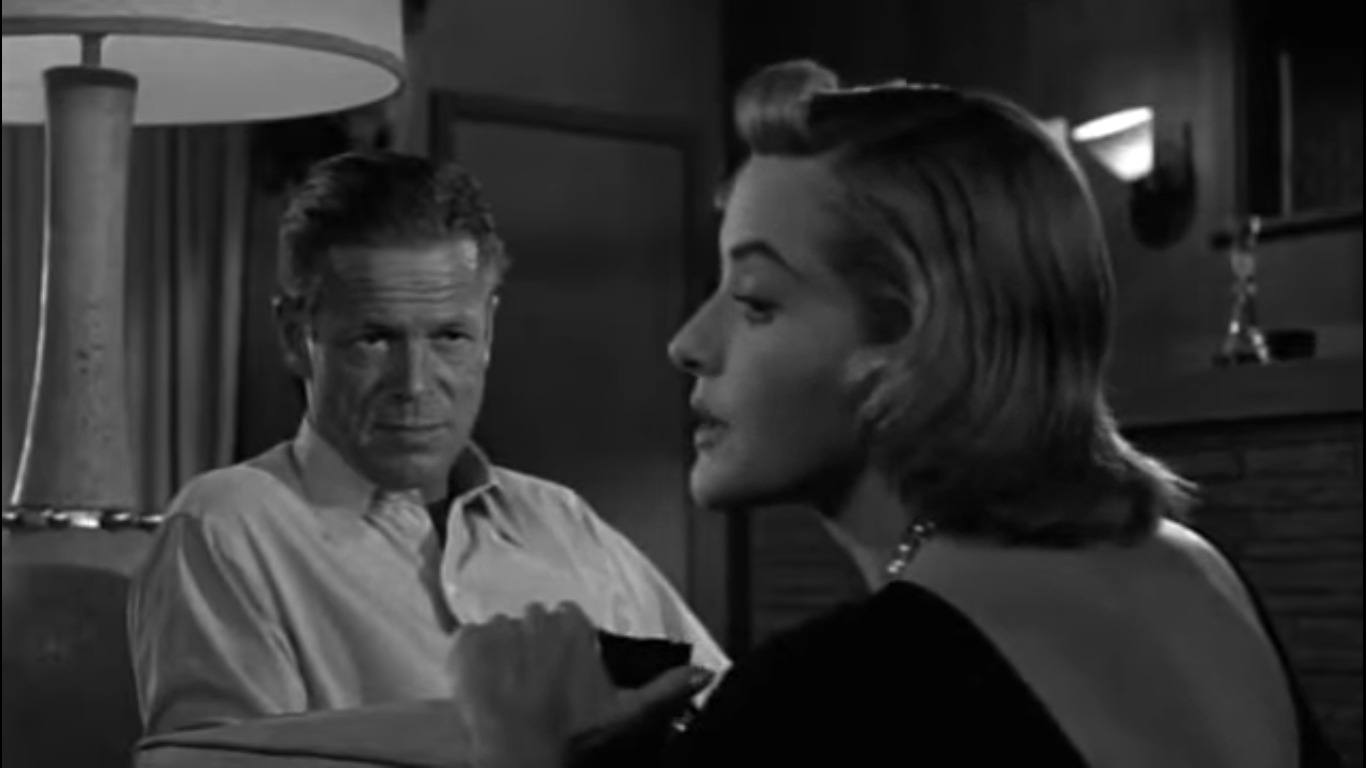
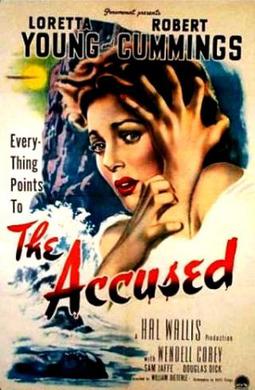
The Accused (1949)

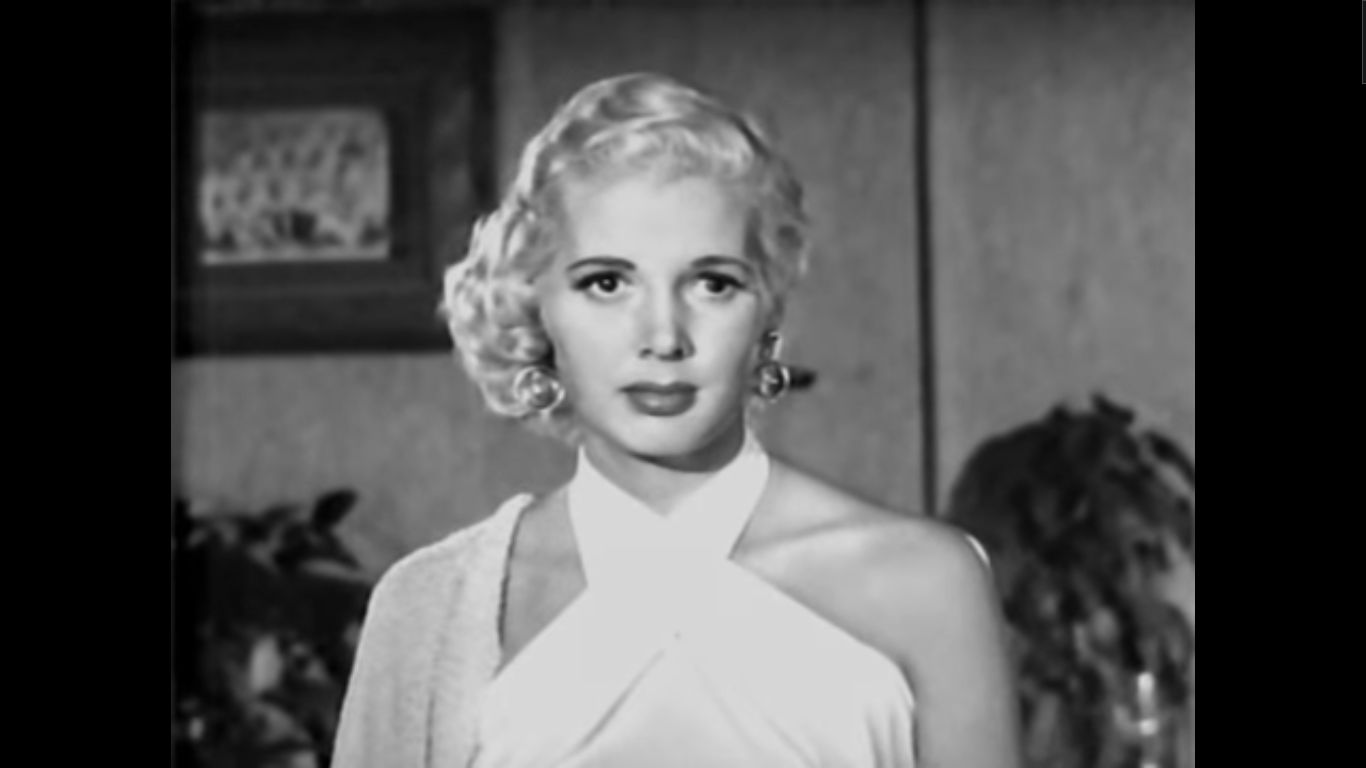
Loretta Young must own a pair of the most luminous eyes in the history of Hollywood, and in black and white, she’s incandescent. More important than that, she’s one of the great sympathetic heroines of Classic Hollywood. In The Accused, she plays both a woman in danger and a working professional. They don’t have to be mutually exclusive, and it makes for a far more nuanced character, especially for the post-war 40s.

Like poor Ida Lupino in Woman in Hiding, we meet her in the dead of night on the road. It’s evident she’s frantic and on the run from something. She gets picked up by a truck driver, though she’s not much for conversation, and he lets her off without much consequence.

A flashback introduces her pre-existing life as Dr. Wilma Tuttle, a professor of psychology at an unnamed university in L.A. It’s finals week as students take their exams and classes wind down.

We get an inkling of drama as we watch the wordless interaction between the fidgety teacher with a leering male student, mirroring her every move and, no doubt, turning in a Bluebook analyzing her own personal psychoses from biting on pencils to tugging on her hair. It’s a queasy relationship because, although she’s in a position of authority, she also seems helpless to do anything.

Douglas Dick does well as the slimy, if charismatic, co-ed who looks ready to entrap his teacher; he’s a kind of skeevy-eyed homme fatale playing teacher’s pet and coaxing his favorite instructor along — first offering her a ride home and then stopping by the seaside in Malibu.

Without using too much equivocation, it becomes a movie about assault and trauma, with the feminine victim becoming the accused, much like Anne Baxter in Blue Gardenia. There needn’t be a movie, but in the 1940s, she operates out of a position of fear in a predominantly male world.

Wilma’s internal monologue gets a bit oppressive, becoming a monotonous crutch, but the cavalcade of performers who come alongside Young are a worthwhile reason to stay the course. Robert Cummings and Wendell Corey aren’t showstoppers necessarily, and still, they have the prerequisite appeal to see them through the career of a reliable actor in Hollywood.

We meet lawyer Warren Ford (Cummings) and Lt. Ted Dorgan (Corey) together at Malibu police headquarters. The former was the boy’s guardian, and the policeman is investigating the case. After the boy’s body washed up on the beach, it was deemed an accident and no foul play.

No fingerprints were found in the car. Immediately, as an audience, we’re doing our mental calculations. Could this be, or is it merely a glaring plot hole? I’ll save you the trouble. Young was wearing gloves as a true lady does in the 1940s. Or else she wiped them…

The film’s asset comes with how it ties all of its primary relationships into twisted knots, all in the name of interpersonal tension. Warren has some personal connection with the deceased, but he quickly becomes enamored with the lady professor, and why wouldn’t he be? They effectively mix work and play, with Cummings being the smooth silk to Corey’s abrasive sandpaper approach.

In its latter half, The Accused becomes a Columbo episode from the inside out. We have our Hollywood star. There’s an opening prologue before the police get involved, and she falls in love. She also begins to feel trapped by what otherwise would be everyday occurrences as she tries to protect herself and cover her tracks.

One of her pupils is a primary suspect. She’s also requested to drop off the dead boy’s Bluebook, which might incriminate her. The truck driver who picked her up in the dead of night is called in as an eyewitness. Then, there’s the business of a missing note that she left for the dead boy and then misplaced. She must find and incinerate it.

Corey’s character is difficult to read. There’s something horrid about him, far worse than his incarnation in Rear Window, and yet he tries to play it off as an act or all part of the game he’s embroiled in on the daily as he does his job. It’s a bit of a curious surprise to see both Henry Travers and Sam Jaffe taking up positions in the police lab. There’s a rational inevitability about the work they do.

Wilma feels the heat, and a date at a boxing match brings out all her latent traumas to the surface again as she transposes the boxer in the ring with the boy she killed. In one sense, there needn’t be a movie because she is a victim, though she digs a bigger hole for herself.

Ultimately, the movie’s denouement is open-ended. The courtroom proceedings are just beginning, and her fate is far from settled, but as we stare into the dazzling eyes of Loretta Young, it’s easy enough to know she will beat the rap with a hedge of innocence around her.

If you dwell a little too much on the implications, the optics that Dorgan also observes might be a flaw in the justice system — if sympathetic appearances are taken as everything. However, in a movie about a woman who is assaulted and then plays the culprit out of fear, it’s at least par for the course.

There’s also a couple of oddities: Corey flirts with her in the courtroom, and Cummings is effectively defending her for killing his “nephew,” though they weren’t close. And still, Corey’s impish sense of humor and Cummings’s passionate orations for his beloved don’t change the bottom line.

This is Loretta Young’s movie, and even as she plays an intelligent woman often hassled and infantilized by the world around her, there’s something so winsome and generous about her performance. The noir elements burn off to make it a story of reclamation and vindication of a life. If you go digging, it does feel like a movie moderately ahead of its time, courtesy of screenwriter Ketti Fring and Young, respectively.

3.5/5 Stars
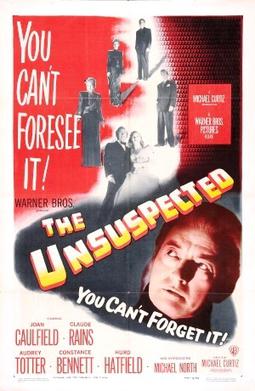
The Unsuspected (1947)

The Unsuspected has a delicious opening dripping with a foreboding chiaroscuro atmosphere. It’s the dead of night. There’s a woman on the telephone tucked away in a back room. The familiar face of Audrey Totter picks up on the other end of the line. She’s out enjoying herself at a club with some male company.

Someone emerges and descends on the flustered secretary. Moments later, she winds up hung from the ceiling — a grisly murder framed as suicide. For ’40s Hollywood, it doesn’t pull punches.

Since Totter is a consummate femme fatale, it’s easy to question what angle she could possibly have in this whole affair. We don’t have the answers, and so we must follow the rest of the film to find out; it’s a genuine pleasure to be afforded the opportunity.

If it’s not apparent already, we are in the hands of professionals with Warner Bros. stalwart Michael Curtiz directing a screenplay by Ranald MacDougall and the director’s wife, Bess Meredyth.

The film is dressed up nicely for a bit of noirish drama with the added benefit of the shadowy, gothic interiors when the story moves to the abode of one Victor Grandison (Claude Rain), a revered radio mystery performer who is reeling after the death of his secretary and the loss of his beloved niece who perished recently at sea.

Rains is an actor with such poise and regality, but building off his turn in Notorious, he plays another complicated figure. It’s a role worthy of his talents, and he anchors a packed menagerie of the usual suspects.

Totter as the sultry Althea always seems to take vindictive pleasure in playing the venomous harlot, and she’s just about one of the best from the era. With her arched eyebrows and intense eyes, she reflects the perfect epitome of an opportunistic, venomous vamp. Though it’s possible she only looks the part. Other people are willing to stoop to murder.

Her inebriated wet noodle of a husband (Hurd Hatfield) feels like a non-entity in comparison, and that’s precisely the point. Fred Clark always has a shifty authority about him, and he’s a close associate of Grandison. Over time, we realize he’s actually the local police detective, a handy man to have as a friend…

The ubiquitous Classic Hollywood heavy Jack Lambert is introduced in one lingering shot, looking out the window of some dive hotel window. What could he have to do with all of this? It’s difficult to implicate him immediately, but we know he’s waiting there for something.

Constance Bennett might just be the finest addition to the cast. She was the wit and experience like Eve Arden a la Mildred Pierce, both beautiful and able to trade banter and wisecracks with just about anyone. She lends a sense of levity to a movie that might otherwise feel oppressively dour. In some ways, she lives above the fray of everyone else, providing a kind of narrative escape valve for the audience.

If you think you already have a line on The Unsuspected, it’s a joy to mention it’s a movie full of perplexing wrinkles. A mysterious stranger (Michael North) shows up on their doorstep unannounced like a specter, and he asks to see Grandison. His next claim is even more outlandish: This young man, Steven Howard, was secretly married to Grandison’s niece Matilda.

Then, a dead person is resurrected like an apparition. Joan Caulfield’s character suffers from a cruel lapse in memory. What happened to her? I should have noted it sooner, but she has the aura like Gene Tierney in Laura, down to the portrait.

Like that picture, it’s a movie spent deciphering people’s motives; it feels like everyone is keeping secrets and no one wants to tell. Is it a case of elaborate gaslighting? It’s not unthinkable in the noir worlds of the 1940s, and Caufield is a ready victim, so sweet and innocent.

What are we to think? Who can we trust? In taxicabs, we find conspirators of a different kind — those trying to ascertain the truth behind a suicide. Because they know there is more than meets the eye.

Matilda returns to her home, lighting it up with the glow of her virginal white countenance in the dark recesses of the family mansion. It feels like oil and water. She does not belong there, but the story is still unresolved. There are several skin-crawling moments as Matilda is subjected to danger with a touch of Hitchcock’s Suspicion (1941). Something’s not quite right, but perhaps her mind is playing tricks…We know she’s not crazy.

It might be low-hanging fruit, but the crucial nature of the antagonist makes the film feel like an early precursor to the Columbo series. Although we don’t know everything right away, eventually the audience is given the keys to the murder, and we must sit back in earnest to watch how they play out, from botched murders to car chases with the police toward the city dump.

I’m also intrigued by the trappings offered by murder mystery radio programs, and though they are used in other films like Abbott and Costello’s Who Done It?, to my knowledge, they aren’t as prevalent in Classical Hollywood as one might imagine.

There’s a delightful meta-quality with Grandison narrating plotlines that played out in the story around him, adding another perturbing layer for the filmmakers to play with. It feels especially fitting here, thanks to Rains’s mellifluous voice and the continued prevalence of mystery and true crime stories to this day. It seems like we still can’t get enough of them over 75 years later. The Unsuspected represents the best of Warner Bros. and the mystery genre, wrapped up in a movie that rarely gets talked about.

4/5 Stars

The Chase (1946)

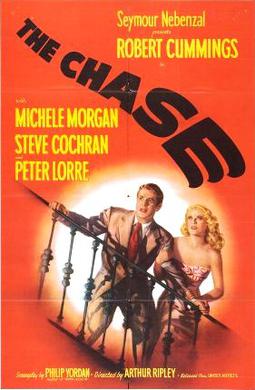
The Chase opens as a wonderful contrivance of noir done up in a couple of successive visuals. A bedraggled man (Robert Cummings) stares through a shop window at a griddle laden with fresh bacon and hot cakes. He leans in so his hat brim mashes up against the glass, and proceeds to cinch up his belt. He doesn’t have any dough.

Then, he looks down right at that precise moment and notices a wallet at his feet stacked with cash. Any person in the real world would have seen it immediately, but it’s set up perfectly for the camera. He proceeds to treat himself to breakfast and a cigar, and after he has a full belly, he decides to pay a visit to the address inside the wallet.

You get a sense of the milieu with a mention of a standoffish Peter Lorre staring through a peephole and questioning what the stranger wants. Our hero is unwittingly cryptic, saying he wants to see one Eddie Roman — he has something to give him…

It could be a belly full of lead or something more innocuous, and, of course, it’s the latter. They give him the once over and reluctantly let him in. The room’s stacked high with statues and ornate antiquities; somehow, they make the interiors feel not just capacious but hollow.

Who lies down the corridors is anyone’s guess because this isn’t where ordinary folks dwell, only cinematic creations. Sure enough, the ex-Navy man Chuck Scott has just happened to fall in with a psychotic lunatic (Steve Cochran). We’re introduced to his temperament when he gives his manicurist a slap for screwing up and sends her simpering out the front door.

Still, he’s impressed by Chuck: An honest guy shows up on his doorstep, and he even tells him he treated himself to breakfast for a dollar and a half (those were the days!). For being such a standout guy, he repays him with a gig as his chauffeur. When you’re destitute, you don’t bite the hand that feeds you.

There’s an uneasy tension in everything Cochran and Lorre, his right-hand man, have their hands in. The controlling Eddie is married to a young lady (Michèle Morgan) named Lorna; he’s hardly allowed her out of the house in 3 years. It says so much about their relationship.

The sadistic slant of the movie becomes increasingly apparent as they stick a different dinner guest in the wine seller to be ripped apart by Eddie’s prized pooch. He has something they want for their business dealings, and any semblance of hospitality burns off as his bubbly conversationalism quickly turns into despair.

For a time, The Chase becomes a kind of contained chamber piece drama. It’s not obvious if it will break out and be something more as Chuck forms an uneasy existence between the backseat driving of his new boss and the despondency of Lorna, who stares out at the crashing waves of the ocean, all but bent on presaging Kim Novak in Vertigo by jumping in and ending it all.

Lorna and her newfound advocate book two tickets to Havana and are prepared to skip out together. Even these scenes evoke a foreboding mood more than anything more concrete because there’s only a vague sense of plot or purpose. From here, it builds into this debilitating sense of obscured conspiracy in the bowels of Havana.

There are obdurate carriage drivers, slinking foreigners, and cloak-and-dagger antics that find his woman harmed and Chuck fleeing from the authorities. The surreal tones of the story just continue to proliferate with novel characters and new environs materializing rather than moving systematically from one scene to the next.

This inherent sense of surreal atmosphere might place the picture ahead of its time, with a select few films of the era. However, it comes off as rather stultifying after auspicious beginnings because it doesn’t accomplish what many of the great Classical Hollywood films managed by telling compelling three-act stories with a sense of economy.

The underlying perplexing tension set against a dreamscape, siphoned from Cornell Woolrich’s source material, is not enough for The Chase to fully pay off on the goods. It feels more like an intriguing experiment than a successful crime drama.

3/5 Stars

Russell Rouse: Wicked Woman (1953) and New York Confidential (1954)

Wicked Woman (1953)

There’s some instant shorthand at play as the titular woman takes a bus into town to set down some roots for awhile. It’s apropos given the salacious title and the opening ballad looking to capitalize on the first impression.

Beverly Michaels steps into view and does the rest, more than holding up her end of the bargain as the eye-catching platinum blonde, Billie Nash, a name made for this kind of trashy downbeat drama.

In truth, she comes out of the heyday of platinum blondes: the Monroes, Mansfields, Van Dorens and all their ilk. Still, there’s little chance of confusing Michaels with the others. For one thing, she only has a sliver of their fame, but also she’s such an individual beauty. Svelte with eyes that are dark at times almost sad and sleepy. They serve her performance well.

She checks into a local dump and with her payroll she’s can’t be too picky about her accommodations so she shovels out the dough to keep a roof over her head. It’s the kind of place where someone as pretty as her turns the heads of all the men. Across the hall is the small-time pipsqueak Charlie (Percy Helton) anxious to make her acquaintance. If she even deigned to address him, it would make his miserable day.

If you’re like me, you remember Helton for a cameo in White Christmas, maybe a stray episode of Get Smart, and of course, that wonderfully iconic hoarse voice of his. It’s almost like taking Mickey Rooney and putting him in Drive the Crooked Road, except this guy was always a bit player. Here he gets one of his biggest showings as a tiny, dismal runt of a man, and even he has pride and desires in life.

If there was any initial reluctance, Wicked Woman more than fits the bill offering up hot jazz and a wily woman who knows how to play the opposite sex like an instrument. It earns her a free meal and a laundry list of other favors. She doesn’t mind because this is the way the world operates. A girl’s got to get ahead any way she knows how.

It happens again when she signs on as a hostess at a local joint. She’s always sashaying and slinking around burning up the local establishments and street corners like red-hot coals. The first moment she sets sights on Matt Bannister (Richard Egan), she gives him the eyes. He runs the place with his hag of a wife. Already we know their marriage is instantly in jeopardy when Billie lands the job.

Later, during business hours, Egan lights a cigarette, takes a puff, and sets it down in her general vicinity. She gets the idea and takes a drag. In Hollywood terms, if this were a geometric proof, it’s basically the transitive property in action. It’s easy enough to put two and two together.

Like Brad Dexter, Egan has a bit of the physique and the piercing eyes perfect for an sleazy drama like this. It borrows liberally from the convention blending shades of Postman Always Rings Twice and Scarlet Street mashed together and made tantalizing thanks to Beverly Michaels.

The man and woman are soon caught up in a plot together and their mark is easy — her faculties all but deluded by alcohol — and she’s getting worse.  All they have to do is cash out on the business without her knowledge, and they can run off below the border, just the two of them.

But these kinds of sordid affairs always ratchet up the tension. That’s part of the expectation — part of the fun — and I wouldn’t dare spoil that. It strikes me that while most of the scenes have a clandestine intimacy, one of the film’s biggest moments turns confrontation into a public affair because everyone is in everyone else’s business. It goes with the communal showers and the nosy landlady.

These are pretty much the expectations of the world. It can only end the way it began with this sultry siren taking the same bus out of town with a one-way ticket to wherever. And the cycle begins again.

On a different note, the film’s star, Michaels, and writer-director, Russell Rouse, would get married soon thereafter and remained so until Rouse’s death. Fortunately, life didn’t imitate art in this regard.

3.5/5 Stars

New York Confidential (1954)

New York Confidential provides a bird’s eye view of the world of “the syndicate.” It’s a Naked City-type perspective with an impartial Voice of God providing us the context of the crime world calling the shots in the urban jungle. It’s not exactly a fresh premise since the decade engendered many such pictures.

What makes it mildly interesting derives wholly from the performances and there are some actors worthy of note. Although the movie itself always feels like it’s playing at a gangster movie — a narrative we’ve seen umpteen times before it was tackled so definitively by The Godfather.

Here we have Broderick Crawford and Mike Mazurki, even J. Carrol Naish, all playing their respective types in this world we’re probably already familiar with. It’s the milieu of the syndicate where organized crime and legitimate business have coalesced with the culture of the old country. Meanwhile, hits are carried out with merciless precision. It’s just another less sentimental side of the business.

When Richard Conte shows up there’s some real promise. The way he so smoothly mows down some thugs at the bar. It’s casual and self-assured for the era. It’s like no one can touch him.

Even as gang wars run rampant in the city, he’s too cool and calculated to get dirtied in the fray. He goes about his business, does his job well, and gains the trust of his superiors because he’s smart and charismatic. He also rebuffs the come-ons of his boss’s moll (a mostly underused Marilyn Maxwell). It’s yet another act of self-preservation.

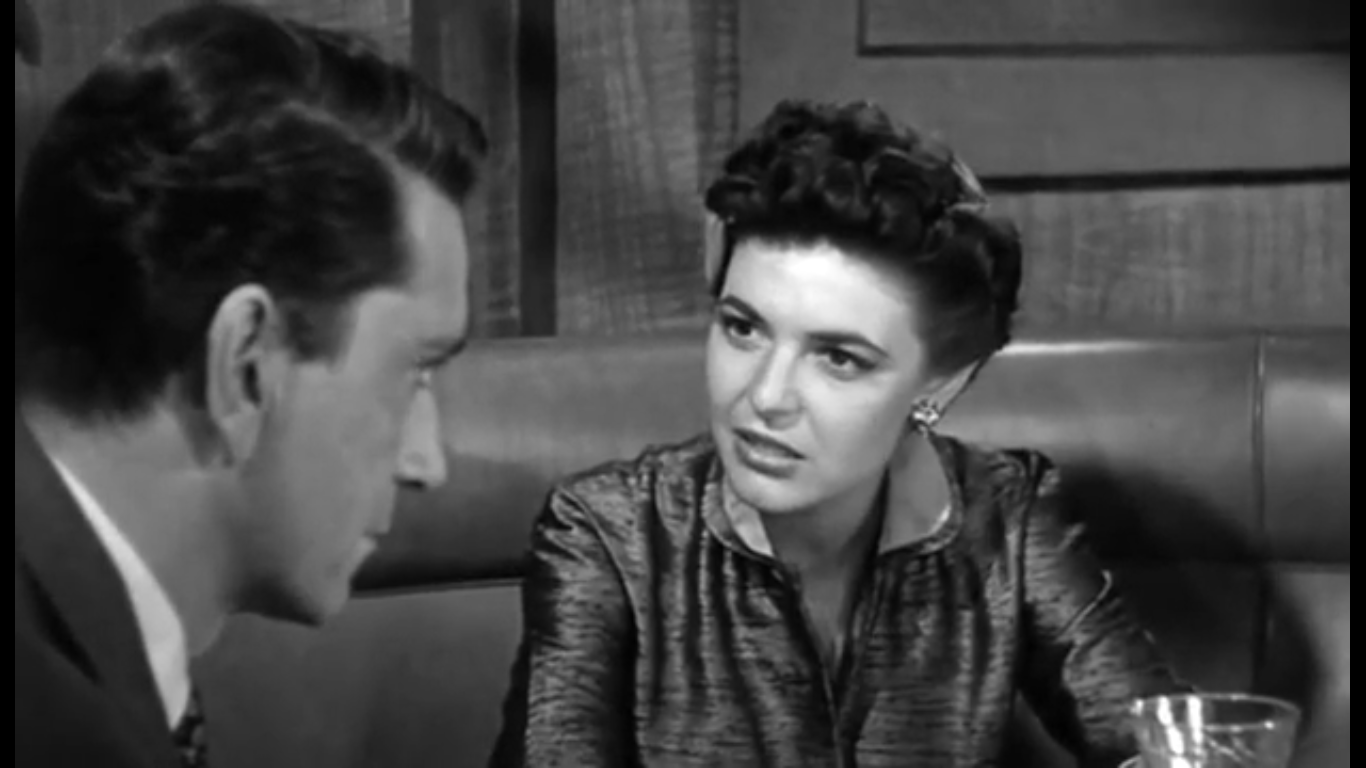
Then, Anne Bancroft shows up. She’s still an ingenue with breeding but also the spirit capable of clashing against her father’s own notoriety. He can never quite become respectable, and she must reconcile her affections for him while still loathing his brand of business.

Piety, decency, and legitimacy. These are the terms the movie must deal in because this is the world at stake. Father and daughter quibbling over blood money and splitting at the seams. Meanwhile, we sit by watching the story escalate. The paces feel mostly rote and all but inevitable. Again, the onus of the film falls on Conte, Crawford, and Bancroft as their dynamics give a human face and motive to a movie that otherwise feels mostly clinical in nature.

3.5/5 Stars

Shield For Murder (1954): Edmond O’Brien Gone Bad

In a movie like 711 Ocean Drive, Edmond O’Brien proved himself capable of being a cad over the course of his performance. With Shield for Murder, there’s no buildup or pretense. He establishes himself as a stone-cold killer right from the outset before we even get a peek at the credits. It’s a tough, uncompromising introduction and to his credit, he sells out to make his role of Barney Nolan one of his most memorable.

Having seen a decent number of his performances, I consider this a compliment because more often than not, he turned in spirited even gamely performances. Whether starring in B-grade features or supporting in A-listers, he had a knack of bringing something enviable to his parts — something you don’t soon forget.

In Shield for Murder, he’s a veteran cop with 16 years on the payroll. One of his colleagues (John Agar) is the first to the crime scene, and he gives Barney the benefit of the doubt because he owes the man his life. In truth, he idolizes him, and for very good reason. Barney’s the man who picked him off the street as a boy and straightened him out. You can’t just overwrite that history in a matter of minutes.

For the time being Barney is in the clear. After all, he’s on the side of law and order. At the police precinct, Emile Meyer brings a level-headed, no-nonsense stability to the role of the police chief. An in-office journalist provides a worm’s eye view of life inside the station’s walls. Being a veteran on the beat, he holds a jaundiced eye and remains skeptical of the crooked cop when everyone else believes in his integrity.

If noirish pictures require corruption and duplicitous activity in the shadow hours, then there also seems to be a prerequisite for female counterparts. The way the camera lingers over a scantily-clad Marla English looking herself over in the mirror almost feels indecent. It’s like another leering face.

What it does do so effectively is create a kind of instant juxtaposition. Because Patty Winters is the picture of innocence. English who was only 19 at the time, has such a warm face and this moment suggests a hint of insecurity more than any amount of vanity.

When we find out that she’s Barney’s girl, suddenly, their attraction fits together, and we can understand how they gravitate toward one another. They both hold something that the other does not. Even as her jealous beau orders her to give up her spot as a cigarette girl, he whisks her away to a model home.

Barney shows it to her proudly. It’s pre-furnished and the kitchen is full of all the latest appliances for modern living. They go to the master bedroom. It’s almost scandalous again, but they are so genuine and happy. This is the very evocation of the 1950s American Dream in suburbia. While he’s not rich, he’s a proud man. The money he acquires and buries on the premises are so he can take care of her. Never mind how he got it.

And yet that’s just it. If the pre-credits are like a violent sock to the gut, providing a first impression of this man, then all the humanizing events that follow cannot totally redeem his character. Surely there is a sliver of good in him. He hasn’t always been this way, but there’s also a sense it cannot make up for his sins.

First, it’s the bookmaker he shoots in the back. Then, it’s the deaf and mute witness left for dead on the stairs. These moments punctuate the story, and they act as staves between Barney and his friends. He’s driven away from them — holding secrets from them out of necessity.

In one memorable extended scene that feels a bit like an aside, Barney sits at the bar downing drinks. There’s a platinum blonde sitting nearby, who doesn’t speak for a moment. Carolyn Jones plays the woman, and she’s an effective foil for Patty — an alternative for the moment. They share a Spaghetti dinner, except Barney isn’t hungry. Instead, he pummels the two tails a local kingpin has set loose on him and leaves the family joint in a shambles.

The final act can only go one direction, and it’s the road of devastation. He becomes a wanted man on the run from his own colleagues, and the man leading the investigation is his best friend; no matter how uncomfortable the current situation , it cannot be any other way. It’s too late. Out of desperation and fear Barney wants to take Patty away. She doesn’t recognize the gravity of the situation. She becomes emotionally traumatized as he flees the scene.

Everything choice going forward only buys him more time. He dons his old policeman duds as a disguise. He seeks refuge with Richard Deacon, who’s hardly the criminal type. He’s busy poring over his academic textbooks as the desperate cop looks to broker a trip out of the country.

I’m pleased to say the finale actually works a bit better than the crescendo of 711 Ocean Drive, if only for the fact it localizes the action and makes it more accessible to all of us. We are able to understand the threat of the gunfight in such an intimate and ordinary setting. He has it out with a gunman at the Union Heights indoor swimming pool in a sea of shrieking bystanders.

But he must make it to his money at all costs. These final solitary moments we have with him totally crush any idealistic notions of the great American dream in post-war society. It blasts a hole right through the entire thing.

While Shield for Murder is blunt in its symbolism, there’s something rather poetic, even fitting, in how it chooses to wrap up the tragic trajectory of a cop who’s gone sour. He’s the good man — formerly a straight arrow — who watched his dream crumble around him. We see it firsthand. It’s brought on by his own aberrant desires.

However, thanks to O’Brien, it has everything you expect, nay demand, in a gritty crime picture totally immersed in murder and corruption. When the end titles come, they feel earned like the movie has delivered on the fatalism we want. There’s little that pretty or polished about it, and in the annals of noir that’s more than a good thing.

The star makes it more than worth the price of admission (especially in the 1950s). There’s probably not a sweatier protagonist, and in a noir film that plays like yet another compliment. He makes us feel his anxiety as well as his deceitfulness.

3.5/5 Stars

The Burglar (1957): Dan Duryea and Jayne Mansfield

The Burglar is instantly established with a pleasing visual geography. In fact, this kind of pervasively engaging visual landscape is constantly being reinforced, and in his first feature, director Paul Wendkos shows off his perceptive eye. Though he was a workhorse in television, it does lead one to wonder how an industry can so easily canonize certain names and so easily forget others.

But let me take a moment to laud the talents of Dan Duryea. He is such a fantastic bulwark to build a film around. He’s never one to garner prestigious fare, but all the pictures he was allowed to anchor have a certain predetermined grittiness to them that makes them feel inherently watchable. By now he’s older and not as sturdy as he used to be. But that face and his demeanor are still very much the same.

Jayne Mansfield had yet to reach meteoric stardom when the film was first made, although it was re-released a couple years later to make a profit off her newfound celebrity. What a stark and thrilling contrast it is to her usual bombshell image in the likes of A Girl Can’t Help It and Rock Hunter. It feels reminiscent of Marilyn Monroe in Don’t Bother to Knock or maybe Niagara.

When glam girls are allowed to be something more than just a pretty face, it can be remarkable because we see them less and less as objects and more like human beings. Their emotions touch us, and they feel real with problems and issues in drab black and white as opposed to luscious shades of Technicolor.

The Burglar is conceived in such a depressing world. It opens with a Newsreel about Sister Sarah a pseudo-religious figure who lives lavishly thanks to the goodwill of some of her faithful benefactors. This subject in itself feels worthy of more dissection, but it’s really only an opener.

We realize of course this is all pertinent exposition. Nat Harbin (Duryea) and his cronies plan to get within the iron gates of her mansion and run off with as much as they can. However, they know they only have 15 minutes to pull the job while Sister Sarah watches her favorite news broadcast. That’s not much time barring any further complications…

It’s such a sweltering opening full of tension and real dramatic heat. Surely, the movie cannot maintain this kind of fervid criminal activity for the rest of the movie. Of course, it can’t and part of this is the function of the story.

They get the loot but now they must wait it out — we watch their nerves and relationships unravel around them — as the authorities begin their search. Except it feels less and less like your typical police procedural. It has more going for it — partially thanks to David Goodis’s script.

The pieces don’t all fit together seamlessly. They sort of bump up against one another and slide into place. It’s not always taut, cogent, or particularly pithy, but there’s an inbred existentialism and weariness dancing around the corners; it’s difficult to shake.

This melds quite well with the grungy, sweaty cinematography that feels suitable for the burgeoning TV market. At one time it can be both claustrophobic and artful in its construction of mise en scene. It’s the antithesis of decadence, but that doesn’t mean the frame isn’t packed with intriguing visual landscapes.

Martha Vickers also gets her second noteworthy femme fatale role a decade after The Big Sleep — too bad she couldn’t be bequeathed more of them. She had a knack, and it’s no different in The Burglar, although she doesn’t show up until well into the movie.

Simultaneously, the manhunt continues and Nat finds himself being tailed by a shadowy stalker who seems to have a far more private interest in what they are doing. If neither one of these threats comes to fruition, then the gang will probably end up imploding out of mutual distaste. Though they work together out of necessity, they also come to loathe each other’s guts, especially in such close proximity under constant duress.

Duryea is protective of Mansfield, but it’s more of an obligation than affection. He’s made a vow now buried in their past somewhere. He sends her off to Atlantic City for her own safety, but as the movie bowls over, he has no recourse to follow her there, regardless of the danger he brings in his wake.

Coney Island-like atmosphere provides a wonderful visual contradiction to play off the criminal elements that hold the impending tinge of noir-filled doom. It uses the shrieks and ghoulish attractions of a carnival show like many of its great noir predecessors — Brighton Rock, Lady from Shanghai, Woman on the Run, and Strangers on The Train all spring to mind. It certainly deserves at least a mention in this company.

Duryea and Mansfield make full use of the place going from the boardwalk to a house of horrors to a water show, and as the benches clear out and they’re left alone in the cavernous space, it signs the end of the story with one fatalistic final act. Of course, it feels like a foregone conclusion. These pictures rarely end another way. The inevitable catches up with them.

But what I will remember indelibly are some of the individual shots. The Burglar has some of the most epic perspective shots I can recall in recent memory. They punctuate the film like many of the close-ups, and we are left with something so resolutely impactful. It feels like a flawed diamond in the rough. It’s the kind of unwonted gem you won’t soon forget even as the blemishes slowly fade away.

3.5/5 Stars

The Sound of Fury – Try and Get Me (1950)

The Sound of Fury opens with a kind of portent. A demonstrative street preacher yells out at the pedestrians walking by to “Prepare to meet thy God and Repent of their sins.” He pretty much gets trampled with all his pamphlets ending up on the ground in a sea of humanity. It’s really not all that important why it happens, but it does show the indifference and the frenzy that so easily overtakes the masses.

Howard Tyler (Frank Lovejoy) is a man down on his luck with a wife and son to provide for and no job. Life has hit the skids. At home, his demure wife (Kathleen Ryan) pleads with him to find work because every day she’s begging for groceries, and trying to make ends meet. With her pregnancy and a little boy always asking his Pop for stuff, it’s enough to make a guy despondent. He feels totally useless.

It’s in moments like these where honest living seems to give you zilch, only heartbreak, and it’s easy enough for decent men to get enticed by evil. It starts innocently enough, and it’s all for the sake of a buck as Tyler gets seduced by the sirens of noir.

I use this metaphorically because what really does it is a meeting in a bowling alley. He goes there to drown his sorrows. Instead, he meets a confident man finishing up a frame named Jerry Slocum. Slocum’s swimming in dough with fine threads and not a care in the world. Howard looks at his life with envy.

Years before Michael Jackson, Lloyd Bridges proves himself to be a smooth criminal. You probably already can see where this is going without it being spelled out. However, in order to make it explicit, Howard signs on as a getaway driver. He keeps the motor running as Jerry cleans out the cashboxes of local gas stations.

Suddenly, they’re both implicated in a life of crime. At this point, there is no salvaging their lives, as they submerge deeper and deeper. They go so far as to kidnap the son of an influential man. This is far bigger than Howard ever dared to imagine, but he cannot get out — not now.

The Sound of Fury looks to integrate a few more characters. Initially, we don’t know how they fit exactly. It’s a dinner party. A man and his wife. They have a house guest and then his editor (Art Smith) from the newspaper drops by. He’s trying to get his top columnist to look into some local robberies. They hold a discourse on the destruction of public health, sensationalism, and social responsibility of the press. It all feels a bit didactic if altogether well-meaning. It also has no power to save Howard.

The kidnappers send out a ransom note and wait. For Jerry, he plays it cool. It comes naturally as he reunites with his best girl (Adele Jergens), an opportunistic blonde who has dreams of leaving her crummy life behind for the exoticism of Havana. She doesn’t care how Jerry bankrolls it; she’s just impressed that he can. They’re like fire and ice constantly scorching each other and making up just as ferociously.

Lovejoy is coupled up with the other girl (Katherine Locke) in the back seat. If not for the fact that he’s already married, they might be a decent match because they both have a similar propriety and quiet humility. Alas, it can never be. Not only because of his family life but they’re also embroiled in a crime that cannot be easily brushed off. There’s no turning back.

When they pull up to a club with the girls it’s almost like watching a film through funhouse mirrors or something with contorted angles distorting the floorshow and all the gaiety on the floor. It’s totally unnerving. This is just the beginning as Lovejoy’s character falls to pieces. He’s not made for this life of duplicity. It unhinges him as he implicates himself and the film begins to run on this wild energy that will see it through to the end.

It’s the final moments of the film where it stakes its entire reputation as we face an onslaught on so many fronts: visual, emotional, and psychological. We watch the masses descend on the courthouse to gawk, condemn and belittle the criminals after they are brought in. There is no quelling the tide of the momentum and from thenceforward the movie gets carried away by the mob.

Evoking the same ardent energy of Fritz Lang’s Fury (adapted from the same source material), it’s a bit like a modern storming of the bastille. The culprits fly through the jail like apes and howling banshees, and the feeble attempts by the police to maintain any semblance of law and order are quickly snuffed out.

Many generations later, The Sound of Fury feels like one of the most obvious pleas against the swells of McCarthyism in the company of more notable indictments like High Noon or even Invasion of the Body-Snatchers. It’s not merely about the narrative speaking volumes, but the resulting effect on many of its cast members. Cy Endfield was soon forced to flee to England, and he would finish the rest of his career abroad.

The great character actor Art Smith — memorable in everything from Ride the Pink Horse to In a Lonely Place would watch a reliable career go down the tubes. Lloyd Bridges was also affected although he was able to find some relief by cooperating with HUAC. So while they weren’t lynched, it was men like these who were given a damning choice.

They could name names or hold fast and commit career suicide, receiving all the ignominy that came with such a choice. Neither could they stop the tide of fury leading to blacklisting and self-exile, and worst still, they probably more than saw the writing on the wall. There’s nothing more terrifying. You see the malevolent forces at work, and you’re powerless to do anything about them.

The parallels between the movie and real life hardly point-for-point between two killers and accused communist sympathizers. What’s relevant is the wide-ranging reaction top-to-bottom, be it fear or this kind of embittered, hate-filled retribution. Suddenly there is no place for civil discourse. Emotions, which are not inherently bad, begin to boil over and dominate the social spheres.

I’m not an authority on the Red Scare or McCarthyism, nor did I ever experience the full brunt of the Cold War, but even as the issues change and the times with them, at our core, human nature always seems to adhere to the same patterns. True, we are predisposed toward avarice and turpitude, but even our battle cries for justice fall far short.

The fact that the movie was released under two titles and never truly caught on or that Endfield is not more of a household name feels like a cruel sign of the times. Watching it now, from its opening images of a fire and brimstone street preacher to the devastating final acts of violence, it’s sure to rattle the cage. Hopefully, now, we’re better able to appreciate it, and heed its warnings on the state of humanity.

3.5/5 Stars

Confidentially Yours (1983): Fanny Ardant, Hitchcock, and Truffaut

This is my Entry in the Classic Movie Blog Association’s Fall Blogathon Movies are Murder!

Although no one knew it at the time, Confidentially Yours would become the makeshift curtain call to Francois Truffaut’s career as he died of a brain tumor shortly thereafter. The movie in no way makes up for the works we lost out on, but there are some fitting summations worth appreciating. Truffaut cast his latest muse, Fanny Ardant, in the lead role — subverting the prototypical blonde Hitchocockian heroine.

Like her predecessors, Ardant is winsome and brave, whether in stage garb or a trenchcoat in the tradition of noir working girls like Ella Raines or even Grace Kelly. They’re capable of being both intrepid and alluring on screen as the dauntless motor behind the story.

It’s true the film’s plot, execution, and sense of style owe a debt of gratitude to Truffaut’s cinematic hero. Like Alfred Hitchcock’s film Stage Fright, Confidentially Yours covers murder and the performative aspects surrounding it.

There’s a kind of duality because Ardant is not only a secretary embroiled in a local murder, but also moonlights as a stage performer at night even as she dons various parts throughout the movie to aid in her detective work. Much of this fades away as mere pretense as we get deeper and deeper into the nitty-gritty world of old-fashioned noir.

Confidentially Yours boasts a brisk beginning befitting a more contemporary film: A man is brutally shot out at a pond, and there’s only one obvious suspect. Truffaut implicates his own star through the cut because the first image we see after a bloody murder by a faceless perpetrator is Jean-Louis Trinitnant walking back to his car. He sees a nearby car door left ajar, and he closes it before returning to his own vehicle and driving off. When the police come to question him later, he seems to slip up in his story.

Surely he’s a guilty party. He has motive. His wife was unfaithful, and now one of her many boyfriends is dead. What’s more, Trintignant plays him as a brusque character — he’s not winning any awards for likeability — and yet these are not the metrics for guilt and innocence as we’re probably already all aware of. To use a staid figure of speech, people are often more than meets the eye.

Also, there’s the question about fingerprints. He left them all over the crime scene. Either he’s an incalculable fool or there’s more to the story. Ardant occupies an unenviable position. She seems to be working for a guilty party, she’s given the ax by her embittered employer, and yet she still finds some compulsion to begin poking around.

She starts sleuthing, coming into contact with a melange of lawyers, policemen, and shadowy undesirables. It’s easy to get bogged down by what feels like an incomprehensible cascade of plotting, but isn’t this the point? It’s not the particulars but the means of getting there proving the most important, and Ardent is one of the most supernal vessels we could possibly imagine. Somehow she seems like the predecessor of Hayley Atwood with the poise of Isabella Rossellini thrown in for good measure.

One of the film’s other lasting assets is the gorgeous monochromatic tones of Nestor Almendros. It proves to be an immaculate act of mimesis plucking the movie out of the ’80s and allowing it to drift into that timeless era of yesteryear that only lives in the thoughts and recollections of our elders who experienced the world and dreamed in black and white.

As her employer stays mostly anonymous behind his shuttered-up storefront, Ardant becomes his hands and feet, searching out a ticket taker at a movie house, and then leading to a nightclub. Later, she looks to infiltrate a prostitution ring using all her wiles to spy out the window of the lavatory. Eventually, her tenacity is rewarded, and she does what the police seem incapable of through normal channels.

Truffaut for me will always be one of the most ardent cinephiles with the likes of Martin Scorsese and a handful of others. Men who often made fantastic, exhilarating films, but not out of a debt to mere craftsmanship or technique. It’s so palpable how much they love these things. Their films can’t help but smolder with a boyish fanaticism they were never quite able to shake.

Scorsese still seems to make a young man’s movies with an old man’s themes, and even though we lost Truffaut at 53, hardly in the autumn of his life, he had some of the same proclivities. He loves the genre conventions of old. There’s almost a giddy enthusiasm to do his own Hitchcock movies like Shoot The Piano Player, Mississippi Mermaid, The Bride Wore Black or even this final entry.

And yet on the other end of the spectrum with the likes of Antoine Doinel, The Wild Child, and Pocket Money, he managed to tap into these deep reservoirs of emotional soulfulness. It feels as if adolescence is incarnated and imbued with empathy by someone who never quite left that life behind.

Since Godard still manages to have an influence on cinema culture as one of the revered old guard throughout this century, it remains a shame we lost Truffaut so prematurely. He still lives on through his films and the admiration of others like Steven Spielberg, but I do feel like if he was still alive today, his love of the movies would be equally infectious if not more so. I suppose it makes the catalog he left behind all the more important.

I didn’t consider until this very moment, but with “confidentially yours” the director is leaving us with his final valediction before signing off. It seems fitting his complementary farewell drips with the pulp sentiments he relished starring a lady whom he loved.

4/5 Stars

Note: This review was originally written before the passing of Jean-Luc Godard on September 13, 2022.

He Walked By Night (1948): Richard Basehart and John Alton

He Walked by Night is akin to T-Men or Border Incident in its pervasive use of “Voice of God” narration. Today, all of this feels blasé and staid like newsreel footage without much substance. Over time, the voice feels a bit like a pesky mosquito not so much in tone or frequency but simply in his tendencies. He won’t leave us in peace. What he is worth are a few minutes of civic history circa 1948 for those invested in knowing something about the distant past.

The real juicy bits are when noir seeps into the equation. To set the scene, there’s a cop returning home from his beat late at night; he sees a mysterious-looking figure loitering around a shop. He confronts the passerby, and the fugitive opens fire.

Quickly, the wheels of justice are notified on the switchboard, and the police force is mobilized to track down the fugitive who vanishes into the dead of night. Like any of these sorts of police procedurals, most of our “heroes” are innocuous types with a chiseled jaw and voices made for straightforward “just the facts” television — Scott Brady and Jack Webb among them.

In fact, Webb would use the experience of this movie to bring a little program called Dragnet to the radio waves. It would take on a life of its own with two subsequent runs on the newly minted medium of television. He Walked By Night is of the same ilk.

Very few of the characters impose any sort of will or inventiveness on the story. It’s strictly by the book with John Alton putting everyone else to task. Boy oh boy could he shoot a gorgeous movie; it shows in every frame.

There is one challenger to Alton’s preeminence because Richard Basehart’s performance stands out, and it’s the most visible and elegant opportunity at something memorable. Everyone else is an average Joe or a victim. He actually gets to do something and embody an enigmatic character with multiple layers and compulsions. Set off by his matinee idol good looks and tentative demeanor, he erupts with wrath creating an indelible impression.

If there’s any downside, it’s only a minor qualm he probably had little control over. There’s never an appreciation or at least an understanding of the killer. In 1948 the movies weren’t ready for that, but it’s part of what makes the movie feel rather sterile. It’s all about the case, which while somewhat contentious, plays out in conventional parlance. The exhibition in style more than makes it worthwhile, but He Walked by Night feels fairly paltry in narrative terms.

It’s true that the real events have a tinge of cinematic drama and in the post-war years, these kinds of hard-fact docudramas were in vogue. But with this being based on a real killer and genuine terror, the creators cannot sketch too much in any way that makes the audience too uncomfortable.

Again, where it deviates or rather executes to the most sublime is through the photography of Alton. It punctuates and accentuates the story in ways that are irreducible. You simply have to marvel and people have done so for generations. If you want a solid representation of film noir, this is it, hook, line, and sinker.

Take a scene midway through the movie where the cops have gotten in touch with a shop owner (Whit Bissell). He unwittingly did ongoing business with the wanted man — not knowing the evasive Roy was actually a violent kleptomaniac. In fact, Roy returns to the electronic dealer’s office wary of a trap.

It’s here where Alton finally gets another chance to spring into action, exerting himself on the movie and forever changing its course. The shadowed interiors bisecting Basehart’s face as he slinks back into the darkness are positively sumptuous. The sound design proves equally striking; we don’t hear any scoring, not one foot hitting the ground. It gives it this almost illusory quality. These are phantoms at work.

When they put out his description, and he’s forced on the lam, it’s the next progression in the picture’s glorious dragnet of immersive chiaroscuro. Basehart makes a daring escape on the rooftops with a getaway set up for just such an occasion. Then, he escapes into the catacombs of the city evolving into a full-fledged storm drain noir. I’m accustomed to the waterways of Vienna as opposed to the sewers of L.A. They play just as well in what becomes a defining moment of the film.

Pounding feet and flashlight beams spell impending doom as they encroach on the fugitive’s position. It relies even more on the juxtaposition of light like a knife in the dark. I know my own timeline is not chronological, but if I had never seen The Third Man, He Walked by Night’s finale would feel even more novel and like a truly slam-bang finish. It accomplishes so much through visual tension and delivering on the manhunt that has been going on throughout the entire movie. There really is no better way they could have gone about it.

Until the very end, He Walked by Night is a performative war between the by-the-book sense of realism that feels like post-war convention, and then the manic, slightly repressed expression that burst forth only after hours. It’s no contest and this bodes well for this ’40s crime procedural.

3/5 Stars

Desperate (1947): Anthony Mann Noir

It’s easy to imagine Steve Randall (Steve Brodie) has the life of many men circa 1947. He’s a war vet, and he makes an honest wage as a truck driver. Brodie and the effervescent Audrey Long are stars befitting the budget of the film, but I rather like them for it. There’s nothing prepossessing about them, and we appreciate them for their sheer likability; they’re humble, honest folks.

From the first instance they’re in a room together, they also prove themselves to be an adorably in-love couple, between flowers, anniversary cakes, and news of a baby on the way. It certainly is an auspicious beginning, and yet it’s all so wholesome; it feels like an instant tip-off that this picture is going to hell very fast. It proves to be the case.

Because Steve gets a call to carry a special load of goods. He doesn’t think anything of it, and he could use the extra dough on his salary. Only too late does he realize his old friend is asking him to haul stolen merchandise. This wasn’t what he signed up for, but they don’t care.

Raymond Burr fortuitously has a reputation for playing the pertinacious district attorney Perry Mason because without that there’s little doubt he would be forever immortalized as one of the most vicious baddies ever conceived in the age of noir. There’s something between his piercing eyes, the command of his voice, and his formidable frame that just leave an instant impression. He knows how to use them to his full advantage in the role of Walt Radak, a merciless criminal who also has a protective streak when it comes to his kid brother.

This is crucial because, in the botched burglary, it’s his brother who is taken by the authorities; the other thugs are frazzled but get away, and all of a sudden Steve is in a load of quicksand sinking fast.

Arguably, the creative apex of the film — or at least its fundamental allure — is suggested in a low-lit sequence in the gangster lair. Steve is cornered and Walt is ready to rough him up, literally knuckling the camera. Moments later, the man’s face is disfigured by a jagged bottle, and he’s pounded to a pulp under a swinging light fixture. We don’t see it explicitly, but the scene is so violently expressive; it’s all the more evocative thanks to this very specific stylization. It’s noir at its finest courtesy of Anthony Mann.

Although maimed, Steve does get away, and he whisks Anne out of town, disregarding her pleas for him to go to the police. He’s scared, worried for his wife’s safety, and he wants to vindicate himself before going to the authorities. What it means is that both Walt and a wry police detective named Ferrari (Jason Robards Sr.) are looking for him, and only time will tell what happens when one of them finds him.

They trade out the urban apartments, trains, and trucks for rural farm life, which becomes a kind of escape valve accentuated even visually. It’s the film’s moment of reprieve as they are immersed in Anne’s doting family who agree to throw her a true Czechoslovakian country wedding — what they never had time for before — and they dance the day away.

The ending is already inevitable. Walt’s slimy private dick (Douglas Fawley) is able to locate Steve, and the vindictive mobster comes ready to pay the fugitive a call. With his baby brother’s impending appointment with the electrical chair, he’s bent on having Steve knocked off at the exact same hour. He might not be able to save his brother, but he can get some semblance of revenge. It’s an eye for an eye mentality with noirish stakes.

When they’re finally thrown together in Steve’s apartment, Mann’s not messing around, and the film’s climax delivers both in its theatrics and as an extraordinary exercise in substantive style. Between the music, the smoke, and the nervous rat-tat-tatting creating the cadence of scenes, he goes into those fabulous claustrophobic close-ups of all his main players and the ticking clock smashed together as one. They create an excruciating effect because we know when the time runs out so does Steve’s life.

Mann milks the moment for everything it’s worth and his handling of time is so very effective. There’s not an ounce of realism in the scene. Maybe we have a dining room table, a kitchen, a fridge, but everything else is fabricated and manipulated to ratchet up the tension of the moment. The results speak for themselves.

The final shootout on the stairwell of the apartment building is yet another feat of ingenuity using everything at his disposal from the visual motif to the shadows, even frightened neighbors opening their doors momentarily only to slam them again.  It all culminates in the final crescendo and the ultimate release of anxiety.

It’s easy to see Anthony Mann coming into his own and what a stunning creative force he was. Desperate doesn’t garner too many laurels today, but it capably highlights what makes Mann such a popular journeyman filmmaker. There’s so much grit and tenacity stamped into the very fabric of his genre pieces, whether film noir or his later westerns with Jimmy Stewart. There’s nothing lifelike about them, and yet he magnifies the tension so much so that they function as such a blistering exploration of crime and vindictive human psychology.

3.5/5 Stars