The Prowler (1951)

the-prowler-1The whole thing turned on a freak accident. You’ve got to believe that Susan.

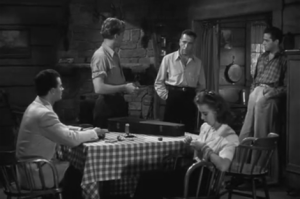
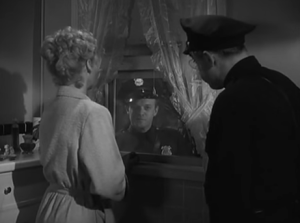
The Prowler doesn’t waste a moment of time with its opening credits as we are privy to a woman shrieking from within her bathroom. Why is fairly obvious. There’s a voyeuristic prowler on the loose and the police must be called on the scene. The men on call are Webb Garwood (Van Heflin) the discontent young gun and Bud Crocker (John Maxwell) the genial veteran. They search the premises, meet the flustered gal (Evelyn Keyes) and leave her be with no signs of a prowler remaining.

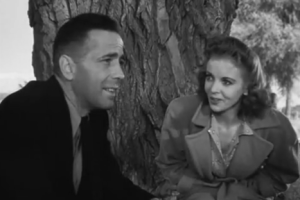
In fact, from that moment onward the prowler is only a phantom, a figment of the imagination, a convenient scapegoat. But blacklisted screenwriter Dalton Trumbo also cleverly uses this “person” to move his story forward seamlessly. The stage has been set. Our young cop has his interest piqued. Here is a beautiful, seemingly lonely woman and he can be her knight in shining armor. He’s taken by her and drops in on her with the pretense of monitoring her safety. In such a way, the narrative progresses into a love affair and an adulterous one at that. Because Susan Gilvray is married to the man who is always on the other end of the radio (ironically voiced by Trumbo himself sneaking his way into the film). He talks to her from far off and rather like the eponymous prowler, he too seems an almost otherworldly phantom haunting both Webb and his girl in their deceit.

It becomes obvious soon enough that Webb is the most crooked cop on record as he sets up a scenario that is tragic and he casts himself as a victim of circumstance. But it’s all orchestrated in such a way that Susan is free of her marriage and Webb receives the sympathies of the general public in the ensuing court proceedings. Soon after the drama has subsided, the pair of clandestine lovebirds turn around and get hitched. The next stop on their journey together is out to the desert as the action gets transplanted. Webb is keen on running a hotel and seeing a bit of the desolate country his former partner was always touting.

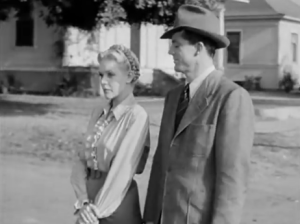
It’s in this back half where director Joseph Losey is able to develop his second major locale the ghost town of Calico which becomes the stark backdrop for the final act. It’s in such a setting where the couple looks to flee their misdeeds but they’re already so far gone, caught up in a lie that they cannot hope to mitigate. And that’s the tragedy. Webb cannot help to give up the lie even even with the love that he has found. Worst of all, it never was love at all.

Van Heflin was mostly an earthy, rough-hewn sort of actor but in the Prowler he’s surprisingly slimy and it’s a joy to watch him in that kind of role. Meanwhile, Evelyn Keyes is quite pretty and evocative but there’s almost a weary gauntness to her that’s hard to pinpoint. It hints a little bit at the hollowness and fleeting aspect of this romance that initially enraptures her but leaves her disillusioned. Also, the fact that Webb is surrounded by chummy average Joes like Bud and the dead man’s brother (Emerson Treacy), it just becomes more obvious how corrupted he is. Because it’s these real square, true blue individuals who willingly vouch for his character when he has none. They trust him completely when there’s nothing but deceit within him.

Dalton Trumbo is certainly ripping a few pages out of the likes of Double Indemnity and The Postman Always Rings Twice, but he does a master class job to the glory of the B pictures. And he really only seems to falter once. Although it’s a major plot point, a turning point, it somehow hurts the film that we see Susan’s husband in the flesh. It’s only for an instance, but in that instance, he loses that phantom quality. He’s real and far from being haunting, the fact that we know him, makes this story sad really. In the end, we realize The Prowler in the expected sense, never existed. It was all an apparition, a figment of the imagination, simply utility for one man’s avarice.

3.5/5 Stars

Born to Kill (1947)

born-to-kill-1If you know what you want in life be sure of it and you can’t miss. I found that out early.  ~ Lawrence Tierney as Sam Wilde
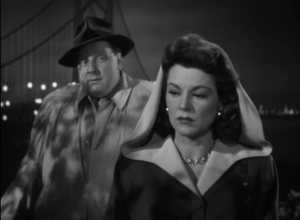
Reno was always a Hollywood euphemism. What it stood for, of course, was divorce, a dirty word given the sensibilities of the 40s and the 50s. But then again, being the dirty, licentious, pernicious movement that it was, divorce is a perfect starting point for film-noir. That’s where we first meet Helen Brent (Claire Trevor) as she walks down the front steps of the courthouse.

She’s free of her former husband and about to leave her current residence to be closer to her sister back in San Francisco. She also has a wealthy beau on tap who seems to fit her well-to-do, refined nature. In fact, Claire Trevor is different than perhaps we’ve ever known her before, tempered and proper from the higher echelons of society — hardly a femme fatale — so it seems.

Except that’s not quite the case. Put her in contact with a certain type of man, a man of brute aggression and unfettered jealousy and she’s bound to get into trouble. It happens rather haphazardly as Sam Wilde stiff arms his way into her life. Because, the fact is, that is how he does everything. Their meet-cute happens over a craps table of all places. No words are spoken. They give each other the eyes. He is just off a fit of rage and she is looking to return home. So in the end, they wind up together, drawn to each other.

But she is spoken for, and not to be impeded by anything Sam easily shifts his sights on Helen’s younger foster sister Georgia (Audrey Long) who actually holds the wealth in the family after receiving a great inheritance. That suits Sam just fine as he closes in on this new prize. Georgia in her innocence is taken by this new man. Meanwhile, Helen at the same time abhors this man pursuing her sister and still madly desires him in some twisted way. Their affair is as passionate as ever.

born-to-kill-2However, evil always looks to catch up with the guilty party and a private investigator is poking around in all the places he can to find the culprit behind an egregious crime. Walter Slezak’s Albert Arnett is a witty sleazeball with the lowest scruples imaginable when money is concerned. But he also happens to be decent at his occupation bringing him to San Francisco in pursuit of answers.
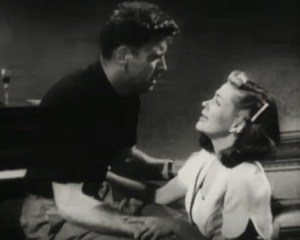
Sam is assisted by his faithful accomplice Marty (Elisha Cook Jr.) showcasing his ability with playing crooked pushovers. In the meantime, Helen finds herself losing her fiancee in the drama while being blackmailed by the shady Arnett.

There’s now nothing buffering Helen from the explosive evil in her drawing room. Her sister’s life is torn apart and Helen and Sam must have it out once and for all. They’re too deadly — too volatile for their own good — as everything around them begins to unravel and implode. We expect nothing less in the end.

For being a lesser star, Lawrence Tierney undoubtedly made a killing off his fist-throwing brusque tough guy roles. He’s no turnip, as he puts it, and if there ever was a homme fatale — a deadly male — he most certainly would be the gold standard…

I find more bitter than death the woman whose heart is snares and nets and he who falls beneath her spell has need of God’s mercy.” This is a bit of poetic observation from Slezak but there’s also a tremendous resonance to what he says quoting straight from the Bible’s wisdom literature. But perhaps this wisdom also goes both ways since it’s not just the woman who is fallen and corrupted but most certainly her male counterpart. Humans were not Created to Kill but over time they have been Born to Kill and Born to Die too. There’s a difference and that really is the tragic lot of humanity as we know it. Vanity of vanities everything is vanity. 

This is without question Robert Wise’s toughest, deadliest, grittiest picture. He never made a film with more vices or more despicable characters. Imagine, a character who kills for no good reason at all. Just because someone gave him the cold shoulder. It really scrapes the darkest recesses of the barrel. The way of the transgressor is hard. More’s the pity. More’s the pity. It’s cynical too.

3.5/5 Stars

Criss Cross (1949)

criss_cross_1949_trailer_2Aesthetically, Robert Siodmak’s roots in German Expressionism are crucial to the formation of the film-noir world as we know it today and Criss Cross has to be one of the most diverting additions to his repertoire. Once more he’s paired with his star from The Killers (1946) Burt Lancaster with another raging score from Miklos Rozsa and yet again there is a heist involved. However, whereas the film inspired by Hemingway’s original story was a story about a washed-up boxer — a humble Citizen Kane if you will — with some criminal elements mixed in, Criss Cross is all thriller. It represents the subset of film-noir that is the heist film, but it would hardly be film-noir without something going terribly wrong. This event is integral to the plotting as is the love triangle that becomes the main axis of the ensuing action.

The location shooting throughout L.A. is put on display in the opening shot when the camera swoops down on a parking lot right outside a lively nighttime watering hole known as the Round Up. In these early stages, Siodmak reels his viewers in with a seductive close-up of Yvonne De Carlo looking straight at Burt Lancaster, her lover, except in looking at her man she’s also staring directly at the audience as well with those earnest eyes of hers. And from that point on her role as a femme fatale is cemented for good.

We know she’s undoubtedly nothing but trouble and yet we cannot help but be strung along with Lancaster. After all, someone that beautiful cannot be all bad, right? They never are, right? And we spend the rest of the film grappling with these questions, although the worst is always inevitable. So it goes with Criss Cross.

However, for the audience to try and understand the stakes of the story, most of the great film noirs develop the character’s pre-existing life as much as they magnify the moments of immense conflict. Criss Cross begins in the middle but soon flashes back to when Steve Thompson (Lancaster) first returns to Los Angeles, the sparkling city where his family lives as well as his former wife Anna (De Carlo). And despite the sirens going off and the chiding of friends and family including his mother and his concerned cop friend (Stephen McNally), he finds himself attracted to her once again like a moth to a flame.

He’s soon infatuated once more, embroiled in passion and at the same time petty bickering, tied up in complicated knots as Anna is also seeing the gangster Slim Dundee (Dan Duryea) who doesn’t take kindly to having another man around. In immaculate fatale fashion, Anna plays everyone off with a certain degree of vivacity and at the same time deadly innocence. One moment lively and carefree, the next biting and selfish. You can never pin her down and Steve never does. Still, he’s devoted to her. He goes half-way on a heist with his bitter rival just to save face and subsequently finds himself knee-deep in corruption that he never dreamed of, all because of a girl.

But aside from dealing with a guilty conscience, he still must survive a vengeful gangster.  The number of crisscrosses isn’t all that important, only the fact that they happen and on numerous occasions. The film finishes up with a gloriously fatalistic ending that while abrupt, in typical Classic Hollywood fashion, still delivers a satisfying final conclusion, going out just as it came in, with a rewarding dose of noirish intrigue.

Echoing the words of Proverbs, “The lips of an adulterous woman drip honey, and her speech is smoother than oil; but in the end, she is bitter as gall. Her feet go down to death.” That about sums up Criss Cross: an exhilarating and altogether deadly exercise from Robert Siodmak. Those questions still burrow into the back of our mind to the very end. Was Anna really insidious or just misunderstood? We’ll never know exactly. But perhaps the results speak for themselves. Anyways, that’s for each individual to judge on their own.

4/5 Stars

Spider-Man: Homecoming (2017)

220px-Spider-Man_Homecoming_posterThis was yet another pleasant surprise. Just when I think I’ve finally washed by hands of superhero movies the cineplexes are blessed by two pictures like Wonder Woman and then Spiderman: Homecoming. And they couldn’t be more different. Still, as much as Wonder Woman was invested in its heroine, you get the sense that the crew behind this film care some about Peter Parker too.

Peter (Tom Holland) is living the dream. He got to do battle with the Avengers and Tony Stark has taken him under his wing and he has video proof of it all. He’s expecting great things. He’s expecting to leave the drudgery of high school classes, band, and academic decathlon behind.

Except for most of the film, he is relegated to thwarting small-time crime and he never gets to fight extra-terrestrials or other unearthly beings from outer space. It’s precisely this point that suggests there’s something profound about this character without any of that added white noise.

It’s the very fact that Peter is struggling with his own identity, how to be Spiderman and keep it a secret while simultaneously trying to realize the full extent of his abilities. He’s walking a tightrope because he wants to tell his Aunt May (Marisa Tomei) and he wants Mr. Stark’s right-hand man Happy (Jon Favreau) to call him up for his next assignment so he can prove himself. And yet nothing happens like he wants. No one takes him quite as seriously as he wants. After all, he is a teenager. As some famous philosopher once noted, “with great power, comes greater responsibility.”

But Tom Holland imbues Peter with a genuine likability that lights up his performance from end to end. This guy isn’t a jerk or a moody loser. He falls somewhere in the middle, making idiotic decisions but always because he believes them to be right in that wayward teenage brain of his; he only gets distraught because in his world Spiderman is all he has. Without it he is nothing. That’s his own insecurity speaking.

In one scene that’s undoubtedly meant to be impactful and which subsequently gets referenced later, Tony Stark takes away Peter’s suit after a debacle with an ocean liner and in so many words he says that if Peter needs his suit to be someone then he doesn’t deserve it. Maybe this and the related scenes are needlessly overt in reflecting our hero’s fall and redemption but if nothing else they cast our protagonist in a positive light. He is one of us.

Another thing that constantly reminds us of this fact, has to do with the world and characters he is surrounded by. First of all, the writers do something fairly refreshing and they give him the honor of fighting a villain who is grounded on earth — a man (Michael Keaton) just trying to provide for his family. He is vengeful when the government (Tyne Daly) cancels his contract in favor of the affluent private corporation of Stark Industries. It’s a very real issue wrapped in a superhero film similar to Civil War’s antagonistic dilemma, part of what made that previous film and this one compelling.

But whereas that was a battle among friends, this picture is understandably a high school story. In fact, I couldn’t help noticing the John Francis Daley/Jonathan Goldenstein writing credit not to mention the inclusion of a certain decathlon advisor (Martin Starr) making it hard not to draw up a minor Freaks & Geeks connection.

Honestly, it’s hard to put Spiderman on that level but it does begin to tease out the high school experience as Peter is forced to live a double life while chasing after Adrian Toomes and his clandestine arms operation all across town. Because just as important are his friendship with his Star Wars-loving best bud Ned (Jacob Batalon), teenage crushes, parties, National Decathlon Championships, and, of course, Homecoming.

That’s the beauty of this story. It never tries to take on some epic agenda but far from settling it finds the importance in both the hero’s journey and the growth of someone in the throes of their adolescence. Peter knows that his nighttime activities are hurting his relationship with his aunt and hindering anything that could be between him and his amiable dream girl Liz (Laura Harrier).

The film’s greatest twist (which I’ll consequently omit)  is a beautiful bit of storytelling because it links together Peter’s two worlds so openly. Before they were two entities crisscrossed and tied together like chords of his spider webbing. But there comes a point where they are so closely connected he can no longer keep them separate. He must face it all even if it can’t be resolved as he would like.

So as the Marvel Universe rolls ever onward this picture turns out to be a rewarding entry because in some respects it chooses to tell a smaller story. Still, that story has some lovely touches and a rich cast that more than carry our attention.

The fact that the school outcast (Zendaya) wears a Sylvia Plath t-shirt cracked me up as did a bit of shameless Star Wars product placement, not to mention Captain America fitness videos. But there’s also some sentimental nods as well, namely to Ferris Bueller and the war memorabilia in the Principal’s office honoring his relative who fought alongside Cap during WWII (played by Kenneth Choi in both films).

Michael Keaton turns in a surprisingly sympathetic performance as a “villain” and everybody from Marisa Tomei to Donald Glover are enjoyable in their admittedly small parts. Of course, we have the laundry list of cameos from Robert Downey Jr., Jon Favreau, Gweneth Paltrow, and Stan Lee too as expected.

I won’t harp on this topic too much but it’s obvious that Spiderman is making a concerted effort to be ethnically diverse with its cast which is awesome and refreshing on so many levels. Whether they’re trying too hard with this perfect spectrum of ethnicity is not something to criticize at this point in time. Still, it does suggest that surrounding your typical characters with a lot of diverse individuals in cameos and supporting roles is good enough. Rather than forcing these smaller roles to meet public outcry, there’s a necessity for a better solution.

If the recent Hawaii Five-O pay equality news is any indication, the current state of affairs often has more to do with how the parts were initially created whether in Spiderman or Hawaii Five-O and not how they are interpreted. What might be more radical still is creating these same types of stories and standalone parts for actors who have normally been relegated. I would love to see a Donald Glover movie (on top of Community of course), a Kenneth Choi movie, or even a Jacob Batalon movie. But while we wait, go enjoy Jon Watt’s film for all it’s worth without an ounce of reluctance.

4/5 Stars

Murder by Contract (1958)

murder_by_contract_filmposterEvery once and awhile when you dig through the treasure trove of cinema which includes the B film you can wade through the refuse and come upon something truly special — elevating itself from all the lesser offerings of the past decades. Murder by Contract is such a film.

It’s not simply about the sheer economy because that’s what these lower billed films were supposed to be. Having a shooting schedule of a mere 7 days was hardly out of the ordinary. But it’s what all those involved from director Irving Lerner to cinematographer Lucien Ballard to lead Vince Edward were able to accomplish in that amount of time. This is an undeniable cult classic coming on the tail-end of what we know as film-noir and it’s easy to notice there’s something strikingly different about this film. It more ways than one it feels real, authentic, and true. Out of necessity, it chooses simplicity over the normal Hollywood production values and there’s an honesty in that.

Martin Scorsese even acknowledged the impact this film had on him at an early age and it’s true you can see bits of influence even in Taxi Driver as Travis bulks up and prepares for his future endeavors. You can see his fitness regiment mirrored in Claude our main person of interest.  In the same montage, the director adeptly suggests the passage of time while developing our protagonist through his silent actions.

Certainly, at face value, this is a very simple hitman film and there have been many ultra cool gunmen then and now. But there’s still something striking about the one we meet here. When we meet him he’s not a hit man at all but he’s driven to become one. He wants a contract, he gets it, and he carries it out. He does what he needs to do and he’s smart about it.

Vince Edwards does emit a certain calm and collected coolness but he’s also surprisingly existential for a film of this seemingly inconsequential nature. Alain Delon’s Jeff Costello is enjoyable for the very fact that he doesn’t talk. This man is interesting because he does — with choice words for waiters and about women among other topics. You get the sense that he’s a Superman as Dostoevsky wrote about and his handlers joke as much but that’s simply how he lives (Look, boy, you and me, we don’t pretend to be supermen. Me, I don’t even claim to be Mighty Mouse). Always smart, always proud and purposeful.

Given its initial humble locales, it’s easy to assume that the story is going to continue in this same vein for its entirety. But when Claude gets hired for a high-profile hit in Los Angeles his scenery also gets an upgrade to sunny Southern California. His timeline is two weeks but he’s content to soak in the sun, take his time, and think. He’s cool as always. The two men — his constant companions — who are to see that he completes the job are almost comically impatient. They don’t seem made for the crime business but here they are waiting at golf ranges and sitting in movie theaters to please their out of town guest before he goes to work earning his paycheck.

Another compliment to Murder by Contract is that it feels extraordinarily methodical and that’s a perfect reflection of Claude. He does get to his work in due time and he faces challenges, meeting them with the necessary reactions. Still, that doesn’t mean the hit is a piece of cake and because he waited so long even a pro like Claude begins to feel at least a little pressure. His two contacts are equally tense if not more so. Things begin to get testy between them as the deadline looms large.

This has to be the most idiosyncratic and interesting score I’ve heard since The Third Man. The strings of the electric guitar are used to haunt our consciousness as we nervously watch events unfold. Because that’s a lot of what being a hitman entails. Waiting around, biding your time. It requires nerves of steel. And Claude is business as usual to the end. But his business is a hard one.

4/5 Stars

“The only type of killing that’s safe is when a stranger kills a stranger. No motive. Nothing to link the victim to the executioner. Now why would a stranger kill a stranger? Because somebody’s willing to pay. It’s business. Same as any other business. You murder the competition. Instead of price-cutting, throat-cutting. Same thing. There are a lot of people around that would like to see lots of other people die a fast death… only they can’t see to it themselves. They got conscience, religion, families. They’re afraid of punishment here or hereafter. Me, I can’t be bothered with any of that nonsense, I look at it like a good business. The risk is high but so is the profit.” ~ Vince Edwards as Claude

The Big Clock (1948)

TheBigClock.jpgWith its rather dreary title aside, The Big Clock is actually an enjoyable thriller that works like well-oiled clockwork. It’s true that oftentimes the most relatable noir heroes are not the hardboiled detectives, although they might be tougher and grittier, it’s the hapless everymen who we can more easily empathize with. Bogart, Powell, and Mitchum are great but sometimes it’s equally enjoyable to have someone who doesn’t quite fit the elusive parameters that we unwittingly draw up for film-noir. Ray Milland is a handsome actor and he was at home in both screwball comedies (Easy Living) and biting drama (The Lost Weekend). He’s not quite what you would describe as a prototypical noir hero.

In some fascinating way, The Big Clock falls somewhere in the middle of those two reference points and to explain the very reasons it becomes necessary to start from the beginning. In fact, our story opens in a cold open that’s foreboding, shadowy and tense. The reasons being we don’t quite know yet and that’s how we get to know George Stroud (Milland), a workaholic chief editor of a crime magazine. He’s got a lovely wife (Margaret O’Sullivan) and a kid but, really, he’s married to his vocation. He’s never even been on a proper honeymoon.

And the reason for all this is Mr. Earl Janoth (Charles Laughton) the newspaper magnate with the vice-like grip and enigmatic way about him. He’s very practical in how he shows his displeasure (docking pay and firing employees at will) and it also allows him to exercise complete control in all facets of his business. That and the fact that his life is constantly on schedule, perfectly epitomized by the giant clock that has become the emblematic tourist attraction of his empire.

It’s a fascinating reflection of modern times circa 1940s Hollywood with international communication, journalists, and media conglomerates helping the world to function on a national level with mass media. Oddly enough, the story hardly conjures up Citizen Kane but instead the crime-filled frames of While the City Sleeps.

This film functions on two layers due to the fact that someone has been murdered. The blame is being pinned on a phantom man who looks strikingly like our hero, but simultaneously, the evil lurks close at hand. And things begin to fall into place. Strout is called upon to close in this criminal but only he knows that the man they are trying to capture is him. It’s complicated by the fact that, conveniently, he’s also the only one who knows for sure of his own innocence. After all, he would have known if he murdered someone. Here lies the tension as the film comes full circle back to its beginning – back to its climactic moments. Now we comprehend what’s at stake.

But what sets The Big Clock apart is the satisfaction in every little human interaction. The many characterizations are surprisingly lively and are at times fit more for a comedy than the darkened hallways of film-noir. Rita Johnson takes well as a bit of a femme fatale while Laughton pulls off his role with a certain sphinxlike iciness. Meanwhile, Laughton’s real-life wife, Elsa Lanchester delivers a scene-stealing performance as an eccentric artist who finds herself at the center of this entire investigation because of one of her very outlandish (and incriminating) paintings. And as every noir needs a thug, a menacing, mute Harry Morgan carries the mantle as is necessary–thank goodness he got promoted to M*A*S*H in due time. Everyone else, from the bartender to the elevator girl, to bar regulars all have wonderful moments to shine and show some personality that fills out the frames of the narrative.

Furthermore, John Seitz’s photography is on point, his camera roving with the necessary precision making for dynamic sequences while also developing the perfect tonalities of light and dark within the corridors of the mega news conglomerate. Director John Farrow is not all that well-remembered, but either way, The Big Clock stands tall as a quality film-noir that still somehow finds ways to be invariably funny. It’s a rare but still greatly welcomed combination.

4/5 Stars

Veronika Voss (1982)

veronikavossYou get a sense that if they had ever met, Norma Desmond and Veronika Voss might have been good friends. Either that or they would have hated each other’s guts. And the reason for that is quite clear. They share so many similarities. Both are fading stars, prima donnas, who used to be big shots and now not so much and that seems to scare them so much so that they try and cover their insecurities with delusions of grandeur. Having to look at your near reflection would be utterly unnerving.

In the case of Rainer Werner Fassbinder’s penultimate film, the tale of Veronika Voss actually finds inspiration in a real-life figure. It’s often true that you cannot make something like this up. You can play with the truth and stretch it a bit but still, there’s at least a kernel of reality here. The source of the story is the UFA actress Sybille Schmitz a star who came under fire for her continued work in the German film industry during the Nazi regime along with a disclosed love affair with Joseph Goebbels. That in itself made her a somewhat controversial legend. That and her tragic demise…

But rather like his forefather Billy Wilder, it seems like Fassbinder too was interested in teasing out a bit of the comedy and bitter tragedy of such a bygone star. Someone who used to be big and must begin to acknowledge the fact that they are no longer what they once were. Except very rarely are they willing to acknowledge their shortcomings. There lies the tension in Sunset Boulevard and Veronika Voss.

Voss, as played by Rosel Zech, is perpetually out of breath, preoccupied with lighting and shadow, the perfect environments to showcase her looks. Nervously trying to hold onto the last shreds of her waning fame. Now she’s scrimping to get just one role a far cry from her commanding star power when she worked with her one-time husband and screenwriter.

She’s rather incredulous when she meets Robert Krohn (Hilmar Thate) a bland sports journalist who doesn’t have the slightest idea who the great Veronika Voss is. Imagine that. It’s hard to know if that’s actually something to be surprised about or if it simply dictates the sign of the times. In 1955 Voss is an apparent nobody, a has-been. She simply has not accepted the reality.

Robert has a girlfriend and they seem generally happy but still, he begins a bit of an amorous romance with Voss. However, he also gazes into the deep recesses of her personal life which are currently dictated by the controlling and manipulative Dr. Katz. The lady doctor constantly keeps the dwindling star medicated and helpless, sucking dry all her assets in the process.

The film ends calamitously but its pale tones almost make us forget the drama. Instead, all conflict gives way to a distinct wistfulness. Popping pills and alcohol are a lethal combination (Fassbinder’s own death is a testament to that), but there’s something so debilitating about human greed and treachery. It’s positively lecherous, sucking the lifeblood out of all adjoining entities.

Going back to the Norma Desmond and Veronika Voss parallels, there’s no doubt that both are thoroughly tragic figures. It shows how fickle humanity can be. We’re so quick to love someone when they provide some sort of agency or pleasure but lose that allure and you’re kicked to the curb. That’s the way things often work — the sad inner workings of the world.

Fassbinder always has a knack for framing his sequences given his background in the theater and numerous scenes are shot through windows, windshields, and the like. Also noticeable are the quick transitions and wipes cutting from scene to scene like films of old. Voss also utilizes a fascinating layered sound developing an auditory collage of dialogue, score, and diegetic music. Featured tunes like Johnny Horton’s Battle of New Orleans and Tennessee Ernie’s Ford’s brooding Sixteen Tons serve a double purpose. They lend a specific time stamp to the alert viewer, while the country sounds simultaneously feel strikingly at odds with this world that we are introduced to.

But one last time the parallels become obvious, this time between the director and his subject. There’s a sense that he knew all too well what it was like to be someone like Veronika Voss. Famous beyond your years and in the same breath so utterly tragic. And both their lives, the adapted truth and the reality, arrived at much the same devastating ending. As surely as sparks fly, Man seems born to trouble.

4/5 Stars

Baby Driver (2017)

Baby_Driver_poster.jpgEdgar Wright has a reverence for movies, he knows his movies, and when he makes his own movies there’s always an inherent understanding of the cinematic landscape–taking what’s already been done and proceeding to add his own affectionate spin on it.

There are aspects of his filmography from Shaun of the Dead (2004), to Hot Fuzz (2007), and Scott Pilgrim (2010) that are familiar but you can never accuse him of being derivative because he seems fairly incapable of that mode of filmmaking. Coming from such a tradition of off-kilter modern classics, it’s no surprise that Baby Driver is far from your typical heist film though it boasts both cars and crime in equal measures.

Part of what sets it apart is a soundtrack, something that has been put back in vogue recently by films such as Guardians of the Galaxy. It reflects how popular music can replace a score by tying itself so closely to the plot and the most important elements of its characters so much so that it becomes vital even to the narrative arc.

In this case, it involves Baby (Ansel Elgort) a young getaway driver plagued by the memory of a life-shattering car crash, one of the many traumas being tinnitus, a ringing in the ears that he helps to alleviate by constantly blocking it out with music. Thus, he can be found with a ubiquitous pair of earbuds tucked into his auditory canals ready with an iPod Classic full of tunes for every occasion (He even has a pink one with sparkles).

Of course, his driving songs prove to be the most important and he uses music to keep himself in the zone when he’s making the getaway. What helps him concentrate proves to be an equally thrilling experience for the audience, immersing us in the action in the most utterly electrifying and crowd-pleasing way possible. Cars swerving this way and that down the busy urban jungle of Atlanta with retro tunes blasting in surround sound. If that doesn’t epitomize a summer blockbuster than little does.

Criminal types including a psycho killer named Bats (Jamie Foxx) and an armed and dangerous couple Buddy & Darling (Jon Hamm and Eliza Gonzalez respectively) are only a few of the colorful figures Baby falls into company with. Doc (Kevin Spacey) is their contact who runs all their operations with a plethora of inside contacts and a dry no-nonsense precision. He trusts Baby because he’s never steered him wrong. But it does beg the question how did this young man get himself into this life?

Because when he’s off “work” he spends time caring for his deaf foster father (CJ Jones), mixes audio cassette tapes out of his bedroom and frequents the local cafe that his mother used to work at. There’s also a waitress (Lily James) in said diner who intrigues him and brings him out of his shell with genial vivacity.  They share music as much as they share aspirations and mundane conversations.

But the danger is that the soundtrack becomes a gimmick and it’s true that Wright does a couple of no-nos including having his characters meet and subsequently fall in love over music, namely Carla Thomas’s 1966 hit “BABY” and Beck’s “Debora.” That’s an unforgivable cliche and yet we still want it and in his very best sequences he builds around the cadence and rhythms of the complementary songs that fit immaculately with the editing too. Whether a jaunt to grab coffee, the mundane creation of a peanut butter sandwich or a car chase, each becomes like a musical dance that’s surprisingly fresh.

If the genres of musicals and chase films ever had a point of intersection it would be Baby Driver. These opening moments have the energy of a Gene Kelly musical or even this past year’s La La Land pulsing through them. But it’s equally indebted to the heritage of The Driver (1978), Drive (2011), and of course the king of the heap, Bullitt (1968). The bottom line is that there is a care to deliver the goods as expected and have fun while doing it. There’s something refreshing about practical stunts that don’t utilize CGI and nevertheless manage to feel all the more exhilarating and real. There’s no question that this is an action film. But an action film set to the beat of the music.

Unfortunately, after setting such a fascinating groundwork for a film and delivering on a concept that seems admittedly absurd at times, it does feel that Baby Driver descends into utter chaos–action film hell if we want to coin a term–full of profane violence. No longer does it fully utilize the concept that it was built around or the engaging methods it initially used to draw the audience into yet another colorful creation of genre fiend Edgar Wright.

It’s as if the final act of the film doesn’t quite know where to go. The characters start to deviate from the axes that they have been moving on thus far. Not unsurprisingly Buddy is bent on getting revenge on Baby but Baby also shows a darker side without much provocation and Doc suddenly becomes a romantic sticking his neck out for the young lovebirds. There’s a certain amount of confusion on what direction to go next.

However, you could easily make the case that these developments are simply mirroring reality for a getaway driver, especially one as young as Baby. This is partially a tale of maturation. Losing innocence and trying to find it again without completely blocking out the world around you. In the end, the film settles down just enough into a conclusion that fits the parameters set up in the beginning. It’s lifted from the bloody wreckage and actually slows down long enough to ground itself in its characters once more as stylish and satisfying as ever.

4/5 Stars

D.O.A. (1950)

doa1950As one of the greatest B-films of its day, D.O.A. is framed by a crackerjack gimmick that actually pays heavy dividends. We watch a man making his way down a long corridor as the typically stringent score of Dimitri Tiomkin pounds away behind the credits. In this initial moment, our protagonist Frank Bigelow (Edmond O’Brien) rushes into police headquarters to report a murder: His own.

So begins a film that’s a gripping piece of noir from start to finish.  Through the following flashback encapsulating almost the entire storyline, Bigelow recounts his former life. He was an insurance man working the daily grind in beautiful Banning California. When he’s not working he’s trying to dodge the come-ons of his secretary Paula (Pamela Britton).

In fact, he gets away for a little vacation in San Francisco, away from the girl and from his suffocating job and he’s looking to live a little. A lively sales convention that’s taken over his hotel gets his spirits up as does the large population of charming women. In fact, every time a pretty gal walks by his eyes bulge out of their sockets (denoted by comic sound effects). He even makes a few chums.

But this is just the topsoil, the initial slice of life that Bigelow finds himself partaking of. He doesn’t realize what will soon happen and it happens so haphazardly it’s almost hilarious. It’s ludicrous really. Still going on the town, he hits up a jazz club that’s gone absolutely jive crazy as the beatniks of the day might say. It’s a real swinging place. But there’s also something deadly waiting for our hapless protagonist.

In one fateful moment, everything changes. He begins to feel sick. He’s disoriented as his existence takes a nose dive into a world of paranoia — it’s the true markings of noir. The news from the doctors isn’t good either. He’s been infected with a luminous toxin. How or by whom, he doesn’t quite know. It’s all deliciously cruel suggesting that all that is evil, all that is depraved, all that is poisonous, shines ever so brightly in the dark. In fact, that’s where evil thrives.

Still, Bigelow has no idea what he’s gotten himself into and he’s tasked with something that perhaps no one in the history of cinema has ever had to do. Find and apprehend their own murderer. There’s a trail of sultry girls and distracting exposition that all in all makes for a thoroughly bewildering plot. We should expect nothing less. Still, the end goal is finding one George Reynolds or Raymond Rakubian. Bigelow doesn’t quite know which one yet and neither do we.

Needless to say, watching O’Brien scramble across the streets of SF past onlookers and incoming traffic feels quite real and that’s because it was filmed with a certain amount of authenticity. There are scenes that were filmed on backlots to be sure but this isn’t one of them. In such moments, it’s quite easy to get a sense that in some ways this sequence directed by Rudolph Mare could be real. In fact, his background in cinematography can be seen plainly with what he finds interest in shooting. It all works together rather well. D.O.A. has one foot in reality and the faithfully doting Paula gives a little more weight to Bigelow’s state of being. There’s more at stake now, thanks in part to this girl who really does love him. She’s worried about him for most of the story.

Perhaps most extraordinarily, to the elation of film-noir lovers everywhere, D.O.A. does not cop out and it delivers a satisfying conclusion. Aside from a compelling lead performance by the promoted supporting player O’Brien, the hulking Neville Brand comes onto the scene with a psychotic turn as Chester the nervously taunting heavy (always mumbling ‘soft in the belly’). It’s true that many a good film noir needs a quality thug and Brand fits the bill. He personifies the tone of the film — brooding and deadly.

4/5 Stars

Green for Danger (1947)

green-for-danger-2Green for Danger gives murder mysteries a good name because it is drawn up excellently but also with a degree of charm and that should not be taken too lightly or maybe it should. But either way, there’s no doubt that director Sidney Gilliat’s tale based off of a novel by Christianna Brand is quality entertainment.

Early on the fitting backdrop of wartime Britain circa 1944 is developed from a historical moment that is uniquely dynamic in its own right. The German V1 “doodlebug” rockets are raining down overhead leaving the Isles in rubble. In such an environment nurses and doctors must work continually to care for numerous patients in need of medical assistance. The most pivotal patient for the sake of this story is the seemingly unextraordinary postman Mr. Huggins. Complications on the operating table do not bode well for him and he doesn’t make it. Though it hardly seems the pretense for murder.

Still, some are not so sure. Namely, the suspicious Sister Bates and yet another murder, this time more blatant, gathers the attention of Scotland Yard and so they send one of their men over — our trusty narrator — the one and only Inspector Cockerill (Alastair Sim).

He dictates the entire story with a rather amused detachment, conducting his job with a certain degree of care but he doesn’t mind a laugh or two. It’s truly a delightful performance from Sim, playing the jocular inspector like we’ve never seen before. His is a dryly wicked wit and he’s even prone to little bits of physical antics. One moment he watches with the giddy satisfaction of a schoolboy as the doctors duke it out, making no effort to stop the violence. But he also makes full use of a pair of voluminous eyes that can shift between sly glances and glaring accusations whenever the change is called for.

green-for-danger-1He comes in and steals the film but he does have some enjoyable castmates to work off of. Dr. Barnes (Trevor Howard) the anesthesiologist and the suave surgeon Mr. Eden (Leo Genn) are both in love with the same girl and understandably so. The attractive Nurse Freddi (Sally Gray) is a real prize but only one among a taut nursing staff including the fragile Nurse Sanson and the always lively Nurse Woods (Megs Jenkins). Before the Inspector arrives on the scene they are the true backbone of the storyline and it’s confirmed early on that the murderer comes from within their ranks. The age-old puzzle is left, to decipher who the culprit is and for what nefarious purpose.

It’s hardly a spoiler to say that the revelation of the murderer and the reason for the murders is hardly the highlight of the film. Because although we are dragged along by our curiosity as we have been trained to do with such mysteries, engaging films such as Green for Danger have more depth than the simple patterns of intrigue with a big reveal at the end. Because once you’ve seen one, you’ve seen them all, or at least you won’t be surprised the next time around. But this rendition has enough life in its characters, specifically Sim, to work beyond a basic murder mystery plot.

It strikes me that British backdrops often serve as the best environments for Whodunits and the quintessential nature of this reality has to do with certain sensibilities that the British people generally embody. They are civilized, proper, and not prone to the same fits of drama as other people. There’s also a reason that film-noir is an American genre and not really English. That darkness seeps out more readily and uninhibited.

But the Whodunit can still function because, despite their outward exteriors, that does not mean the characters within this film cannot still stoop to jealous action and even murder. Green for Danger is a thoroughly enjoyable exercise in such themes.

4/5 Stars