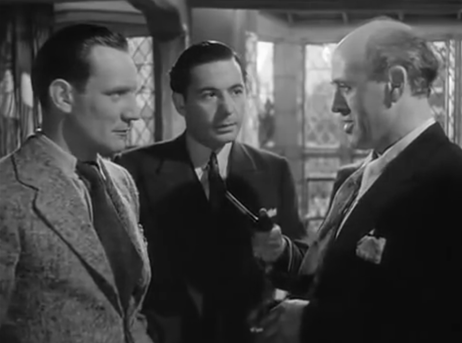
Review: The Phantom Lady (1944)

phantom-lady-1Robert Siodmak might not be the foremost of lauded directors, but it’s indisputable that film noir as a genre, a movement, a style, whatever you want to call it, would be a lot less interesting without him.

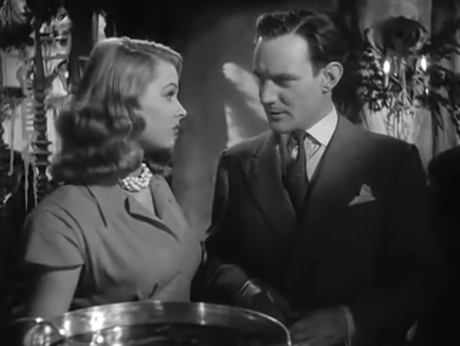
Phantom Lady is a perfect illustration of that fact as it takes a simple plotting device and rides it through the entire story to a fitting conclusion. It’s not a taut thriller or really anything of the kind but the characters and even the cinematic choices make it a surprisingly shadowy delight.

As the title suggests, any explanation of the narrative must begin and end with this phantom lady who, if you want to use storytelling terms, is the MacGuffin, the entity driving the plot forward to its final end. She’s necessary but as we might predict she’s at the same time integral to the story and not at all important.

Because the fact that she is missing is simply a pretense that leads to a response from our hero. And at first, our hero seems pretty obvious, the handsome down on his luck Joe with a pencil mustache (Alan Curtis). Once upon a time, I confused him with another noir regular Brian Dunlevy but no more. Anyways, our actual hero comes to the fore after the inciting incident. This man Scott Henderson all of a sudden comes back from a crummy night at the theater to find himself accused of strangling his wife. The cops seem to have a guilty until proven innocent modus operandi. True, the eyewitnesses for his alibi seem knee deep and yet everyone has hushed up, including a bartender, a jazz drummer, a flamboyant performer. Worst of all his female companion for the evening has vanished into thin air.

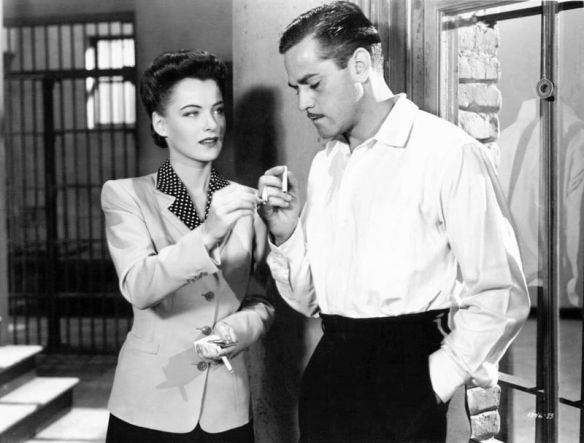
With no alibi, Scott still sticks to his ridiculous story that no one believes and he winds up sentenced for the murder of his wife. If you’re still following, it’s at this juncture where the story really begins. Henderson’s plucky secretary “Kansas” (Ella Raines) is smitten with her boss and determined to prove his innocence. So she becomes our intrepid noir hero digging around in the sleazy bars and dance halls, tracking down possible leads. A tight-lipped bartender is subjected to her merciless tailing and she even ingratiates herself to a swinging jazz drummer (Elisha Cook Jr.) who can really make his sticks fly.

They get her closer to the trail but each one becomes a successive dead end. She gains some encouraging allies in the initially skeptical detective Burgess (Thomas Gomez) as well as Scott’s best friend who has just returned from a trip to South America (Franchot Tone). Together they try and wrap up the loose ends. Of course, as an audience, the dramatic irony sets up the tension as we know what’s going on behind the scenes. So this is still partially a mystery as the search for the phantom lady continues but the joke’s really on us because soon enough we know what’s happening. However, whether it’s too late for our heroes is quite another question altogether.

Siodmak does well to develop a stylized atmosphere and there are some especially intriguing touches. The foremost is how many sequences, including the tailing sequence, function without music and yet jazz is utilized in a frenzied interlude that is almost unheard of in noir for its sheer vivacity. It’s oddly disconcerting, the juxtaposition suggesting this utter contrast between personified joy and the darkness that is seeping into the story. After all, a man is about to be sentenced to death. Jazz certainly does not fit the mood.

There’s also the paradigm of the noir working girl played perhaps most iconically by the audacious Ella Raines. In many ways, this is her film and she’s as good and almost better than many a gumshoe and insurance investigators. It’s a role that Raines embodies with great resolve and a certain amount of drive that we can appreciate in a female character of that day and age. She’s far from an objectified figure because she has brains and desires of our own — even if they are all for the well-being of a man.

It also should be noted that this was the first production credit for pioneering British screenwriter Joan Harrison. She was only one of only three woman producers in Hollywood at the time and this is a film that she could certainly be proud of with an impressive noir heroine.

3.5/5 Stars

Terms of Endearment (1983)

terms_of_endearment_1983_film

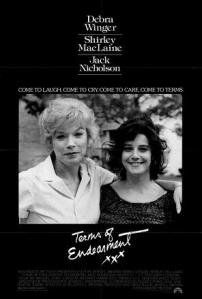
I owe a comedic debt to James L. Brooks and that’s for the basic fact that he’s made me laugh countless times, namely because of his work with sitcoms. The Mary Tyler Moore Show and Taxi are two prime examples. The casts he brought together and the writing, the writing is just absolutely superb, orchestrating that tricky balancing act between humor and heart.

When I look at Terms of Endearment from a purely objective perspective it looks like a wonderful picture. James L. Brooks, the mastermind of so many great projects is writer, director, and producer. It’s his first time behind the camera for a film and his cast is what most others would only dream about. Looking down the cast list is like a hit parade.

Shirley MacLaine as the widowed Aurora, the quirky mother who is strangely difficult, looking for love and still somehow detached — with both her daughter and a plethora of male companions. The always spirited Debra Winger as her daughter Emma. Her husband, the fresh-faced lawyer, Flap is played by Jeff Daniels. The always devilishly grinning Jack Nicholson plays the washed-up astronaut next door who makes the strangest and somehow most viable of suitors for Aurora. And the other nooks and crannies are filled in by the likes of Danny DeVito and John Lithgow. So with such a rank and file, there’s no question that this film should be remarkable.

But for some reason, it just doesn’t come off. It’s not that it doesn’t have its moments or that it’s not intermittently funny, romantic, and moving. There are tinges of those qualities that this film is undoubtedly looking to elicit. But for some reason, one that is somehow difficult to articulate, Terms of Endearment never brought me in like the truly great films have a habit of doing.

Was the plotting too slow? Were there too many characters? Was it due to the fact that I have never been a huge admirer of Shirley MacLaine’s work? To each of these, I would have to give a fairly decisive “No.” In fact, for me, this is one of MacLaine’s finest roles (along with The Apartment) to date. She’s somewhat perturbing, inscrutable you might say, but that also makes her the most interesting character. Watching her cold maternal figure evolve is one of the interesting aspects of this story.

Because she is trying to learn what it is to love and in a sense what it is to show that affection which comes second nature to most. Over time I’ve become increasingly impressed with Debra Winger because there’s always something so dynamic about her — a certain vitality that allows her to do comedy and tragedy equally well.  Both are on display here but for that same unknowable reason, Terms of Endearment did not move me as much as I expected. That’s no criticism just the simple, honest truth as clearly as I can lay it down.

But I respect this film because any film about people, their relationships, and how they navigate the tragedies of life is worth at least a little bit of trouble. Parsing through those very relationships is what this story cares about like Brooks’ earlier works. Maybe it did not affect me as much as I might have expected but that does not take away from the fact that mother-daughter bonds are worth exploring as are marital turbulence and personal tragedy. Because each of these is a very real circumstance and there’s something incredibly honest in trying to examine such things. For that, I commend Brooks as well as his film.  I will not be singing its praises necessarily but we all can respect Terms of Endearment for the very fact that it’s sincerely trying to dissect our world with wit and grace. Whether it succeeds is very subjective indeed. But then again, that’s part of the magic of the movies. At their very core, they are subjective.

3.5/5 Stars

Wonder Woman (2017)

Wonder_Woman_(2017_film)It might sound like meager praise but Wonder Woman is the most engrossing DC offering thus far. It also seems almost unfair to compare across the aisle against main rival Marvel with its terribly lucrative cottage industry or for the very fact that any comparison might suggest how derivative this feature must be.

Yes, Man of Steel and Batman V. Superman cannot hold a candle to most of their competition and Suicide Squad was an atrocious misfire. But this is a film that stands on its own two feet — on the feet of its director Patty Jenkins (Monster) and its heroine Gal Gadot.

Jenkins’ Wonder Woman is ripe for praise and adulation on multiple fronts.  Its closest equivalent would be Captain America: The First Avenger (2011) with its period setting as a stunning backdrop for a superhero narrative. In this one, Diana Prince (Gadot in her first true starring role) is joined by a ragtag band of renegades including Steve Trevor (Chris Pine) and his eclectic compatriots including a drunken sharpshooter, a failed actor with a penchant for linguistics, and a resourceful Native American of formidable stock. They look to sneak into the heart of enemy territory to bring a decisive end to the war (in this case WWI).

But the film also plays a bit like a fish out of water comedy. Diana is the girl born of the Amazons in antiquity and isolation living out the legacy of Greek mythology  — which consequently also seems fused with the Judeo-Christian God and the Fall depicted in Genesis.

Like Thor, she too is god-like, a being outside the realm of humans, trained by her aunt Antiope (Robin Wright) and shielded from the outside world by her mother (Connie Nielsen). Thus, when she actually enters into their world it’s ripe with humorous cultural incongruities. Casual conversation about ancient treatises on sex, sporting the latest fashions which are a bit more modest than her typical attire, learning how to dance, and getting her first taste of an ice cream cone. Each brings a smile to our faces as an audience.

Still, despite her immense skills and innumerable abilities, Diana like Agent Peggy Carter from Marvel is faced with a culture that is not ready for someone who is simultaneously beautiful, strong, independent and wholly unencumbered by normal male patriarchy.  Someone who will not be repressed, blasting through the glass ceilings and cathedral steeples for that matter.

Diana can hardly comprehend how these discrepancies exist. In her eyes secretaries are only glorified slaves and powerful men who sit together in rooms making decisions have no honor whatsoever as their men are brutally slaughtered. It’s ludicrous and it many ways she’s not wrong. We begin to empathize with her character and the problems she sees in the world — the innate desire she holds to make everything right.

Because that gets to what is really truly phenomenal about Wonder Woman. For even the mild superhero enthusiasts she is emblematic of the entire genre with everyone from Batman to Superman, Captain America, Spiderman, Hulk, and all the others. But the one thing that puts her in a class entirely her own is that she is a woman. And this is not meant to single her out but to suggest how important this film is. Lynda Carter gave a landmark performance on the television airwaves in the 1970s but this is the first time this monumental icon has made it to the big stage and it is long overdue.

As such this film becomes a fitting parable reflecting the struggles of women in a callous industry and an oft callous world. Diana becomes a champion of all those women thoroughly capable of living life with individuality, confidence, and above all love for their fellow human beings. Diana comes at life from what some narrow-minded folks might call a woman’s perspective caring deeply about the helpless and their suffering but for the rest of us, it’s a very human point of view.

However, it’s equally important to note that in an attempt to make Diana of great import does in no way relegate the other characters and Steve (Chris Pine) becomes one of the most enjoyable supporting blokes in recent memory.

Gadot and Pine play complementary roles that perfectly mesh together. They’re both brave, they’re both extraordinary, they both care deeply but it can be in different ways. Steve finds himself rescued by Diana and protected by her immense powers as he continues his espionage activities behind German lines. Still, he’s able to explain the intricacies of the world to her and lead her to realize that humanity is not as black and white as she assumed it to be. That is big. In Diana’s eyes, the whole arc of the film is like so. If she can kill Ares, war will be over and mankind will fall back into unity as Zeus had originally ascribed.

Wonder Woman supplies a final twist that while somewhat understandable from a cinematic point of view still manages to take a little of the meaning out of Diana’s realization. Since this is also a love story, that in some ways slightly salvages an ending that succumbs to the usual superhero tropes and pyrotechnics. It’s this further discovery that while Diana may not be to blame for all this chaos, humanity despite their faults is still worth fighting for. What Steve calls “truth” I would probably call “grace” and it’s semantics really but it simply suggests this idea that we do for others what they do not deserve, out of love, the highest noblest form of sacrificial love — always seeing others before yourself even those you disagree with — even when it comes at great cost. For Steve and Diana, those mean two entirely different things again as he tries to thwart the Germans nefarious intentions and she battles it out with someone with powers, not unlike her own.

Despite an admittedly clunky framing device to set up its narrative, the film does learn something from the Suicide Squad as well by focusing on origin story over a mere objective or mindless action. Wonder Woman begins to falter when it simply gets caught up in the normal rhythms of superhero films with villains, explosions, and the like.

What’s interesting are these characters, the wounds that they carry with them, their environments and how that shapes the world that they find themselves in. In this case, Gal Gadot proves to be a winsome heroine with an impeccable blend of innocent beauty, boldness, and heart that’s completely disarming. Meanwhile, Pine’s as charming as ever but let’s not forget whose film this is because we’ve waited long enough. Wonder Woman has made a triumphal return and not a moment too soon for DC.

4/5 Stars

Happy Independence Day!

Portrait of Jennie (1948)

portrait-of-jennie-3The strands of our lives are woven together and neither time nor the world can break them.

From the outset, you get a sense from the grand philosophical dialogue and imagery that we are being treated to a classical Hollywood precursor to Terence Malick’s Tree of Life. Quotes from Euripides and Keats flash over the screen. Profound questions are brought to the fore. What is time? What is space? What is life? What is death?

And it is somehow a spiritual film and not because of convents or biblical references. It’s a different type of spirituality — more elusive than a simple description. It’s summarized by the early supposition that each person must find their own faith. You must learn how to care deeply about something. And these initial suggestions give a hint to the film’s intention although the rest rolls out in more typical Hollywood fashion courtesy of David O. Selznick.

Eben Adams (Joseph Cotten) is one of those starving artists types who gets very little monetary value out of his creative vocation as a painter. Although initially brusque, he does receive some encouragement from a pair of veteran art dealers (Ethel Barrymore and Cecil Kellaway) and for the majority of the film, they remain buttresses to his career.

They see a spark of talent in this man — though not fully realized — there’s something there that can develop into something beautiful. Perhaps they see the landscapes like he does, where the images of the world are literally on canvass (Director William Dieterle denotes this phenomenon well).

portrait-of-jennie-2But it’s a chance encounter with a young girl named Jennie (Jennifer Jones) that gives Eben the type of inspiration that every artist dreams of because it’s precisely this spontaneous spark of joyous energy he needs to add something vibrant to his own life. In her constantly evolving role, Jennifer Jones exudes an effervescence, a certain radiance in body and spirit that lights up the screen in embodying this apparition of a girl.

She meets Adams first near a park bench, then doing whirly-birds on the ice rink. They continue to have these little moments together made up of chance encounters and pieces of fate. Although the film hardly gets to explore the idea, Portrait of Jennie plays with time for the sake of love. And it conveniently allows its two characters to meet each other at very different reference points in life. For him, it’s only a few days. For her she’s no longer a young girl, now blossoming into a mature young woman. And that is part of the tantalizing charm. Their chemistry flourishes. It becomes evident that much of romance is made up out of memories, these little fleeting moments of joy in being together.

It’s fantasy aspects make it a fine companion piece to the Ghost and Mrs. Muir as well. Light, passionate, moving, all those things. Yes, its conclusions on love are more than soppy, but a little soppiness does wonders in this cynical world we find ourselves in presently.

Out of context, it sounds ludicrous that Adams pilots a boat out into a New England gale for no reason except that it is the last place Jennie was seen. But interestingly enough, this conclusion hardly feels out of the ordinary since we intuitively know that Eben is going where he needs to, or at least where the film suggests he needs to go. And it’s not terrifying in all its technicolor glory because those apprehensive feelings easily give way to the raw majesty of it all — the pure awesomeness of the crashing waves — the churning forces of natures.

In these moments the film reaches its crescendo of love while also coming full circle to its opening prologue. But there’s something inside of me that feels unfulfilled with this ending. There’s a hollowness. Eben and Jennie had something together but what is it exactly, is difficult to comprehend completely. Eternal, no. Immortal, no. It’s only a moment. That is all.

portrait-of-jennie-1I find that despite his pedigree Joseph Cotten still comes off as an underrated actor and with each film I see him, I enjoy him immensely. Maybe for those very qualities. He’s not altogether handsome but he has a pleasant face. His voice isn’t the most formidable or debonair but it does have character. The supporting players lend some Irish flair to the cast and it’s striking that everyone from Ethel Barrymore to Lilian Gish glows with a certain hope. There is no obvious antagonistic force in this film. Eben Adams found his inspiration — the muse of a lifetime — and that passion is enough to lay the foundations of a film.

In some ways, I am discontent with the actual portrait of Jennie. The film acts as a better portrait of who she was as we continually get small swatches of her personality and glimpses into her character. In comparison, that painting seems little more than an austere shell. It lacks the same joyous vibrancy of the woman it was hoping to capture. That is to Jones’ own credit but to the detriment of the story. The painting lacks the same aura of the film.

3.5/5 Stars

The Hitch-Hiker (1953)

hitch-hiker_posterPart of the harrowing allure of the Hitch-Hiker is that it’s actually based on a true incident that occurred only a year before the events shown. It’s not as if someone took artistic license with some murderers and made it into a horror spectacle. Hitchcock’s Psycho especially comes to mind.

Instead, director Ida Lupino takes a much more universal approach with an opening title card suggesting that the events that follow about a man and a gun and a car could really happen to any of us. Perhaps it’s a cheap plotting device but it does throw the audience into the passenger seat quickly as they are introduced to a rash of murders and the hardened killer behind the spree Emmett Myers (William Talman) who soon has the entire mobilized police force looking for him.

The meat and potatoes of the film involve the brutal murderer taking two vacationing fishermen hostage and grinding away at them as he utilizes them to flee the authorities and bends them to his will. After all, he’s the one with the gun, and he’s proved numerous times he’s not squeamish about using it.

It also plays into the narrative’s hands that both Edmond O’Brien and Frank Lovejoy are not necessarily classically handsome. But they work as everymen. If Joel McCrea was the poor man’s Gary Cooper sometimes I think of Edmond O’Brien as the poor man’s Humphrey Bogart but that’s neither here nor there. Because in little films like this O’Brien left an indelible mark on film-noir. D.O.A. and The Bigamist are two other such examples. Lovejoy on his part is extremely understated, not even being able to quite place his face but we cannot help but admire his quiet stalwartness. O’Brien’s character seems the flightiest of the three and within their ranks, we’ve found a triangle that creates the contentious dynamic that’s the foundation of the film’s entire conflict.

A film of this length and from this era doesn’t have any right to be as intense as it is, yet the Hitch-Hiker proves to be just that. It’s chock full of not only frank depictions of wickedness but enough psychological torture to send tremors up the spines of an audience. It’s a real sweaty thriller. William Talman is absolutely diabolical in a performance that is as vindictive as any other role that comes to mind. It’s that evil.

Meanwhile, the deeply underrated cinematographer Nicholas Musuraca (Out of the Past) flaunts his skills in low budget filmmaking while former husband-wife duo Collier Young and Ida Lupino team up in another surprisingly compelling project, despite its meager production values. I laugh derisively at any contemporary who might have suggested Lupino could only do so-called issue-driven “Woman’s Pictures” because The Hitch-Hiker is really all about three men where the tension mounts to great proportions. Forget any other category. This is a stone cold crime film that goes beyond a simple gimmick.

3.5/5 Stars

Panic in the Streets (1950)

panic_in_the_streets_1950It disappoints me that I was not more taken with the material than I was but despite not being wholly engaged, there are still some fascinating aspects to Panic in the Streets. Though a somewhat simple picture, it seems possible that I might just need to give it a second viewing soon. Let’s begin with the reality.

This noir docudrama is somehow not as tense as some of Elia Kazan’s other works. In fact, it’s port locale anticipate the memorable atmosphere of On The Waterfront, although it’s hard to stand up to such a revered classic. Still, the film does have its own appeals.

It begins with a gritty setting full of grungy character and New Orleans charm that continues the trend of post-war films taking the movie cameras to the streets and to the people who actually dwell there. In this way, the film shares some similarities to The Naked City.

The acting talent is also a wonderful strength with Richard Widmark playing our lead, Lt. Commander Clint Reed, this time on the right side of the law as a Naval Doctor trying to contain an outbreak of pneumonic plague before it spreads exponentially. His compatriot is played by the always enjoyable Paul Douglas a world-wearied police captain who must grin and bear joining forces with Reed.

The film is full of seedy undesirables and the most important and memorable one is Jack Palance (in his screen debut) showing off his tough as nails personality that was certainly no fluke. His right hand blubbering crony is the equally conniving Zero Mostel and together they make a slimy pair for the police to close in on. Because it’s one of their associates who ends up murdered but it’s only in the coroner’s office where they find out he was infected with something fierce.

This sets the sirens going off in Reed’s head and while not an alarmist, he wants everyone to consider the gravity of the situation. He has some trouble working with the police but he also seems to understand that this is not an isolated issue but it can affect his family — his wife Nancy (Barbara Bel Geddes) and his precocious boy (Tommy Rettig). But not just his immediate circle, but his entire community. And so he and Captain Warren race against the clock to not only to prevent an epidemic but solve a crime and apprehend the perpetrators. So this is undoubtedly your typical police procedural enlivened by New Orleans but there are also different layers to what is going on that have broader implications.

For instance, what do you tell the press? Do you keep it under wraps or let them shout it from the rooftops so the criminals get away scot-free — like rats fleeing the scene of the crime? Are you just looking for the murderers or are you considering the entire community at large? These questions deserve to be parsed through more thoroughly than I possibly can. So while Panic in the Streets is more methodical than a tense drama there are some very good things to it. Namely its location, its cast, and the universal nature of its central conflict.

3.5/5 Stars

Claude Jade as Christine Doinel

claude jade

As often happens in the life of a classic movie aficionado, I became acquainted Claude Jade quite by accident and it happened at a random point in her filmography. In Hitchcock’s Cold War thriller Topaz (1969) she has a small part to play but the Master of Suspense was pointed to the actress by Francois Truffaut the French critic and director who had undertaken an immense interview with Hitch that has remained a treasure for cinema fanatics.

But still, that in itself has little bearing on Claude Jade. Jade came to the forefront of my mind after watching several entries in Truffaut’s famed Antoine Doinel saga starring Jean-Pierre Leaud, the first of these being Stolen Kisses (1968). And she immediately left an indelible mark on this viewer because she seemed the complete antithesis of our main character. Antoine was always a bit of a troublemaker, a vagrant, a malcontent, and whatever other negative descriptors you want to throw out. In some respect, it’s difficult to like him.

Yet from the first moment we see Christine Darbon, the wide-eyed ingenue, Antoine, and the audience are immediately taken with her for those very reasons. She’s so kind and sweet in ways that Antoine never manages to be. There’s an innocence and a playfulness behind her eyes that’s disarming. If we knew any better, we would say that he had no right in pursuing a relationship with a girl such as this. But to his credit, he does eventually get his life figured out just enough to begin to see her.

It’s these interludes of Stolen Kisses that we might say puppy love is bubbling up. There are furtive glances. Breakfast at the kitchen table. Walks through the neighborhood park together. It feels like a little slice of paradise and even in their utter differences, it seems that Antoine and Christine might make a life together. Perhaps they were even made for each other after all.

bedandboard1

In Bed & Board (1970), the next installment in the series, the couple is now married and rather happily so. They have a baby and he has a flower shop and she teaches violin lessons. But they have each other and they are content. Reading in bed together after the day’s activities are over or eating a dinner of baby food because going to the store like adults is far too difficult.  How could Antoine not be happy with a wife such as this?

However, he is always plagued by inner demons and infidelities. In this case, dismantling his marriage and all that is good with his life with another woman. But part of what makes Christine phenomenal is the immense grace in which she handles Antoine. Again and again, we are reminded of just how much he does not deserve her and yet she sees something in him that is worthwhile and worth staying with. If nothing else, she makes us appreciate Antoine as a protagonist, blessing him with a human side, and suggesting there are still some redeeming qualities left in him.  So by the film’s end despite the turmoil and turbulence, they went through, they still have enough affection to stay together.

In Truffaut’s final installment Love on the Run (1979), the passage of time is not so kind to them as is often the case with life. But what stays the same is Christine (and unfortunately Antoine too). She remains a caring figure lighting up the screen with her charm, youthful exuberance, and quiet dignity even with she is slighted.

I will end by quoting the eminent critic Pauline Kael who noted in one of her reviews that Claude Jade was “a less ethereal, more practical Catherine Deneuve.” If I’d have to wager a guess on what she was getting at, it would probably be something along these lines. Deneuve was always this aloof beauty who exists in almost a different stratosphere and if we might be so bold to make the assumption, she feels almost unattainable. Maybe she doesn’t live in the same world that we do. Hers is a cinematic existence. But Jade in her playful winks and everyday interactions makes us feel like we know her well.

Because her life with Antoine is not unlike our own in some respects. That makes us appreciate her immensely and adore her even moreso because she feels like one of us. Deneuve is revered because she is beautiful in an elegant way. She would never be one to get her hands dirty. But with Jade, there’s that immediate connection. Rather than create a dichotomy however between “ethereal” and “practical” I’d much rather say that I appreciate them both and the impact that they both had on French cinema.  Antoine Doinel, sometimes I think you’re an idiot. In fact, I know so. How could you not remain true to a woman with a face like that?

claude jade 2

This is my entry in the Reel Infatuation Blogathon….


Review: A Hard Day’s Night (1964)

A Hard Day's Night 2.pngAre you a mod or a rocker? ~ reporter

Um, no, I’m a mocker ~ Ringo

As a 4 or 5-year-old, I didn’t know who the Marx Brothers were and no one had told me yet about Cinema Verite and what that meant. But I loved the Beatles. Also, I didn’t find out until years later that Richard Lester was an American director who caught the eyes of the Fab Four and predicted the MTV age with its frenetic editing style. But if you actually watch A Hard Days Night with the eyes of an unabashed fan — like I was as a boy — none of that matters. So let’s leave that on the drawing room floor and look at what makes this film pop with vitality all these years later.

Any conversation must begin with the music. The film bursts onto the screen with the iconic riff of A Hard Day’s Night as the Beatles scramble down a street corner fleeing frantically from a screaming mob of fans. It perfectly encapsulates this rash of Beatlemania that was exploding onto the world stage and making its way across the pond.

And what the film does so well is create this fun aura around the four lads from Liverpool. There silly, fun, a bit cheeky too but there’s something so endearing about them still. It struck me this time around that these are four men are hardly over 20 years of age and yet they had fame and stardom thrust upon them. And they are superstars but they don’t act quite like superstars.

A Hard Day's Night.png

The filming style and handheld camera work lend themselves not only to Lester’s frantic style but there’s also an indication that this is a day in the life type of musical comedy (no pun intended). It’s the perfect combination of quotable one-liners and zingers paired with a certain British humor (I now declare this bridge open!) and some of the early classics from the Beatles canon (Can’t Buy Me Love, She Loves You, etc).

Paul’s Grandfather (Wilfrid Brambell) is very clean but that’s only a veneer for a searing personality that looks to manipulate others and stir up trouble. On Paul’s own account he’s a real mixer.  Norm is their road manager and general killjoy while Shake is his gangly hapless sidekick good for a few laughs of his own.  If you want a “plot” in the conventional sense you probably won’t get it but it’s enough to watch the boys run out on their obligations by sneaking off to dance parties or abandoned fields to do their own renditions of Monty Pythons silly Olympics.

A Hard Day's Night 3.png

We watch them in their idle moments as John messes around in the tub and George exhibits his shaving prowess on Shake’s mirror image.In another moment George takes a wrong turn and finds himself in some new age advertising agency where he unwittingly tears their campaign to shreds by calling their merchandise “grotty.” Meanwhile, the boys are herded from press junkets to tapings, from makeup to answering fan mail (a train and a room and a car and a room and a room and a room). That’s about their life at this stage.

It’s odd to think that the name The Beatles is never spoken in the film. It just is. It’s part of the world consciousness. It brings to mind a chance encounter John has with a woman who while she doesn’t utter his name notes his striking resemblance to one of the boys. In the end, she’s mistaken and he walks away muttering that she looks more like “him” than I do. So A Hard Days Night is a film that while boasting great music and wonderful comic mayhem still is a slight commentary on the Beatles stardom.

They have become beholden to their rigid tour schedule. Prisoners in a sense. But they still find time for personal expression and a bit of playful rebellion despite those very restraints. Of course, the backbone of this comic-laden rock musical is the pinnacle of their artistic expression — their music. By now all these songs are like old friends to me that it hardly seems necessary to list them off one by one. You just have to hear them.

In the final moments before their climactic show, Grandad stirs up Ringo to go out and live a little and so the boys must track him down before time runs out. What follows is an inane ruckus involving the majority of the local bobby population. But all four make it back and put on a lively showing for their adolescent admirers screaming their heads off the entire set.

As quick as they arrived they get whisked off by a helicopter to their next destination ready to rock another day. I’m not sure if this is based on the film or my own wishful dreaming, but I like to think that they’re heading across the ocean blue as the flagship of the British Invasion. When you watch this film it all comes into clearer focus what all the hoopla was about. They had a genuine charisma, a certain presence, and their music speaks for itself after all these years. Still sincere, catchy, and enduring even in its pure simplicity. Billions of screaming girls can’t all be wrong.

5/5 Stars

The Bigamist (1953)

the-bigamist-1I despise you and I pity you. ~ Edmund Gwenn as Mr. Jordan

The Bigamist is at first a delightful noir — in one aspect unassuming and yet groundbreaking when put in a broader context. Ida Lupino is not simply a good female director. She is a good director, period.   She left a body of work both behind and in front of the camera that speaks for itself. Even the small ones like The Hitchhiker and The Bigamist have a certain strength about them.

In this case, the film’s title flashes with the superficial tinges of a sordid drama but when you actually get into the thick of it all, there’s a great deal of tenderness and certain heartbreak there.

In some ways, Edmund Gwenn becomes our main character’s father confessor as the protagonist explains how it all began through flashback: The plotting is simple. Harry Graham (Edmond O’Brien) found himself living a double life. But it’s not just that. He loves his wife Eve (Joan Fontaine). They genuinely care for each other deeply and now they share together in business but he spends a great deal of his time on the road. They’re even planning to adopt a child together since Eve cannot have a child of her own. Obviously, during his frequent bouts on the road, Harry gets lonely and we’ve undoubtedly heard that excuse countless times and it’s been the calling card for a great deal of infidelity.

the-bigamist-2Except at first what Harry does, does not seem like infidelity. In one integral scene Harry takes one of those bus tours to see the stars because, after all, Beverly Hills is that land of movie stars and their extravagant lifestyles. Jimmy Stewart, Jack Benny, Oscar Levant, Barbara Stanwyck, and Jane Wyman are all given a nod. There are even a few playful in-jokes to the always genial Edmund Gwenn who turns up as the adoption agent. All of this is essentially fluff but it’s on that same ride where he meets someone — a woman named Phyllis Martin (Ida Lupino).

It’s true that they’re both looking for a friend and they gravitate towards each other. It’s nothing more than that and Phyllis invites her newfound friend to a restaurant made in the popular mode of Early American Chinese. It’s where she works. But he hardly cares. He sees her more and the most astounding thing is that he tells his wife about it almost in jest saying he met a brunette in California. The reason he cites: she wasn’t beautiful but she was nice.

And right in that moment, you can see what’s particularly striking about The Bigamist. It’s a frank, open, and honest film in an often prim and proper era of certain sensibilities. The Bigamist looks to be a film to trod all over those social mores and yet extraordinarily enough it doesn’t. Yes, in certain ways it dissects them but it does it with great care and a tenderness for all parties involved.

It’s not so much a dark brooding noir but a film of interpersonal tragedy rather like earlier such examples as Pitfall or They Live by Night where bits of darkness pervades the home and relationships which are admittedly fragile because of the humans involved. Topics of divorce, infidelity, and pregnancy further complicate matters.  But not in some lurid exploitive way to sell tickets.

It’s oddly ironic on multiple levels. Of course, we know as an audience that he is seeing another woman but that’s only the beginning. In a major fit of situational irony, it works exactly contrary to what we might expect. Edmund O’Brien’s lead is a good and decent man. His wife is not a holy terror but played by one of the sympathetic heroines of the 40s and 50s, Joan Fontaine. Furthermore, Ida Lupino is not some sleazy femme fatale. In fact, she’s the one who initially rejects his advances and shows reluctance to marry him.

the-bigamist-3It strikes me how it’s often the small, tiny, unassuming pictures that impact me the most and this film did wrench my heart over the course of only a very few minutes. The final court sequence sums up the reasons quite well because it ends the film on a moral note setting up a rather convicting paradigm.

We see both women there. We see the accused sitting in front of the judge and jury willingly admitting his guilt. His is a society that winks an eye at a married fellow with a mistress and yet he, a man who genuinely loved two women, is found at fault under the law. The defense attorney on his behalf calls for punishment tempered by mercy.

When those two women walk out of the courtroom as the proceedings end, it does not mean that any of it can ever go back to normal. Will either of them even take him back? We can make an educated assumption but that’s not really for us to know. However, on a universal level, the words of the attorney reverberate in my ears. Each one of us has aspects of our character that are undoubtedly despicable but also elicit pity. It only makes sense that each of us deserves a certain amount of punishment but also a measure of mercy. It’s up to us to extend that to others. Because the reality is that we might not be that much better than the eponymous bigamist. Judging by his character we might actually be far worse.

3.5/5 Stars

Slap Shot (1977)

slap-shot-2

The question is, what to do with Slap Shot? It’s grungy, dirty, and foul-mouthed. Bloody and violent. Did I mention profane and boisterous? Loud and obnoxious? Yet somehow there’s still something idiosyncratically lovable about this board busting hockey film. Is it wrong to call it an adult version of The Bad News Bears? After all, the men that the film follows are actually real professional hockey players. Not some kid looking to play at their local gymnasium. Except hockey’s still not the biggest sport (not even today) and the Charleston Chiefs are a minor league club if I’ve ever seen one.

But it’s precisely that quality that keeps us around. Because we all gravitate towards the rejects and the bottom dwellers. The people we can easily feel sorry for and who simultaneously make us feel a little bit better about ourselves.

In bringing George Roy Hill back with Paul Newman and surrounding him with quite the cast of lug heads, epitomized by the gloriously violent Hanson Brothers, Slap Shot somehow became a cult classic.

Player-manager Reggie Dunlop is in the twilight of his career. It’s hardly a secret that the Chiefs aren’t doing so hot and it looks like this might be their last season. It’s a fairly abysmal existence for all involved then Dunlop has the bright idea to let go of any inhibitions. Soon he has his boys brawling with everyone imaginable. Opposing players, fans, referees, anyone who is living and breathing. The funny thing is that this new style of play actually elicits winning results and the public loves them for their brutality.

One perfect illustration of this chaotic pandemonium occurs when the opposing goalkeeper goes diving over the boards to continue his showdown with Paul Newman. They shared a few choice words beforehand. That’s putting it lightly.

But these are also the same group of guys who leave every battle bloodied and bruised. The same group of guys who wind up playing cards on the bus or get mesmerized by the latest corny soap opera on television at the local watering hole. They’re a sorry lot who also happen to be ridiculously funny at times.

It’s the rowdiest of films with at least a couple screws loose. If we were to be pretentious I guess who would chock it up to Slap Shot having “Character.” But I’m not sure if it would be too far from the truth to blame this film for leading the charge in legions of awful R-Rated comedies with no merit whatsoever.

Even with Slap Shot, there are some rather interesting tonal shifts. It’s as if Nancy Dowd’s script looks to get sincere once or twice. Or there were thoughts of getting dramatic. But then the gloves came off and the sticks were thrown aside and there was a collective “Nawww!” from all involved. Not surprisingly this was one of Paul Newman’s favorite roles because he’s not just a ne’er do well or an old crotchety wise guy, he’s a legitimate scuzzball.

Also, it doesn’t hurt that Slap Shot’s soundtrack is now synonymous with the bouncy infectious notes of Maxine Nightingale’s 1975 classic “Right Back Where We Started From.”  The added addition of Fleetwood Mac doesn’t hurt it either. So, yes, I would hardly call this one a revered classic, and I’m still digging around for some redeeming qualities. I’ll let you know. But Slap Shot never claimed to be anything of those things.

It’s unashamedly crude. Gratuitously violent but so over the top as to be comic and there’s not even the slightest attempt to cover any of this up. It could be that Slap Shot is one of the more honest portrayals of human nature. Humanity loves sports. We’re often losers and outcasts with few redeeming qualities when you really get to know us. That’s by no means a promotion of Slap Shot but more of a qualification.

3/5 Stars