Review: The Gunfighter (1950)

thegunfighter1“Ringo don’t look so tough to me.”

Those are the words that propagate a legend and simultaneously follow notorious gunman Jimmy Ringo wherever he goes. There’s always some impetuous kid looking to have it out with him and every time it’s the same result. The kid never listens and Ringo rides off to the next town, wearier than he was the last time.

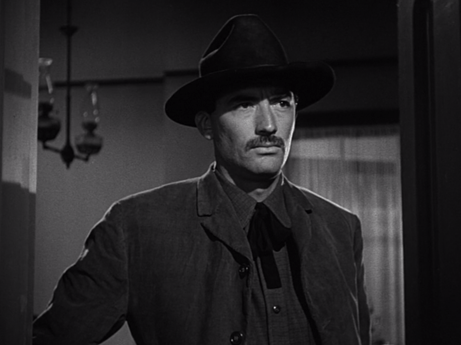
The Gunfighter has a surprisingly vibrant script with numerous names attached to it at different times including William Bowers, Nunnally Johnson, and Andre de Toth.  It evolves into a sort of chamber piece made into a carnival show when Jimmy Ringo (Gregory Peck) comes to the town of Cayenne.Kids milling about peering in and catcalling as this “murderer” sits in the saloon like a sideshow attraction.

It’s an oddly compelling commentary on celebrity, and in this case, notoriety as everyone far and wide knows the name Jimmy Ringo and is either in awe of it or ready to prove they’ve got the guts to take him down. He’s constantly being sized up, continually being gawked at, or gossipped about. That’s the price of such fame.

But on the opposite side of the coin, and incidentally, the side no one much cares to think about, there’s a jaded man who’s made a life out of gunning down other men and moving from one town to the next to the next. There’s something very human about growing old and that’s what Jimmy Ringo has done. Because as the years march ever onward your whole mindset shifts along with your priorities. A life on the run doesn’t have the same luster. You want to be able to settle down, to be happy, to be at peace. But old vendettas take a long time to die, continuing just as long as the legends that they follow.

the gunfighter 2Of all men to understand Ringo, you would think that the local Marshall (Millard Mitchell) would be the last, but he happens to be an old friend of the gunman. They used to run in the same circles before Mark softened up. His life mellowed out, while Ringo’s reputation continued to build.

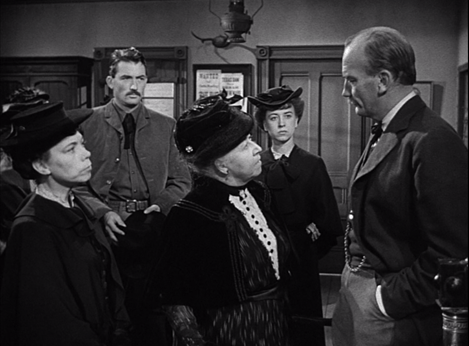
The subsequent sequence in the jailhouse illustrates just how much weight a simple name can carry. When the well-to-do ladies of the town come to the sheriff with their petition for justice, they think little of the stranger who tries to shed a little light on Ringo’s point of view. However, the moment they hear his name uttered, everyone is in a tizzy, rushing out of the jail lickety-split. It reflects just how hypocritical their form of morality is.

the gunfighter 3The main reason Ringo stays in a town that doesn’t want him is all because of a girl (Helen Westcott). He waits and waits, biding his time, for any word from her, and finally, it comes. He gets his wish to see her and his son in private. These scenes behind closed doors are surprisingly intimate, casting the old gunman in an utterly different light.

Of course, none of that saves him when he walks out that door back into the limelight, living the life of Jimmy Ringo, whether he likes it or not. If the three vengeful brothers don’t get him, there’s someone waiting for him up in a second story window or hiding behind a corner. A man like that can never win in the end.

It struck me that this film has some thematic similarities to another film of the same year, All About Eve. Aside from the fact that I personally enjoy Gregory Peck a great deal more than Bette Davis, both films focus on aging icons. While Ringo is not so much manipulated as undermined by his own legacy, his story ends with a young man much like himself riding off into the distance, to take up the life that Ringo led for so long. The specters of such notoriety will haunt the boy until the day he dies, and much like Eve, the deadly cycle begins again. Henry King made an unprecedented 6 films with Peck and this is probably the hallmark for both of them, certainly their most prolific western respectively.

4.5/5 Stars

Kansas City Confidential (1952)

KCConfidential.jpgSaying that Phil Karlson has a penchant for gritty crime dramas is a gross understatement. And yet here again is one of those real tough-guy numbers he was known for, where all you have to do is follow the trail of cigarette smoke and every punch is palpable–coming right off the screen and practically walloping you across the face.

Like all heist films, there must be a point of inception, however, Kansas City Confidential finds its story after the crime has been committed and the perpetrators have split up without a hitch. The man who takes the heat, their fall guy and the unsuspecting stooge is Joe Rolfe (John Payne who is adept at playing such roles) a nobody truck driver and a convict once upon a time.

It seems like the perfect crime as the three hired hands all wore masks and had no connection to each other, except for the stocky and demonstrative Mr. Big, the mastermind behind the whole operation and the one calling the shots. He sends each man off with enough money to tide themselves over until he contacts them to reconvene for their big payoff. Whether or not he will actually cough up the 300,000 clams he owes each of them is quite another story.

Still, each man heads his own way and Joe is getting grilled by the cops day after day in the hopes that he will crack. Finally, he is released, but with no prospects and no job, he sits in a bar stewing in his anger. The story takes it’s next big turn when he follows a lead down to Mexico to tail one of the hoods in on the job Peter Harris (Jack Elam). And although Joe is going in blind, he soon catches wind of the impending rendezvous in Barados and decides he’ll just show up as well, to get to the bottom of the entire mess.

It’s there where he first crosses paths with two other leering hoods, the beady-eyed Tony Romano (Lee Van Cleef) and the silently brooding Boyd Kane (Neville Brand). However, while keeping tabs on these cronies, he keeps company with a budding lawyer Helen Foster (Coleen Gray), who has come to call upon her protective father, the former policeman Tim Foster. If this set up isn’t plain enough already, it certainly becomes increasingly interesting as the gears continue to turn towards the story’s inevitable climax.

Most certainly Kansas City Confidential boasts jarring close-ups, low budget facades and perpetually sweaty faces that accentuate its unsentimental noirish qualities. However, Coleen Gray acts as a more enlightened noir heroine, who does not grovel for her man or weep incessantly at the thought of danger. Instead, she’s training to be a lawyer, and rational but still unequivocally kind. Despite not having a proper meet cute, the chemistry between Gray and Payne still works surprisingly well.

What makes the film inherently more interesting is how the crime is embroiled with family issues. Because, as an audience, we know Mr. Big’s identity: a corrupted cop who got a bum steer and now is going to reap the benefits of setting up some real losers. Still, that doesn’t excuse what he did and Joe got dealt a similarly sorry hand. The fact that Foster’s daughter is involved sheds him in a more humane light and in the same instance makes Joe a more likable figure. In many ways, she brings out the best qualities of both these characters. It’s the darker recesses that lurk behind their characters. Those are made more evident by the likes of Lee Van Cleef, Jack Elam and Neville Brand, a real rogues gallery of baddies if there ever was one.

4/5 Stars

Everybody Wants Some!! (2016)

everybody wants some 3“Things are only as meaningful as the meaning that we allow them to have.” ~ Beverly

How can Sisyphus and baseball be connected? Budding lovebirds Jake (Blake Jenner) and Beverly (Zoey Deutch) tackle this question as they float contentedly in inter-tubes with college just beginning. Sisyphus is, of course, the mythical figure who tragically spent his entire existence pushing a boulder up a hill. How does that relate to baseball? Just like anything, if it becomes our sole focus, it takes on immense meaning. Looking at it one way or another it can either be seen as a blessing, a curse, a chance at a singular purpose or even an obsession. But without question, each individual person has a chance to latch onto what they find meaning in as they float through life fluctuating between contentedness and discontentedness. That’s not only what college but, what life in general, is all about.

But that’s enough waxing philosophical because as Richard Linklater has the penchant for doing, Everybody Wants Some is a romanticized, idyllic visual collage, of what it is to be in college, what it is to be a baseball player, what it was like to do all those things in the 1980s. Some will look at it disinterested because it seems to be a pretty narrow lens but as we already acknowledged, Linklater’s films always carry a fondness for their subjects — oftentimes capturing moments, little snapshots of time and space, the building blocks of life really.

We can even look at Richard Linklater, his past, his pedigree and there’s no doubt that this is another meaningful film for him. For some, there will be a similar meaningfulness to this time capsule of his. However, even for those who are not quite sold, there’s something deeply personal and heartfelt about his work that’s hard to take away from him. In that respect, his work is always universal.

In truth, Linklater follows in the tradition of many of the great European filmmakers where Plot is certainly not king. Because anything in screenwriting 101 or out of the Hollywood milieu emphatically declares that conflict is key. Watch most anything from the Texas native and the normal plot conventions go out the window since that’s not where his interest lies. And yet Everybody Wants Some still remains diverting during its entire run.

It follows in the footsteps of Dazed & Confused over 20 years its elder and it’s a film similarly ripping at the seams with song and dance. It’s another one of the vignette movies basking in nostalgia whether it’s Van Halen, Twilight Zone anecdotes, Gilligan Island punk music or any number of other things. These boys spend, not the last night after high school, but the waning days before college sitting around their house talking about who knows what, getting sky high, hitting golf balls off rooftops and taking part in endless competitions in ping pong, knuckles and anything else that can be needlessly turned into a game.

But to a lesser extent, Linklater’s latest film also has ties to Boyhood because although it might take place decades before, it picks up where the other film left off. It’s easy to forget but a big part of Everybody Wants Some!! is about a boy meeting a girl in the first days of college.

There’s still so much to be done and the film only briefly brushes on what it means to be in college but that’s not its main objective. Anyone who has played sports or went to college can identify with the camaraderie of being part of a team or the elation of all the excitement laid out in front of you the next four years.

Everybody Wants Some!! uses the typical Supers onscreen to denote the countdown until reality hits and school and sports begin for real. There’s a brevity to the moment that this film captures. Sure, in many ways, it’s filled with raunchiness and raucous fun but it also signifies a carefreeness that is very rarely realized at any other time in your life. It brings to mind one of the ballplayers Willoughby. It comes out that he faked his transcripts and is actually well over the playing age. Why would he do such a thing? We would think it’s for some competitive advantage, but no,  he just wanted to prolong this little piece of paradise. Partying and playing baseball with the world as your oyster.

Because whereas this is the beginning for some like Jake, it’s also nearing the end for others. That’s the scariness and in some senses the beauty of life. All of us are walking along our own roads like passing ships in the night but that does not mean we have to go it alone. The key is finding community and honing in on a purpose that gives our lives meaning. We have to live for the moment because those moments are transient and before you know them, they’ll be gone. Make the most of them. Enjoy them. This year as well as next.

3.5/5 Stars

It Happened on Fifth Avenue (1947)

220px-happened5avenueThe fact that Miracle on 34th Street and this film came out the same year seems to suggest that there was something special in the air of New York City that year. It was a magical place, specifically during the Christmas season with Santa Claus going on trial and winning, while tramps helped reform millionaires. Admittedly, It Happened on Fifth Avenue is one of those films that could easily come under fire for its implausible plot, its unabashed sentiment, and any number of other things.

But if you have any amount of Christmas cheer at all, it’s overwhelmingly difficult not to enjoy this cheering story for what it offers up in the areas of heartwarming comedy and holiday spirit. There’s even a bit of misty-eyed sentimentality that’s sure to weaken the callous heart that’s ready to be melted.

And the story finds its roots in some very real issues. One is the housing crisis following the end of World War II with GIs flooding back into the country with families to raise and no jobs and no homes to be had. The situation further aggravated by the wage gap. The rich just seem to get richer, buying up all the land and resources in town,  namely the notorious John O’Connor — the second richest man in the world by latest figures shouted by passing tour guides on sightseeing buses. Ironically, in such an environment the panhandling community is especially strong and foremost among their ranks is sophisticated tramp Aloyisius McKeever (Victor Moore).

He migrates as the crow flies to Winter palaces and Summer getaways belonging to those in the affluent sectors of society. He has set up a bit of a revolving timeshare but you could say it only goes one way. None of his benefactors seem to know they are being so charitable and Mr. MeKeever does his best not to draw attention to himself. Letting himself in through fence boards, sneaking down through manhole covers, and setting up an elaborate trigger system to turn off all lights at the moments notice. In this way, he manages to live a rather comfortable life undetected in the boarded up estate of the aforementioned magnate John O’Connor.

Although he’s a rather peculiar character, a conniver and a bit of an opportunist, it should not go unsaid that he does have a conscience — a moral code if you will — that makes him increasingly compelling. Aside from his quirky ways, Aloysius McKeever is quite generous even if it involves someone else’s capital. Soon his great home that he is “borrowing” is filled with a few GIs and families including the drifting Jim Bullock (Don DeFore) who was thrown out of his apartment after Mr. O’Connor bought the land. Now with a place to gather himself, Jim has the seed of an idea — retrofitting old army barracks into track housing for returning GIs. The only problem is they need real estate, real estate being snapped up by the one in the same John O’Connor. You’ve probably gotten tired of hearing his name by now.

All of this would be unrelated if it weren’t for a girl who ran away from finishing school, Trudy O’Connor (Gale Storm). Her last name says it all already, and when she flees to seek asylum at her father’s  winter estate, she’s surprised to find it occupied. It makes for a funny scenario but rapidly she settles into the community and simultaneously falls in love with Jim.

At this juncture, Trudy asks her father for perhaps the biggest favor of her life — that he would play it her way — masquerading as another vagrant so that he can meet her love and not sway him to marry Trudy with the imminent promise of great wealth. And that’s the next enjoyment of the film, watching stuffy old Mr. O’Connor forced to be a guest in his own home, bossed around by Aloysius. But he’s not the only one out of sorts, Trudy’s mother (Ann Harding) also comes to live with them as a cook and this creates yet another complicating layer of wistful romance.

In the process, everyone learns something. There is a newfound appreciation for people and life. What it means to make an honest day’s wages. What it means to live for more than money. What it means to truly love someone so much that you don’t want to live a day without them. Even what it means to live in a caring community that looks to bless each other and share resources in such a way that no one is in need. I would even wager a bet that this is less socialism and more of what the early Christians talked about in Acts.

The film is blessed by some lovable, wonderfully comic performances from a couple great Hollywood actors, most notably Victor Moore and Charles Ruggles who highlight the storyline’s oddities. Meanwhile, some of the younger stars have winning charm that would translate into several solid careers in the growing medium of television. For some ready made feel-good Christmas magic, look no further than 5th Avenue.

3.5/5 Stars

Review: Rebel Without a Cause (1955)

_Rebel_Without_a_Cause_James Dean

You can wake up now, the universe has ended.” – Jim Stark to Plato in Griffith Observatory

James Dean’s “The Rebel Without a Cause.” It’s his image as much as it is a film for many people. But if we actually take the time to examine him,  Dean subverts expectations. There’s this aura built around him as that iconic rebel–cigarette in hand–a glint in his eyes. However, the beauty of his performance as Jim Stark is how broken and even gentle it is. Certainly, we remember the moments where he screams at parents, bashes in desks and kicks paintings, but really most of his screen time is made of quiet nuances. He has no friends. He’s lonely and reserved. He just wants respect.

He wants someone to listen to him–someone to stand up for what’s right. And he feels like a pendulum swinging madly between his bickering parents, constantly making him go this way and that, moving from town to town, time and time again. It sickens him and he reacts in the only way he knows.

Rebel is just as much a subversive film, being so daring as to suggest that juvenile delinquency is a sort of created social construct. Kids do bad things, sure, teens are no good, but if you dig around a bit and look in the closets, the skeletons reveal themselves in due time. We now conveniently call them “family of origin issues,” but that puts everything in a nice box when the reality is actually very messy.

That’s why the crucial scene in Rebel is when our three solitary teens go to Plato’s (Sal Mineo) abandoned mansion getaway in the dead of night.  Alone it would be a house of horrors, but in community, they make it a pleasant affair–even playing a game of “house” complete with stuffy honeymooners, who don’t want kids unless they never have to see or talk to them again and a realtor who is is willing to give them the place for $3 million a month (Thankfully the newlyweds have a budget!). In essence, amidst their jests, they’ve become one happy family, finding a bit of solace from the asphyxiation of the world around them. The world accentuated by not only their parents but their peers too. However, it cannot last.

It’s these moments that feel so light and carefree and that’s the key. Blink and you’ll miss them. Look away and the bubble is popped. Focus on the drama and you’ll get it all wrong. Because the moments of drama are exactly the moments that you expect to get some deeper understanding of their psyches. You look at Jim in the now iconic scene on the staircase, quarreling with his parents or Plato running off like a frightened rabbit packing a gun. We can shake our heads and ask “why?” but if we only sit back and listen, it becomes all too obvious.

If Mr. and Mrs. Stark just listened, if Judy’s parent’s paid heed to her, if Plato actually had parents present in his life, maybe they could see what was “tearing them apart.” The suffocating hopelessness of the world that seems magnified tenfold in your adolescent years, as things are changing so rapidly. You’re getting pressured beyond belief and to top it off, it seems like no one understands you–not in the least.

Thanks be to Nicholas Ray for bringing such an intimate study of youth to light, because it’s certainly melodrama, elevated by the unpredictable magic that is James Dean. That’s often the spotlight of this film and quite understandably so, given the lore around his legendary career and tragic death.

But cull its depths and there’s even more if we look at how everything is initially foreshadowed at the Observatory, where the man in a droll tone nonchalantly summarizes the insignificant end of earth–only an infinitesimal speck in the patchwork of the universe (“In all the immensity of our universe and the galaxies beyond, the earth will not be missed. Through the infinite reaches of space, the problems of man seem trivial and naive indeed, and man existing alone seems himself an episode of little consequence”).

Buzz tells Jim before their “Chickie Run” that he actually kind of likes the guy now, but still, “You gotta do something. Don’t you?” It’s the despondency of their existence. Buzz soon dies and people hardly bat an eye.

Never before had I considered how this entire story unfolds in the course of one tragic day. It’s not realism by any means, but instead, it’s bursting with the passion and pain as reflected by Ray’s camera and impeccable use of color.  It’s as if the teenage experience is being wholly magnified and consolidated into a single moment. That’s what Rebel Without a Cause embodies.

5/5 Stars

Niagara (1953)

800px-Marilyn_Monroe_NiagaraRainbows, the soft misting of waterfalls, and honeymooning couples going through the tunnel of love. It hardly feels threatening at all, but that’s what makes film-noir so delicious. As the film style most reflective of the human condition, it proves that the dark proclivities and jealousies of the human heart can crop of anywhere–even a gorgeous tourist trap like Niagara Falls.

Niagara’s frames are composed of grandiose and lush imagery, and the film is greatly aided by on location shooting which develops an even more engaging world for this technicolor noir to take place.

Joseph Cotten takes on a menacing role as the tortured husband, his most notable ominous turn since Shadow of a Doubt, however, a tad more sympathetic. Meanwhile, Marilyn Monroe takes a turn as a seductive siren, the other half of this troubled couple spending a weekend at a Niagara Falls Cabin B.

She’s given plenty of screen time to strut her stuff and though early in her career, she would soon enough be catapulted to stardom forevermore with the likes of Gentlemen Prefer Blondes and How to Marry a Millionaire. As they often say, the rest was history and more so than that, she indeed made history.

If you look at her performance as Rose, while not her most enduring, it still catches the eye, due to the way she carries herself–even how she walks down a cobblestone road. You cannot help but be at least moderately mesmerized by her whole image.There was no one before or after, quite like her. She was a singular figure with no true equal.

Jean_Peters_mends_Joseph_Cotten's_hand_in_Niagara_trailer_1Without a question, Jean Peters becomes our favorite character as Polly, and it was an eye-opening for me personally to see her in a role so vastly different than Pickup on South Street. I had pigeon-holed her, rather erroneously as such a character, but Niagara shows a more tempered side to her persona that felt more representative of her as an actress. Max Showalter plays her husband, the genial and oblivious Ray Cutler, who takes his lovely wife on a long overdue honeymoon, only to have it totally ravaged thanks to the Loomises.

Henry Hathaway as per usual is a capable filmmaker, who utilizes his stars and location quite well. Charles Brackett builds this conflict between a vacationing husband and wife with his script, but it really is the visuals that elevate it to the heights of a surprisingly compelling noir. The scenes within the catacombs of the falls and at the very edge of the drop off are of particular note–both beautiful and raging in the same instance. The climactic moments between a lurking husband and his fleeing wife in the clock tower are also remarkably stylish, reflecting how a color film can still style drip with noir sentiment.

It’s a film checkered in shadows and bathed in darkness as much as it is rainbows. In some ways, that makes it all the more harrowing. Colors don’t necessarily make everything bright and cheery, they distract from what is really going on, and in this case, the falls prove to be more than an opportune locale for a honeymoon…and murder. 

3.5/5 Stars

Remember the Night (1940)

remember_the_night_posterI find that many of the best Christmas movies aren’t really about Christmas at all — at least not in the conventional sense that we’re so used to. Not trees or presents or lights or even holiday sentiment although those might all be there.

The films that start to tease out the true meaning and impact of the Christmas season start by looking at people and their relationships with one another. Because, truth be told, we so often get distracted by the bright colors and shiny objects that get in our way.

That’s actually part of what Remember the Night is about. Lee Leander (Barbara Stanwyck) is a woman who has a penchant for stealing jewelry. She’s not a kleptomaniac or wrong in the head, she’s just a poor, unspectacular woman with nothing to show for in life. She lives in a hotel. And so the minute she’s apprehended and prosecuted in the courtroom you would assume that it’s nothing out of the ordinary.

Except this is a romantic film starring the likes of Fred MacMurray and Barbara Stanwyck working from a script from Preston Sturges and under the guidance of Mitchel Leisen. So obviously that tips us off that love is in the air. Especially during the Christmas season, love is all around us — peace on earth and goodwill towards men.

Except when Lee’s trial is postponed by the astute district attorney on the other side of the table, it looks like she’s in for an abysmal holiday. She has no money, no place to go, and she’ll be spending her time behind bars (with a Christmas dinner of course). But John Sargent goes through a change of heart and his heart is fairly big when you get to know him. He ends up getting Lee out of jail for Christmas dinner as recompense and goes a step further still by inviting to take her back to her family home. They both hail from rural Indiana.

In this leg of the film, on the road, they begin to warm to each other. A certain amount of empathy sets in as they must flee pell-mell from some small town law enforcement after unlawfully milking a cow on private property. However, John also stands by his new companion when she returns to her childhood home — a place she ran away from at an early age — she’s not welcomed back.

And while it doesn’t tell the story of Christmas overtly, it’s at this point that Remeber the Night begins to make sense. Hence the title. At least in my mind. Because what night would you remember? The logical progression of thought would be the first Christmas — the moment where the biblical narrative notes that there was no room for the child in the inn and so he was forced to be housed in a lowly manger on that silent night.

If you look at John’s mother and aunt played so lovingly and nurturing by Beulah Bondi and Elizabeth Patterson, you get the sense that they were probably aware of that event. However, how they act is also a natural outpouring of their hospitable natures. They welcome Lee into their home, they welcome her like family, they go so far out of their way to make her comfortable. Certainly, this is only a backdrop for the broader more sentimental focal point of the film which we were expecting. The accused and the prosecutor begin falling in love, but they still have to return to the courtroom when their holiday is over.

But that’s what wonderful films do. They work above and beyond their plotline being displayed at face value. Sturges was always a spectacular screenwriter even before becoming a director and here he develops a tale that comes off less frenetic than many of his later works, but it’s also imbued with a great amount of feeling. But credit also goes to Leisen for tailoring the script to his leads.

And as it’s set during the holidays, that makes it into a timely movie for the Christmas season (and New Years). Because the bottom line is that it’s about love, but not just in the romantic sense. Love of family. Love of your fellow man (and woman). Love of other people so much so that you are willing to sacrifice and take on the penalty for your actions, deserved or not. If we strip down the impact of Christmas to its core elements that’s essentially what it is about as well. So remember this movie during the holidays and remember that night if you’re so inclined.

Merry Christmas to all, and to all a good night!

4/5 Stars

Keys of the Kingdom (1944)

TheKeysoftheKingdomvideocover.jpg“Heathens are not always low just as Christians are not always high.” – Gregory Peck as Father Chilsum

Tales of humble priests are more fit for the likes of a Bresson or Rossellini, but Hollywood proves it too can offer up a film with resonance along similar lines. It’s a more melodramatic tale, a  historical and religious epic of sorts, carved out of the studio era mold, but its facets are auspicious and abundant. The script comes from veterans Nunnally Johnson and Joseph L. Mankiewicz.

It’s also hard to believe that it was this role as Father Chilsum that truly galvanized Gregory Peck’s career early on. Because if you look at him, he’s an imposing figure, kind-faced and calm. Still, there’s an unwritten maturity that seems to dwell beyond those eyes of his like he’s been doing this for a long, long time. It makes his playing an old man not all that unbelievable, in spite of any amount of makeup.

Keys of the Kingdom is also blessed by the studio system with the likes of Thomas Mitchell, Edmund Gwen, Vincent Price and a surprisingly adequate array of Asian performers including Philip Ahn, Richard Loo, and Benson Fong in an especially notable turn as the Father’s faithful right-hand man Joseph.

Despite having a loving family, Francis came from humble roots and tough beginnings illustrated by the long-held divide between Catholics and Protestants. Even as he resolved to join the clergy, his heart struggles with love and assignments that feel unfulfilling to his heart.

That is until he asks to be assigned as a missionary in a province of China. In the ensuing decades, he works to leave his mark of goodwill on a community, and he’s an upright man not looking for so-called “Rice Christians,” believing such bartering is a forgery for God. As his track record reflects, he’s a rather unorthodox as far as priests go, but he makes up for it with sincerity. His best friend is an atheist, a doctor from back home, and he’s not just concerned about the spiritual well-being his flock but their physical health too–all too soon becoming a trusted healer of the town, despite having little to no official medical training.

And although his gains are humble, he garners the respect of most everyone he meets. His fellow helper Joseph, the initially curt Reverend Mother (Rose Stradner) and even a republic soldier Major Shen (Richard Loo), who is amazed by the religious man’s resolve. True, his congregation is hardly a boon of religious conversions, but he begins an orphanage, taking in discarded children and nurturing them on the mission grounds. Many years later the Father Chilsum is to be sent back home for the sake of his health. It’s a bittersweet goodbye to this place he called home for so many years.

However, there’s a peaceful contentment to his character that Peck reflects so seamlessly. This was a man who came here to this foreign land with a vision that went beyond conversion rates. First and foremost, he cared about loving people well, and everything else was added to him.

3.5/5 Stars

A Man Called Peter (1955)

A_Man_Called_Peter.jpgThe film’s tagline reads, “Your heart will sing with joy” and that about sums up A Man Called Peter.

Henry Koster was the director behind such underrated gems as The Bishop’s Wife and Harvey, and although this film is starkly more realistic, it shares the same unabashed earnestness of its predecessors. Its tone is similarly reverent of its subject matter, the story of the man Peter Marshall (Richard Todd), but that’s hardly a point of derision because its sincerity feels well-founded.

The narrative cycles through his changing life and times from his childhood days as a rebellious boy in Scotland to the defining moment when he truly resolved to follow God’s plan in his life. Following his days in seminary, he goes on to two parishes in Covington and Atlanta, Georgia. One church flourishes from humble beginnings and the latter, while boasting a large congregation is weighed down by apathy and financial problems.

It is there where Peter Marshall’s impassioned sermons begin to breathe life into the dead bones in the pews, leading people from near and far to take heed of his words. Like any charismatic speaker like a Dr. King or even a John Knox, his words are rich and passionate. To use a film term, the sermons become stirring monologues from the pulpit delivered unbelievably convincingly by Richard Todd.

He talks emphatically about the rationality of the Gospel and the idea of relying on a certain amount of faith.  He elucidates the character of the real Christ of the Gospels with tremendous vigor. He muses on human love and what that means for him and others — most of the young ladies present listen with baited breath.

One such admirer and a longtime faithful parishioner is the young college gal Catherine Wood (Jean Peters), and it is no wonder she falls for him. However, initially, her love for him is not so much unrequited as it is unknown. That is until the day she comes to meet her hero face to face. Their love story is equal measures tearful and romantically splendorous as they come together, pursuing what they truly perceive to be God’s will.

And they lead a humble albeit happy life before Peter makes the biggest transition of his pastoral career, moving congregations to a historical relic of a church which formerly had presidents in attendance. Now it’s a building half full of old hypocrites and a handful of apathetic souls, but once more Reverend Marshall comes with a fervency in his sermons, while still exhibiting an underlying graciousness. For lack of a better word, he drops truth bombs. Some people aren’t ready to hear, but many are.

What follows is a radical religious revival throughout Washington D.C. His congregation becomes a young people’s church and a welcoming haven for governmental officials still kicking the tires of religious faith. But Peter Marshall welcomes all in and in turn has an exponential impact on not only his community but the very fabric of this nation. He becomes trusted counsel to Congressmen, plays ball with local children and helps set up a local canteen for outgoing soldiers.

By anyone’s standards, it seems like Peter and his faithful Catherine have done so much good. But as often happens, tragedy hits their humble family with a vengeance. Catherine is stricken with tuberculosis which keeps her bedridden for many months. But together they get through it and she recovers, only to have Peter be offered a position as the chaplain of the Senate. However, once more, bad things happen to good people and Peter suffers a coronary thrombosis. Only days later he’s dead and it truly feels that only the good die young.

It simply does not make sense, but if we look at Peter Marshall himself for guidance, he gives us a roadmap of how we can try and cope. Even when his wife is sick, he encourages her that God does not trade retribution with us. It’s not like all the weight of our past misdeeds are stacked up against us. Still, he cries out to his God with the illness of his wife like the psalmists of old. He doesn’t have to be content with suffering, and he’s not, but he’s also fearless in his own life. He lives with almost reckless abandon, because of a certain confidence in his faith.

For some, this religious biopic will be admittedly pious and slogging but there’s a surprising richness to Marshall’s story, embodied quite excellently by Richard Todd. Its colored frames are rich equally matched by Marshall’s own mellifluous brogue and personable humanity. Jean Peters subverts my expectations once again with heartfelt depth. It’s a film made in an age when shot lengths could linger, allowing us to ride the waves of a single performance or a bit of dialogue. But most astonishing of all, it’s quite easy to draw parallels to now, because as it happens, there’s nothing that new under the sun.

It should make us beg the question, what if pastors and their churches were living out these kinds of lives? Genuinely loving other people well and dramatically impacting the communities around them — in a sense breathing new life into tired and weary people. If Peter Marshall is any indication, there’s a possibility for dynamic change. Reverend Marshall passed away at the age of 46, but it’s easy to conclude that his was a life well-lived. If only we were all so lucky. Thankfully there’s still time.

3.5/5 Stars

Japanese War Bride (1952)

Japanese_War_Bride_VideoCoverMuch like Sam Fuller’s Crimson Kimono (1959), Japanese War Bride’s title carries certain negative stereotypes, however, its central romance similarly feels groundbreaking, allowing it to exceed expectations.

The film opens during the waning days of the Korean War. A man lies incapacitated in a hospital bed, but he couldn’t be happier because he’s met the love of his life. Maybe it’s war fatigue or something else, but he simply cannot take his eyes off the pretty young nurse Ms. Shimuzu (Shirley Yamaguchi).

And although prospects don’t necessarily look that promising, since duty calls, Jim leaves that hospital bent on getting that girl for his wife. He’s serious. So serious in fact that he goes straight away to convene with Tae’s grandfather (Philip Ahn) that he might persuade him for Tae’s hand in marriage. Although warning that the road ahead will be a difficult one, the sagacious man, relents, reluctant to stand in the way of this blossoming love.

It’s after the happy couple is picked up at the train station by family and settle into the old family home, that it becomes obvious that things aren’t quite the same. They’ll be more difficult than they first appeared.

Jim’s parents and brother are welcoming enough, but there is still a necessary period of gelling as they get used to their new family member. Even Jim encourages his petite young wife to be more assertive and embrace American culture fully. She does her best.

japanesewarbride2Jim looks to build up a happy life with her as he looks to take some of his father’s land to keep a home of his own and raise crops. Tae begins to acclimate to her new life and gains the respect of the Taylor family while making a few friends including the kindly Hasagawa siblings (Lane Nakano and May Takasugi) who work at a factory nearby. The icing on the cake is when Tae announces she’s pregnant and Jim could not be more ecstatic.

Still, what crops up are the subtleties of racism through slight snubs and bits of insensitivity. First, the skeptical sister-in-law (Marie Windsor) drops pointed remarks towards Tae. At first, they are so veiled, they seem only a passing wisp of a word, hardly worth acknowledging. But following one of the neighbors confessing how much she hates all the Japanese, it becomes evident that all is not right in Monterrey.

One moment Tae is getting accosted by a drunken merrymaker at a party who jokingly calls her a geisha girl. Then the family is scared, rightfully so, when Mr. Taylor receives a threatening letter. It voices the opinion of an unnamed “friend” about the fact that there are rumors floating around that Tae’s baby looks fully Japanese and she has been spending time with Shiro Hasagawa. A scandal of this kind will ruin Mr. Taylor’s reputation among his fellow growers. It will ruin him period.

But most important to this story, it infuriates Jim with a fiery rage. He’s angry at all the narrow-minded folks he used to call friends. He’s mad at his family and most of all Fran for her part in Tae’s distress. It’s in these most tenuous moments that  Tae decides to take her baby and seek asylum somewhere else to get away from the cultural chasm that has formed. Of course, they are reunited and there is a version of a happy ending, but it does not take away from the bottom line. They’ll still have to struggle against societal pressures and flat-out bigotry. However, if you’re in love, there are many rivers you are willing to ford and the same goes for Jim and Tae.

japanesewarbride1Japanese War Bride is continuously fascinating for the presence of Japanese within its frames. First, we have a rather groundbreaking and relatively unheard of interracial romance between the always personable average everyman Don Taylor and stunning newcomer Shirley Yamaguchi. Their scenes are tender and hold a great deal of emotional impact. It’s the kind of drama that has the power to make us mentally distraught but also imbue us with joy.

The film carries even more sobering underlying tension given the relative freshness of World War II. Mothers are still bitter about the deaths of their sons and that righteous anger is not discriminating between people. It only sees race. Meanwhile, Shiro and his sister reflect the times as Nisei, who were affected by internment and increased amounts of prejudice. While Shiro was imprisoned in Japan during the war, his family was interned at Tulare near Sacramento and his resentful father nearly had all of his land taken. Many other Japanese farmers were not so lucky.

For her part Marie Windsor plays her prime role as the antagonistic woman to the tee, effectively embodying all the small-minded, underhanded folks out there that live life without a genuine kindness for their fellow man. Poisoning other people’s mind just as they are poisoned, and it’s this type of rancor that leads to fear and bigotry. A breeding ground for hatred. In some shape and form, it still rears its ugly head to this day. What makes this film special is how it reflects the realities as it pertains to Japanese and Japanese-Americans. Veteran director King Vidor’s effort is a generally authentic and nuanced tale that pays his subjects the ultimate respect even in its more melodramatic moments.

3.5/5 Stars