
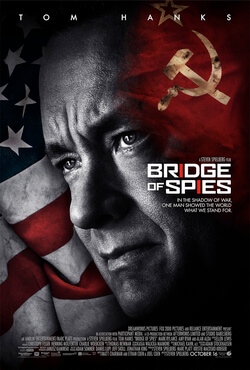
 Steven Spielberg is this generation’s Alfred Hitchcock in many ways. True, he’s not as much of an audacious experimenter, but he most certainly knows the movie making craft. He understands suspense, good storytelling, and strong production values. Because he still is one of the most entertaining filmmakers to date, maintaining a grasp of all the integral details that make a Hollywood film interesting.
Hitchcock famously made two Cold War thrillers of his own in Torn Curtain and Topaz that were unfortunately rather disappointing. In this respect, Spielberg may have just bested the Master with his own espionage thriller Bridge of Spies. The secret is that he too grabs hold of an everyman story, utilizing one of his most magnetic collaborators Tom Hanks, but he also has an immense appreciation for the historical subtext. This is as much a historical drama as it is a human drama or a spy thriller. The fact that it functions on multiple levels gives it a greater degree of depth.
The film starts with a rather ordinary fellow (Mark Rylance) who we don’t know anything about, except he is rather old and likes to paint. Soon the FBI is on his tail and we quickly remember that this is 1958 — the Red Scare is real — the Cold War is freezing over. Ethel and Julius Rosenberg are fresh on everyone’s mind as Rudolf Abel (Rylance) is imprisoned on multiple accounts of conspiracy.
This is a big deal and the whole country is watching, nay, the whole world is watching including the Soviets. The job of defending Abel appears a thankless one and so the buck gets passed to an insurance lawyer named James Donovan (Hanks). Whereas everyone else sees this as a sorry position to be in, Donovan understands it’s a stellar opportunity to reflect the ideals that the American justice system are founded on. Not everyone is so keen with his ideals, especially when it involves a Communist. It is in these early scenes where we understand the fear of a nuclear threat is real. Yes, the Red Scare is real. You begin to understand how it could take root in the American public. After his face is seen in the papers, Donovan receives the ire of the public and it affects his family.
Meanwhile, no one knows it but the FBI is proceeding with a highly sensitive mission in Soviet airspace. Any slight screw-up and nuclear war seems inevitable. But of course, the long-remembered Gary Powers is shot down in a U2 plane taking recon footage and all of the sudden things have gotten a lot hotter.
The second leg of the narrative follows Donovan as he tries to broker a deal between the two superpowers for a prisoner swap. Both countries are intent on keeping a lid on their national secrets. If Donovan’s task was just an exchange between Gary Powers and Abel it would be, shall we say, simple, but there has to be an added wrinkle. There always is. We get at least a taste of what the Berlin Wall truly did in creating a fissure between families and friends in Germany. However, crucial to this story, it also trapped an American student named Frederic Pryor in the GDR. Now Donovan has two men to try and retrieve, one bargaining chip in Abel, and two powers he must deal with. The Soviet Union are the main priority along with Powers, but his contacts in the GDR are still miffed about not being recognized by the U.S. They are not about to be pushed around.
Really we can break Bridge of Spies down to just a few men, but these seemingly simple actions and interactions are blown up and magnified to the nth degree on a highly political scale. If this is actually, in essence, how this war played out in real time then it is almost a ludicrously crazy ordeal.
Still, as Spielberg always does, he reverts his story back to the human component and Donovan, the man who put his vocational talents to good use in ways that had global impact. Imagine, he was a civilian, a man who was hardly given any authority by his own government, and yet his fortitude was ultimately rewarded. Then, at the end of a hard day’s work, he returned quietly to his wife and kids with the jar of marmalade he had promised to bring home.
Spielberg does well to evoke nostalgia, with the coats and the ties, the hats and ’50s sensibilities. And though we can guess the outcome of this biography before we get there, that doesn’t make the historical climate or how we get there any less gripping. That’s where this story succeeds. Furthermore, Mark Rylance’s performance is thoroughly grounded and his scrupled man of honor truly reflects socialism with a human face, all the while wielding a droll sense of humor.
It’s easy to look at the past events of world history with a more tempered eye. We can see the rationale of Donovan, the blind paranoia of the American public, and the unyielding tensions on all fronts. The day and age may have changed, but just have a look around. There are still tensions rising to this day. We still need the common man to enact change, now as much as ever. It’s that type of sentiment that really separates Spielberg from Hitchcock. His every man comes with heart.
4/5 Stars

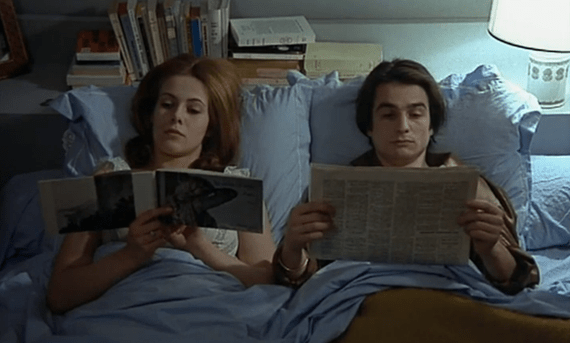 Arguably the greatest French comic was Jacques Tati and like Chaplin or Keaton he seemed to have an impeccable handle on physical comedy, combining the human body with the visual landscape to develop truly wonderful bits of humor. Bed and Board is a hardly a comparable film, but it pays some homage to the likes of Mon Oncle and Playtime. There’s a Hulot doppelganger at the train station, while Antoine also ends up getting hired by an American Hydraulics company led by a loud-mouthed American (Billy Kearns) who closely resembles one of Hulot’s pals from Playtime. Furthermore, there are supporting cast members with a plethora of comic quirks. The man who won’t leave his second story apartment until Petain is dead and buried at Verdun. No one seems to have told him that the old warhorse has been dead nearly 20 years. The couple next door that is constantly running late, the husband pacing in the hallway as his wife rushes to make it to his opera in time. There’s the local strangler who is kept at arm’s length until the locals learn something about him. The rest is a smattering of characters who pop up here and there at no particular moment. Their purpose is anyone’s guess, and yet they certainly do entertain.
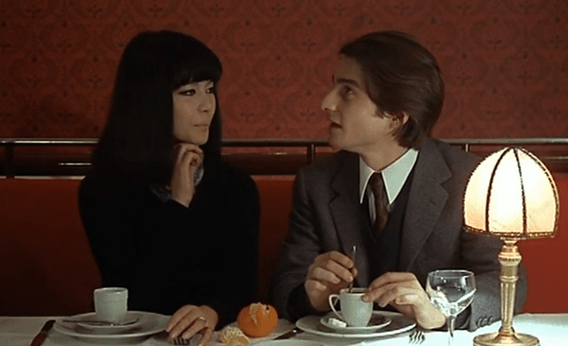 But as Truffaut usually does, he digs into his character’s flaws that suspiciously look like they might be his own. Antoine easily gets swayed by the demure attractiveness of a Japanese beauty (Hiroko Berghauer), and he begins spending more time with her. Thus the marital turbulence sets in thanks in part to Antoine’s needless infidelity –revealed to Christine through a troubling bouquet of flowers. It’s hard to keep up pretenses when the parent’s come over again and Doinel even ends up calling on a prostitute one more. It’s as if he always reverts back to the same self-destructive habits. He never quite learns.
 If you’ve read any of my reviews on the original trilogy, you undoubtedly know that Star Wars had a tremendous impact on my childhood. That’s true for many young boys. It was the film franchise of choice, and it wasn’t just a series of movies. The beauty of Star Wars is that it encompasses an entire galaxy of dreams beyond our own. It’s a world that reflects ours in many ways — the difference is that they have lightsabers. But not just lightsabers. Aliens. Spaceships. Planets. The Force. Characters who for all intent and purposes live like us. Good, that is in constant conflict with the evil in the world. It’s a struggle that is constantly evolving.
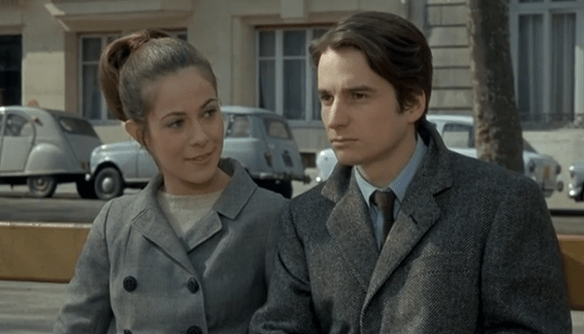 Charles Trenet’s airy melody “I Wish You Love” is our romantic introduction into this comedy-drama. However, amid the constant humorous touches of Truffaut’s film, he makes light of youthful visions of romance, while simultaneously reveling in them. Because there is something about being young that is truly extraordinary. The continued saga of Truffaut’s Antoine Doinel is a perfect place to examine this beautiful conundrum.
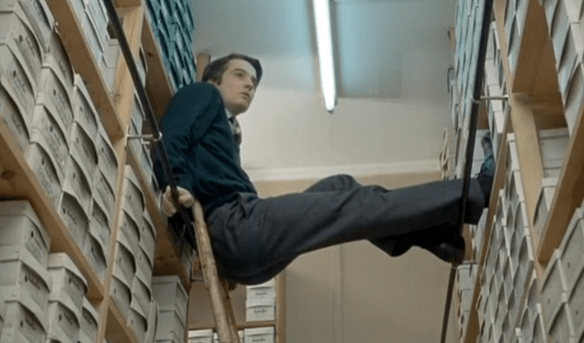 In fact, all in all, if we look at Doinel he doesn’t seem like much. He’s out of the army, obsessed with sex, can’t do anything, and really is a jerk sometimes. Still, he manages to maintain an amicable relationship with the parents of the innocent, wide-eyed beauty Christine (Claude Jade in her spectacular debut). Theirs is an interesting relationship full of turbulence. We don’t know the whole story, but they’ve had a past, and it’s ambiguous whether or not they really are a couple. They’re in the “friend zone” most of the film and really never spend any significant scenes together. Doinel is either busy tailing some arbitrary individual or fleeing pell-mell from the bosses wife who he has a crush on.
 By the time he’s given up the shoe trade and taken up tv repair he’s already visited another hooker, but Christine isn’t done with him yet. She sets up the perfect meet-cute and the two young lovers finally have the type of connection that we have been expecting. When we look at them in this light, sitting at breakfast, or on a bench, or walking in the park they really do seem made for each other. Their height perfectly suited. Her face glowing with joy, his innately serious. Their steps in pleasant cadence with each other. The hesitant gazes of puppy love.
 While
While  Whereas the previous Torn Curtain was generally concerned with life behind the Iron Curtain, Topaz is decidedly more continental moving swiftly between Russia, France, America, Cuba, including a few pitstops at international embassies. However, the film does end up spending a lot of time focused on Cuba which can very easily be juxtaposed with the East German scenes in the former film. Hitchcock once more creates an illusion of reality using the Universal backlot and the adjoining area to craft Cuba, and he makes into a place of sunshine and romantic verandas, but it also runs rampant with totalitarian militia. It’s perhaps more exotic and welcoming than East Germany, but no less repressed. In both cases, they become a perilous locale for our protagonists. Still, rather unlike the previous film, Topaz lacks a truly A-list star like Paul Newman or Julie Andrews.
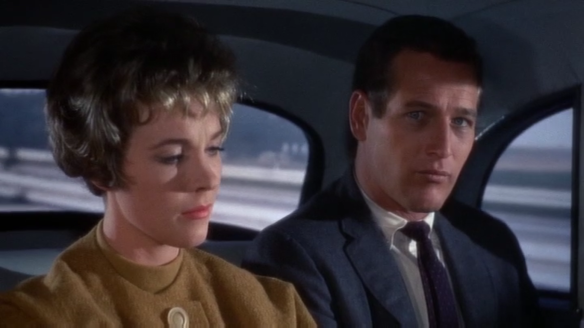 Torn Curtain was
  However, when you watch any Hitchcock film you do wait to be dazzled with some twist or trick because he was always one to bring humor and fascinating aesthetic qualities into his films. Torn Curtain has a few such moments that quickly come to mind. The most prominent has to do with the editing of the sequence in the farmhouse. It is here where Gromek is murdered by Armstrong and the housewife, but it is cut in such a fascinating way. It contrasts with Psycho’s shower sequence quite easily as they try and murder him first by strangling and then anything they can get a hold of whether it’s guns, knives, shovels. There is no score to speak of. Soon it becomes a methodical rhythm of cutting between contorted faces as they slowly but surely move towards the stove. The brutality and length of the ordeal suggest how ugly and laborious it is to kill a man. Hitchcock certainly does not glorify it in any sense.
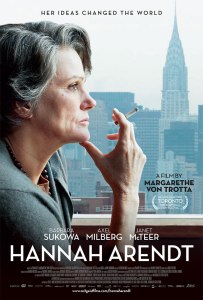 The term “banality of evil” has floated through the lexicon ever since German philosopher and columnist Hannah Arendt coined the phrase during the Eichmann trial back in 1961. In fact, the words gained so much traction that they have undoubtedly lost some impact due to overuse. However, this film takes equal interest in the backlash that she received on her remarks about the Jewish community. Her claim that the Jews were collaborators with the Nazis and privy to their own destruction, undoubtedly would be unpopular now. Back then it was a pure lightning rod for scurrilous criticism and hateful backlash.
 The Awful Truth came out of a trend that was in vogue during the 1930s. It’s called a comedy of “remarriage.” During the Hays Code era, it allowed films to nimbly skirt the whole issue of divorce and extramarital romance. We would see it again in the more remembered screwball His Girl Friday and various other forms as My Favorite Wife and The Lady Eve.
 We are definitely in the age of the well-wrought period piece and Brooklyn has all the trappings you could want. Adapted from Colm Toibin’s novel the film showcases a pure, noble heroine in Eillis Lacy who like many others makes the journey from her homeland of Ireland to the golden-paved streets of New York.
 4 Star Films