All Quiet on the Western Front (1930)

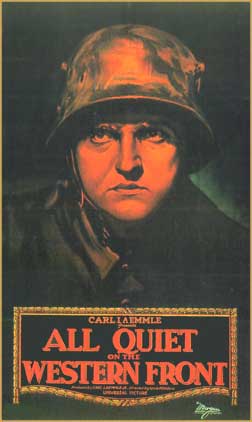
c7ab8-all_quiet_on_the_western_front_1930_film_posterDirected by Lewis Millstone and starring an ensemble cast headed by Lew Ayres, this archetypal anti-war film based on the novel of the same name, begins with a group of school boys during the dawn of WWI. This group of patriotic German youth is hungry for adventure and the glories of war. 

Then they arrive and begin their training which causes them to despise their commanding officer and they also lose some enthusiasm. It gets worse when they head to a combat zone and join a company of veteran soldiers without any food to eat. They finally head to the front and after a day in the trenches their number is fewer. 

Trench warfare proves to be hardly as glamorous as it seems with constant bombardment, rats, lack of food, and most of all the shedding of blood. One of their pals loses his leg and his boots, then slowly more get knocked off or wounded. Now Paul is one of the only ones left but after a bout of hand to hand combat with a French soldier he becomes even more disillusioned. Paul too gets wounded and is sent home on furlough to his family but he finds his friends and family have no concept of the gritty, grimy reality of war. He returns to the lines one more time and a few of his old comrades are still alive. 

However, in a fateful moment Paul reaches out for a butterfly in his trench and just like that he is dead. The last of this school room full of young, naïve boys is now dead or injured. That is the horrible scar left by not only by WWI but any such conflict. 

Despite the fact that all the main German characters are played by Americans, this film has a sharp sense of realism that extends all the way through the film. Even though many of these young actors were unknowns and are not well known today, together they made a powerful ensemble. The themes of this film were so powerful in fact that it was banned in Germany.

5/5 Stars

Stage Door (1937)

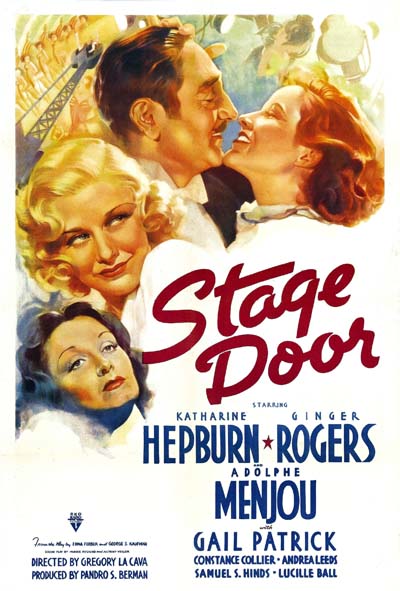
Stage_Door_(1937)Watching Stage Door illustrates one of the pleasures of film because it’s an unassuming classic that very easily could be overshadowed by other films. Its main stars are Ginger Rogers and Katharine Hepburn, who both have numerous films more well known than this one.

However, this story about a boarding house for aspiring stage actresses is a light piece of sassy fun while still finding moments for poignancy. Rogers is a cynical dancer named Jean, and she is not too pleased to be getting a new roommate. The last one moved elsewhere after constant fighting. But the new girl, Terry Randall (Hepburn), is different. She is from a well to do family, but she is pursuing a career in acting so that she might stretch herself.

The other girls look on with an air of contempt thanks to her fine clothes and pristine manners. She doesn’t fit the mold of many of the other struggling actresses looking for their big break. Many spend their evenings trying to grab hold of a sugar daddy such as famed theatrical producer Anthony Powell (Adolph Menjou). Several of the girls have their eyes on him as they try and land a role in his next big production.

Kay Hamilton is the most well-liked girl in the house and arguably one of the most gifted performers. She opened the year before in a production that won her rave reviews, however, a year later she has yet to get another break, and she is running out of funds. Powell’s show is her last big chance. Thus, when Powell cancels her audition last minute for a trivial reason, Kay faints and an irate Terry bursts into his office to confront him. He is initially turned off, but then he chooses her for the lead role of the upcoming Enchanted April.

Although the girls were beginning to warm to Terry, Jean has trouble forgiving her as tragedy strikes. In fact, Terry almost refuses to go on stage altogether, and yet she goes out and gives an emotional performance that is hailed by critics. In the end, Terry and Jean are reconciled which is far more important than any type of fanfare.

In many ways, Gregory La Cava’s Stage Door feels similar to The Women (1939). Both films have casts with women in the primary roles and the stories are at times volatile, with so much drama and many zinging comebacks. Some of this was courtesy of the supporting cast which included such legendary comediennes as Lucille Ball and Eve Arden. Ann Miller is even present, but at its core Stage Door is Ginger and Katharine’s film. Pardon my curiosity, but did Fred and Spencer ever do a film like this?

4/5 Stars

Dinner at Eight (1933)

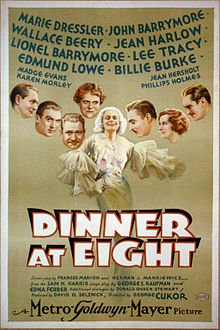
220px-Dinner_at_Eight_cph.3b52734Dinner at Eight is another all-star slug fest from MGM meant to capitalize and top the success of Grand Hotel from the previous year. This time around, well to do wife, Millicent Jordan is setting up a charming dinner party for a wealthy English couple Lord and Lady Ferncliffe who are traveling to New York. The hostess is frantically trying to figure out dinner guests for the big occasion because everything must be perfect. Observant viewers will notice that the high strung lady of the house is played by Billy Burke (more widely known as the Good Witch Glenda). Her husband Louis (Lionel Barrymore) is a kindly shipping magnate, who was hit hard by the depression, and his health is also failing as a result. Their daughter has problems of her own since she does not really love her fiancee and has fallen for the much older, and washed-up alcoholic actor Larry Renault (John Barrymore).

Next on the list of probable invitees is Carlotta Vance (Marie Dressler), the formerly prominent actress, who is now still in the twilight years of her career, but she still carries on a lavish lifestyle with furs and all. She is old friends with Louis, and she is always ready and willing to reminisce, fish for compliments, and offer a little sage advice on the side. She’s a character we like.

The most dynamic pair is most certainly Wallace Beery and Jean Harlow. They play the gruff, crooked businessman and his equally feisty wife, Dan and Kitty Packard. They’re hardly together because he’s working and she’s buying up clothes and caught up in an affair. When the two of them finally are together in the same room, they are constantly at each other’s throats. No punches or barbs are spared. And yet on the invitation to the Jordan’s they both pull their act together. He wants to meet the highly prestigious Ferncliffes, and she wants a chance to get dressed up. They’re quite the match.

With a title like Dinner at Eight, you expect the drama to take place around the table with the guests all seated together. However, that would be rather stuffy, I suppose, and instead, the dinner only acts as the culminating event to push the plot along. We actually never see the guests at the table, only the action leading up to it. Millicent is in a tizzy, especially when she hears the Ferncliffes have a change of plans. Her husband’s health is slowly deteriorating at the same rate as his company. The arrogant actor Larry Renault bickers with his agent about his next role. Honestly, this was the most unsatisfying of the threads, and it did ultimately end in tragedy. However, I’d be interested to know how close this parody actually came to John Barrymore’s actual life, because sometimes it’s hard to know how to parse the fiction from the reality when they seem to overlap.

Once all the guests are assembled it’s a rather ragtag group, but it is a fun mix of characters, and Millicent gets her cousin Hattie to attend along with her Garbo-loving husband who is unenthusiastic about the whole affair. It’s a satisfying overall result and an enjoyable enough ensemble that George Cukor directs with relative ease.

4/5 Stars

Grand Hotel (1932)

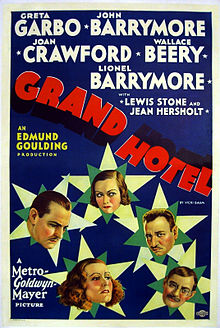
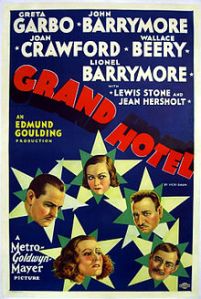
GrandHotelFilmPosterGrand Hotel is the epitome of a Hollywood superstar ensemble, and it would set the bar for all the films that would try to imitate and surpass it. Thanks to Irving Thalberg and the studio with more stars than there are in the heavens, MGM delivered a film that was a smash hit and after well over 80 years, it still remains an important visual relic.

The cast was beyond a contemporary viewer’s wildest dreams. It was that good. You had Greta Garbo, John Barrymore, Joan Crawford, Lionel Barrymore, and Wallace Beery among others. Nowadays many of these names do not carry as much clout (I must admit even to me), and the idea of a film starring numerous big names seems almost mundane. Just take a look at Oceans Eleven or The Avengers. But we must understand that at that time it was a stroke of genius because usually only one or two stars were set aside to be in a certain film. It was seen as the most commercially viable philosophy at the time.

Then came Grand Hotel: As Dr. Otternschlag (Lewis Stone)  muses it’s “always the same. People come, people go. Nothing ever happens.” It’s counter-intuitive but in some ways, that’s what makes this film so much fun. People love stories with fun vignettes that criss-cross and weave in and out. It’s even better when the stories contain the likes of Garbo and the Barrymores. Not to mention Joan Crawford.

It’s a fun world and a lasting tradition that many films have attempted to replicate because honestly, most audiences love these types of realities that they can escape to and in turn, be a part of. In this case, it’s this opulent hotel in the heart of Berlin full of bustling bellboys,  lavish suites, and all the pleasures life could afford.

Furthermore, the guests come from every walk of life imaginable making it all the more enjoyable to watch their intermingling and chance encounters. There is the prima ballerina (Greta Garbo), who has recently gotten cold feet and even canceled a show in her melancholy. It allows for Garbo to utter her famous line, “I want to be alone.”

Then there’s the baron (John Barrymore) who is also in desperate need of money. You might label him a cad because he resorts to theft several times, but if he is a thief he also has a heart of gold befriending and comforting nearly everyone he meets. He especially makes Ms. Grusinskaya very happy and it allows for some amorous scenes between John Barrymore and Garbo.

Next comes Mr. Kringelein (Lionel Barrymore) who is the lowest of all the individuals in the hotel, but since his imminent death is ahead, he is finally going to live a little and he finally gains some of the friends and respect that he has always wanted. On the other hand, Wallace Beery plays Preysing the big magnate who is trying to swing an important deal to keep his company afloat.  Mr. Kringelein is one of his nameless underlings who keeps his books. Preysing has little concern for the “little man,” until he is desperately in need of help.

Last, but not least, is a radiant and spry Joan Crawford as the stenographer. She’s far from the star, but she does seem to steal many of the scenes that she pops up in. Also, despite all the ups and downs, she gets the happy ending she deserves.

I must admit that Grand Hotel takes a little time to set the scene and pick up steam, but when it does it’s a lot of fun. You know it’s a special film when the two Barrymore brothers are acting together, playing two so very different individuals. Yet underlining every scene they share together is the indisputable fact that they are related.  You also have Garbo and Crawford in the same film without either sharing a scene with the other! For an updated take on this type of story give some attention to Wes Anderson’s Grand Budapest Hotel. Otherwise, this lavish 1930s production is worthwhile, because it really does feel like you’re watching film history.

4/5 Stars
Miracle of Morgan’s Creek (1944)

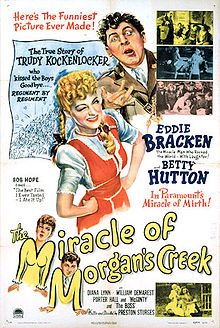
220px-The_Miracle_of_Morgans_Creek_1944_posterPreston Sturges was a revelation when I first saw Sullivan’s Travels and then The Lady Eve. His scripts are always wildly hilarious and full of memorable characters, whether they are headliners or just supporting the stars. The Miracle of Morgan’s Creek (1944) was a lesser known film to me, starring Eddie Bracken and Betty Hutton, but I was ready to see what this screwball could deliver.

With the start of the war, there began a push on the home front to strengthen morale by throwing parties and drinking victory lemonade in honor of the boys going overseas. Young Trudy is intent on dancing the night away with a lot of soldier boys. She just wants to do her part in the war effort after all. Her grumpy and domineering daddy Mr. Kocklenlocker (William Demarest) forbade her from taking part in such a shindig.

She sullenly goes to the movies with Norval Jones (Eddie Bracken), the young man who has been infatuated with her since they were kids. However, she somehow talks Norval into letting her go off to a party, and she spends the night living it up, while he waits dejectedly at the theater. When she finally returns its late morning of the next day and Norval knows her father will kill him.

However, Trudy also discovers a ring on her finger signifying that she married a soldier in her wild stupor the night before. The only problem is she cannot remember who it was, there were so many soldiers that she danced with after all. On top of that, add the prospect of a baby and you have a real doozy that has small-town scandal written all over it.

Norval tries his best to help remedy things for Trudy, only to wind up in jail with a big to-do building up — even making its way to the governor! Things don’t look good for poor Norval until Trudy gives birth and it’s a MIRACLE! When he finds out about what happens he has a little fainting spell.

That’s the craziness that is the Miracle of Morgan’s Creek, thanks to the rapid-fire dialogue and caricatures created by Preston Sturges. William Demarest is especially memorable as the hard apple Mr. Kocklenlocker who is always bossing his daughters around, but he’s not all bad. By now Morgan’s Creek looks dated, but all the same, it is still a memorable piece of WWII homefront cinema. Supposedly it was standing room only back in the day and honestly, it’s surprising that this film ever got past the censors. Bigamy, pregnancy, and so much more all comically mentioned in a 1940s film. Who would have thought?

4/5 Stars

Heaven Knows, Mr. Allison (1957)

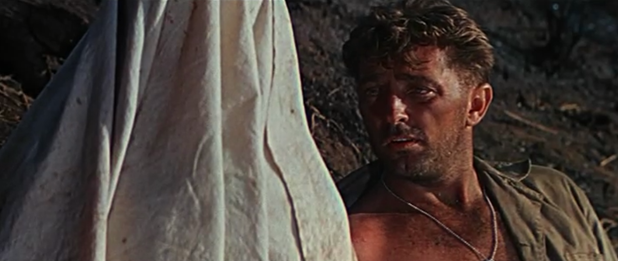
heavenknows3From John Huston comes another film about a woman of principle and a man who seems to be everything she is not. This time instead of Katharine Hepburn and Humphrey Bogart aboard The African Queen in WWI, we have Deborah Kerr and Robert Mitchum stuck on a deserted island together during WWII.

Kerr is Sister Angela who was on the island only a few days with a priest before he passed away. Now she is alone taking care of herself in solitude. That is until castaway Marine Mr. Allison washes up on her shore in a raft. For a time it is just the two of them as the Sister offers the marine food after his long, arduous journey. But after getting rest and some nourishment, he returns the favor proving his resourcefulness at scrounging up food on the island. For a while, they live in relative ease like this.

But they are reminded that the war is still going when the Japanese set up camp on the island. The unlikely pair finds themselves living in a cave together. Allison invades the camp on the sly to acquire food for them, and they continue to manage in hiding. Once the enemy is gone, the exuberant marine gets drunk on some sake and professes his love to the novice nun. Although the situation had never quite been awkward up to that point, it quickly becomes so. Sister Angela, in a tizzy, flees out in the pouring rain and winds up getting sick as a result.

heavenknows5To add to the predicament, the Japanese forces return, and back to the cave, it is. This time Mr. Allison must kill a soldier in order to get a blanket for Sister Angela. Soon the Japanese are burning the underbrush in pursuit of the culprit. It’s dire straights certainly, but then help comes.

Mr. Allison once again proves himself and regains the faith and admiration of Sister Angela. Once the marines roll in Mr. Allison is able to leave the island on a stretcher with the faithful novice by his side. They are a strange pair, but their relationship makes this story actually engaging. In a way, the life of a marine and a nun have some similarities, although they fall at completely different ends of the spectrum. In the same way, Mitchum and Kerr are adept at playing their roles to that degree. Allison is rough around the edges, a Joe Palooka type, and yet he means well. The nun is devoted to her calling, proper, and it never seems as if she could ever approve of Mr. Allison. And yet, in the midst of all the divides that seem in place, a true bond forms. It’s an entertaining relationship and these two stars,  led by John Huston’s direction, made it thoroughly enjoyable.

4/5 Stars

Shane (1953)

Just rewatched this gem from George Stevens. One of the great western classics!

4 Star Films's avatar4 Star Films

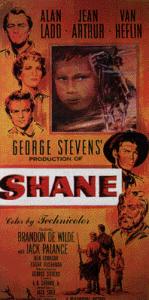
10788-shaneposterThere is often something special about westerns and Shane is no different. Directed by George Stevens and starring Alan Ladd, Van Heflin, Jean Arthur, and other great character actors, Shane is simple yet charming. It has many of the qualities of a great movie because of what it shows of mankind. Furthermore, it simply makes you feel good.

In the film Shane (Ladd) is a wandering ex-gunslinger who decides to live with a frontier family as a hired hand. His presence makes everyone happy because he is quiet, humble, and fundamentally so good. However, there is trouble from a man named Riker and his gang. Heflin’s character is adamant he must face the foe and defend his home. Shane will not allow it knowing this is a job for him. The two friends fight it out with Shane winning and riding into town. In the end, he wins the shoot out but more importantly he is…

View original post 333 more words

99 River Street (1953)

99river4This is a Sam Fuller type crime film that’s not pretty, it’s full of gritty realism, and it ends up being an unassuming little gem that is a great joy. However, instead, this film comes from director Phil Karlson pairing him with John Payne. In film-noir, boxers always seem to take a center stage and it is never (or hardly ever) the champs. It’s the near misses or the bums. Ernie Driscoll (Payne) falls into this category as well.

After his big fight and an unfortunate conclusion to the bout, Driscoll is all washed up and he and his wife know it. He relives the moment in agony and dejectedly takes a job as a taxi driver, while he tries to figure out a future without boxing. You can tell his wife is fed up with this way of life, and she’s getting awfully snappy. Driscoll is unhappy, with his marriage going down the tubes, so his only encouragement comes down at the coffee counter with his buddy Stan and the bubbly actress Linda.

Things get worse when Ernie sees his wife with another man who also happens to be a real thug. Ernie is humiliated and looking for revenge, but on Linda’s bidding, he follows her to the theater because she is in desperate trouble. He obliges and yet again he feels like he’s been made a fool of. He cannot even seem to trust her.

Ernie wants desperately to get back into the ring, against the better judgment of his former manager. But he still is caught up in the whole mess with the cunning tough guy Victor Rawlins who stole Driscoll’s wife. The man shows how little the girl meant to him in comparison to the money and after getting a payoff for a fat load of diamonds, he waits for a freighter to take him away.

Linda wants to help Ernie after what happened on the stage, but she cannot stop Rawlins. It’s up to Ernie to duke it out on the docks, and it turns into a real brawl where he struggles not to get his bell completely rung after a gunshot to the chest. It’s the biggest fight of his career and somehow he wins. Really 99 River Street sounds like a run-of-the-mill noir, but Payne’s performance is rather good. It feels rather like Edward G. Robinson in Scarlet Street where no one seems to be on his side. However, he does ultimately have two solid allies in the faithful dispatcher Stan and the always vibrant Linda. Ernie finally follows Stan’s earlier advice and whispers sweet nothings into the ear of his love. It’s a happy ending for a noir.

The cast is rounded out nicely by a wonderful group of character actors including Brad Dexter, Jack Lambert, and Jay Adler who all work as the scum of the earth-dwelling in New York. The contrast of the bubbly Evelyn Keyes with the more aloof Peggie Castle was also very effective in the film. Now I need to see Kansas City Confidential as well.

4/5 Stars

Kiss of Death (1947)

kissof1Film-Noir gets interesting when the stylized, more formalistic world of this dark genre begins to seep into the familiar human drama that we as an audience are more used to. Many of us have families. We have jobs so we can provide for our families.  Or maybe some of us don’t and that makes for some tough decisions.

In Henry Hathaway’s Kiss of Death, Nick Bianco (Victor Mature) has been out of work for a long time now, so on Christmas Eve, in order to get presents for his two little girls, he robs a jewelry store with a few other accomplices. What sets him apart is he’s not your stereotypical ruthless criminal. He’s a family man, but he’s also bought into the idea that you don’t squeal. So inevitably after he gets caught and booked, Nick will not talk and he gets sent to the clink. The assistant D.A. (Brian Dunleavy) tried to help him, but Bianco took the three years in Sing Sing instead.  After all, his wife is doing fine and so are his daughters.

While he’s in the clink, however, he gets tragic news that his wife committed suicide and his two girls were sent to an orphanage and that changes his entire outlook. He needs to get out of there, and he’s ready to sing if that means getting to see his girls. He begins communication with D.A. Louis D’Angelo again, and he also begins to receive visits from a pretty young woman named Nettie (Colleen Gray), who used to babysit his girls back when his wife was still alive. As his relationship and gratefulness in Nettie grow, Nick also comes in contact with Tommy Udo who is also serving time. He’s a thug with a maniacal laugh and psychopathic personality if there ever was one. He’s not a good guy to cross.

The dkissof2ay finally comes when Nick gets out and he has Nettie waiting for him with his two girls. They are a beautiful happy family and Bianco has remade his life possibly better than it ever was before. However, he’s still beholden to the D.A. and they want him to get dirt on Tommy Udo. They don’t know what they’re asking, but still, Nick goes through it reassured that depending on what he can get, Udo will be put away for good. But of course, the slimeball beats the rap and Nick’s now a sitting duck. He sends his family away and waits for a confrontation with Udo.

His home life has all of a sudden been shattered, and he’s a wreck. Udo’s sadistic laugh undoubtedly ringing in his ears. In a different era, this film could have spiraled deeper and deeper into the darkness after the final confrontation. Supposedly there was one cut of the film where Widmark’s character actually got away and Mature was left for dead. The ending that was decided upon is still harrowing but holds a Hollywood silver lining as Coleen Gray’s narration ties up the story in a nice bow.

There potentially was also a scene in Kiss of Death with Mrs. Bianco where Udo took advantage of her and drove her to commit suicide, but it was deemed too graphic at the time. Although I would admit that such a scene would have made Udo even more despicable, he really did not need much help. Widmark plays him to a tee with a chilling laugh that would make the Joker proud. Mature is certainly not the standout, but he’s a necessary every man who we can empathize with. The demure Colleen Gray (who unfortunately just left us) is also fun to watch as the girl who stands by him. She also serves to narrate our story informally. Maybe it’s just me, but I really do not grasp the importance of this title. It gave me major misconceptions going in, but that’s not necessarily a bad thing.

4/5 Stars

People on Sunday (1930)

peopleonsunday1One of the last German silent films was People on Sunday, a modest project from a group of young men. Our stars are young professionals in real life and only amateur actors who did not quit their day jobs. They only could film on the weekends and that’s how we end up with People on Sunday! It takes on a faux-documentary style, and it follows the lives of four individuals as they meet one another and then spend a pleasant Sunday afternoon together.

There is certainly a breezy playfulness to the film as the two men and two women spend time frolicking at the beach and reclining in the sun. They share laughs while eating and listening to records. It quality fun and there seems to be a general innocence to their behavior that while sometimes rude is all in good fun.

This is, in fact, a film of the late Weimar Republic, without the cloud of Hitler’s Nazi regime hanging over the country (not until 1933). It stands in sharp contrast to later works or documentaries because People on Sunday is seemingly free and wholly unrestrained by ideology or prejudice.

We should undoubtedly be grateful for this historical piece of New Objectivity cinema and the reasons are twofold. First, since the film essentially works as a documentary, it gives us a wonderfully clear picture of what life was like in the world of Berlin. There are continuous shots of the city streets, passing vehicles, and people making their daily rounds.

One especially memorable moment occurs when the story takes a short aside to afford time for a montage of faces. The camera slowly captures face after face providing a sample of all the individuals who walk these streets. They transcend time and space because of their humanity, their mundane quality, and they have the same lightness of our main characters.

When we look at the names behind People on Sunday, it is almost staggering to acknowledge these men who were formerly unknowns.

As directors, you have Robert and Curt Siodmak. Your main writer is the great Billy Wilder. As cinematographer, you have another great in Fred Zinnemann, and finally, production was helped by the B-picture master Edgar Ulmer. Due to the rise of the Nazis, all of these figures would end up emigrating to Hollywood and the rest was history.

In many ways, we are indebted to them, because they helped form some of the great American classics and you can already see them honing their craft. The images are visually arresting and there is even a sense of humor that we could seemingly attribute to Wilder. It would only get better from then on.

If I’m not mistaken there are several scores that have been used to accompany the film, but I did really enjoy the Czech film orchestra because it added a lot to this otherwise silent picture. Hope you enjoy this unassuming jaunt as much as I did.

4/5 Stars