Classic Movie Beginner’s Guide: Audrey Hepburn

I wanted to continue with my series of classic movie beginner’s guides. The idea is to make learning about old movies more manageable by providing bite-sized chunks to watch. In other words, 4 films to begin with.

Here’s our latest list on Audrey Hepburn, one of the most beloved and widely-photographed figures of all time.

Roman Holiday (1953)

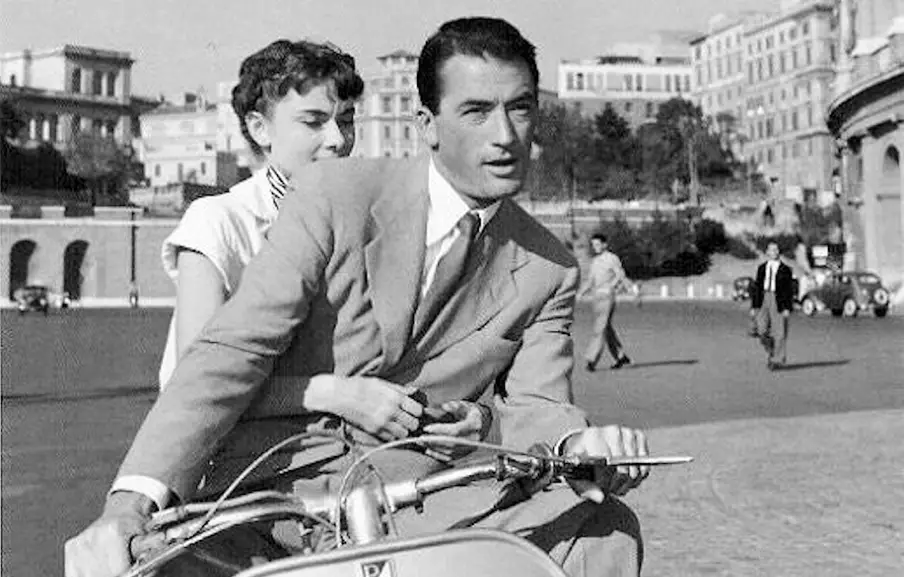
She came onto the scene as a radiant princess. Literally. Her Cinderella-like romance with Gregory Peck through the streets of Rome is one of the great cinematic fairy tales of all-time. Understandably, it netted her acclaim and made her an instant Hollywood star. She’s just too adorable not to love.

Sabrina (1954)

Image result for sabrina 1954

Not a bad follow up to land a movie with director Billy Wilder and two big stars in William Holden and Humphrey Bogart. Audrey more than holds her own with her waifish elegance and fitted with a wardrobe newly-acquired from Givenchy.

Breakfast at Tiffany’s (1961)

Image result for breakfast at tiffany's

Parts of this movie certainly haven’t aged well (Mickey Rooney ahem!), but there’s also so much that’s enheartening about this classic romantic comedy. It’s one of Audrey’s finest and most vulnerable performances stretching her innumerable talents. Those opening shots are magic. Moon River is for the ages.

Charade (1963)

Image result for charade 1963

I could have picked a handful of other movies that you should also watch, but this one is just too fun not to mention. Audrey and Cary Grant together are obviously delightful. It’s also in the public domain too so no excuses for not getting around to watching it someday.

Worth Watching:

Funny Face, A Nun’s Story, My Fair Lady, How to Steal a Million, Two For The Road, Wait Until Dark, They All Laughed (and everything else if you love Audrey)

The Seventh Victim (1943): Lewton’s Economy Rules

Seventh-victim-poster_one_sheet.jpgWhat a picture for Kim Hunter to have come into her own (and Mark Robson for that matter). The 7th Victim is a chilling gem, and the motor to move the story forward is an audacious girl, Mary Gibson (Hunter), who makes a decision to leave her boarding school of stain glass and angelic choirs, to search after her missing big sister.

Upon arriving in New York, Mary finds out Jacqueline, in an uncharacteristic fashion, sold her profitable cosmetic company eight months prior. Something must be up. Our kiddy noir hits its paces as Mary’s intrepid investigations lead her to Dante’s Italian Restaurant. She checks in on her sister’s rented room only to find a chair and an ominous hangman’s noose.

Next, she files a claim with the missing person’s bureau and looks to hire a private eye to give her help in a city that feels generally unfriendly. However, this is not entirely the case as she makes the acquaintance of Jason, a local poet who looks to lighten up the atmosphere. Likewise, Hugh Beaumont acts as a calming force in this labyrinth of turbulence and underlying dread. Nevertheless, he warns Mary that her sister, “Lived in a world of her own fancy. Didn’t always know the truth.” Another portent of some ill fate awaiting her.

Admittedly, on a micro-level, all the pieces simply do not fit together. To understand why we only need look at what moments were potentially left on the cutting room floor. In the age of narrative incoherence in crime storytelling, The 7th Victim is among the best (or worst). The fact that in such a short time it can be so befuddling must speak to something. Dissenters might clamor this is a disjointed mess but if this is faulty storytelling there is also a sense of apprehension present, inherent to such narratives.

It cannot simply be about four scenes that were famously cut out of the picture. Though we would have gained clarity in one sense, in another these missing pieces somehow aid in this byzantine journey weaving a yarn out of relatively meager resources. The dialogue is just okay but on a macro level, it’s all very intriguing.

The creme de la creme of chiaroscuro photography occurs when Mary goes down to a mysterious shop with Mr. August on a clandestine mission that goes awry. Anyone walking into such a world would know to begin with no good will come of it, inching down a hallway of darkness.

Then, we have the curious appearance of Dr. Judd (Tom Power) from Cat People who conveniently provides another male character with information on Jacqueline’s current situation. He subsequently has deep abscesses of knowledge about a cult of Palladian Devil Worshippers operating out of Greenwich Village. Again, we have a mythology evoked with traditions and sacred texts lending credence to this widespread conspiratorial atmosphere.

Because of course, as you might have guessed already, Jacqueline (Jean Brooks), now cloaked in a bob of dark hair, found herself immersed in a very foreboding crowd. They don’t look too kindly on those who let their secrets out. Another stylistically rewarding moment comes right after the woman is released from certain death and winds up wandering the darkened streets in a near dazed state. She scurries away into the shadows to evade an unknown pursuer — frantically seeking the aid of an oblivious theater troupe.

We’re on again with the perplexing waling nightmares because the film chooses to dwell in such places. But if the picture chooses to acknowledge Satanic cults the equal and opposite must be called upon to whether the evil. Though not an obviously religious man, the good psychiatrist asserts there is proof that good is superior to evil.

It comes in the words of the Lord’s Prayer. He speaks the words, “Forgive us our trespasses as we forgive those who trespass against us…Deliver us from evil.” Again, the real world liturgy pads the narrative with a kind of believable ethos even as Jacqueline is still hounded by some unknowable, supernatural specter.

The final scene is a blink and you missed it circumstance. Provided a few more seconds to sink in it could have been a horrible thing. As is we hardly have time for the facts to dawn on us until the movie is over, literally seconds later. While not optimal there’s no discounting how the scene was handled visually. Even in this single moment, it says so much with what is not seen and a sound compared to so many other pictures bloated with extravagant sets and resources.

7th Victim is a reminder that sometimes our movies lack imagination, thinking money and special effects can be thrown at a story to make it novel. While this might be true on a most superficial level, sometimes it is constraints that bring out creativity and reveal to us how starkness in the right context can be a beautiful gift. Val Lewton’s horror unit is one of the small wonders of classic cinema, and they cast an indomitable shadow, widely in part to cinematographers like Nicholas Murucasa. This one is another low-lit gem. Once again economy rules.

4/5 Stars

The Leopard Man (1943): A Work of Sound and Shadow

190px-Leopard_man.jpgIt’s fitting that a pair of castanets act as our entry point into the latest entry from Val Lewton’s RKO unit. Not only do they instantly grab our attention, but they foreshadow the auditory nature of the film and, in the cultural context, provide a little shorthand for where our setting might be.

Because with this stereotypical “Latin flavor” we find out soon enough we are indeed in New Mexico. At the local nightclub, Kiki (Jean Brooks) bemoans the fact her rival Clo-Clo (Margo) is constantly clicking, and it does seem blondes like herself are on the downside. However, her boyfriend, a fledgling publicity man (Dennis O’Keefe), has a new stunt to make waves with the viewing public.

When he walks into her dressing room with a leopard on a leash, she nearly dies of fright, and we have entered into the kind of territory intent on making our B feature a pulpy pleasure. Kiki reluctantly makes a grand entrance with her new pet and makes quite the impression as patrons look on with shivers of trepidation. Except her moment doesn’t last long as Clo-Clo scares the creature off and it goes racing off into the night — a beast off on the loose. One can only imagine what a deadly cat might get up to lurking in the shadows on any given evening…

From this point onward, the picture introduces a plethora of players from a fortune teller hiding in the shadows with her deck of cards just waiting to tell Clo-Clo her fortune. There’s the hapless bloke Charlie who gave up his prized leopard to Manning and wants his remuneration.

Then the local girl deathly afraid of the beast at large and nevertheless gets locked out of the house by her mother until she fetches the cornmeal for her father’s supper. We know the inevitable is about to happen. The creature will find her. Her world is developed almost solely through sound. The drip of water. Feet trudging through the dirt. A train passing overhead. They punctuate the scene immaculately leading into the big reveal. Because we know what is waiting for her…

She makes a mad dash to the front door of her home crying out to her family to open up but she gets no further. Like Cat People before it, The Leopard Man is made as much out of what is not seen and it has one of the most startling cinematic death scenes executed through utter minimalism.

Because although Manning and his girl feel awful about their hand in this girl’s tragic death, they soon realize more might be afoot. Another grisly death follows and then a subsequent evening Clo-Clo…

It is the stripped-down sound design in the picture that reflects the Lewton/Tourneur unit at the pinnacles of their powers. Where pure suggestion is imbued with so much meaning. So little can be so very much. Whereas M was a picture where the killer has a calling card, in this film the murders can be remembered by their accompanying sounds.

The wind whipping through the trees as a woman sits locked in a garden. A car engine driving off to get someone to open up the gate. Rustling leaves being stepped on and then quiet. With Clo-Clo it’s little different with the same repetition of her heels clicking on the pavement in rhythm with her castanets. Then, she too reaches a finality.

Despite the stylistically rewarding elements, The Leopard Man gets less interesting with time as it comes out the leopard might be masking a more mundane serial killer plot. Not to sound overly callous, but this is more of a real-world development. Aside from courting too many characters who dilute the impact of the whole story, The Leopard Man feels more stagnant than its predecessors.

The greatest pity is how there isn’t the same unnerving magic hanging over the picture. It probably has too big a stake in reality. What its predecessors were blessed with, in narrative terms, was the supernatural mixed in with everyday reality. The Leopard Man falls on the wrong side of the fence, unable to leave us with the same type of lingering specter. Its strengths were always in what was not actually there, instead of human beings of tangible flesh and blood.

3.5/5 Stars

I Walked with a Zombie (1943): Shadow and Psychology

IwalkedwithazombieThe film commences brilliantly as Frances Dee can be heard in voiceover with almost fond recollection, matter-of-factly stating, “I Walked with a Zombie.” The way she expresses it immediately debunks anything we might think from an admittedly exploitative title. Producer Val Lewton does not settle for a straightforward slapped together horror flick.

His ambitions were always to elevate the concepts he was handed into something indelibly interesting. Our heroine Betsy Cornell (Dee) is a Canadian nurse who applies for a position taking care of a man’s wife. It’s all very mysterious, but she’s eager to work and sets sail for San Sebastian where she will be in the service of Mr. Paul Holland (Tom Conway).

Lewton re-framed the source material into a Jane Eyre tale transplanted to the West Indies. Here Ms. Cornell arrives by boat, immediately struck with a callous first impression of the aloof Mr. Holland. He easily dismisses her childhood fear of the dark, while noting he never should have hired her.

I still contend most children are never afraid of the dark per se but what might come out of it. It’s the fear of an unknown thing lurking out of reach. Meanwhile, his younger brother (James Ellison) is a charming fellow who immediately takes a liking to the new nurse and helps to make her feel welcome. We have polar opposites set up and obvious points in a possible love triangle.

However, in following the plotting of Bronte’s work, the elder half-brother is tortured by a secret, literally locked away. It is, in fact, his mysterious wife, whom Betsy unwittingly meets one night, upon hearing a startling noise. At first, she’s taken aback by this specter of a woman, this ghost, this living dead.

But as her kindly doctor explains, supplying a firm foundation of ethos to this enigma, a portion of the spinal cord is burned out, and it has permanently made her a sleepwalker who can never be awakened. Aside from a potentially dangerous foray into shock therapy — to induce some sort of coma and hope for the best — her future prospects look dim. That is unless there’s an alternate means to bring about healing.

Like the Wolf Man before it, we are introduced to a stylized but nevertheless real locale that thrives by mixing the logical digressions that come from our world with ghostly influences. Screenwriters Curt Siodmak and Ardel Raye create a kind of poetic mythology for a supernatural conclusion to be crafted out of. Whether they meant to or not, they succeeded in canonizing zombies in the same manner werewolves were developed in Siodmak’s earlier script.

What’s lovely is how Betsy foreshadows all sorts of events to come and there are strangely mesmerizing objects to captivate us. The figurehead of a slave ship features Saint Sebastian himself pierced by arrows. It lends this undercurrent of the brutish injustices of the slave trade to the landscape we must come to terms with.

These very same traditions have the same weighty dolefulness but are also imbued with an otherworldly quality of its own. It gives this shading to the African-American characters who seem so happy-go-lucky like other Hollywood creations, and yet there’s an almost unnerving sense about them as if something is working under the surface. It’s hard to put an exact finger to it, but though they look similar, they aren’t quite straightforward stereotypes.

A local club singer chants an island song mixed with family folklore telling of the deep-rooted tragedies of the Holland family. The local populations are also adherents of local voodoo customs, and their nightly drumbeats ring out through the air ominously, picked up by the tropic winds. It’s yet another layer to this continually bewitching atmosphere.

Another character of crucial importance is Mrs. Rand, the deceased patriarch’s widow, and Wesley’s birth mother.  Her own station in life, as the wife of a Christian missionary, creates a juxtaposition between a so-called normal religion and a darker, more dubious strain.

Because it cannot help but bump up against the voodoo rituals even as black and white people now exist together. In fact, one might say the religious rituals become nearly intertwined. Betsy begins to realize maybe some powers at be might be capable of lifting the spell that has entranced Ms. Holland, even as she herself falls for the comatose woman’s husband.

As such, it is not horror lingering over the frames but a near mesmerizing catatonia. It carries you up in its grips from start to finish, trying to decipher what to make of such a vision. Enchantment, ugliness, cruelty all apply. And yet it’s difficult to cry out and out evil against the people partaking in these dances or voodoo ceremonies. The acts themselves might be evil, but the people are held in the grips of entrancement. Everyone is, to varying degrees, weighed down with desolateness even before the fateful dead are laid to rest.

We must recall the beginning voiceover once more. The fact Betsy walked with a zombie might hold an inherent element of terror, but more so, it carries with it a despondency that cannot be lifted. It hangs over us and haunts us just as the lurching Carrefour does throughout the picture.

The beauty of most any of the Val Lewton films of the 40s is how the studio and the audience expected one thing — a low budget horror flick with a provocative title — then the producer turned around to make micro-budget gems steeped in shadow and psychology. They have more depth and complexity than they have any right to.

Each entry boasts sumptuous visuals hiding weaknesses in the budget department to fully develop, not necessarily a world, but the impression of a world. One might contend the latter is far more powerful in an expressionistic capacity. Arguably, Lewton had no more formidable collaborator than director Jacques Tourneur who had an established knack for conjuring up the most splendid atmospherics.

This time he is aided by the black and white photography of Roy Hunt. In their hands, every character has a doppelganger in the form of shadows creeping along the walls with their human counterparts. It’s developed with the utmost efficiency, which seems all but a lost art these days.

But the astounding economy is matched only by a ceaseless ingenuity. Because the artfulness they managed to accomplish on the very same shoestring budget, is part of what makes them marvels even today. If you willingly invest your time in one of these RKO pictures, it’s very likely you’ll be met with a lasting impression. The dividends, as far as cinematic capital is concerned, are enormous.

4/5 Stars

Classic Movie Beginner’s Guide: Alfred Hitchcock

This series is meant to help fledgling classic movie fans grab hold of a few titles they should watch. Instead of trying to be comprehensive, I want to try and make the discovery manageable with only 4 films.

Let’s begin with one of the most universally beloved directors of all time, “The Master of Suspense” himself: Alfred Hitchcock.

He began his career in silent film and made a name himself with a bunch of early British thrillers in the 1930s. After transitioning to Hollywood in 1940, his career took off and by the 1950s he was one of the most widely-known directors in the world.

Here are a few films to get you started!

Notorious (1946)

Classic Movie Beginner's Guide: Alfred Hitchcock

It kills me to leave off so much early Hitchcock. The Lady Vanishes, Rebecca, Foreign Correspondent, Shadow of a Doubt. You should go watch them all. But Notorious, starring Cary Grant and Ingrid Bergman, is arguably one of his finest romantic thrillers. It’s masterful.

Rear Window (1954)

rear window 4.png

I know, I know. It’s quite a big jump but this is also the quintessential Hitchcock movie (at least in my humble opinion). James Stewart and Grace Kelly. Limited space and a harrowing murder plot. This film is a textbook example of how to create tension. There’s so much here worth talking about. I’ll leave it at that.

If you like it, check out Vertigo and The Man Who Knew Too Much remake (with Stewart) and Dial M for Murder and To Catch a Thief (with Kelly).

North By Northwest (1959)

It didn’t earn its nickname as the most epic man-on-the-run Hitchcock movie for nothing. Between crop dusters and Mt. Rushmore, Cary Grant and Eva Marie Saint, this one is an absolute blast of thrilling exhilaration. For bonus points, see how it reworks themes of Hitch’s earlier masterwork The 39 Steps.

Psycho (1960)

Here we are. The one everyone will forever associate with Hitchcock and showers everywhere. And Norman Bates. And his mother. Anyway, it’s another technical masterpiece in manipulation. It rewrote the books on modern horror and still packs a psychotic punch. Pun intended.

Worth Watching:

Let’s make this easy and say all of them. And for the record, I realize I left out Vertigo. Go watch it.

4 Living Legends Part 5

Here is another entry in our ongoing series of Classic Hollywood Stars who are still with us. This is an effort to acknowledge living legends who are well-deserving of our appreciation.

Marsha Hunt (1917-)

Marsha Hunt is one of Classic Hollywood’s amazing centenarians. Before having her career sabotaged by the Hollywood Blacklist in the age of McCarthyism she showed surprising utility in a range of pictures including Pride and Prejudice (1940), Kid Glove Killer (1942), Cry Havoc (1943),  and most memorably in Raw Deal (1948).

Eva Marie Saint (1924-)

Aside from starring in such perennial classics as On The Waterfront (1954) and North by Northwest (1959), she was also married to her husband Jeffrey Hayden for over 60 years, until his passing in 2016.

Angela Lansbury (1925-)

With her starring lead as amateur sleuth Jessica Fletcher in Murder, She Wrote, it’s sometimes easy to forget how early Angela Lansbury started her career in Hollywood. Some of her wide-ranging performances included Gaslight (1944), Picture of Dorian Gray (1945), The Manchurian Candidate (1962), Bedknobs and Broomsticks (1970), and, of course, Beauty and The Beast (1991).

Sidney Poitier (1927-)

There is so much to be said about Sidney Poitier’s impact on American cinema and representation of African-American masculinity. His catalog is still staggering to this day going beyond high profile successes from ’67 like In The Heat of The Night, To Sir With Love, and Guess Who’s Coming to Dinner. No Way Out (1950), Defiant Ones (1958), Paris Blues (1961), Lillies of The Field, and A Patch of Blue (1965) are all worth searching out, among many others.

The Third Man At 70

Oh, how I love The Third Man (or The 3rd Man). Regardless of how you write it, Carol Reed‘s post-war noir is one of those special films that was a case of love at first sight.  I knew some of the reasons already, but watching the film with a friend (on his first viewing) teased them out even more so. It was a nice reminder of why this film continues to enchant me and engage me on fundamental levels time after time.

Dutch Angles in Post-War Vienna

third-man1

My buddy was right. The Third Man is inherently disorienting. Visually the film presents all of its subjects from a stilted perspective. They’re always slanted, featured in crammed together close-ups, and never quite sitting square in our line of vision from the camera’s uncomfortably low angles. Whether we realize them or not, there’s no doubt the dutch angels (from “Deutch” or German) manipulate how we experience the action.

Starting with these formalistic elements, the mood is perfectly ingrained in the fundamental building blocks of the story with the crumbling city sectioned off into its uneasy alliances between the WWII victors. We have a crosshatching of districts and a melting pot of language and objectives.

Thus, when the blundering American author Holly Martins walks into the story, he, like his audience, has very little understanding of what is going on. His level of comprehension is lost in translation even as he goes around trying to get to the bottom of the scenario. Joseph Cotten does a fabulous job in the part effectively becoming our eyes and ears in the environment.

And this strong association is part of the reason I so vehemently decried Netflix’s tampering with the original film’s ambiguity. If you’re like me and Holly Martins, you’re no polyglot, aside from a few token phrases here and there. When the old man or woman in the house rattles off something, you’re lost in the unfamiliarity. You’re waiting for someone to explain it, even trusting on the good graces of others. In some regards, you are helpless.

It’s part of the way the film toys with us. You realize the whole time maybe you’ve been played and a whole level of the film’s context has flown over your head. Subtitles alleviate our ignorance but also cause us to lose out on some of the perplexity felt as a result of such a global battleground. The Third Man capitalizes on the richness of these cultural ambiguities.

The Zither & Herb Alpert

going places

The music is next on my list. My friend was right again. The title song’s awfully familiar and after Anton Karas got plucked off the streets of Vienna to provide the lively but strangely hollow and foreboding soundtrack, it would go onto some acclaim on the music charts (including a guitar rendition by Guy Lombardo).

The tune is one of a select few early movie themes to hit the mainstream remaining fairly recognizable even today. This is even more surprising given its inauspicious roots. My friend connected the dots later only to realize he’d heard the particularly Latin-flavored version by Herb Alpert and The Tijuana Brass on their album !!Going Places!!  He taught me something new, but you learn a lot being friends with an avid record collection.

Quick Pacing

img_thirdman

It might be a mere generalization, but I feel like there are often complains leveled at films of yore that they languish, there’s too much talking, and they don’t boast enough action. But I think my buddy was spot on once more. The Third Man has surprisingly timely pacing (aside from the deliberate final shot).

One of the practical reasons for this might have been director Carol Reed literally being hooked on the stimulant Benzedrine to get through his hectic shooting schedule around the clock. This might be one explanation for the zip, even in the opening monologue. However, there’s also an undeniable drive to The Third Man because it’s stuffed with questions, mystery, and underlying tension.

As information begins to reveal itself, we have screeching taxi rides, reveals, harrowing meetings on Ferris wheels, and climactic chases sequences clattering through the rubble-strewn streets and labyrinthian waterworks. But the reason it grips us has to do with falling in with intuitively compelling characters. That’s as good a place as any to bring him up…

Harry Lime: Super-Villain?

welles_thirdman5

The final observation I found to be particularly interesting was my buddy’s acknowledgment that Harry Lime felt surprisingly modern, a precursor even to the current villain. I want to tease out this idea even more because I’ve been drawn to movies that layer their menace. I can think of the likes of Black Panther or Mission Impossible: Fallout as two recent examples.

However, what I mean by this is how you don’t quite know where the trouble is going to come from, who you can trust, and who will betray you. It makes for a glorious puzzle to navigate. Is Calloway someone we can give our allegiance to? He’s an awful stickler for the law without clemency.

Mr. Crabbin is an unnerving chap before we ever learn who he is and the shifty-eyed likes of the Baron, Dr. Winkel, and Popescu have far more to tell than they willingly divulge. The woman Anna (Valli), who loves Harry, is almost delusional with her unwavering love for a scoundrel. Even Cotten, our initial hero, lumbers around like a drunken idiot, thinking he has everything figured out.

And of course, there’s Mr. Harry Lime himself. The most iconic charismatic, machiavellian anti-hero. Orson Welles makes him a dashing shadowy specter, larger-than-life and theatrical. But there’s no discounting the mercilessness pulsing through him. None of these characters are straight-laced by any stretch of the imagination. They have some flaw, evil, or vice dragging them down. Lime just remains the mastermind and the poster boy of it all.

The one character who seems like a generally agreeable chap is, of course, the one who SPOILERS gets it. Somehow it fits the times and the world. It couldn’t be any other way.

So 70 years on The Third Man still remains one of the preeminent examples of a quality thriller, pulsing with atmosphere, style, romance, and intrigue. To say they don’t quite make movies like this anymore is immaterial.

What’s truly staggering is how brilliantly Carol Reed’s film still holds up. I look forward to many more viewings to come, preferably with a friend or two. After all, they’re the ones who help me appreciate classics like these with new eyes.

Happy 70th Year to The Third Man! You’re still looking great!

I’m also proud to be a part of the Classic Movie Blog Association celebrating 10 years of existence. Here’s to many more.

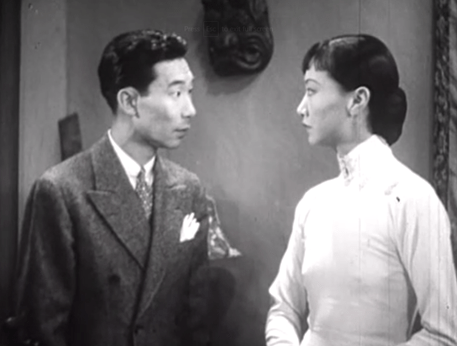
Daughter of Shanghai (1937) Starring Anna May Wong and Philip Ahn

daughter of shanghai

No, this isn’t an alternate universe. There really was a film from the 1930s starring both Anna May Wong and Phillip Ahn. They’re not just supporting players or bit parts to fill in a few stereotypical roles, either, but actual leads. More amazing still, they both speak English without a hint of an accent. They are Asian-American, intelligent and brave — in an era lacking comparable heroes.

Ahn is a G-Man sent by the government to investigate a smuggling ring bringing in hordes of aliens from foreign locales. Wong is front and center as a woman whose father, a local merchant, will not cave to the strong-arm tactics.  He ultimately becomes a casualty of the clandestine syndicate looking to elbow its way further still into the illegal trade.

Lan Ying Lin (Wong) escapes her captors and is intent on infiltrating their racket and putting an end to it, once and for all, to avenge her father’s death. She ends up going undercover as a dancer at an exotic dive in an effort to get to the bottom of the mystery. She does not know the meaning of the word danger, her finest attributes being a certain stubbornness and resiliency.

She makes quite the impression bringing her “Daughter of Shanghai” act to the seedy exotic cantina. Her boss (Charles Bickford) is a grungy braggart who discloses that he is instrumental in helping sneak certain people in through Uncle Sam’s backdoor. Bingo.

Meanwhile, Kim Lee (Ahn) takes up with a mangy sea captain who’s on the other end of the racket supplying the “cargo.” The inside man convinces his not too bright superior that he can speak Russian — a sample of his linguistic skills include those useful Russian phrases, “Alpha, Beta, Gamma, Epsilon.” Being as “exotic” as he is, it’s easy enough to swallow and not another inquiry is made on the subject.

Despite being a quickie, clocking in at barely over an hour, Daughter of Shanghai still manages to have enough time for a couple murders, a barroom brawl, some exotic dance numbers, gambling, and copious amounts of alcohol. The dialogue’s a bit shoddy and there’s no time to waste so the story operates in very straightforward, uncomplicated turns. It’s B level without a doubt, but it utilizes everything at its disposal to draw up the punchy melodramatics necessary to make a story such as this impressionable.

In the end, our two heroes are reunited in their quest only to make the chilling discovery that villainy is a little closer than they ever dreamed. Ahn gets a chance to slug it to Anthony Quinn in a very early spot in the actor’s career. But he gets some much-appreciated help from a pug-nosed, good-natured chauffeur who makes up for his lack of brains with brawn.

One of the strangest dichotomies comes at this point because although Wong has been our guiding heroine thus far, she nevertheless watches the fighting between the men all but powerless to intercede. Regardless, justice is enacted. It’s a group effort.

Admittedly, if it wasn’t for the leads, maybe we would quickly forget The Daughter of Shanghai, but such a cast is so few and far between that this is a historical relic certainly worth unearthing and therefore worth remembering. That doesn’t imply it’s perfect by any means.

The road toward nuanced representation is a long and arduous one requiring baby steps only to be impeded with various obstacles and inevitable steps backward. Because it’s easy to be homogenous, unimaginative, and flat. The outliers are where we find intriguing artifacts suggesting exceptions to the rule, cultural documents that dared to give us a different portrait of humanity. In my labyrinthian odyssey to discover hidden gems, those are the ones I’m invariably drawn to.

Anna May Wong and Philip Ahn should have been bigger stars if not for the perceived impediment of their ethnicity. Daughters of Shanghai is a tantalizing taste of something altogether groundbreaking. That makes it worthwhile even as there’s an air of disappointment. Oh, what might have been. However, we must be thankful this treasure still exists.

3.5/5 Stars

Classic Movie Beginner’s Guide: Gregory Peck

We want to try something a bit different at 4 Star Films. Most of what we put out are film reviews. As the years have gone by, they’ve gotten quite hefty. Frankly, they’re what I get the most joy out of writing.

But I thought it would be a welcomed addition to help other nascent film fans out with some Beginner’s Guides to introduce Classic Hollywood actors, directors, etc.

We will introduce 4 films that we enjoyed (both big and small) while referencing others throughout. Hopefully, this combination of titles will provide ample rabbit holes to jump down and be on your way. This week our topic is none other than Gregory Peck!

Keys to The Kingdom (1944)

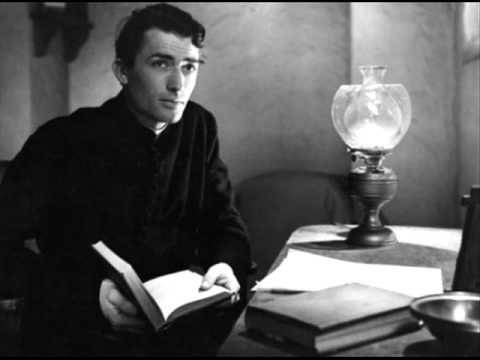
Gregory Peck was a founding member of The La Jolla Playhouse but he took his stage acting to Hollywood and quickly became a formidable new leading man. Some of his early performances in the likes of Spellbound, Valley of Decision, and The Yearling show the breadth of his talent and the candor that would make him a star for decades. Keys to The Kingdom uses him quite well as a missionary to China who strives to live out a life of loving his neighbor in a world straining with discord.

The Gunfighter (1950)

Due to his commanding presence and imposing voice, Gregory Peck fashioned himself into quite the western hero in his own right. He could play heroes (The Big Country), he could play villains (Duel in the Sun, Yellow Sky), and he could ride somewhere in-between (The Bravados). However, he arguably had no better opportunity than his performance as a jaded gunfighter turned into a sideshow attraction.

Roman Holiday (1953)

Yes, it made Audrey Hepburn a star. Yes, it’s a quintessential romantic comedy. Yes, Rome has never looked better but Gregory Peck also made a valiant go at comedy and did quite well thanks to the chemistry with Hepburn and Eddie Albert. Designing Woman (with Lauren Bacall) nor Arabesque (with Sophia Loren) were quite as spectacular, but the star power is still worth coming out for.

To Kill a Mockingbird (1962)

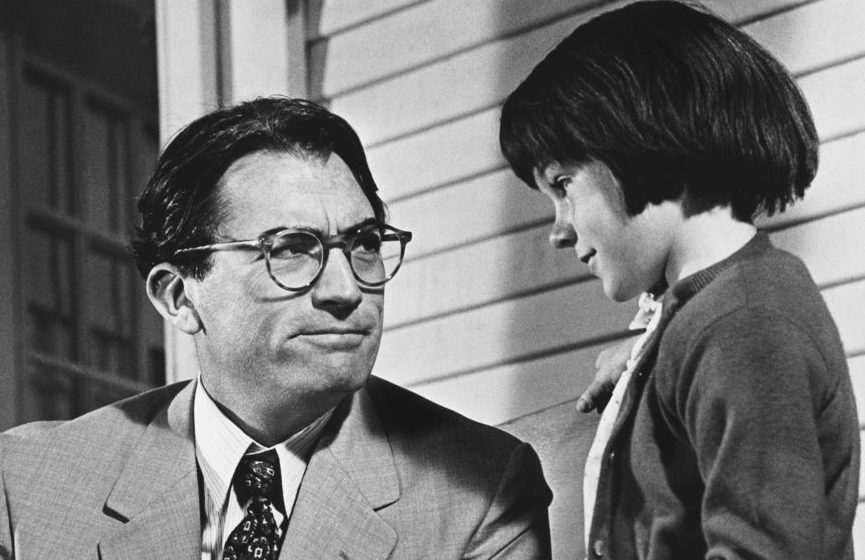
If there’s one synonymous role for Peck, it’s Atticus Finch from To Kill a Mockingbird. And I’m pretty sure he’d be proud to acknowledge it as one of his finest achievements of integrity. Times have changed. Perceptions of To Kill a Mockingbird‘s narrative are more complicated, but Peck’s performance cannot be understated. The rapport he built with the likes of Mary Badham is undeniable.

Worth Watching:

Twelve O’Clock High, Captain Horatio Hornblower, Moby Dick, On The Beach, Pork Chop Hill, Guns of Navarone, Cape Fear, Mirage, etc.

The Florida Project (2017): The Antithesis of Hollywood Escapism

the florida project.png

When we run in different circles it’s easy to have a conveniently jaundiced view of our society. On a personal scale, I’m talking about our neighborhoods, our towns, our community institutions. We turn a blind eye to those things that do not concern us — maybe they’re below our station in life — and so we live unclouded by the hardships around us.

We form tribes and often do our best to stay separate whether it’s along social, ethnic, political, or religious lines. Though we have an innate desire to pair off and form communities, it can have detrimental side effects. At our very worst, we become polarized units totally at odds with one another. To a lesser extent, our enclaves remain insulated and never interact or acknowledge those outside our social bubble. Places like the Boys and Girls Club, Food Banks, and churches slog on without vibrant community support systems because heaven forbid we lower ourselves.

The Florida Project is a sobering portrait and an altogether necessary one because it offers an uncompromising glimpse at a lifestyle that’s easy enough to disregard. This is an issue needing recognition.

Because just down the road from Seven Dwarves Ln and Disney World, the purported “happiest place on earth,” there are signs of degradation and malevolent poverty. We are met with the garish purple and pinks of the low-rent hotels.

But there are two obvious camps. Tourists who are only passing through and the locals who have set up camp long-term living week to week on the money they scrounge up. Spend some time there, even during a seemingly carefree season like Summer Break, and you see the deleterious nature of the ecosystem. Such activities seem endemic.

Front and center are Mooney (Brooklynn Prince) and her band of friends. They’re like a merry band of precocious little terrors. If they were older we might call them hoodlums but now they have the pretense of being cute. Except they’re hardly innocent. Spitting on someone’s car from a second story for “fun” and getting in any type of conceivable mischief they possibly can. Like turning off the power in the throes of summer or panhandling.

They are the epitome of the cliche “idle hands are the devil’s workshop.” And yet their behavior is indicative of their parents (or lack thereof). Because a lot of what Mooney does feels reinforced and learned from her role models. It becomes equally evident her imagination is always vibrant out of necessity. It shields her from the world and her constant state of want. It is her only avenue to something better.

But we must ask where will the buck stop? Is it the social systems being flawed or non-existent? Halley (Bria Vinaite), Mooney’s young and disaffected mother, looks to sell perfume for a profit at a nearby resort just to eke by a day late on rent. She has trained her daughter up to scrounge for change to buy ice cream. Mooney always shows up at the back door to receive handouts of free waffles and extra maple syrup with a friend.

The kiddos go on a demolition rampage and when they’re bored of that they divert themselves by lighting a house on fire. Of course.

It grabs the attention of the entire neighborhood and necessitates the local fire department coming out to quell the flames. It’s like a block party the way the locals congregate, drinks in hand, whooping, and snapping pictures in front of the conflagration. The kids don’t seem to realize until after the fact, the effects of such a serious form of arson.

the florida project 2.png

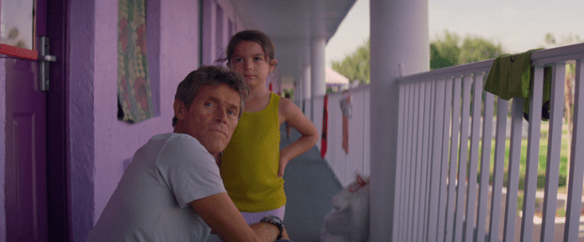
Through all these ordeals, Willem Dafoe is the Most Valuable Player. Because as the local manager of the Magic Castle, Bobby, he provides some semblance of well-meaning humanity in an otherwise unfeeling and incredibly tense wasteland. Because the crusty exterior reveals a genuine concern for kids and even when he’s disgruntled his hard-working, good-natured spirit shines through. He extends the same care to a trio of inbound storks that he does the tenants who are constantly harrying him.

There so many hardships and yet the people resigned to this life have issues of their own. There is a pervasive disrespect shown to everyone and lifestyle choices are a bit dubious at times. The saddest aspect is impressionable children being subjected to so much that is objectionable at such a young age.

Halley has left her former career choice as a stripper behind, but she seems less than enthused about applying for new work. She also shows attitude toward anyone who will not immediately bend to her requests or even those who try and stay on their side. Her retaliation can be utterly malicious, at times, even as her sense of entitlement is trying.

Likewise, she teaches her daughter posing for hypersexualized selfies while her smoking, drinking, and male company with no sense of commitment, only prove detrimental to her daughter. These are the exterior issues that make themselves plainly apparent.

My only concern or minor reservation is the fact we never get much of the interior life of these adults. I would like to get to know Halley and Bobby better. But because this is very much Mooney’s story, grace can be extended. Her point of view is the most applicable to this narrative because it is not able to comprehend everything or even bring it to a succinct resolution. There are so many unresolved issues. It should not be on a child to have to solve them.

It’s the realization, in the end, Mooney is just a kid. She doesn’t know the situation her mom is in. She isn’t completely liable for all the behavior she perpetrates.  In many ways, she’s oblivious and yet all the negative influences affect her even implicitly. She cannot comprehend the nuances of her mom’s situation because to her it’s simply the way life is. There is no other example to match it with. It starts with the social environment around her.

In a final twist, Sean Baker deems to cap his film with a Disney ending with the girls running off from the dizzying world around them for some type of oasis. Make of it what you will. It’s a bit like running off to the movies because you want to escape life. But The Florida Project is not Hollywood escapism. It’s immersive, yes, but in a way that will make you reconsider the current cultural landscape. If it does not make us open our eyes and carry a dose of empathy for those residing in our own communities than few things will.

The Florida Project does not cast blame and yet it draws us inward to ask the honest questions. How is our society failing? What might we do to fix this? On the smallest, most personal scale, what can each of us do to promote human flourishing? Because one thing is for sure, even if the movies normally coming out of the industry reflect otherwise, this is not an isolated occurrence.

Our society is full of Mooneys and if we learn anything from this film it should be to appreciate their worth as human beings even as we grieve their unfortunate circumstances and life choices. If we are more fortunate than them, it is solely a gift and we were blessed so that we might be a blessing to others. To those who much has been given, much is expected. I’m saying this as much to myself as anyone else.

4.5/5 Stars