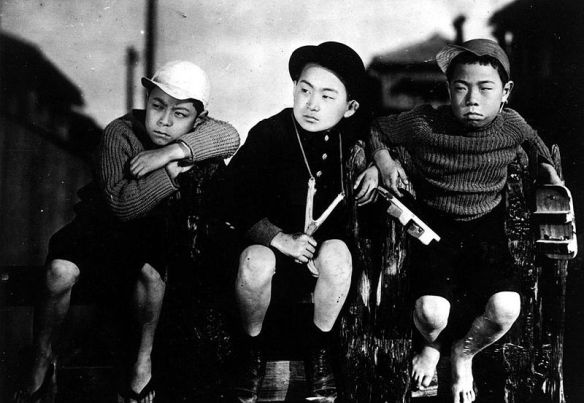
Ohayo (1959)

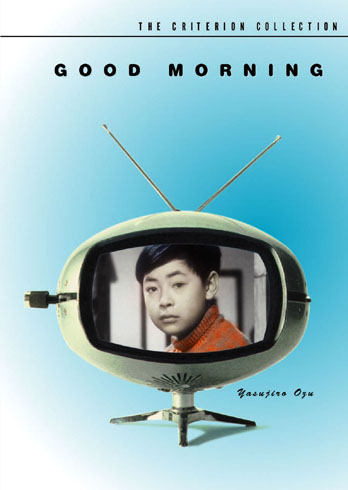
Good_morning_dvdIf Yasujiro Ozu can be considered foremost among Japan’s preeminent directors then there’s no doubt that Ohayo (Good Morning in English) is one of his most delightfully silly films. But that’s only on the surface level.

Young boys are unified in their affection for watching sumo on television and passing gas as a great gag to pull on their friends. Nosy housewives gossip incessantly whether it be the next door neighbor’s new washing machine or the mysterious disappearance of dues for the local women’s association. Meanwhile, most of the men go to work and spend their evenings knocking a few back at the bar noting how much the world is changing around them. Then they go home oftentimes a little drunk.

Ohayo is actually a reimagining of one of Ozu’s most remembered early pictures during his silent days I Was Born But… (1932) and yet he skillfully reworks the storyline into an everyday comedy of family and neighborhood drama that’s full of humor and his brand of quietly observant social commentary.

Ozu always took great care in analyzing family units and matrimonial bonds that affected relationships. Although we have a bit of a fleeting young romance in the works, this film’s greatest concern are two young boys from the Hayashi family who are giving their parents the silent treatment until they are allowed to have a television. Their parents are holding out and it begins a rather humorous ordeal as the brothers Minoru and the ridiculously comical Isamu (constantly exclaiming “I Love You”) try to make it through dinner, school, and so many other daily activities without a word.

As he would dissect many times over, Ozu focuses on the generational divide that was emerging and becoming increasingly prevalent in the post-war years as reflected by technological advancements like television and other such devices slowly turning present Japan into a land of a million idiots. At least that’s what the older generations feel.

Still, it’s just as equally occupied with the moral customs that have long ruled the nation where wives can speak so kindly to their neighbors up front only to slander them behind their backs a moment later. Saving face and personal honor is often cared about far more deeply than anything else — even in some circumstances when it happens to be at the expense of another family member.

Perhaps the most troubling thing is the very Japanese predilection to talk about nothing in particular, filling conversations with salutations, pleasantries, and comments on the current weather patterns. It hardly ever gets to anything of substance and that comes in numerous forms. Sometimes it means a young man never gets around to sharing his feelings with a girl or adults never being particularly candid with neighbors or spouses. There’s very little of that kind of transparency to be had. Few of the words passed along between people in conversation mean all that much.

The irony of the whole situation is that, in one such instance, it’s a young son who calls them out on it and he proceeds to get a heavy scolding from his father (Chishu Ryu) who bluntly tells him that he talks too much. Meanwhile, although Izamu can be constantly chiming “I Love You” in English, there’s an uneasy sense that his parents and most certainly his father, might have never said the words to him.

In these very simple ways Ozu rather delicately and still humorously tackles many of the issues that have long plagued an honor-based culture such as Japan’s but he does it with an adroitness that uses touches of humor and his own understanding of human nature to craft yet another universal tale that’s ultimately sympathetic in its portrayals.

It unsurprisingly feels like it could be a Japanese episode of Leave it to Beaver except for the father never has much of a talking to with his sons and the mother may be as put together as June Cleaver but hardly feels ever as affectionately maternal.

Equally spectacular is Ozu’s mise-en-scene which as per usual is meticulously staged and gorgeous in scene after scene. He offers up each individual image in a flat two-dimensional way that can best be described as taking cues from not only the theater but Japanese woodblock paintings with wonderful symmetry and compositions boosted by color.

He uses the clique of adjoining homes as the perfect set to send his characters in and out of with the hint of comedic forethought. While watching characters walking by on the hillside up above the homes — their figures slowly moving in and out of the frame past the houses — this provides some of Ohayo’s most visually stimulating images pleasing the eye incessantly.

There’s always a visual fearlessness that you see in very few others because he not only has color at his disposal but the staging is on point as is his disregard of the 180-degree rule of perspective. It just works. What is more, he also continues to use what could best be called establishing shots by western audiences. Except they hardly ever need to establish anything. It’s as if he simply put them there because they are vivid depictions of the reality he is painting — adding yet another distinct contour to the world he is working with — going beyond the figures that he places within the frame.

There’s no doubt that this is Ozu but not all that surprisingly this might be my personal favorite in his oeuvre for the aforementioned reasons. It feels like Ozu operating at his most playful while nevertheless maintaining his peak form as a filmmaker.

4.5/5 Stars


My Sassy Girl (2001)

my sassy girl 1.png

We meet a college-aged Korean guy (Cha Tae-hyun) as he relates his first encounter with the girl (Jun ji-hyun) who would ultimately become his girlfriend. In the throes of a drunken stupor, she flails perilously near the railway as an incoming train comes on so he steps in to pull her back to safety. They board minutes later — he’s still watching her warily — only for her to puke all over a commuter.

Assuming he is the boyfriend, Gyeon-woo is chastized to do something about his girlfriend and so reluctantly he takes her still intoxicated by piggyback to the nearest hotel. This whole complicated scenario happens to him twice and it lands him in jail.  It doesn’t sound like the pitch-perfect moment to start off a romance but then again My Sassy Girl never has perfect pitch and that’s where it succeeds.

The film opens with these exaggerated comically cringe-worthy interactions and yet it settles into something far more fulfilling than its attention-grabbing gross-out antics. While Gyeon-woo gets all but pulled into the scenario you realize that there was a single decision. He cared enough to intervene on this girl’s behalf. Maybe he regretted it but it’s doubtful.

What was his life beforehand? Fairly inane and nondescript. He hangs out with his buddies as they grunt about inconsequential things. His face is prone to glazed over expressions. He’s constantly whining to his mother over the phone after forgetting to visit his Aunt — the Aunt who always pinches his cheeks and tries to set him up with an eligible girl. When he’s not getting swatted at by his mother at home, his father gives him a going over for not getting better grades. He’s a rudderless young man with no true conviction or sense of purpose. He’s in need of some kind of shakeup.

my sassy girl 3.png

The Girl (who is never given a name) is actually the one who dictates the sheer unpredictability and consequently, the hilarity of the picture. Jun Ji-hyun pulls off a remarkable part that brims with a feistiness, playful whimsy, and utter solemnity as it cycles between scenes. She smacks him around and bosses him to do this and that based on a momentary fancy. Also, her facial expressions are on point.There’s so much sassafras as we used to say in high school. She willingly calls out people for their behavior in public places as well as their wardrobe choices. The filter is all but lacking. She’s a creature of caprice.

Anything that Geon-woo does to her disapproval prompts her threatening catchphrase, “Wanna Die?” Partially as a veiled threat and partially as a rhetorical assertion. It works in many circumstances. Most importantly she has fun because that is her antidote to try and forget something — to get past some prior hurt — and to reclaim her life as her own.

Like the Japanese film Shall We Dance (1996), My Sassy Girl also garnered an American remake due to its popularity. But the remakes in both accounts cannot measure up to the originals for a very simple reason. These stories are meant for the cultures they came out of or at least they are given greater import in their respective countries of origin. The first film was about freedom of expression in a society that values a certain amount of conformity. My Sassy Girl highlights a character who all but goes against the norms of how people are supposed to act as she carries herself with a certain amount of unpredictable vigor.

There are some clunky seemingly superfluous scenes but our leads have a disarming even unorthodox chemistry about them that weathers it all. One scene, in particular, stops up the film’s middle where they sneak into the theme park on The Girl’s birthday only to be held hostage by an AWOL soldier. It’s ultimately another expression of romantic sentiment but it disrupts the hilarity for an extended period of time. Because those are the moments when the story is at its best.

The direction can also be a bit distracting as the camera swirls around and does this and that with POV shots inserted and lines of voiceover narration but we can attribute that merely to the film’s jarring intentions. They help personify this volatile, idiosyncratic character at its core.

The original slap bet is born on the Subway. Squash games inevitably wind up with the ball nailing Geon-woo in the face. He’s also inept at swordplay and he can’t swim. Meanwhile, she holds aspirations for writing screenplays and forces him to read her work. He notes there’s always a hero coming from the future infused with action-packed terminator or samurai vibes.

All of this movie’s finest moments of romantic hilarity can be summed up in the list of 10 points Gyeon-woo recites by heart relaying how to treat his girl:

  • First, don’t ask her to be feminine.
  • Second, don’t let her drink over three glasses, she’ll beat someone.
  • At a cafe, drink coffee instead of coke or juice.
  • If she hits you, act like it hurts. If it hurts, act like it doesn’t.
  • On your 100th day together, give her a rose during her class. She’ll like it a lot.
  • Make sure you learn fencing and squash.
  • Also, be prepared to go to prison sometimes.
  • If she says she’ll kill you, don’t take it lightly. You’ll feel better.
  • If her feet hurt, exchange shoes with her.
  • Finally, she likes to write. Encourage her.

The latter half dips more deeply into the well of sincerity and though it might seem difficult to buy this sentimental side of the characters, we’ll gladly make allowances because we’ve been through so much with them. It turns out The Sassy Girl has more to her as we always suspected.

In an excursion to one of her favorite spots that is shaded by a solitary tree, they bury a time capsule with letters written to each other. On her behest, they will come back in two years to read them but for now, she must go away and figure things out. It seems a dismal and confusing point of departure for Geon-woo and the audience. But he resigns himself to it and moves forward.

However, the film very much wants to drill into our heads that fate means building a bridge of chance for your love. It gives romance this edge of grand design where all things fall into place for those who are truly meant to be together. Fittingly, circumstance brings them back full circle. Surely, some will need to take this with a grain of salt but no matter, when it’s all said and done, there’s no question that My Sassy Girl is a satisfying rom-com moment after moment. The leads are just too memorable to pass up.

3.5/5 Stars

Inherent Vice (2014)

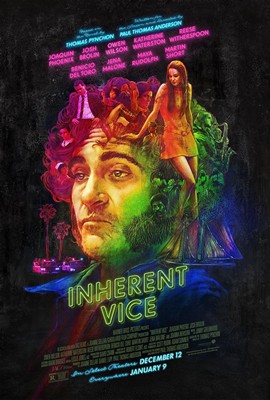
Inherent_Vice_film_posterIt’s not something you think about often but stoners and film noir fit together fairly well. Why more people haven’t capitalized on this niche is rather surprising. Think about it for a moment. Film noir in the classic sense is known for its private eyes, femme fatales, chiaroscuro cinematography, and perhaps most importantly a jaded worldview straight out of Ecclesiastes.

Some of the greats are also notorious for utterly baffling plots that come to no clear conclusion. Still, rather than chocking it up to faulty storytelling, these unfathomable aspects only lead to a greater ambiguity. Thus, you can imagine what occurs when our point of reference is on something. You take something that is already indecipherable and make it absolutely impossible to discern reality because there’s no sense of knowing what is actually real even before funneling down to specific plot points. Inherent Vice is precisely that film, a neo-noir bathed in rays and full of dopers.

Paul Thomas Anderson makes this affectionate and supposedly quite faithful adaptation of Thomas Pynchon’s novel connect most obviously through voice over. It captures a certain rhetoric — the poetic lyricism that manages to anchor the plot in some bewitching way — while also providing a great deal of latitude in storytelling which the narrative gladly capitalizes on.

This private investigator, Doc Sportello (Joaquin Phoenix),  is a benevolent stoner. His girl Shasta flutters back into his life and like they always do she comes as the bearer of bad news — a flower child in trouble with a lead for him to follow before she disappears into the night. Being a private eye he follows up the loose threads but he’s not necessarily a good private eye or a generally judicious one and that doesn’t bode well.

It’s pointless to try and tie everything together. In fact, this is as good a time as any to disclose that Reese Witherspoon, Benicio Del Toro, and Owen Wilson all show up but it’s almost possible to forget about them.

Doc investigates some vague leads about one real estate owner Mickey Wolfmann who has disappeared, gets word of a mysterious syndicate called the Golden Fang while searching after a member of a cult, and subsequently gets hired to find a missing husband. His worst enemy and greatest ally simultaneously is Detective Bigfoot Bjornsen (Josh Brolin). All the cases get resolved without the least bit of satisfying closure.

Still, the incomprehensible plot highlighted by absurdities is almost something that needs to be expected from a film such as this built out of the tradition of The Big Sleep (1946), The Long Goodbye (1974), and even Harper (1966). It’s another knowing riff off of the private eye pictures of old.

The bottom line being that precise malaise. It’s easy to lose it amid the stoned out status quo, characters medicating themselves on smokes and drugs and drink. They seem happy enough. At the very least they’re not torn apart by anything. And yet the very fact that Doc in particular witnesses so much — unveils so many things — and remains despondent is indicative of the whole story.

It’s an understated chill comedy that is meant to mesh rather ironically with the film noir world and like Altman’s film before it, there’s this lovely incongruity that works so well. All highlighted by the very fact that we fail to truly discover what is fact and what is fiction.

Everything is taken in stride rather nonchalantly by Doc who ambles along with his various leads in the relaxed manner that will remain his calling card. His attempts at scribbling down notes only result in random word clusters. But, and I hesitate to say this because it might give the wrong impression, in some sense, it does feel like we’ve seen this humor before in Airplane! (1980) and The Naked Gun (1987).

We like Doc. If he wasn’t high all the time, he’d probably be a pretty nice, cognizant, charming fellow but his response to all that is around him is rather pathetic and pathetic in the way of a dog with his tail between his legs. Flailing to the will of corrupt cops or allowing the vices of others to rule the day. But then again, what is he supposed to do in this world? The everyday villains are too many, the mountain to overcome is too high, and so he slowly sinks back into his fog. It’s a nicer, more comforting place to be than the world at large.

Cross that with Neil Young’s ambient jams in “Journey through the Past” and “Harvest” or the laid-back radio plays of 93 KHJ including The Cascades, The Association, Sam Cooke, and Kyu Sakamoto and it goes down pleasantly. As do the agreeable touchstones of Adam-12 and “Three Hour Tours” on primetime television.

It provides the film with a bit of the nostalgic haze that still manages scintillating vibes of sunny Southern California. But no one need remind any of these characters that this is the same beach paradise that saw the egregious murders committed by the Manson family, the shooting of Bobby Kennedy, the Watts Riots, and so on and so forth.

Taking a hit can sustain for a momentary high. Embracing your girl in the pouring rain can remain a fond memory. Music can float through your brain lazily. Television makes a nice diversion. The pursuit of money and power can drive a life for a while. But surely life is more than all of these — the things we use to mask the hurt and the pain we are subjected to as human beings — the numerous distractions in this “postmodern” world of ours. Surely there’s gotta be more…

4/5 Stars

Road to Rio (1947)

Road to Rio 1.png

My dad has been and forever will be a fountain of pop cultural knowledge. I learned the little I know from the best, the difference is, he lived through most of it. Still, I must admit, at times I didn’t believe some of these touchstones of yesteryear when I was a kid. How could anyone have actually written a song called “Hello Muddah, Hello Faddah” and what in the world does “You’re in the Groove Jackson” mean? They can’s possibly be real.

Of course, for those more enlightened than I was back then, you would have already known that both these fantastical things were in fact true. Alan Sherman was quite the nut and the same goes for Bob Hope and Bing Crosby. In that roundabout way, we get to the Road Picture that I’ve always cherished at least a little bit because of one particular gag. But let’s start closer to the beginning.

The wonderful thing about the Road films is the very fact that their two bozos know exactly who they are and they never stray from those characterizations from one picture to the next, even if the schemes change as do their names. There’s the same self-referential jabbing and fourth-wall-breaking executed in a way that later films would pick up on too. People loved Hope and Crosby and they enjoyed their onscreen buddy-buddy just as much. By the looks of it, they always seemed to be having as much fun as the audience and that’s the key. It’s contagious comedy.

I’m inclined to think that some of the greatest comics are the ones who come up with the lines on the spot. But whether or not Hope and Crosby actually ad-libbed any of their verbal jabs, to their credit, they had a complete handle on their personas and so every phrase comes off as genuine.

They’re always trying to pull off some get-rich-quick scheme only to wind up in some wild locale completely broke.  We’re always provided the enjoyment of Crosby’s ever-present condescending pet name “Junior” for his partner in crime. Because he takes on the mantle of the idea man and Hope unwittingly ends up doing the dirty work, in this case, a circus bicyclist up on a trapeze.

Crosby is also always playing the easily duped gentleman — a real sucker for the ladies — who’s not above throwing his pal to the lions except when it really counts. Plus you have to throw a little crooning in there to make all the ladies swoon a bit. We get an appearance by the All-American songstresses The Andrew Sisters performing “You Don’t Have to Know the Language” with Bing.

Still, everyone knows all that is “happening” in the world circa 1947 is in Rio so there the boys go as stowaways, of course, after getting chased out of town by an angry circus promoter. That’s what all the great comics do. Namely, The Marx Brothers, who were consequently also directed by Norman Z. McLeod in Monkey Business (1931) and Horse Feathers (1932).

Our two bunglers now aboard a slow boat to Brazil meet the ever-present Dorothy Lamour, the bodacious beauty in all their movies, as a grateful knockout, a damsel in distress. But something dastardly is going on as the gorgeous woman is caught in the hypnotic clutches of Gale Sondergaard who has a couple hired cronies (one played by a personal favorite Frank Faylen).

There are some real laugh riot moments not least among them watching the pals don their stuffiest British accents as they sway on the ship’s deck to snag an easy meal from a seasick patron or our heroes dressed to the tee doing their best impression of the samba. Of course, you have some tried and true favorites like “Patty Cake” or Hope’s sardonic one-liners such as affectionately calling his trumpet “Grable-bait.” Look it up if you don’t get it.

But the showstopper is the formation of their groovy band Americain made up of our hapless heroes and three Brazilian street musicians who earn a crash course in English. Composed of three universally accepted phrases: “You’re in the Groove Jackson,” “This is Murder,” and “You’re Telling Me.” Presto they’re Americans in a pinch and what follows is “Who’s on First” light.

The final charade is to break up an ill-fated marriage with a bit of safecracking and they bungle it immaculately.  The greatest surprise of all is that Hope actually gets the girl (like Road to Utopia) except this time he gets a little help.

3.5/5 Stars

Johnny Guitar (1954)

johnny guitar 1.png

“I’m a stranger here myself.” ~ Sterling Hayden as Johnny Guitar

In watching even only a handful of Nicholas Ray films, it’s possible to discern fairly quickly that his films are often about the marginalized outsiders. Rebel Without a Cause (1955) is the most iconic example but this theme goes a lot further than that single movies. He even plays with the same ideas in Johnny Guitar his extraordinarily distinctive western from 1954.

There are other westerns that open like this. A stranger (Sterling Hayden) riding through the mountains and making his way to the nearest town. He overlooks a stagecoach robbery going down and miners blasting away at a mountain with dynamite. There must be a purpose to it all but the significance fails to resonate quite yet.

He goes to the local watering hole: Vienna’s. Except there’s no one there. It’s a ghost town. There are only a few solitary figures working the roulette wheels and the bar. No one else. But still, the stranger walks in as if he’s meant to be there. We don’t know why yet.

By all accounts, Sterling Hayden wasn’t much a cowboy but he had the presence of one. In the movies sometimes that’s enough. Here’s the eponymous Johnny Guitar, the man with his instrument strapped to his shoulder with little stake in the local goings-on.

Namely, the grudge match brewing between the hotel’s fierce proprietress Vienna (the always cutthroat Joan Crawford) and fiery western lass Emma Small (Mercedes McCambridge) who packs a whole posse of cattlemen including ornery John McIvers (the venerable Ward Bond). It doesn’t help matters that Vienna opens her doors to the despised Dancin’ Kid (Scott Brady) and his cronies.

We, like Johnny, have no particular stake in their quarrel though there is a sense of some past grievances. In fact, everyone seems to have a history but we are hardly ever given a nibble, never through flashback and rarely in exposition.

Nicholas Ray creates a gorgeous world in color that showcases some of the most attractive imagery of the West in Classic Hollywood on par with The Searchers (1956) and Rio Bravo (1959). And it boasts an equally colorful array of characters including quality supporting cast members like Bond, Ben Cooper, Ernest Borgnine, Royal Dano, John Carradine, Frank Ferguson, and Paul Fix.

But the subversion of all norms begins with Joan Crawford, the woman who loves the sound of the roulette wheels spinning, ever severe, packing a six-shooter in her blue jeans. While the TruColor does much to enhance not only the scenery but her performance as her piercing eyes burn through everyone she stares down. Johhny Guitar might be in our title but Vienna is our undisputed star.

The relish of the film is perfectly rendered by the complete lack of clarity initially. It’s trying to get a line on everyone in an attempt to understand what’s going on as their allegiances are made fairly evident. It’s a matter of picking a side. But the sides are incredibly difficult to decipher. In fact, even in her moments of complete innocence, it helps her character that Crawford very rarely comes off as a sympathetic person — in reality or on the screen. So if she’s our protagonist then we’re in for a tough outing.

Of course, the feud that’s central to the tale was also twofold unraveling on both sides of the camera. Mercedes McCambridge and Joan Crawford loathed each other to put it lightly. They probably wanted to tear each other’s hair out and while not the most benevolent of relationships, it undoubtedly stoked the fires of the film’s drama. In fact, it seems like there weren’t many people who did like working with Crawford. Hayden never wanted to be in another picture with her again either. Still, once more, it all functions in front of the camera exquisitely.

There’s certainly some truth in drawing up parallels with George Stevens’ Shane (1953) but the moral lines are a lot more jumbled and the intentions of the plot far less direct. Shane is a success because it’s a fine piece of classical storytelling still underlined with an imminent threat. Johnny Guitar is beguiling because it breaks with all the conventions of the West while still carrying its own amount of subtext that’s hard to figure.

Should we even care that the posse gets these men? But you see, that’s nearly beside the point. It’s not about right or wrong but this muddled center controlled by Joan Crawford and Sterling Hayden. The man and the woman with a bit of a past but not enough that they will fall into each other’s arms and live a faithful life at one another’s side. That’s just not in their nature. Still, riding the fence proves to be a taxing ordeal.

We witness the most peculiar bank robbery as far back as I can remember committed by the local outlaws who until they ran off with the loot hadn’t exactly done anything wrong, in spite of being despised by a whole town. In other words, they played the roles expected of them. Then, a pair of hangings takes place but instead of your typical unrepentant criminals being strung up, you have a kid and a woman both ending up with a rope around their necks. The enforcers’ stomachs begin to churn uneasily. This isn’t how mob justice is supposed to work.

Subsequently, the battle to subdue the frontier is brought home with the most unconventional showdown in the western canon that’s fundamentally also one of the most stunning. It blows up in your face and then leaves you questioning this entire ordeal.

Peggy Lee’s title track is used to sing them out as one final note in this dazzling western courtesy of Nicholas Ray; dazzling for the very reason that it does everything contrary to what we have learned. It continually makes a conscious choice to upend the accepted script attached to the mythology of the West, rewriting its own narrative full of vivid imagery and equally blistering outcomes.

4.5/5 Stars

Review: Jules and Jim (1962)

jules et jim 1.png

Jules and Jim breaks out of the gates with a frantic burst of energy giving off the effect of a comedic circus act or a whirling carousel and at times it functions as both. Champion of the French New Wave, Francois Truffaut, at 29 years of age injects the film with this kind of frantic lifeblood tearing through the material and time with almost reckless abandon. If Breathless (1960) was not the title taken by one of its contemporaries, this picture could have just as easily taken the name.

You see, Truffaut takes Henri-Pierre’s Roche’s autobiographical novel, the work of an old man, and transforms it into a period piece shot by a young man. The distinctions reveal themselves in full force.

It’s a cinema of attraction with whips, tracks, freezes, jumps, and flies constituting a fluid adventure that’s given free reign to go in so many directions thanks to the versatile camerawork of Godard regular Raoul Coutard as well as connecting voice-over narration (provided by Michel Subor) and a score courtesy of George Delerue.

Still, as Truffaut lets us sink into his story things come more clearly into focus but never so they reach a point of complete clarity. He never dwells too long on a moment or an idea. Instead, choosing to move through the lives of his protagonists touching on so many moments and relationships and ideas. Thus, in one sense Jules and Jim never slogs but it also still functions as a fairly compelling work of historical drama covering a lot of terrain in a condensed amount of time. Some may find that off-putting others will welcome it as a refreshing permutation of the Hollywood status quo.

The year is 1912. An Austrian named Jules (Oskar Werner) and a Frenchman named Jim strike up a friendship that feels like the perfect representation of the deep lasting bond that can form between two individuals. They are young men with a great many of the same interests and a comparable outlook on life.

They’re always benevolent toward one another, they never fight, and they share a mutual satisfaction in the arts while diverting their time at the gymnasium, playing dominoes, and of course, in the company of women. From there one of the great cinematic friendships is forged for life. Though tested, not even a woman can tear their bond asunder…completely. At least not in the way we might expect.

It all begins when they become enamored with a statue, an opaque figure with a pleasant smiling face that captures them so much so that they must go and see it for themselves. But far more striking is the woman they meet back in France who embodies that same bewitching quality.

They meet Catherine (Jeanne Moreau) as they have met many other women in the past for tea or an afternoon of trivialities and conversation. Except Catherine is one of the few that stays with them. Of course, she is personified by none other than Jeanne Moreau that monumental beauty and one of the undisputed queens of the Nouvelle Vague alongside Anna Karina in Godard’s early works.

There’s a frisky and lithe vivacity that carries her through the film’s earliest scenes as she dons her disguise as Thomas frolicking through Paris in one of the most iconic and enduring sequences of the cinema. An overwhelmingly attractive abandon radiates out of her. Truffaut has set Moreau up as such with his narrative and she does the rest.

However, still, as the story continues to progress and she marries Jules and they make a life together with a daughter named Sabine, there are other qualities that come to the fore. Namely, her maturity with a hint of sophistication that still leaves space for that same carefree vigor continually coursing through her and garnering the undivided attention of the camera.

In the complete inverse of the film’s title, you find its true attraction and the figure who makes the whole story what it is.  Jules so aptly puts it that she’s “a force of nature that manifests itself in cataclysms.” She’s so very uninhibited.

Thus, Jules will love her for a lifetime and Jim will count her among his very closest companions but still, she is a complicated creature and perhaps Truffaut is playing out his own mesmerization and subsequent befuddlement with women. Catherine is an epitome of that. She has other lovers. She openly cavorts with Jim who wants to love her even as he wants to stay true to his best friend. She constantly does what is least expected but that goes with the territory of Truffaut’s invention.

As such, it is less of a conventional love triangle and more precisely a menage a trois as the French might say. This is not so much about dramatic conflict as it is tragically sad in the end. Because this is a film about friendship as much as it is love and it’s a dream friendship as much as it is a romantic fantasy. Maybe it’s possible for both to exist partially in the forms projected onscreen and yet Truffaut fills both with so much that we easily yearn for.

There’s the song “Le Tourbillon” that Moreau sings and it quite remarkably ties into this film. The words come from her lips gayly, describing a woman who could very much represent Catherine and then a lover who are both “Each blown their way by the whirlpool of days.” There’s not a better way describing the course of this film.

It’s consumed with so many interludes and subsequent shifts that are almost matter-of-fact from the breakout of the Great War to its ultimate resolution or the marriage of Jules to Catherine and her eventual affectionate advances toward Jim.

Within these segments, it occurs to me that the film hardly comes off like a drama. Still, there are moments of comedy and undoubted tinges of bitter tragedy. But what we’re left with is what Truffaut best described himself — a bit of a knowing paradox of tones.

“When humor can be made to alternate with melancholy, one has a success, but when the same things are funny and melancholic at the same time, it’s just wonderful.”

It is another of the great tragicomedies of cinema like a Citizen Kane (1941) or 8 1/2 (1963) but there’s no doubt that this is Truffaut’s own rendition and it remains the heart & soul of the Nouvelle Vague for its defining visuals that have ingrained themselves in the cultural landscape the world over.

4.5/5 Stars

Review: Notorious (1946)

notorious 1.png

I never put much stock in a Hitchcock title out of force of habit or lack thereof because he never seemed to. But thinking on Notorious I came to the rather unextraordinary epiphany that it refers to lovely Ingrid Bergman as much as any Nazi, at least from a certain perspective.

In the film, she plays the daughter of a Nazi war criminal who was put on trial and found guilty. She, however, is not implicated in his deeds. Instead, busying herself with having a good time, drinking, dancing, laughing — all the superficial pursuits that can distract her from a post-atomic world. You might even say her reputation precedes her and that provides the framework for how others see Ms. Huberman. Namely, one government agent named Devlin, put on her case and writing her off early on as a certain kind of woman.

There’s that initial shot at one of her parties where all the guests are dancing and drinking and everything’s jovial and there Cary Grant sits on the edge of the frame just his profile identifiable to us. And the beauty of the scene is that Ingrid Bergman starts talking to him but instead of showing us his face Hitchcock elects to wait until everyone is gone and they’re sitting together in the next scene. But already there’s this implicit sense that there’s something unusual about this man even without putting words to it.

In the subsequent scene, we get our first view of Cary Grant and Ingrid Bergman together and how wonderful they look. But Bergman’s character makes an off-handed remark about love songs, about how they’re a bunch of “hooey.” Of course, that pertains to this film and where it will decide to go in the realms of romance, but in my own mind, I see it also functioning as a reaction to Casablanca’s “As Time Goes By” — a film where lovers fell in love partially because of a song.

It’s easy to put the title of a spiritual sequel on Notorious for numerous reasons. Once again we have Bergman and Rains in crucial roles and then trading out Bogey for another legend in his own right, Cary Grant. The paranoia of Casablanca is replaced with the sunnier disposition of Rio de Janeiro which nevertheless is underlined by a certain looming Cold War menace. In this case, instead of the letters of transit, we are provided a Hitchcock MacGuffin, including a bottle of wine, some uranium, and an iconic UNICA key.

But if nothing else these minor remarks can put the debate to rest conclusively. Notorious is a spectacular film in its own right and it enters some similar yet still uncharted territory in accordance with the waters Casablanca chose to ford a few years prior. Meanwhile, Grant has glimpses of his previous self from other films but soon enough he falls into the role of cool and calculated federal agent Devlin in what feels like a true departure.

There’s that supremely unnerving shot as we take on the perspective of a disoriented Ingrid Bergman as Grant walks into the room and hangs over her in a strangely alarming way. Everything is setting up the dynamic at this point.

Still, others will remember the extended make-out session that made history by upholding the Hays Code ” three-second rule” while simultaneously perfectly encapsulating nearly an entire romance in a matter of four or five minutes. There was little else to be said because it was all seen in that one sequence and Hitchcock could proceed with his conceit.

Because, ultimately, Hitchcock’s picture is built around this idea: The American government has a little job to be done and Alicia and Devlin are caught in the middle. Thus, it becomes that time-worn idea of love versus duty. In one sense, Devlin’s caught in a terrible position and yet in the other he treats Alicia so badly — and it’s not simply that this is Alicia but this is beautiful, sweet Ingrid Bergman that he is pushing away. Still, in pushing her away, it’s leading her toward the objective.

He’s simply not willing to dictate anything because that means being vulnerable. Very simply he’s not willing to open up.  Cary Grant has never felt so icy, so aloof, and so unfeeling. Then, on top of this, Sebastian (Rains) looks a far more agreeable fellow cast in such a light. He genuinely loves this woman even if she is a spy. It makes for a conflicted viewing experience.

Though there is a juncture in the film where Devlin is beginning to shift his way of thinking. But as if on cue (undoubtedly) one line of dialogue out of Alicia’s mouth during a racetrack exchange (“You can add Sebastian to my list of playmates”) poisons his whole frame of mind again. His prior opinions of Alicia are confirmed and he sours to her — never giving her the benefit of the doubt from that point forward — and ultimately torturing her so that there is no other choice.

Just like that, she goes through with it. Instigating her relationship with Alexander Sebastian (Claude Rains) and succeeding so thoroughly that she’s married to him soon enough. For the U.S. government this is a smashing success but for Alicia and Devlin it’s nothing of the sort.

The descending stairwell crane shot is textbook Hitchcock and so often cited but it’s for that very reason. He so directly points us toward the cues of the scene and he does it with his usual technical elegance.

He gives us a party but it’s a party underlined with so much tension because there are stakes that go beyond the nominal appearances. There’s the fact that Devlin’s one of the party guests but also Alicia has that all important key that proves to be their chance to figure out what Sebastian is hiding. But it also makes them far more suspicious.

Beset with paranoia as much as illness she’s suffocated by the presence of her husband and mother-in-law. It looks like Devlin will never come to her. But he does. We’ve seen this before. Cary Grant comes to her bed as she lies there disoriented and looks up into the eyes of this man looking to be her savior instead of opting to use her. At least on one account, the tension has been resolved.

But in the same breath never has there been so much sympathy as for Claud Rains in the closing moment indicative of how Hitch has even given his purported villain a chance to be sympathized with and Rain’s typically compelling performance does precisely that. So even in this final moment, Hitchcock is playing with us giving us that Hollywood ending that we desire and at the same time undermining it in a wonderful way that’s both suspenseful and artistically arresting.

Notorious just might be the Master’s purest expression of his art lacking the micromanagement of Selznick in Rebecca (1940), the technical experiments of Rear Window (1954), the psycho-sexual layers of Vertigo (1958), the man-on-the-run motif of North by Northwest (1959), or even the low budget and marketing frenzy of Psycho (1960), while still garnering the highest production values in its day.  The results speak for themselves, positioning Notorious as one of the definitive romantic thrillers by any standard.

5/5 Stars

Review: Spellbound (1945)

spellbound 1.png

The Fault… is Not in Our Stars, But in Ourselves… — William Shakespeare

It’s so easy to adore Ingrid Bergman and it’s no different in Spellbound. Yes, she starts off as an austere psychiatrist purely interested and invested in scientific thought and practices in psychoanalysis. However, by the film’s conclusion, she evokes the passionate vitality that made her so beloved in pictures such as Casablanca (1942) and Notorious (1946).

The eminent Gregory Peck was still in the dawn of his career and while not your typical Hitchcockian hero, he is Gregory Peck a handsome actor with tremendous presence and a quiet dignity that made him an acting favorite for years to come, shortly to gain the reputation of an undisputed superstar. Put two such icons together and it’s honestly very difficult not to be won over, especially in a Hitchcock picture.

In fact, I’m predisposed to empathize with both of them from the very beginning and to thoroughly enjoy this picture even if it’s hardly the best of Hitchcock or the respective stars. But the story about the female psychiatrist Constance who falls in love with her colleague and subsequent patient one Dr. Edwards does have its share of enjoyments without question, aside from the names above the title.

As with any solid Hitchcock movie, there’s psychological duress and the man is implicated in a murder that he must run away from even if it’s proved he is innocent. So Spellbound is no question a romance and a bit of a mystery wrapped up neatly in a psychological thriller.

Michael Checkov the famed Russian stage performer (and nephew of Anton Chekhov) plays Dr. Brulov, Constance’s old mentor — a charming sort of gentleman who is impertinent but oh so sweet to his friends  — exhibiting the most jovial of personalities.

Even today, there still is a certain logic to psychodynamic therapy as there is to cognitive behavioral therapy that seems believable depending on how it is utilized and who is practicing it. Thus, though there are jumps Spellbound makes that are a little bit preposterous or a little too easy to resolve — like the perfect correlation between dreams and reality — there’s still kernels of truth in this film and it must be lauded for tackling the ideas of Freud in ways that were fairly groundbreaking for their day.

It also boasts the famed dream sequences inspired and partially orchestrated by the acclaimed surrealist artist Salvador Dali. His imprint is undeniable on the images that Peck recounts, reminiscent of the Persistence of Time and other similar works. Even Hitchcock would continue to address these topics with an arguably more Hitchcockian dream sequence in Vertigo and some similar analysis at the end of Psycho to assess Norman Bates.

Of course, Hitchcock films are at their best when the plot is working in spite of dialogue. Though the script is composed by Ben Hecht who has a long list of wonderful accomplishments, there’s also the influence of the overbearing hand of David O. Selznick on the picture meaning it relies perhaps too much on verbal explanation instead of Hitchcock’s own timeless setpieces or visual approach to cinema. Still, he does manage a few perspective shots that are particularly interesting providing us the frame of reference of several of his characters in key moments.

There’s also the benefit of Miklos Rozsa’s particularly elegant score which nevertheless is less a Hitchcock score as Bernard Hermann would famously compose later. In some respects, it suffocates the drama though it does include the cutting edge use of the Theremin, this marking one of its earliest appearances in a film score.

But ultimately, Spellbound does have a delightful false ending, as things slowly spiral down into despair only to find their new conclusion as all the puzzle pieces of Peck’s character begin to fit together. His exoneration is followed by the ousting of the real perpetrator, another quintessential Hitchcock villain.

The summation seems to be that though humanity might be wrought with shortcomings, many of them buried so deep inside, love does have an uncommon power to heal old wounds. The fault might be in ourselves but that need not be the resolution of the story.

3.5/5 Stars

Review: Rope (1948)

rope 1.png

Rope’s title sequence is composed of your prototypically serene establishing shot. But really, you could not have a more unique and in some sense unnerving picture. It was Alfred Hitchcock’s first foray into Technicolor and it’s quite the looker as are the beautifully constructed backdrops that spice up the mise-en-scene for this glorified stage play.  He also busied himself with camera set-ups in an effort to shoot the picture as near to a single take as was possible with the technology of the time. He actually “cheated” a bit by splicing segments of film together at intentional breaks to give the effect of continuous motion. Still, it’s an impressive endeavor all the same.

But the experiment is twofold both behind and in front of the camera. It’s all a reworking of the murderers Leopold and Loeb, two affluent students who succumbed to Nietzsche’s superman complex. The project was an early script by playwright Arthur Laurents penned from an adaptation by Hume Cronyn, a Hitchcock regular in several earlier pictures (Shadow of a Doubt and Lifeboat).

In this case, Brandon (John Dall) and Phillip (Farley Granger) are looking for the perfect victim in the perfect murder. Where murder is a crime for most men but a privilege for a few — like themselves.  It all begins with a shockingly graphic opening for the 40s that rips away any shred of upper-middle-class sensibilities put upon us by that establishing shot. It’s all a ruse.

The assertive, far more charismatic Brandon also happens to be the main architect pulling along the flighty Phillip into his little experiment.

The act of throwing a small get-together against this exhilarating backdrop proves tenuous because of the insidiously dark deed that Hitchcock has made his audience privy to. Otherwise, this would be a run-of-the-mill picture of cocktails and hor ‘d oeuvres. But underline it with a murder and it’s a completely different proposition altogether.

Their exhibition comes as little surprise from two men who are snobbish, entitled jerks. Their lives are so dull that they stoop to murder to see if they can be brilliant enough and brazen enough to pull it off, going so far as inviting their most astute mentor played by none other than James Stewart.

Though I enjoy him as much as the next fellow, Stewart does feel oddly out of place in this film and within this role of Rupert. He seems to know it too. Nevertheless, Hitchcock would find far superior uses for him in due time.

There are also a couple knowing winks to the sinisterly attractive James Mason (a future Hitchcock collaborator) who is conjured up to do battle against the dreamboats Erroll Flynn and Cary Grant by a few admiring partygoers. Of course, no one seems to take into account that they have Jimmy Stewart right in their stead.

We begin to feel for Janet and Kenneth two schoolmates who have been used in the game. She is soon to be engaged to the formerly eligible David. Kenneth was the beau she was with before he broke it off. Now their lives are manipulated just like the late boy’s father who is also invited to the gathering.

Rupert proves that he knows something’s afoot not that it’s all that difficult to see Granger’s character slowly coming apart at the seams. Alcohol hardly helps his unstable demeanor. It becomes a showdown with his two pupils but he could have never expected this. It’s on this level that Rope is thoroughly troubling. It’s in this way that we begin to understand why Nietzsche might have been troubled by his own conclusions. There is little hope in this conception of the world.

Simply put, the film is dour to its core. It has no heart and in that sense, Jimmy Stewart does not feel at home within its heartless frames. The charade falls short for these very reasons. Though it’s technically ambitious, it doesn’t quite manage that perfect Hitchcock balancing act of crime mixed with wit. There’s no way it can with such a worldview.

Still, Rope shows, if anything, that Hitchcock is never complacent, always looking for the next great challenge. That is one of the many reasons that we still hold him in high regard as one of the foremost directors of any age. Because even a callous film such as Rope is worth seeing.

3.5/5 Stars

Avengers: Infinity War (2018)

Avengers_Infinity_War_poster.jpgEntering into the latest Avengers blockbuster I felt like I was missing something thanks to a cold open that places us in an unfamiliar environment. It’s a feeling that has come upon me on multiple occasions previously.

Not only because as a mild enthusiast I’ve missed a stray entry here and there but I also easily forget interconnected events and after a certain point, why bother? We have come to accept there will always be another Marvel movie.

Yes, this is the culmination of 10 years that began inauspiciously with Iron Man in 2008 only to balloon into a skyrocketing phenomenon that will not disappear any time in the near future. Superheroes like Iron Man, Captain America, Thor, Hulk, and so many others have reemerged as integral parts of the public consciousness. And many fans have been waiting with bated breath for this day and they will wait again and again for future movies like it. That’s an established fact. Regardless, they can breathe a sigh of relief and thoroughly enjoy themselves with this realization of all their dreams up on the big screen. It will hardly disappoint.

To describe the plot of Infinity War is almost arbitrary as SPOILERS in this day and age are guarded against like the plague but here is a nibble anyway. Thanos (Josh Brolin), a being who has long been alluded to, is finally on the scene. The opening sequence is a microcosm of what he hopes to do on a cosmic scale, leveling half of the remnant left over from Asgard.

As a supervillain, he has a vision for the world that’s not too unbelievable. He seems to have been acquainted with Thomas Malthus’ work (even unwittingly so) while holding a contorted view of what empathy is. What others term mass genocide he deems an indiscriminate mission of mercy — killing half the universe’s population will mean resources are more widely available for everyone else left alive. He proves to be one of the most interesting characters within the narrative for the very fact we have barely met him before.

Infinity Stones also become of utmost importance again as Thanos must add them to his collection so he can rise to the stature of a demigod and dictate the outcome of all life with the snap of his finger. That’s some kind of power! The stones themselves are exquisitely color coordinated. One is safeguarded by Dr. Steven Strange (Benedict Cumbertach), another is implanted in Vision (Paul Bettany) and fiercely protected by his girlfriend the Scarlet Witch (Elizabeth Olsen). The Soul Gem brings Thanos back in contact with his two stepdaughters Gamora (Zoe Saldana) and Nebula (Karen Gillan) with grave consequences.

Everyone else who makes an appearance (and at times a lightning-quick cameo) relies on a viewer’s running tabulation of everything up until this point in the MCU. And though you’ll probably enjoy seeing these characters that you have some familiarity with — and you even laugh throughout — there is a sense they are only vague contours. There are too many of them for the resonance to run deep and personal. It really only works if audiences have bought into the machine and already have some background with these heroes in place. The scarier thought is if viewers do not. Infinity War would be void of any meaning. All flashes of imagery, destruction, and hyper-frenetic editing. Any other actual amount of personality would be absent.

Some people live and others die but to confess I didn’t much care whether any of these characters perished is one of the most unfortunate realities of the movie. It’s not that I know they are coming back necessarily or anything of the sort. I admit to being fickle. I can’t remember why I should care about these characters. Because for some so much time has passed since I had any connection with them. To watch them become collateral damage has little resonance with me. I’m numb to it.

I won’t make allusion to archetypal literature like Hamlet or film references like Star Wars or Harry Potter because in some ways that would denigrate that material. Am I being a bit harsh? Perhaps I am. In fact, it was Hary Potter and The Deathly Hallows (2010) we have to thank for this current reality followed close behind by The Hunger Games and The Hobbit. Stories like these coincidentally begun the practice now popular in the industry.

It was no longer about simply having sequels but milking a movie for all it was worth — breaking them up into pieces — making films that were meant to be a part of a greater whole.  It’s not a film so much as a commodity. Differing from the earlier examples like The Godfather movies or even The original Star Wars trilogy — those were pictures that very much could stand on their own merit. Not that they were not enriched and more fully realized with their later installments but we could consider them alone.

Infinity War comes out of this philosophy where a film was never meant to be taken by itself. Everyone knows it. The producers, the directors, the actors, and the audience.  By now as a collective assemblage of viewers, it seems like we’ve been cowed into submission.

I for one watched the movie and never quite relished it — there was nothing all that new or novel — and yet I was never bored per se. However, even my newest favorite superhero Black Panther felt like he was now fit into the Marvel mold. Nothing surprised. Nothing ignited a deep-seated exhilaration inside me. A Stan Lee cameo comes and goes.

Though the picture does promise action and verbal sparring which it delivers handily. In fact, if you consider the screenplay by writing duo Christopher Markus and Stephen McFeely, they do an admirable job with both the monumental juggling act and crosscutting of multiple storylines. The same can be said for the other dynamic duo directing, brothers Joe and Anthony Russo who must perform the same type of orchestration that would have buried a single director in his grave.

Still, there is an uncanny feeling the picture is made up of two kinds of scenes. You have action sequences packaged nicely with all the trimmings and CGI to your heart’s content. Then you have in contrast many stagnant sequences with all these big names standing around in a single location talking it out usually over some point of conflict, sprinkled with a few jokes or exposition that feels all too familiar. The well-timed comic relief disguises how run-of-the-mill everything is.

That’s what’s Marvel has in many ways perfected. In this regard, there’s nothing lacking and if it’s what you signed on for now 10 years ago (without even realizing it) it takes little hesitation to say you will be satiated at least until the next Marel movie and the next installment of Infinity War in a year’s time.

However, I couldn’t help but leave the experience feeling slightly lackluster about the affair. Because in many ways Infinity War is the culmination of a generation of films and really the emblem of where Hollywood continues to head. Sure, we have yet to get the second half of our story but if this is any indication of what we have to look forward to in the future, it does look like a fairly blasé fate at that. Though the jokes and the pyrotechnics are present in full force, there is little magic — that certain amount of intangibility lifting entertainment above the mediocre and allowing it to capture our imaginations. My only question is — as someone unread in Marvel comic literature — what could the Deus ex Machina possibly be?

3.5/5 Stars