Tea and Sympathy (1956): Are You Masculine?

The 1950s saw director Vincente Minnelli continually evolving from mostly musicals — a pleasing genre he never totally forsook — into a period of his career ripe with luscious Metrocolor dramas.

Movies such as Tea and Sympathy, Some Came Running, and Home from the Hill, don’t get too much coverage in broader circles, especially compared to Oscar darlings like An American in Paris or Gigi. However, in many ways, they’re equally interesting, if not more so.

As the story opens on a  prep school green, it proves the world still had class reunions generations before and if the content was different, the people aren’t all that dissimilar. Tom (John Kerr) is someone we get to know quite well over the next two hours.

However, we are only introduced to him because Minnelli’s camera cycles to him as he traverses his former stomping grounds. While not prototypically Hollywood handsome like John Saxon or George Hamilton, Kerr is incessantly interesting and easier to project our own insecurities onto. He’s a bit severe, more awkward, but able to imply a certain sensitivity.

He ventures into his old dorm and all the memories come flooding back. Minnelli doesn’t go with a dissolve or a fade-out, but he moves his camera through the window down to the grass below as if we are entering into an entirely different world, and in a sense we are.

The space is the same but the years have gone and faded back into the past for us. Deborah Kerr works away cultivating her garden as John Kerr (no relation) eagerly looks to offer her any assistance. It’s plainly apparent he has a major crush on the teacher’s wife.

Those unfamiliar with the play might think they already have an inkling of what this picture is about, young unrequited love, adolescence blooming into adulthood. There are elements of this, but Tea and Sympathy becomes far more groundbreaking and pressing in turns.

Because Tom Robinson Lee is totally ill at ease around girls; he can’t dance, and he’s slated to wear a dress in his school’s latest stage production. Don’t try and explain to his peers what the Greeks and Japanese used to do on stage. He’s a sorry excuse for a man; that’s what he is.

It’s an equally awkward situation when he makes fast friends with the faculty wives — Mrs. Reynolds among them — and she tries to be gentle and kind to him. Because he’s really a decent boy. He gladly shares among this company that he can sew and cook showing them his skills with a needle and thread.

The jocular Mrs. Sears (Jacqueline DeWitt) jokes, “You’ll make some girl a good wife.” These are all tiny barbs of cinematic emasculation that cannot go totally unnoticed. It’s difficult for them not to have a cumulative effect.

Sure enough, he’s found out when some of the boys playing football along the beach see him, and he’s quickly in danger of being labeled. Because Tea and Sympathy is a movie totally immersed in the mores of the 1950s. These are issues of masculinity and gender roles altogether intensified by the furnace of contemporary societal pressure.

Because further down the shoreline, the boys toss around a football, roughhouse, and read off questions in an “Are You Masculine” quiz led by Mrs. Reynolds’s he-man husband (Leif Erickson). The news of Tom spreads like wildfire, and he earns his ignominious name “Sister Boy.” It’s the kind of reputation that does not die easily. His bedroom door is marked and he’s roughed up all in the testosterone-induced fun of boys both raucous and cruel.

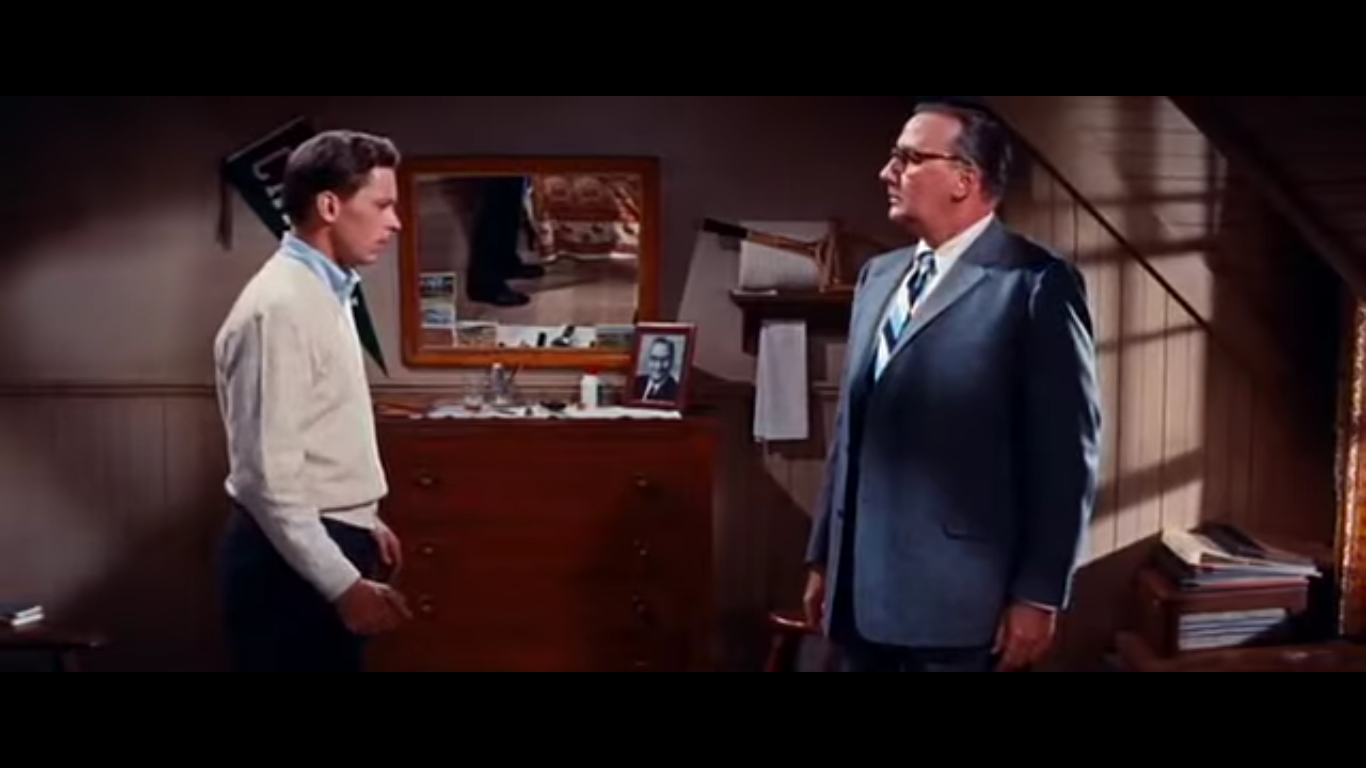
You would think he could regain some respect out on the tennis court the following day, routing his opponent, but even this is hardly enough to burnish his reputation. It’s made more awkward by a visit from his dad, who can sense that the “regular guys” are against him. Of course, “regular” becomes code for being complicit in this debilitating sense of peer pressure ruling the school and its generational legacies.

Edward Andrews has a kind of easy southern charm both somehow outwardly genial and still riddled with so much dysfunction. He chides Tom that you’re known by the company you keep. He should get a crewcut and take part in the pajama fights which are like a rite of passage. There’s something to be said for conformity — becoming one of the boys as it were.

Still, the town has changed since he was a boy. They sit at the counter of the local watering hole as the long-suffering waitress Ellie is kidded and harassed incessantly as she tries to work the tables. His dad feels some amount of vicarious humiliation seeing how much of a social pariah his son seems to be. It makes him uneasy.

It’s a bit of a visual cheat, but it’s also one of the most effective set-ups in the movie as Mrs. Reynolds goes in to grab the drinks in the kitchen, and she hears the conversation coming quite freely through the window as the two men talk about the young men. Mr. Lee and Mr. Reynolds were mates in the old days and they aren’t above speaking plainly about him — how different he is. It’s obvious their words burden Laura’s heart; we see the empathy building over her face because the men don’t understand.
If it’s not apparent already, the whole system they are devoted to is broken to its core. For this boy sewing is his sin. In retaliation his peers take a stance. Since he’s not one of them, one of their tribe, he must become the scapegoat to reaffirm their shaky position.

Keeping in line with this, faculty wives are supposed to remain bystanders providing only a little tea and sympathy. A giant pyre is lit in the middle of the commons setting the stage for a pajama fight — something that has been passed from generation to generation.

From a cinematic standpoint, there’s this underlining tension to the event reminiscent of the Chickie Run from Rebel Without a Cause. It suggests something fated and inevitable about what they do — what they subject themselves to. Isn’t it in the earlier film where one boy says, “You‘ve gotta do something. Don’t you?” Here it’s institutionalized.

For a time, Al (Daryl Hickman) is Tom’s roommate and his only advocate. Mrs. Reynolds speaks to Al in admiration; he showcases physical vs. moral courage, and yet it’s lonely pushing against the social currents. Even his father admonishes him. He must be a nail hammered back into place — a place of conformity.

Mrs. Reynolds acknowledges to her husband that they don’t seem to touch anymore. There’s a distance between them, and it only grows darker and colder as the picture progresses. As we find out, her first husband died during The War: “In trying to prove himself a man, he died a boy.”

Tom is stricken by the same path. He vows to meet up with Ellie, the town’s tramp to prove his mettle as a misogynistic boy’s boy. Surely this is the only way he can prove himself and meet their standards — the standards of his own father. It’s not worth documenting the whole sorry affair. It’s garish, unseemly, and pitiful. Production Codes or not, Tom wants real love and affection. This isn’t it.

His father shows up again puffed up with pride for the first time in a long while. Because his boy has gone and got himself expelled for being off-campus with an undesirable woman. It’s like a badge of honor — being out of bounds — and showing off the extent of his masculinity, whether real or imagined. It doesn’t matter to Mr. Lee as long as he can imagine his boy being made in his own contorted image.

However, the picture suddenly does something remarkable. It seeks refuge resorting to its only comfort.  The scene where Laura comes upon Tom kicked back, lounging in the forest leaves the scholastic world behind altogether for the ethereal and the sublime.

It loses any semblance of ’50s hothouse and forsakes the visible emotions of Metrocolor for something intimate and serene. Laura’s final charge to the boy is plain — be kind.

I wasn’t sure what I thought about Tea and Sympathy as it dissolved back into the present. Of course, the way the film was structured, it was necessary, and yet it seemed like the import was already made evident in an embrace between two people. What more did we possibly need?

But as Tom finds the letter and reads its contents, what looks to totally ruin the movie with moralism is augmented by two aspects. Minnelli’s camera begins to move, capturing the wind rustling through the trees and floating through the open spaces giving them a sense of pensive reverie of a different kind.

Deborah Kerr’s line reading is spot on. No one else could deliver it in such a way making it bear all the warmth and truth in a manner that feels entirely genuine.

Her character reframes everything we have seen and instead of simply placating the production codes, it feels like she is delivering some sagacious bit of nuance Tom might only understand with the passage of time.

She is so important to this picture, and she blesses it with her usual poise and grace helping to fill the void in a movie lacking a great deal of goodness. She becomes its primary beacon even as she looks for goodness for herself.

Given its themes, it would be easy for the film to become a totally salacious, opportunistic bit of illicit love. But in part thanks to Kerr and Minnelli’s care, it never becomes relegated to such status. It represents something much more.

I couldn’t stop thinking about this idea of moral courage. Tea and Sympathy somehow exhibits how one goes about it. It’s not simply about being counter-cultural or going against the tides of the times or being progressive. There is such a thing as goodness, as kindness, as gentleness — fruit we can see in our lives.

It has nothing to do with signaling our virtues, how positively or negatively others will perceive us, or the identity we look to embody. My hope is that even while our society evolves, growing further enlightened, fickle, and oppressive in various turns, we might learn what it is to have unwavering moral courage.

It’s a struggle, but it’s simply the best way to love others well, providing something more than merely tea and sympathy. Because this is not a healthy formula to help assuage the world’s ills. We require something far better.

4/5 Stars
Bonjour Tristesse (1958)

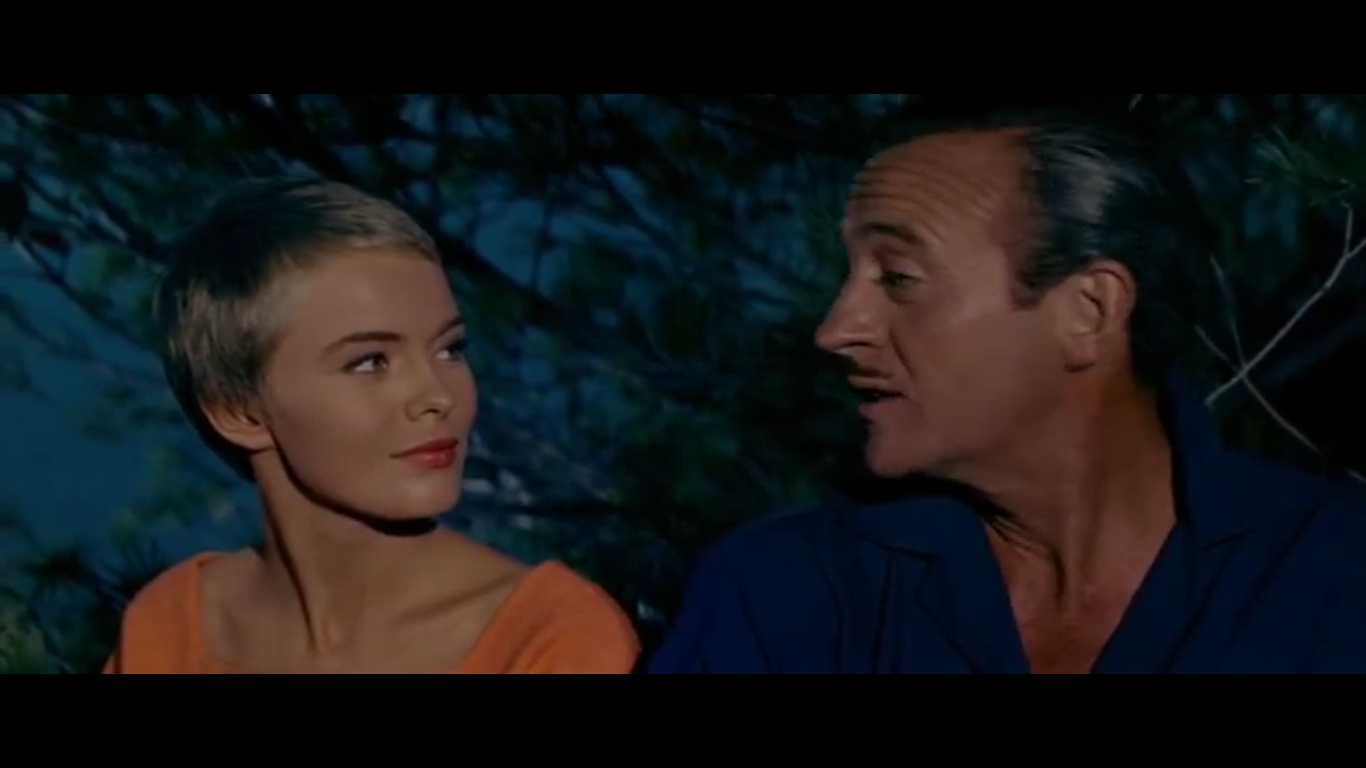
Otto Preminger famously combed through headshots and plucked Jean Seberg out of her Iowa hometown to be groomed as his latest star. St. Joan was far from a stunning ascension for the young starlet, but her follow-up with Preminger, Bonjour Tristesse, showcases her incandescence.

Adapted from Francoise Sagan’s novel about youth set on the French Riviera, I cannot think of a better environ to augment Seberg’s talents. Her Cecile is a carefree spirit and rather noncommital when it comes to anything like marriage, but Seberg imbues her with a poise well beyond her years.

The fact that the picture is positively cascading with ritzy, sun-soaked opulence more than suits a jaunty David Niven and the pixie-haired Seberg — they’re a father and daughter duo — who know no other existence than utter extravagance. Preminger more than matches his stars with gorgeous tones drifting from black and white to vibrant color.

They feel all but compelled to recline on the veranda to soak up the sunbeams with a cool beverage or take a refreshing dip in the water. Who can blame them?  The audience is allowed to live vicariously through all their pleasures, and it makes the interim portions of Bonjour Tristesse both light and luscious in content.

If you haven’t gotten the idea already, Preminger’s picture conjures up ample comparisons to Hitchcock’s To Catch a Thief or Demy’s Bay of Angels sharing much of the same world. What happens exactly? That is and it isn’t easy to say because it’s the mood and the time spent with the characters in their environs that’s both scintillating and charming. Some characters almost evaporate between the beaches, casinos, and champagne bubbles. The most important ones give the film buoyancy and a dash of substance sprinkled in.

However, to hone on any sort of plot, it begins rather simply as a comedy of the situation with father and daughter pulling off shenanigans together. They have such a cultured camaraderie, that it’s second nature to refer to each other by their first names. Romantic dalliances are also expected, between Elsa (Mylène Demongeot) the pretty young thing Raymond traipses around with and Cecile’s latest fling, a strapping young man named Phillippe (Geoffrey Horne). He’s one out of a laundry list of past suitors. They’re contented enough with their free-flowing lifestyle.

Then, follows the auspicious day when Anne (Deborah Kerr) arrives. She’s been invited for the summer holiday as a friend of Raymond’s late wife. She’s not of their ilk with a sense of propriety that they’ve never taken much time to worry about or even consider. One can only imagine what she will think of the laissez-faire romantic lifestyles of Cecile and Raymond. The tensions in the fresh sea air from the outset.

However, we must take pause because there is also a sense of deja vu in the atmosphere. Surely Niven and Kerr have played these characters before in other movies — their dashing playboy and refined prude — this time falling in love with each other. Even Seberg with her iconic pixie cut looks utterly familiar if only due to the ubiquitous iconography of Breathless a few years later.

Whether totally conscious or not, it does feel like Bonjour Tristesse is totally in dialogue with the onscreen personas of its three stars. This feels very much like a component of Old Hollywood where stars were built around their types and somehow instead of disappearing into roles, they brought their own individual sense of authenticity and emotional truth to whatever part they played. For the best ones, it’s like each subsequent role was built on the foundation of their previous work.

Jean-Luc Godard even acknowledged, “The character played by Jean Seberg [in Breathless] was a continuation of her role in Bonjour Tristesse, I could have taken the last shot of Preminger’s film and started after dissolving to a title: “Three years later.”

In the latter half of the film, it’s the character’s youth that becomes strikingly apparent as she grows jealous of their new houseguest who has tamed her father and taken away some of her long-held freedoms in an attempt to make her a more traditional young lady.

And yet the happy-go-lucky gaiety remains up until the very brink of devastation. Otherwise, we watch with rapt interest as she goes darting after her lady oppressor like the epitome of her gamine self ready to watch her fall into the emotional trap orchestrated by her girlish ploys. Suddenly all the merriment isn’t so merry after all and it’s terrifying in its incisive cruelty. We are reminded of the selfish vindictiveness of youth. C’est la vie.

For garnering such a tepid response in its heyday, Bonjour Tristesse represents much of the allure of Old Hollywood though it rarely gets the plaudits of some of its brethren. Somehow, between Preminger and Seberg, Niven and Kerr, and sweeping Cinemascope, it’s easy for the picture to get lost in the shuffle because the four of them have innumerable other productions of note.

This one deserves at least a second chance for its mise en scene alone. Preminger actually does something with it to the point that the final moments of the movie mean something. It’s not the same film we thought we were signing up for.

It’s gorgeous, vain, at times, even superficial, but we would be remiss not to pick up on the inherent melancholy played in sharp contrast to the vibrant palette. Suddenly, it makes complete sense why their present is in black and white and only the past can remain in color.

4/5 Stars

Black Narcissus (1947): Another Archers Masterpiece

Screenshot 2019-12-22 at 65652 PM

Under their collaborative umbrella, The Archers, Michael Powell and Emeric Pressburger formed one of the most mystifying and extraordinary partnerships within the annals of British cinema history. Black Narcissus is just one of the many enchanting jewels in their collective crown.

Part of the acclaim must be heaped on Jack Cardiff because there’s little doubt; his compositions are absolutely stunning front to back. It starts with this gorgeous even intoxicating brand of Technicolor mingling the real and artificial in a manner on par with anything Hollywood was cranking out at the same time.

Whether through miniatures, grandiose matte paintings, or Pinewood Studio sets, it creates a spectacular illusion as a cinematic representation of the Himalayas. In perfect juxtaposition are the sculpted interiors with columns and facades bathed in this equally mesmerizing patchwork of glowing light and meticulous shadows. Not in the sleazy low-grade setups of film noir, but rather like the Rembrandts and Carravagios might have done it in their Baroque works.

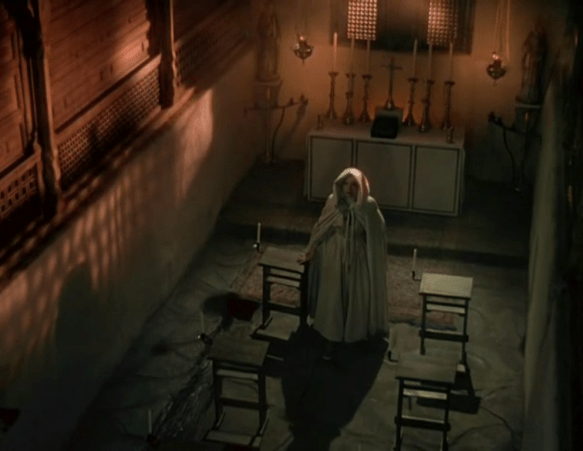
One of the earliest images to leave an impression comes from the POV of two nuns as they gaze down at a cruciform table with nuns moving about for their daily meal.

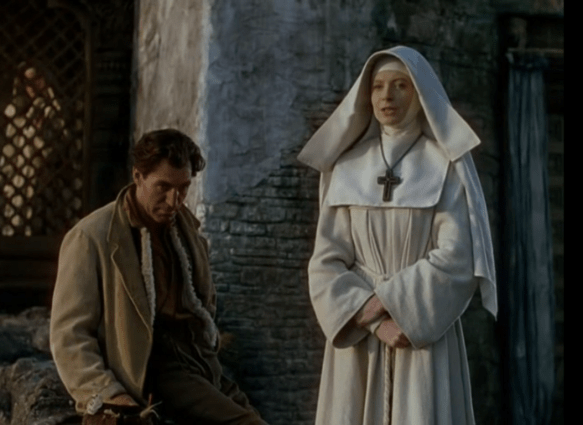
Deborah Kerr as Sister Clodagh comes off somehow regal in her white habit, proud and imperious, even as she sets out assiduously to manage the task at hand. The Sister Superior divvies out her allotted help scrounging up a task force of sorts, within the convent walls, to send out into the world and form a community.

Admittedly, the veteran sister has her doubts about the youthfulness of her counterpart, chiding her pupil, “The superior of all is the servant of all.” This is her word of admonition as they head off to face the unknown set before them.

I’ve never fully considered the methodology of the habit and yet purely from a cinematic perspective, what it does is put all the focus on an individual’s face — their features and, thus, their emotions speak for them. Then, of course, hidden under the garb is their heart and this is the seat of all their actions whether sympathetic or callous. Otherwise, they might all look the same. But of course, the head and the heart are what set us all apart.

While they are nestled in the Himalayas, there is some mention of Darjeeling, India as a stepping stone to civilization, and yet otherwise they are quite secluded. Still, they make it clear they are not merely looking for a place of solitude to live out a reclusive existence.

Mr. Dean (David Farrar), the knowledgeable yet resident cynic, is meant to be their point of contact to help them settle in, but his brusque often insinuating comments lingering in the air don’t begin the relations in a cordial manner. The fact he’s a handsome, strapping young specimen creates yet another layer of unspoken tension.

He explains the local General used to keep his women there — his concubines and wives — in a place where the nuns have plans to turn into a medical dispensary with a school and a space to minister to the needs of the local populations.

But there are numerous reasons to be uneasy. The people pile into their compound with their sick and old overwhelming the newly installed outpost. There’s also the wind, altitude, and disease which have a curious joint effect on the new transplants still trying to gain their legs.

Screenshot 2019-12-22 at 65153 PM

The sisters find everything distracting, even disturbing, and Sister Clodagh, for the first time in ages, finds her mind clouded by past memories — triggering flashbacks from her former life. Could it have been a mistake to join the order? Are these her nagging regrets come back to haunt her? She yearns for the liberation of a normal life, and she’s not the only one.

Likewise, the best encouragement she can muster against the elements and spiritual forces working against them is to, “work hard, work until you’re too tired to think of anything else.” She hasn’t been equipped by any other means, and it becomes obvious she will not be able to succeed with such a plan.

At the same time, they receive requests to take in a local outcast Kanchi (a bedazzled and brown-skinned Jean Simmons) known for her meretricious ways. Also, a young prince (Sabu) inquires about being a pupil within the establishment, which normally only caters to women and children.

We see the remnants of imperialistic disdain especially in Sister Ruth (a wildly manic Kathleen Byro). Far from being all marked with the image of a higher being, she sees the indigenous people around her as lesser beings whom she deigns to help in all their ignorance. It is this relationship between the enlightened few on Christian mission and the impoverished heathens.

We must come to terms with this complicated relationship even with Sabu playing opposite the Anglo Jean Simmons in brownface. Effectively a cross-cultural attraction forms between them even as he is her social and patriarchal superior within the storyline.

The aftermath of WWII also meant many displaced people groups were readily available to serve as extras in the picture, and in this regard, the film is blessed with some genuine sense of authenticity around the edges to counteract the whitewashing represented by Simmons, Edmond Knight, and May Hallat.

The film implicitly dances around these ideas. One moment the fiery-eyed Sister Ruth dismisses the young general as vain and black like a peacock. Although she does seem utterly tantalized by his lavish clothes and his pervasive scent: the titular black narcissus.

He’s also the one who on Christmas night says with all candor, ” I am very much interested in Jesus Christ.” Sister Clodagh extends him some leniency for speaking of their Lord and Savior with such familiarity. Ironically, it is the half-drunk Mr. Dean who chastizes her in the very same moment: “He should be casual and as much a part of life as your daily bread.” Truthfully, she doesn’t like it; it hits far too close to home, especially from a man of such ill-repute.

Screenshot 2019-12-22 at 63158 PM

While not quite the same sentiment as Luis Bunuel, there is something about the movie that proves unsettling in a religious context. There’s some unseen force, whether merely ill-fortune or closer still spiritual warfare, taxing them and splintering their meager enclave apart.

The two defined poles have been made obvious. Either you give yourself up to the world like Mr. Dean or live like the Holy Man. Neither will do for the Nuns who are stuck in the middle as the emblem of Christ in this far-off land.

After, the locals are scared off by the death of one of their infants and leave the Sisters all alone, hysteria sets in. With time, the impending psychological drama fills the world with unease. It has all these unnerving undercurrents accentuated by Cardiff’s own striking palette bursting with this vibrant even violent color scheme.

Mr. Dean matter-of-factly notes there is “something in the atmosphere that makes everything feel exaggerated.” The comments feel strikingly self-reflexive of the film’s own art direction burning images deep into our retinas.

Screenshot 2019-12-22 at 63518 PM

Still, the sisters are left drifting and dreaming through the world. It matches the, at times, hypnotic often queasy psychological torment in Hitchcock’s Vertigo to the point it pulls you in and wears on the psyche. That’s before even getting to the climax, which coincidentally also relies on a bell tower. It manages so much out of the very fact it is being manufactured to create a heightened impression of reality by manipulating the audience.

Even in the final scene, as the clouds envelop the castle high above and the Nuns are led off dejectedly in their little caravan, there’s nothing but this residual innervation. They must give up their mission and be humbled knowing they will be sent to other lowly assignments having failed by the world’s standards.

While India isn’t central to this story there is this lingering sense of colonialism as missionaries were often tied up with this since they were such a staple of the British Empire. There are enough movies to suggest this is true including The Bitter Tea of General Yen, Keys of The Kingdom, and 7 Women.

The rain starts to pour down in sheets as if signaling the end of something — something being totally overrun. Could it be the British Empire collapsing right in front of us? If you were curious like me, India officially gained independence in August 0f 1947. This was after Black Narcissus‘s release in the U.K. and during its run in the U.S.

Somehow they feel interlinked even as this story bursts out of the confines of reality under the exhilarating vision of The Archers. It remains an astounding feat in cinematic magic verging on the otherworldly, positively possessed by color. Like all the most enduring films, it stays with you long after the credits roll like a bewitching fragrance.

5/5 Stars

The Night of The Iguana (1964) and The God-Shaped Hole

night of the iguana 2

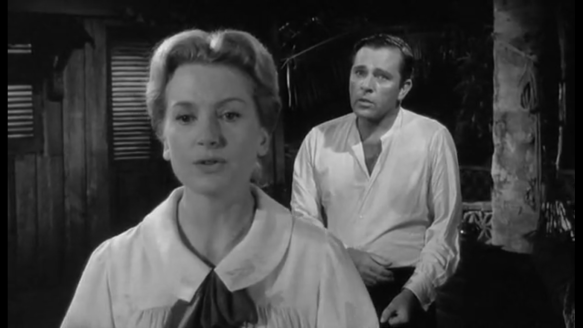
It’s a Sunday morning in St. James Episcopal Church. The minister pulls his sermon from Proverbs 25:28: “A man without self-control is like a city broken into and left without walls.” But there is an elephant in the room, an unspoken force coming between the shepherd and his sheep. He starts to stutter before he erupts in an indignant tirade lambasting his parishioners.

There’s something unsettling in seeing Richard Burton as a minister. I would have felt a similar unease with Peter Finch as a preacher (he was a surgeon in A Nun’s Story). Although it’s true, the similarly resonant actor, Richard Todd portrayed one of the most sincere clergymen ever in A Man Called Peter.

But Burton has the largest and most volatile personalities of all three.  So when he loses his train of thought during his Sunday sermon, perched from his pulpit, it’s not altogether unwarranted watching him implode on the spot. We expect as much.

It feels like Reverend Lawrence T. Shannon (Richard Burton) has inherited the lectern from Barabara Stanwyck in Miracle Woman, though his conflict is more difficult to sort out. It’s as much about the watch-dog hypocrisy in his own church as it is his personal crises of conscience. We don’t know what his presumed sins are, but as the pews clear and he thunders down the aisles, he calls out the fleeing congregants, denouncing them thusly:

“You’ve turned your backs on the God of love and compassion and invented for yourselves this cruel, senile, delinquent who blames the world and all that he created for his own faults! Close your windows. Close your doors! Close your hearts – against the truth of our God! ”

Be that as it may and totally regardless of his innocence or guilt, the next moment we see Shannon, he’s fallen to a new low — taking a busload of Texas schoolteachers down through Mexico so he can serve as their tour guide past all the religious relics below the border.

night of the iguana 3

What a sorry figure he is — a tortured, broken, smarmy man just trying to get by. This portrayal is generally enhanced by the realization that Richard Burton, though he probably grew up in The Church of England, was at the very least a cultural atheist. Nor does he come off as a ministerial type. He was notorious for drinking like a fish. Meanwhile, his highly publicized off-screen tryst with Elizabeth Taylor was commanding the contemporary tabloid covers. It all fits into this conflicted, mercurial performance of his. Hardly likable but strangely compelling for all its wild instabilities.

James Garner is said to have turned down the role because “it was just too Tennessee Williams” for his taste. He’s not wrong and frankly as much as I love him to death, the part wouldn’t have fit. Burton can carry it off because his demons, whether real or imagined, are far more visible onscreen.

However, there is another pressing question. How in the world do you get the creative marriage of John Huston and Tennessee Williams? I’m not sure if you could call it a perfect match, but it’s ceaselessly interesting. It’s a new side of Mexico — in the fishing village of Puerto Vallarta — well after The Treasure of The Sierra Madre. Consequently, the setting seems a bit left-of-center for typical Williams fare even as the sordid dramatic content is much what we would expect. In the middle somewhere the two men meet.

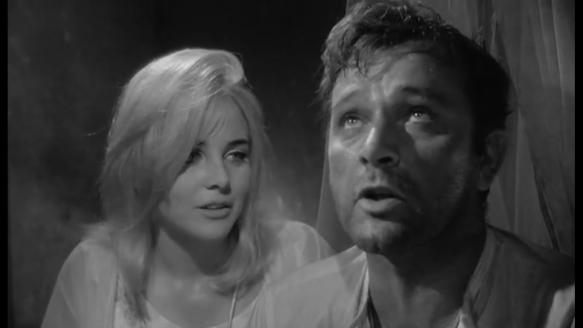
The words from Proverbs are easily recalled as the disgraced Reverend finds himself being pursued by a loquacious young blonde (Sue Lyon continuing in her Lolita vein). She finds him easy to talk to and fascinating — his life is engaged with people’s souls and yet he’s young and virile. Charlotte takes a dip with him innocently enough and still notes she could never do this with the preacher back home in Texas.

It’s the first sign of hot coals. He wants nothing of her coquettish advances even as the acerbic chaperone Ms. Fellowes (Grayson Hall) watches him like a hawk — ruling over the girl with an iron fist of ascetic repression. It makes her a tiresome thorn in Shannon’s side; he’s about ready to go mad. Eventually, he does.

Having just about enough of their campfire songs and rigid drudgery, he shanghais the busload of priggish Baptist schoolteachers, taking them on a harrowing ride, bumping their way down the dusty backroads. He screeches to a halt, jumps out, rips out the distributor head, and proceeds to streak up the hillside with his suitcase. They might as well be in the middle of nowhere.

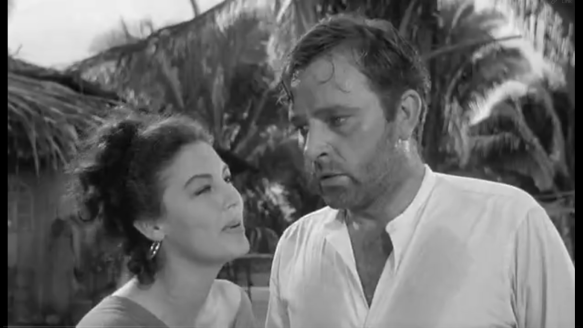
For the sake of this movie, they are not. The tropical Costa Verde hotel is hidden up in the forest overlooking the water, and it just happens to be run by an old friend of Shannon’s. Fred is dead, but his wife, the larger-than-life Maxine Faulk (Ava Gardner), is still running the place. She’s an earthy force to be reckoned with indebted to Gardner’s lively showing.

If not for her, Burton would probably steal the show, but he’s met with another gale storm of enduring cheerfulness and utter obstinance. Their impact is such you almost forget about Deborah Kerr. Sure enough, she appears on their doorstep as the peripatetic painter, Hannah Jelkes, who travels with her grandfather, a diminutive, 98-year-old poet.

night of the iguana 1

Though the other two dominate the screen, she quietly commands it. When Gardner and Burton get to shoving the drink cart at one another, it is Kerr who becomes their unofficial mediator. Because she is a voice of reason, an artist with a pensive gaze, and a surprisingly lucid perspective despite her meager lifestyle.

Later Charlotte bursts into Shannon’s room yet again causing him unwanted torment as she tries to get him to go away with her. She’s very good at stirring up men’s hearts and instigating mini scandals in the process. In another scene, a fistfight for her affections breaks out between the tour’s bus driver (Skip Ward), and some local boys replete with music, maracas, and stereotypical flourishes. Huston plays it for a laugh. It’s inconsequential if not altogether inane.

Because it is from the stage, The Night of The Iguana does seem to stall. Eventually, the bus leaves without Shannon and the second half of the story feels like an existential dialogue more than anything else. It could be a dead-end, though on the merit of our three established stars, it remains something intermittently though-provoking if not entirely compelling.

The curious thing is how the adversary melts away. True, the bus leaves with both his temptation and condemnation and yet he has pity even on his adversary. “Miss Fellowes is a highly moral person. If she ever recognized the truth about herself it would destroy her.” He recognizes her as another conflicted, constricted creature — a fellow Iguana tied up to a post.

With the bottom dropped out of his life, Shannon wants to swim to China, seemingly a handy euphemism for ending it all. He’s taken to the brink of his wits, lashing out at Maxine and anyone else who will avail him. It’s Kerr who rules the final act amid the paucity of moral rectitude. She perceives that his version of Golgotha is on a green hillside overlooking the water. His cross being strung up in a hammock on the verandah. In comparison, it seems like a fairly cushy alternative. She strips him down to who he really is.

Far from condemning him, Jelkes feels strangely sincere and genuine, particularly for Williams. She perceives that his problem revolves around “The need to believe in something or in someone — almost anyone — almost anything.” It’s Augstine or Pascal’s God-shaped hole rehashed. Likewise, she deflects his metaphors. She is not a bird but a human being. Nothing human disgusts her except if it’s unkind or violent. What extraordinary statements they are, and Kerr delivers them with a perfectly composed performance.

As each person tries to decipher their own religion or least some semblance of existential understanding, whether through legalism, drink, or sex, even cutting Iguana’s lose as a private act of personal Godship, she’s the one character who brings down the thoughts and words of the wise and makes them feel foolish.

For a film suffused with a great deal of religiosity, she’s startling unprepossessing. And yet in her words and in her humanity are the roots of something bountiful and beautiful in their very simplicity. It’s the kind of simplicity that can help loosen the Iguana from the hitching post, where we find out by sojourning, it’s possible to fill up the vacuum inside each and every one of us.

4/5 Stars

Classic Movie Beginner’s Guide: Montgomery Clift

In our ongoing series, we continue shining a light on classic actors we think more people should get to know. This week our focus is none other than Montgomery Clift!

Monty Clift was one of the unsung champions of a new brand of acting that bridged the gap between the New York stage and the soundstages of Hollywood. Before Marlon Brando, James Dean, and others, Montgomery Clift introduced moviegoing audiences to a new form of intense masculinity paired with a striking vulnerability.

His life was marred by tragedy but instead of dwelling on that let’s celebrate the extraordinary career he forged for himself with some of the great directors of his generation. Here are 4 of his greatest movies with performances to match. 

Red River (1948)

Image result for red river 1948

What’s immediately apparent about Monty Clift is how particular he was about his roles. Because his film debut was nothing short of an instant classic. In this iconic sagebrusher from Howard Hawks, Clift went toe-to-toe with a vengeful John Wayne, playing an adopted son and his father who vie for control of the family herd with startling outcomes. 

The Search (1948)

Image result for the search 1948

Once more Clift aligned himself with an esteemed director — this time Fred Zinnemann — and invested himself in a story with real-world urgency. He plays an American soldier who takes in a young boy orphaned by the war. They strike up a relationship while racing against the clock to reunite him with his kin. The chemistry between the two is beautiful to watch.

A Place in The Sun (1951)

Image result for a place in the sun

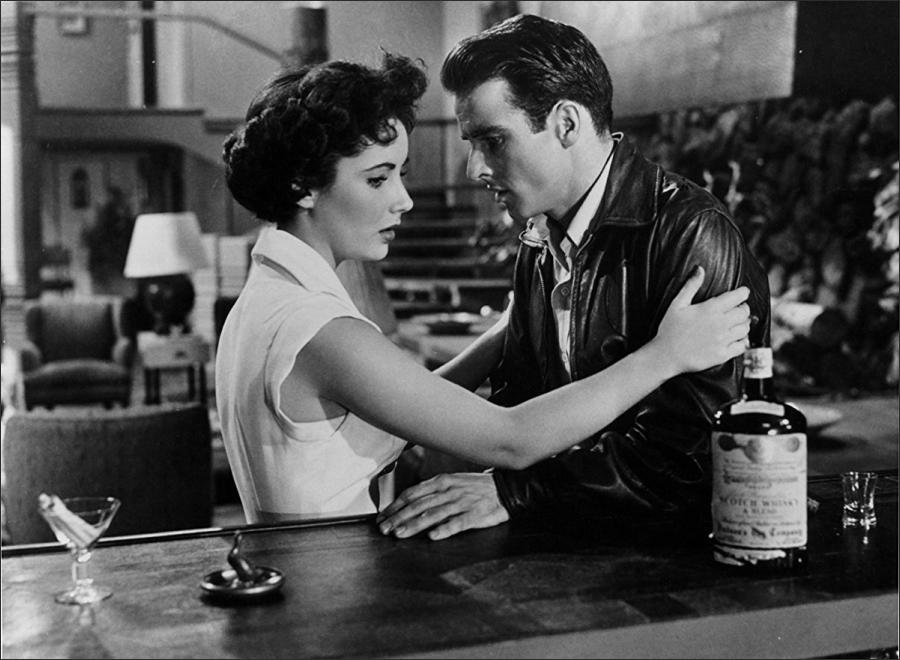
This is the film that will forever define Clift’s career slotting him opposite a dazzling Elizabeth Taylor in one of her first adult roles. The adaptation of Theodore Dreiser’s An American Tragedy, directed by George Stevens, captures the emotional weight Clift was able to channel into many of his greatest roles. It’s one of the most devastating romances of American film thanks in part to Clift and Taylor.

From Here to Eternity (1953)

Image result for from here to eternity montgomery clift

Although I’m led to believe the film is slightly overrated, there’s nothing wrong with Monty who brings his continual range as a troubled soldier on the eve of Pearl Harbor. Though it’s easy for him to get overshadowed by kisses in the waves between Burt Lancaster and Deborah Kerr or the gutsy performance of Frank Sinatra, there’s no question Clift is front and center playing opposite Donna Reed.

Worth Watching

The Heiress, I Confess, The Young Lions, Wild River, Judgement at Nuremberg, The Misfits, Freud: The Secret Passion.

Heaven Knows, Mr. Allison (1957)

heavenknows3From John Huston comes another film about a woman of principle and a man who seems to be everything she is not. This time instead of Katharine Hepburn and Humphrey Bogart aboard The African Queen in WWI, we have Deborah Kerr and Robert Mitchum stuck on a deserted island together during WWII.

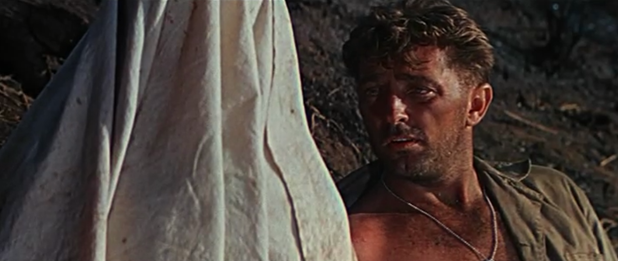
Kerr is Sister Angela who was on the island only a few days with a priest before he passed away. Now she is alone taking care of herself in solitude. That is until castaway Marine Mr. Allison washes up on her shore in a raft. For a time it is just the two of them as the Sister offers the marine food after his long, arduous journey. But after getting rest and some nourishment, he returns the favor proving his resourcefulness at scrounging up food on the island. For a while, they live in relative ease like this.

But they are reminded that the war is still going when the Japanese set up camp on the island. The unlikely pair finds themselves living in a cave together. Allison invades the camp on the sly to acquire food for them, and they continue to manage in hiding. Once the enemy is gone, the exuberant marine gets drunk on some sake and professes his love to the novice nun. Although the situation had never quite been awkward up to that point, it quickly becomes so. Sister Angela, in a tizzy, flees out in the pouring rain and winds up getting sick as a result.

heavenknows5To add to the predicament, the Japanese forces return, and back to the cave, it is. This time Mr. Allison must kill a soldier in order to get a blanket for Sister Angela. Soon the Japanese are burning the underbrush in pursuit of the culprit. It’s dire straights certainly, but then help comes.

Mr. Allison once again proves himself and regains the faith and admiration of Sister Angela. Once the marines roll in Mr. Allison is able to leave the island on a stretcher with the faithful novice by his side. They are a strange pair, but their relationship makes this story actually engaging. In a way, the life of a marine and a nun have some similarities, although they fall at completely different ends of the spectrum. In the same way, Mitchum and Kerr are adept at playing their roles to that degree. Allison is rough around the edges, a Joe Palooka type, and yet he means well. The nun is devoted to her calling, proper, and it never seems as if she could ever approve of Mr. Allison. And yet, in the midst of all the divides that seem in place, a true bond forms. It’s an entertaining relationship and these two stars,  led by John Huston’s direction, made it thoroughly enjoyable.

4/5 Stars

An Affair to Remember (1956)

anaffairto2An Affair to Remember (1956) has always been noted as a great American romance as far as I can ever remember, and I figured out that part of that was because it gets a mention in Sleepless in Seattle (1993). Whatever the reason, I finally got around to watching it and it is certainly an enjoyable weepy. Any film with Cary Grant as a romantic lead is usually, at the very least, charming and this one is too. He is a famed man on an ocean liner who has finally gone and gotten himself hitched. It’s big news and as soon as the ship touches down he is going to meet his love.

Quite by chance, he meets Deborah Kerr’s character and they are immediately taken with each other. Soon their friendship grows into an affectionate romance, and yet they feel uncomfortable in front of the other passengers who seem to be watching their every move with interest. They both know that once the boat reaches New York things will not be the same between them for some time.anaffairto4And so it is, but they had made one last plan to meet each other at the top of the Empire State Building. Grant makes it, but Kerr is detained for a very good reason. After seeing her in an awkward situation at the theater, Grant resolves to go see her and get to the bottom of what happened. It’s a tearful, albeit happy, reunion as they come back together.

If any of this feels familiar, like a rerun, that’s because it is. Leo McCarey actually made An Affair to Remember (1956) as a scene for scene remake of his earlier film Love Affair (1939). I never thought I’d say that I like a film with Charles Boyer more than a comparable one with Cary Grant, but it’s the truth. I’m not sure if it’s because I saw it first or that the film feels more intimate, but I really enjoyed Love Affair. An Affair to Remember is certainly elegant in color and Deborah Kerr gives a fine performance, but I was personally blown away by Irene Dunne as an actress. In fact, back in the day, Dunne worked quite a bit with Cary Grant (The Awful Truth, My Favorite Wife, and Penny Serenade).

So my advice is, go back and give Love Affair a watch. It’s still by McCarey with much of the same story so it’s really a personal preference what film you like more.

3.5/5 Stars

Separate Tables (1958)

bdd6d-separate_tablesStarring Burt Lancaster, Rita Hayworth, Deborah Kerr, David Niven, and Wendy Hiller, the films follows the evens at an Inn in England. This relatively simply film is less about plot and more about the interactions between people. Lancaster is a troubled man who is trying to forget his past marriage. Hayworth is the attractive wife he left who has her own insecurities, Kerr is the timid daughter who always obeys her mum, and she takes a fancy for the Major. Niven is the Major, a seemingly kind older gentleman with a less desirable side. Add a few more guests and Wendy Hiller as the sensible owner of the inn and you have this movie. What first begins as separated tables eventually evolves into something else entirely.

4/5 Stars

From Here to Eternity (1953)

b0508-from_here_to_eternity_film_posterDirected by Fred Zinnemann, the film has an all star cast including Burt Lancaster, Monty Clift, Deborah Kerr, Donna Reed, and Frank Sinatra. Clift is a former boxer and bugler who has been transferred to a post in Hawaii. The commanding officer wants to have him fight for the company but Clift is adamant that he will not. From that point on life is made difficult for him on the base. However, he still finds time to go to a club with his friend Maggio (Sinatra) where he meets Lorean (Reed) and falls in love. At the same time the intelligent company sergeant Lancaster, finds himself falling for the commander’s wife (Kerr) who has an unhappy marriage. However, he feels he cannot become an officer effectively terminating their relationship. The dramatic events culminate in the attack on Pearl Harbor which overshadows a smaller tragedy. This movie certainly had a cast full of famous people, but I have to say it was not my favorite film. All the same there definitely are some good moments.

4/5 Stars