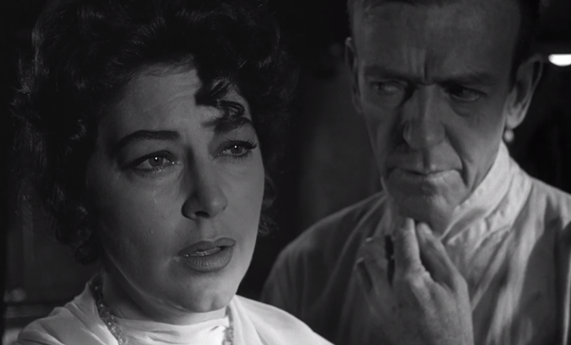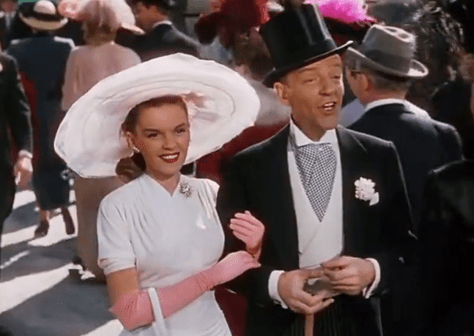
Easter Parade (1948): Judy & Fred Together At Last

easter parade 2.png

There’s a slight disclaimer that must go with Easter Parade. It has very little to do with Resurrection Sunday. More so, it’s a premium excuse for a lavish musical. At least in this regard, it thoroughly accommodates its audience.

The show starts off gloriously, not with dialogue, but with song, reminiscent of the great operettas of old or the future works of Jacques Demy where the film is buoyed by a range of voices imitating the joyous chorus of life. Here we have the seemingly ageless Fred Astaire strutting down the street greeting folks, doing some window shopping, picking out a hat as models file by and everyone chimes in with “Happy Easter!”

What becomes immediately apparent, even as we are thrust right into song, is the immaculately colored world, bright and cheery, personifying the holiday festivities and simultaneously satiating audiences who come to expect such glorious decadence from Technicolor movie musicals of the age. It rarely disappoints in terms of pure opulent set design.

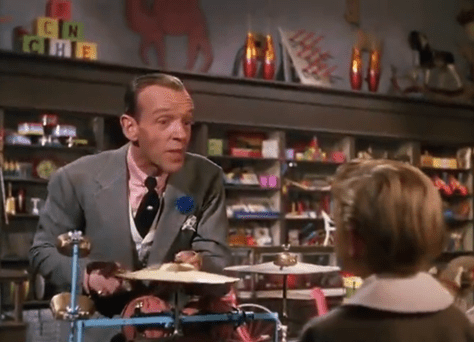
When Astaire spies a bunny in a toy store window, it inspires his finest number in the picture, a worthy precursor in fact to his shoeshine number in The Band Wagon (1953). Because what sets it apart is how alive, lithe, and playful it is. Gene Kelly was imbued with this ability too, but you have to witness it to completely understand the magic when environment and inspiration coalesce.

They could animate the world around them by taking lifeless objects and turning them into tools to personify emotion. Like all the preeminent performers, they take the tirelessly rehearsed and make it feel like the epitome of the organic, in a way that suggests we are discovering something precisely at the same moment they are. We are part of the magic born out of the moment.

Astaire banging on drums and xylophones. Twirling sticks and tossing toys like, well, a kid in a toy store. The story hasn’t even started yet, and he’s already made Easter Parade into something special. It’s when you’re reminded that these lavish musicals were at their best when they momentarily lost their plotlines through acts of artistry and inspiration that still managed to somehow advance the narrative.
easter parade 1.png

At some point, the exposition must arrive and with it a plot. It comes in the form of Don’s ravishing and vain dance partner. Nadine (Ann Miller) is intent on striking out on her own and commanding a larger audience. In fact, she’s already made up her mind and signed a contract with Ziegfeld, leaving Don to start from scratch with a new partner. Regardless, there’s no denying the chemistry they had together. Astaire and Miller absolutely light it up in “It Only Happens When I Dance With You.”

However, now feeling betrayed and saddled with a bit of a Pygmalion complex, he convinces himself that he can turn any second-rate performer into his costar, and he just happens to pick Hannah Brown (Judy Garland). The unassuming starlet splits her time as a waitress at a local bar while struggling to differentiate her left foot from her right. She looks like a hopeless case. Not so!

Fresh off his quality success in MGMs Good News (1947) from the year prior, Peter Lawford is inserted in the storyline as the close friend of Don and Nadine, caught in the middle of their personal and professional squabble. When he meets Hannah in the rain, it only makes things more complicated. One could wager that the handsome and youthful Lawford is partially miscast, but he has a good-natured charm that makes us disregard any of that. We like him as much as we’re supposed to.

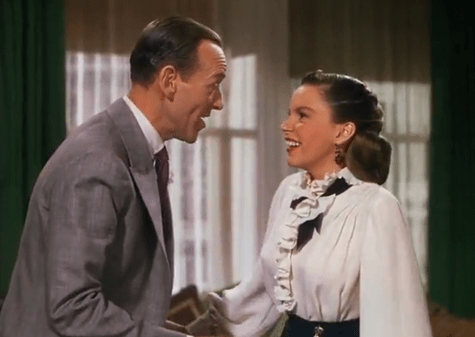
From their initial encounter, the Astaire and Garland relationship is front and center, evolving into the film’s most important dynamic. So far the movie is coming through on its promises. Again, we’re not all that interested in their acting per se, unless I’m just speaking for myself.

What actually strikes my curiosity is seeing them perform in tandem because they were consummate professionals who knew the Hollywood circuit like the back of their hand by now. Astaire, though still looking so spry, had years already logged with Ginger Rogers and others, not to mention stints on Vaudeville and the stage. Garland of course, though still quite young, had, since adolescence, been trained up and groomed in the ways of Hollywood. The shining examples early on, of course, being The Wizard of Oz and then her onscreen partnership with Mickey Rooney.

“Couple of Swells” endears itself as a delightfully corny number with our stars ruefully ditching the fine attire for artful dodger, tramp-like garb. Buying into their affectionate relationship by this point is no difficult task. They’ve made us believe in it.
easter parade.png

In truth, Garland had never met Astaire before their teaming though she had purportedly wanted to work with him for many years because he was the tops — the best of the best.

The rest of the production’s background is tumultuous, and the actual details sketchy at best. Scriptwriters Frances Goodrich and Albert Hackett were initially called upon only to have their draft touched up by Sidney Shelton. Vicente Minnelli was removed as director at the behest of Garland’s psychiatrist, deeming it better for her to work without her husband.

We might also call it an odd chance of serendipity as Gene Kelly (Garland’s co-star in many MGM musicals) was also slated for this project until he broke his ankle playing volleyball (right before production commenced).

Who was coaxed out of retirement to take on the role instead? Only the best: Fred Astaire. And Astaire would retire numerous other times thereafter, but you just cannot keep a man who was born to dance like he was away from the floor. Thank goodness he would come back for numerous more efforts. His successes in the 50s are too innumerable to count.

Simply put, he makes every movie he’s in worth watching for the mere chance that you will glimpse something spectacular. Paired with Garland, a world-class performer in her own right, there’s no missing, even if both have more iconic pictures. That’s probably more a testament to their iconic careers than the merits of Easter Parade. Because it all but delivers on everything you come to expect from the two names written above the title.  There’s a good chance you’ll be left with a broad smile on your face.

4/5 Stars
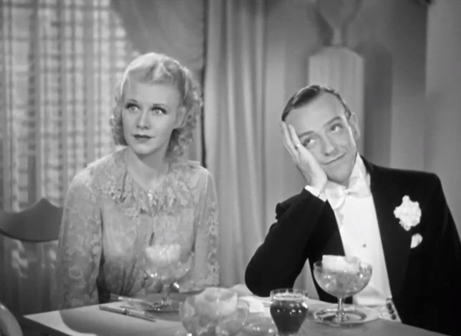
Shall We Dance (1937): Fred, Ginger, and The Gershwins

shall we dance 1937.png

The name Gershwin is synonymous with “The American Songbook” and part of the draw of Shall We Dance is how it included two of them: both the brothers, George and Ira Gershwin. Ira would tragically pass away that same year. However, together they provided the compositions and lyrics for the film which, in some sense, feels like an atypical Astaire and Rogers vehicle.

While Mark Sandrich is in the director’s chair once more following The Gay Divorcee (1934), Top Hat (1935), and Follow The Fleet (1936), there are some unprecedented deviations from the normal foolproof formula. Namely, Astaire plays Peter P. Peters, an American who trades in his taps for a Russian ballet company. He’s certainly will always be a hoofer in most people’s eyes, and it does feel oddly out of character.

What hasn’t changed is his instant infatuation with Rogers, a famous tap dancer in her own right, named Linda Keane. But he must contrive some sort of gimmick and thusly takes up the persona of the touchy Russian dancer “Petrov” to antagonize her on the road toward love. Meanwhile, he tries his very best to evade the flirtations of his former dance partner Denise (Ketti Gallian) who looks to snatch him up.

Of the earliest offerings, Astaire gives us the treat of his cane dancing like he did in Top Hat and then there’s a fine boiler room number, “Slap that Bass” supported by a host of African-American performers thrumming with a healthy dose of character.

The film’s most catastrophic mix-up comes when the newspapers begin promoting a secret marriage between our two stars, thanks to a cockamamie story Peters cooked up on the spot to keep his former suitor at bay as he leaves on an ocean liner.

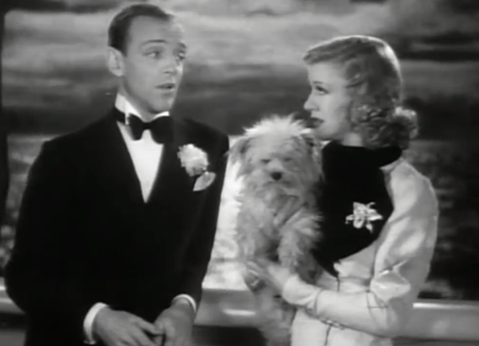
Petrov and Keane develop some chemistry dog walking together on the deck of the ship only for the gossip swirling about to reach a fever pitch. Astaire’s bumbling boss, Mr. Beard (Edward Everett Horton) uses it as the perfect chance to get rid of her for good. Meanwhile, Eric Blore as his ever-huffy hotel clerk tries his best to figure out the marital status of Petrov and Ms. Keane when preparing their rooms. They leave him ceaselessly befuddled.

Then, a second nefarious scandal is cooked up by Keane’s road manager (Jerome Cowan feeling out of place with the screwball elements), who does his best to kill the upcoming marriage his star has embarked on.  Thanks to some late-night photography and a mannequin bearing a striking resemblance to Linda, the news spreads like wildfire. What are his motives, you ask? He’s got his own reasons.

shall we dance 2

Not surprisingly, the closest thing we get to the Astaire and Rogers numbers of old are also the film’s finest entries, including the comic tune “They Laughed at Me” sung by Rogers before being joined in a routine by Astaire. After they sneak out to get away from the publicity hounds, “Let’s Call The Whole Thing Off” proves a handy follow-up number.

The extended sequence purportedly took a plethora of takes, upwards of 100, while the final fall into the grass left Fred and Ginger with black and blue backsides. They suffered and yet as the audience, we no doubt reap the benefits, especially because Shall We Dance hardly has their traditional big numbers like a Top Hat (1935) or Swing Time (1936) so seeing them on skates together is nearly consolation enough.

They show everyone by getting married, making it easy enough to get divorced so Linda can marry the man she’s meant to. Since their movies always took a page out of screwball comedies anyway, it makes sense this picture is another riff on the comedy of remarriage, which could be a sub-genre all its own.

Ultimately, two shows are merged in an instance of inspiration and yet that doesn’t mean that Petrov’s got the girl. An oddly disconcerting final number follows as Astaire dances with a host of gals all donning Ginger Roger’s face, disrupted by a shushing war instigated by our favorite misfits Blore and Horton. Though the picture could have used a feisty female like a Helen Broderick or Alice Brady, there’s also never enough of Blore and Horton to suit their faithful fans. They make every film a little more colorful, and it would hardly be an Astaire-Rogers picture without a stellar supporting cast of veteran jokesmiths.

Surveying Shall We Dance, it’s certainly not at the top of the pantheon of the movie musicals that these two icons made together, but it’s ripe with some of the usual delights in spite of a laborious plot and a different brand of dancing than we’re used to. It’s hard to complain too much about the results. There’s no doubt the entertainment value for true aficionados still remains.

3.5/5 Stars

The Gay Divorcee (1934): The Astaire & Rogers Foolproof Formula

the gay divorcee.png

The plots to the Astaire and Rogers musicals are usually deceptively simple. Thus, thanks be to their dancing transcending it all. The affair opens in some posh corner of Europe where the always dithering Edward Everett Horton is sitting with Fred Astaire who has to prove his identity to get out of paying a check. They’ve both conveniently misplaced their wallets. After a routine complete with pretty girls and dancing fingers, he gives an impromptu performance of his own bringing down the house and proving he really is world-renowned performer Guy Holden.

Later on, at the docks, a fellow American, arriving in England (Ginger Rogers), is meeting her lovably fatuous aunt (Alice Brady) only to have her dress accidentally caught in a travel trunk. The man who comes to her aid and subsequently rips her garment is, of course, Astaire. Being a gentleman and genuinely taken with her, he gives her his coat to cover up, but the damage has already been done. She finds him a bit bothersome. You can tell it instantly by every look of disdain she throws him. Meanwhile, he eats up any pretense to talk with her, though she dismisses his advances. It’s how the story always goes.

He turns his resolve to find the girl, matched with the everyday occurrence of getting dressed to go out on the town, into the number “Needle in a Haystack,” which has Astaire exuding his typical elan on taps. Of the millions of women around, he’s looking for one very particular needle, and he’s not above canvassing the streets, even if it’s an insurmountable task, made increasingly apparent through montage. It goes to all this trouble only to very coincidentally rear-end her as he’s rubbernecking (adding yet another reason for her not to like him much).

Meanwhile, Egbert (Horton) is looking to make his father proud of him in the family law firm, though he’s never seemed to have much gumption or stomach for the trade. His worst nightmare, Hortense (the same Alice Brady) comes back into his life also bringing with her the proposition of a case that just might be his opportunity to assert himself. Mimi, the same woman constantly harried by Holden, is looking to get out of a loveless marriage and so the inept lawyer suggests setting up a rendezvous with a professional gigolo to end the union for good.

He invites Guy along for the ride knowing the sunshine, gaiety, and girls might do him good as a distraction for his lovesickness. He needs to forget this girl he’s so taken with. However, they’ve failed to compare notes. It doesn’t take extra-sensory perception to read where the picture will go from here, in fact, there’s hardly a need to continue. The human mind might do a finer job in its vivid imagination to derive what complications will arise from such a premise.

It’s a pleasant surprise to see Edward Horton doing a little saucy jig, “K-nock K-nees,” which also proves an early showcase for 40s wartime superstar Betty Grable if you’re able to recognize her. Likewise, in the subsequent scenes, Eric Blore is delightful as ever, this time as a waiter with his typical crisp & snooty delivery, ably sparring with the comic foibles of Horton.

Fortuitously, he turns up in several more instances to serve up the tea things along with idle chatter to anyone who will lend an ear. Astaire and Rogers’s first number together is the Cole Porter standard “Night and Day,” only to birth further misunderstands thanks to one ironic code phrase, “Chance is the fool’s name for fate.” Don’t ask for an explanation.

“The Continental” is an impressively glossy number that until Gene Kelly conjured up his American in Paris (1951) dream sequence, clocked in as the industry’s longest continuous dance number. Some of it involves our leads, but not the whole thing. It feels much more like a Busby Berkeley extravaganza.

And yet right there you understand the exquisite nature of Astaire and Rogers because they made dancing into something intimate and personal. It was between two people as much as it was a lavish production number, and that’s what resonates with us even after the curtain falls and we’ve been wowed by the expansive nature of the staging.

Yes, the geologist husband finally makes his token appearance as expected and the hired romancer Tonetti (Erik Rhodes) continues to bumble along in an effort to play his raffish role. Of course, Astaire proves far more convincing in the part of the lover finally getting the girl as expected.

Does any of this matter? Hardly. But it’s one final opportunity to get Astaire, Rogers, Blore, Horton, and everyone else in a room together. That’s surely enough to recommend this frolicking trifle of gaiety starring everyone’s favorite couple on taps. There’s nothing better to lift your spirits than Astaire and Rogers.

4/5 Stars

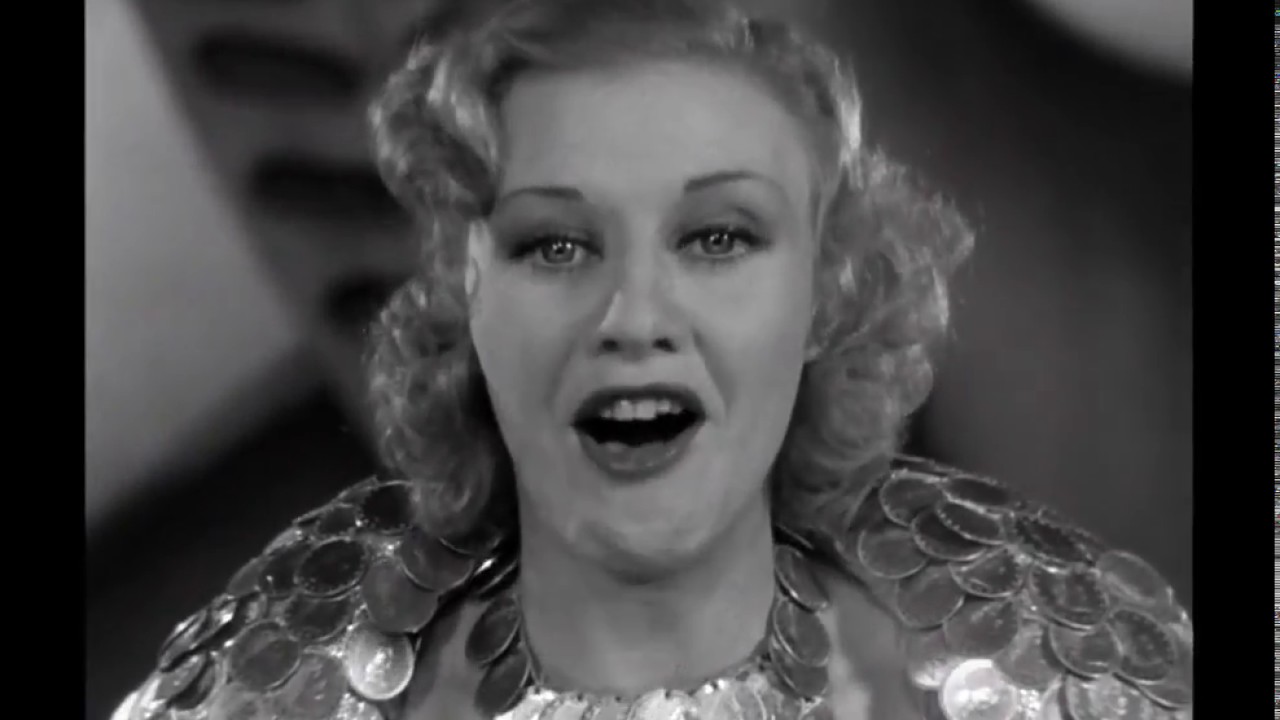
Classic Movie Beginner’s Guide: Ginger Rogers

As we continue to look at musicals our recent beginner’s guides have been focusing on stars at the center of some of the best films of the era. Today let’s focus on Ginger Rogers.

Aside from being part of the incomparable dance partnership with Fred Astaire, Ginger Rogers was also an accomplished comedienne and a tested dramatic actress who showed surprising elasticity throughout her varied career. Here are just a handful of her best movies.

Gold Diggers of 1933

Image result for gold diggers of 1933 ginger rogers

Some might forget Busby Berkeley started to choreograph a new syntax for the movie musical and crucial to one of the industry’s most successful Depression_era backstage dramas was Ginger Rogers. Joining forces with Joan Blondell and Aline Macmahon, among others, they build on the success of 42nd Street.

Top Hat (1935)

Image result for top hat 1935

For some people, this is the ultimate Astaire and Rogers movie featuring some of the most extravagant sets and career-defining numbers together. The cast is rounded out by old favorites like Edward Everett Horton and Eric Blore. However, of course, the main attraction amid the screwball foibles are our shimmering leads, Rogers sporting her iconic feathery ensemble.

Swing Time (1936)

Image result for swing time 1936

Others will say this George Stevens-directed feature is actually the greatest Astaire-Rogers pairing and who would blame them? The dancing is phenomenal and the songs equally amicable including standards like “The Way You Look Tonight.” Surprise, surprise, Ginger and Fred are magical together yet again.

Vivacious Lady (1938)

Image result for vivacious lady 1938

So many films could earn this spot but Vivacious Lady is buoyed by the real-life chemistry and friendship of Ginger Rogers and James Stewart. The material is fairly light, but they handle it with ease. In a turning of the tables, Stewart was yet to be a big star and Ginger Rogers vouched for him. Greater things were yet to come for both of them.

Worth Watching

Flying Down to Rio, The Gay Divorcee, Roberta, Follow The Fleet, Shall We Dance, Stage Door, Bachelor Mother, Kitty Foyle, Major and The Minor, I’ll Be Seeing You, Monkey Business, etc.

On The Beach (1959): Peck, Gardner, Astaire, Perkins, and Apocalypse

on the beach 1.png

I recall my dad sharing a recollection about On The Beach. Back when it came out he went to the drive-in with his family, and they took in the movie. He fell asleep part of the way through only to wake up and the movie was still going. While not necessarily a profound observation, the film is unequivocally long. For some, it will verge on the doldrums, especially for a story about the end of the world.

However, I am tempted to like it for some of the creative decisions it chooses (and in my father’s defense, he never said he outright disliked the movie). It acts as one of the first prominent films detailing the aftermath of a nuclear war. Also, unlike many of its contemporaries, it leads with a cold open closeup on Gregory Peck’s face as he commands a submarine. The camera is quick to maneuver through the space showing us all the levers and nobs with shipmen scurrying around carrying out their various duties.

It’s already a different feel than something like Run Silent, Run Deep (1958). We can actually breathe because there is no suffocating atmosphere to speak of. That’s what makes the emptiness of the space on the outside so startling. It’s almost too open; it’s all but void of meaningful life except for small envoys existing far enough away from the disaster zones.

Conceptually, the apocalyptic near-future is an intriguing world to come to terms with, just as it is frightening. Because it’s a hybrid society still existing in the world and only time will tell if it can subsist.

We familiarize ourselves with a segment of humanity now living in Australia, and America seems to be decimated. Everyone refers continually to “These Days” — it implies the allowances made in such extreme circumstances. People cannot go on living the way they always did, and things formerly unheard can happen without so much as a bat of an eye.

Shortage leads to a random assemblage of old and new technology to get by. For transportation, electric trains and horse-drawn carriages have a function. And yet for amusement, folks still have beach days soaking in the sun as if nothing is awry. It seems like small consolation for the 5-month expiration date being put on the world.

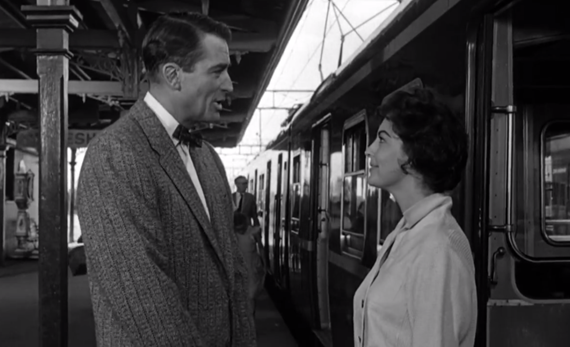
At first glance, On The Beach doesn’t seem to be about much. It’s really about one major event scattered with the residuals of human relationships. One of our main players is Commander Dwight Towers (Gregory Peck), a widower who lost his family to the catastrophe while he was on duty. Currently, he has come to Melbourne to receive a briefing from Admiral Bridie (John Tate) on what they might possibly do next.

Struggling with survivor’s guilt, Towers strikes up an intimate relationship with one Moira Davidson (Ava Gardner). A radio signal originating in San Diego calls him back to the sea, and he heads out, unsure if he will ever see her again — yet another person he must reluctantly say au revoir to.

on the beach 3.png

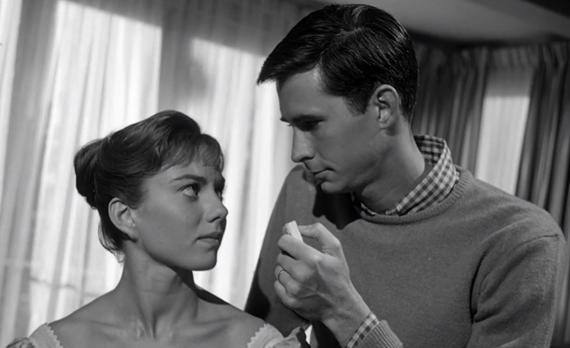
Anthony Perkins fits into the story as a younger version of Towers, Lieutenant Peter Holmes. He still clings onto his young family while worrying about what might happen to their slice of marital bliss. Because she is less-remembered, I am apt to especially be interested in Donna Anderson who gives a sincere performance as his wife (though it starts to unravel as the clock ticks). Mary cannot bear the implications of their society, as they have a newborn and with her husband away, there will be no telling what will happen to them. It unhinges her.

The most ominous shot during the voyage is an eerily empty Golden Gate Bridge, indicative of the entire West Coast. It’s literally dead. When they finally arrive in San Diego, it proves to be a near ludicrous dead-end involving a window shade and a coke bottle. Even Yankee know-how wasn’t able to avoid utter destruction.

It occurs to me On The Beach is not trying to exploit the situation, but it is using the backdrop to say something as Stanley Kramer always tried to do with his pictures. While he’s not the most virtuoso of filmmakers, his intentions are always upfront, which is admirable.

The director always aligned himself with fine acting talent even affording a trio of former musical stars shots at dramatic parts to reshape their prospective images. That in itself takes unwavering vision. In this one, Fred Astaire gets his chance as the hard-drinking, chain-smoking, acerbic scientist Julian Osborn. You’ve rarely seen him this way before. Whether it entirely suits him is relatively beside the point. Gene Kelly and Judy Garland would follow in a pair of uncharacteristic departures in Inherit the Wind (1960) and Judgment at Nuremberg (1961).

on the beach 4.png

Whereas the source novel apparently laid out who was to blame, the film develops a level of senselessness because no one — even those holding the highest clearance levels — seems to know how the tripwire was set off. They can only speak to their current reality. It makes an already disturbing situation a little more unsettling since there is a sense of universal ambiguity.

The questions linger. Might it have been an accidental mistake leading to the annihilation of our entire world, people all but expunged from the surface of the earth? It’s a chilling thing to begin admitting. Julian (Fred Astaire) is forced to acknowledge he doesn’t know.

It could have been some bloke who thought he saw something on a radar screen knowing if he hesitated his people would be obliterated. If this were the case, he would have only succeeded in setting off the dominoes. In fact, this nearly happened in real life one fateful day on September 6, 1983, to Stanislav Petrov, though he chose to wait, and it proved to be a faulty signal from his equipment.

It’s evident mutually assured destruction is a horrible system to wager on. And once you are past the point of no return, the apocalypse is a horrifying entity if there is no sense of hope. Most films must choose between inevitable doom versus some kind of hope.

In the waning days, we are antsy for finality, and it makes you realize just what the circumstances bring out. Waiting around for the end of the world sounds awful. And yet On The Beach manages to land the dismount even if the interim is slow-moving. True, there aren’t a flurry of events and there are a few asides — like Astaire winning the Grand Prix — which feel slightly superfluous to an impartial observer.

However, again, some kind of statement is being put to the fore, more nuanced than we might initially give it credit for, if not altogether succinct. It’s not simply an alarmist diatribe but there is a sobering urgency to it. The film foregoes the austere religiosity of the street preachers for something perceived to be much warmer.

Ava Garner standing on the shore, kerchief waving in the breeze, watching the receding figure of Gregory Peck on the deck of his sub is the movie’s indelible image. We need people around us to love and be loved by. Of course, some ill-advised individuals (myself included) live their everyday lives just waiting around for something. Hopefully, it doesn’t take nuclear devastation to kick our lives into overdrive.

3.5/5 Stars

Holiday Inn (1942): White Christmas and Blackface

holiday inn 1.png

Let me put this out in the open. Christmas movies are some of the most difficult films to regard subjectively because the majority of them are either tied to our childhood and fond memories, which are as much a part of the experience, or the alternative; they were not a part of our traditions at all. White Christmas (1954) is a personal movie for me — one that I have known intimately for years — where all the lines and songs play like old friends.

Holiday Inn, not so much. It plays well on paper and I am usually a subscriber to the original always being the best. However, even in a highly subjective, not-so impartial way, it’s hard for me to go out on a limb for it. The one glistening asset it does maintain — fluffy and welcoming as Christmas itself — is the introduction of Irving Berlin’s “White Christmas” for the first time.

It’s slipped inauspiciously into the film within a quiet interlude, not a huge stage extravaganza, as Bing croons with Marjorie Reynolds sitting by his side. The little ditty, of course, would go from being just another Irving Berlin tune to the highest-grossing Christmas single of all-time.

It’s staying power never ceases to amaze because the yearning, the vocals, everything about it taps into something deep and resonant as the season itself. There’s one word for it: hope. It’s an expectancy in what is coming.

In music terms, it meant gold or rather platinum. Either way, it’s still with us today. If this was the only reason to see Holiday Inn, it would probably be worth it just to get a glimpse at history. So there we have it.

The picture sets would actually be reused 12 years later with White Christmas and we have a similar dynamic between Bing Crosby and his costar. There’s even an eerily similar dressing room scene in both. However, as much as I love Danny Kaye, a man of many talents, comedic and otherwise, he was still the second banana. He was really good at his role, but he’s the number two man.

Fred Astaire’s no supporting act. Because Bing Crosby might have been a hot commodity in the 1940s, but even if Astaire wasn’t quite as big as he had been even a couple years before with Ginger Rogers, he was still Fred Astaire. You do not lose his past histories and former glories in the blink of an eye. So the dynamic, if anything, is that of equal footing. It becomes a duel between the crooner and the virtuoso man on taps. It’s fitting their very personas are built into the plot.

holiday inn 2.png

Bing wins out with “White Christmas” while Astaire gets a few jabs in himself. The drunk dance is the film’s best and the height of jocularity. According to legend, Astaire had some bourbon to get into the scene. It’s the age-old maxim, you have to be really good at what you do to make it look so bad — Astaire obliges by stumbling and bumbling his way around with perfectly choreographed precision.

Unfortunately, Holiday Inn, in all its seasonal gaiety, stops stone-cold with blackface. I knew it was coming, and it still repulsed me, effectively souring everything that comes in its stead. It isn’t made any better by the fact it functions as part of the plot — used as a disguise. It happens because Fred Astaire always ends up stealing his buddy Bing’s woman — leaving him heartbroken.

He already lost Lila (Virginia Dale), who wound up running off with a millionaire, so he’s not about to lose the effulgent starlet (Marjorie Reynolds) who found herself at his humble countryside establishment. Jim (Crosby)  even finds a very sneaky way to make sure she doesn’t make it to a floor show with Ted (Astaire)  in front of some Hollywood agents. She one-ups him when she gets wind of it and so Fred is forced into an “impromptu” firecracker solo.

The ending has a ball poking fun at the meta elements in this storyline. Linda is now a rising Hollywood starlet harboring hurt from a lost love — the usual hokum — as her director describes to her on set. This is the part she’s meant to play. Of course, we know she’s living it; there’s no need to act.

However, what better place for a refrain of “White Christmas” than a movie set. Because someone is waiting in the wings. Bing Crosby with his pipe, his tinkling of the bells, his whistling, and of course, his velvety voice. He ruins the take for the imaginary movie, but he makes the real movie that much better.

Holiday Inn is passable if only as a showcase for two of the greatest talents of the generation in Astaire and Crosby. They carry it valiantly with their song, dance, and ladlefuls of charisma. Thank goodness, as the plot and just about everything else, is thin.

3/5 Stars

You Were Never Lovelier (1942): Hayworth and Astaire

you were never lovelier.png

Buenos Aires conjures up a very specific Rita Hayworth film — the one that remains emblematic of her career and also typecasted her — you probably know it too, Gilda (1946). Thus, when You Were Never Lovelier opens in the same city, there’s this instant evocation in the parallel worlds. Because if these pictures take place in the same location, in theory, then cinematically they are vastly different.

Our first introduction is a face wedged behind a pair of binoculars. Once they’re pulled away we see Fred Astaire looking glumly as his horse trots by to the finish in last place. It sums up his struggles with gambling. He is a loser. Why does it matter? Though he’s a famed dancer back in New York by the name of Robert Davis, in this foreign locale he’s just a hoofer in need of some cash.

Quite by chance, he runs into his old pal Xavier Cugat who forewarns him that local club owner Eduardo Acuna (Adolphe Menjou) is quite the disgruntled customer. He’s not very easy to please. His constantly harried personal secretary Fernando, a distant relation, proves a perfect example. Consequently, burlesque comedy veteran Gus Schilling just might be the most hilarious addition to the cast based on his huffy indignance.

But just as Cugat predicted Acuna isn’t impressed by Davis nor does he want to sign him. Right now he’s simply ecstatic that his eldest girl is just about to be married. Next, in line is his daughter Maria (Hayworth) who has her pick of all the boys in town, though she never commits to any of them nor shows more than mild interest in their advances.

It all almost feels too suffocating as an insufferably schmaltzy family drama. There was enough room in my heart for Three Smart Girls (1936) even Four Daughters (1938) but another such movie might be pushing it. Ingenue sisters bustling about, mothers providing sniggering inane conversation and the father is not even as lovable as Charles Winninger or Claude Rains, who instead holds onto a ludicrous tradition that daughters must be married off in order. Worse still, he manipulates his daughter into falling in love with someone who doesn’t exist. All in her best interest, of course.

Astaire and Hayworth couldn’t get together fast enough. But when they do its hard to take our eyes off so why bother getting stuck on all the various mishaps? For instance, the fact that Menjou is the hands-on father, he’s doing his best to manufacture a romance for Maria through boxes upon boxes of orchids filled with notes professing the love of a secret admirer. Its only function is offering a point of miscommunication and misunderstanding.

you were never lovelier 2.png

Despite a less than cordial introduction, Hayworth sees Astaire with new eyes when she mistakenly believes him to be her mystery man. Father feels like he’s in a bind and so he orders Davis to play the part and let her down easy. He’s not about to let his daughter get married to HIM!

Astaire keeps his physical talents on ice for a time barring a few foot taps, getting his first real showcase at a wedding where he flexes his vocal cords. His pure tonality and diction made them perfect pipes for innumerable American standards. Though he doesn’t heat up his taps until 35 minutes into the picture.

His first substantial meeting with Ms. Acuna and her family turns out far differently than any parties planned, namely Mr. Acuna or Robert. “I’m Old Fashioned” sums it up as our two stars go out on the veranda for some quality one-on-one time and share a dance together.

Hayworth sports the most seductively saucy raised eyebrow leading Astaire in one exchange to ask her, half-jokingly, to turn around. Staring at her face — beautiful as it is — melts him to jelly. He can hardly get his thoughts together in her presence. There’s also the dissonance of what he’s been instructed to do by Mr. Acuna and how he feels for this girl.

Despite purposefully forgetting to invite Mr. Davis to a fancy dress Anniversary Gala, an invitation manages to find its way to Robert regardless, setting up the final act in this tempestuous matchmaking affair. Acuna is in dire straits. The game seems to be up and yet the suitor he had long wanted to get rid of, falls on his sword and helps the other man save face.

Never fear. We know that our two stars are fated to be together. Later Astaire comes clomping around in a suit of armor and promptly tumbles right off under the fair maidens bedroom window. And yet his girl gladly takes him anyway derailing her white knight complex and dancing off into the distance as nice as you please.

As much as the mechanisms of this story drive me up a wall, I cannot dismiss Astaire and Hayworth. Its a minor vehicle for both but a spotty delight nonetheless. The very fact that Rita Hayworth herself considered it a personal favorite is merit enough. One might imagine that it’s every young dancer’s dream to keep time with Fred Astaire. It was no different for Margarita Carmen Cansino. Gilda was passion twisted up in perverse contortions. You Were Never Lovelier allowed it to be innocently saccharine instead, like a dream of childhood. Sometimes we need those movies.

3.5/5 Stars

Broadway Melody of 1940 (1940)

Broadway_Melody_of_1940_Poster.jpg“The more you know about women the less you know about women.” It’s the story of my life and also a marvelous entry point for this film because it really is a throwaway line. It’s referred to several times thenceforward but really means nothing more. Anyways, if we came to this film simply for the plot it would have been buried under heaps of other more elegant or frenetic comedies over the years. But the reason to revisit this one for all those eager thespians out there is solely for the dancing and what dancing it is.

Don’t get me wrong. It would be tantamount to cinematic blasphemy to say that Fred Astaire belonged beside anyone else rather than Ginger Rogers on the dance floor but maybe it’s the novelty of the situation that makes me quite thoroughly enjoy this effort that paired him with his contemporary, the premiere dancing star Eleanor Powell.

Though working at a different studio now  (MGM instead of RKO), the plotline could have easily followed in the footsteps of many of Astaire’s earlier pictures. It’s pure cotton candy fluff about mistaken identity since he gives the name of his best buddy to a man he thinks is a collector. Is he surprised when he finds out days later that the man actually had connections with a big stage production starring the one and only Clare Bennett?  By throwing out the name of his chum King (George Murphy), he unwittingly paid his best friend the biggest favor of his life and he takes it in stride willing to sink into the background.

Still, he can’t help but harbor a crush for the divine Ms. Bennett and he starts getting a little peeved with how the fame is going to King’s head which leads him to get pig-headed and worse yet completely swacked before his grand opening. Obviously, someone else needs to fill in and wouldn’t you know it, we just happen to have Fred Astaire waiting behind the curtain to step in. The rest you can probably figure out for yourself. Meanwhile, Frank Morgan and Florence Rice appear intermittently providing a bit of comic background noise to fill in the idle moments with some mild buffoonery.

But the dancing, the dancing is as sublime as it’s ever been and it’s breathtaking watching Powell’s solo numbers as well as some of the other stunts, some comical and others mindboggling for their precision (Plate throwing and ball balancing come to mind). A few Cole Porter tunes still have their allure namely the famed “Begin the Beguine” number as well as the peppy “I’ve Got My Eyes on You” elevated still further by the dancing that goes with them.

Watching Astaire and Powell is enough. Because dancing done well by Astaire, Rogers, Kelly, Cagney, Powell, O’Connor, Charisse, any of those names, transcends the plotlines they find themselves in and captures us in a moment of sheer euphoric joy. This is coming from a man with two feet so far left that they’re practically right, so perhaps I’m too easily impressed, but I’d like to believe that every time they thrill me with their taps I’m getting my socks blown off by something sensational. Others can judge it as they may but I’ve said my peace.

3.5/5 Stars

Silk Stockings (1957)

silk stockings 1.png

In full disclosure, though I admire Ernst Lubitsch’s directorial eye and Billy Wilder’s trenchant wit, the Ninotchka (1939) premise alone never intrigued me. But as with all the great pictures, it’s not necessarily the main conceit but the execution of the story with its own unique digressions which matters most.

That’s why having screen goddess Greta Garbo paired with the two men mentioned above is of note. They ultimately created something delightful together. And as we draw the line all the way to Silk Stockings almost two decades later, the names attached are equally important.

We can probably start with Fred Astaire who was in a period in his career that constantly seemed to fluctuate between retirement and flurries of inspired activity. In this particular case, he would follow Silk Stockings out into the theaters with a second success in Funny Face (1957) pairing him with Audrey Hepburn for the first and only time.

Though he had his initial misgivings about the material and his director, Rouben Marmoulian proved to have quite the success with Silk Stockings, which would subsequently be his last effort in a generally underrated career. He took the successful stage play and transferred it to the screen, this collaboration even featured several more tunes from Cole Porter’s repertoire while writers such as Leonard Gershe (who had already penned Funny Face) and industry veteran Harry Kurnitz worked on the script.

Then, Cyd Charisse had the seemingly insurmountable task of inheriting the role owned by a larger-than-life star if there ever was one — Garbo herself. And yet maybe it’s a reflection of my own predilections in performers but I rather like Charisse in the part not because of the acting per se but for the moments where she’s able to shed the role and become the sentient ever dynamic being she is as a dancer.

The ball starts rolling when an American film producer, Steve Canfield (Astaire) tries to coax a brilliant Russian composer named Boroff (Wim Sonneveld) to compose the score for his next film. Simultaneously three of his countrymen have been enlisted as emissaries on Parisian soil to bring him back home before he gets polluted by capitalist dogma any further. The oafish louts are eclectic talents as diverse as Peter Lorre, Jules Munshin, and Joseph Buloff.

Of course, if you know anything of Ninochtka (1939) or retrospectively, Wilder’s similar One, Two, Three (1961) you’ll know that they too get seduced by the decadence of capitalism to humorous ends. It seems there is only one person who will not fail in her mission, that is Ninotchka (Cyd Charisse), an austere devotee of the party whose only interest is observing French trivialities on a purely academic basis while making sure her comrades remain diligent in their duties. She’s a tough case to crack. It’s bound to take time and yet at some point, Canfield gets to her with a little help from “The City of Lights.”

Janis Paige enters and wows the reporters and everyone else with a tornado of flirtatious vivacity captured in the number “Glorious Technicolor Stereophonic Sound.” Like It’s Always Fair Weather (1954) before it, the musical number manages a few jabs at the direction the industry was heading with the advent and subsequent cultural boom of television. And yet in his shrewdness, Astaire lobbied for the picture to be shot a very specific way and sure enough, it got made in Cinemascope and Eastmancolor with Stereophonic Sound.

silk stockings 2.png

After shedding her dour exterior, Cyd Charisse gets arguably her finest starring spot in any film, playing opposite Astaire again following The Band Wagon (1953) and despite the constraints of her character, she fairly rapidly transforms into the free-flowing, immaculately graceful spirit we know her to be.

Fittingly, Charisse earns the film’s most emblematic scene where she exquisitely dons her first pair of silk stockings along with an entire wardrobe as she goes through her ideological transformation which subsequently transforms her very movements with carefree ease. She brings it to life moment by moment so effortlessly. In “Fated to Be Mates,”  Astaire and Charisse are featured together at their most lively as the leading man leads his partner in twirling carries and their dance devolves into a show verging on parkour and gymnastics.

Along with the amorous “All of You” to instigate his relationship with his repeatedly aloof leading lady, Astaire gets another contemporary showcase that simultaneously alludes to his rich legacy in the industry. “Ritz Roll and Rock” perfectly encapsulates this performer-extraordinaire who came out of a certain era and yet never seems outmoded even in the latest music craze.

He went out on top and continued to perform at that same level to the very end. Not every leading man can say that. Of course, the exclamation point at the end is the smashing of his top hat for all posterity. As we’ve all probably noted over the years, it’s a bit of a moniker for him and fittingly when he’s gone, it’s retired too. No one else deserves to wear the crown of the king.

3.5/5 Stars

NOTE: My entry in The FRED & GINGER BLOGATHON !


Royal Wedding (1951)

royalwedding1The Wedding of Queen Elizabeth and Prince Phillip was a once in a lifetime experience. They’re still together to this day and yet when they got married she was not even queen yet. It’s hard to believe. It’s only fitting that a momentous occasion like that would get a film, and Stanley Donen‘s musical is a bouncy little dance fest that uses the wedding as its backdrop, hence the title.

The story follows the brother-sister dance team extraordinaire of Tom (Fred Astaire) and Ellen Bowden (Jane Powell), who after a smashing opening weekend of their show Every Night on Sunday, get a call to perform in London in the wake of the big occasion. So they get aboard the first ocean liner available and head abroad. Tom is more interested in work than love, and Ellen leaves behind a string of beaus behind, but none of them meant much to her. She finds a budding romance with Lord Brindale (Peter Lawford), and it looks like it might actually amount to something. Quite by chance, Tom finds out a woman he meets on the street happens to be part of their production, the dancer Anne Ashmond (none other than Winston Churchill’s daughter Sarah). So of course, we have these two budding romances forming as the show gets into high gear and siblings must balance their obligations with love. It’s not always easy or without heartache, but it ends up just as glorious as the Royal Wedding.

Fred Astaire is an ageless wonder looking as spry as he ever did, and his individual numbers are probably the film’s best. His coat rack dance in the gym seemingly pays homage to his friend Gene Kelly and shows his brilliance at breathing life and vitality into inanimate objects. They become his partners in the dance. His inspiration for expression.

royalwedding2Furthermore, his dance on the ceiling looks as remarkable now and feels just as magical as it probably was back then. It’s a marvel because we look for any sign of a trick, but everything looks so fluid. Thus, it’s so easy to quickly forget the technical aspect and simply be blown away by the inventiveness of Astaire.

Jane Powell is a wonderfully bright young beauty and a lovely co-star for Astaire in both song and dance. It was refreshing not to have them playing romantic leads opposite one another and the brother-sister dynamic fittingly mirrored Astaire’s own longtime real-life partnership with his sister Adele. All in all, it’s a light and elegant bit of fun that’s an exuberant delight. It does what it sets out to do and that’s about all you can ask for.

3.5/5 Stars