
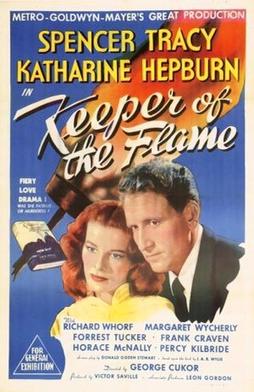
 Keeper of The Flame strikes me as good ol’ fashioned Hollywood storytelling. It’s conveyed through a fatal opening car crash and a flashing montage of newspapers spelling the death of that great American institution, Robert Forrest. We’re hooked immediately as the story keeps on rolling.
The world itself in the formerly sleepy town has the definitive consciousness of Home Front America, full of interiors and then exterior-looking interiors, all on the studio lot. Moreover, there’s a frantic industry and a general chaos in the face of shortages, bringing out American know-how and good humor in the face of everyday adversity.
Namely, a bevy of journalists and well-wishers descending on the place not fit to handle such an overflow, especially during wartime. A harried Donald Meek monitors the telephone line and does his best to get the flood of people in front of him booked in any vacant rooms still available.
Steven O’Malley (Spencer Tracy) wanders in unannounced and mostly unseen. He pays respects to an old friend who barely recognizes him. It’s the eyes. He gives Janey (Audrey Christie) that quiet congenial Spencer Tracy look, and she asks quizzically if it hurt much when Hitler gave him the boot.
We glean he must have been a war correspondent, either based in a concentration camp or the Berlin press bureau. Their jokes are casual. You know they must do this in their line of work and in 1942, we can hazard a guess they don’t know the full extent of what they’re saying.
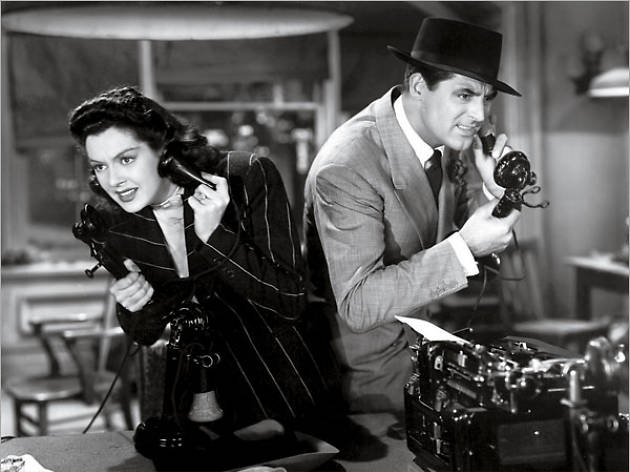
Christie has the whip smart repartee of a journalistic working woman a la Rosalind Russell. Since the house is packed, she coyly registers him as her “husband,” though there’s another colleague up for her affections (a young Stephen McNally).
O’Malley has an aspiration to get into the grieving Mrs. Forrest so he might share her husband’s story with the people. Riffing off of It Happened One Night, his pals quip that she’s the Queen of Jericho and he’s no Joshua. The walls of her castle won’t come down for just anybody. Though Tracy always had a certain dogged tenacity about him, and that’s what makes him a compelling, active hero.
Algonquin Round Table alum Donald Ogden Stewart builds out his screenplay in the opening act with all these intriguing nooks and crannies and characters who seem capable of existing of their own accord with intricate backstories.
Howard Da Silva is a guarded vet of the Argonne and de facto groundskeeper of the Forrest estate. A little boy (Darryl Hickman) grieving the wake of this great man from a lamppost; we learn he too has an intimate connection to the deceased.
There’s another relation to Mrs. Forrest who’s equally distrustful of the press and drinks his sorrows away with ginger ale. The dead man’s bespectacled press secretary (Richard Whorf) chooses a different approach: He’s highly elegiac and accommodating because his job requires levels of PR, though there’s plenty he’s not letting on about.
Beyond Christie, a personal favorite is the peculiar old cabbie (Percy Kilbride), laconic and chewing his cud while offering up homespun wisdom. He provides O’Malley transportation to and fro as the journalist pokes around for his story.
We know from a fair distance Keeper of The Flame is a kind of grade-A American propaganda piece, and it finally becomes most explicit when Tracy gives a little soft-spoken speech to Daryll Hickman about not letting the unseen enemy make them slaves and kick them around by putting chains on their minds and tongues.
In its defense, it’s mostly soft-pedaled moralizing because Tracy’s soapbox is small and he has a way of making the serum of slightly hokey words tolerable thanks to his usual candor.
However, the local doctor (Frank Craven) provides one of the most telling remarks after paying a house call to the imposing estate: “Ever since we’ve been falling out of touch with God, we’ve become pushovers for hero fever.” When he speaks of a young woman who was sent away, he surmises, “You don’t fall in love with a god, you just worship him.” He’s a sympathetic fellow and in making his opinion of Forrest quite clear, it’s one of the first dubious signs we have to go on.
These ideas are thematically rich with potential, not to mention controversy. The movie becomes less so with the tinges of forested and thunderous gothic melodrama. Coincidentally, it’s not material I would immediately attribute to George Cukor although the 1940s were replete with such fare.
And it’s true there is a vague Citizen Kane-like bend to the story of a prominent man now dead. Although I also think of Welles’s other great figurehead Harry Lime for casting a shadow over the film, which is not too dissimilar to Hitchcock’s Rebecca, albeit gender swapped. These are mostly uncharitable comparisons and few can argue the point.
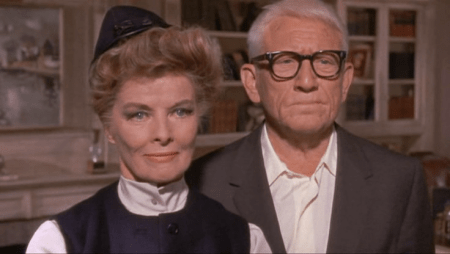
Katharine Hepburn might seem uncharacteristic in something so grim and restrained, but she proves her capacity for it. While I always am skeptical of her as a shy wallflower in a picture like Undercurrent, she handles this tormented role with a certain inscrutability. Although I don’t know if even she can manage keeping the story from getting out of hand.
There’s something in it on the tip of my tongue tying into almost John Fordesque mythmaking, whether it be Fort Apache or The Man Who Shot Liberty Valance. Sometimes you print the legend to protect people because the truth is too destructive to reveal. Except Tracy isn’t squeamish about giving the electorate a sober reality check.
In this regard, it feels like a daring sort of picture and you wonder if this was the saving grace, making it a draw for audiences beyond the conspicuous nature of the romance and brooding genre elements.
Still, the initial propaganda moments burn off only to come back like a raging conflagration. Hepburn brings them back again and she drops them right in our laps when she mentions fascism as embodied by her late husband. In one sense, it’s an impressive rallying cry and also an utter disappointment given the film’s best parts.
The finale of literal fire and water is all things histrionic and ham-fisted. Hardly the film’s finest achievement. All of this comes with a convenient ending, but I suppose in wartime you give the people what they want — assuming this was it.
Even with the underlying sentiment, Keeper of The Flame still has its moments that feel downright groundbreaking, and better yet, the wit of the supporting characters lives on in the mind’s eye. Alas, this was not meant to be.
Most of all, I regretted characters like Audrey Christie and Percy Kilbride fading away without consideration; I suppose they were sacrificed on the altar of a greater cause. I understand the sentiment and still, it feels like a waste of a stellar set-up for such conventional ends — even if it was for the sake of galvanizing wartime propaganda.
Perhaps this is all the more reason to want more out of the film. This is a good impulse because it means there are more than a few things worthy of praise.
I’ve only one final thought. In many ways the movie presages what Jacqueline Kennedy chose to do in the wake of her husband’s tragic death. More than once in the movie, an allusion is made to Abraham Lincoln, and Jackie made sure her husband had a funeral evoking that of the nation’s first slain president.
Then, at his final resting place in Arlington Cemetery, there burns an eternal flame. She was the keeper of that flame — solidifying his stature for generations of Americans. I won’t get into conjecture about her husband’s legacy, but it does play as an intriguing counterpoint to this film’s central figure.
3.5/5 Stars








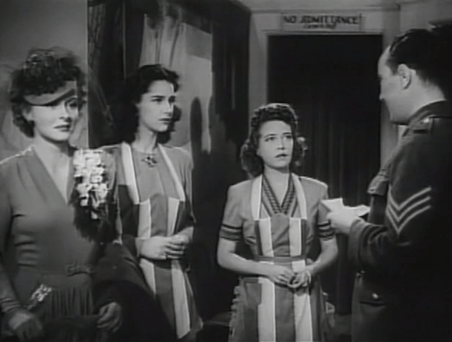
 There are also strategic vignettes sprinkled throughout to boost morale and the camaraderie between allies. A few Brits can be heard taking part in the gaiety and making friends with our protagonists. A table of Hispanic soldiers takes in a floor show. One of our hostesses gets a moving letter from her older brother in the marines who is bent on returning to his family and proving that his training can outlast any “Jap” out there. There’s a last-minute marriage ceremony that we are privy to. Sam Jaffe introduces the audience to a few Russian allies, an Australian soldier has just returned from the front, and several Chinese air cadets get a rousing appreciation. Merle Oberon (the only actress close to being Asian in the film) gives them a stirring sendoff. Finally,
  4 Star Films