Vincente Minnelli Films (1958-62)

Gigi (1958)

Lerner & Loewe’s adaptation of Colette’s Gigi is a picture accentuating the France of Hollywood’s most opulent dreams and confections frequented by the consummate French people of the movies: Maurice Chevalier, Leslie Caron, and Louis Jordan.

Whether it’s Ernst Lubitsch or Billy Wilder or Vicente Minnelli, Chevalier doesn’t change much. He’s convivial with the audience existing just on the other side of the camera. He gives off his usual cheeky, harmless charm that doesn’t always play the best seeing as his first tune is about the litters of girls who will grow up to be married and unmarried young women in the future.

Gigi (Caron) is one of their ilk, a carefree gamine who lives under the auspices of her Grandmama’s house, a startling domicile touched by Minnelli’s charmed palette of deep red.

In some manner, Gigi seems to represent the worst of Minnelli. Yes, it was wildly popular in its day, but all of its manicured embellishment and immaculate set dressings feel mostly fatuous and merely for their own sake. While one can easily appreciate the pure spectacle of the thing, the director’s best pictures show a deep affection for characters.

Here all manner of songs and tête-à-têtes are cheery and bright, while never amounting to something more substantive. It’s easy to suggest the movie revels in its own frivolity. Gaston (Jordan) is a ridiculously wealthy young man and Eva Gabor is his companion, though the gossips get ahold of them. They’re not in love.

Another primary reservation with the picture is how Leslie Caron is summarily stripped of most of her powers. At times, dubbing feels like an accepted evil of these studio-era musicals or a stylistic choice of European maestros. However, in Caron’s case, not only is she not allowed to sing, she can’t talk for herself either (dubbed by the cutesy Betty Wand). I might be missing something, but this seems like a grave misfortune.

You can add to this fact the further grievance she never really has a traditional dance routine, and there’s nothing that can be appreciated about the picture in comparison to the crowning achievements of An American in Paris. All that’s left is to admire is her posture and how she traipses across the canvasses Minnelli has devised for the picture. This alone is hers to control, and she just about makes it enough.

My favorite scene was relatively simple. Gigi and Gaston are at the table playing cards, and they exude a free-and-easy camaraderie. If it’s love, then it’s more like brother and sister or fast friends who like to tease one another. It isn’t yet treacly with romance. Instead, they break out into a rousing rendition of “The Night They Invented Champagne,” which distills its point through an exuberant melody.

The lingering power of the film is how it does its work and grows on me over time. It considers this not totally original idea of trying to become who you are not in order to please others. Gigi must learn the breeding and the etiquette, acquire the clothes, and in short, turn herself inside out in order to fit into rarefied society.

Gaston doesn’t want her to be like that, attempting to replace all the elements of her character that make her who she is. This is what he likes about her. If it never turns to eros, then at the very least, it’s shared affection. Caron and Jordan make their auspicious entrance at Maxim’s and, it feels like a precursor to Audrey Hepburn’s introduction in My Fair Lady. It’s not a bad comparison since most of the film is filtered through speak-singing.

Does it have a happy ending? In a word, yes, but Chevalier singing about little girls doesn’t make me any less squeamish the second go around. Thankfully, Minnelli is no less of a technical master with Gigi. Still, film was not meant to live on formalistic techniques alone.

3/5 Stars
Bells Are Ringing (1960)

The title credits are so gay and cheery with so many admirable names flashing by on the screen, it almost negates the sorry realization that this is the last go-around for the famed Arthur Freed Unit at MGM. Pick out any of the names and there’s a history.

Say Adolph Green or Betty Comden for instance; they were the architects of some of the era’s finest. Anyone for Singin’ in the Rain or The Band Wagon? The movie spells the end of the era, though there would be a few later holdouts.

Like It’s Always Fair Weather, Will Success Spoil Rock Hunter?, or Pillow Talk, Bells Are Ringing is well aware of its cultural moment, and so it reminds us about the necessity of telephone answering services. Actually, one in particular called Susanswerphone.

It’s easy to love Judy Holliday from the outset as she’s playing crazy gymnastics on the telephone lines because automation hasn’t been created yet. Originally, she was a comedienne best remembered for a squeaky voice and a ditsy brain. Bells Are Ringing, which she originated on the stage, allows us to see a different contour of her movie personality, one that might as well hewn closer to the real person.

She does her work ably only to suffer through a dinner date from hell (with her real-life boyfriend Gerry Mulligan). However, we couldn’t have a movie without a dramatic situation.

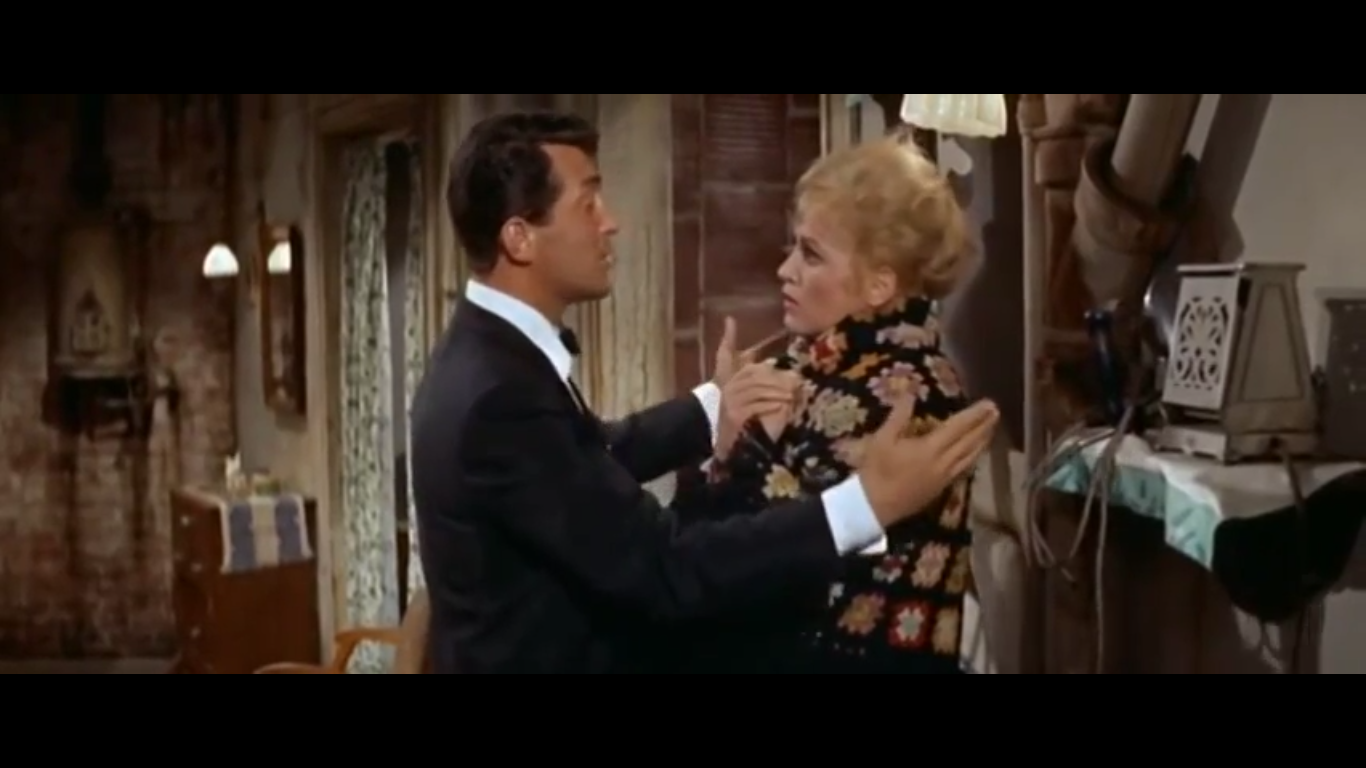
The staff are forewarned never to cross the line to “service” their clients. But she breaks the cardinal rule, overstepping the bounds of a passive telephone operator and becoming invested in the lives of those people she communicates with over the wires. Not least among them, one Jeffrey Moss (Dean Martin).

She’s just about lovesick over his voice. It’s no mistake that she puts on her lipstick before ringing him up to remind him about a pressing engagement, as if he can take in her appearance intravenously. Alexander Graham Bell never quite figured out the science behind that.

It’s not much of a mystery to us what Moss looks like. Because if you read the marquee, you know it’s Dino. But she doesn’t know that and scampers up to his room to save him. Surely there’s a Greek tragedy trapped in here somewhere. If it’s not about falling in love with a reflection or her own work of art, then it’s about the sound of a man’s voice. She wants to help him gain confidence in his own abilities as a writer.

But first please allow me one self-indulgent aside. Dean Martin had a point in unhitching himself from Jerry Lewis. Sure, Lewis had a groundbreaking career as an actor-director, but Dino was so much more than The Rat Pack and his TV program.

The string of movies he took on throughout the 50s and 60s never ceases to intrigue me. He could go from The Young Lions, Some Came Running, and Rio Bravo to pictures like Bells Are Ringing and Kiss Me Stupid. For someone with such a distinct professional image, he managed a steady array of parts.

The number “Just in Time” in the park is made by Holliday in striking red and Dino crooning through the night air. There’s a goofy brand of showmanship between them that we were lucky to see in many of the old MGM pictures. It’s their own rendition to complement Astaire and Charisse from Band Wagon showcasing Minnelli at his best and brightest as we are brought into a moment of fluid inspiration where all facets of the production look to be working on high cylinders.

At the nearby party, Holliday becomes overwhelmed by the Hollywood glamour scene, as all the folks jump out of the woodwork and start smooching as Martin descends down a spiral staircase. This only happens in the movies, and yet it’s a summation of her blatant otherness. She doesn’t fit in this crowd where everyone is on first name basis with the biggest names in the business (“Drop That Name”). It seems like their worlds are slowly drifting apart as her secret life is about to totally unravel.

However, Martin joins forces with a musical dentist and Mr. impressionist himself, Frank Gorshin, who puts on his best Brando impression as they bring the movie to a striking conclusion. The same woman has changed all their lives for the better. Now they want tot return the favor. Moral of the story, get yourself an answering service, especially one with someone who cares like Judy Holliday.

3.5/5 Stars

Two Weeks in Another Town (1962)

It might play as unwanted hyperbole, but when I look at Two Weeks in Another Town, it almost feels like a generational predecessor to Heaven’s Gate. Although Vincente Minnelli’s picture is well aware of the old hat and the emerging trends of cinema, it’s raging against the dying of the light, as it were. He subsequently bombed at the box office, and we witnessed the cinematic death knell of an era.

The director makes the transition from b&w to color well enough as you would expect nothing less from him. Kirk Douglas has what feels like a standard-issue role seething with rage thanks to a career hitting the skids. He’s bailed out of his sanitarium by a collaborator from the old days and shipped on-location to Rome.

There we get our first taste of a demonstrative Edward G. Robinson playing the tyrannical old cuss Maurice Kruger. He’s right off the set of the latest Cinecitta Studios big screen epic with George Hamilton, an Italian screen goddess, and Vito Scotti working the action.

But Two Weeks in Another Country is just as much about what is going on behind the scenes of the production. Robinson and Claire Trevor together again have a far from congenial reunion after Key Largo generations before. They’re part of Hollywood’s fading classes, though they’re far from relics.

Minnelli takes the personal nature of the material a step further. In a screening room watching The Bad and The Beautiful, the self-reflexivity has come full tilt as Douglas wrestles with his image onscreen from a decade before.

Meanwhile, Cyd Charisse makes her entrance on a jam-packed road flaunting herself in the traffic. She’s charged with playing Carlotta — Jack’s former wife — she’s bad and if her turn in Singin’ in the Rain is any indication, she’s fairly accomplished in this department. It’s almost a novelty role because she’s rarely the focus of the drama, only a sordid accent.

The pieces are there for a truly enrapturing experience as only the olden days of Hollywood can offer. I’m thinking of the days of Roman Holiday, sword and sandal epics, and La Dolce Vita. The movie is a reaction to all of them in the flourishing TV age with its glossy romance in beautiful cars, glorious rotundas, and luscious beaches.

It’s not bad per se, and yet it seems to reflect the very generational chasm it’s readily trying to comment on. George Hamilton utters the movie’s title and it’s all right there — utterly temporal and disposable in nature.

These moments and themes feel mostly empty and, again, while this might be precisely the point, it goes against our human desires. Either that or the movie is begging the audience to connect the dots. We want the critique wedded with entertainment. Because most of us are not trained to watch movies from a objective distance. Our mental wiring does not work like that especially when it comes to epics.

Jack is taken by a young starlet (Dalia Lavi) he meets by chance, thanks to her proximity to the troubled production. His and Veronica’s relationship becomes one of the focal points and one of the few deeply human connections in the picture.

Later, Jack’s bellicose benefactor, Maurice, falls ill. The added melodrama is to be expected along with raucous slap fights and the scramble to get the picture in under budget before the foreign backers try and pull out. The old has-been comes alive again — momentarily he has a purpose and companionship — until he’s besieged by new pressures.

Although it was purportedly edited down, it’s not too difficult to observe Minnelli doing his own version of Fellini’s earlier movie from 1960 with the dazed-out remnants of an orgy and a young Leslie Uggams singing her torch songs.

The apogee of the entire picture has to be Douglas and Charisse tearing through Rome in a mad fury. It’s the craziest, most chaotic car ride that can only be conceived in Hollywood; it’s so undisciplined and wrenched free of any of the constraints of realism. The back projections up to this point are totally expressionistic.

And as the car lurches and jerks around we realize we are seeing the film crossover: What we see behind the scenes and on the screen are one and the same, merely facades, and little more. It’s the kind of unbridled moment that could easily earn derisive laughter or genuine disbelief. There’s no way to eclipse the moment.

Instead, what follows is a cheery denouement out of a goofball comedy. Jack resolves to put his life back on track opting to leave behind his young leading man on the tarmac with a girl until they meet again. Hollywood, as is, was not totally dead — there was still some light in the tunnel — but if the box office receipts are any indication, tastes were changing.

3/5 Stars

Tea and Sympathy (1956): Are You Masculine?

The 1950s saw director Vincente Minnelli continually evolving from mostly musicals — a pleasing genre he never totally forsook — into a period of his career ripe with luscious Metrocolor dramas.

Movies such as Tea and Sympathy, Some Came Running, and Home from the Hill, don’t get too much coverage in broader circles, especially compared to Oscar darlings like An American in Paris or Gigi. However, in many ways, they’re equally interesting, if not more so.

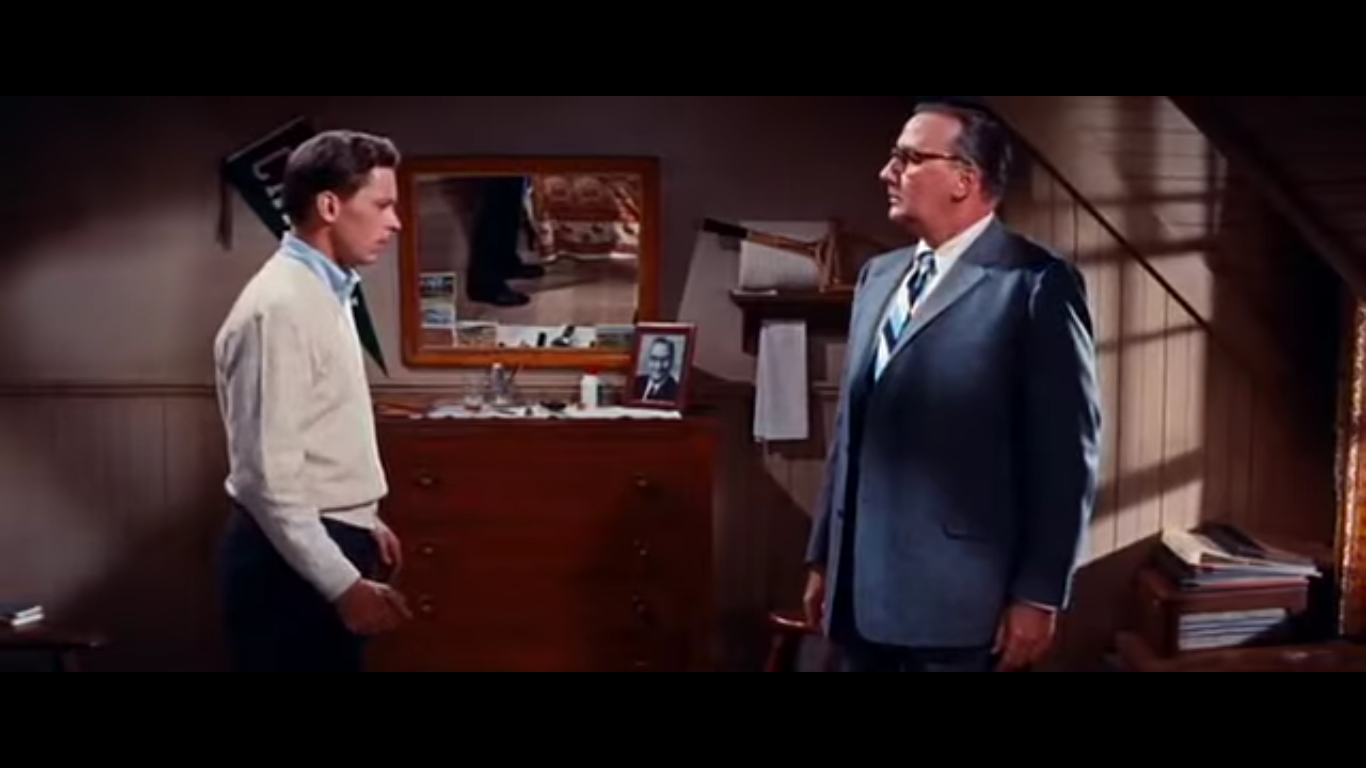
As the story opens on a  prep school green, it proves the world still had class reunions generations before and if the content was different, the people aren’t all that dissimilar. Tom (John Kerr) is someone we get to know quite well over the next two hours.

However, we are only introduced to him because Minnelli’s camera cycles to him as he traverses his former stomping grounds. While not prototypically Hollywood handsome like John Saxon or George Hamilton, Kerr is incessantly interesting and easier to project our own insecurities onto. He’s a bit severe, more awkward, but able to imply a certain sensitivity.

He ventures into his old dorm and all the memories come flooding back. Minnelli doesn’t go with a dissolve or a fade-out, but he moves his camera through the window down to the grass below as if we are entering into an entirely different world, and in a sense we are.

The space is the same but the years have gone and faded back into the past for us. Deborah Kerr works away cultivating her garden as John Kerr (no relation) eagerly looks to offer her any assistance. It’s plainly apparent he has a major crush on the teacher’s wife.

Those unfamiliar with the play might think they already have an inkling of what this picture is about, young unrequited love, adolescence blooming into adulthood. There are elements of this, but Tea and Sympathy becomes far more groundbreaking and pressing in turns.

Because Tom Robinson Lee is totally ill at ease around girls; he can’t dance, and he’s slated to wear a dress in his school’s latest stage production. Don’t try and explain to his peers what the Greeks and Japanese used to do on stage. He’s a sorry excuse for a man; that’s what he is.

It’s an equally awkward situation when he makes fast friends with the faculty wives — Mrs. Reynolds among them — and she tries to be gentle and kind to him. Because he’s really a decent boy. He gladly shares among this company that he can sew and cook showing them his skills with a needle and thread.

The jocular Mrs. Sears (Jacqueline DeWitt) jokes, “You’ll make some girl a good wife.” These are all tiny barbs of cinematic emasculation that cannot go totally unnoticed. It’s difficult for them not to have a cumulative effect.

Sure enough, he’s found out when some of the boys playing football along the beach see him, and he’s quickly in danger of being labeled. Because Tea and Sympathy is a movie totally immersed in the mores of the 1950s. These are issues of masculinity and gender roles altogether intensified by the furnace of contemporary societal pressure.

Because further down the shoreline, the boys toss around a football, roughhouse, and read off questions in an “Are You Masculine” quiz led by Mrs. Reynolds’s he-man husband (Leif Erickson). The news of Tom spreads like wildfire, and he earns his ignominious name “Sister Boy.” It’s the kind of reputation that does not die easily. His bedroom door is marked and he’s roughed up all in the testosterone-induced fun of boys both raucous and cruel.

You would think he could regain some respect out on the tennis court the following day, routing his opponent, but even this is hardly enough to burnish his reputation. It’s made more awkward by a visit from his dad, who can sense that the “regular guys” are against him. Of course, “regular” becomes code for being complicit in this debilitating sense of peer pressure ruling the school and its generational legacies.

Edward Andrews has a kind of easy southern charm both somehow outwardly genial and still riddled with so much dysfunction. He chides Tom that you’re known by the company you keep. He should get a crewcut and take part in the pajama fights which are like a rite of passage. There’s something to be said for conformity — becoming one of the boys as it were.

Still, the town has changed since he was a boy. They sit at the counter of the local watering hole as the long-suffering waitress Ellie is kidded and harassed incessantly as she tries to work the tables. His dad feels some amount of vicarious humiliation seeing how much of a social pariah his son seems to be. It makes him uneasy.

It’s a bit of a visual cheat, but it’s also one of the most effective set-ups in the movie as Mrs. Reynolds goes in to grab the drinks in the kitchen, and she hears the conversation coming quite freely through the window as the two men talk about the young men. Mr. Lee and Mr. Reynolds were mates in the old days and they aren’t above speaking plainly about him — how different he is. It’s obvious their words burden Laura’s heart; we see the empathy building over her face because the men don’t understand.

If it’s not apparent already, the whole system they are devoted to is broken to its core. For this boy sewing is his sin. In retaliation his peers take a stance. Since he’s not one of them, one of their tribe, he must become the scapegoat to reaffirm their shaky position.

Keeping in line with this, faculty wives are supposed to remain bystanders providing only a little tea and sympathy. A giant pyre is lit in the middle of the commons setting the stage for a pajama fight — something that has been passed from generation to generation.

From a cinematic standpoint, there’s this underlining tension to the event reminiscent of the Chickie Run from Rebel Without a Cause. It suggests something fated and inevitable about what they do — what they subject themselves to. Isn’t it in the earlier film where one boy says, “You‘ve gotta do something. Don’t you?” Here it’s institutionalized.

For a time, Al (Daryl Hickman) is Tom’s roommate and his only advocate. Mrs. Reynolds speaks to Al in admiration; he showcases physical vs. moral courage, and yet it’s lonely pushing against the social currents. Even his father admonishes him. He must be a nail hammered back into place — a place of conformity.

Mrs. Reynolds acknowledges to her husband that they don’t seem to touch anymore. There’s a distance between them, and it only grows darker and colder as the picture progresses. As we find out, her first husband died during The War: “In trying to prove himself a man, he died a boy.”

Tom is stricken by the same path. He vows to meet up with Ellie, the town’s tramp to prove his mettle as a misogynistic boy’s boy. Surely this is the only way he can prove himself and meet their standards — the standards of his own father. It’s not worth documenting the whole sorry affair. It’s garish, unseemly, and pitiful. Production Codes or not, Tom wants real love and affection. This isn’t it.

His father shows up again puffed up with pride for the first time in a long while. Because his boy has gone and got himself expelled for being off-campus with an undesirable woman. It’s like a badge of honor — being out of bounds — and showing off the extent of his masculinity, whether real or imagined. It doesn’t matter to Mr. Lee as long as he can imagine his boy being made in his own contorted image.

However, the picture suddenly does something remarkable. It seeks refuge resorting to its only comfort.  The scene where Laura comes upon Tom kicked back, lounging in the forest leaves the scholastic world behind altogether for the ethereal and the sublime.

It loses any semblance of ’50s hothouse and forsakes the visible emotions of Metrocolor for something intimate and serene. Laura’s final charge to the boy is plain — be kind.

I wasn’t sure what I thought about Tea and Sympathy as it dissolved back into the present. Of course, the way the film was structured, it was necessary, and yet it seemed like the import was already made evident in an embrace between two people. What more did we possibly need?

But as Tom finds the letter and reads its contents, what looks to totally ruin the movie with moralism is augmented by two aspects. Minnelli’s camera begins to move, capturing the wind rustling through the trees and floating through the open spaces giving them a sense of pensive reverie of a different kind.

Deborah Kerr’s line reading is spot on. No one else could deliver it in such a way making it bear all the warmth and truth in a manner that feels entirely genuine.

Her character reframes everything we have seen and instead of simply placating the production codes, it feels like she is delivering some sagacious bit of nuance Tom might only understand with the passage of time.

She is so important to this picture, and she blesses it with her usual poise and grace helping to fill the void in a movie lacking a great deal of goodness. She becomes its primary beacon even as she looks for goodness for herself.

Given its themes, it would be easy for the film to become a totally salacious, opportunistic bit of illicit love. But in part thanks to Kerr and Minnelli’s care, it never becomes relegated to such status. It represents something much more.

I couldn’t stop thinking about this idea of moral courage. Tea and Sympathy somehow exhibits how one goes about it. It’s not simply about being counter-cultural or going against the tides of the times or being progressive. There is such a thing as goodness, as kindness, as gentleness — fruit we can see in our lives.

It has nothing to do with signaling our virtues, how positively or negatively others will perceive us, or the identity we look to embody. My hope is that even while our society evolves, growing further enlightened, fickle, and oppressive in various turns, we might learn what it is to have unwavering moral courage.

It’s a struggle, but it’s simply the best way to love others well, providing something more than merely tea and sympathy. Because this is not a healthy formula to help assuage the world’s ills. We require something far better.

4/5 Stars

Brigadoon (1954): Cyd Charisse and Gene Kelly

I have fond memories of traipsing across the Old Course in St. Andrews and attending the Military Tattoo near the Royal Mile in Edinburgh. There’s something untamed about that landscape remaining austere and beautiful, perfectly suited for tartans, bellowing bagpipes, and the rat-ta-tat of drums. The country feels wild and free and still imbued with years of ancient history.

Brigadoon is hardly an authentic look at highland life. It was based on a Broadway play after all. They traded out the actual highlands for a studio backlot to save money. But as such, the world feels like a total Hollywood confection from Vincente Minnelli. I hardly mind just as I barely mind the California heather of National Velvet for a stand-in.

It comes down to representing a place that is more mythic than a concrete place we know firsthand. It exists in our memories and recollections. Now, this is dangerous: It can lead to a myriad of stereotypes and misconstrued truths. I’m not sure how cultural appropriation or even “whitewashing” ties into this tale, but it’s true Hollywood has borrowed from the Scotts and spun their own version.

However, the film itself couldn’t be more pleasant. Gene Kelly and Van Johnson are lost up in the fogs of the highland in the midst of their pheasant hunting expedition. Meanwhile, we get acclimated to the village of Brigadoon. There’s a charming number, “Waiting for My Dearie,” with Cyd Charisse surrounded by all the fair maidens of the town as she dances with a gal with a pot for a helmet and a mustache on her lip. They all prepare for the marriage of Fiona’s sister to a local lad.

Johnson and Kelly are soon integrated into the community through a moment of gaiety as the tune “Bonnie Jean” becomes emblematic of the merry way of life these people live where song and dance are the only conceivable way to express themselves. In this way, it seems to suit the parameters that the musical inherently provides.

However, something else happens: Tommy (Kelly) falls for Fiona (Charisse) almost at first site. What else would you expect because every character he ever played must fall hopelessly in love with the girl. This is what Fred Astaire did a generation before them.

He’s pleased to find it is the younger Campbell lass who is getting married and not the elder. “The Heather on The Hill” feels like the lynchpin number. We saw something similar in “Dancing in The Dark” with Astaire playing opposite Charisse in The Band Wagon. Because this is the moment where all other distractions momentarily subside, and we are able to distill this movie down to its core relationship. What other emotion could dance hope to convey but the rapturous, ineffable palpations of romantic joy.

It’s enchanting to watch their forms move so fluidly through the space where they become an extension of the world around them. Where a limb of a tree or a basket is part of their movements and the dance that they are undertaking together. It says all the things they feel for one another not in word but in deed and action, and it feels all the more evocative for this very reason.

It occurs to me that dance often comes in two distinct forms: there’s the utterly communal and then the strikingly intimate. They bring people together, reflect their woes, and put a voice to their romantic elation. Sometimes they’re even comic. Johnson more than provides his share of sardonic wisecracks, and he’s quite good in the role.

However, my main qualm with the picture is in the story department. Now the film is based on a stage production, and that’s where the initial weakness lies. Because this is yet another tale of transcendent love. We learn something telling about Brigadoon midway through the movie, which would have been helpful for setting the stakes early on.

It’s hardly an “I See Dead People” revelation, but it tries to give some context to why these folks live so isolated from mankind — all but forgotten — and so Fiona takes them to the village schoolmaster to tell the tale. Salient or not, the movie slows down to explain itself and thus loses some of its luster in the process. They don’t even try and use song and dance to save it from the horrors of over-exposition.

Likewise, the ending feels all crammed together and while we have the tent pole moments one might expect from a Golden-era MGM musical, the narrative cohesion simply is not simpatico. The two travelers leave Brigadoon behind for the urban hysteria back in New York. The juxtaposition is obvious and Tommy’s having none of it; he vows to return to the one place he’s ever truly been happy.

It’s dubious that a wise guide in one moment can explain the mysterious nature of Brigadoon, and then still later can announce with a grin how grand romance can supersede all manner of hindrances between two lovers. It’s like the most convenient cop-out explanation — the path of least resistance.

There’s the expected reunion. It’s what the story is meant to build up to — there’s this sense of appreciation, after all, Gene and Cyd are back together as they should be. But something else nags at us. It feels hollow because the story doesn’t gel — it doesn’t feel earned — and we wanted this reunification more than anything. It’s a shame because otherwise I’m a big fan of what Brigadoon represents and no matter its flaws, it still remains an underrated musical.

I’m not surprised Charisse voiced it as her favorite picture with Gene Kelly. Their scene together in Singin in Rain is a provocative showstopper, and It’s Always Fair Weather blooms with a melancholy and timeliness in the television age. In Brigadoon, you could easily argue they share some of their finest individual moments together regardless of your verdict of the overall film.

3.5/5 Stars

Cabin in The Sky (1943), Georgia Brown, and Lucifer Jr.

Like Stormy Weather, it’s a slightly unnerving form of mimesis as Cabin in The Sky sets about depicting the lifestyle of Blacks. There’s not a white folk to be seen, and yet there’s no doubt they have been integral in developing this musical fantasy out of a Faustian-like folk tale.

It’s telling that two of the only other mainstream films with prominent onscreen representation of Blacks were the religiously-tinged musicals Hallelujah and Green Pastures. Whether real or imagined, there was this perceived sense that Blacks were only identified with these limiting salient features. This was their only utility onscreen and thus, Hollywood kept on representing them in a narrowly defined manner.

It’s not like this is simply a modern observation with renewed enlightenment of the 21st century. First-time director Vincente Minnelli noted it too in a later interview, “If there were any reservations about the film, they revolved around the story, which reinforced the naive, childlike stereotype of blacks…If I was going to make a picture about such people, I would approach it with great affection rather than condescension.”

The eponymous Cabin in the Sky number is a perfect example of how Minnelli subtly develops the cinematic space, in this case expanding the intimate moment of his leads into a much broader chorus of singers. At least pictorially, the director seems to have his performers’ interests in mind.

In the opening moments, a booming minster calls upon two of his local parishioners: the devout housewife Petunia (Ethel Waters) and her backsliding husband Little Joe (Eddie Anderson), a hapless man prone to worldly vices like gambling. He wrestles with the devil on the daily while his bright-eyed wife prays ardently for the Lord to look with disfavor on his gambling and sure enough, he never wins a plugged nickel.

Be it box office repeatability or plain ignorance, there is no contest. Blacks had very few outlets in movies. But the talents are undeniable. It’s intriguing to think that while Jack Benny was performing in a Nazi satire like To Be or Not to Be, Rochester was finally getting out of his shadow, albeit playing a role that pretty much stayed true to his usual characterization. In both cases, it might be difficult to teach old actors new tricks, harder still is getting an audience to accept them as such.

In its day, the NAACP lauded the film. Most of the performances have a jaunty affability; it’s not about a lot of bells and whistles, the wall of orchestral sound notwithstanding, but it’s an agreeable diversion. One cannot help but see Ethel Waters as emblematic of the film: all smiles while she belts out “Taking a Chance on Love.” She brims with pious candor even as the actress looked to punch up her rather thankless role and give it more substance (and religious morality).

Somewhere between Hellzapoppin’ and Stormy Weather, we have a Faustian struggle done up with the musical trimmings and the stereotypical religious leanings of the time. The film can be considered using the same paradigms as a film like Here Comes Mr. Jordan or even A Matter of Life and Death, in this case, exemplified by a chorus of Black angels and Black demons doing a bit of spiritual jousting.

Little Joe is a simple fellow. His only aspiration, when he’s not lounging in a hammock, is to become a hotel elevator operator much to his wife’s delight (The picture makes a constant punchline out of his illiteracy).

At his wife’s behest he’s busy with the process of “getting saved,” and he has an appointment with repentance, but some of his gambling partners show up on the steps of the church ready to collect their outstanding debts.

God’s General and Lucifer Jr. (Rex Ingram in a particularly gleeful performance) use Little Joe as a spiritual battleground. I’ve known it for some time but haven’t had a reason to acknowledge Rex Ingram of late. It’s a pleasure watching him because he seems in on the joke more than he is a victim of the scenario like so many Black performers.

His Idea Men in Hotel Hades include none other than Louis Armstrong and two of the most troubling figures in 20th-century representation of African-Americans: the googly-eyed Mantan Moreland and bubble-headed Willie Best. They deserve more care and nuance than I can provide, so for the time being I’ll defer to others.

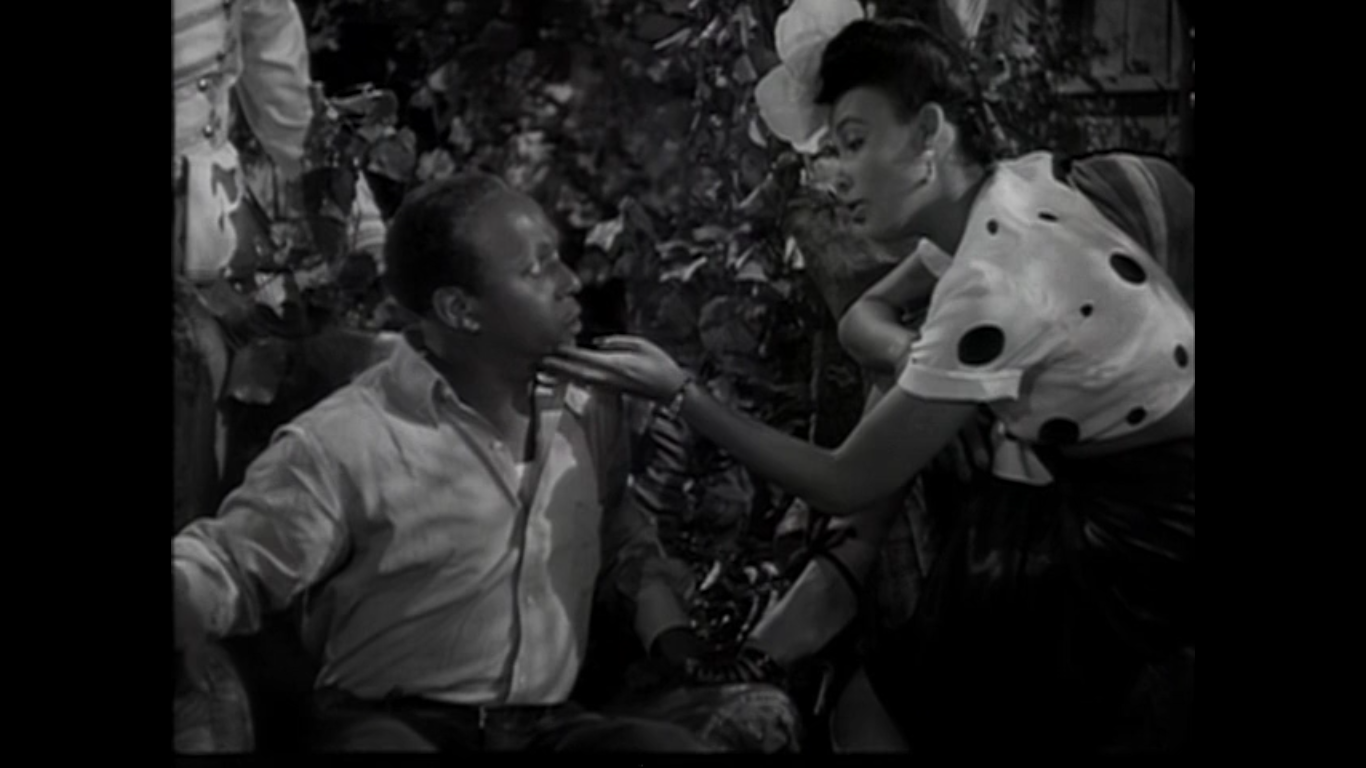
While there scenes in the hellacious office are talky and promote more dubious theology, they spin a couple of webs to entangle Little Joe. First, there’s sweet Georgia Brown. Lena Horne dons her best perfume and polka dots to knock his socks off.

She’s introduced with a sultry jazz motif, moseying along as Ingram plays the serpent kicked back on her bed, whispering little intimations into her ear as if by chance. Horne positively melts the celluloid as she coaxes Rochester toward the path of vice in “Life is Full of Consequence.” It becomes a marvelous dueling duet between the two performers forming one of the core conflicts of the film as Little Joe yowls, “I’ve been burnt more than twice.”

It hardly matters that a bubble bath scene deemed too racy for the era was totally excised. Horne leaves her mark, and it’s a memorable role. However, she deserved better in her career going forward.

Lucifer Jr. is surprised by the human’s steadfast fidelity to his wife and so Louis Armstrong dreams up a new scheme (“Give a man money. Watch him act funny”). An Irish Sweepstakes engenders consequences and misunderstood intentions of its own. It seems secular society has won out as represented by the blasphemous (and ridiculously fun-looking) halls of Jim Henry’s. It’s a hangout full of exuberant snapping, swinging, and Duke Ellington himself.

The overwhelming, overflowing of the moment is a joy to be a part of highlighted by the dapper dancing extraordinaire John Bubbles (John William Sublett). In his hat and cane tap dancing ensemble, ostensibly, it’s hard not to see echoes of Fred Astaire and in truth, in the early days the famed white hoofer was taught and no doubt patterned his style after his Black contemporary.

When Bubbles and Horne get these glorious close-ups to sum up a couple of their numbers, it feels deserved like a resounding show of recognition of careers that were never going to garner the plaudits of their white counterparts.

While not everyone will likely appreciate jazz being equated with worldly debauchery, it serves as a convenient metaphor. In contrast, religion seems regressive and prudish, anti-fun, with a God who is a cosmic killjoy.

The musical’s catastrophic ending is some humdinger. It doesn’t seem like typical Minnelli until we’re met with the aftermath, and we see how wonderfully conceived this smoke-filled, jagged-edge pile of rumble is as a newfound visual labyrinth.

Again, it’s not to be taken too seriously, but Little Joe’s life is reflected as a mission to balance the books in order to get through the pearly gates. After all, the heavenly ledger must be rectified. It’s mostly Hollywood hokum.

Instead, I feel compelled to end with something that moves me. Rock and Roll pioneer Sister Rosetta Tharpe sang the gospel spiritual “Journey to The Sky,” which conjures up a similar metaphor and begins like so:

There’s only one thing that I long for
When I reach that heavenly land
To see my Jesus in His glory
As I go from land to land
There’s only one thing that I long for
When I reach that heavenly land
And I know, I know we shall see Him
In that sweet, oh My Lord, peaceful rest

3.5/5 Stars

Freaks (1932): We’re All Sideshow Attractions

One of the personal details of Tod Browning’s life was his adolescence spent working in the circus. This gives him an accessibility to the material that some other less-attuned director might have lacked. And yet there’s little denying Freaks is a genuine showpiece when it comes to turning heads. It still bristles with controversy and outlandishness 90 years later.

The movie itself is presented as such to the audience. If you are familiar with any of these carnival entries from Browning’s own The Unknown or later works like Nightmare Alley or The Greatest Show on Earth, you have an immediate comprehension of the milieu.

The people we are about to witness are presented as “living, breathing monstrosities” and “accidents of birth” to the audience. If not outright reviled, they should be reeled at with horror and maybe a dash of pity. These opening moments make it evident the whole movie is quite literally a sideshow exhibition.

But somehow as the movie builds, it both feels exploitative and strangely sympathetic. This seemingly conflicting observation deserves to be broken down. And for this, we must start with the characters and their world.

One of them is the gorgeous trapeze artist, Cleopatra (Olga Baclanova), who is obviously aware of her own attractiveness and uses it to woo those around her. Because perceived ugliness or otherness has a habit of making the vein feel that they themselves are even more superior. Never once does she have a genuine ounce of care for the other performers. They are more like playthings than real people.

Front and center is the dwarf Hans (Harry Earles). Although he already has a girl, he becomes increasingly smitten with the gorgeous blonde and she gladly strokes his ego — fawning over him — she thinks she’s giving him the thrill of his life. When she finds out he’s come into a decent sum of money, that’s even better, and one day they are wed. The fact she is colluding with the local strong man remains to be brought to light.

But this is only one facet — one individual storyline in the world — since Freaks intersperses a lot of narratives throughout highlighting numerous real-life people who existed as sideshow attractions.

A single line of dialogue that might resonate with others goes like this, “God looks after all his children.” The implication is that there are no exceptions or omissions. These people are ostracized simply for the way they look or act, and while they might be different than the norms of their contemporary society, it in no way makes them sub-human. They are worthy and deserving of the same human dignity as everyone else.

Even as Freaks has been hailed as a horror film of the macabre — and there is some truth in this given the way Browning presents the material — he also normalizes the experience of these outcasts. Mind you, this is back in the 1930s. People were more than prepared to gawk at conjoined twins, bearded ladies, a human caterpillar, etc. But we’re not totally enlightened people now by any means. I admit my own shortcomings; some of these characters unnerve me but that is only based on outward appearance. We supposedly learn this in childhood, but how wrong it is to judge people by outward appearance alone.

We need to know their character before we dare to make such rash judgments. In many ways, while Leila Hyams and Wallace Ford are “normal” able-bodied folks, they are also allies and open our own eyes to these characters.

The production was turbulent with footage being heavily cut and talents like Victor McLaglen and Myrna Loy balking at the material. We cannot fully know their reasoning, whether it involved subject matter, money, or costars. Hopefully, we have the opportunity to appreciate Freaks more now because whatever the underlying reasons, Hollywood gave performers on the fringes the spotlight.

As we sink deeper into the bowels of the movie, we are privy to a wedding feast. All the outcasts sitting there, and Hans feels so ashamed as his new wife berates him and his “deformed” friends. It’s so pernicious and ghoulish all at the same time.

My mind could only drift off to what a wedding feast is meant to be. It’s a celebration, it’s a community, it’s a reminder of all the blessings we have been afforded in our lives; it points to a hopeful future of what is yet to come, and it is a capstone of mutual commitment. It’s open to all and everyone who is willing to accept it and be made new. Alas, we live in a broken, befouled world.

Given its shared setting and tortured themes, Freaks plays as a fine companion piece with Browning’s earlier silent feature The Unknown. In fact, it features a finale, equally evocative and terrifying, if not more so. Because a plot to kill Hans is enacted, but he catches wind of it, and they strike in the dead of night as their carnival show moves on amid a downpour.

In some alternative universe, this might be some misshapen, ill-formed hell as Cleopatra is chased off into the darkness by the “Freaks,” who take vengeance upon her. In a moment of self-reflection, the horror is not so much about our own ugliness; maybe it’s more so about how we belittle and dismiss other people. Are we also deserving of such a grisly fate?

Tarred and feathered and paraded in front of everyone as a sideshow attraction to stew in our ignominy for a lifetime. It’s a hellacious image but also a striking warning call. Judge lest you be judged. But enough with the moralizing. If you let it, Freaks still has the power to shock your sensibilities.

4/5 Stars

Blackboard Jungle (1955)

Billy Haley and The Comet’s “Rock Around The Clock” is often touted as the first rock n’ roll tune. I won’t get sucked into that discussion for the time being, but whatever we want to call it, there’s this sense of youth culture — teenagers as a demographic — coming into bloom.

Future generations would harness the music of the contemporaneous adolescent culture to greater effect. In Richard Brook’s Blackboard Jungle, it feels a bit more one-note and generally unattached to the marketing and main message of the picture. They haven’t quite harnessed its power. Because like the gangster pictures of old — or even The Wild One and Rebel Without a Cause — this is meant to be another cautionary tale about delinquent youth. In its day, it was no doubt considered dangerous and indecent.

There’s some of that, but an honest assessment would acknowledge how tame most of it feels now. It’s the 50s take on the teenager problem through the eyes of a Hollywood still neutered by the production codes. However, that’s not to say there is nothing to be relished about the movie or gleaned from the depiction of cultural anxieties.

I’ll let you be the judge of whether or not Glenn Ford does an adequate job at playing a teacher. It’s certainly not a western and although there are tinges of an urban jungle, it’s not quite your prototypical city noir. To his credit, in spite of his usual intensity, his scenes with Anne Francis, in particular, do reveal a certain sensitivity. He uses his brawn on a number of occasions; he has a foot in that world, and yet there’s some sense he is a gentleman and an aspiring family man.

Still, his life as a new recruit to North Manual Trades High School feels a bit like baptism by fire. Despite its gruff and no-nonsense administrators as represented by such ready veterans as John Hoyt and Emile Meyer, there’s no question the all-boys, multiethnic melting pot of a school has a major discipline problem.

One wry teacher who’s been around the block calls it the “garbage can” of the education system. And he’s resigned himself to taking out the trash. Nothing more. As such, in preparation for the first day of school, there’s an uneasiness in the air. Even as Mr. Dadier (Ford) desires to reach his class, there’s a sense that battle lines are being drawn up: you have students on one side and teachers forming a rear guard. One new recruit, a bookish Richard Kiley comments, it’s like being back on the beach at Salerno doing the war. In other words, this mission is not for the faint of heart.

The world and the atmosphere around the school evoke so much. One of the primary pleasures of the picture comes with actually familiarizing ourselves with this rank and file replete with familiar faces like the Louis Calherns, Kileys, and even an odd Richard Deacon or Jamie Farr here or there. We can only experience the power dynamics and the underlying conflict thanks to the range of characters.

I have very little practical hands-on knowledge about New York geography, but there is this sense that the high school featured here could exist not too far away from the courtroom in 12 Angry Men. If the morality on what to do with punks and malcontents doesn’t entirely overlap, then the visual landscape feels like a shared space.

But enough delaying tactics. We must acknowledge the emblematic youth at the heart of Blackboard Jungle. Gregory Miller (Sidney Poitier) is cool and disaffected. Dadier ushers him out of the washroom during a mid-period smoke break. He’s made his stance toward education plain. Though he’s a more complex case than his opening introduction might suggest. Most people are.

Artie (Vic Morrow) thrives as the gang’s primary leader, at least in the fact he’s good for a derisive comment and stirring up his cronies in rebellion against the establishment. Boys like Miller’s have intelligence and some semblance of passion.  Artie’s got nothing of the sort. He has a future career of hoodlumism all sketched out.

It’s not a radical hypothesis, but watching Sidney Poitier here, it’s easy to surmise that if he had been white, he would have been lauded as a cult icon on par with Brando or Dean. However, to his credit, he takes the part in a direction commensurate with his specific talents. While Morrow at times feels like the typical street thug, Poitier eschews many of these conventions over time.

Considering the opening preamble and where the movie goes, it’s intriguing to consider the implications. It does preach a message of racial tolerance — that certain people aren’t too far gone and teens are humans too — but there does seem to be an easy fix. You have to pin the blame on the black sheep. They are the ones souring everything. It has nothing to do with skin color, but perhaps the pains, the fears, and the psychological duress of youth.

One of the most powerfully symbolic moments is not any fistfight or savage skirmish. It happens in a classroom where the boys, urged by Artie, bust a teacher’s collection of jazz records. Kiley’s reaction is hardly devastation. He’s more so shellshocked and resigned to bewilderment. What would come over them to do such a reckless thing? They get no utility out of it. It’s merely an act of spite, a way to wreak havoc and target other people so they become inured to it.

Creativity or beauty of any kind, anything that doesn’t conform to teenage masculinity, even flaunted sexuality gets quelled and totally crushed into the ground. There need not be a better summation. Otherwise, there are few revelations in the movie and the finale is tense if not altogether authentic, brimming perilously with self-serving melodrama.

In this facet alone, it seems time has not been kind to The Blackboard Jungle. At the very least, it’s because a myriad of similarly-minded movies were built out of its image — on its shoulders even. If you’ve seen Stand and Deliver or even Poitier’s later success, To Sir, With Love, it makes the work here feel outmoded, if not altogether negligible.

However, after everything else burns off, there’s a particular appreciation for Poitier. If Morrow deservedly filled the space of a punk antihero, then Poitier derives a nuance out of his role that seems unprecedented, and he would keep on presenting such seismic and extraordinary performances to the American screen. Even in his relative youth, I’m always in awe of his intuitive stage presence.

Far from simply offering a convenient context for the movie and its student-teacher factions, Ford’s character reaches out to Poitier because he is the leader that others follow. In 1950s America this seems like an almost startling statement. Here is a black man being acknowledged as capable of leading the masses. But when you watch Poitier, it doesn’t seem implausible by any means because he plays it so assuredly.

Thus, Blackboard Jungle might as well remain as a time capsule of 1950s sensibilities, beatnik-era slang, burgeoning rock n’ roll culture, and most importantly of all, a showcase for one of the movie industry’s incomparable talents. Yes, I’m talking about Jameel Farrah.

3.5/5 Stars

The Shop Around The Corner (1940): A Christmas Love Story

The_Shop_Around_the_Corner_trailer

The Shop Around The Corner samples a Hollywood-style Hungary that nevertheless establishes it as a much humbler, quieter picture than seasoned Lubitsch aficionados might be accustomed to. It’s subsequently one of his best efforts for this very reason. There’s an intimacy to it, recalling his own upbringing working in his father’s tailor shop based out of Berlin, during his youth.

Initially, it feels like curious casting — James Stewart playing a Hungarian is absurd and he makes no attempt at an accent — and yet Lubitsch had the foresight to understand his appeal. He lacks all the suavity and urbanity normally associated with the director’s creations. In fact, for an American audience beginning to grow used to Stewart’s own steadily rising star, they connected with his disposition since it was very much the antithesis of stereotypical Hollywood or the highbrow of 1930s Lubitsch pictures. But it is the tone that matters most.

Because, again, this is not Hungary in the flesh — it is out of the mind of Lubitsch, a creation of nostalgia, warmth, and sentimentality — and on its streets, Stewart is more than at home. He fits the spirit of what The Shop Around The Corner cordially represents.

It is not a place right in front of us but just out of reach in the near-beyond of our memories and our imaginations. It represents our hopes and high ideals, even the sentiments of hope wrapped up in the Christmas season. Stewart as a figure — a token — is somehow able to stand in for so many things.

But there is more to it. Stewart delivers something a bit more substantial than his “aww shucks” persona, which was continually teased out leading up to the days of Mr. Smtih Goes to Washington. There’s also a stern assertiveness present, ready to come out; it just needs a spark, some point of instigation.

Enter Margaret Sullavan, his perfect counterpart and sparring partner. Her breathy delivery is quiet and understated, while still somehow implying this spunky resilience residing inside her character. This is what Sullivan brings to the part herself, earning a reputation as a demanding and “difficult” performer who sent shivers down the spines of major studio magnates, knowing full-well what she wanted. As a result, she found initial success though she’s mostly forgotten today.

Accordingly, her Klara Novak turns out to be a crackerjack saleswoman, at first pleading for a job, then proving Mr. Kralik’s rebuttals wrong by turning right around and earning employment. This sets the stage for their prevailing antagonism from which a love story must bloom. 

But that comes a bit later. The movie opens with all the staff of Matuschek and Co. congregating outside before the workday commences waiting for the front door to be opened by their employer.

Frank Morgan is Mr. Mathuchek, a blustering and a demanding fellow who can never quite make up his mind about the shop’s inventory. For that, he trusts his most faithful and pragmatic right-hand man Kralik (James Stewart), who has been the company’s longest-serving employee. If there are any decisions to be made, he’s the man to make them.

Felix Bressart is a fine family man and friend who always has a habit of fleeing the scene when the boss is requesting personal opinions. What he provides is quiet stability and an encouraging ear to Kralik.

Among the other current employees is the brownnoser with fine threads Vadas and the precocious errand boy Pepi (William Tracy) who does everything in his power to get ahead. With their communal workspace, a number of things come to pass. The relationship between Kralik and Ms. Novak continues turbulently as she manages to sell one of their useless purchases to an unsuspecting customer — a cigarette box that plays “Ochi Chernye.”

Simultaneously, Mr. Kralik is maintaining letter correspondence with an unknown paramour who engages his intellect on ideas of art, culture, and literature. One is reminded how The Shop Around The Corner extrapolates the axiom of not judging a book by its cover. Closely related is the fallacy of getting caught up in books such that you fail to see and comprehend the reality playing out right in front of your nose.

You read Anna Karenina, Madame Bovary, Dostoevsky, only to realize the people living and breathing right beside you are not only more than what’s meets the eye — they are simultaneously writing their own stories. We can’t always mold them to fit the narratives we know. Both Ms. Novak and Mr. Kralik seem to know these issues intimately without realizing it.

Because this is a Lubitsch picture, irony comes into play quite early; although it’s difficult to know if Stewart or the audience come up with the answers first. Maybe it hits us at the same time. If you don’t already know what it is, I’m not licensed to say. Allow it to happen to you.

Meanwhile, for some unseen reason, Mr. Matuschek grows cold and distant — going so far as relieving Kralik of his post in an uncharacteristic move. It’s the film at one of its lowest points. This was the fountain of all Kralik’s joy until he is so unceremoniously plucked from his position. Because we realize this job is his life, these people his extended family. Even Ms. Novak feels sorry that they must say goodbye, though patching things together might be altogether too little too late.

Sampson Raphaelson’s story kindly reconciles this conflict as Kralik and Mr. Mathuschak smooth out the situation. What still remains is the meeting with his mysterious correspondent. The Christmas season is upon the shop, and they work tirelessly to have the biggest sales in Christmas Eve history. They succeed. It’s punctuated by holiday bonuses for everyone, a soft powdering of snow, and genial celebrations all around — even for lonely Mr. Matchuchek.

This could be the end, but of course, we cannot forget the main reason Lubitsch has cast his eye on this inauspicious shop. Among many other things, it’s to unpack themes of love. The lights are low in the backroom, and Kralik is trying to get the words out, playing up the piece of jewelry he bought for his unseen beau.

Ms. Novak tries to accept her own fate with fortitude as her former rival tramples over her dreams with a reality check. Their words meet midsentence as she recites the recitations from her own dream suitor:

“True love is to be two, and yet one.”

“A man and a woman blended as angels.”Heaven itself.” That’s Victor Hugo. He stole that.”

“I thought I was the inspiration for all those beautiful thoughts. Now I find he was just copying words out of a book. He probably didn’t mean a single one of them.”

“I’m sorry you feel this way about it.”

She’s been led to believe he’s a balding, chubby fellow playing at a great romantic. As it turns out, he’s lanky and bowlegged, but not without his charms; he meant every single word. He says to her, “Take your key and open the post office box and take me out of my envelope and kiss me.” His proclamation of love stops her cold as the recognition comes over her face. She follows suit soon enough, and there you have it…

No more fanfare is necessary. We have the cathartic moment as a romantic tree-topper that Stewart and Sullavan more than earn. Even right here, it’s the same old Lubitsch with an unequivocal knack for finding the most satisfying conclusion, whether in drawing room comedy or backroom romance.

4.5/5 Stars

Note: I wrote this in conjunction with a series of reviews on the films of Margaret Sullavan released earlier this year.

Mogambo (1953): John Ford Updates Red Dust

Mogambo

Whether it’s apocryphal or not the term “Mogambo” is purported to be the Swahili word for “passion,” although it’s difficult to know if this was only hearsay propagated by westerners (now including myself).

Regardless, it boasts an intriguing if altogether curious assemblage of talent. One would be remiss not to acknowledge John Ford as the story looks ripe for his kind of gripping panoramas. What’s lovely about the exterior shots is how it feels like a new prairie — a new landscape for Ford to photograph and bring his exemplary eye for portraiture and compositional space to.

Against this backdrop you have both people and animals living in this symbiotic give and take of aggression and nurturing — in some ways hearkening back to the primordial roots of Adam and Eve taking care of creatures in the Garden. Is it a stretch to wax lyrical in such a way? For another director, it’s quite possible, but because Ford was always the propagator of myth and parables it seems only fitting to use this language to describe the picture.

On a more pragmatic note, Mogambo is Red Dust transplanted to the African plains and maintaining the heavy influences of Western Imperialism. Though there is one fine concession, a “score” made up entirely of Congolese tribal music providing what feels like an authentic backbeat and rhythm to the movie. Otherwise, it’s a Hollywood Technicolor extravaganza in toto, albeit one delivered courtesy of Pappy Ford.

The plot isn’t of exceptional interest given the fact it already has antecedents in other movies, and it feels especially antiquated now. However, it’s also a double-edged sword as they don’t make any movies quite like this anymore, and so there’s a certain amount of novelty in the established panoply.

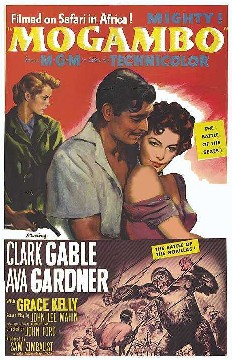
Vic Marsell (Clark Gable) is a big game hunter for pay in the modern world. Eloise “Honey Bear” Kelly — a real firecracker of a woman (Ava Gardner) — winds up at their secluded outpost on the invitation of a maharajah. The main problem is the man picked up and left without bothering to tell her. She’s good and stranded.

Her attempts to make her way back to civilization don’t work so well, and their outpost becomes quite the mating ground with the arrival of a callow man of learning (Donald Sinden) and his wife (Grace Kelly). You need not be a soothsayer to wager a guess what might happen in this sweltering country.

Ava Garner’s no Harlow gold, and she doesn’t have to be. If it’s not plainly obvious, she’s Ava Garder, a cloying, sassy icon in her own right more than capable of finding her place among the animals and everyone else on the African Safari.

She’s a barrel of laughs to have around, and she has a quip for every occasion be it Secretary birds or (Bobby) Thompson’s Gazelles. Consequently, she also proves herself to be an incorrigible pot-stirrer and, thus, the film’s most enchanting asset.

While Gable still feels adequate doing the rounds as his prototypical gruff hero (over 20 years after his initial success), Gardner gives off this sensual aura of sport and irreverence. Grace Kelly has the naive sheen of a prim and proper anthropologist’s wife out for an adventure, which of course, she is.

Given our players and Ford’s manning of the romantic drama, it’s the broader themes paired with the laid-back sense of fun — reminiscent of a Howard Hawk’s picture — that become the most agreeable moments.  This is before it burns with the imminent flames of passion.

Every detail and accent of the environment seem to reinforce the romantic tensions creating these parallels between mating rituals out in the wild and their human equivalents. It’s an open-air Noah’s ark. Every creature is looking for its respective mate.

Ava Gardner pacing with her parasol joined by the Leopard pacing in its cage. A lion in the bush growling for a lioness. Hippos fighting in the local riverbed no doubt over a female companion. There are even polygamous males in the local communities with tribal premarital rituals to guarantee fidelity.

In lieu of a flood, Mogambo swipes the famous storm scene from Red Dust, but it’s punctuated by a singular moment of its own. It’s the first sign of electricity. Gable yanks off Grace Kelly’s headscarf and brings it about her neck with a forceful tug. Nothing else happens, but the animalistic fury and the passion is obvious, matching both the animals and the weather right outside the window.

There is another element we could consider and as I don’t like to spend too much time on these things, I only mention it in light of the film. Garble and Kelly famously had a romantic fling on set. Far from being a real-life love triangle — Gardner was still married to a devoted Frank Sinatra at the time — the younger starlet went to her elder for worldly counsel. And she provided it. If intuition proves correct, Gable wasn’t a far cry from the man he portrayed in this film, at least when women were concerned.

The final act takes them out into the jungle in pursuit of gorillas, “the truest link between man and his primordial derivation,” although a local father might have a word or two to say on the origin of species — Man in particular. Soon thereafter, relationships get more complicated and they begin to splinter under pressure as per the expected conventions.

If I can make a summation, you come to Mogambo for how the milieu informs the romance and not the other way around. Length catches up with it in the end as the steaminess slowly burns off. What we are left with are the palette and the performances. It’s well nigh enough to make this movie spectacular entertainment. Fans of either Ford, Gable, Gardner or Princess Grace should at least prick up their ears. Although, in the end, Ava steals the show.

3.5/5 Stars

Mutiny on The Bounty (1935) with Gable, Laughton, and Tone

mutiny on the bounty

More recently I’ve found myself straying away from period pieces and epics and not necessarily because there is something fundamentally off-putting about them. Nor do I think it can solely be blamed on my admittedly short attention span in this increasingly inane and vapid social media-fueled society we live in.

To prove my reasoning, I only need to express a couple of repurposed lines, “To whom much is given, much is required.” It’s not from Spider-Man, no, but it does suggest a movie like Mutiny on the Bounty already has a mountain to climb. It needs to do more to wow me than one of its shorter more economical brethren. Therein lies the issue at hand: greater expectations.

The year is 1787 and the Royal Navy is on a mission to acquire breadfruit trees as sustenance for slaves in the West Indies. This is implied to be a tale about how a mutiny led by a man named Fletcher Christian (Clark Gable) laid the groundwork for modern British sea law still ruling the seas to the present day (that is, 1935).

Thankfully, it never feels quite like we are being taught a moral or a lesson of social significance. It’s nothing more than entertainment, though it’s still one of the great seafaring epics (not starring Errol Flynn).

A handful of hapless men are pulled out of a tavern away from their wives and loved ones and conscripted into a two years voyage with a Captain Bligh (Charles Laughton). Another man of privileged stock takes his post gladly (Franchot Tone).

When his crew is finally aboard and assembled, Bligh sets the precedent of unyielding discipline with a flogging of some poor unfortunate chap. His men look on gravely, no doubt questioning what they’ve gotten themselves into. It’s true the sea is a fierce adversary with gales whipped up and immersive wave-drenched decks swaying madly under their legs. However, if there is a touch of man vs nature in the drama, it’s even more vehemently about bouts of human conflict and insurrection.

Director Frank Lloyd makes liberal use of claustrophobic close-ups played in sharp juxtaposition to the more grandiose naval imagery. It signals the tone of the world even as this grand scale is made tactile through the onscreen relationships. Namely, that of a tyrannical captain and his hapless crew as he ceaselessly dishes out lashes and other sordid punishments indiscriminately even unto the point of death. There must be a breaking point. For now, we wait as they grin and bear their taskmaster.

One of the few sources of jocularity is the ship’s surgeon (Dudley Digges) a blustering old sea dog who dubiously lost his leg — the story of how it happened is the source of many of his largest yarns. Still, he too is in danger of being a casualty. No one is safe on a boat where the most precious cargo is botanical and not human. It’s these plants that are given preferential treatment when rations are concerned.

The crew is half-raving, stir-crazy as they finally weigh anchor on the shores of Tahiti — taken by the country’s beauty, coconut milk, and native girls. Our voyage has reached its midpoint and dipped its toes into what feels like paradise. Is it a coincidence that Bligh seems to all but disappear? Instead,  Tone busies himself picking up as much of the dialect as possible, and then Gable is taken by the pretty woman making eyes at him; they don’t need language to communicate.

mutiny on the bounty Gable and Tone

It’s the interim period of leisure and romance. But this respite must come to an end and with it, we arrive at the beginning of the end. After all, the whole story has been mounting to this precise point as we’ve all but avoided the inevitable.

If I’m to engage with my boyhood proclivities, Mutiny is not much of an actioner or at least not in the sense of a rip-roaring swashbuckler. It’s a war between titans, men of differing ideals, only to be interrupted by the unpredictable ferocity of the sea. So in this way, it’s more of a character piece injected with action. Still, this is not the bottom line.

The conflict is in staying the voyage (and the film) to see whose will is enacted in the end: Bligh’s or Christians with Byam forced to navigate the turbulent waters of ambiguity in-between. One positive of the picture is how none of the three men seem to entirely steal the show; they seem to be on surprisingly equal footing.

Yes, Laughton is an impudent, bull-headed taskmaster but hardly one of the most nefarious villains of all time. This is a tribute to the actor. He sculpts Bligh into a wretched, small-time human being who’s too big for his britches.  A paranoid weasel blinded by his devotion to duty and the sound of his own voice. He doesn’t forget those who revolt and his retribution is swift.

However, he is all but cast aside and forgotten, an insignificant little man, who knows how to make his way amid the rules and regulations of the Navy. It’s a more galling ending than if he had been lost at sea or most preferably eaten by a shark. But Laughton is a credit to the role showcasing his mind-boggling dexterity and range among actors of his day and age.

Gable is ultimately made into a kind of mythical figure out there on the ocean somewhere, but he is not destined to wander aimlessly — he and his rag-tag crew find a place to rest and call home. He wears the fierce, proud masculinity of Fletcher Christian just as you would expect him to (with our without his trademark pencil-thin mustache).

But if they are the two behemoths doing war against one another with the ship and the sea as their arena of battle, it is Tone who actually gets the final word as our initial in to the story. He is the every man, and therefore, the voice of reason for all of us. While I wouldn’t go out on the plank to say The Mutiny on The Bounty is a so-called “great film,” it does a service to its genre as one of MGM’s most prominent period pieces of the decade and a fine showcase for some of their most acclaimed stars.

4/5 Stars

Waterloo Bridge (1940) and The Farewell Waltz

Screenshot 2020-01-05 at 62101 PM.png

If you’re like me, Waterloo conjures up a limited array of mental images. Napoleon and The Battle of Waterloo. The Kinks and Waterloo Sunset. That’s about the extent of it. Now I can add Vivien Leigh, Robert Taylor, and Waterloo Bridge to the list.

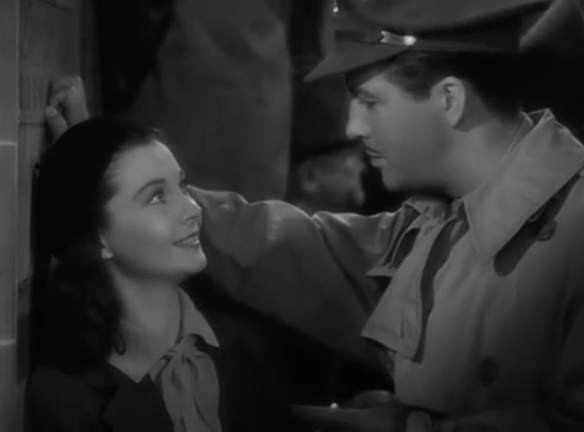
Fittingly, our opening prologue begins at the titular location, as a handsome man with a touch of gray, dressed in military attire, makes a ponderous appearance. The place holds an obvious resonance for him even as he holds an unnamed token in his hands. This is Robert Taylor. He probably looks too virile to be an old man, but that’s hardly his fault. At any rate, he’s preparing to give one of the most continuously amiable performances of his career.

Then, we’re back in time. For a minute the cultural moment caught me off guard. Even though the flashback seemed to denote the first war to end all wars, how our star couple first meets, heading to the Underground for an air raid, feels like a distinctly World War II-era image. However, it happened earlier as well, and it makes for a very practical meet-cute.

With the Germans threatening to rain down their ammunition, the Underground is stuffed to the gills with all sorts including Captain Roy Cronin and Myra Lester (Vivien Leigh), a member of a ballet troupe. This might be their first and last meeting, but the spell between them is too bewitching. The cinematic mechanisms of star-crossed love are at work.

There’s a warmth and romantic civility bathing the picture, and it’s the kind of feeling you often seem to get in pictures of old — at least the most supernal ones. I can think of a handful: Random Harvest, Love Affair, Now Voyager, maybe The Ghost and Mrs. Muir. In a word: Stars. Because the scenario can change and yet when the talents fit together, there’s just something so disarming and delightful released into the atmosphere.

We want to soak it in and be in the moments with them to feel the same swells of emotion. Whether war or some other force pulls them apart or gets in the way of their love, they always face it with a good humor and a grace that we can live vicariously through as the audience out in the dark.

All of this might see like an admittedly surprising proclamation because anyone who knows anything about Leigh will first consider Gone With The Wind from the year before and then her larger-than-life relationship with Laurence Olivier. He was the man she wanted for this picture. Alas, he was called to make Pride and Prejudice (1940). What came into being with Waterloo Bridge is probably better.

Oh that we could be as handsome a Scotsman as Robert Taylor (with a better accent) or such an immaculate and gorgeous ballerina as Vivien Leigh. As such, their romance is set in this heightened supercharged arena created by wartime.

The film’s most illustrious scene is the “Farewell Waltz” by candlelight, played to the soft melancholy tones of “Auld Lang Syne.” In the silence or, rather, without dialogue, the magic of the moment is the film’s apogee. That song becomes one of the strongest motifs at the movie’s disposal.

It might have been the most bittersweet short film of all time if the first 30 minutes were all we got. All things considered, it wouldn’t be a bad place to end allowing the pleasantness to waft over us and invade our collective hearts and minds.

Still, their story continues for over an hour more. There must be complications. Robert Taylor is soon on the train platform, a fellow soldier holds a bawling son amid the hubbub, and our protagonist’s head is on a swivel as he moves down the platform. The camera follows close behind; he’s anxious to see his love just one last time before he ships out for what may as well be forever. It sets the tone going forward.

Their joint life together suffers in the wake of his departure and we can say “departure” because the movie stays behind as he goes overseas. It works in the story’s favor not to break off and try and tell both sides because this way it gets at the feelings of those left behind fretting on the home front.

Still, the final act needs something more. In comparison, it feels like a bit throwaway as if the movie is coasting on the power of those first minutes of romance and quite literally that haunting chorus of “Auld Lang Syne.”

You can write it off as sanitized rendition of its 1931 brethren or otherwise call for a perceptive reading between the lines, but what the picture must resolve once and for all is Myra’s shame — the guilt she holds onto while her man is gone.

Because even with the spunky support of her best friend Kitty (Virginia Field), she is left destitute without the lifeline of her husband. Whether he lives or not, she must subsist someway, and she chooses the only conceivable path, prepared to live with the ignominious consequences.

The only way to redeem the ending is to reflect it back at the audience — back at all of us — because it’s indicative of what many of us deal with. It consists of the lies we tell ourselves when no one is around. We’re unlovable. We’re too far gone. We’re the Judas. But the movie fails to go anywhere creative and poor, downtrodden Myra hardly fits the description of a loveless tramp.

The final saving grace is Vivien Leigh. Her quizzical right eyebrow gives all of us lacking perfect facial symmetry hope. Despite her final moments being trance-like, she is more than capable of the art of captivation even in her character’s execution of the inevitable. If I don’t quite buy her convictions taking her to such a sorry conclusion — the logic seems a bit drastic even for the time period — it’s easy enough to get swept away by her emotion alone.

Robert Taylor for one, gives a performance brimming with vitality, and he feels like more than a chiseled block of wood. He reminds us that in order to have true love there must be two involved. That place. His token. They only maintain their meaning because he shared them with someone else. We get the privilege of being there with them both.

4/5 Stars