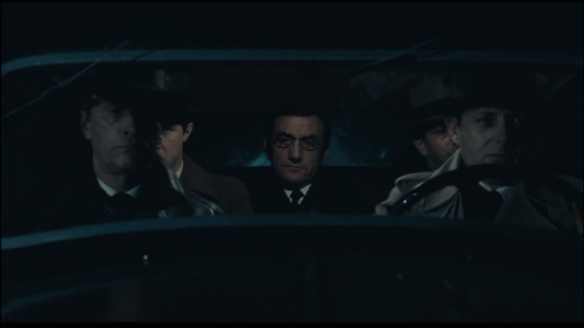
Duel (1971): The Stirring Success of a Young Spielberg

Duelweaver

Duel stands as a stirring reminder that this is the same Steven Spielberg who brazenly got himself on the Universal lot because he needed to be in as close proximity to movies by any means possible. There was no other alternative.

Here is a young, brash filmmaker, part Hitchcock, part Truffaut, and all American humanist. Is it wrong to say he is dearly missed? Because this is not to imply films like Bridge of Spies or The Post do not have merit or are not worthy of acclaim. However, it does feel expected of them. If ever a gigantic cinematic undertaking could be termed safe, they are, at least in terms of comparison.

Duel is full of the electrifying exuberance of youth with a director out on the prowl to prove himself. He most certainly does. He cannot help but shape our perceptions along the entire adventure through impetuous moves and constant manipulation. But that is what the directors and the magicians behind films are capable of at their highest potential.

What sets it apart instantly is the point of view. As an audience, we are flying down the streets of what can only be L.A. and the world is being relayed to us from the cab of the car as the radio whirs with the typical chatter.

Baseball scores. The latest exploits of Lee Trevino. A man calling in proclaiming himself a member of the silent majority and simultaneously afraid folks will get the wrong idea if it gets out he’s not his family’s primary breadwinner. His masculinity is in danger of being under attack. Blah blah blah.

It is not a film saturated in dialogue so whatever you hear serves a key purpose either thematically (like in this case) or to define character conflict. This is the first instance where it becomes especially apparent.

The movie, originally a television movie, also fits nicely into TV’s cultural moment with Dennis Weaver of later McCloud fame and Spielberg himself having directed an early episode of Columbo for Sunday Mystery Movie Night.

Our hero is a Vietnam war vet still trying to exorcize demons while grappling with his own faulty sense of masculinity that has his own marriage going down the tubes. What follows is a laughably simple premise executed exquisitely to a fever’s pitch.

Because David Mann (Weaver) is currently being delayed from getting home to his wife and kid due to a business trip. It can’t be helped and seen in this light, Duel might easily be a suburban family drama about the daily monotonies of life as a member of the aforementioned silent majority.

And yet Duel slowly unfurls a more menacing and blatantly overt conceit. Real, tangible opposition is created in the arrival of a flammable tanker and rolling pollution factory belching exhaust. The story as originally conceived by the prolific Richard Matheson preys on the anxieties about L.A. smog and the uninhibited road rage brought to a simmer by the daily commute.

Because soon enough Mann, for some inexplicable reason, finds himself being pursued and bullied off the road by the massive truck. It’s the personification of a destructive vendetta out on the road. It’s vindictive. It feels personal. But we never understand why.

As they begin to make their way across more secluded desert highways and byways, what starts out feeling like a practical joke continually escalates. It follows him to a diner, waits for him menacingly, and comes upon him as he tries to service a broken down school bus. The kids seem to jeer him, a jarring image, given the fact this ominous big rig comes to their aid. Could it be they are in cahoots? The fears begin to proliferate.

However, from a narrative perspective, the true masterstroke is how Spielberg never tips us off to who the phantom pursuer is. He is more a creature of diesel propelled by exorbitant amounts of fury rather than a human being — a cinematic creation more than a real-world entity.  It sounds eerily familiar to a mechanical shark just hopped up on gasoline and plowing down the roadways instead of the deep blue.

Thus, the parallel to Jaws are all too obvious. This is a low budget, compact, and even punchier rendition. However, everything goes back to Spielberg’s fearless inventiveness, whether it’s in the elementary way in which to frame shots or to build up this ever heightening sense of paranoia as the world begins to collapse around our protagonist.

Dennis Weaver embodies this brand of All-American, nevertheless, plagued by demons, and his spells of voiceover, particularly in a roadside diner, lend an added depth to his anxiety.

It is one way we are given license to get inside of his head as he tries to guess which old boy sitting at the counter is the one out to get him. His nerves are all about shot by the end of it and if he’s our surrogate, as an audience we do not fare much better.

Obviously, there are these moments of dialogue, but the sparse moments full of near-wordless action recall Hitchcock quite vividly. A film can be won and lost in how it utilizes these moments, and Spielberg rides them out to great effect.

When the radiator hose breaks, and it feels like sheer desperation time the camera is literally peering up through the steering wheel on the most severe angle on Dennis Weaver yet. Because we have hit the most crucial moment in the picture.

Mann is broaching a precipice of mad despair as he wills his vehicle to not completely fall to pieces around him. He’s physically incapable of running any longer because his wheels have betrayed him. His only hope is making it to the top of an incline so he can coast his way to freedom.

Whether he conquerors the beast or not, the struggle is not without consequence on both our hero and the audience. You would assume Duel is a movie that would feel stagnant and yet even with rhythms that repeat, it somehow manages to maintain a level of tension that must be accredited not only to Spielberg and his cameraman but Weaver’s anchoring performance as he goes through a hellish battle against the steely-beast. TV movies often get a bad rap but Duel is at least one shining example in their favor.

4/5 Stars

The Cheat (1915) and The Story of Sessue Hayakawa

405px-The_Cheat_FilmPoster.jpegEast is East and West is West and never the twain shall meet.

The cinema landscape was still in its utter infancy in 1915. Thus, beyond the monumental impact of D.W. Griffith, The Cheat is another subsequent landmark production for a couple of the talents it helped align.

There would be no Cecil B. DeMille without The Cheat. It was his coming-out party with the viewing public, slating him as a craftsman of delicious dramas gorging themselves on all sorts of sensual themes and pleasures. It meant bang-bang box office receipts and kept DeMille inexorably at the top of Hollywood for years to come.

Sessue Hayakawa must also receive a nod not only as a groundbreaking pioneer in an industry that still doesn’t boast too many Asian performers but also as one of the most important stars of his day. Period.

Simply comparing his style of acting with many of his peers during the silent era bears telling results. In an age, of not only discrimination and stereotypes but also extensive overacting for the camera, his parts are almost reserved in comparison. No doubt this understatement derived from the Japanese attempt to strive for the so-called absence of doing or “muga,” when it came to performances.

Because the teleplay on its own is fairly rudimentary. A well-off wife (Fannie Ward) is pouting because her husband (Jack Dean) won’t give her the funds for a new dress. He needs his investments to pay dividends first.

In being so impatient, she resolves to leverage the red cross funds she’s been entrusted with by her woman’s group  — $10,000 of assets — and hands it over to an acquaintance who promises a sure thing in return. Of course, no one needs to be told it doesn’t bode well and as a result, the wife is out $10,000. She’s willing to turn anywhere, even her regular companion the suave foreigner Prince Haka Arakau (Tori in the original release).

Although gentlemanly and innocent enough at first, the lascivious prince looks to press his advantage, agreeing to give her the money — with strings attached. Extramarital drama and blackmail ensue with the tyrant putting his literal stamp on her as a sign of ownership. It’s actually quite perturbing, especially in a modern world finally looking to cast light on the sexual predation of women.

Beyond this caveat, The Cheat no doubt accentuated contemporary fears of the Yellow Peril as much as it titillated with the handsomeness of its foreign star. So while it’s playing into the long-accepted narrative including diatribes against immigration, it’s also taking advantage of the situation for pure entertainment value. There’s little discounting the purpose.

There’s a shooting that the husband admits to and a subsequent court trial full of sordid scandal-worthy confessions. The problems are ultimately amended and a happy ending found, making for an abrupt denouement meant to satisfy the masses. Given the customary, even archetypal trails the story takes, it feels much more rewarding to consider The Cheat most specifically from its place as a crucial historical time capsule outside the realm of mere plot.

Accordingly, Sessue Hayakawa was such a lucrative star during the early 20th century, it’s almost ludicrous to consider. He was making millions of dollars a year as one of the highest-paid actors of the age to rival the likes of Douglas Fairbanks or even Charlie Chaplin!

The fact that he is barely known in this day and age is a shame though it makes some sense given the cultural climate then and now. He became a screen idol in an age wrought with racial discrimination. His place as a box office smash was based mostly on his foreign allure and attractiveness as a forbidden lover. He was the toast of the town with white audiences as a fantasy character though he was rarely ever allowed to break out of the mold created for him in films like The Cheat.

We are presented with this perplexing dichotomy of this world-renowned actor who feels like an outlier in a tradition that normally emasculated Asian characters, and yet there’s still problematic perpetuations in Hayakawa’s own characterizations. It’s a two-sided issue that, regardless, is nothing short of intriguing given how early in the nascent stages of film he became a star. Dig into his history even a little bit and you are met with a continually fascinating career. For one, he entered acting on a near fluke.

After arriving in Chicago to study to become a lawyer, he was waiting for a tanker to take him back to Japan from California only to bow out and take up with a local theater. He subsequently caught the acting bug. One of the crucial figures in his early breakout was fellow countrywoman and future wife (anti-miscegenation laws forbid cross-cultural marriages), Tsuru Aoki.

Eventually, Hayakawa would emigrate back to Japan in the 1920s and slogged through WWII in occupied France of all places. After the war years, he experienced a resurgence and came to be known to a new generation of audiences for the likes of Tokyo Joe, Bridge on The River Kwai, and Hell to Eternity. For this body of work, he deserves an audience, even today, because there’s no discounting the crucial part he played, not simply in Asian representation, but in the very fabric of Hollywood history itself.

3.5/5 Stars

Smile (1975): The Miss America Satire Lost Some of Its Sheen

Smile_(1975_film).jpg“Smile” is a timeless hit among a plethora of classic Nat King Cole tracks. The innate warmth and the soothing nature of his vocals shine through every note. It took me many years to realize the tune was actually a Charlie Chaplin composition from City Lights later reworked with lyrics.

However, this is not a review of The King or The Tramp. It is about a movie, but to consider it, one must acknowledge the song is so very sincere, it can be used in highly ironic ways.

Case in point is Smile the movie, which was obviously fashioned as a genteel satire of Miss America culture.

It is a depiction of a different America that we can never go back to. Sometimes those words might sound wistful though, in the case of Smile, it’s more of an assertion. Because this lightly-handled prodding of societal mores, full of its share of cutesy and sickening moments, is really a commentary on a very suspect culture.

Still, one must ask the question: how much does the industry get inadvertently glorified by such a comedic extravaganza throwing all these young girls, harried folks, and inquisitive onlookers into an environment complete with plenty of pizzazz and a full-fledged happy ending?

There’s a moderate danger of missing the point — even if it is twofold. We can laugh or “smile” but we must also consider how ludicrous this all is. Thankfully the movie is aided by some of its wonkier inventions in case we’re tempted to take it at face value.

Smile is, of course, easily overshadowed by Nashville (1975) with its more discernible social significance, a grander ensemble, and a lot more going for it on all fronts. That’s not to say Smile is a bad movie. In fact, it is probably an underrated one, generally forgotten with the myriad of other 70s entertainment options moviegoers will normally flock to.

The story itself has the ring of something terribly agreeable. It’s a lightweight day-to-day observation of the annual Young American Miss Pageant in beautiful Santa Rosa, California. All the would-be “Misses” are bussed in to take part in the competition and all the laurels that come with such a crown.

Their hearts are a tizzy with excitement. Former champion Brenda DiCarlo (Barbara Feldon) knows just the feeling. Her advice is, as always, to “smile” as she helps to prepare the girls for their exhibition (which is not a competition). Although everyone knows otherwise.

Meanwhile, a Hollywood choreographer (the esteemable Michael Kidd) is brought in to work on the routines, the janitor worries about the undue stress that will be put on the pipes, and local used car salesman Big Bob Freeloader (Bruce Dern) gets ready for his civic responsibility to judge the contest.

He’s the epitome of a square, wheeler-dealer, car salesman who in his own way sees himself as a pillar of society, even if he helps to propagate the dubious cultural practices of the times.

His son, “Little Bob,” looks to snag a polaroid camera with his friends so they might capture the recently arrived pageant hopefuls in various states of undress. Though played for comedic effect, it really is a jarring, uncomfortable digression.

Because already implicit in the content are the strains of mid-century misogyny, essentially built into the fabric of society. It begins with the grown-ups as good, healthy All-American fun, until it easily seeps down to their children, teaching boys how they are to perceive girls.

Simultaneously, the local male fraternity initiation feels dangerously close to a white supremacist meeting, albeit with strange rituals (ie. kissing a dead chicken). On the ethnic front, the one non-Caucasian character, a Mexican-American, is looked on with immense derision by all the others and with the depiction, I wouldn’t blame them.

Her starry-eyed ambitions to be American are seen in a handful of characters, though she’s the only one hampered by a pointed accent. Again, it’s these obvious red lights that are being poked fun at. There’s little question about it, but if these are the issues we are dealing with, there are still other de facto problems that probably slip through the cracks.

It has not aged well even as we still have rampant issues of sexual objectification and any number of prurient problems. It could be very well that I am not in touch with the current cultural moment. If so, I stand corrected. But the odd mixture of nostalgia with light satire does come off as a weird, messily concocted cauldron of tones.

The free-flowing contact with the wide range of characters also means we never ably connect with anyone in a resonant manner. Likewise, director Michael Ritchie’s story, like The Candidate before it, is taking aim at society but in this instance, it feels like there are too many marks. It cannot cover all the ground and, therefore, feels a bit scattered.

Unfortunately, it’s lost some of its comic zing with the passage of time. Still, one of the finest bits of humor comes in an outrageous sequence when a man looks to end his life with a pistol.

His wife the former American Miss tells him he should deal with his problems instead of taking the coward’s way out. He proceeds to point the gun at her and let it go. He winds up in jail and she’s only scratched, agreeing not to press charges, much to his chagrin.

In fact, Andy DiCarlo might be the most genuinely enjoyable character for the very reason he sees the utter insanity of this world, even if everyone else brushes him off as being a little strange.

They think he needs to loosen up some like all his peers, kissing the butts of dead chickens and cheering for girls paraded up on a stage like glorified cattle. Now that’s entertainment! In this light, Smile does sound somewhat hilarious. Chalk it up to a misanthropic mood if you want. However, I’ll maintain people weren’t made to always be smiling. Sometimes a smile just won’t cut it.

3/5 Stars

NOTE: As a childhood Get Smart fan, I tried not to hold it against Smile for casting Barbara Feldon in her part. I tried my best to be objective, but, for me, she will always be 99.

Klute (1971): Starring Jane Fonda and Donald Sutherland

klute.png

There was arguably no man more well-versed in 70s paranoia thrillers than director Alan J. Pakula and if we want to consider the genesis of his “paranoia trilogy,” we must begin with Klute. Aside from the thematic elements and Pakula’s evolving pedigree, it is the partnership with the ever-meticulous Gordon Willis that truly stitches this loose grouping of films together.

Klute is set in New York and though you never forget this fact exactly — we spend a lot of time watching Bree Daniels (Jane Fonda) move around town — the film is not built out of the seedy streets like The French Connection (1971).

The majority of the action takes place within interiors where the low-lighting and limiting factors of the space add a certain psychological depth. There is something unnerving out there reflected in the characters themselves.

In his first film score, Michael Small evokes the perturbing tinkling sounds no doubt found in many Columbo episodes and all such fare from the 1970s. This film does feel like a case of localized dread.

It involves suits and pimps, but the scale is fairly small, even if it’s indicative of situations throughout the city. Next, the conspiracy would get larger and corporate in Parallax View. Finally, it would be at the very top, in the federal government, and in this case, it wasn’t simply fiction; it was real, a la All The President’s Men.

In this particular iteration of the thriller, a top-level businessman has all but disappeared, and his concerned wife is aided by the services of a mutual acquaintance and private investigator: John Klute (Donald Sutherland). He is hired on by the man’s firm to get to the bottom of the issue.

Some incriminating letters to a New York call-girl seem to suggest a Jekyll and Hyde existence that his wife knew nothing about. It’s deeply troubling, but it gives Klute a point of departure. Soon he’s questioning Bree (Fonda), who doesn’t remember the man — she’s in high demand these days — and she’s not about to be pumped for information.

Still, the persistence of this enigmatic out-of-towner eventually gets to her as he doggedly keeps after her with quiet persistence. 2 years prior she was beaten by a client and in the past, she has received a string of prank phone calls, not to mention being tailed on occasion. It comes with the trade.

What’s striking about Bree is how real and pragmatic she is about her life. With her brown helmet of hair and undisputed confidence, she takes the day-to-day in stride. She’s not ashamed about being good at what she does, and it’s even a bit empowering to be in such demand while so easily controlling her emotions. With clients, she’s able to maintain a cool and detached demeanor, totally in control of her situation.

However, she’s also not a stagnant individual, trying to move away from her past, tied down to an abusive pip (Roy Scheider), and a certain lifestyle that comes with the territory. There were formerly aspirations to be an actress, and she spends hours with a therapist talking through her issues. It becomes apparent she is one of the many who is an adherent to external processing.

Thus, John Klute is her perfect foil in all regards. She openly lambastes his kind as “hypocrite squares,”  leaving their ivory towers in the country to look down their long noses in scorn at the corrupt city dweller. The dichotomy of the sinful folk and the methodical morality of this suburbanite is being drawn up.

Still, he doesn’t fit such a convenient definition. His is a constantly unphased, totally imperturbable demeanor. His words are chosen very carefully and sparingly; his actions are taken with a certain purpose. Then again, the same might be said of her. Regardless, their aspirations are of a very different nature.

The title itself seems a near misdirect. One can easily contend the picture is named after the wrong character. After all, Fonda is the undisputed shimmering star of independence. And yet the film is bolstered by all its main characters because out of them the narrative is made compelling and essential, based on the bearing it has in their lives.

Screenwriters Andy and Dave Lewis whip together a script that revels in these figures, even as they themselves play against a larger, harsher milieu. It works in strokes of lingering dread and an unnamed apparition out there somewhere.

No scene is it more apparent than when Sutherland literally chases a phantom out of Bree’s apartment only for the person to vanish into the night without any resolution. It is this open-ended nature that supplies tension.

Except there is ultimately a conclusion and it comes in a very real and present form. Given that we are dealing in a world of call girls, loneliness, and sexual desire, it makes sense our solution would tap into these deep-seated issues.

Without giving away the punchline completely, Klute‘s ending makes my insides crawl. In an admission that might have well come from Norman Bates, one character even acknowledges, “There are little corners of everyone which are better off left alone.” It hints at the dark, rancorous proclivities of human nature. They lay dormant only to erupt in vengeance.

Supposedly Jane Fonda thought the film was preaching a message that if a woman has a good psychiatrist and a man at her side, everything will turn out right. This might be the implicit conclusion of the storyline when we take it out of the confines of what we see. However, there’s also still a sense that Bree has a personality and a will to be her own person. She is strong, at times self-destructive, and she has been through hell and back again.

What resonates is the complexity of this independent person who also has frailty. It’s not simply women but all people who need a bulwark of others around them in order to survive.  When two or more are gathered together something powerful forms.

It is not solely about weakness, or maybe it is, because in some form we are all weak, even if we don’t wish to acknowledge it. We cannot stand up to the onslaught of outside oppressors every waking moment of every day of our life. At some point, we must let our guard down.

Thus, Klute is not a film that leaves us thinking someone is weak for requiring help. Instead, I am reminded of the coarseness of this world and the necessity to find others to help us push through it. Alone we will not survive. We cannot survive.

4/5 Stars


The Heartbreak Kid (1972): Elaine May’s Graduate

the heartbreak kid 1.png

I was aware that this was an Elaine May film and for a brief moment I saw Jeannie Berlin and mistakenly believed our director was making an appearance. Berlin is, of course, May’s daughter, and she’s the spitting image of her mother. The same look. The same lilt in her voice. The same comic timing.

In a sense, we have this weird frame of reference now. I’m not saying Lila (Jeannie Berlin) is a stand-in for her mother per se, but we nevertheless have a curious dynamic to cull through. If we didn’t know any better, we would say this is a typical Hollywood film told from the male perspective.

Charles Grodin is an attractive young man and a newlywed who has just married a nice Jewish girl. They’re headed out on their honeymoon in Virginia Beach. What happens next is not the honeymoon phase at all. It’s the sinking feeling he’s made a mistake. Can he really spend the next 40 or 50 years of his life with this woman?

At first, they’re having a grand ol’ time singing “Close to You” on the freeway, and I couldn’t help but thinking of the inro to The Mary Tyler Moore Show or closer yet The Crocker Bank commercial that spawned another Carpenters’ hit. Here we are headed for new beginnings — a life together — and we’ve only just begun.

However, normal rhythms must be interrupted. It starts when Lila starts getting too lovey-dovey in the car. Then, she’s eating Milky Ways after they sleep together or she’s taking eons getting ready to go down to the pool deck. You get the sense her husband is just getting to know her for the first time. It’s really disconcerting if the moments weren’t equally hilarious

He’s already hustled and harried. For the most part, Grodin must push through the picture in deadpan because the film is much more a tempered affair (with a few piercing outbursts).  He responds to his romantic counterparts impeccably, first the unacknowledged goofiness of Lila and the cool flirtation of blonde, collegiate siren, Kelly (Cybil Shepherd). There’s both a rhythm to his diction and a gigglyness that overcomes him — like a little schoolboy — completely selling his double life and the comedic situation.

It’s partially the fact the scenario gets so outrageous. Because from her first toying with him on the beach, Kelly won’t stop ribbing him to death. First, it’s her “spot” on the beach then it’s her “seat” at the bar, and she’s got him playing along. He doesn’t mind getting trifled with. In fact, he instantly goes fawning over her, despite being very truly married.

Of course, that sets up the blackness of this comedy given the situation. There’s not any kind of spouse murdering or anything grotesque, just infidelity… And I say this facetiously because obviously a situation like The Heartbreak Kid played real and straight would be devastating. In real life, such scenarios don’t come with laughs.

However, Elaine May observes it beautifully and while Neil Simon’s script is mostly spot-on, it feels not so much uncharacteristic of his work as it does a creative departure. The collaboration is as much May’s as it is his, and she puts her unmistakable imprint on the material.

Soon Lenny is already planning his second life and, he hasn’t even gotten finished with his first, married to his current wife a whopping 5 days. His arguments and excuses in keeping Lila bedridden and out of the know are so fluid and self-assured it’s astounding. It’s easy enough to do with Lila.

Still, Kelly’s father (a supremely obstinate Eddie Albert) is another matter, a domineering paternal figure who’s made his position on Lenny’s pursuit of his daughter quite clear. He vehemently opposes any such actions with every fiber of his being. Over his dead body as it were.

Lenny, however, is all in. He makes the trek out to Minnesota, of all places, where the Corcoran’s reside and where Kelly currently attends university. When they get a moment alone together, he pleads with her, “Don’t play games with my life.” It’s pitiful really. A comedy such as this must continually tread the lines of tragedy as much as humor. He’s certainly a real shmuck.

They each treat their romantic partners horribly and yet by the end, it’s easy to find the story weirdly sincere. Amid all the zaniness, Lenny somehow manages to get what he was searching after — the dream girl — to right the supposed mistakes of his life.

In one sense, I cannot help but use the same lens as The Graduate. The scenarios are in some ways strikingly analogous. However, The Heartbreak Kid also owes a greater debt to the remarriage comedies of old, albeit without the imposition of the production code.

The Graduate dynamic might be partially coincidental and yet we have directors in Mike Nichols and Elaine May who famously came into the public eye as a comedic duo.  The creative realizations of the two films make sense because their type of specific, deeply insightful humor can rarely help but enter satirical territory. It comes with the intelligence and perceptiveness they bring to everything whether stand-up, directing, what have you.

The Graduate, of course, has this chaotic crescendo where Benjamin storms the church and runs off with the girl. The Heartbreak Kid is arguably even more devastating and yet it manages it through subtlety. In the lingering moments, Lenny is sitting on a couch in his second wedding reception. He’s gotten his prize — the girl he gave up everything for — but it’s strangely unsatisfying or at least when we look at him and the expression on his face, he seems unfulfilled.

Why is that? Maybe it’s some unnameable force, but I saw it to a greater extent at the end of The Graduate as well. Benjamin Braddock went through hell and back again to get a girl. Lenny’s journey was bumpy, but it also felt lighter, even low-key. Still, it goes out with a pop song too; again, more subdued and still, there’s a concerted effort to lead us obliquely into the unknown future.

The Graduate rode the pensive waves of Simon & Garfunkel while The Heartbreak Kid is provided a through-line by a cover version of The Carpenters’ “Close to You.” Although there is no comparison, we have a similar connection to a cultural touchstone. May’s film couldn’t find a more straight-laced song to keep on calling on only succeeding in further contributing to the unsettling dissonance.

I’m no authority to cover this topic in-depth, but I recall reading something to the effect that Nichols was very cognizant in casting someone very un-WASP-like in Dustin Hoffman. We could say the same of Lenny and all the locales he finds himself in, especially Minnesota. Whether merely implied or not, he is the outsider, both physically and culturally, in a similar manner.

May does well to take the dippy setup that feels very Neil Simon and push it deeper still. How a film about such a topic can be genuinely funny and somehow still manages slivers of warmth is beyond me. It’s a screwy feat of acuity, a true testament to the minds behind its creation.

4/5 Stars

Accident (1967): A Study in Middle Class Malaise

accident 1.png

There’s little quibbling over what the inciting action in this film might be. It’s titled Accident for a reason. The serenity of an English home is disrupted by screeching tires and then a horrendous, blood-curdling crash following in its wake.

But the sequence is as much indebted to silence as it is noise. All the time director Joseph Losey chooses to immediately call on his audience’s sense of imagination. All we see is the home. Not the car, not the circumstances; at least not initially.

The opening is a textbook example of using what’s not there to his advantage. Because instead of showing the grisly accident, Losey stays neatly framed on this grand manor. Compositionally, he knows full well what he’s doing.  We can trust we are in capable hands from thenceforward.

While the title might be easy, the rest of the picture is a hard-fought, slow-burning exercise in destructive relationships. Though this is a study of the middle-class malaise, it’s indicative of an entire society — even an entire world — disillusioned by the way history has turned.

The aftermath of the car crash is all we are allowed. A man (Dirk Bogarde) — we can gather the man of the house — wanders out to find a car flipped on its side. I’m admittedly not well-accustomed to Dirk Bogarde. I am predisposed to believe him to be out of the mode of James Mason, perhaps slightly more maladjusted — still, his elder fell for a younger girl in Kubrick’s Lolita as well.

The other figure of interest is a young woman (Jacqueline Sassard), nearly catatonic, first climbing out of the car, treading on the face of her dead companion, then slumping her way across the front lawn. We have yet to fully comprehend the dramatic situation nor how these people relate to one another.

The film’s screenplay is realized by famed playwright Harold Pinter though adapted from someone else’s work (Nicholas Mosley). As distilled by his pen, it is all about subtleties and subtext. The performances, as a result, are so restrained — even painfully so — and they fit a world without dramatic musical cues and few cathartic moments of emotional release.

Likewise, it enlists a morose, often drab color scheme of mostly cool blues and grays, highlighted every now and then by lacquered wood desks and door frames. As the film progresses into more mundane scenes, I almost want to compare them with Yasujiro Ozu’s whether drinks or bottles placed in a room or shots of color drawing one’s eye. There is a pleasing attention to detail in such scenes which for all other reasons are the height of banality.

accident 2

This is, of course, a story rooted in the past where context can come into play to help elucidate the present. It feels all but necessary. At an earlier time, we meet Stephen (Bogarde), an academic and well-regarded tutor. His pupils include the charming William (Michael York) and the strikingly beautiful heir to Austrian royalty, Anna (Sassard). There’s little question love is in the air. At this point, it feels youthful and innocent.

Likewise, the professor returns home for evenings reading stories to his two adorable children as his gently ribbing wife (Vivien Merchant) works nearby, currently pregnant with their third child. There is a sense this family represents all that is fine and upright about the British middle class.

The film continues to remain minimalist and casually laid back. What follows are moments on a punting expedition which are nevertheless injected with a sleepy sensuality playing out between the trio: the tutor and his pupils. Next, they’re over for lunch and the prospect of a lazy afternoon of lounging and tennis.

Stephen’s dorky and slightly conniving colleague, Charley (Stanley Baker), invites himself along for the festivities. There’s a sense he wants to be in on this, and he proves to be hardly as innocent as he lets on. But we have yet to realize exactly why.

Instead, we can content ourselves with what Losey is building around us as we watch. One particular technique is to start in a close-up only to pull back on that space which instantly becomes a focal point of a far larger canvass. Not only is it slightly disorientating but it does very intentionally guide our focus. It cannot help but direct our eyes.

accident 3

There must come a point of no return as the picture enters its most stylish and enigmatic phase, which subsequently becomes the most devastating. With his wife away having the baby, Stephen inexplicably meets an old flame (Delphine Seyrig) and proves himself to be a closet cad, confirming our earlier suspicions.

Except the scenes with the other woman — the daughter of the Provost — extend the sense of dream-like reverie by foregoing typical back and forth dialogue over images. Instead, their patter is conceived in voiceover — nonchalant and smooth. Perfect for denoting the falsity of such a romantic fantasy. It cannot last.

Then, he comes home to find quite the jarring surprise but resorting to its usual tendencies, the ousting of Charley and Anna in a tryst results in less confrontation and even fewer emotions.

It’s like they are constantly being drawn further and further in, cold and impregnable. Stephen’s own detachment might come from catching them in a situation that he just experienced himself. He’s no innocent bystander. There can be no surprise or condemnation because it’s just like looking in the mirror. All he can do is resign himself to passive receptivity.

The depressive atmosphere of this world is irrepressible, reflecting the privileged elite with their frivolous diversions and usual lethargy mixed with deleterious desires. Thus, Accident is distressing, not due to any matter of pacing as much as it is the intentions of the characters themselves. The male characters in particular.

Jacqueline Sassard, as beautiful as she is, does feel mostly like an object of affection in the vein of a Vertigo or other such pictures. Where all the men are ogling over her, secretly dreaming of time spent with her alone. This is indicative of the poison going through the majority of their romantic relationships. If youth has yet to be sullied, as represented by the callow Michael York, middle-age has certainly tainted masculinity.

To the very last zenith, Accident remains the epitome of a slow, torturous burn of a movie that by some form of insanity, manages to end just as it began, almost as if nothing has happened and no change has been enacted. Because what is insanity if not something horrendous happening and then nothing being done to prevent it from happening again? It’s a mad spiral of destruction.

The only thing that makes it worse is the lack of concern. There is no emotional well to be dug into. It’s simultaneously the most perturbing and compelling element of Losey’s work here. It says so much by saying very little at all.

4/5 Stars

The Swimmer (1968): A Fable Starring Burt Lancaster

The_Swimmer_poster.jpgI am tempted to call The Swimmer a pretentious fable about the waters of life. It is set in the upper echelon of Connecticut society, but the same cross-section might hold true in California as well. In fact, one could say this film effectively extends the pool metaphor of The Graduate (1967).

Because it is indicative of not simply prosperity, but “The American Dream” as well, synonymous with plastics and water filters that filter out 99.99 of all solid matter. Whereas Benjamin Braddock (Dustin Hoffman) floats along in the water lazily, not quite sure what he is doing after graduation, Ned Merrill (Burt Lancaster) has a completely different experience, though he does live in the same WASP bubble.

For him, he forms some quixotic fantasy to swim his way back up the hill to his home, making his way by taking a dip in everyone’s pool on the road there. It dawns on him that “Pool by pool they form a river all the way to our house” and so he takes a swim down memory lane.

Each new home he comes upon puts him in contact with old friends, neighbors, children, acquaintances who never want to see his guts again, and various social gatherings. We don’t necessarily have enough time to make any judgments on those around him — they might easily come out of Mike Nichol’s film as well — but we do see an awful lot of “Neddy.”

What is extraordinary and simultaneously maddening about The Swimmer is how it blends dream-like, sun-soaked imagery verging on the surreal with these real-world scenarios. We can easily imagine a real-life counterpart to each of these people existing in the flesh and yet the film is never concerned about drawing them out.

It’s playing with the landscape and reveling in its own metaphor. We have refracting light cutting through the trees, deep piercing irises staring off into the distance unblinkingly.  Vaulting bodies and galloping legs provide the continuous motion to propel our picture ever onward even as it languishes in these self-indulgent asides.

Because there are many encounters between all of Merrill’s swimming strokes, the best recourse is to highlight only a few. Julie Ann Hooper (Janet Langard) is the pert young babysitter who agrees to join Mr. Merrill on his endeavor. Between quotations from the lurid Song of Solomon and admissions of girlish crushes, they have a fine time.

But every moment of gaiety is just as easily forfeited when all the pretense of fun and games are lost in the face of ugly reality. Ned tries to play their relationship off as something innocent, but it verges on the uncomfortable time and time again. There comes a point of no return.

Another telling moment comes when he happens upon Shirley (Janice Rule who replaced Barbara Loden), a woman reclining poolside with a magazine in hand. It comes out that they had a messy history together. He was the philandering husband and she the “other woman.”

Her defense mechanisms are those of bitterness and acerbic retorts. Within this context, she feels merciless, and yet one must admit she has a reason for harboring a grudge. Again, it speaks to Ned — this “suburban stud” who has insulated himself with agreeable fantasies. He doesn’t realize how he has harmed others.

His final leg — arguably the most telling — is at a public pool where his decadent delusions are rudely shattered for good. These folks do not have the pretense of all his affluent friends and so they view his life with a certain amount of aversion. They see right through his facades, and they aren’t buying the schlock he’s peddling. It turns out his life is a decaying, crumbling mess on all fronts.

Cocktail parties and rivers of champagne only serve to exasperate the problems at hand as the men and the families they hold up begin to fracture under the weight. Underneath the surface of the water, fissures have riddled his very foundation. He cannot hide them any longer. It’s only in the final minutes we realize how very dire the situation is.

Burt Lancaster, from a physical standpoint, seems like a marvel, defying his age as he streaks through the woods like a youthful buck and churning through the pools with methodical ease.

He’s still capable of making the ladies swoon too but there’s the ever-present undercurrent there. There’s this quality to him — capable of being the cad and somehow tragic in the same sense — that’s ever arresting. Just look into his eyes and you know it to be true. It’s quite a stirring performance and as the most important piece to this drama, he more than accommodates the audience.

3.5/5 Stars

Little Women (2019): Gerwig’s Spirited Adaptation of An American Classic

Little_Women_(2019_film)I once had the opportunity to tour Louisa May Alcott’s house on a family vacation. It’s one of those experiences I’m not sure you appreciate until you have the time and space to look back on it.

However, even then I think there was this innate understanding of how this beloved book was sewn into the very fabric of Alcott’s life and her family home in Concord, Massachusetts. You cannot begin to separate the two.

What’s so intriguing about Greta Gerwig’s adaptation is how it almost conducts an intertextual dialogue with the source material. It frames its story — the creation of a novel and its main character of Jo March (Saoirse Ronan) — in order to map out something of Alcott’s life too. Because, again, they are very much intertwined. 

From what little I know about her, she seemed an equally driven, independent, and brilliantly-minded individual. In her own life, she never got married (unlike her characters) and she also provided for her family.

The movie itself has a brazen free-flowing structure taking material some of us might know intimately (and others not quite so well) and finding renewed meaning. To explore plot feels inconsequential — and not just because it is so familiar — Little Women is, by its very nature, anecdotal. It’s about the passage of time as girls evolve into women without ever being totally beholden to any singular event. 

If I might make a wildly unsubstantiated reference it comes off a bit like Francois Truffaut’s Jules et Jim (1961), at least in form, where wild expanses of time are chopped up and compressed into these fluid increments. It feels like a young person’s version of an old person’s book. It courts the timelessness already present but, far from being stodgy, the movie burst with its own vigor, always lithe on its feet.

But this also funnels down to the staging and characterizations as well. Especially for the scenes set during their early years, it’s obvious the writer-director tries to capture the near-spontaneous, giddy energy that’s often the fuel of sisterhood. It can be an overwhelming force of nature full of emotion, affection, and contention in all the most meaningful of ways.

Even as someone with only a modicum amount of knowledge about Little Women (mostly from previous movie versions) Greta Gerwig shows such an immense appreciation for the material, she almost willfully carries us along with her. Even when we’re not quite sure what she’s doing or where she’s taking us, we learn to trust her decisions. If nothing else, she cares about these characters as much if not more than we do.

It’s true her version starts in what is normally considered the end of the narrative, as it slaloms back and forth from past to present with ease. All the moments, as far as I can recall, have antecedents in earlier versions, but as Gerwig stitches them together, it’s as if they are rejuvenated and given rebirth — a new context in which to be understood.

Perhaps the greatest accomplishment is how each sister in this newly minted construction is given their own definition and the ability to stand on their own two feet. Because, if you recall, Jo March has always been the undisputed star of these movies; she has provided the central protagonist and P.O.V. from which to understand these stories. If we are to believe Gerwig, Jo essentially wrote them after all.

There’s no denying Saoirse Ronan is our through-line in the narrative here as well amid all its undulations and purposeful digressions, and yet it feels like I get to appreciate the other March girls in ways I never have before. I don’t think it has much to do with star power — because traditionally there have been big names in most of the roles. Again, it is Gerwig who gives each a platform and her players graciously oblige.

Florence Pugh modulates wonderfully between moments of girlish cattiness and whining while simultaneously setting her eyes on mature ambitions, whether it be marriage as an advantageous business proposition or aspiring to be a great artist taken to Paris by Aunt March.

Far from simply capturing the past and the present of Amy, Pugh somehow makes the most complicated, even unlikable sister come out, in the end, gaining our deepest admirations (and sympathies). For those unaware of Pugh’s talent, it stands as yet another breakout performance.  

Emma Watson is able as the decent and contented Meg whose life still spills out of the mold of propriety she’s always been relegated to. There’s a bit more to her. Then Amy (Eliza Scanlen) remains the gifted musician and somehow the purest and most naive of them all. Her purpose is to fill the world with goodness and beauty. Some things never change.

Marmy (Laura Dern) — the family’s moral anchor — might come off an angelic goody two shoes quoting scripture judiciously (ie: “Don’t let the sun go down on your anger”). It could be a little much, that is until you realize her love is genuine, and she’s worked on it for an entire lifetime. Meryl Streep could probably play Aunt March in her sleep, and it’s not just a figure of speech; she does. Her performance is generally prickly and imperious while also belying a suspected soft underbelly. 

Laurie (Timothee Chalamet), as always, is found on the outside looking in at the March’s household. Their brand of enveloping community is so attractive you yearn to be a part of it, drawn into the fold as one of their kindred. After obliging with a token of his good-will, he quips “man is not made to live on books alone.”

In truth, I’ve never appreciated Chalamet more. There always seemed to be a pretentiousness drawn about him. Here there was something a bit different. It might have been the merit of Laurie teasing it out, but he felt slightly more animated and alive in a way that makes him likable. Although he is a man bred in affluent spheres, he nevertheless, hates their stuffiness.

He would rather dance a jig with Jo, and he calls out the March sisters when they falter into the general public’s pettiness because he knows the people they really are in the familiarity of their own home. In fact, he has tussles with nearly every sister, but never out of malice; there’s always such genuine care, even love, in its multifaceted forms. 

What I truly appreciate about Gerwig’s relationship with the text is how she openly courts contrasting ideas. Specifically, there are threads of feminism coursing through the narrative even as they extrapolate off ideas Alcott dealt with years ago.

And yet in the same instance, she does not shy away or completely dismiss romantic love or a more traditional desire for marriage. Case and point is Meg who is genuinely glad to be courted by a decent man she loves before raising a family together, in spite of their poverty. For Meg, this life fills her up with joy

So in some sense, Gerwig’s having her cake and eating it too paying deference to a timeless piece of American Literature while still perceiving it through her own personal creative lens.

You might say this even from a casting perspective with Ronan, Chalamet, and Tracy Letts all being holdovers from Lady Bird (2017). It might be the importance placed on female relationships, or the buoyancy frolicking with a sweeping passion through the storyline.

We get the happy ending if we so choose while also being allowed the space to consider an alternative. It doesn’t feel wishy-washy. Instead, it’s engaged with the enigma of Louis May Alcott herself even as it’s engaged with the process of creating art.

For me, it has the best of both worlds. Little Women has not been compromised and yet we have not been gipped of Gerwig’s own cinematic vivacity. While it’s not a perfect adaptation — not always intuitive to follow — it never scrimps on life-giving vitality.

You can note the humanity in profound new ways mined from a novel that’s been culled through and cherished for generations. I’ve never believed Little Women was a “women’s picture” or just for an American audience.  It is, in fact, universal. 

4/5 Stars

Night Moves (1975): Arthur Penn’s Neo Noir

Night Moves 1.png

“I saw a Rohmer film once; it was kinda like watching paint dry.” – Gene Hackman as Harry Moseby

Gene Hackman is still with us but unlike others who are predisposed to continue working, he was content in setting a hard and fast end to his acting career. All that can be said is he is dearly missed. Even a less renowned project like Night Moves suggests how indispensable his talents were to the acting landscape of the 70s and 80s.

Director Arthur Penn was not an obvious practitioner of genre subversion as say, Robert Altman, but if you look at the likes of The Left-Handed Gun (1958), Bonnie and Clyde (1967), Little Big Man (1970), and certainly Night Moves, it’s obvious he took accepted genres like westerns, gangsters movies, and film-noir only to give them a fresh point of view.

It seems fair to assume this film finds its place among the likes of Harper (1966) and The Long Goodbye (1973) because it begins by acknowledging the successive hoops of private investigator films with conscious self-awareness.

However, in such cases, the true entertainment comes in the departures, when it pertains to artistic vision, content, and narrative digressions. Penn shows particular preoccupation in a man at odds with his times and ultimately, a man unable to navigate the world, both personally and professionally.

In one very blunt admission, the lone wolf P.I., Harry Moseby (Gene Hackman), acknowledges, “I didn’t solve anything. It just fell in on top of me.” Later, when asked where he was when Kennedy was shot. He responds wryly, “Which Kennedy?”

This is the perfect sentiment in a Vietnam, Post-assassination, Post-Watergate age where rhyme and reason seem all but cast to the wayside. If things reach a resolution at all — and a fatalistic one at that — it feels inevitable. In one sense, there appears to be little personal agency in the current cultural landscape. It’s no different for Harry.

It’s also imperative Night Moves boast a familiar point of demarcation. The despondent point of view is already in place, but it takes time for it to build up to what might already be a foregone conclusion.

It must begin in what feels like a conventional realm. Moseby receives a request from an aging Hollywood B-Girl whose husband formerly made Biblical epics. Now her free-loving daughter Delly (the saucy Melanie Griffin) has gone missing. The actress entrusts Harry with finding her daughter and bringing her home. It’s everything but a by the book assignment.

In fact, Alan Sharp’s script is equally aware of its traditions. Mrs. Iverson inquires if Moseby’s “the type of detective who once you get on a case nothing can get you off it: bribes, beatings, the allure of a woman.” He responds without missing a beat, “That was true in the old days before we had a union.” His fee of $125 a day plus reasonable expenses is also dirt cheap compared to Jim Rockford.

But this is indicative of his general temperament. Asked about his affinity for some grungy old antiquities from a would-be detective partner, he responds bluntly, “I would if they didn’t all remind me of Alex Karras.” Later, when he traps his wife with his crippled rival, far from the virile adversaries of yesteryear, the man coaxes him to take a swing at him, “The way Sam Spade would.”

He is a P.I. as only Gene Hackman could play one forming a beeline through The French Connection (1971) and The Conversation (1974). The core tenets of each of these varying protagonists are flaws — deep and messy. He is prone to violence and resentment and yet somewhere buried deep is a certain tenderness — a conscience and a moral compass of some kind. This ever-fluctuating identity is key.

He feels like a traditionalist more at home with the gumshoes of old than the new-fangled technology guiding detective agencies now. Hackman even rivals Elliot Gould in The Long Goodbye, but he doesn’t seem as absurdly out of place so much so that it verges on the satirical — even from a visual standpoint.

His emotional and personal framework is what puts him at odds with this current generation. On stakeouts, of course, he occupies himself with chess matches, watching the mark out of the corner of his eye, and it becomes the film’s defining metaphor.

In making the rounds, he questions a mechanic and one of Delly’s friends named Quentin, followed by the hotshot pilot who wooed her away. The last is the veteran stunt coordinator (Edward Binns), all leading him on the trail to his prize.

His primary case seems to be well on its way to a conclusion far sooner than we might have ever imagined. He tracks Delly down to the Florida Keys, following the leads to her step-father (John Crawford) and the in-house dolphin expert (Jennifer Warren) who are making their domicile on the edge of the water. It’s a little bit of quaint paradise, and it feels rather like a dead-end, where crime stories might come to die.

If this is the outcome of the case, it seems anti-climactic at best. Still, something keeps us glued to the screen. We appreciate the characters and there is some amount of intuition mounting. Arthur Penn would not abandon us like this without something more to ruminate over. Night Moves just keeps on getting more and more perplexing by the minute.

It’s because the issues at hand are not localized; they only seem to morph and proliferate with every encounter, folding back on themselves to create more issues through the simple rhythms of character. Fittingly, actual travel is rarely denoted, only implied by varying cars and sudden jumps in location, thus continuously expanding the story.

It starts with Moseby but trickles down to any number of people he crosses paths with. Melanie Griffin’s part, much like Jodie Foster’s role in Taxi Driver a year later, does its very best to get under my skin, as both play squirm-inducing and unforgettable Lolitas.

Meanwhile, Moseby orbits within this confusing solar system of female relationships. It begins with the problems with his wife and patching up their relationship; because he knows what’s happening, but he doesn’t try very hard to fix things. He just keeps on with his work. Paula is the one who truly tickles his fancy; she’s warm and independent — working for Tom Iverson because, in her own words, “he gets nicer, not meaner when he’s drunk.”

Talking to Paula on another evening Harry explains a famous game in 1922 where Bruno Moritz failed to make a handful of knight moves. “He had a checkmate and didn’t see it.” These words linger in our mind from thenceforward. Because thoughtful films do not lay out these clues without there being a payoff, and these prophetic lines of Harry’s indeed foretell his own failure. The distractions are too many and his faculties are misdirected and diverted in all the wrong places.

At no instance is this more apparent than the film’s ensuing conclusion. A befuddling series of events begin to unwind. There are fluke accidents on a film set, drudged up bodies, outright murder, and aerial assaults at sea. It concludes with what can only be described as a hypnotic, if not entirely haunting final image — for one last time Harry was unable to see the whole puzzle. He stares helplessly at yet another scene that blindsided him.

Night Moves is a film you almost need time to marinate in. Because at first glance it feels like a sloppy, less meticulous Chinatown plot. Revelations arrive when it is far too late. Yet in its own way, Penn’s movie feels deeper than a surface reading and Hackman is a messed-up hero on par with anything Jack Nicholson could muster up.

However, the antagonist and the opposing forces are of a different nature. If not quite as sinister as Chinatown, they’re equally jarring, leaving us with a wistful impact of despondency. Chinatown is made up of a world that we must helplessly accept as passive bystanders.

It can be propped up as one of the finest mysteries of all time like a tightly wound clock of impeccable foreshadowing and interconnections. Night Moves leaves us with a boatload of loose ends still unresolved and unexplained.

The mystery and focus constantly seem muddled and shifting away from center just as our own focus continually seems to drift. It’s hardly as methodical as its predecessor but this looseness still couches numerous befuddling reveals, as abrupt and disjointed as they might seem.

Of all places, our protagonist’s opinions of art-house cinema provide one last fateful portent. He gets antsy watching a film like Eric Rohmer’s My Night at Maud’s where dialogue takes precedence over action.

But it is also a film of choice — little microcosms that require decisions. It’s apt Rohmer’s characters are creatures of choice. When we look at Harry there are similar issues and yet his choices feel pointless because he has little comprehension of the scenarios at hand.

However, there’s no way for someone like him to experientially understand all the situations and, in the end, he pays dearly for it. If the moral of the story is not learning to appreciate Rohmer’s cinema, it is, at the very least, a call to appreciate that we are people of choice as much as we are relational beings. Both are crucial to life. Harry never quite figures either out quickly enough.

4/5 Stars

Breaking Away (1979): Bloomington Indiana on Wheels

220px-breaking_away“When you’re 16, they call it sweet 16. When you’re 18, you get to drink, vote, and see dirty movies. What the hell do you get to do when you’re 19?”

Oftentimes sports films are memorable for merely pioneering underdog stories or analogous themes meant to inspire. But then we get a whole slew of imitators coming afterward. You see it with baseball, basketball, football — most of the big ones — each one already boasting a substantial fanbase and accepted canon of classics. However, cycling has never been as popular in the States and thus, watching Breaking Away, even today, feels like it’s own unique experience.

Sure, it’s the age-old, small-town coming-of-age story. There are too many of those to even begin counting the good ones (much less the bad). We’re supposed to care for four dreamy highschoolers going out against the world. There is so much that could feel hackneyed and overdone. But married with cycling, Breaking Away has yet to meet its equal. Off the top of my head, there is no other cycling film that channels this same sense of exuberance or captures a certain time or place like the Bloomington, Indiana featured herein.

Because along with Hoosiers, Breaking Away is in the running for the most Indiana movie of all time. It lives and breathes the tangible air made very apparent in Steve Tesich’s script. He has an intimate understanding of this area, having lived there in college and even having been a member of a cycling team.

So for every forgettable yarn that I’ll graciously refrain from mentioning, we get an American Graffiti or Dazed and Confused. Breaking Away is very much the same. Their skill comes in taking the individual and the deeply personal memories, only to realize them in a way that cannot help but be universal.

It grabs hold of those strains and feelings that we all can relate to, no matter our background or race or creed. In some circles, it has to be the greatest common denominators. Like not knowing what you’re doing with your life. Having a difficult relationship with parents. Even being the underdog forced to prove yourself against Goliath.

In this case, our protagonist is a scrawny kid (Dennis Christopher), nevertheless, obsessed with cycling and therefore, Italian culture. He’s going through a phase that’s just about driving his father up the wall. He’s a man who won’t have any “inis” in his house from Fellini to Zucchini.

 Dave’s a cultural sponge where imitation is and always will be the highest form of flattery, even going so far as to thank the saints on one particularly fortuitous occasion (“Oh Dave, try not to go Catholic on us”). Along with the constant biking comes the Italian language used in the home, opera records, and shaving his legs (like an Italian).

It’s how he’s able to make a unique identity for himself aside from being the former sick kid who doesn’t know what he’s doing with his life. We’ve all been there. At least he’s added a little flair to his existence while he still can.

What ensues is a cringe-worthy romantic introduction as he submerges into his Italian persona just to get acquainted with a girl. It’s almost a defense mechanism because he’s too unsure to be himself; it’s much easier to put on a larger-than-life, sing-song facade. If it gets rejected there’s no harm. Moonlight serenades outside the sorority house window follow and stirring heart-to-hearts.

If Italian culture and a girl become his main extracurriculars, then most of his formative time is spent in the company of his buddies. Mike (Dennis Quaid) is the tough guy with the chip on his shoulder. He’s protective of his turf and always ready to rumble with the more affluent sects of society. He’s not about to back down from anyone.

If there’s a Mike in every crowd, there must also be a lovable airhead like Cyril (Daniel Stern), good for a few laughs so tensions simmer down. The last amigo is the shaggy-haired and affable pipsqueak Moocher, who is no doubt in the most serious relationship of all the boys. In his own way, he might actually be the most mature.

Regardless, they are constantly reminded of the realities of living in a college town. Part of this is the socio-economic aspect. They spend their summers swimming in the local quarries, as opposed to the sleek indoor swimming pools and co-ed decadence of all the out-of-town college kids.

They proudly wear their somewhat derogatory label as “Cutters,” the local blue-collar families who either don’t have enough money to get into the school or perhaps they aren’t bright enough. I’d be willing to believe the former more than the latter.

However, if Dave Stoller thinks he’s found who he is, events cause him to reevaluate his very identity. Not about being a cyclist — he still can ride faster than just about anybody in town — but there’s more to him than that. He’s forced to sort it out.

Because the day he’s been waiting for finally arrives, and he realizes his dream to ride with the team from Italy who have come to Indianapolis. Being in their stead provides him with a rude awakening. When he gets sent careening off the tracks by some foul play, his idols tumble right down with them. He realizes the necessity of being his own man and so he goes out on another limb.

He admits to the girl his whole Italian shtick was an act. He made it all up. Not surprisingly, she lashes out in bitterness over his bout of deception. It sends everything spinning into a tizzy. The untouchable, alluring college girl has a moment of genuine frailty and our hero is ousted for what he was — not simply an insecure adolescent — but a jerk for putting her on.

There is also tangentially the obvious paralyzing fear of stepping off into the great unknown that is the future and out of his father’s life into his own. What Breaking Away does a fine job at is coloring the relationships, not just between peers but a father, son, and mother.

Barbara Barrie is sublime as a steady ever-understanding wife and calming maternal figure. She performs the role seamlessly. Equally important is Paul Dooley as Ray Stoller. He’s full of irritations and hilarious punchlines that give way to real feeling.

He’s born out of a generation that does not know what affection is. They are proud and they work hard and grit it out. He helped excavate the land that became the university, and now he’s a used car dealer. Looking at his son he sees someone who is soft and inexperienced. And yet when he’s really honest and speaks his heart, he wants something better for his boy than what he had.

This is how you know parents care. No matter how much they might grumble and gripe, most everything they do is to set up their children for a better future. It’s no different in Breaking Away. Coincidentally, parents almost always make the greatest cheerleaders because they’re always there.

 If Dave’s tumble off the bike and the renunciation of his girlfriend were subsequent slaps in the face to his ego, then the Little 500 Race is the obvious chance at redemption. Again, the beats are oh-so-familiar but at this point, it doesn’t matter. The wheels are spinning and we’re ready to cheer on the boys as they seemingly take on the world or at least all the hotshot fraternities dismissing their very existence. It’s superfluous to mention the ending.

The euphoric joys of a goosebump-filled finale cannot be totally dismissed. It makes one realize the power of characters that we are able to empathize with. Knowing what will happen doesn’t take away one ounce of the excitement because we feel for them and are urging them to succeed.

We are a part of the Cutters team and every burn, every lap, every push they make against adversity, means something to us too. There is nothing self-important about it and this above all else allows it to be a sheer delight.

Peter Yates career, while somewhat uneven, boasts some quality outings if you consider the likes of Bullitt and Breaking Away. They could not be more different (the settings alone are starkly juxtaposed) and yet they do capture a very specific milieu — in this case, through a free-and-easy coolness — with kinetic energy utilized to its utmost degree.

Both are a reminder that far from taking away from the human experience — vehicles can be an extension of them, in allowing characters to realize greater potential. Bullitt in his charger, bouncing through the streets of San Francisco and then Dave blazing down the highways and byways on his bike in and around Bloomington.

The evocation of a specific place with corresponding feelings is so important. Content doesn’t matter as much as long as it manages to leave a lasting impression on us. Evocative narratives do just that.

4/5 Stars