For Me and My Gal (1942)

for me and my gal 1

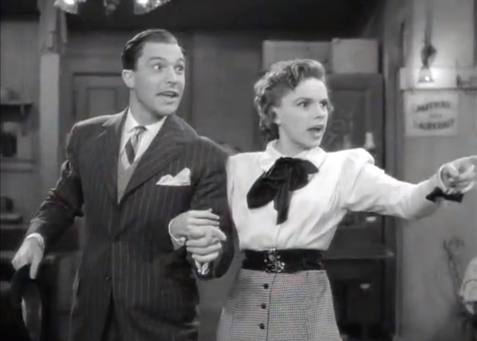
Here is a good old-fashioned American musical that effectively acts as an homage to the vaudevillian circuit that saw many performers realize their talents including numerous future Hollywood icons. At the core is a musical dream team in Judy Garland and Gene Kelly.

Behind the camera is the much revered Busby Berkeley who made musicals into gargantuan extravaganzas thanks to how he managed to capture human forms from above like no one before him. Ironically, here he’s working in a somewhat more conventional and dare I say, informal setting where we get to share the mundane spaces with our stars.

Kelly is Harry Palmer, a man who makes a living clowning around on stage. The arm spinning pirouettes and the athletic moves that defined his style of hoofing are obvious from the outset as are his infectious charm and winning smile. He’s still in the latent stages of his genius but that’s okay. There’s still time.

Judy Garland at this point in her career already had sizable stardom and it was Kelly the Broadway up-and-comer featured in his film debut. But in the ensuing decade, there was no doubt about it whatsoever. They both became quintessential musical stars of a generation along with a select few.

Jo Hayden (Garland) is a song and dance gal who while not having made “The Big Time” yet, still has a noticeable amount of talent. She partners with the good-natured Jimmy Metcalf (George Murphy) who harbors an obvious crush on her. She thinks he’s sweet.

Harry Palmer on the other hand, always seems to be making a fool of himself. A genuine person like her can see right through his come-ons. While her gangly brother (Richard Quine) agrees to finish up his med school, Jo is following her ambitions to get somewhere. She subsequently realizes she does have a bit of chemistry with Palmer on stage after an impromptu performance, if not for the fact that she is already a part of an act.

Jimmy does the noble thing and lets her go as they all have their sights on the Palace Theater in New York City.  You see, it’s the holy grail for vaudeville performers. It means you’ve made it. Palmer is ecstatic when he meets a singer (Martha Eggerth) who already performs there, thinking she might be his in. But he remains true to what he has going with Jo. Still, time and time again they’re playing small towns and their aspirations never seem in reach.

Even when it is right there in front of them and their manager (Keenan Wynn) has seemingly pulled through, Harry is torn up to find that he’s been drafted to head over to France to help the doughboys in putting the Kaiser to rest. He’s no draft dodger but he wants his dream so much and they are so close to being realized. He takes a plan of action that Jo misconstrues as cowardice. She’s ashamed that he would do such a thing especially since her brother is overseas fighting already.

Thankfully that is not the final word. Life sometimes has a curious way of bringing people back together and in the case of this cinematic world, we get a cheering finale courtesy of the MGM dream factory. While For Me and My Gal revels in its star power and the intimate chemistry built between them on the stage and in dressing rooms or in train compartments, we are soon reminded that this film has an ulterior motive. It’s a musical, it’s a romance, but it’s also a product of the American homefront.

Like a Sergeant York (1941) or a Yankee Doodle Dandy (1942) this effort was made with a higher purpose to act as a kindling rallying cry for nationalistic fervor going into WWII. However, just like its contemporaries, the reason we’re still watching it today isn’t necessarily due to those aspirations but the emotional connection elicited from its stars. This is what makes For Me and My Gal truly swell with sentiment. Thankfully Judy Garland and Gene Kelly got together on two more musical efforts to keep it going. Because they help elevate this above the spectrum of a run-of-the-mill propaganda musical with their palpable charisma that transcends any maudlin patches.

4/5 Stars

The Strawberry Blonde (1941)

the strawberry blonde 1.png

The opening shots of The Strawberry Blonde are not unlike Easter gatherings at my family’s house. Croquet in the backyard…well, that’s about it. But that’s precisely the distinction that’s being made as Raoul Walsh develops a dichotomy between two societies on either side of a brick wall.

On one side the Yale college boys play guitar as their gals all gussied up sing “Meet Me in St. Louis” after a rousing game of croquet. They are eye-catching and the frivolously well-off members of the elite. We think of them and their gayly prim and proper ways when we conjure up archetypal mental pictures of the so-called “Naughty Nineties.”

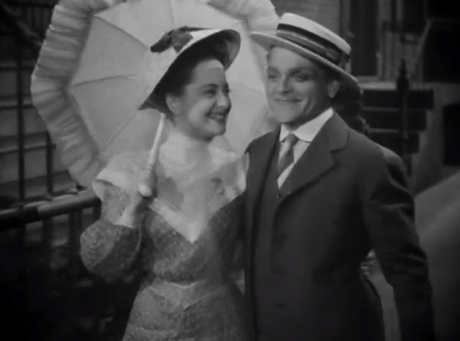
On the other end, two working men play a good old-fashioned game of horseshoes. They’re a different type of folk. A Greek barber (George Tobias hidden behind an accent and a mustache) and our pugnacious protagonist Biff Grimes. It’s not a typical Cagney picture but it’s still a typical hard-nosed Cagney and that’s the joy of it.

To use his vernacular, he’s a real hairpin. The kind of guy who never takes nothin’ from nobody but has made a habit of getting stepped on his entire life. Whether it’s the girls he’s missed out on or the fights he’s lost or any number of other footfalls. A 5-year stint in prison springs to mind.

Still, he can’t believe he missed out on the flirtatious, bodacious strawberry blonde Virginia Bush (Rita Hayworth), what seems like so many years ago now. But as was his habit, Biff’s friendly rival Hugo Barnstead (Jack Carson) ended up the lucky man.

Following their fateful first encounter, Biff gets continually saddled with Amy Lind (Olivia De Havilland) which obviously would be far from a disappointment with any sensible man. That doesn’t stop Biff from being sore. He needs a house call to get it through his thick skull that he really has a life to be grateful for.

This is the Epstein Brothers’ glorious revamping of a failed Gary Cooper vehicle from 1933, in this case, made to tailor fit James Cagney. The actor returned to his old studio, Warner Bros., looking for a change of pace to get him as far away from gangster fare as possible. Likewise, director Raoul Walsh was looking for a change after the riveting but tragic drama High Sierra (1941).

Given the results, it’s little surprise that the director considered it one of his personal favorites among the many pictures he helmed over the years. The quality cast starts with Cagney but we really have four superb talents at its core rounded out by Olivia De Havilland, a vivacious Rita Hayworth, and that old happy-go-lucky jokester Jack Carson. Alan Hale fills in as Cagney’s derelict father who’s always finding himself getting thrown out of the local saloon by the ear.

By now I all but take James Wong Howe’s photography for granted but as per usual, The Strawberry Blonde looks two-tone drop dead gorgeous as it lights a world with nostalgic hues of turn-of-the-century New York. Whether moonlight, streetlights, or candlelight, it is a film that is totally evocative of a bygone era.

Where men removed their coats to partake in fisticuffs. The same men humored their best girls with Sunday walks in the afternoon while local bands paraded through the park their brassy tunes wafting through the air. The barbershop subculture was in full bloom, quartets and all. Likewise, modernity was coming into its own with nitrous oxide, horseless carriages, electric lights, women’s suffrage, and the art of spaghetti imported from Italy.

In some paradoxical way while being nostalgic it still finds a way to feel surprisingly progressive particularly through the character of Olivia De Havilland with all her so-called improprieties. A nurse who winks, smokes, and whose mother was a bloomer girl and her aunt was an actress. At least on the surface. Maybe she’s not quite like that.

Meanwhile, Biff is always trying to save face his entire life and as a married man, he’s trying to save face with his concerned wife. He lives with discontentedness instead of satisfaction but just as the times keep on changing, Biff does too, realizing how lucky he is.

What makes the film itself a charming change of pace is the fact that it’s not concerned so much with one singular defining moment of drama but an entire life and it elicits a connection with a time and place even as we feel a sense of pity for Biff. It’s not a bleak film, more of a wistful one, and with wistfulness, a lighter more nostalgic tone can still be evoked.

Even to the end when Cagney takes on the masses it’s great sporting fun and he gets in his licks like any of his gangster pictures but he does it with a loving wife and a life to be wholly satiated by.

4/5 Stars

“Don’t be a hypocrite Virginia. Spiritually you winked.” ~ Olivia De Havilland as Amy Lind

Lured (1947)

LuredPoster.jpg

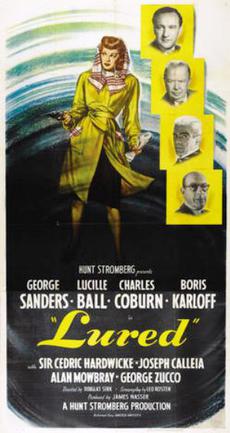
Herein is a slightly off-kilter serial killer, mystery-thriller and early American film in the career of German emigre Douglas Sirk. Of course, the action is actually set in England. It’s a film that builds a paranoid framework like The Lodger (1944), I Wake Up Screaming (1941) or other like-minded films. However, it goes through the normal paces only to lurch forward in the most curious directions.

The parties involved include a Scotland Yard guided by that industrious Brit for a day Charles Coburn. Other people of interest include a street-smart nightclub dancer (Lucille Ball) who saw one of her co-workers go missing after a rendezvous with a mystery man. In fact, a rash of disappearances of young attractive women has overtaken the city.

Thus, upon finding Ms. Carpenter to be a plucky and intelligent young woman the inspector calls upon her services to force their elusive perpetrator out in the open acting as the tantalizing bait. She begins to respond to advertisements in the paper — his calling card — to lure victims into his clutches.

The only problem is figuring out who the man might be because numerous candidates roam the streets and many people circa 1947 placed postings in the paper. It’s common practice. Among people she gets caught up with are a delusional fashion designer who became unstable after years of criticism. The one and only Charles van Druten is played by none other than Boris Karloff in one of the film’s many digressions.

Likewise, Ms. Carpenter answers a call for a position as a maid, though the prospective employer’s intentions prove to be far more insidious involving some dealings in South America and too-good-to-be-true promises of advancement. Once more Scotland Yard puts an end to the criminal activities but is no closer to their murderer.

One of the more prominent people of interest is Robert Fleming (George Sanders) a man of vast influence and a stage producer who finds classical music tepid and most of the upper echelons of the society’s elite even worse. He goes about it all with the playful disdain that can only be attributed to George Sanders at his best.

In fact, his manner is off-putting to Sandra as well but their prickly beginnings cannot completely derail romantic feelings. In those respects, both Ball and Sanders prove to be adequate romantic leads propelled by their wry comedic proclivities. That’s far more rewarding than any romance. The only problem is that he might not be who he claims to be and at any rate, a great deal of circumstantial evidence is piled up against him. A final push for justice must be made.

Lured isn’t an instant classic as the tension while there is never altogether sweltering. But simultaneously the screen is crammed with quality performers and just enough idiosyncratic moments and bits of humor to keep the film from being absolutely conventional. George Zucco is by far the most amusing of the many supporting characters as the crossword puzzle-loving officer H.R. Bartlett who acts as Sandra’s guardian angel while simultaneously coming upon many of his solutions through simple eavesdropping.

This is also a telling film that should make us uncomfortable and it’s not so much that things feel overwhelmingly misogynistic and objectifying of women, it’s the even more sobering fact that things have not changed as much as we would like to believe.

What is the root of most serial killing? Surely we can see familial issues or mental instabilities but oftentimes it’s tied in with a distorted sense of love wrapped up in perverse fantasies hidden from view.

Our killer is obsessed with the poetry of Baudelaire and uses it to realize the fantasies that he never seems able to act out on. The man’s interest is in destroying beauty instead of making love to paraphrase Coburn’s character. When he finally is revealed I’m not sure it’s a surprise but then need we be surprised? Many “normal” men are capable of great evil. They’re simply good at covering it up.

3.5/5 Stars

So Proudly We Hail! (1943)

so proudly we hail 1.png

There were three reasons to watch this film. Their names are Claudette Colbert, Paulette Goddard, and Veronica Lake. Yes, this picture directed by Mark Sandrich was fairly groundbreaking in its day for telling a story about nurses during WWII but there might be mixed feelings across the board about how the story unfolds.

While I still try and organize my own perceptions, a moment can be allotted to take stock of our stars. Claudette Colbert strays quite far away from her comedic sweet spot in a dramatic role as Lt. “Davy” Davison that she nevertheless conducts with a compelling fortitude.

The studio also all but got rid of the iconic peekaboo bangs of Lake and exchanged any of her many noir gals opposite Alan Ladd for a vengeful nurse, Olivia D’Arcy, traumatized by Pearl Harbor and the dirty Japs who ruined her life forever. She’s practically a different person.

Although Paulette Goddard hardly ever appears in a sweater, the boys are still enthralled by her like always but even she is given a major reality check about the hardships of war. And that’s part of what this film was meant to reflect — that it wasn’t just the brave soldiers who were putting their lives on the line — but there were legions of women too sacrificing and giving their all.

Paramount also did a very commendable thing in trying to de-glamorize their biggest stars in deference to delivering this stirring patriotic drama as a eulogy to all of those at Bataan and other South Pacific battlegrounds. But while the intentions are admirable, there’s this underlying feeling that Hollywood still creeps into the story far too often, which makes sense, since this is a Hollywood picture.

It all begins with an extended flashback as the film follows the nurses through their deployment. First, there are the tearful send-offs leaving families for the first time or gals leaving their best guys. In the case of Joan (Goddard) she gets away from two of them and by the time she’s onboard, it looks like she’s already landed a new one (Sonny Tufts).

In the wake of the hysteria following Pearl Harbor, the nurses are for the most part caught in a fog of war without any knowledge of what is going on and the Japs have all but jammed their communications. They continue floating around listlessly just waiting for some definitive plan of action.

When it comes and they are brought in as reinforcements to the Bataan peninsula. Here finally it seems we get our first look at the front lines. What reality really looked like. The mayhem that overtakes any war zone. It’s pure insanity. By the film’s midpoint, they are being pushed back and the evacuation becomes a life or death ordeal. We finally begin to see the casualties.

What follows is a single moment that comes like a kick in the gut and it’s a segment in the picture that we cannot criticize for being hammy or over-sentimental, delivering a visceral shock that’s a painful reminder of how abhorrent and horrible war truly is. Lake is allowed to let her hair down for a final instant as she leaves the picture in searing fashion. It burns but there is another inkling that suggests that this might really be emotional manipulation.

My main qualm is that the picture feels fake in a theatrical sense. If it’s true that film puts a mirror to reality, it also seems equally true that we often only care to see what we want to in that reflection. We document that and then do a little touch up afterward. James Agee harshly likened So Proudly We Hail to war through the lens of a housewife’s magazine romance.

My own feelings are perhaps more nuanced. It’s propaganda to be taken with a grain of salt. In one sense it couldn’t be more realistic as a document because it comes out of that time and place as a timely film while the war was still raging abroad. But the narrative is still so wrapped up in romance and melodrama built out of said love stories or personal torment. And yet it indubitably has its affecting moments that are difficult to brush off.

What I really appreciated was that its intentions were honorable. To give a spotlight to women and it also depicted a number of Asian allies in a positive light whether they be Chinese (Hugh Ho Chang) or Filipino children dreaming that Superman will come to save the day.

All this is to say in convoluted terms that So Proudly Hail cannot be condemned as an awful picture outright. It does some things well and others with a level of mediocrity but what do my words matter now nearly 75 years after the film came out?

Hopefully, contemporary audiences were uplifted by its intentions. I’m inclined to recommend another picture taking place during the same time. They Were Expendable (1945) directed by John Ford and starring the trio of Robert Montgomery, John Wayne, and Donna Reed is another title worth considering.

3.5/5 Stars

“I’m a Chinese madame, not an Indian.” Hugh Ho Chang as Ling Chee

Sleep My Love (1948)

sleep my love

It’s an alarming cold open. Allison Courtland (Claudette Colbert) wakes up on a train to Boston with a gun in her purse and no recollection of how she got there. It drives her into a fit of hysterics that riles up the whole train, though a fellow passenger (Queenie Smith) attempts to steady her nerves. We can’t blame her much since she’s been through quite the ordeal. Still, Courtland spends the entire picture trying to figure out what’s happening as does the audience.

Her concerned husband is played by Don Ameche that suave and charismatic heartthrob. It’s easy to see how he could be absolutely charming in comedy fare (ie. Midnight). Here he’s not so enjoyable. Perhaps in attempting drama, he comes off as too flat. There’s not enough definition there to be compelling. He’s just another handsome face.

Meanwhile, Allison’s evenings are haunted by a specter of a man (George Colouris) who keeps her under psychological duress with broader implications that tie him to a sultry and sulking siren and an entire plot to discredit Allison’s sanity through hypnosis and mind games. If it sounds ludicrous it is but Hollywood was mesmerized by the powers of such forces in the post-war years.

Because you see, she conveniently is the holder of a large inheritance and it seems like a lot of people want a piece of the pie and they’ve gone to great lengths to get it. Hazel Brooks continues in the same mode as Body and Soul (1947) providing the film’s femme fatale, Daphne, sizzling with avarice.

Most people are probably not accustomed to Douglas Sirk and film noir together but this movie proves it to be so, unfolding as an eery paranoia-filled drama that is very much brethren with Hitchcock thrillers like Suspicion (1941) or even Notorious (1946) along with George Cukor’s Gaslight (1944). And some of the broad aspects of psychological conspiracy are akin to I am Julia Ross (1945). However, Sleep My Love does enough to carve out its own unique path even if it’s not as prominent as these earlier titles.

Because Claudette Colbert far from going it alone finds a formidable ally in Bruce Elcott (Robert Cummings), a friend of one of Courtland’s old acquaintances the bubbly Barby (Rita Johnson). Elcott becomes quite the sleuth and a character of tremendous integrity who seems a far better fit for our leading lady than her actual husband. He’s also falling for her.

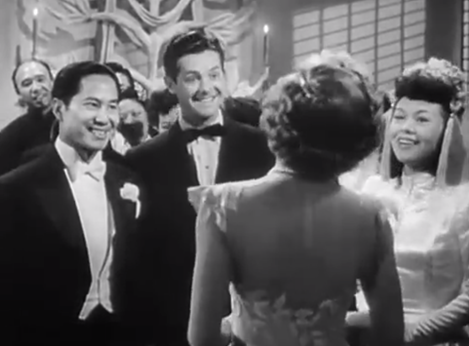
A high water mark of the film is an extended wedding sequence that is surprisingly fascinating. First off, it’s rather remarkable because it shows a wedding between a Chinese-American couple (Keye Luke and Marya Marco) and it plays it straight and true without any stereotypical sentiment. It feels like a real wedding and an authentic portrayal of this union without the necessity of needless bigotry to sully the moment.

The evening festivities prove equally joyous for our stars who form a quality bond and what feels like it could have been an unfortunate aside becomes one of the film’s most diverting sequences choosing to forego dime a dozen drama for a bit of depth.

In subsequent scenes, Keye Luke, Bruce’s “brother” from his extended time in China becomes his right-hand man as he tries to get to the bottom of Mrs. Courtland’s curious situation that turns perilous very, very quickly. It blows up in the end with a domino effect of dramatic trip wires that set off all sorts of outcomes that came hurtling to their conclusions as quickly as they began. It’s over the top certainly but no less a gripping finale if the film is given leeway in the areas of realism.

If this film is not what we would come to think of in Douglas Sirk there’s no doubt that it feels less dated than most, anthropologically speaking, coming from an intellectual man who seems to carry an open-minded and forward-thinking approach.

Likewise, the intense interest in the human psyche might have matured in the years since, but there’s little doubt that it still holds a prominent place in our modern world with its ceaseless intricacies. One could say psychological complexity is one of the reasons movies still get made today. That and a craving for romance.

3.5/5 Stars

Kings Row (1942)

kings row 1.png

Kings Row is apparently a good place to live. The billboard in town says as much. It’s the goings-on in the community that tells a different story — providing a conflicting more subversive view of small-town America.

The story starts out with 5 children. It feels like we hardly get to know them before they are already grown. For some, it feels like we hardly get to know them, period. Robert Cummings is Parris, a fresh-faced polite young man who still exudes a naive innocence and he manages it at 31 years of age. He certainly doesn’t look it.

Those qualities are precisely what is called for in Kings Row, a film directed by Sam Wood (The Devil and Miss Jones) that feels like an enigma — a sprawling coming-of-age drama that dares to show the dark underbelly of society in a very patriotic time.

Despite being hampered by the Hays Codes and its gatekeeper Joseph Breen, Casey Robinson’s script is still a fairly adequate adaption. It comes off surprisingly frank for a mainstream success during the war years even if it can’t quite cover all the vast territory the book undoubtedly expounded upon. But it was a notable forerunner of such pictures as Peyton Place (1957) or even Blue Velvet (1986) years later. It does not shy away from cancer, death, suicide, psychological duress, and all sorts of malice.

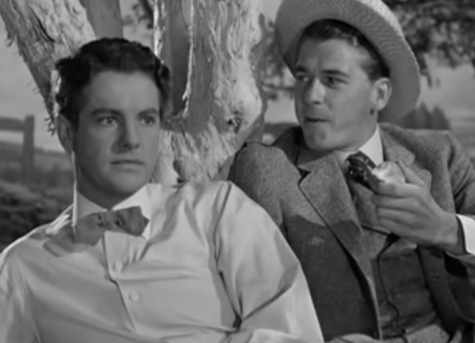
Cummings is joined by Ronald Reagan playing his best buddy Drake McHugh, an affable straight shooter with that winning Reagan charisma. Reagan and Ann Sheridan prove to be a great delight with undeniable chemistry if not for the fact that they don’t actually share a scene until well into the picture. In normal circumstances, you would say they’d make a happy couple.

Meanwhile, Cassandra Towers (Betty Field) and Lousie Gordon (Nancy Coleman) seem at the fringes of the narrative if not all but forgotten. Cassandra was formerly Parrises sweetheart when they were kids. But her family is ostracized in town because her unseen mother has mental problems and her father (Claude Rains) pulls his daughter out of school. Parris doesn’t get to see her until years later when he’s under the doctor’s tutelage. He learns to admire the man but that doesn’t make the family dynamic any less disconcerting.

Likewise, before setting his sights on Randy Monaghan (Sheridan) from the other side of the railroad tracks, Drake had his eye on Louise but her parents, Dr. Gordon (Charles Coburn) and his wife (Judith Anderson), were vehemently against such a union. They believe Drake to be unscrupulous, fearing what others will say about his nighttime buggy rides.

Not to be outdone, Drake gets over his first love and moves on with his life. It’s one of the most satisfying parts of the picture. He seems genuinely content. Though he is miles away in Vienna, Parris is continuing his aspirations of becoming the first psychiatrist in his hometown.

But Kings Row remains a coiled spring of melodrama quickly catapulting from romance to drama back to passion then darkness and romance again. Drake’s life back home turns morosely tragic giving rise to the line that would define Reagan’s career, “Where’s the rest of me!”

James Wong Howes’ photography is A-grade as per usual. The shades of melodrama are his to dictate and he does it exquisitely suggesting tonalities with every composition. The well-remembered score by Erich Wolfgang Korngold has an undisputed majesty which seems to be echoed in some of John Williams most resplendent works from Superman to Star Wars.

There is so much that goes as unspoken subtext in the movie, simultaneously helping and hindering the final outcome. Easily forgotten are the troubling parent-daughter relationships with brokenness at the seams. Claude Rains appears in a very severe role as Dr. Towers who seems like a good man but in the same breath, he still has some lifelong demons he cannot contend with.

Charles Coburn is positively acerbic, channeling every bit of malevolence he can muster. It’s another small but markedly different role than his usual cantankerous or avuncular comics. The trifecta of supporting talent is rounded out by Judith Anderson who only has a couple scenes but they paint a picture of yet another strained mother-daughter dynamic. These issues provide an alternative unnerving layer to the drama but there are so many other subjects to be broached so these feel muddled.

Kings Row barrels towards a lightning fast conclusion that looks to resolve the film’s entire length in a matter of a few moments and that proves to be a heady proposition. An almost unnaturally joyous ending cannot quite tie up all the loose ends and the questions we may still have as outsiders trying to come to grips with this world. But there is one that does become evident and one thread of morality that shows itself.

Humanity was not made to live paralyzed by gossip, hearsay, and secrets that can never be completely rectified. Instead, what we can do is bring all that is in the darkness into the light and do our best to hold on dearly to our relationships.

Because strains of hypocrisy, sickness, and pernicious intent will look to undermine our happiness until the end of time. One of the keys is striving for a life that takes the hardship and comes out of it with a continued zeal for life. Battling all that is depressed and despondent with a spirit of pure integrity.

So while there’s still something unspeakably unsatisfying about Kings Row that’s not to take away from its positive outcomes. Just seeing a smile cross Ronald Reagan’s face once more almost feels like it’s enough. I still remember going to the Reagan Library and watching some clips from Kings Row, a film he likened to his best work. Now many years later I can finally say I’ve seen it for myself.

3.5/5 Stars

It Started With Eve (1941)

it started with eve 1.png

We enter a newsroom that feels like it could be ripped out of His Girl Friday (1940). The editor is lining up his copy for the following day with a big front-page spread on the renowned millionaire Jonathan Reynolds (Charles Laughton). They just need him to die and they can print it.

Of course, at this point, it looks like it’s all but in the books. He’s a very sick man, on his deathbed, straining at what look to be his final gasps of air. His son (Robert Cummings) is rushing away from his vacation to be at his father’s side before it’s too late. The doctor fears the worst but his son makes it back from Mexico City in time to catch his father.

They share some tearful exchanges. Then, comes the fateful moment where his dad asks to meet his new fiancee. Wanting to honor his father’s last wish, Johnny goes pell-mell to his fiancee’s hotel but she can’t be found anywhere and he tries everything.

In a frantic moment of duress, the man makes a decision that will forever alter the course of his life. A hatcheck girl at the hotel (Deanna Durbin) becomes the perfect stand-in for his fiancee on a dime.

Frantic, he promises her 50 bucks and takes her to his father’s bedside. They share a poignant exchange and Johnny thanks her for her services and thinks that is the end of it — of his father and his relationship with this woman — but he’s terribly mistaken on both accounts.

Against all medical opinions of the family doctor (Walter Catlett), Mr. Reynolds makes a miraculous recovery and is back to his old ways craving cigars and steak for breakfast. It’s joyous news until he wants to have breakfast with Gloria Pennington whose actual name is Anne Terry.

Now his son is in a jam and he pulls Anne away from her train to Ohio to keep his father happy by maintaining the charade. Now he’s in deeper than he wants with one “fiancee” hitting it off with his father and the other with her mother waiting to be introduced to Mr. Reynolds. Needless to say, the local bishop (Guy Kibbee) gets the wrong idea about the boy he has known from youth who has become a degenerate philanderer supposedly keeping company with two different women.

Johnny could care less. He’s still in a bind and his main goal is to get everything patched up by paying off this girl again and enlisting the help of the doctor to introduce his fiancee into their home very naturally before the big party his father is throwing. It’s easy enough to tell his father that they have a lover’s quarrel and the “engagement” is off.

And yet, Anne doesn’t let it go that easily and she returns to profess the error in her ways and make up. Because now she has a larger stake in this new relationship. She’s a struggling musician who has heaps of talent. It’s just that she’s never gotten a chance to share it with someone important. This is her one shot at a big break. But far from being an opportunistic girl, she also adores this man and to some extent likes his son for a certain amount of sensitivity that he has.

Durbin and Laughton are brilliant fun together because he remains the crazy glue that holds this “romance” together. While things look like they have run their course and Johnny has salvaged everything the way they were originally meant to be, Mr. Reynolds goes off script and does the unanticipated, he drops everything at his gathering to see Ms. Terry.

But of course, we already know they aren’t a real couple and so it makes for an initially awkward and then a surprisingly jovial evening, finished off with a lively round of the conga. Mr. Reynolds succeeds in almost giving his good doctor a heart attack and sends his son for a real loop. In another fit of Deja Vu, Johnny races after Anne’s departing train to catch up with her once more. This time for good.

Charles Laughton is undoubtedly the M.V.P. of the picture providing a delightfully grouchy yet lovable turn hidden behind a mustache and a happy old boy persona which channels a bit of a naughty schoolboy at that.

Cummings has a knack for the clumsy, flustered comedy that comes as a result of his initial bumblings. He and Durbin work through the hilarious miscommunications that ensue beautifully as standard procedure in such a screwball musical. Instead of kissing like normal people they giggle, cackle, pinch, bite and do about everything else including play fight around the interior study. But if that isn’t love then I don’t know what is.

4/5 Stars


My Favorite Blonde (1942)

my favorite blonde

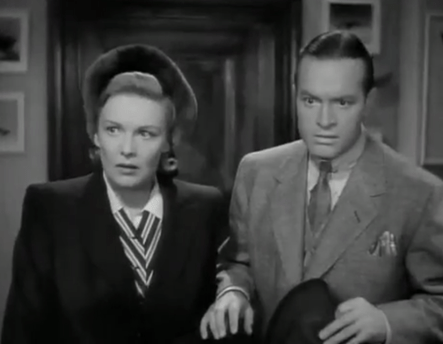
Bob Hope was one of the 20th centuries greatest personalities but sometimes his pictures weren’t always up to par. The most obvious exceptions would be the majority of the Road pictures with Bing Crosby, The Paleface films with Jane Russell, and this fun addition pairing our beloved funnyman with the divine Madeleine Carroll.

It’s not quite a Hitchcockian thriller but Madeleine Carroll provides an icy blonde secret agent while Bob Hope is in usual form with his typical smart-mouthed nitwit characterization that garners our love.

Carrying over some of the world from The 39 Steps (1935), enemy agents are looking to intercept invaluable secrets that are needing to make their way to America in the hands of Karen Bentley (Carroll). Her partner has already bought it and she has two tails observing her every move.

The place she chooses to hide away at is the backstage of a vaudeville joint where Larry Haines (Hope) is just finishing up with his penguin partner Percy who has a big contract coming in Hollywood. Larry has been included on the bill as an afterthought.

But all that is put on hold when this beautiful, mysterious woman wanders into his life. He gladly entertains her company and yet he doesn’t know what else comes with that proposition. In typical fashion, Hope’s character always bites off more than he can chew whether it be villains or women. He’s got no answer for either.

A near wordless confrontation occurs on a train as the girl hides and Hope sits with some leering thugs in the club car, filling the moments with nervous comedy bits.

His answer for Ms. Bentley isn’t much better. It’s the same type of patter that would be recycled in My Favorite Brunette (1946) or other Hope sketches where the woman plays it straight, seducing him and he’s outright oblivious from the first advance. He has no defenses to speak of. A few strands of cajoling baby talk and he’s putty in their hands.

But the gal gives him so many mixed signals he’s libel to run out on her cockamamie ways or let her have it (Yeah the little man is hurt and if the little woman doesn’t watch it she’s going to get a little hit in the head). Still, they somehow keep winding up in the same places. Perhaps it’s because she’s conveniently hidden vital international secrets under the lapel of his coat.

He somehow feels like the only normal fellow in a screwed up world but if everyone else is playing cloak and dagger games, that becomes the new normal and he begins to look all the crazier turning increasingly more paranoid due to the various antics around him. Maybe he doesn’t have all his buttons after all. If he’s our new archetype for the man-on-the-run, then I’m Cary Grant.

Some throwaway expositional dialogue over the film’s MacGuffin gives Hope ample time to retort with a joke about his ring being filled with Benny Goodman and his band (They had to drop a clarinet player. It was a little crowded). That exact moment exquisitely sums up why the film works. There’s the spy thriller arc that is continuously deflated and lampooned by Hope’s particular brand of comedic zingers.

An ingenious ploy to escape an apartment complex crawling with baddies leads to a rampage to trash the joint while drumming up some marital pandemonium that’s bound to bring some police. It’s sheer comedic chaos and…it works. Ironically, Cary Grant would reuse a similar gag in North by Northwest (1959).

Another moment Hope is taking on the mantle of a baby specialist, Doctor Higbie, much in the way that Robert Donat joins a political rally in The 39 Steps. Both men pull quips out of their backsides to stirring results on their way to their next juncture on their ever-changing itinerary.

Thanks to an absolutely nefarious move by that criminal mastermind Gale Sondergaard, a murder is called in by the real culprits and pinned on our heroes. But Hope continually proves his faithfulness or at least how much he likes the blonde with the face and a certain je ne sais quoi. And that’s part of Carroll’s allure but far from being a glamorous Brit, she proves just how much she can pull off the more screwball elements that Hope already seems at home in.

The home stretch leads to California with the murder rap still hanging over their heads and a funeral parlor in their sights. To get there it took them a bus, a plane, a winking Bing Crosby cameo, and a few watermelons a piece.

Like the best classic thrillers it’s not so much the outcome but the road it takes to get there that we relish the most. This one has a lot of lovely inane speed bumps that perfectly accentuate the utter contrast between Madeleine Carroll and Bob Hope’s character types. They actually end up making a witty romantic couple and Hope as always gets the last laugh in on camera.

4/5 Stars

Here Comes Mr. Jordan (1941)

here comes mr. jordan 1.png

I’ll lay my cards right on the table. I’ve never been a huge fan of Robert Montgomery. He just doesn’t have a charisma or a delivery that I much care for so as far as carrying a whole picture I’m not quite sold.

Still, with Here Comes Mr. Jordan, it all seems to work and it’s funny and clever in ways that would cause Hollywood to strive for storytelling that looked to think outside the box. Of course, the irony is, a new box gets created for people to work inside — a new style or sub-genre — but there’s little question that Here Comes Mr. Jordan feels very much the first of its kind. If not, I stand corrected.

It’s a story effortlessly built around quirky inventiveness. There are fantasy elements here that feel very much akin to the likes of Stairway to Heaven (1946), Random Harvest (1942), and Heaven Can Wait (both films from 1943 and 78).

Heaven is depicted as a kind of celestial processing center where human beings are plucked away from their life on earth to begin a new afterlife. Through intervention, by angelic beings, lovers can all but forget one another only to have some deja vu feeling that they’ve been together before.

And further still, the ideas of the heavenly and angels entering into everyday life soon became a staple of 40s and 50s Hollywood much in part to this picture. Without it, there’s a possibility that classics such as It’s a Wonderful Life (1946) and the Bishop’s Wife (1947) would not have been conceived in their most remembered forms. After all, what would those films be without Clarence or Dudley? Or what would this one be without Mr. Jordan for that matter?

Elaine May must have thought the story was ripe for more exploration too when she penned Heaven Can Wait which expanded a great many of these ideas only in a different context.

Unequivocably this rendition proves to be far from a one trick pony, taking a main conceit that admittedly seems absurd at first — even gimmicky — and turning it into a fantastical comedy with continual possibilities.

Imagine just for one moment that a feisty boxer, Joe Pendelton (Montgomery), preparing for his next big bout flies to the site of the fight only to have his plane malfunction en route. He looks like a goner but he’s pulled from the aircraft too soon by 7013 (Edward Everett Horton). In fact, it’s 50 years too early, his date with the afterlife is not until 1991 (In case you were wondering, Montgomery actually passed away in 1981). Being the bullish personality that he is, Joe’s not going to sit by when he had such a good thing going on earth.

The genial Mr. Jordan (Claude Rains) grants his wish and inserts Joe back into life but they must find him a new body — you see his previous one has already been cremated which makes for added complications.

We plot his journey between two distinct individuals and their bodies and aside from the opening plane crash, a few puffs of smoke, and a few parlor tricks, the film doesn’t rely too heavily on any amount of special effects. For all intent and purposes, things are normal as they’ve always been. It’s just the parameters that have changed. Namely the fact that Joe can see Mr. Jordan and no one else can. First, he’s Bruce Farnsworth formerly a crooked magnate who was murdered in his bathtub by his wife and her lover.

Boy, are they surprised when he turns up again. Mr. Jordan and the audience see Montgomery but the others see and hear the man that they think they’ve done away with. Still, coaxed by Mr. Jordan, Joe or Farnsworth, turns this man’s life around, taking ownership of his past indiscretions and helping the father of a young woman (Evelyn Keyes) who was accused of fraud.

here comes mr. jordan 3.png

Meanwhile, Joe, err, Farnsworth still has his sights on his previous shot at the boxing ring. It all comes off rather odd to those who used to know his alter ego but he calls up his old coach Max Corkle (James Gleason) and he’s finally able to convince him of his true identity due to his beloved saxophone always in tow.

Finally, it looks like he’s on the road that he wants but alas complications ensue. He finds himself falling for Ms. Logan and circumstances are such that he must find another body. He settles on a straight-arrow named Murdoch and subsequently gives the fighter a second chance in the ring while hiring on Max to be his coach so he can still actualize his dreams.

Mr. Jordan leaves Joe in this moment, seeing he has a version of the life he always wanted and the celestial being conveniently removes all of Joe’s memories of a previous life. Of being a man named Joe Pendleton. It makes for some goofy comedy with Corkle and supplies one budding meet-cute with Ms. Logan.

While the theology is probably sketchy at best, it’s a good-natured, comic interpretation of the afterlife that serves the world of the film well. The only thing in question is the ethical nature of angels removing human memories but surely Claude Rains knows what he is doing.

James Gleason is an absolute riot as the one human privy to the whole gag only to look like a complete nutcase when questioned by anyone else who is “normal.” He easily puts you in stitches and Edward Everett Horton has his flustered indignance down pat. He made a career out of it after all.

4/5 Stars

Mr. Blandings Builds His Dream House (1948)

mr. blandings 1.png

Here is a Cary Grant and Myrna Loy vehicle that makes a comedy out of the morning drudgery and cramped quarters of domesticated life in that pearl of a city, New York. It’s a satire of the All-American Dream with the wry commentary of Melvyn Douglas guiding us through the raucous adventure.

He positions the story as such, the main confidante and best friend of advertising executive James Blandings (Grant) and his wife Muriel (Loy). Any given morning in their apartment involves early morning duels over shutting off the alarm clock for a few last seconds of slumber. Then, there’s the fighting over mirror space and closet space and drawer space.

But they’re true Americans singing “Home on the Range” in the shower. Singing in the shower seems to generally be a hobby of Cary Grant as he would do it again in at least one other picture. Meanwhile, their prim daughters are attending a progressive school and filling Mr. Blandings breakfast conversation with unwanted social significance.

All he wants is to drink his coffee and read his paper in peace and intact. He’s granted neither luxury. But these are only symptoms of the problem. They have a lovely home in a lovely city with two lovely daughters and a terribly lovely marriage. They’re just hemmed in on every side. And at work, he’s been slammed with the advertising campaign for “Wham Ham” which seems a living nightmare.

It’s Mrs. Blandings’ idea to consider a renovation while Mr. Blandings isn’t too keen on bankrolling interior designing and home redecorating courtesy of one Bunny Funkhouser. Instead, they mutually agree to purchase a quaint Connecticut home with real “character” that coincidentally no one has had the courage (or the naivety) to even try and buy.

But attracted by the “convenient” commute of 50 minutes, a little Revolutionary War History about General Gates’ horse, and their own dissatisfaction with the current state of affairs, they commence the biggest undertaking of their lives.

The Hackett Place could very easily be the prototype of the Haney Place years later in Green Acres. In fact, this film made me yearn for the rustic folks from Hootersville and the construction craziness of Extreme Home Makeover from year’s past because it evokes both.

Rather than deal with it as is, the Blandings knock it to the ground and sink their first wad of cash in the mammoth project. The first of many. But they are hardly attuned with what remodeling entails and the complications never seem to end nor do the bills which come one after another.

While I was secretly hoping that Dreamhouse would be an update on Buster Keaton’s One Week (1920) with Grant showcasing his usually brilliant physical antics, what we got instead is a household comedy full of incessant complications.

While I probably would have enjoyed the former even more, there’s no doubt that this film is worth it for the Cary Grant and Myrna Loy dynamic. It’s that ability to bicker and joust and fight and still have the innate capability to make up and have the audience enjoy every minute. If the film had been made years later it would have been called Mr. and Mrs. Blandings Build Their Dream House. This is without question a joint effort of marital madness and reconstruction.

For those who cherish glimpses of the past available in the present, the Blandings home can still be seen on the property of Malibu Creek State Park in California. Unfortunately, I don’t think the Blandings still live there. Sadly, they vacated the premises some time ago. The commute from Malibu to New York City was probably too much for them.

3.5/5 Stars