The Discreet Charm of the Bourgeoisie (1972): Prime Luis Bunuel

discreet charm 1.png

In school, I remember being enthralled by Edouard Manet’s “A Bar at Folie Bergerie” when it donned on me we were integrated into the piece, and the artist was messing with our preconceived notions by literally toying with our perceptions.

As an artist who came into his own a generation later with the likes of Salvador Dali, Luis Bunuel oftentimes manages the very same feat of artistic manipulation through his films. He’s the iconoclastic prince and lambaster of the bourgeoisie. He is a craftsman with an intuitive sense of how to toy with, not only his subject matter and his characters, but the audience sitting before him.

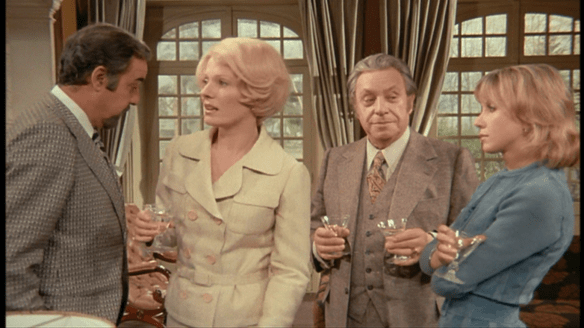
Discreet Charm of the Bourgeoisie, which we might posit as an exemplary monument to his life’s work, begins with a vaguely familiar premise. People are gathering on the pretense of a dinner party, not unlike Exterminating Angel. Except there is no invisible force holding them there. Quite the opposite. For inexplicable reasons, they keep on getting interrupted and thwarted in their attempts to sit down together for the most curious of reasons.

To their credit, the central sextet sells out to the whole charade. Fernando Rey is up to his smutty old tricks as a respected foreign ambassador with a lecherous side cultivated under the right circumstances. His frequent companions are the Thevenots, Francois and Simone (Paul Frankeur and Delphine Seyrig). Nor can one forget the Madame’s air-headed sister Florence who always seems to be perpetually tagging along.

First, they go to their dinner engagement at a friend’s home for round 1. Alice Senechal (Stephanie Audran) isn’t expecting them because she thought she invited them on a different date and her husband Henri (Jean-Pierre Cassel) isn’t at home. It’s an honest enough mistake. Except the next time, it’s more of the same as their libidos get the best of the hosts. Their maid Ines takes it all bravely with a sweet, unassuming smile as if playing dumb to all the idiocy going on around her on any given day.

It is most definitely a film of first world problems gone awry. We have a bunch of dense and pompous people of exceptional superficiality before us. However, this very easily arrived at prognostication starts giving way to more and more surrealist tinges.

The film hits the skids as Bunuel takes us into a realm all his own. Whether it’s the mind of a mad genius or a perverse old man is up for debate among the literati. But of course, he would hardly give their discourse (or mine) a thought.

Things start getting ridiculous with meal after meal stacked one on top of the other to the point of dizzying regularity. Every scene crammed together features a new dining table or a new conversation over drinks with a dash of the absurd for garnish.

Not to mention nested dreams before the days of Inception because of course, everyone, even Bunuel, seems to have some fascination with the meta, going so far as inserting his own dreams into the story purely because he can.

discreet charm 3

What becomes the guiding force is this quintessential fluid sense of absurdism accentuated through the execution of more complex shot sequences utilizing zooms and tracking shots. They maintain the continuity while helping to accentuate this Bunuelian sense of dreamscapes. Because for him that’s much of what the world is, a stream of consciousness, and there’s no necessary distinction. And yet there are times within the film he acknowledges them so explicitly as if to send a self-aware wink to the audience.

Meanwhile, he has gleeful fun forcing his characters to walk down the road together toward nothingness. One moment they’re waking up from a crazy dream. The ladies settle down for tea only for none to be available and instead they’re treated to the ghastly stories from a sad-sack lieutenant’s abysmal childhood.

All bets are off when they’re interrupted by cavalrymen winding up their maneuvers and then passing around a joint in the parlor. Another time they’re arrested for some nameless crime and another gunned down by mobsters without pretense.

I’d hardly call these moments spoilers because Discreet Charm of the Bourgeoisie is full of non-sequiturs. Anything is capable of happening at any moment. Sometimes all of dinner is a stage, and the guests merely players. Other times Vietnam seamlessly fits into the context of the scenario’s commentary (“If they bomb their own troops there must be a reason”).

In a sense, Providence is replaced by the rhythms of chance and the bizarre, laying the groundwork for the director’s implicit worldview. But of course, it stretches much further than that imprinted onto the themes and the very fabric of the characters.

The hypocrisy of the social elites is always being closely tied with religion. Bishops are to be made light of and Bunuel’s conception of their rituals can best be summarized by one telling image of a crucifix, cradled in the arms, getting dirt unceremoniously dumped on top of it. Or for that matter, the same priest gives absolution to the man who killed his parents only to think better of it.

But not for a moment would we mistake any of these abrupt outbursts for true drama; each individual instance is only a trifle, a way for Bunuel to follow his flights of fancy like he always does, trampling everything around him with wry exhilaration.

Whatever madcap visions you can imagine in their drawing-room, they basically wind up coming into being. Although Bunuel doesn’t have the same carnivalesque showmanship of Federico Fellini or the technical and spectacular panache of a Hitchcock, he nevertheless invariably keeps their company.

For better or for worse, his films and the visions they employ stay with you. What’s more, his conception of the world is quite transparent. Fellini was mirrored in the director in 8½. There are shades of the “Master of Suspense” in Scottie from Vertigo, and just about every man in a Bunuel picture bears his mark and, at the very least, his philosophy of total irreverence.

discreet charm 2

What’s striking is how volatile and relevant he feels in the modern age. I for one always find it perplexing to come at his work because not only does his filmography undermine the tenets of classical narrative convention, he also does much to play his audience as well.

“The Folies Bergere” was mesmerizing as we began to understand we are part of the piece. A Bunuel film is similar because you are brought into it as well and yet one could argue he goes a step further by making his audience the butt of the joke.

All your personal hangups and hypocrisies — social, political, religious, romantic — whatever they may be, will be ousted and laid bare. His players are easy targets as representations of the trivial social elite. But then we were tricked into spending all this time with them that ultimately went nowhere. So let me ask you, what does that make us? Be forewarned Bunuel might just get to you too.

4/5 Stars
Army of Shadows (1969) and The French Resistance

army of shadows 1.png

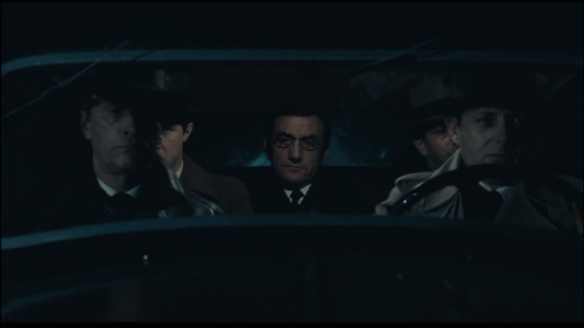
Army of Shadows is another film from Jean Pierre-Melville that falls back into the realm of the autobiographical, even as it’s based on a book by French journalist Joseph Kessel. Because Melville, a resistance fighter himself, had a previous history with this very same world. The names and dates were real, living history for him, and he gladly blended it all into his movie.

It’s also defined by the director’s well-established palette of choice. True to form, it leans into his typically dismal and dour canvass as an overt extension of its characters’ malaise. A rainbow proves a total impossibility in a Melville picture. Equally surprising is a smile on a face or an intonation of laughter.

In the opening interludes, a prison van takes a detour past a rural cottage to pick up a couple basket of provisions. It’s a curious juxtaposition and somehow a fitting bit of exposition about our setting. Because Army of Shadows is a modest epic if you will, ably covering all the ambiguities of an institution like Vichy while simultaneously documenting the moral gradient of good and evil Hannah Arendt so perceptively termed “banal.”

Our hero is a bespectacled, well-mannered man named Philippe Gerbier (Lino Ventura); he also happens to be a vital member of the underground. Hence his arrest and sentence to a local camp. He seems unphased by the whole ordeal as if he’s been here many times before. It’s all unextraordinary after the countless things he must have seen and done.

The subsequent inner monologues are honest if not pedestrian, perfectly in line with the world being developed. Because it’s a film as much about expressions as it is words. Reading over people, waiting, biding time, and weighing the options laid out. In these early instances, Ventura establishes himself as an apt hero, given our context.

In this unsparing portrait of the war years — at the same time both moral and unsentimental — he’s the perfect barometer of the times, rarely showing emotions. He dare not. You come to understand why, when faced with the ordeal of having to dispose of one of your own — a craven traitor — for the good of the outfit.

The zealous young recruit Le Masque (Claude Mann) is eager to do his part, but he’s quickly stripped of his illusions. What follows is a devastating death scene — implied though it may be — because it effectively takes away all pretense of heroes and villains. It sets a precedent for the entire picture and where it will dare to go in order to pay homage to those who went before. One shudders to think that this is one of the easier decisions they have to make.

It becomes a reality of wartime existence. People die unceremoniously; they’re interrogated and tortured even as this onscreen brutality remains minimal. Still, each and every time we’re well aware of the aftermath and the ensuing consequences. It doesn’t make it any easier. The one lesson the experienced pass on to the naive is to always carry a cyanide capsule on your person.

Although the film is unsentimental, it’s not altogether unfeeling. Rather there is a maintained sense of wistfulness around the frames. Mainland Europe has been sent through the wringer, and it went on so long they almost came to accept the status quo. Even the German “Heil Hitlers” feel a bit bedraggled and half-hearted by now.

Army of Shadows is built on the foundation of a profound paradox. Because in reflecting its own subjects, it remains extraordinarily aloof while still managing to be deeply personal, even intimate.

They keep their humanity guarded. To show it would be a weakness to be exploited. But in this razor-thin web of moral ambiguity and dubious decisions, it’s the one element holding them together.

army of shadows 2.png

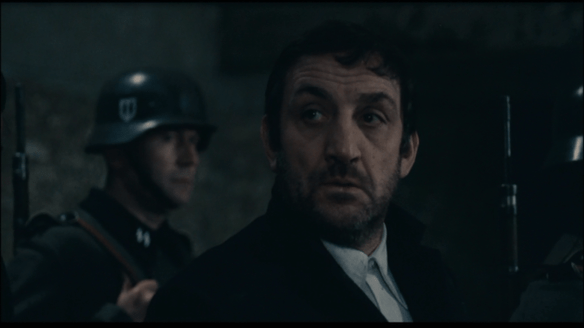
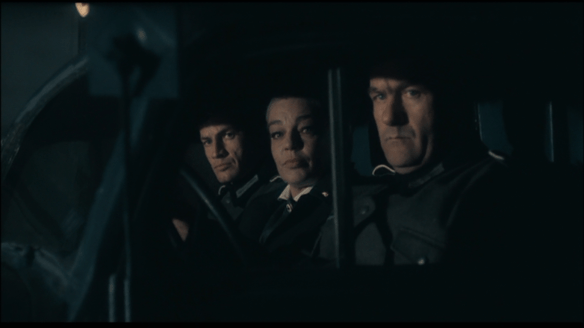
It’s striking that while he walks down a dank corridor flanked by SS troopers to a foregone conclusion, scenes flash before Gerbier’s eyes. A pretty nurse in London. Walking in the forest with Mathilde (the inimitable Simone Signoret) amidst the calm of nature. They are glimmers of something else totally contrary to what he is experiencing at the moment. He clings to them fiercely because they offer some semblance of humanity.

The same might be said of Mathilde — an extraordinary woman of immense mettle with only one weak point — a family for whom she cares deeply about. Again, you cannot totally eradicate their hearts and souls.

This is not an action film; the events making up their days feel rudimentary and yet in each case, something might go horribly wrong. We live life right alongside them in this state of perpetual anxiety. Gerbier takes on an old acquaintance (Jean-Pierre Cassel) to run errands including transporting vital radio parts past the authorities.

They conduct a late-night rendezvous with a British submarine to evacuate P.O.W.s and some of their leaders back to the British Isles. In fact, these are some of the film’s most curious digressions.

A medal is bestowed for bravery. Gerbier and his companion Luc Jardie (Paul Meurisse ) view the raptures of Gone with the Wind in the cinema rather pensively. Even with the air raids, life is seemingly brighter in Britain, with bits of freedom still hidden away behind closed doors and in dance halls. We wonder where the film can go from here? Is it stalling? No, it’s giving us the respite we desperately need.

I deeply admire seemingly ordinary people who are unwavering in their resolve to walk into the lion’s den for the sake of liberty, knowing full-well what they are getting themselves into. I believe Willam Goldman called it “stupid courage.” There’s no more startling example than those who willfully returned to Nazi oppression.

army of shadows 3.png

In this case, it’s an easy choice as Gerbier feels beholden to rescue his comrade Felix (Paul Crauchet ) who is currently being held at Gestapo headquarters, tortured to the point of exhaustion. It spells an end of the beginning because, in these dismal days of ’42 or ’43, things would only get worse before they got better.

Army of Shadows settles on a cruel conclusion indicative of the storyline thus far. In this way, the film maintains its narrative integrity. There’s no happy-go-lucky denouement slapped on. No such luck. They are faced with the impossible problems — the “Sophie’s  Choices,” if you will. I am reminded of Mathilde masquerading as a nurse, helpless to save a friend lest she betrays her cover. Or there’s Luc breaking with precedent by showing his face in public to pay his final respects to a friend.

In its day the film was a victim of poor timing, being released in the wake of ’68 with De Gaule, the former war hero, more despised than ever for his handling of the student protests.

Thus, the film became commercial and critical collateral damage, even failing to garner wider release in American until 2006! However, now it’s easy enough to look at it and one can hardly begrudge Melville his brand of patriotism since it strikes such a resonate chord with his own experience. As such, I’m led to deeply respect the film for its uncompromising perspective. It drains you of all veneration and hero-worship from the opening shot of German soldiers clomping through the Arc de Triomphe.

The true miracles are of an ordinary nature. Survival and yes, maintaining even a shred of decency in such a compassionless world. Sometimes the ultimate act of love is the most painful. The most devastating revelation the very fact that everything you might be clinging to could just as easily be a lie. What’s more, we might never know.

Forget villainy. Heroism is not a far cry from jaded, fatalistic acts of duty by insignificant little people sadly forgotten by time. I felt compelled to believe its depiction even as they unnerve me. It leaves no pretenses about war-torn France.

4.5/5 Stars

AFI Corner: 2010 My Film Odyssey

This is the Introduction to a new column called AFI Corner for film fans who want to get to know The American Film Institute’s 100 Films lists. It’s in concurrence with #AFIMovieClub and the 10th anniversary of becoming a classic movie fan myself.  Thanks for reading.

Always in the back of my mind, I had the idea of trying to write a book or compendium on how I got into movies. If you couldn’t guess already, the highly original title of said book was to be 2010: My Film Odyssey (or some derivative).

Well, it’s never gotten off the ground and probably for good reason. The world rejoices. Who would want to read a poorly edited monolith like that? After all, I’m hardly the Stanley Kubrick of the written word. However, in the same breath, 4 Star Films would have never existed without that year and these lists.

It was in 2010 where I began to take a genuine interest in classic cinema. It really was an odyssey born out of curiosity and my own ignorance about movies. I wasn’t exactly an avid moviegoer in those days.

File:North by Northwest movie trailer screenshot (28).jpg ...

But a family vacation introduced me to TCM (my family never had cable), and I got to see a handful of respected classics. 12 Angry Men (#87), To Kill a Mockingbird (#25), and It’s a Mad, Mad, Mad, Mad World (#40 Laughs) among them. Seeing Mt. Rushmore and Devil’s Monument in the flesh, meant I rushed to my local library when I got home, so I could see North by Northwest (#55) and Close Encounters of The Third Kind (#64 Original).

From there, the details are a bit murky. Somehow I came across the American Film Institute’s lists online, the two flagship editions being released in 1998 and 2007 respectively. I was too ignorant to know how much dialogue (and controversy) came with the unveiling of these lists.

All I had was my curiosity and a desire to see more. When I started, I did my due diligence and checked off a whopping 12 out of 100 back in 2010! And if you’ll notice, almost half of the movies were ones I watched that very same summer for the first time.

So I built up some steam and started taking to the list. I took numerous more trips to the library. Had family members and acquaintances all check their progress on the well-worn paper copies I had so I could match their progress. It was evident I was still a movie novice. But I was learning.

Before I get ahead of myself, I should point out this blog came out of the handwritten notebooks of “reviews” I used to keep. After almost every movie I watched, I had a desire to try and write something down, not only as a record of what I had viewed but also to give it some meaning. I didn’t want it to be a mindless endeavor. I wanted to be invested.

Its a Mad, Mad, Mad, Mad World Trailer2.jpg

Looking back, I laugh. The writing is stunted and formulaic. It’s more plot summary, and there are very few original ideas, but, again, I was learning — growing as a movie lover and a writer.

I’m not sure how this column will evolve, but I would love to share some of those reviews, many of them buried somewhere on this very blog, and then provide some commentary on them based on the movies and my own personal experiences with them.

Because while my life stage and location have changed quite a lot in the last decade, the movies have remained a constant. What I bring to them anew is what’s so enjoyable with every rewatch.

If I was a true raconteur I would have spun a better tale about my film odyssey. That’s part of the reason my magnum opus never materialized. Instead, I’ll leave you with this. I never actually completed any of the AFI lists outright. As of last year, I have seen 99 of 100 titles from AFI’s 100 Years…100 Movies (10th Anniversary Edition)!

Yeah, in 10 years I went from 12 to 99 (The one title I haven’t seen is The Deer Hunter, I know, I know). It doesn’t sound that amazing. However, this fails to count all the countless digressions and sidetracks carrying me through all the nooks and crannies of cinema. And while I might get around to watching #100 someday, I’m actually fine not having finished.

For anyone reading this, with aspirations of going through this list or something similar, I think it’s a reminder that the journey is not just about completion. There’s something to be said for setting goals (even a dubious one like watching more movies) and then going out and enjoying the experience. I can say resolutely this hobby has given me a great deal of joy, and it continues to do so even as it increases in leaps and bounds.

I hope you join me in the AFI Corner to explore more of these lists. I also hope it’s a reminder that something like these compilations is innately flawed, but they are not an end; instead, they’re a beginning. At least that’s what they were for me, and they can be for all of us. A beginning of community, conversation, and connection. Please join me!

How many movies have you seen from AFI’s 100 Years…100 Movies (10th Anniversary Edition)?

How did you get started watching classic movies? 

A Special Day (1977) with Loren & Mastroianni

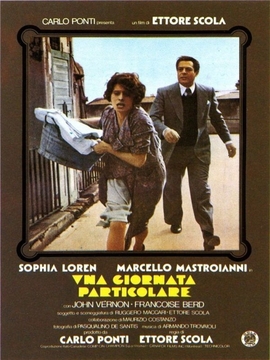
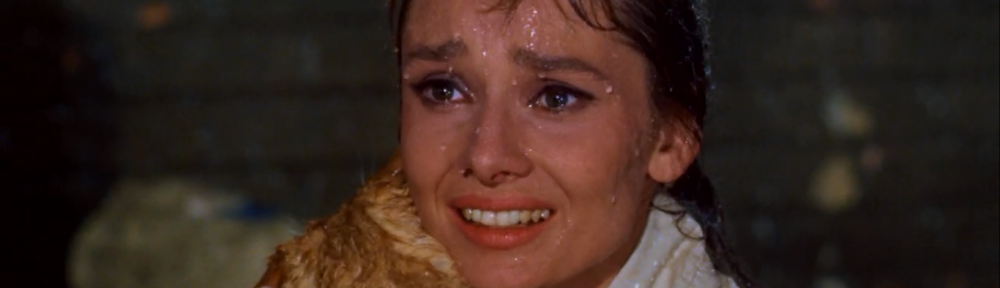
a special day.jpgThe film opens with newsreel footage delivered to us in an undoctored format effectively presenting us a view into the past. It is the momentous (some would say fateful) day Adolf Hitler made his triumphant visit to see Benito Mussolini in Italy.

The year is 1938. And it has all the pomp, circumstance, military exhibitions, and blind nationalism one comes to expect with such historical depictions. Director-screenwriter Ettore Scola elects to give us the past instead of totally constructing a version of it. Because that is not what his film is about.

Even to consider Fellini’s farcical take on fascism in Amarcord, complete with swooning beauties and talking Mussolini faces in flowers, A Special Day couldn’t be more divergent. It works and operates in a much smaller more confined space, serving its purposes just fine. As the movie itself opens, we are immediately met with the most confounding of palettes — an ugly clay-colored hue — hardly the best for drawing on fond memories. In fact, it’s utterly unappealing.

This is not a criticism, mind you, because the pervading drabness is another calculated creative decision. What it provides is a very concrete articulation of the world. Furthermore, without committing to the broader context, Scola is able to focus his attentions on one building.

So yes, there is this huge cultural event with a gravitational pull dragging everyone out of the house in droves to celebrate with patriotic fervor. Everyone wants to see the Fuhrer and Il Duce for themselves. But this is all pretense, again, serving the smaller, more intimate scale of the film. It’s for the best.

Not totally unlike Hitchcock’s Rear Window, the housing complex becomes a limiting factor, but also a creative asset. The architecture and space evolve into something worth examining in itself. Within its confines, our two protagonists are thrown together thanks to an escaped myna bird. One is a long-suffering housewife (Sophia Loren) forced to stay at home while her family enjoys the festivities. She’s a middle-aged Cinderella with all the youthful beauty sucked out of her.

Her husband (an oddly cast and dubbed John Vernon) is an arrogant party supporter and all her six children are either brats or too young to know any better. Her station as a mother and wife feels totally underappreciated, even dismissed.

The other forgotten person she happens to meet is a radio broadcaster (Marcello Mastroianni), unwittingly diverting him from an attempt at suicide. Because the current regime has no place for subversive naysayers like him on the national airwaves.

There’s a questioning of whether or not there’s enough for a film to develop. Can it hold on and keep us on board for over an hour? Given everything so far, it’s a no-frills scenario. There’s not much to work with, and success in itself seems like a tall order. Thank goodness we have the likes of Sophia Loren and Marcello Mastroianni. The promise of having them together is a worthy proposition and in this case, it hardly disappoints.

If you’ve only seen them in their star-studded, glamorized roles, prepare to be astounded. Loren could never look completely dowdy, but there’s definitely something forlorn about her. She carries it off quite well. Likewise, Marcello, normally a suave fellow, still has his prevailing moments of charm, but he too is equally subtle.

At least in the case of Loren, it seems like Hollywood only ever saw her as a screen goddess with an accent, and thus cast her in roles catering to that predetermined persona. And yet in her native Italy, in a movie like Two Women (1961) or here in A Special Day, it’s as if they gave her the freedom and the trust to stretch herself and really prove who she was as a bona fide actress.

The little doses of magic they drum up together carry scenes and if you’ve ever seen any of their movies, the intuitive chemistry coursing between them is, by now, almost second nature. Dancing steps of the rhumba to the cutouts on the floor. For one single moment, a saucy tune drowns out the choruses of a fascist regime.

Later she tries to quickly style her hair in the bathroom as he bungles grinding the coffee and sweeps it under the rug like a sheepish schoolboy. Or he makes his valiant attempt at fixing the lamp over the kitchen table that always leaves Antonietta bumping her head. These are the lighter notes.

But if these are the distinct instances of near frivolity, then A Special Day is about so much more on a broader scale. It casts an eye on a society that deems women as totally auxiliary in both intelligence and importance.

Likewise, one is reminded about the institutionalized hatred including vitriolic prejudice against homosexuals. Where people have lost their image and are merely cogs in a political, faux-religion of the state. Not everyone fits in. Gabriele even exhibits a touch of mild insurrection to the state by not abstaining from using the banned “lei” instead of “voi” when addressing others, as the former was seen as too effeminate by Italy’s fearless leader.

If not totally radical, the relationship at the core of this movie feels countercultural, even as it probably taps into the basic longings of many. In some strange, miraculous way they understand one another, unlike anyone they ever have before.

It’s how the film is able to be an empathetic portrait of humanity. Never has it been more evident that understanding can exist anywhere and between anyone in the most unusual of circumstances. So by the time the day’s festivities are winding down and the crowds rumble back in, the two kindred souls part ways to their separate ends of the courtyard, and yet there’s no way not to think about one another.

Gabriele starts packing up to be shipped off and deported because Mussolini’s regime is no place for a man like him. Antonietta puts together dinner for her family — all the normal duties required of her — existing once more as the silent life force behind the entire household. Her mind can’t help but wander to the only person who seems to know her, just as one’s eyes can help but glance at the light he helped fix only hours before.

He takes one final survey of his apartment, his room goes dark, and he’s escorted out of the courtyard, quietly, without any fanfare. The wide void between their apartments has never felt greater. It is the antithesis of a Rear Window ending.

After a few moments of leafing through The Three Musketeers — the book he gifted her — she wanders off to bed and follows suit by turning out the light. Darkness overtaking the day in the never-ending rhythms of life.

If it wasn’t apparent already “a special day” is meant to elicit two connotations. The state would have you believe the sights of Hitler, Mussolini, and grand feats of military might are the type of memories you won’t soon forget. Perhaps they’re even worthy of telling your children about someday.

However, for others, “a special day” means something far more. It has to do with empathy and truly knowing someone and being known like you’ve never been known before. For isolated people in a callous and lonely world of monotone, it’s so much more than all the bells and whistles at a parade. In its own unassuming way, A Special Day is a heart-wrenching love story to the nth degree.

4/5 Stars

Amarcord (1973): Life is a Carnival

Amarcord.jpg

The most magical moments of Federico Fellini’s Amarcord occur at the very beginning and near the end. First, when the puffballs flutter through the air as a sign of spring and then, later, when a soft layer of powder signifies the advent of winter.

It’s a reminder of nature, of seasons, of how life is made up of rhythms, from beginning to end. If you live in California you miss out on that kind of tangible expression of life. You cannot capture the lyrical quality as the Italian maestro captures them over his vignette-driven spectacle with the aid of editor Ruggero Mastroianni.

Part of the reason I loved living abroad — in Japan specifically — there was some sense of the seasons, the utter sereneness of new-fallen snow, and a word to describe the wistfulness that often goes along with nostalgia and the lasting impression of memories (“Natsukashii”).

Fittingly, “Amarcord” is a provincial Italian expression for “I remember,” and this film is full up on quaffs of nostalgia and playful observation from the always lively creative reservoirs of Fellini. You cannot acknowledge the satire of his film without appreciating the affection embedded within it. They are closely related. Because even as you see all the faults and foibles, you cannot help but cast a sympathetic eye on these imbeciles — at least the lovable ones.

If someone else did it, you would get the sense of something mean-spirited, but when it’s your own people and your own way of life, somehow it comes off as not only humorous and perceptive but surprisingly warm.

The pacing is free; the scenes as loose as can be. Our only real markers of change are the aforementioned seasons. Around them, we get to know people. Spring means puffballs but also the local burning of an effigy on a giant bonfire to bring in the new season, complete with firecrackers and festivities.

School life is a lark full of windbags and crotchety oddballs who obliviously try to impart knowledge to their pupils on the highest arts. Their study regimen includes Greek, mathematics, the frescoes of Giotto, ancient history, the relation between church and state in Mussolini’s society, and so on. Each is a lost cause.

Around the dinner table, Mama and Papa Biondi have raging fits in what we might deem typical Italian fashion. They’re constantly bickering and scolding the bambinos for every infraction. In some upside-down manner, it’s a sign of their love and concern.

It’s true the town’s adolescent population, including their son Titta, get up to all sorts of dirty tricks, languishing in their fantasies, and going to confession only out of duty to their parents. There’s nothing contrite about it. Perhaps they don’t know any better.

You can make this argument judging from more general observation. Through Fellini’s lens, a fascist nation under Mussolini is often ridiculous. Flirtatious “Bellas” like the town hairdresser Gradisca (Magli Noel) swoon with nationalistic fervor at rallies, races, Grand Hotels, and the triumphant passage of the SS Rex — a vessel of national pride. That is until it capsizes all the beaming onlookers in their dingies.

One is reminded life is simpler and full of everyday peculiarities. Take Uncle Teo who gets a day on the town, outside of the mental institution, only to spend most of it barricaded up a tree, proclaiming how he wants a woman. One can only imagine it must be a lonely, dreary place on the inside. Then, there are snowball fights in the streets with the paths carved out of the snowpack and Gradisca a perfect target for all the gamely youth.

Nino Rota’s score accentuates so much mood, so much atmosphere, adding to the visual carnival, like a jaunty march and it is, taking us through time and sending us to places all over the little town.

On this grand scale, I’m inclined to like the idea of Fellini’s carousel of images, at least more than the particulars. This whirling, lively, rendition of life in its march of time speaks to so much about existence itself. The themes of looking back at the old ways — with nostalgia — but then also picking apart where we’ve come from to see the flaws and the idiosyncrasies. Some worthwhile, others worth stripping away and dismissing.

One of the most alarming takeaways is just how bawdy Italian culture is. Now it’s nothing new, but we are reminded of uncomfortable truths. Like the fact, Gradica is the ravishing eye-candy for every leering male in town, young and old. It speaks to so much about the male heart and mind, obsessed as it seems to be with women as commodities.

Eventually, Gradisca finds a man, her “Gary Cooper,” and we don’t have much inclination if he’s worthy of her or not. Still, it signals a change. Her wedding is a joyous Italian affair, but it also signs the beginning of the end. It’s as if, when she goes, along with her goes all the trimmings of their youth.

I am reminded of one moment when Grandpa is wandering around aimlessly in the fog. He’s not exactly a saint either. Regardless, he loses his way and laments the fact there are no trees, no people, no birds, no wine. If this is death, he’s not one for it. The situation solves itself easily enough when a carriage rattles by, and he’s found to be right outside his house.

Could this be Fellini’s way to comment on the situation and then temper it so quickly? Because a lot of the characters in Amarcord seem to be caught in this oblivious sort of fog. The greatest tools at Fellini’s disposal are merriment, humor, and even vulgarity to try and defuse situations, whether about love, death, politics, religion, whatever it is. And it’s a relatively effective form of satire a lot of the time.

However, every once in a while you remember it can only get us so far. The “eat, drink, and be merry for tomorrow we die” mentality, doesn’t quite fill one up with assurance. At least it’s not lasting. Because whether we like it or not, time is always high-stepping onward regardless of whether we’ve made peace with it or not. The turning of the seasons signify life and also death. No one feels that more than Titta. That’s what he’ll remember. Only time will tell if it gets any easier.

3.5/5 Stars

The Sting (1973): Newman and Redford Reunited

the sting 3

To my mind, there’s never been a dream team quite like Paul Newman and Robert Redford — a perfect one-two punch of camaraderie and cool — it comes so easy. All the ladies wanted to swoon over them, and all the men wanted to be like them. Because what they have together is something envied by us all.

Butch Cassidy was, of course, the breakout success helping to redefine the western in 1969 while also cementing the burgeoning buddy genre. It’s amazing we only ever got one other picture in the storied partnership. Thankfully it was The Sting.

Let me be candid. It’s not as great as its predecessor. I never had the same fondness for its narrative diversions and yet even on subsequent viewings, it assuredly plays to its strengths.

The period crime film captures a strain of nostalgia that feels even more euphoric seen through a second lens. This is Scott Joplin, ragtime, old-time title cards, wipe transitions galore, fine threads, better hats, and an ode to the past — twofold. This is prohibition reintroduced by way of the 1970s.

The world of Chicago gambling rackets fits somewhere in between a James Cagney & Edward G. Robinson’s Warner Bros. gangster flicks and John Garfield’s roles over a decade later (ie. Force of Evil). However, while the world is similar, director George Roy Hill has blessed The Sting with a playfulness. It lacks a cynical even brooding edge which would have been so easy to ascribe to. This is the 1970s after all. It would have been in vogue.

But in dealing with the depression years and corruption with a jocular edge, Hill has won himself an audience. He’s made it a game rather than a drama and as such it’s a welcome vessel of entertainment. This is no Godfather or Chinatown, French Connection or Dirty Harry. The Sting gives itself license to lighten up a bit. The delightful opening gambit is a taster for coming attractions introducing grifter extraordinaire: Hooker (Robert Redford), and the old vet who’s taught him everything he knows.

Luther spins tales of “The Big Con” which in their line of business is the big leagues for every man who has ever swindled someone. He urges Hooker to shake off the dust of their crummy town and make something of his unique talents. If the young drifter got his way, he would have stayed put. Still, he has crossed someone very powerful in local racketeer Doyle Lonnegan (Robert Shaw). There’s no recourse but to shove off and begin the next stage of his training.

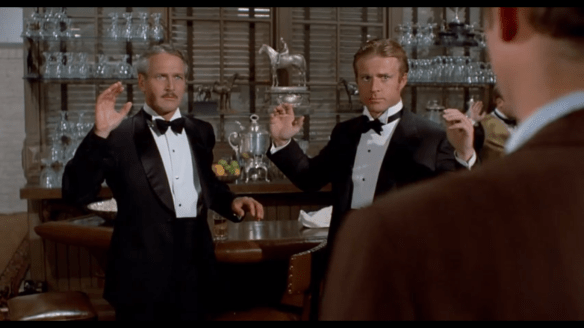
He must meet the man Luther spoke highly of The Great Henry Gondorf (Paul Newman). In their first encounter, he’s completely swacked only to utter his first words under a showerhead raining water down on his hungover noggin. When Newman’s grouchy voice finally rings out it’s another form of wish fulfillment we’ve been waiting for. He even soaks his head a la Harper (1966). The anticipation is beginning to set in.

The Hollywood landscape has changed in 4 years. Now Redford is the worldwide megastar. Newman is still a big draw and as good as ever. Regardless, it’s a real hoot to have veteran pros like Harold Gould and Ray Walston. Somehow they feel like television actors to me and that’s by no means a dismissal. In fact, it’s actually a seal of approval; they make The Sting more colloquial even familiar.

Things pick up aboard a train as Gondorf sinks the hook into their pray so they can begin the task of reeling him in for the catch. It’s about keeping the mark off-balance, never letting them know they’re not in control, and making a whole lot of fun for the audience because we’re in on the whole shebang.

He makes a late entrance to a gentlemanly poker game by apologizing, “Sorry I’m late guys. I was taking a crap.” It’s a portent for the entire showdown. Newman hamming it up as the steely-eyed Robert Shaw looks on as if he takes every iota of the other man’s being as a personal affront. It’s a very calculated charade getting under his skin quite effectively. The brilliance of Newman is not taking himself too seriously. He has a good time with every beat and the movie benefits.

It’s a pleasure to watch him walk all over Shaw because Newman might be smug, but we’re in his corner and that comes from his long, hard-fought badge of loyalty. He’s one of those actors we relish playing the scoundrel. Harrison Ford might be the other.

As they look to hook Lonnegan by first getting his ire up and then conveniently setting him up with an ambitious inside man (Redford), we have a game on our hands. Meanwhile, the other boys assemble the crew with a makeshift gambling joint being renovated as they speak.

Hearing Ray Walston’s voice over the action, calling the races, is somehow comforting a bit like having My Favorite Martian reruns on in the background. The film is weak in the female character department but fortuitously Eileen Brennan is able to bring something hardy to the world with her mere presence.

And yet it wouldn’t be a story without a few wrinkles would it? Shaw throwing his weight around in order to play by his rules. They must acquiesce to his demands in order to make him feel secure. Then there’s a nagging cop after Hooker for some prior infraction. Soon even the Feds (led by Dana Elcar) get involved as the whole charade continues to crumble precariously.

the sting 2.png

Through it all Redford keeps his cool and looks equally fine streaking around town in his suit — usually to keep from getting the book thrown at him. He might as well be channeling the free-and-easy charisma of Steve McQueen from The Cincinnati Kid. Fittingly, The Sting is an apt descendent of not only that film but Newman’s own stellar vehicle: The Hustler.

Aside from just creating a world of smoky nostalgia, Hill is brave enough to have wordless interludes. The music is robust enough, not to mention his stars and his setting, allowing us to appreciate everything. Sometimes more is said in these moments than in any bit of filler dialogue. We get the privilege of picking up the pieces for ourselves and sitting back to bask in the thrills. The last few minutes are the grand payoff, and it’s lightning-quick but never better.

The Sting is short of a monumental artistic achievement, but it is an experience as only movies provide. It gives laughs, payoffs, and twists in a manner that is wholly satiating. To be a part of a communal event like this is something familiar and warm.

The ultimate joy of The Sting is its ability to play the audience as much as the mark and yet still giving us the relish of feeling like we’re in on the joke. It’s a movie that willingly provides the best of both worlds. And of course, we have Newman and Redford. I’ll stand by it. There was never a better pair.

4.5/5 Stars

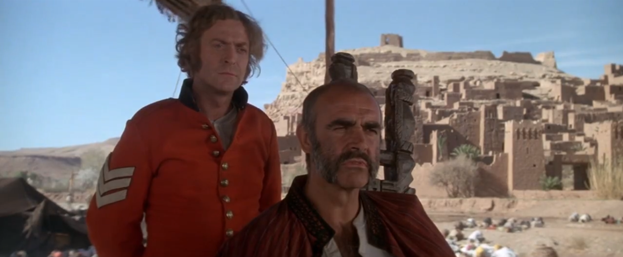
The Man Who Would Be King (1975): Starring Sean Connery & Michael Caine

the man who would be king 1.png

There is a sense that John Huston is on a tear to prove he can outdo David Lean. However, this might only be an observation based rather unfairly on circumstance. Because Huston purportedly meant to make the picture at numerous junctions in his career, though it never got off the ground with any of the dynamic duos originally put to the fore.

There was Humphrey Bogart and Clark Gable at first. Then Peter O’Toole and Richard Burton. It could have even been a reunion for Butch Cassidy and The Sundance Kid (1969). Ultimately, none of these pairings came to fruition.

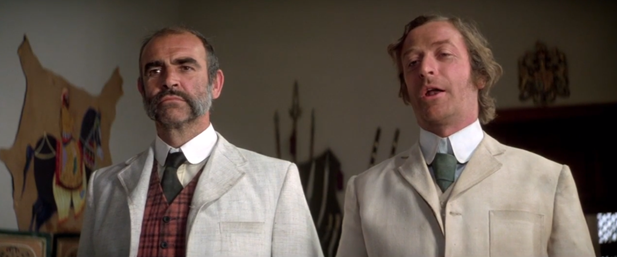
Finally, with Sean Connery and Michael Caine, it was given a new lease on life. Regardless, of your personal affinities, it ends up being an unmitigated success given their instant camaraderie even beyond any amount of action, intrigue, or world-building.

Connery is one of the great action icons, partially thanks to Bond, and Caine is very much his equal for a string of iconic roles of his own. It’s no coincidence they both have a “Sir” before their names and still remain two of the most beloved actors in Britain to this day.

Following in the mythic footsteps of Alexander Great, Daniel Dravot (Connery) and Peachy Carehan (Caine) aspire to be the first Europeans to rule the isolated territory of Kafiristan in centuries. In all fairness, The Man Who Would Be King is as much about two lunatics as it is men of valor, soldiers of fortune, and brothers in arms. 

Their venture has them fending off local bandits, crossing the frozen deep, and looking to influence the local lords with their modern weaponry. It’s one step on the long road to becoming immortalized. With the fortuitous help of their translator Billy Fish (Saeed Jaffrey), a Gurkhan lone survivor of a British outfit, they now have a mouthpiece to pass down their will to the local populace. 

They make liberal efforts to lean into the god complex in order to have an easier time subduing the people and subsequently, mobilizing a personal army. However, in crossing paths with the much-revered spiritual leaders, they find it’s just as providential to be Freemasons. Some brotherhoods are universal.  

It is actually Dravot who is perceived as a god and soon his head gets overblow with his personal ambitions to have a queen and a kingdom with bridges and infrastructure to connect the entire territory.

He is looking to fulfill all the hopes of his protectorate as a divine answer to their prayers. It’s his buddy Peachy, the mere mortal who knew him well before he became a god, trying to show him how nutty this is. It also proves fatal. 

the man who would 2.png

Michael Caine’s performance, in particular, is broad, overblown with vigor. Is he putting too much gusto into it? Given the stakes of the material and how it plays, he probably does it just right. Because we half expect our characters to be blustering and larger-than-life giants.

One can imagine not only Huston but his actors as well would have relished the material for these very reasons. It really digs into this sense of adventure while giving them parts to grab hold of. This is on the most visceral level; we see it playing out on a grand scale. Still, the picture has a certain intimacy worth expounding upon.

Because while it’s easy to refer to pictures of old as references, say Lawrence of Arabia (1962) or even The Lives of a Bengal Lancer (1935) or Gunga Din (1939), what sets The Man Who Would Be King apart is the simplicity of the principal relationship.

The beats of the plot are nothing altogether new and novel; it makes sense as Rudyard Kipling’s original novella came out in 1888. However, strip everything away and what are we left with? It really is nothing more than a buddy film.

Certainly, it becomes complicated by all sorts of issues and yet what remains the common denominator as the story unfolds? It’s the relationship between our two leads. Hence the potential ties to Butch Cassidy being somewhat telling. Having a pair of charismatic anti-heroes to cheer for makes it extremely easy on the audience. It takes very little to ask for investment.

Above all, it reminds me of those aforementioned tales of old. They weren’t abashed about having a good time and giving way to adventure in the absence of social significance. There seems to be very, little apart from the actors, who place the movie in the 1970s.

After all, Huston was himself an old boy coming from a different generation altogether. Being the maverick and gargantuan personality of machismo in his own right, it seems fitting he would gravitate toward such a tale. Where the bonds between men speak volumes as do their unquenchable cravings for wealth and glory, verging on the obsessive.

Huston is provided his inroad through a real historical figure. Again, the idea of having an author like Rudyard Kipling (Christopher Plummer) be the inception of the story is not a new device. We have Somerset Maugham utilized in The Razor’s Edge for instance and the most obvious might be the narrator of Joseph Conrad’s Heart of Darkness.

Except this movie is Heart of Darkness in some inverted world where the dark jungles of Africa are replaced with the golden plains of an equally harrowing Middle East. The constricting dankness is substituted with the dangers of the great unknown, wide-open spaces with their own share of pleasures and subsequent perils.

Once more we cater to analogous themes of human avarice and cravings to be made a deity over other human beings. Where setting oneself up as a king of a nation is more of a dream — the ultimate prize in obtaining power and glory — there is no dark underbelly initially.

One cannot help in drawing parallels to The Treasure of The Sierra Madre (1948) where the lust for all the riches the world has to offer rarely avail themselves without cataclysmic implications. Even as it can be riveting to watch such a big-screen adventure, we must check ideas of superiority or superman complexes.

While The Man Who Would Be King comes to accept this colonialistic world order rather than subverting it, at the very least it does imply the flaws in such a dogma. We’ve continued to see the fruit of such ideologies well into the 20th and 21st centuries.

4/5 Stars

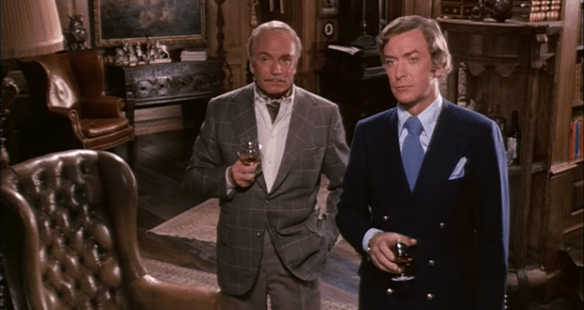
Sleuth (1972): Starring Laurence Olivier and Michael Caine

sleuth 1.png

I don’t play games. Many of my long-suffering friends would attest to the fact that this statement is only semi-facetious. Perhaps it must begin with what games are used for. They are recreational, diversions meant to be enjoyable so that two or people might gather together and have a memorable evening.

Except for me, games always have a habit of bringing out the sides of people I never much like. The overly competitive ones who have no sense of the rules; there’s no sportsmanship or any seemingly rational concept of fair play. Either that or they care too much about them — tooth and nail.

The moderately well-adjusted people I seem to know and love, all of a sudden, become animals tapping into their primordial proclivities toward the survival of the fittest.

Another reason I don’t play many games is a reflection on my own poor attitude. I don’t like games much because I’m never very good at them. I’m the victim. The one always losing and getting beaten and putting on a fine face until the next debacle. And why waste my time doing that when I could be doing something far more constructive with my time like say, watching a film…

With this long-winded subtext, I’ve tried to make it apparent why Sleuth might already be rough going for a bad sport like myself. It’s tapping into a world that I already abhor.

Thus, it’s a pure testament to how fine a cast and crew we have to say my opinion of the picture cannot help but be complimentary. Ironically, it readily leans into the issues I have with games to create an engaging conflict.

By the 1970s, Joseph L. Mankiewicz feels like a bit of a bygone relic leftover from the 1950s and some of his finest achievements like All About Eve. It might sound like a harsh observation, but even his greatest film noted the inevitable waning of a once illustrious career.

Thankfully Sleuth is still a credit to his name and how could it not be, bolstered by excellent material by Anthony Shaffer (based on his play) and two certified British treasures in Michael Caine and Laurence Olivier?

They meet in the middle of a maze that reminded me of one summer day on a vacation to Hever Castle. It’s the first in a whole host of games with Michael Caine bemusedly attempting to make his way to the voice emanating from the very center.

Finally, he gets there only when the hidden entrance is revealed to him — the first in a line of wry twists. It’s a portent of the forthcoming recreations.

For a good bit, we don’t what the business at hand is meant to be. Then as they wander through a parlor in the midst of small talk about trinkets and the usual pleasantries, Olivier gets right down to business. The other man wants to marry his wife. Instantly we have the conflict and the basis for our entire film. It doesn’t take much to see why.

You could rarely pay for a better two-man show though there are a few others who drift in and out of the conversations carrying their own importance. Namely, the woman they are both fighting over or the no-nonsense Inspector Doppler (played by Alec Cawthorne) who pays a housecall. Even these characters rely wholly on the mystique created by our leads. (They are indebted to them more than we initially realize).

Obviously, the blocking of scenes is crucial, but it also relies readily on the stars and they oblige, aided by the witty material. The best part about it is the very fact there is this sense of freedom. The house is a centralized space and yet they are given free rein of it, and they’ll readily go tromping around doing just about anything they please. Digging around for old costumes. Ransacking rooms. Blowing up safes.

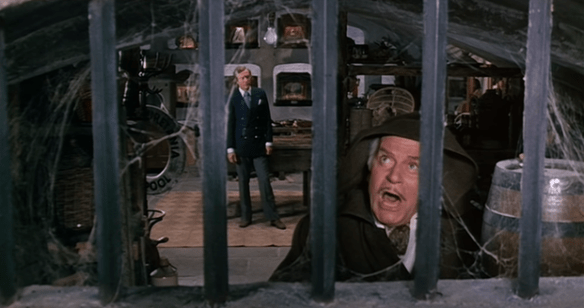
There’s is very little that feels homey about the antiquated interiors, seemingly possessed by all manner of automatons. At first, it feels like the perfect lair from which Andrew Wyke (Laurence Olivier) will lure his unsuspecting prey into a duel of wits for his wife’s hand.

sleuth 2.png

They thrust and parry like gentlemen, and Olivier is having a real fine time with the theatricality, vaulting between manic fits of imagination conceived by an authorial mind and then the verbose orator with an affinity for showmanship. It’s all about games and parlor tricks and misdirects, easy enough to get carried away with.

One moment it’s a competition, then a mystery, then a murder. A farce, a set-up, an in-house theater company, a revenge yarn, and another murder. The mechanisms of the plot become less important as it becomes a Columbo episode. How will our culprit, who shall remain nameless, be caught? Except this too is another ploy.

If it’s not apparent already, Sleuth is this maddening game of emotional whiplash as new wrinkles are revealed from start to finish. These revelations are what also keep it quite gripping. Folding over again and again and again as the duo oscillates between cat and mouse, vying for the upper hand. Vaulting into each man’s corner to play the villain and the victim, the mark and the conniving mastermind.

We have such disparate images as Caine running for his life at gunpoint. Then Olivier knee-deep in a coal heap while Caine coolly notes no one of a darker complexion ever manages to make it into Wyke’s fictitious fantasy world. The rival even jeers his finest literary creation, the aptly named  St. John Lord Merridewe.

These are only slight proddings, ploys in a vast web of interconnected stratagems. Of course, this is only a movie so no real people were harmed in the making of this scenario.

The only people who get played are those of us sitting in the dark (both figuratively and literally). One of the greatest joys of the charade is guessing one ploy only to be ambushed by a flurry of new wrinkles.

For it to function, Sleuth must work in a manner of parity, and thankfully Caine is more than up to the challenge. It’s by no means actor and understudy or the opposite even, the old stalwart displaced by the youthful newcomer.

They do feel like partners with equal footing in this game. Here lies the key. So if playing along with Olivier and Caine is the punishment I must resign myself to, I will take it compliantly. There are far worse ways to while away an evening. However, I still don’t play games if I can help it.

3.5/5 Stars


The Other Side of The Wind (2018): Resurrecting Orson Welles

Film_Poster_for_The_Other_Side_of_the_Wind.jpgWith the name of Orson Welles comes any number of conflicting connotations not far removed from his greatest achievement: Citizen Kane. However, if we had to try and pinpoint an apt superlative it would fall somewhere in between a mythic and Brobdingnagian titan of cinema. He was a personality like few others.
Taking this into regard, The Other Side of The Wind could only conceivably be a colossal failure if it were in so many words: facile. Thanks be to the movie fates; Welles’ last work is no such thing. It is a glorious, extravagant mess of a film. Trying and befuddling scene after scene.

It has for many years been “The Holy Grail” for cineastes and to have it finally released to the public 40 years later — with so much hype spinning around, it might have easily been a letdown.

What a pleasure to admit how Wellesian this film is. Looming, unwieldy, pretentious, and loaded with complexities. All of these are compliments, mind you. It is corroded and alas, not the fully cohesive vision of an auteur, but its powers have barely been deluded by time.

The very form of the film, told from so many points of view, with all sorts of angles and qualities of footage, serves the very structure of the narrative. The fact it was indeed shot over half a dozen years, with hours of celluloid to ultimately cull through, only adds to its fractured quality.

The time in between its conception and release allows for fuzzier edges and dust to settle over the history with many of the primary players dead and gone. We still have first-hand eyewitnesses like Peter Bogdanovich and Joseph McBride and yet even they are now so far removed from the material. The myth has been allowed to instill itself.

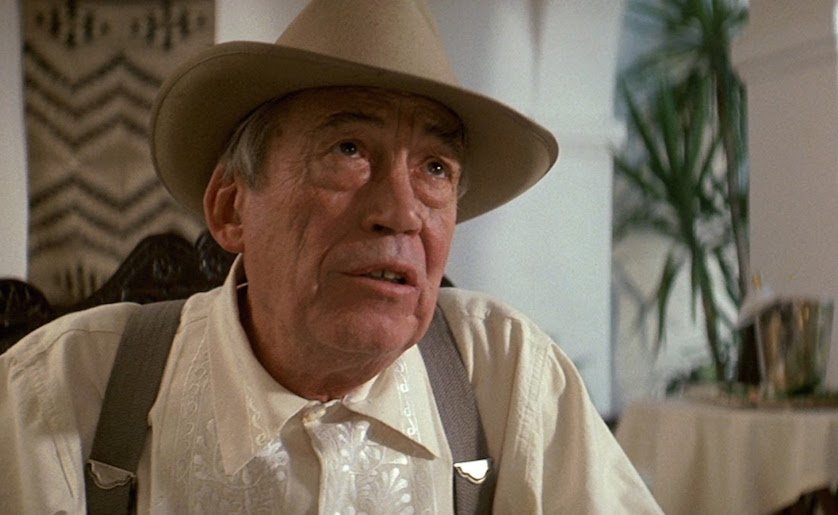
Simultaneously, Welles once again makes us so radically aware we are watching a film, and he is directing our gaze. It’s his most audacious intent to blur the lines between reality and mere film narrative. It spins on this axis of meta mythos, instantly evoked by the film-within-a-film narrative and the caravan leading up to the 70th birthday of J.J. Hannaford (John Huston).

The biography is too obvious to ignore with thinly-veiled characters and the real-world issues plaguing Welles himself. Where to get the funding, literally making the story up as he goes along, and trying to stay relevant in a Hollywood that has all but abandoned him. It’s the old Norma Desmond conundrum (from Sunset Blvd). He’s still big. It’s the pictures that have gotten small. Furthermore, the fiction is too great to believe every word as the Sunday school truth.

Early on, the cuts are so quick and jarring, the viewer’s head is almost spinning to keep up. Because the choppy, looseness to it all almost feels amateurish and yet Welles is trying to drag us into his charade. He is creating a patchwork for us to get caught up in.

Early-onset fatigue must be acknowledged because The Other Side of The Wind can be a taxing ordeal with the constant cuts, close-ups, and whips from person to person even within a single conversation. It’s the antithesis of all traditional Hollywood continuity, thus serving its purpose.

This is also a fine time to mention the strikingly effective (if perplexing) riff off European art-house, with a startling amount of nudity, especially for a Welles picture. Bob Random and Oja Kodar are spliced into everything else, wordlessly pursuing one another through a cryptic labyrinthine of artistically stimulating landscapes. The film-within-a-film takes most obvious aim at Michelangelo Antonini who no so coincidentally filmed his Zabriskie Point in the home right next to Hannaford’s lair.

It’s also no small coincidence Ernest Hemingway is mentioned in passing as this spirit of the macho film director J.J. Hannaford is put up to the light of scrutiny. Huston himself was very much made out of the same mold. He was the epitome of a hard-living, hard-drinking, cigar-chomping man’s man. Each line of his craggy face tells a story. Each sputter in his voice is from years of such a lifestyle.

While Orson Welles isn’t an immediately similar figure, he ran in the same circles, shared overlapping industry experience, and probably internalized some of the same ideology pertaining to masculinity. They were both members of the Old Hollywood Guard.

Except the fine distinction is John Huston was not over the hill yet with such recent successes as Fat City and The Man Who Would Be King, two pictures that could not be more engaging for entirely divergent reasons. The verdict was still out on Orson Welles.

Meanwhile, Peter Bogdanovich adds yet another personal element to the picture. He was rather like Welles’ disciple, if not the propagator of his myth, and certainly a friend. But even their relationship became complicated when you consider the unspoken competition between them.

The young film critic-turned-filmmaker was at the forefront of The American New Wave and, at this point right in the middle of his trifecta of instant classics. The Last Picture Show was even heralded as the most important picture by a young filmmaker since Citizen Kane.

However, feathers were ruffled, jealousies set in, and what was formerly amiable, slowly deteriorated. You can even see it in how Welles is obviously jabbing Bogdanovich not so tactfully about his relationship with the much younger Cybil Shepherd. In the movie she is portrayed by the blonde robot who comes to J.J.’s party, appearing, uncomfortably, like easy prey for a predator.

Other persons of interest are Lilli Palmer who is an obvious stand-in for Welles’ lifelong friend Marlene Dietrich and then an acerbic, intrusive Susan Strasberg doing a send-up of Pauline Kael. I know very little about the Raising Kane fiasco and so it makes it difficult for me to make an educated assessment with what to do with this.

Then, we have posts filled by members of the Hannaford mafia who could easily be members of Welles’s own tribe including Mercedes McCambridge, Edmond O’Brien, Cameron Mitchell, and Norman Foster.

It’s sad to admit I have little to nothing resonant to add about their characterizations. They merely exist in this discombobulated world revolving around Hannaford.

It’s difficult not to put this movie in juxtaposition with Citizen Kane because they share the same gargantuan camp as only Welles seems capable of. In some ways, we might contend The Other Side of The Wind is Kane outside-in. The former film begins with a token of childhood. The life comes after and it seems ultimately meaningless. Revelations mean very little.

In the latter film, we begin at the opposite end of the spectrum at the end of a life and yet we never work back or get enough of a hankering of who this man is, much less all the phonies and wannabes around him.

I couldn’t help thinking as Hannaford and Brooks parted ways, I hardly know anything about them. There is not a meaningful throughline amid their continual babbling and bits of philosophizing.

What’s more, very little feels sincere. And yet this is itself an insidious lie. Because I know so much about them, that is, Huston and Bogdanovich. I’ve seen their films, I can recount a decent part of their history, their relationships with Hollywood, etc.

So The Other Side of The Wind is a bit like a rich canvass that gets more intricate and reveals more, the more we bring to it. The layers are there, all twisted and tangled, sometimes leading to dead-ends or left unresolved possibly due to narrative oversight. Maybe the actor was no longer available or the footage got ditched altogether. But of course, it’s, again, one and the same.

You don’t have a prayer of knowing much about J.J. Hannaford at the end of his party nor much about this film’s plot — what there is of it — but there is still more. We have these continual undercurrents — these refractions of reality — and we must dig through all the inexplicable pieces to try and discover some shards of truth.

Finally seeing The Other Side of The Wind feels like a giant sigh of relief. Let me say it now. It’s far from a perfect movie. But it is an extraordinary artifact from a phenomenal creative mind. It is a project worthy of Welles’ vision for the very flaws it exhibits from beginning to end.

Because slivers of himself find their way into the frame. His real-life struggles, demons, feuds, friendships, jealousies, preoccupations, and intimate fears all snuck in both overtly and unconsciously. This just might make it one of the most personal documentations we have from the man.

It’s a gift worth acknowledging, warts and all. The most honest word to offer in analysis is the very fact it mirrors the man. It’s the utmost compliment too. Francois Truffaut is quoted as saying, “I have always preferred the reflection of life to life itself.” One can only surmise if Orson Welles would agree or not. The Other Side of The Wind is as close as we’ll ever get to knowing.

4/5 Stars

Classic Movie Beginner’s Guide: John Huston

In our ongoing series of beginner’s guides for up-and-coming classic movie enthusiasts, we thought it would be well worth it to acknowledge one of Hollywood’s larger-than-life directors in John Huston.

Before starting out as a screenwriter, he galvanized his reputation collaborating with Humphrey Bogart and simultaneously helping shape the genre that would ultimately be labeled “film noir” by the French. His own career proved the film industry could be a family affair as he worked with both his father, Walter Huston and then his daughter, Angelica Huston, at the bookend of his own career.

Here are 4 of his most iconic films:

The Maltese Falcon (1941) - Images - IMDb

The Maltese Falcon (1941)

Based on Dashiell Hammett’s indelible private eye, Huston’s Maltese Falcon is singular in its own right and it had to be. Not only was there the source material, but also an earlier film version. While Humphrey Bogart has none of the protagonist’s written characteristics, it’s immaterial. In a perceptive stroke, Huston pulled prose from the novel while creating taut, atmospheric, highly choreographed visuals to augment the performances. Consider Key Largo or The Asphalt Jungle for more noir thrills.

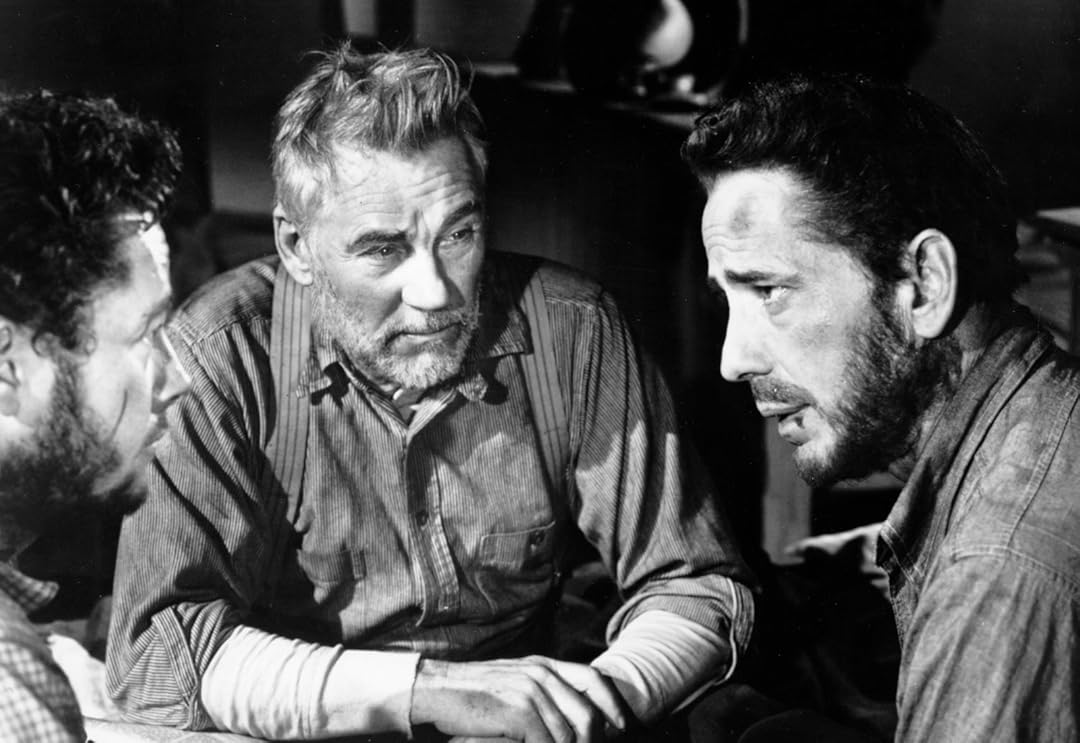
The Treasure of the Sierra Madre

The Treasure of The Sierra Madre (1948)

One could easily argue it was John Huston who helped usher in a groundbreaking generation of on-location shooting in a more mobile post-war Hollywood. Armed with two dynamic performances from Bogart and his chipper father Walter Huston, this epochal story of greed is an absorbing drama about the souring of humanity. It’s doesn’t need no stinkin’ badge to prove it either.

New on DVD: 'The African Queen' - The New York Times

The African Queen (1951)

Whether or not it feels like a departure for John Huston (Beat the Devil or Heaven Knowns, Mr. Allision could be considered the same), The African Queen is a stellar adventure piece bolstered by two of the most inimitable players: Humphrey Bogart and Katharine Hepburn. Carving through the jungles makes fast friends of the two great giants of Classic Hollywood, and Huston makes it a gripping time at the movies.

Will🧙‍♂️Menaker on Twitter: "Basically everything about America ...

Chinatown (1974)

Many will probably note John Huston did not direct Chinatown. For some of his contemporary work behind the camera, consider Fat City or The Man Who Would Be King. However, his beguiling performance as Noah Cross, in one of the preeminent neo-noirs, is too good a turn to pass up in this acknowledgment. Despite the palpable charm, he undermines it with a deliciously despicable underbelly — much like 1930s Los Angeles.

Worth Watching

Jezebel, High Sierra, Sergeant York, The Killers, The Red Badge of Courage, Moby Dick, The Misfits, Night of the Iguana, **The Other Side of The Wind, Wise Blood, Prizzi’s Honor, The Dead, etc.