Get Out (2017)

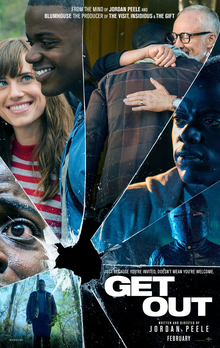
Teaser_poster_for_2017_film_Get_Out.pngGet Out seems like a simple enough premise. Ridiculously simple even. We’ve seen it millions of times in rom-coms or other fare. It’s the fateful day when the significant other is being taken to meet the parents. Whether they pass this test will have irreversible repercussions on the entire probability of the relationship’s success. Maybe that’s a tad over the top but anyways you get the idea as Rose (Allison Williams) drives her boyfriend Chris (Daniel Kaluuya) to meet her parents.

But if anything Get Out is the Anti-Guess Whose’s Coming to Dinner and I say that for a number of reasons. That picture was groundbreaking in its day because Stanley Kramer made an issue-driven film about an interracial couple coming to meet the parents in the age of Loving v. Virginia  (1967) still being on the recent record books. Miscegenation was still outlawed in numerous states across the country. Granted, it was set in California, that open-minded oasis in the West, but that doesn’t mean parents weren’t still skeptical about the union. It’s easy to be a champion of racial equality and quite another to have your daughter marry a man of a different race. At least in 1967. Now it shouldn’t be an issue at all. We are an enlightened people, after all, informed by a 21st-century worldview…

Yet Get Out works because it shows the flip side of the coin. You have that same forward thinking, liberal idealism that’s reflected on the surface for all to see. It’s a bit of the Hepburn and Tracy characters from the earlier picture that we see in these parents (Bradley Whitford and Catherine Keener).

Except here they’re not who they seem to be and their enlightened qualities only mask the ugliness that is hiding inside of them. Perhaps they are more nefarious and wily than the outright bigots because they hide their prejudice proclivities so well. Their racism is systematic and acceptable in the framework of modern society.

It’s nodded at and laughed off at cocktail parties because they are the folks who would have voted for Obama for a third term and their favorite golfer, of course, is Tiger Woods. He plays their civilized game and before his downfall, he played it well. As such, they can accept them without much hesitation because it’s these men who have seemingly conformed to their way of life.

A few other obvious cinematic touchstones to appreciate Get Out are The Shining (1980) because there’s an inscrutable nature to the horror that’s  underlined by dread more than fear in the accepted sense. It makes for an unsettling final act that lingers for a long time. Meanwhile, the entire conspiracy that’s going on under the surface brings to mind Rosemary’s Baby (1968), simultaneously unnerving and darkly comic to its final moments much like Get Out.

This is by no means a pop out at you horror movie which I admittedly don’t hold much taste for. Jordan Peele’s effort is far more than that. Slowly crawling under your skin insidiously looking at some unnamed problems of our society in the domain of race and it does it in such a way that’s perturbing and ultimately brings up some powerful questions on the front of a social commentary.

This is a movie that upends expectations starting out as one thing which we assume will be offered in the package of a horror picture and it morphs into something far more interesting that has the compelling power to stay with audiences long after the momentary shock value might dissipate in a typical film with few lofty aspirations.

If nothing else, it confirms that there is still so much progress that needs to be made in our nation and Peele positions himself as far more than a comedian but a fascinating creative mind behind the camera. Get Out is a shining reaffirmation that creatively potent and timely films are still being made today. It is not meant for everyone but there’s no question it has something new to offer.

4/5 Stars

Too Late for Tears (1949)

Too_Late_for_Tears_DVDA couple is driving along a desert highway when a bag loaded full of cash is tossed into the back of their convertible by a passing motorist. They’re a pair of everyday nobodies and yet this single act of fate throws their entire existence into chaos. Of course, it gets a little leg up thanks to Jane Palmer (Lizabeth Scott) as she takes the wheel to get away with the cash, convincing her husband Alan (Arthur Kennedy) that they hold onto the payload for awhile. Finally, he relents and leaves the briefcase in a Union Station locker.
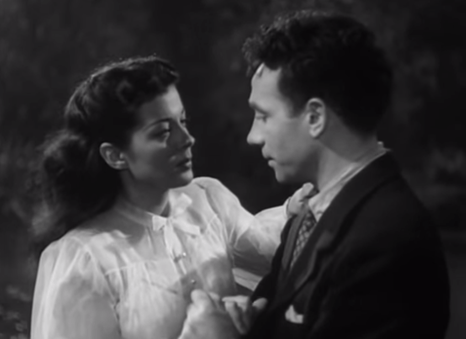
It’s a tad of an unbelievable scenario but that’s what makes it so exhilarating as Lizabeth Scott plays all parties involved using her doe eyes and feminine wiles to great effect like the foremost of femme fatatles that she is. And the fact that she does it both unwittingly and with willful intent is crucial to her turn for the very fact that it creates the seesaw of emotions.

There’s a certain sense of ambiguity because we begin to invest in her story and like her in one sense, while simultaneously distrusting her motives that seem mostly driven by avarice more than anything else. There’s also this extraordinary quality about her where she somehow manages to look young and feel old all at the same time thanks to her memorable baritone. It’s a bit unsettling.

The next important figure is Danny Fuller, Dan Duryea donning one of his sleazeball roles as a drunk who nevertheless has a bit of a sympathetic side at least put up against the acerbic poison of Lizabeth Scott. She’s the epitome of that long-held expression that greed is the root of all evil. If she didn’t write the book on it, she at least tore through its pages voraciously. Initially badgered by Danny for swiping the payoff he believes is rightfully his, she soon has him roped into her plan. It’s almost too much for the cad to bear. He calls her “Tiger” sardonically at first but he doesn’t realize how right he is.

But the most interesting setup in the narrative are the contrasting couples and they might not pair up the way you first expect with Arthur Kennedy getting the short end of the stick. He starts out happily married and winds up out of the picture.

There’s the rapacious Jane matched with Danny boy as they both feed into each other with their distrust and vices. Then you have the ever-present “Good Girl” or guardian angel,  Alan’s sister, Kathy (Kristine Miller), a sensible,  prepossessing young woman who only begins to distrust Jane as circumstances become more and more strained.

Meanwhile, Alan’s old war buddy (Don DeFore) comes a calling on his old pal and finds himself spending time with the man’s sister instead. But they become our necessary counterpoints to balance out the film’s more corrupt characters.

The final reveal that we’ve been waiting for arrives and it spells the end of Jane’s charade as she’s brought tumbling down. But as noir has a habit of doing, it manages to paint a bit of a happy ending against this dark backdrop with Kathy and Don winding up with each other and a shoulder to lean on. Still, that final image cannot quite downplay all the deceit and murder that has gone down up until now.

Too Late for Tears resonates thanks to a pair of incomparable sordid performances by Scott and Duryea. Miller and DeFore make a lovely couple but it’s the moneygrubbing ones who make this a true noir delight because they represent the incorrigible vices often found in humanity. That’s a lot more fun in the movies.

3.5/5 Stars

Review: Moonrise (1948)

moonrise 1.png

It’s like being in a long dark tunnel…the way you look and act and talk. ~ Gail Russel as Gilly

From its very foreboding outset, there’s no question that Frank Borzage’s Moonrise could be characterized as film-noir. Everything suggests as much from the scoring to the stylized imagery and even the subject matter. We have hangings, brawls, fistfights, and murder all under 5 minutes of celluloid. But equally important, the film delves into the psychological depths of despair and more than any of Borzage’s films it seems invested in the mental well-being of its characters.

Dan’s personal narrative is brought to us early on. His father was hung for some inexplicable reason. The kids in school brutally tease him about the ignominious shame of his family which he has no control over and all throughout his life thereafter he carries a chip on his shoulder. We don’t quite understand him but at least we begin to empathize. We meet Dan (Dane Clark) again as an adult at a local dance.

That’s where the next chapter in his story begins as he tries to bridle his anger and keep the reins firmly in check. It doesn’t always work so well for him. After all, he is the man with a constant death wish driving cars on wet roads like it’s the Indy 500. He is the man who is prone to strong-arm tactics. He is the man who trusts no one to be his friend and expects very little from others. But he does have one thing going for him.

Her name is Gilly (Gail Russell), she’s the local schoolteacher, and if nothing else her very presence humanizes him. She formerly ran with the local hotshot (Lloyd Bridges) but she has found some quiet decency in Dan and if she sees it, maybe we can see more in him as well. In some ways, he’s still a little boy and she reads him like one of her students with thinly veiled observations. His frumpy Aunt Jessie pins him as a good boy but that doesn’t make up for the absence of his parents or the anger that he still harbors from boyhood.

But a small town setting and a purported crime prove to be an ever-intriguing synthesis of Americana and the ugly underbelly which if it doesn’t rear its head through gossip alone, then murder certainly fits the bill in a pinch. It’s summed up by dances, carnivals, and coon hunts with an undeniable undercurrent of darkness.

As far as I can tell Charles F. Haas had few other feature scripts to his name but his work in Moonrise offers up some interesting figures full of witticism and unique voices that help to differentiate each from the diverse pack.

The bullied mute Henry Morgan is at one time befriended and also berated by Dan. Rex Ingram proves to be a landmark African-American actor for the era, full of a quiet strength and wisdom. As local keeper of the bloodhounds, he addresses his canines as Mr. Dog surmising that everyone is entitled to a certain amount of dignity. Just as importantly, he rightfully asserts that man is a communal being (Man oughta have a woman. Man oughta live with other folks).

The Local Soda Jerk has the jive talk down pat and Lloyd Bridges and Harry Carey Jr. fill in for a couple relatively minor spots. Of course, Ethel Barrymore is in the coveted keynote cameo as Daniel’s  sagely Grandma. But aside from Ingram’s significant turn, Alyn Joslyn is one of the more entertaining characters as the sheriff who waxes philosophical. One of townsfolk even notes as much that he should have been a preacher man instead of a lawman.

Cinematically speaking, Moonrise proves that the finest places to meet your best gal seem to be darkened interiors and if nothing else it’s a feast for the eyes and a treat for the audience. And it’s true that with its quaint country backwoods and swamps, Borzage’s picture shares some of its world with Joseph L. Lewis’s Gun Crazy (1950). But for Borzage, in particular, this feels very much like a departure which is by no means a bad thing. Here the love story is still present but it seems to ultimately have a different functionality altogether from many of the director’s most remembered entries.

3.5/5 Stars

Review: Giant (1956)

giant 1.png

People might come to Giant for James Dean. They might come seeking out the final film in George Stevens unofficial American Trilogy (including A Place in the Sun and Shane).  Maybe it’s even the promise of a sprawling epic of monumental length and scope that turns out to be both a blessing and a curse by most accounts.

But this adaptation of Edna Ferber’s novel, despite all of this, is really a film about marriage and family in a world that’s constantly changing. Rock Hudson is a towering giant in his own right turning in a performance that works as quintessential Texan Jordan “Bic” Benedict. Elizabeth Taylor proves that far from a one-dimensional classical beauty, she has acting prowess as well delivering a spirited showing that gels with Hudson for the very fact that it often chafes against his characterization. Meaning they’re believable as husband and wife.

James Dean plays their marginalized ranch hand Jett Rink who is nevertheless treated well by Bic’s  hardy sister Luz (Mercedes McCambridge) as well as Leslie while harboring a life long feud with Bic over the ensuing years.

Time turns this story into a battleground of two dueling giants. One a life long rancher of great stature. The other a modern figure blessed with a meteoric rise as an oil magnate. Their resentment carries through the generations as much as their differing fields reflect the sign of the times. The tectonics shift as the old guard of the Texas plains is replaced with a new breed of powerful men.

Of course, Dean’s performance is the stuff of legend and there’s an idiosyncratic, grumbling magnetism about it as only he could do. This isn’t Brando and it’s not even Monty Clift who previously played opposite Elizabeth Taylor in Stevens’ earlier picture. It’s James Dean showcasing his personal flare.

The final moments of his “Last Supper,” after his subsequent rise to glory, are devastatingly pathetic. The mighty oil tycoon of Jetexas falls into utter disgrace crashing to the floor of the empty banquet hall with a clatter. Rolling around in a drunken stupor, making a shambles of his grand exhibition of wealth, and simultaneously concluding Dean’s last scene in front of an audience.

His life would be taken even before Giant finished filming, some of his last scenes of dialogue being reread by close friend Nick Adams, his temperamental nature and habit of mumbling lines impacting the production even after his passing. Still, George Stevens himself, despite the insurmountable hell he was put through, and the hits his shooting schedule took, even admitted that Dean was something special.

You might not like him but all of us seem to gravitate to him for some inexplicable reason. He carries our gaze with his ticks and his delivery. It’s as if he forces us to take heed even out of a necessity to understand him, his head downcast, his hands fidgeting and such, all a ploy to carry our attention. It generally works.

giant 2.png

Yes, we lost him so young but the beauty of Giant’s epic stature is that in cinematic terms Dean was blessed with a full life. We saw him as a fiery youth in East of Eden (1954) and Rebel Without a Cause (1955) and in Giant he evolved into an equally tortured man who grew old before our eyes. That’s the magic of the movies. But sometimes it’s so easy to have his legend overshadow all others.

The latter half of the film is really about the Benedict family evolving with the maturation of their children. Dean is worth a closer look certainly, but I’m inclined to enjoy the performances of Carroll Baker and Dennis Hopper nearly as much if only for the simple fact that they’re less heralded.

Baker is the daughter caught in the throes of romance and decadence who finds Jett Rink more fun partly for the very fact that her stuffy parents abhor what he has become. Meanwhile, Hopper brings a surprisingly earnest candor as the Benedict’s eldest son with aspirations to be a doctor instead of a rancher, pushing against family tradition, subsequently marrying a Mexican-American bride, and facing the unfortunate ostracization that comes with such a life.

Some of the most evocative scenes are actually held between Hudson and Taylor. To most, their careers were known for personal lives exploited by tabloids. They don’t get the same adulation as Dean as actors. Still, in this film, they do something quite spectacular in a more unassuming way. They quite authentically reflect the life of a married couple as their romance and life together waxes and wanes over the years. That includes Jett Rink’s onslaught and the trials with kids but, at the core it’s just the two of them, grappling with it together.

Because this is a film that unfolds over decades we come to appreciate the changes that come over the characters and not so much the makeup or touches of gray. More important are the strides they make in their lives or even how they remain the same.

They model what it is to be young and in love, to quarrel and bicker and to make up and to be diplomatic and to have dreams and aspirations and to want the best for your children and at the same time hold grudges and feel like the ones you love are purposely trying to undermine you.

To begin with, this is a fairy tale romance of opposites. Hudson is the formidable Texan bred as a rancher and he comes to the upper echelons of eastern society looking for a stallion and he comes back with a bride instead.

She comes to his country initially welcomed and then feeling like an outsider in a land that is so set in its ways. Men and woman are expected to exist in certain spheres. White folks don’t fraternize with Mexicans. And cattle barons tame their land and breed their stock like their fathers before them. It’s tradition and they stick to it. Bic Benedict is raised in that Texas tradition dating all the way back to the Alamo, his stock proud, fiery, and tough.

Still, his wife Leslie is just as audacious but in different ways, testing his sensibilities and testing the matrimonial bonds of their marriage. She rather comically proposes her own marriage, looks to break up the boy’s club mentality that dictates the culture, and tramples over the de facto laws of the land in favor of goodwill to all. That means if a baby is sick, she fetches a doctor. The color of its skin makes no difference. In that atmosphere, it’s radical that she extends kindness to everyone, not simply her own “kind” as it were, whether divided by class or racial barriers. Ultimately, it’s a testament to the sorry state of affairs but also of her personal convictions and they bleed into the rest of her family.

The final showcase comes not in his front and center bout with Jett Rink because although we’ve been expecting it for decades, as such it never comes. Jett’s not worth it anymore. Instead, Bic’s shining moment comes in, of all places, a roadside diner. He’s not as strapping as he used to be and he gets wailed on something awful. But in this moment as he’s duking it out with a local bigot, the platform that he stands on is not simply about his family name or his own personal honor as a Benedict but along the planes of what is morally right and wrong.

Rejecting service to people based on the color of their skin is inherently wrong. Disrespecting people of other races can and never should be accepted. Years before he would have never taken a stand on such touchy issues but he’s matured in that regard and his wife falls in love with him all over again. She sees first hand why she grew to love this man.

He lies there on the floor heaving and bloodied with food flung all around him the oddly upbeat throngs of “Yellow Rose of Texas” still whirring on the jukebox but ironically Leslie has never been more proud of her man. It’s that paradoxical maxim written about many times. Blessed are those who are persecuted for doing good.

Most modern viewers will honestly thank their lucky stars that they don’t make epics like this. But there’s something fleetingly enchanting about these old-time vehicles that managed to encompass so much space with grandiose ambitions and awesome imagery full of million dollar skies and fluffy clouds as far as the eye can see.

The West is dead as is the American genre. The stars as we knew them are no more. We are still a nation struggling with issues of race and class. Love and marriage. That mixture of nostalgia and timelessness still makes Giant a draw.  George Stevens is one of The Great American Directors and though Shane (1953) will remain his unassuming masterpiece, Giant deserves at the very least a modicum amount of respect as a dying breed of American epic.

4.5/5 Stars

Note: Entry in The Elizabeth Taylor Blogathon!

Man’s Castle (1933)

220px-Mans-castle-1933.jpg“Blessed are the poor in spirit for their’s is the kingdom of heaven”

With Frank Borzage taking on both WWI and WWII in his career it only makes sense that he would take on the event that in many ways bridged them — The Great Depression.

It’s fairly early on in the story where the local resident Ira (Walter Connolly), a minister by day and a night watchman by night cites the Sermon on the Mount and later references 1 Corinthians 1:27. The moral being: Blessed are the poor in spirit and God chooses the lowly things of this world and the despised things to nullify the things that are strong.

If nothing else a character such as Ira is one of the lovable figures in this fairly dank and dreary tale but his words breathe an inherent worth into the masses of everyday individuals slogging their way through the Depression.  In many ways, this film is a eulogy to those very people, the downtrodden, the poor, the heavy-laden folks.

But sometimes those same folks seem to come in all shapes and size making it nearly impossible to get a line on them. We first meet Bill (Spencer Tracy) a veteran fast-talking Artful Dodger-type who works the streets of New York in his top hat and tails. In this very first sequence, he’s in the middle of a seemingly frivolous activity offering breadcrumbs to the pigeons.

He catches the young gal (Loretta Young) next to him giving him the eye and calls her out. Although she might not look it, she’s destitute, going without food on two days now so he begrudgingly agrees to treat her to some fine dining. Of course, when the time to pay the check comes so comes the big reveal. Bill is just about as broke as Trina and they get thrown out (at least with full bellies).

For the rest of the film they hold up together in a shantytown in the local Hooverville where the existence is sparse but Trina exists as a happy homemaker whose indefatigable spirit never seems to dampen. Bill spends his days drifting finding bits and pieces of work here and there and in the evenings he comes home to his gal. Any other circumstances and their lives would seem fairly normal.

He playing the breadwinner. She playing his devoted spouse. Except he gets the bread by serving a summons to a local stage performer and stilt walking in his free moments, among other things. But he scrapes together enough to get Trina a new stove for their hovel. The fact that they remain unmarried is invariably inconsequential and Trina’s not looking to tie down her man — she’s far too understanding and open-minded for such thoughts.

And although partially unbelievable its integral in how Tracy’s protagonist reveals his true character. Yes, he is a man with restless feet constantly playing the curmudgeon — disdaining the “ball and chain.” However, there’s an old adage that would be apt in describing him. His bark is worse than his bite.

There’s no conceivable way that two individuals such as this should remain together and even in the film there are moments when their symbiotic relationship seems to be splitting at the seams.

Tracy is brusque and surprisingly stink-eyed but as is his custom he comes around and has the audience on his side for the very fact that Loretta Young is so devoted to him. On her part, the sprightly and ever-effervescent Young at the ripe young age of 20 might be skinny but she holds her own and is crucial to making this love story something of substance.

Borzage once more dissects a romance that’s, in this case, one of the most unlikely pairings but Bill ceaselessly subverts our expectations. He’s not such a bad cad after all and Trina makes him be better than he has any right to be.

In this specific instance, the two lovers get their happy ending clutching each other closely in a pile of hay aboard a freight train. The destination nor the future seems to matter because the underlining factor is they have each other. You’ll be hard-pressed to find many affluent people in this picture and this is an important distinction to make. This is not a screwball comedy. On the contrary, center stage is given to members of society who are usually marginalized and it comes off exceedingly well thanks to Tracy and Young.

3.5/5 Stars

Note: It’s most likely that the cut you will see is the 1938 reissued version following the installation of the Hays Codes. I’m not actually sure if an original print is still available or if it’s considered lost.

7th Heaven (1927)

Seventh_Heaven_19277th Heaven is one of those films that revels in classical storytelling where the drama is rich and deep; the score hits all the crescendos and fills them in with the sweetest of notes that are both beautiful and moving. The love scenes are rapturous in a way that makes us hold romance in a higher esteem than we did previously and the horrors of war abhorrently brutalize the world like never before. These are the kind of themes as old as storytelling itself.

Director Frank Borzage would play with these same themes time and time again. I say this with every film of his but it’s so inevitably true. There’s no denying it in any frame within his work. It’s just there and yet in Seventh Heaven, he delivers bar-none his greatest, most extraordinary outcome of his entire career, which must only be seen to be believed.

There has never been such an angelic, more serene and innocent face than Janet Gaynor’s or at least you’d be hard-pressed to find one. I became acquainted with her in F.W. Murnau’s masterful parable of love, Sunrise (1927), but here she is equally demure, reflecting all the many qualities of the most ingenuous of beings.

In this particular scenario, her life is horrible, lived out in utter poverty in France and what’s worse, she is abused and whipped by her tyrannical sister. For a silent film, it feels fairly graphic, and there’s little restraint in showing the sister’s uninhibited rage.

But Diane does find herself a savior or rather he finds her. His name is Chico a sewer worker who is promoted to being a street cleaner. Despite his lowly beginnings, his aspirations are high, constantly geared towards the stars, and he really is a strapping even remarkable fellow, if not simply for the fact that he believes in himself.

Though his most telling trait is his anger toward the Bon Dieu — The Good Lord — or in our common terms, God. As he sees it, he gave the Almighty a chance and look what it got him. Absolutely zilch. That’s why he’s an atheist. God owes him 10 francs.

However, in an individual moment of integrity, he speaks up on Diane’s behalf, taking some of her burden upon himself and claiming to be her husband. The act of charity is not lost on her. She’s grateful but now he’s in a bind. If the detectives call on him and find him unmarried, it’s the hoosegow for him. But being the generally sympathetic spirit that she is, Diane follows him back to his home and agrees to stand-in as his wife for a time. He, in turn, is grateful.

Soon he shares a little bit of his rooftop heaven with her along with some faux-marital bliss where they begin to truly enjoy each other’s company. In this mutually beneficial relationship, they find more than mere altruism. It’s in these interludes where true romance begins to bud between them.

It’s in this heaven above the chaos of the world where they begin to fall in love — it’s a reverie that picks them up and carries them away on clouds of peace, comfort, and contentment. Never before have we seen Diane so at ease and never before have we seen Chico so overjoyed.

But once more war tears apart the hearts of those in love. It’s most overtly reflected in the two scores that battle for supremacy. The passionate love theme playing over their embraces full of kisses and then the shrill call-to-arms playing down on the streets as men march off to battle. It’s the melodious juxtaposed with the harsh. That which is mellifluous clashing with these markers of chaos. Chico is finally called into battle but he is not going to leave his love without making a promise even if it’s in words alone.

Marriage once more is cast in this spiritual light ordained by God and some people would agree that it most certainly is but Borzage seems to take it nearly a step further in that it becomes its own religion — once more this rapturous experience to be undertaken as a form of worship. It’s accentuated by the fact that every day without fail at precisely 11 o’clock they both talk to each other, communing together, rather like a prayer, managing to keep them together wherever they might be from the trenches to the munition factory. Their universal union remains forever intact.

The war sequences are utter chaos for the sheer mass of humanity that is mobilized with dust whirling around, cars zooming down the road, and guns pointed in all directions. It’s a fairly impressive showing of cinematic tumult.

But the film’s ending is a sheer miracle of bright-eyed brilliance — a moment of resurrection that’s so powerful — only felt in a few other films so evocatively. Dreyer’s Ordet (1955) being one of the few examples that comes to mind although presently more titles elude me.

Seventh Heaven ends on yet another spiritual note much as it began. In these final moments, the epiphany is not only a miraculous apotheosis of sorts but the stirring realization that in this narrative the Bon Dieu was always working dynamically in Chico’s life — just not in the ways that he was expecting.

Every time he questioned God’s Will he was met with some sort of answer. One could bring into question if this is, in fact, a “Christian” film but it brings in a multitude of religious themes and readily positions itself as another impassioned depiction of love of the highest order as revealed by Frank Borzage.

4.5/5 Stars

A Farewell to Arms (1932)

394px-Poster_-_A_Farewell_to_Arms_(1932)_01Again, I must confess that I have not read yet another revered American Classic. I have not read A Farewell to Arms…But from the admittedly minor things I know about Hemingway’s prose and general tone, this film adaptation is certainly not a perfectly faithful translation of its source material. Not by any stretch of the imagination.

However, I do know at least a little something about Frank Borzage a filmmaker that time has been less kind to, though he contributed some quality pictures during the silent era and during the ensuing generation of talkies — even a couple of reputed classics. And yet watching A Farewell to Arms you can see his philosophies working themselves into the story line — the very themes that he would repeat again and again in many of his movies.

It soon becomes apparent that Borzage’s film is not about a war at all though WWI is a major plot point. He would examine an analogous idea with The Mortal Storm. Its his predilection not to focus so much on the carnage or alienation of war and more so on the effects that such a cataclysmic event has on the lives of those thrust into the middle of it. So his narrative borrows from Hemingway but hinges on this idea of lovers battling against the wiles of the world through the sheer euphoria of their romantic fling and yet it proves to be more than transient.

There’s without question a verisimilitude and a candor to the portrayals of Gary Cooper and Helen Hayes as said lovers — an ambulance driver and a nurse. Two seemingly unextraordinary individuals who nevertheless become extraordinary in each other’s arms. They will go to such great lengths to remain together despite the obstacles hindering them on every side. Perhaps it’s heightened by the times but still, there is this general belief in what they do on the part of the audience — that they can actually fall in love and will do whatever it takes to stay together.

Even if it’s not wholly plausible, they lend that needed credence to the parts. Their emotions feel genuine even as their romance gets crippled by the very circumstances they find themselves in. Where years are sped up into days and marriage must be forged in the most humble of moments. There’s no time or space for a normal life with a normal love affair even if that’s what both parties desire. It cannot be so.

Gary Cooper exudes a gentle tenderness in the majority of his scenes and he manages to be as vulnerable as we’ve ever seen him in the part because this romance tears him apart. Helen Hayes is an actress that I, unfortunately, know very little about but she strikes me as a beauty like Claudette Colbert and yet I find an easier time liking her and by some form of transference, the same goes for the character that she plays. It’s also crucial to note the splendorous black & white cinematography of Charles Lang which paints the contours of this love affair with expressionistic shades while never quite allowing us to forget the war at hand.

Though we can compare Borzage’s film with the original novel it seems equally compelling to juxtapose this cinematic adaptation of A Farewell to Arms with Joseph von Sternberg’s romance, Morocco, of only two years prior also starring Gary Cooper and Adolphe Menjou with von Sternberg’s muse Marlene Dietrich. Hayes doesn’t have the same gravitas or allure of Dietrich but that actually serves her better in this film with what Borzage is trying to accomplish.

Because this story is a tragedy as much as it is a romance of faithful devotion. Whereas von Sternberg seems most interested in the locality and the depictions of his stars — allowing them to have looser morals, you could make the argument that Borzage film holds a greater stake in its thematics and what such a romance can represent in such a turbulent world. The Great War is only an unfortunate backdrop to play the action against and it’s unfortunate because love is a rapturous thing. But it’s the many evils of the world that tear it asunder. The kind of troubles that force two people to bid each other a tearful adieu even if it’s the last thing they want in the world.

3.5/5 Stars

It (1927)

It 1.png

“IT is that quality possessed by some which draws all others with its magnetic force. With ‘It’ you win all men if you are a woman and all women if you are a man. ‘It’ can be a quality of the mind as well as a physical attraction.” ~ Elinor Glyn 

I was always under the impression that the It Girl was a concept that came out of this movie but little did I realize it was literally built into the very construct of the storyline. But that deserves a bit of elaboration.

There are really three figures of note in It (1927). We meet the bumbling playboy Monty first as he ushers in his buddy’s first day of managing a department store with some good luck flowers. He bums around for a moment before happening upon an article by columnist Elinor Glyn and immediately he is taken with this idea of “IT.” He tells his friend that they need to find girls with that very same quality.

It’s a rather staid and antiquated concept when you actually consider its implications. Men ogling women trying to pinpoint this elusive quality or trait that seems far more based on physical features and outward appearance than anything else. And all the pretty maids all lined up in a row welcome the attention from the two well-to-do bachelors. Though it’s important to note “It” can apply to men as well.

Still, perhaps regrettably the term has remained prevalent to label women and still maybe it’s morphed for the better into the calling card of anyone who has ever burst onto the center stage and become the next big thing. However, you could argue that said person becomes a bit of a commodity or a fad for the media.

Still, Clara Bow in her own right was indubitably an icon and it went beyond a gimmick or a plot device. In many peoples’ eyes, especially in hindsight, she represents the free-spirit and joy of The Roaring Twenties as one of the foremost sex symbols of that generation.

You get that sense of the eponymous “It” that goes beyond her so-called sex appeal. It’s that genuine winning charm when she peeks in on her friend’s baby and begins cracking him up with a barrage of funny faces. “It” is when she’s snipping away at her dress to get ready for a night of fine dining at the Ritz because that one dress is all she has to work with. It’s frowning when she’s trying to order off an elegant international dinner menu. Yes, it’s even playfully sliding up onto the bosses desk or posing on a yacht to try and win her man back.

But we also cheer for her because she cares about those who are down and out and maintains a certain level of moral restraint. In other words, she has boundaries and standards set up. She’s not about to let a man just have his way on the first date. She’s a take-charge kind of gal but also a proponent of traditional values. Women in the home and taking care of children. Though she shares some of the striking features of Louise Brooks, the makeup of their characters are very different — not to mention their hairstyles.

This silent romantic comedy like so many others in the storied tradition is made of moments of miscommunication. But Betty (Bow) is not about to let miscommunication get in her way. A pair of colliding boats leaves a soaking wet Clara Bow just waiting to be rescued right after she saves her fellow castaway. Not even the long-held blonde versus brunette conundrum can get in the way. In the end, there’s nothing quite so romantic as clinging to an anchor soaking wet with the love of your life.

Though not the same type of comedy, It (1927) is a rom-com that has some similar set pieces to Harold Lloyd’s pictures. Namely the fact that its protagonist is a sales clerk like Safety Last! and there’s an excursion to Coney Island rather like Speedy. By today’s standards, IT might seem like a mere trifle but there’s no denying the unquestionable impact of Clara Bow and the influence she still holds on our cultural lexicon even today.

3.5/5 Stars

Blast of Silence (1961)

Blastofsilence.jpgIt looks like we’re staring into a black hole. Disorienting. Dark. Swirling around us. Our eyes adjust as our narrator begins his voiceover that will cover the majority of the film’s canvas. In this moment he talks about that initial spark, that moment of birth when humans leave the womb behind and see the light of day for the first time. In that same instance, we burst into the open air and realize that what we were looking at all along was the long dark tunnel from a moving train.

It’s from that train that our main protagonist hops off to get to work. He settles in a hotel room. Gets his assignment laid out with all the applicable details. He spends some time getting to know his target from the comfort of his car and picks up the gun he’ll use to commit the dirty deed. His supplier is a pudgy beatnik with a penchant for rats — a real salt of the earth kind of guy — but Frankie (Allen Baron) was never looking for a new friend.

However, he does bump into an old one. Because New York City used to be his home when he was a boy. He tried to get away from it. His memories of the orphanage and the Nuns who once cared for him. But now he’s back and one of the boys he grew up with is staring right back at him with his good tidings and Christmas cheer.

Frankie gets distracted. This complication throws him off his agenda because for one brief moment he becomes an actual human being and his very human desires begin to overtake the mechanisms of a stone cold killer. These are the same callous instincts that dictated his actions thus far. Things begin to come into their own and evolve into something truly inspired. It’s when Blast of Silence stops being a mere atmosphere or an aesthetic and becomes something real.

Because initially, this crime film is a grungy unsentimental picture that wears its low budget on its sleeve, delivering the kind of crime scenes that Jean-Luc Godard would have been proud of. However, this is not a French New Wave auteur but instead the director and star Allen Baron. At first, it seems like an exhibition not so much in style but a look and a mood and a feel. Drudging up images of the gritty pavements of Brooklyn, shipyards, and train tracks. Meanwhile, the score meanders between jazzy interludes and melodrama given the mood.

There’s a sense that it relies too heavily on its voice-over — the inner monologue of its lead — and still, that’s hardly a criticism because the film does so much that is engaging. In the end, Blast of Silence begins to suggest the immense isolation of a man in such a position. We’ve seen it before but few portrayals are so unflinching and pointed. Even as he pushes towards his objective, he’s simultaneously a picture of loneliness. We begin to question what leads someone to this career path. Some hints are left for us to make our own inferences. He’s an orphan. He’s searching for love. He wants something more. He wants a life with other people. Love, community, family perhaps.

Yet as it goes, God works in mysterious ways and you’re alone again back in the cold black silence like how things began. The film takes on a thoroughly pessimistic ending that nevertheless feels like a fitting conclusion amid the whirling rage of real-life Hurricane Donna. A truly unsentimental journey in the existence of a hitman.

3.5/5 Stars

Review Yankee Doodle Dandy (1942)

James_Cagney_in_Yankee_Doodle_Dandy_trailer“My father thanks you, My Mother Thanks you, My Sister Thanks you, and I Thank you.” – James Cagney as George M. Cohan

I write this on Yankee Doodle Dandy’s 75 Anniversary on Memorial Day and I can say with much regret in my heart that it’s probably not nearly as resonant now as it was back in 1942. Perhaps, as it should be, because we are not living in the thick of WWII in a recently post-Pearl Harbor society. This was a film meant for a very particular cultural moment and it functions as such.

We look at the musical numbers and some are impressive routines with a full array of song and dance sprinkled throughout but there’s nothing outstandingly eye-popping about any of it. It’s true that this musical biography does suffer from a bit of Biopic Syndrome. By now we have been inundated with so many renditions that this version of George M. Cohan’s life is hardly revolutionary.

At best it’s a beaming tribute to an American icon with a bit of palatable wartime propaganda that never does anything unusual nor does it attempt to. At worst you could call Yankee Doodle Dandy overlong with a stiff script that lacks a lot of invention and shows more and more chinks in its armor over the excessive run time. But like Cohan himself, it’s an unabashed flag-waver and in that arena alone it does do some justice to its hero.

Certainly, none of these initial assessments can take away from the great appeal of the main players. More on James Cagney later but for now let’s just say he is incomparable and leave it at that. But we also have the estimable Walter Huston who had a notable career in his own right before being slightly overshadowed by his son John. In Yankee Doodle Dandy he plays the patriarch of the Cohan family, married to a lovely and talented woman (Rosemary De Camp) who is his partner and equal in both wedded life and on the stage. They are loyal All-Americans and they raise up their son and daughter to love their line of work and their country just as they do.

Thus, the Cohans are born as a collective entity, precocious Josie (Jeanne Cagney) and her ever cocksure brother George (James Cagney) who has a big head to go along with a load of talent. While his attitude gets him ostracized, his persistence as a songwriter ultimately earns him success after he unwittingly joins forces with another struggling writer Sam Harris (Richard Whorf). Somehow together they find a winning formula that for decades thenceforth makes George M. Cohan into a household name and subsequently an American legend. He is the undisputed king of unabashed, feel-good, good old-fashioned entertainment.

America’s favorite wartime ingenue Joan Leslie falls easily into the role of the love of George’s life, Mary, the impressionable young gal who fell for him at an early age and stayed by his side as the years rolled ever onward. Everything else changed but her love and faithfulness remained steadfast. With Mary by his side, she sees him through a string of successes, a few minor failures, the birth of WWI with the sinking of the Lusitania, and even the inevitable deaths of his kin. When it’s all said and done, he’s christened by FDR himself with a Congressional Medal as one of the great patriots capable of catalyzing the American Public with nationalistic fervor. So he serves a very important purpose on the Homefront.

The fact that Cohan’s life was practically born and lived out on the stage makes it perfectly suited for a musical adaptation allowing Michael Curtiz to seamlessly segue between vaudeville and Broadway routines and the formative moments that make up George’s life. They all fit together in a fairly straightforward manner that nevertheless is bolstered above all by the talent.

But the opening and closing framing device is unforgivably corny and is probably hampered most by a President Roosevelt lookalike who is so artificial it makes the genuine vivacity of James Cagney all the more disarming. It works the other way too. Cagney feels like he’s acting opposite a lifeless mannequin. And it’s true that as he always seemed to have the habit of doing Jimmy Cagney steals the whole picture.

He had left the gangster fare that had made him famous behind and in pictures such as Strawberry Blonde (1941) and Yankee Doodle Dandy he was given a true chance to strut his stuff and what dynamic stuff it is. Now I’m not much of a dance connoisseur so I have no reference point on where Cagney’s dancing could possibly begin to stack up to the likes of Astaire or Kelly, men who also performed their own choreography. Still, if anything, Cagney’s feet are constantly lively and self-assured as is his entire performance.

He seems like the perfect man to embody Cohan himself an Irish-American who started out as a song and dance man on the stage and whose blood ran red, white, and blue. First and foremost, he is a performer and his performance turns Yankee Doodle into something special, despite its various shortcomings.

Curtiz is a highly capable director but Cagney is the one we have to thank. Because while the film is never daring he always is and my estimation of him grows exponentially every time I see him act. Some performers have the knack of making every scene they’re in better by doing something exceptional that you remember — something that really catches your eye whether minor or grandiose. You only have to watch him tap his way down the White House stairwell to know James Cagney is one of the special ones, no question.

4/5 Stars