 Children believe what we tell them. They have complete faith in us. They believe that a rose plucked from a garden can plunge a family into conflict. They believe that the hands of a human beast will smoke when he slays a victim, and that this will cause him shame when a young maiden takes up residence in his home. They believe a thousand other simple things. – Jean Cocteau
From the outset director Jean Cocteau entreats his audience to have a “childlike sympathy” and as a viewer, you do well to heed his advice. Because, that posture is exactly what becomes the guiding force behind this entire fairy tale that he has developed, in some ways so planted in reality and in others very much the purest of fantasy stories.
Though simple, the film’s special effects are surprisingly mesmerizing with magically opening doors, mirrors and human columns spewing smoke. You half expect to see strings or some other obvious cue to signal that this is all a facade, all hokey tricks, but a moment like that is never obvious. The film maintains much of its magic even after 70 years.
The Beast’s castle shines with the opulence of goblets and jewel, while the farmhouse of Belle and her family is humble, characterized after the artistic works of the great Flemish master Jan Vermeer.The atmosphere is equally gripping and Cocteau stages some of his shots in invariably interesting ways interrupting the plane of view with candles, smoke and anything else that suits his fancy. And that’s the beautiful things about fairy tales. You are not tied down to any sort of logic or narrative convention. His film is free-flowing, pacing itself as it sees fit. Even it’s ending is enduringly perplexing, hardly as straightforward as a Disney adaptation, but there is still immense power in that.
There are also an equal number of familiar reference points like evil sisters, who are blinded by their own avarice and then, of course, their humble sister, Belle, played so exquisitely pure by Josette Day. Her face beams with a radiance not often equaled and whether clothed in rags or the finest robes, it’s her humble elegance that shines through.
But it’s Jean Marais’s performance that is perhaps even more noteworthy if that were possible as he takes on a dual role. The first is more obvious, as Avenot, the man that Belle secretly loves, but it looks like it will never be due to their circumstances. However, Marais also takes on the monumental role of the beast and hidden behind tireless amounts of makeup and fur, it’s easy to lose him in the role. What would have been lost if he was animated or computer-generated, is betrayed in how he carries himself and even how he talks at points. Certainly, he is a creature prone to barbarism and violence, but innate in a performance such as this are those human characteristics. Thus, the perfect fairy-tale ending that we all know by now — probably thanks to Disney — is also a striking reminder. Yes, the fate of the prince of becoming a beast was due to spells and incantations, but we can just as easily be beasts now.
Without trying to go too far with the idea, it’s easy to recognize moments when we act almost inhuman. In fact, that’s the constant struggle of mankind, fighting against our more animalistic desires to do what we actually perceive to be upright. So you see, the Beast is not just a fairy story or the Beast is not simply someone else acting out in a horrid way, but the Beast can just as easily be you and me. In Cocteau’s film, a lot is made of the mystical mirror. Belle looks absolutely divine under its gaze but her sisters show up as an old woman and then a cackling monkey. If each one of us was to peer into that same mirror what would we show up as? What characterizes our lives? Beauty or bestiality? If this story is any indication, at least there is a chance at redemption. But that’s enough of that. La Belle et la Bete is a sublime fantasy deserving airtime alongside Disney’s more well-known adaptation.
4.5/5 Stars
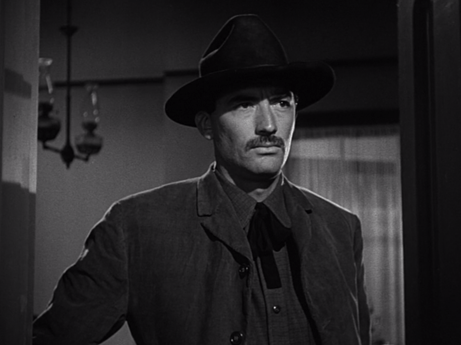 “Ringo don’t look so tough to me.”
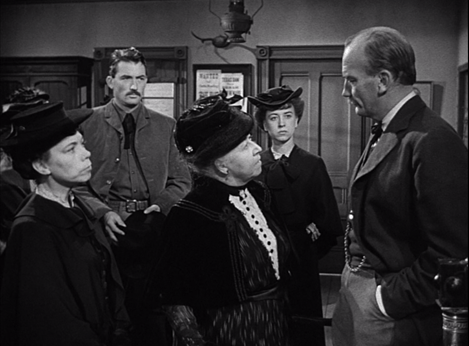 Of all men to understand Ringo, you would think that the local Marshall (Millard Mitchell) would be the last, but he happens to be an old friend of the gunman. They used to run in the same circles before Mark softened up. His life mellowed out, while Ringo’s reputation continued to build.
 The main reason Ringo stays in a town that doesn’t want him is all because of a girl (Helen Westcott). He waits and waits, biding his time, for any word from her, and finally, it comes. He gets his wish to see her and his son in private. These scenes behind closed doors are surprisingly intimate, casting the old gunman in an utterly different light.
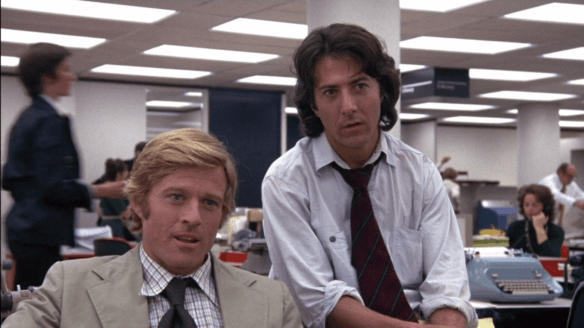 You couldn’t hope to come up with a better story than this. Pure movie fodder if there ever was and the most astounding thing is that it was essentially fact — spawned from a William Goldman script tirelessly culled from testimonials and the eponymous source material. All the President’s Men opens at the Watergate Hotel, where the most cataclysmic scandal of all time begins to split at the seams.
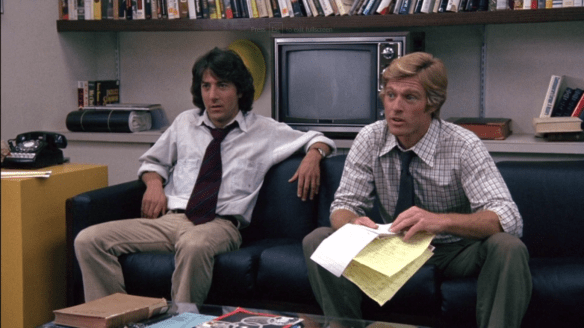 But it only takes a few breakthroughs to make the story stick. The first comes from a reticent bookkeeper (Jane Alexander) and like so many others she’s conflicted, but she’s finally willing to divulge a few valuable pieces of information. And as cryptic as everything is, Woodward and Bernstein use their investigative chops to pick up the pieces.
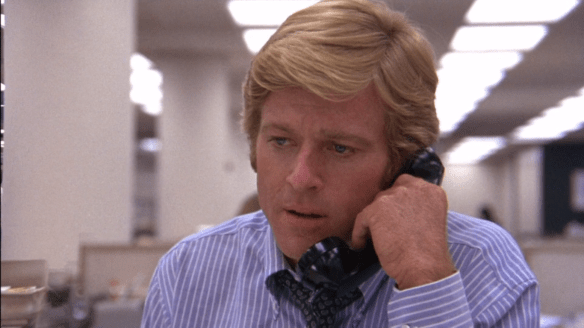 Gordon Willis’s work behind the camera adds a great amount of depth to crucial scenes most notably when Woodward enters his fateful phone conversation with Kenneth H. Dahlberg. All he’s doing is talking on the telephone, but in a shot rather like an inverse of his famed Godfather opening, Willis uses one long zoom shot — slow and methodical — to highlight the build-up of the sequence. It’s hardly noticeable, but it only helps to heighten the impact.
 Inspired directors oftentimes do not make themselves known in grandiose flourishes but in the smallest of touches, and in his debut, Polish newcomer Roman Polanski does something interesting with the opening of Knife in the Water. Perhaps it’s not that unusual, but it’s also hard to remember the last film where the camera was on the outside of a driving car, looking in. We see shadows of faces overlaid with credits and then finally the faces are revealed only to be shrouded by the reflections of overhanging trees glancing off the windshield.
 Thus, it becomes an exercise of technical skill, much like Hitchcock in Lifeboat or any other film that limits itself to a single plane of existence. Polanski’s framing of his shots with one figure right on the edge of the frame and others arranged behind is invariably interesting. Because although space is limited, it challenges him to think outside the box, and he gives us some beautiful overhead images as well which make for a generally dynamic composition. That is overlaid by a jazzy score of accompaniment courtesy of Krzysztof Komeda, a future collaborator on many of Polanski’s subsequent works during the ’60s.
 However, at this point, as a young director, he is simply sharpening his teeth and getting acclimated to the genre a little bit. Knife in the Water builds around the three sides of a love triangle, creating a dynamic of sexual tension because that’s what tight quarters and jealousy do to people. This is less of a spoiler and more of a general observation, but the film does not have a major dramatic twist. Instead, there are heightened tensions, a bit of underwater deception, and finally a fork in the road.
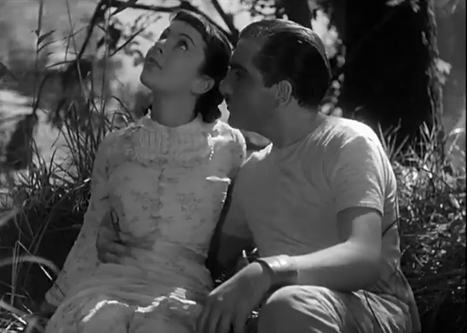 It’s only 40 minutes — hardly a feature film and more of a featurette, but Jean Renoir’s truncated work, A Day in the Country, is nonetheless still worth the time. Admittedly, I still have yet to venture to France and I hope to do that someday soon, but this film propagates marvelous visions of the countryside that resonate with all of us no matter where we hail from. Those quiet jaunts out in nature. Sunny days perfectly suited for a lazy afternoon picnic. Peacefully gliding down the river as men fish on the bank contentedly.
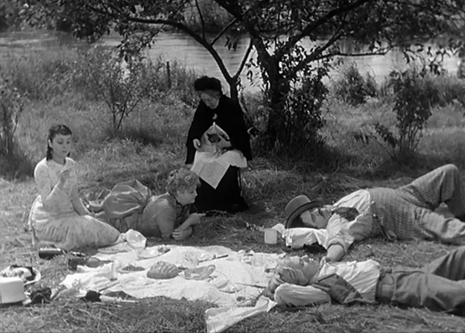 As always these characters set up Renoir’s juxtaposition of luscious extravagance with the earthier lifestyle of the lower classes. However, there is a geniality pulsing through this film, with Mrs. Dufour exclaiming how polite these young men are–they must be of good stock, obviously not tradesmen. Even Mr. Dufour is a good-natured old boy who gets fed up with the elderly grandmother, but he willingly takes the boys charity and advice when it comes to the prime fishing holes.
 We get the essence of what is there and we can still thoroughly enjoy Renoir’s composition. His is a fascination in naturalistic beauty where he nevertheless stages his narrative to unfold in time. But really this mise-en-scene created by the woods, and meadows, trees, and rivers really function as another character altogether. And when all the players interact it truly not only elicits tremendous joy but an appreciation for Renoir’s so-called Poetic Realism. Whether he’s capturing a woman swinging jubilantly on a swing or framing a shot within the trees, we cannot help but tip our hat to his artistic vision. If his father Auguste was one of the great painters of the impressionist era, then Jean was certainly one of the most prodigious filmmakers of his generation, crafting his own pieces of impressionistic realism. In fact, with father and son, you can see exactly how art forms can overlap on canvas and celluloid. They truly share a fascination in some of the same subjects. Universal things like nature and human figures interacting in the expanses of such environments. It’s beautiful really, even in its pure simplicity.
 Yogi Berra famously once said, If the world was perfect, it wouldn’t be. And to go even further still, in As You Like It Shakespeare wrote, the world is a stage and all the men and women are merely players. They have their exits and entrances.” So it goes with this film — The Truman Show. In fact, in some ways, it feels reminiscent of the likes Groundhog Day and even Jim Carrey’s later project
  However, as things progress there begin to be even more warning signs and indications to Truman that all is not right in his world. In truth, his life is a TV show, where everyone is privy to a television program including the audience, but that program ends up being his life. Truman Burbank is at the center of this orchestrated universe and he has been for 30 years. But over time he gets wise to the game and he’s looking to push the limit of the rules as far as they will go so he can get to the bottom of it all.
 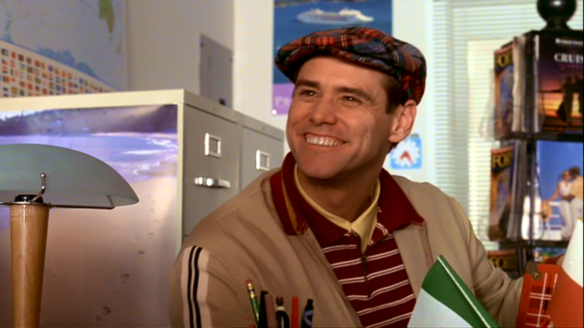 If there is a Creator of the Universe, our universe, The Truman Show puts it in a clearer light. Christoph seems like a somewhat selfish individual who allows his creation to walk off set rather reluctantly, but he finally does let go. Thus, his actions seem to make it clear that the most loving Creator possible would let his creation do what they pleased. He would be in control, but he would willingly give his created ones free will to do what they want. That makes sense to me. I would want to be a living, breathing, mistake-doing individual rather than a mechanized robot. That’s the beauty of this life.
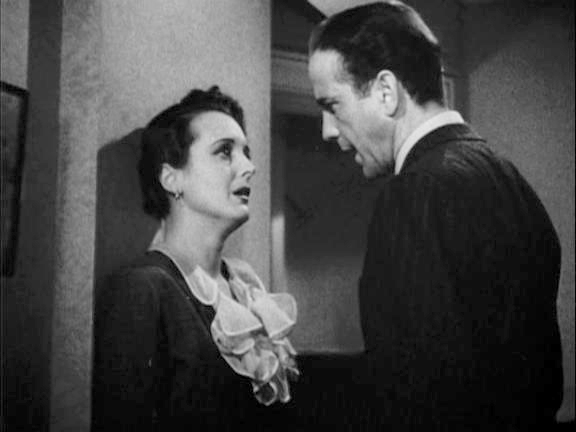 Dashiell Hammet’s “blonde satan” Sam Spade is an icon of not only 20th-century literature but also 20th-century cinema, thanks in part to
 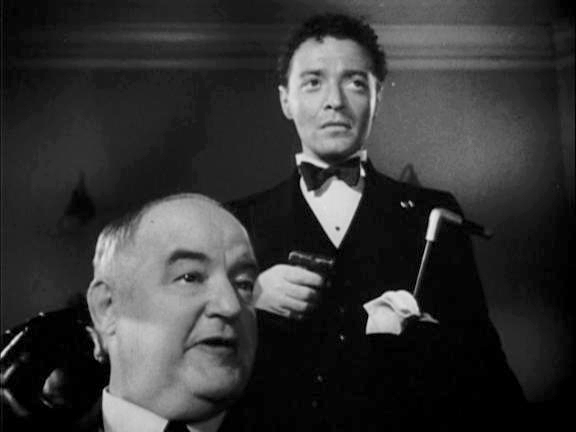 Then there’s Joel Cairo played so cunningly by the always wily and beady-eyed Peter Lorre and Kaspar Gutman portrayed so assertively and pointedly by the perennially memorable Sidney Greenstreet. These two men would come back in Casablanca and numerous other Warner Bros. Pictures, but they are the epitome of iconic characters actors who make any narrative that much more interesting. They have mugs and physiques really made for the dark recesses of the noir world, and when you put these four together it does spell trouble. Add a quietly seething Elisha Cook Jr. as Wilmer, the always personable Ward Bond as a Police Detective, and Lee Patrick as Spade’s doll of a secretary and you have a true winner.
 As I’ve grown older and, dare I say, more mature, I like to think that I’ve gained a greater appreciation for those moments when I don’t understand, can’t comprehend, and am generally ignorant. Now I am less apt to want to beat myself up and more likely to marvel and try and learn something anew. Thus, Marienbad is not so much maddening as it is fascinating. True, it is a gaudy enigma in form and meaning, but it’s elaborate ornamentation and facades easily elicit awe like a grandiose cathedral or Renaissance painting from one of the masters. It’s a piece of modern art from French director Alain Resnais and it functions rather like a mind palace of memories–a labyrinth of hollowness.
 In fact, although this film was shot on estates in and around Munich, I have been on palace grounds similar to the film. There’s something magnificent about the sprawling wide open spaces and immaculate landscaping. But still, that can so easily give way to this sense of isolation, since it becomes so obvious that you are next to nothing in this vast expanse. Marienbad conveys that beauty so exquisitely, while also paradoxically denoting a certain detachment therein.
 Do we understand this bit of interaction at this stately chateau? Probably not. In fact, I’m not sure if we are meant to know the particulars about last year in Marienbad. That doesn’t mean we still can’t enjoy it for what it is. Because Alain Resnais is perennially a fascinating director and he continued to be for many years. Whether you think this is a masterpiece or a piece of rubbish at least give it the courtesy and respect it is due. Then you can pass judgment on it, whatever it may be.
 “Two people shouldn’t know each other too well if they want to fall in love. But, then, maybe they shouldn’t fall in love at all.” – Vittoria
 The initial scene in the stock exchange is gloriously tumultuous and it never lets up. This is the dashing young Piero’s (Alain Delon) domain that he rushes through with lithe business savvy. What this arena becomes is the quintessential Italian marketplace, a hectic theater of business made up of all kinds, involved parties and observers alike. Vittoria (Vitti) is one of those who looks on with mild interest and really throughout the entire film she is a keen observer as much as she is a person of action.
 And the narrative becomes perhaps even more tantalizing than love because it’s the prospect of romance that keeps it going. But it never seems fully realized. It’s frustrating, unfulfilling in a sense, like most of his films. Whether it’s an unsolved mystery or the most perplexing conundrum mankind has ever faced romantic attraction, he always leaves us an open-ended denouement.
 4 Star Films