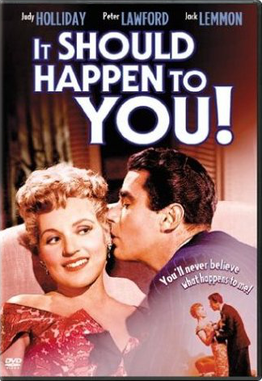
 It Should Happen to You was the brainchild of screenwriter Garson Kanin and director George Cukor with Judy Holliday as their lead. As such it’s easy to cast the movie in the same lineage of Adam’s Rib (1949) and Born Yesterday (1950). Except in this movie, there’s also a featured newcomer, a young man named Jack Lemmon.
The movie opens as any respectable New York movie does in Central Park. In the outdoor reverie of men at their chess boards and kids running around, Gladys Glover causes a hullabaloo for feeding pigeons. One man takes particular umbrage at having her try to pick him up while he was minding his own business, listening to the horse races.
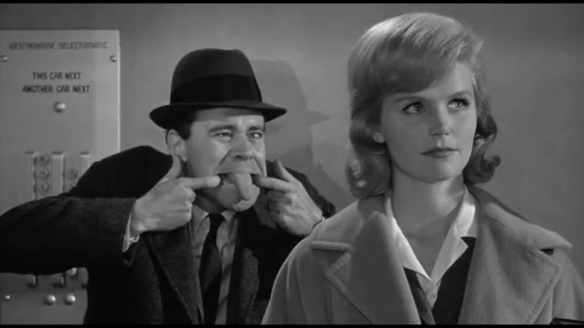
In the aftermath, she meets a documentarian, Pete Sheppard (Lemmon), who has his camera at the ready and an eye for people (Think a precursor to Humans of New York). He’s fascinated by this barefoot woman, and strikes up a conversation before they go their separate ways.
There’s an ethereal, fated tone I can’t quite put my finger on, but we know they will meet again and something is bound to happen. Judy Holliday perfectly exemplifies this airy bubbliness. I would never condescend to exhibit her as a dumb blonde archetype because there is far more going on here.
Gladys Glover sees an open billboard and resolves to buy up the prominent real estate on Columbus Circle. For what purpose we can’t be sure exactly. She says its personal. But she goes through the paces, speaks to the proprietor, and forks out the money that’s normally attributed to marketing corporations, not individual citizens.
Soon the words GLADYS GLOVER appear up on a street corner in lettering that looks like high rises. It’s an extravagant decision and Gladys beams with pride seeing her name like it’s never been before. But that’s not the end of it.
The rest of the movie is about the cascading effects it has since movies are meant to feed off delights of serendipity. It Should Happen to You is that kind of movie.
Peter Lawford plays a disgruntled marketing exec miffed to find out someone else has shouldered in on the billboard that has always been theirs in the past; it was an unspoken agreement between them. When he finds out about Gladys he wants to strike a deal with her. Surely a lady can be bought.
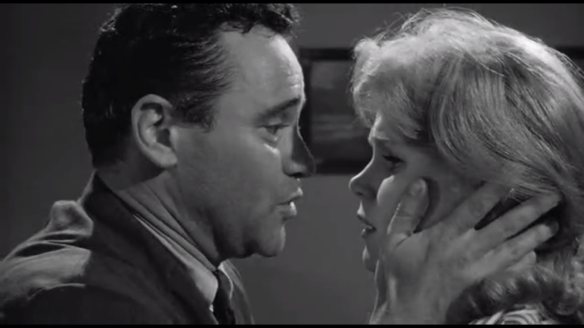
It must be said an angry Jack Lemmon is not always becoming and after moving in down the hall from Gladys, he seems to think more and more that he owns her. A more charitable reading of it is that he’s the only person who actually cares for her well-being beyond her growing reputation as a minor celebrity; he’s also falling in love.
Meanwhile Gladys strikes up an agreement to get her name put up on signage all over the city. When she’s shopping with Pete, a saleswoman helps them only for her demeanor to change instantly when she realizes who she’s helping. It’s like being queen for a day as a crowd forms around Gladys soliciting autographs from the local phenomenon.
She has effectively given them something — a nice souvenir to take with them in their day — and in this way it’s hard not to compare her to Elwood P. Dowd of Harvey. In the movie world they’re able to break into the everyday and give people some common decency and kindness.
However, we also watch from a distance as Gladys gets carried away by the mechanisms and machinery of television. She’s paraded out in front of America without much consideration of who she is as a human being. In one segment she’s even featured on a prim and proper panel show with the likes of Constance Bennett and Wendy Barrie. It feels twee by today’s standards, but the point is made.
Soon she finds herself caught between the indignant protectiveness of Lemmon and the business conferences of Peter Lawford including some extracurricular activities. His company has transformed the typical ethos marketing appeal into the Gladys Glover everywoman appeal for the average American girl. It’s a smashing success.
It Should Happen to You doesn’t feel like a groundbreaking story and part of this might be the fact we’ve seen so many analogous film’s in its wake. There’s this tension between celebrity and success and the kind of down-to-earth humanity that keeps one grounded.
I must say I was taken with the ending where Lemmon says goodbye to his girl using a film, and yet again it presages many of the meta qualities of a film within a film that have enamored writers and directors for decades.
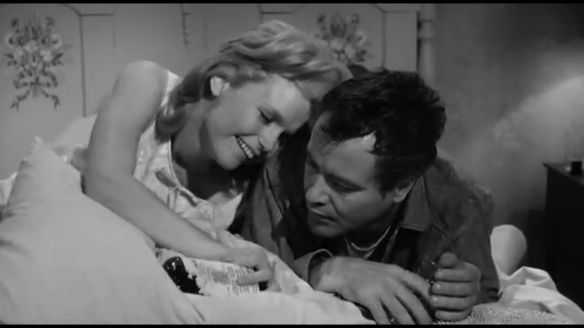
In this particular instance, it’s in service of a romance. The happy ending is that he actually receives a reply. Gladys writes it in the sky for him with letters as big as her billboard. She hasn’t lost her knack for the spectacular, but she simultaneously recognizes someone who has her best interest in mind.
If you said you were going to make a romantic comedy with Judy Holliday and Jack Lemmon, it wouldn’t immediately strike me. Still, if you have two likable performers and put them together, the results speak for themselves, even if the returns are mostly modest.
3.5/5 Stars




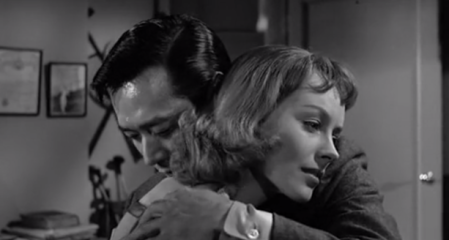
 While a less heralded picture, this Billy Wilder film is a minor classic built around a contrived comedic situation. Dean Martin opens playing a parodied version of himself as Dino the boozing, womanizing, but altogether good-natured playboy who makes a short pit stop in the gas station of the small town of Climax, Nevada following his latest Las Vegas circuit.
 “You can fool all of the people some of the time, you can even fool some of the people all the time, but you can’t fool all the people all the time.” ~ Inscription in the Fortune Cookie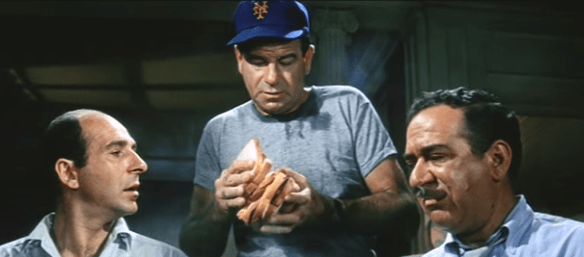

 4 Star Films