Review: Butch Cassidy and The Sundance Kid (1969)

butch cassidy and the sudance 1.png

Despite my general reluctance to say that the Western in its classical form was on the way out, it’s hard not to make such an assertion looking at the landscape of the late 1960s. The Wild Bunch is a common marker of the seismic shift leading to the complete obliteration of the classic western mythology, but there are some related themes strewn throughout Butch Cassidy that make it equally representative of an era or so one could argue.

The times were changing historically speaking and that plays out cinematically in Butch Cassidy and the Sundance Kid. Bicycles are the future, destined to replace the old reliable horse. And the western hero as we knew him has long since gone, replaced instead by vengeful tough guys and in this case a pair of bank robbing antiheroes. Bonnie and Clyde were the new standards and out of that trend, we saw more like them.

So it’s not just the fact that the film takes place at the tail end of the Old West, slowly evolving into the modern, or New West, but simultaneously the genre would never be the same. There’s a bit of a wistfulness to it all. The legend is fun. The mythology is something to be thoroughly embellished, but it too comes to an end. It’s only a wisp of a memory made of sepia tones and silent newsreels. But Butch Cassidy and Sundance will be remembered fondly by the audience just as the West is. Maybe that is enough.

Unfortunately, Butch Cassidy as a film does have its shortcoming which became more apparent with time. It’s possible to be a dated period piece as this film is (although it’s hard not to love “Raindrops Keep Falling on My Head). Still, it can be plodding and some would argue it’s about nothing substantial, nothing meaningful at all. Still, it manages to be one of the greatest western comedies of all time only eclipsed by its own heavy dose of cynicism.

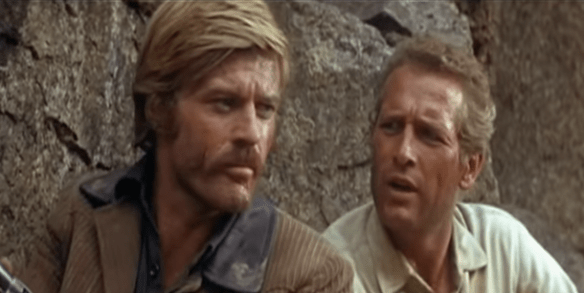
It’s funny watching Butch and Sundance go through their motions. Butch (Paul Newman) is the brains who bemoans the fact that banks are getting upgrades and shipments are being made by trains. After all, they are constantly on the move and it becomes a constant guessing game. He’s given more grief by his gang that looks to overthrow him led by the hulking thug Harvey (Ted Cassidy).

And on top of that every lawman wants him dead. In such moments, being the idea man that he is he entertains thoughts of joining the army for the Spanish-American War or even going to a far off land like Bolivia. Content with his gunplay and letting Butch do the thinking, Sundance rides by his side, certainly his own man but also part of this comic duo.

William Goldman’s script is brimming with wry wit that’s almost inexhaustible. But Paul Newman and Robert Redford loom even larger as the titular stars in this epic buddy comedy. In the age where winning charm and star power still seemed like a genuine box office draw. You came to see actors and in 1969 there were few actors as commanding as Newman and Redford. They had looks and charm. Cool and comedy. Charisma goes a long way. For those very reasons it’s an impressive film and enduringly entertaining. If we cannot watch a film and enjoy it as pure entertainment at least on some level, it really is a shame because that’s one of the many joys of the cinema.

But there’s also something admittedly depressing in how their story evolves. It can no longer be about snide repartee and living the good life robbing banks, continuously augmenting their legendary notoriety. It’s light and funny for a time before slowly spiraling into a deadly cycle.

Perhaps my faith in Butch and Sundance wavered slightly but I will go on resolutely and maintain my immense affection for them that began as a boy. This is still a wonderful film. Outlaws do not have to be one-dimensional. They can be just as funny as they are depressing. That is their right and the legend of the Hole in the Wall Gang is exactly that type of story. We don’t have to see them die. Instead, we get the satisfaction to leave them in one last shining moment of triumph. One final triumph of the West as we once knew it.

5/5 Stars

Park Row (1952)

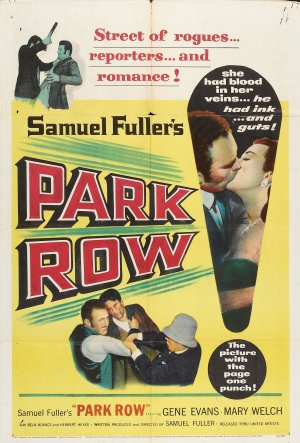
Park_Row_FilmPoster.jpegIt’s no secret that Sam Fuller cut his teeth in the journalism trade at the ripe young age of 18 (give or take a year) and so Park Row is not just another delicious B picture from one of the best, it’s a passion project memorializing the trade that he revered so dearly.
It’s also his typical style of economical filmmaking, shot in only two weeks and clocking in at just over 80 minutes and also funded on his own dime. To show just how much this movie meant to him he wrote, directed, and produced it. It was, of course, a monumental flop at the box office (despite an opening at Grauman’s Chinese). Still, that type of result could never quell a maverick like Fuller always prone to be a bit of a loose cannon who nevertheless perennially released a string of enduringly interesting projects. Consider a lineup of pictures including Steel Helmet, Fixed Bayonets, Park Row, and Pickup on South Street from 1951 to 1953 and you get the idea.

In some ways, Park Row seems like an invariably different film than its compatriots, very unlike Fuller, and yet it still gives off glimpses of Fuller’s style and sentiments.

The year is 1886. An industry has been developed and honed out of the invention and tradition of the likes of Johannes Gutenberg and Ben Franklin. The names of Horace Greeley and Joseph Pulitzer are as good as gold and the hub of that honorable profession, known to the masses as journalism, is based in Park Row.

Phineas Mitchell portrayed by Gene Evans–Fuller’s favorite brawny everyman–is a reporter at The Star, the publication that has a bit of a monopoly run by the icy empress Charity Hackett (Mary Welch). As he badmouths the very same newspaper at the local watering hole, he subsequently finds himself relieved of his position along with a couple of his colleagues.

But together, with the help of an eager benefactor they set out to craft their own newspaper. As envisioned by Mitchell, The Globe will be a paper for the people, devoted to honest to goodness journalism beholden to the facts. And in the subsequent days they take an abandoned office space, build a ragtag team, fix up a printing press, and scrounge around for any type of paper they can get their hands on. What they lack in resources they make up for with grit and determination. Because they have something Charity never had–verve and ingenuity. It sets their little paper apart and the public takes note.

Thus, the film’s entire narrative captures the ensuing journalistic feud between the established paper The Star and their rising rival The Globe. The main conflict coming from the very fact that their business models and mission statements are diametrically opposed.

Led by Mitchell, The Globe finds compelling cover stories to reel in the public. First, it’s a rallying cry for a man sent to prison for illegally jumping 120 stories off the Brooklyn Bridge and living to tell about it. They become his voice, interceding on his behalf and people listen. Next, it’s a public fund to help pay for the base of The Statue of Liberty–that symbol of goodwill, friendship, and ultimately, American liberty and idealism. Every member of the community, no matter the contribution, gets their name printed in the paper out of gratitude.

Still, Ms. Hackett is not about to be outplayed and while she admires her competitor’s tenacity, she is ready to resort to any means necessary to sink them for good. She tries all number of tactics, some more destructive than she ever anticipated. And while she might not be the most virtuous individual she’s hardly a killer. Mitchell hates her guts, rightfully so but that’s not how she wants to be known. There’s some nuance in their relationship, in fact, there’s a great deal of appeal to many of these relationships because they’re brimming with life.

Some noticeable hallmarks of Park Row include Sam Fuller’s typically dynamic camera that moves rapidly into close-ups and tracking shots gliding down the long avenues of Park Row with its horse-drawn carriages, train tracks, and the general hubbub of humanity. There are the accustomary fistfights and explosions, but the film stands out among Fuller’s other narratives for its championing of virtue, honor, and integrity especially in relation to a profession like journalism. It would have been so easy for this to be another expose of lurid sleaze and corruption and yet it’s surprisingly laudatory to the very end.

3.5/5 Stars

McLintock! (1963)

mclintock_4

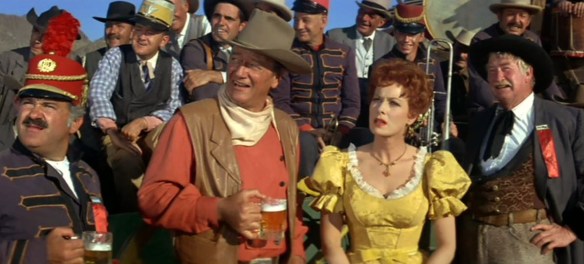
Apparently the name McLintock doesn’t come with the letter T. At least that’s the sense you get when the townsfolk send a salutation to the estimable cattle baron G.W. McLintock (John Wayne). Those who do pronounce that T are either out of towners, educated people, or probably the folks GW doesn’t like much. It’s true that the film is a western reworking of Taming of the Shrew so it’s very much a comedy. For all intent and purposes, it acts as a slapstick farce highlighted by a particularly raucous town-wide fist fight followed by a bungled hanging that just happens to commence right above a mudhole. The results speak for themselves.

But with the influence of its iconic star John Wayne, McLintock is also a fairly obvious commentary from one of Hollywood’s staunch conservatives. Still, the film never acts as a typical Western is supposed to.  In some ways, McLintock is a very modern representation of the West where you have the most amiable sheriff in the world, hardly anyone ever pulls out a gun, and numerous folks have college educations. Except in so many ways, this film can be critiqued for being outdated by today’s standards. There are “Indians,” belligerent Chinamen, and feisty women. GW has mutual respect and good relationships with many of these people but some of the usual sensibilities are still visible.

If the auteur theory can pertain to an actor than this film has Wayne’s handprints all over it. This isn’t a Ford film or a Hawks film or a Hathaway film starring John Wayne. This film is John Wayne’s, even more so than usual.

His son Michael helped produce, he enlisted the son of his old buddy Victor McLaigen to direct, his own son Patrick got a prominent position as a plucky young cattle hand, and so on. He fills the ranks with numerous veteran performers beginning with his greatest female costar Maureen O’Hara as his estranged wife who comes back to town threatening to divorce him and whisk his daughter away to the high society back east.

His trusty right hand Drago is played by Chill Wills while Strother Martin, Hank Worden, and even Edgar Buchannan take supporting turns. Perhaps the most unusual appearances are the presence of the radiant young Stefanie Powers as his daughter and yes, Jerry Van Dyke as a dorky college boy. A special guest spot was found for Yvonne De Carlo as a favor due to the fact that her husband had recently been injured on another film production.

But there’s also a pointed jab at Hubert Humphries in the form of the spineless, insensitive governor Cuthbert H. Humphrey, proving that even Wayne’s politics are channeled into the picture.

The final climax is played for laughs and it does provoke uneasy laughter, at least by today’s standards. It’s hard not to feel strange watching Maureen O’Hara running through town in her undergarments as G.W. pursues her and the town follows behind in hot pursuit. It’s full of pratfalls and slapstick moments that are indeed funny but at what cost?

For some reason, despite the light tone up to this point, it feels cringeworthy when Wayne knuckles down and gives his long-absent wife a shellacking right in front of everyone. Of course, by the end of the film they are together again and I wanted to be happy but this was not The Quiet Man (1952). It felt like Maureen O’Hara had conceded and lost. She returns to the cult of domesticity with her husband which isn’t inherently a bad thing but she hardly feels like a full partner in their complementary relationship.

By this point, although she had the upper hand the entire movie, digging in her spurs, she’s put in her place. In the end, she and GW get to live the life he wants. Because as he notes, “all the gold in the United States Treasury, all the harps in heaven, can’t equal what happens between a man and a woman with all that growing together.”

It’s true that using the word petulant to describe McLintock just doesn’t work. His daughter tries it and he laughs it off and I’m sure if any critic wrote as much Wayne would have done the same or cuffed him one maybe. There were invariably many people who didn’t much like John Wayne but it’s hard not to respect him–even in a comedy.

3.5/5 Stars

I Remember Mama (1948)

I-remember-mama-1948_poster.jpgInitially, I Remember Mama comes off underwhelmingly. It’s overlong, there’s little conflict, and some of the things the story spends time teasing out seem odd and inconsequential at best. Still, within that framework is a narrative that manages to be rewarding for its utter sincerity in depicting the life of one family–a family that feels foreign in some ways and oh so relatable in many others.

In this case, the Hanson’s are a family of Norwegian immigrants circa 1910 and the story gleaning inspiration from two earlier works features a post-war George Stevens at the helm with Irene Dunne anchoring the cast as the titular character.

And it’s true that the film is rather like a eulogy, memorializing this woman who was such a strong, stalwart example despite her unassuming ways. It is her daughter Katrin (Barbara Bel Geddes) who looks back fondly at her mother, as she, now being an author sees her mama as a worthy protagonist for a story. Because, after all, this is their story, personal, individual, and unique.

The film feels anecdotal as much as it is serial, taking galvanizing moments, little snippets of that time and place and crafting a very distinct picture of what life was like back then. And that’s part of the simplistic beauty of I Remember Mama just like Marta Hanson herself.

In the opening moments, the adult Katrin recounts vividly the evenings at the dining room table where the whole family would gather around to count out the weekly expenses. They scrimp and squeak by with the meager funds at hand so mama never has to go to the bank. Meanwhile, the timid Aunt Trina (Ellen Corby) looks to marry the local undertaker and she calls on her sister to rein in their two other sisters Sigrid and Jenny who are both rather unfeeling.

Other happenings include the entrance of the boisterously quirky Uncle Chris who blusters his way into their lives initially frightening the children with his antics which secretly mask a generous spirit. Young Dagmar subsequently goes in for an operation and Mama goes to visit her breaking hospital protocol to keep a promise to her little girl. This instance reflects exactly the character that Marta imbues.

She also appreciates the influence of the families’ elderly lodger Mr. Hyde who reads each evening from his many editions of classic literature from Dickens and “Fenimore Kipling” as mama recounts erroneously. She sees this as a gift not only to herself but also her children, opening them up to thoughts, ideas, and even a little bit of culture that she can never give them. The fact that he leaves behind his books in lieu of rent receives only her gratitude while her sisters become puffed up with contempt.

Again and again, she exemplifies that almost all-knowing love of a parent. While never perfect, there’s an innate understanding of what is best for each one of her kids and she is continually willing to work and sacrifice for the sake of her family. To say what those things are would be precisely against the ethics of such a person as Mrs. Hanson and so I will refrain. See them for yourself and you too will understand as Katrin does what makes this woman great.

This is yet another feather in the cap of Irene Dunne, confirming my belief that she is one of the most underrated actresses of the 20th century. At times she’s almost unrecognizable hidden behind that accent and a certain amount of stern, straightforward, and still motherly charm. Look at her character and you see a woman of such a phenomenal stock and integrity.

Nicolas Musuracas’ crisp black & white photography lends an authenticity to the San Francisco street corners as well as the interiors helping to develop a healthy aura of nostalgia. And you get the sense, that perhaps George Stevens was intent on tapping into a bit of that old-fashioned goodness because the post-war world was a far different, far darker place. I Remember Mama is a film of tremendous virtue and inextinguishable light.

There’s also a bit of a personal connection to this film as well because half of my ancestors were, themselves, Norwegian immigrants. Although I doubt they came through San Francisco there are some familiar touchstones and it’s easy to imagine that these people pictured up on the screen could share the contours and backgrounds of my own kin from bygone generations. Wishful thinking perhaps but it’s also incredibly exciting and that’s part of the reason that I left this story feeling as if I gained something from it.

So Stevens and Dunne succeed excellently with what they set out to achieve providing a character study that is nuanced and still evocative in its pure depiction of the sacrificial love of a parent. Some would say that there’s no greater love than that.

4/5 Stars


Dunkirk (2017)

Dunkirk_Film_poster.jpgUpon being thrown headlong into Christopher Nolan’s immersive wartime drama Dunkirk, it becomes obvious that it is hardly a narrative film like any of the director’s previous efforts because it has a singular objective set out.

It’s economical (shorter than many of most recent efforts) and the dialogue is sparse, sprinkled sparingly throughout his picture. After all, the main goal of this film is not so much to tell us a story — drawing up the lines as they might have been — but actually immersing us in that moment that was so crucial to British morale and ultimately the outcome of WWII.

As such, this is visual storytelling to the utmost degree and it comes off splendidly for the precise reason that film has always been a visual medium as much as we try and make it about dialogue. Because invariably dialogue is often used as a crutch while Nolan’s film relies almost solely on its images to tell its story and that’s a quality of filmmaking that is often lacking in the contemporary industry.

Backstories are all but left to the imagination and there’s immense power in that. Too often storytellers feel a need to spell everything out, providing all the perfect cookie cutter moments in order to hold the audience member’s hand so they comprehend it all. But has something as volatile as war ever been like that? I’m sure we can all answer with an emphatic “NO,” so why would a film be any different? Make people use their brains. Make them feel something viscerally. Leave them in the dark. Keep the outcomes ambiguous.

Likewise, there are no imagined interactions between the major figures at play whether Winston Churchill or Adolf Hitler. In fact, we never see a German’s face. We only see the results of their efforts to deter the British and cut off their escape route. As for Churchill, we never see the great English bulldog but his spirit wafts over the picture — certainly his words too — but it’s that spirit of resilience, that never say die attitude that speaks to his own character. That is enough.

Normally these type of decisions would signal a death wish but Nolan has been rewarded for his brazenness offering up a summer blockbuster that’s all but necessary. Because it tramples over much of the conventional wisdom that the industry has tried to impose on itself to reel in success. If there was any man to do it, Christopher Nolan certainly fits the bill.

There’s still very purposeful action playing out on three fronts. You have the soldiers actually stuck on the beach and in this case, we end up following a group of soldiers. Boys really. First, one who flees back to the beach after his compatriots are gunned down then joins with another boy to try and get aboard a battleship with a man on a stretcher. Finally, they get their chance only to get torpedoed out of the water. Treading in the oil-soaked ocean until someone can save them.

Then, there’s a trifecta of British Spitfires (led by Tom Hardy) traveling across the English Channel to provide coverage to their boys down below. Their exploits are documented with engrossing aerial shots that bring us right into their cockpits as they sit behind the controls looking to evade and vanquish their enemy.

Finally, we have the men of the home guard namely a father (Mark Rylance) and his two sons who answer the call to come to the aid of their young men stranded across the channel. You get the sense that they are riding into the valley of the shadow of death except that the valley of death is the sea and German U-Boats are waiting for them. Still, they push onward to rescue men coming by sea and by air. It too requires costly sacrifice.

Dunkirk’s soundtrack is magnified by ticking clocks and Hans Zimmer’s selection of screeching strings but it’s not necessarily developing the drama for drama’s sake. Again, there’s this underlying striving for authenticity.

One scene stands out in particular when the shell-shocked soldier (Cillian Murphy) asks if the boy he accidentally harmed is okay. He’s sorry now but doesn’t know the irreparable damage he has done. Still, the young man’s brother could lash out in anger. Instead, he takes the high road and tells him the boy is fine. His father grimly gives him a nod. He has made the most merciful decision for all parties involved.

It’s so easy to get caught up in the moment and you begin to understand to what extent these British soldiers were sitting ducks on the beaches of Dunkirk.  Because you are right beside them in every waking moment. And if we understand the horrors and the selfishness that begins to breed as survival instincts set in then just as easily we comprehend the pure euphoria that comes over the men when the flotilla from home comes to their rescue.

Even in these moments what is striking is not so much that Dunkirk is a grand epic but it feels surprisingly intimate. Despite the anonymity that runs through a great deal of this film Nolan still gives us characters that we can attach ourselves to and they begin to resonate not because we know their person inside and out necessarily but we start to empathize with their positions first hand.  When you begin to see the world as someone else sees it, it’s difficult not to connect. And that goes for everyone.

Because this was not just a war of soldiers from the army, navy, and air force. This was a war that involved nurses and the home guard and every other man, woman, and child who rationed their supplies and blacked out their windows all because of the collective war effort.

It’s often the most trying circumstances that bring us together so that we are no longer individuals but we become one. Dunkirk seems like precisely one of those galvanizing events that can forever be looked back on with pride. It personifies bravery, resilience, a stiff upper lip if you want to put it that way. And the significance in survival is that they lived to fight another day and ultimately with the other Allied powers they were able to quell the Nazis.

Some might come out of Dunkirk hailing it as one of the great war pictures of our generation, but truthfully it’s more so a survival story and a tribute to the fighting spirit that often dwells in the souls of men. In an age so often lacking in courage, fortitude, and honor those are the very attributes that rise to the surface and become most evident. Dunkirk is a striking reminder, not simply for the British people, but for us all.

4.5/5 Stars

Morocco (1930)

Gary_Cooper_and_Marlene_Dietrich_in_Morocco_trailer_2.jpgBefore the exoticism of Casablanca, Algiers, or even Road to Morroco, there was Josef Von Sternberg’s just plain Morocco but it’s hardly a run-of-the-mill romance. Far from it.

Although it involves soldiers, it’s also hardly a war film but instead set against a backdrop that presents an exotic love affair as only Sternberg could. With a sultry Marlene Dietrich matched with a particularly cheeky Gary Cooper, it instantly looks to be an interesting dynamic because they couldn’t be more different.

She, a radiant German beauty with an evocative pair of eyes to go with a somewhat sullen demeanor. He, America’s ruggedly handsome ideal of what a man should be. And it in Sternberg’s film neither of them is what we’re used to.

He’s a renegade soldier in the French Foreign Legion. She’s a cabaret singer (that hasn’t changed) but she also manages to be French, not German. Somehow it’s easy enough to disregard because it’s not necessary to get caught up on the particulars.

All that matters is that they both find themselves in Morocco. He is traipsing through town with his division and spends some free time taking in her floor show along with the rest of the rowdy masses. Neither one of them has found someone good enough for them — they’re equal of sorts. He’s a gentleman cad if you will and she’s hardly an upstanding woman, making a living in a dance hall but there’s more to her. It’s hinted that she once had love, perhaps.

It takes so long for them to actually speak to each other but they’re flirting from the first moment they lay eyes on each other. They say so much through simple expressions all throughout the cabaret show. Things proceed like so. She slips him a flower, then an apple, and finally a key. At this point, he gets the drift and we do too.

Later that evening he winds up at her flat and they spend their most substantial time together. It’s full of odd exchanges, meandering conversations that run the risk of sounding aloof. In fact, their entire relationship is replete with oddities.

Another man (Adolph Menjou) is smitten with Amy but he’s never driven to jealousy. He’s good-natured and generous in all circumstances. People like him must only drift through the high societies.

She holds onto some wistful longing for the tall dashing Legionnaire who drifted through her life. But she’s slow to act. Meanwhile, he hardly seems to take it as a blow to his love life when she resigns to stay behind. After all, he’s quite the ladies’ man. He probably doesn’t need another woman. He’s always got several draped over each arm.

Morocco is a film interesting for the spaces that it creates and not necessarily for the story it develops. Visually, by the hands of the director and then simultaneously by Cooper and Dietrich as they work through their scenes both together and apart. Though it might in some ways lack emotional heft, its stars are still two invariably compelling romantic stars of the cinema.

Somehow it still manages to be quite lithe and risque when put up next to its contemporaries. It exudes a certain mischievousness of the Pre-Code Era. It’s not so much licentiousness and debauchery but it wishes to suggest as much. It can be implied without actually going through all the trouble of showing it.

Dietrich sums it up perfectly in her little diddy about Eve (What am I bid for my apple/ the truth that made Adam so wise? On the historic night/ when he took a bite/ they discovered a new paradise). In essence, the world got a lot more exciting when sex and deceit were brought into the equation. Maybe she misses the implications the Fall of Man but that’s precisely the point. Still more Pre-Code sauciness case and point.

In the final moments, where Dietrich abandons her heels and goes slinking across the sand chasing after her man, it feels less like a romantic crescendo or even a tragic turn and more like a ploy by the director to make his leading lady the focal point of his story one last time. She is granted the final bit of limelight. Because in many ways Gary Cooper could not win when it came to upstaging Marlene Dietrich orchestrated by her devoted partner/director Sternberg. Thus, Morocco turns out to be a rather curious love story different than some of the more typical Hollywood fare.

4/5 Stars

The Whole Town’s Talking (1935)

the_whole_towns_talking_1935_posterComic mayhem was always supercharged in the films of the 1930s because the buzz is palpable, the actors are always endowed with certain oddities, and the corkscrew plotlines run rampant with absurdities of their own.  Penned by a pair of titans in Jo Swerling and Robert Riskin, The Whole Town’s Talking opens with an inciting incident that’s a true comedic conundrum.

Bald and beady-eyed Mr. Seaver is called upon to fire the next employee who comes in late to work. A tough proposition to begin with but it gets worse.  Arthur Ferguson Jones has not been late to work in 8 years and of course, today’s the day his alarm clock doesn’t work. Although he gets a reprieve. Still, the next person walking in isn’t so lucky. The hardy, wisecracking Miss Clark (Jean Arthur). And that’s our introduction to our main players.

But the real wrench comes from an age-old device that’s easy to scoff at initially. There’s a doppelganger. Yes, the same upstanding, timid Arthur Ferguson Jones is cut in the spitting image of Public Enemy No. 1, Killer Mannion. But before you check out, consider what this does for this ruckus of a story. It ties it up in knots.

Jones is the talk of the town. Exploding flashbulbs. Cover stories. Tumult. Back in the glory days when the press ran in a pack like hyenas.  His boss invites him to dinner, wants an autograph for his boy. He’s being ribbed by his coworkers and Miss Jones takes an interest in his literary endeavors. This leads to a gig ghostwriting the gangster’s life story in the local paper.

Meanwhile, the police argue about what to do about him. They finally decide to give him a special passport. It says he’s not Killer Mannion. And hapless little Mr. Seaver still badgers his employee to finish up his waiting caseload. What no one expects is that Mannion will sneak into Jones’ home and sets up camp.

And from that point on, everything gets confused. Robinson gets a chance at a great deal of range sometimes having his two diverging roles playing off each other in the same frame. All you need to know is the gangster is looking to leave his new benefactor holding the bag for his numerous crimes. Whether it works out or not is quite another story.

This a particularly odd film for the talent assembled. It doesn’t especially feel like a John Ford film and not simply because it’s not a Western. But at this point in his career, his stock company isn’t even assembled.

Edward G. Robinson will always be identified with gangster pics and it’s true he was tired of that association. Here he’s playing comedy. He has one foot in his usual wheelhouse but the other seems utterly alien to his usual persona. As such it’s great fun.  And his timid common man isn’t even a tragic figure like Chris Cross (Scarlet Street). The comedy is far more apparent and that in part stems from Arthur.

She shows up late to work, gets fired, and still has quips coming out of her ears. She plays all the journalists trying to pump her for facts and at the same time falls for this dope who has her picture framed by his bedside. Perhaps better than anyone she perfected how to be cheeky but still wholesome and caring. Arthur feels most at home in this film more than anyone else, given her comedic pedigree but she and Robinson bounce off each other well.

In a few years she would play a Miss Jones but for right now she’s content calling her colleague by the pet name “Jonesie” and (tiny spoiler) she does become Mrs. Jones. So an oddball romantic pair they might be, but that doesn’t make the partnering of Robinson and Arthur any less amusing. They’re both on their A-game in The Whole Town’s Talking and thankfully there would be many more arresting performances to come.

4/5 Stars

Review: Pickpocket (1959)

pickpocket-1Pickpocket is an intricately staged, truly intimate character study from the inimitable Robert Bresson solidifying itself as one of his greatest works. As was his practice, Bresson took Martin LaSalle, a non-actor to be his leading protagonist.

The Uruguayan-French actor sports gaunt, rather severe features, thick eyebrows, a sauntering gait and a slumped posture. However, there’s also some facial similarity to Henry Fonda there, except LaSalle is even more “normal” if you want to go that far. He seems altogether unextraordinary and still Bresson manages to tell an engaging story with such an unassuming star–not through emotions but the inverse–a complete lack of emotions replaced instead by actions.

Aside from being a vagrant who lives in a dilapidated flat, Michel is a cynic who holds a bit of a superman complex. In fact, he’s not far off from Raskolnikov in Crime & Punishment. The difference being his crimes are more mundane. The outcome is less pronounced. But he too achieves a kind of redemption.

With such a life as he leads, not working, with hardly any friends, or anything to do aside from betting on the horses, Michel fills his idle hours learning what it is to be a pickpocket. It becomes his livelihood as he joins forces with some accomplices, honing his trade, and gleaning inspiration from the life of pickpocket socialite extraordinaire George Barrington. Except Michel seems nothing like this man. He’s no adventurer or colorful personality. He watches the world with passionless eyes, lacking purpose, and hardly talking to anyone. When he does, it’s generally brusque. He’s not looking to make friends–aside from his “buddy” Jacques. He hardly even visits his sickly mother even when she’s lying on her deathbed.

But that’s what makes his nearby neighbor Jeanne (Marika Green) all the more fascinating because she brings something out of him. It just takes him a long time to realize it. I cannot get it out of my head that Marika Green shares some striking resemblance to Natalie Portman. This notion shot into my head the first time I ever viewed Pickpocket. It serves no real obvious purpose but to suggest her stunning beauty and maybe even that there’s a modernness to her or better yet a timelessness behind her eyes that’s full of some sort of inexplicable power. Maybe Natalie Portman has that same quality as well. It’s difficult to say.

It’s striking that many of the scenes in Pickpocket are almost silent, lacking scoring and often even dialogue, and yet they’re choreographed like the most elaborate dance. Instead of feet, though, hands are involved. The dexterous hands and limber fingers of pickpockets.  And his eyes rove as much as his prying fingers.

There are similarities here with Sam Fuller’s Pickup on Southstreet except in this case the life of a pickpocket, this life of second class crime is the extent of his existence. There are no gangsters, plots, or big implications pointing to Cold Wars and Communists. But if they share anything it’s their equally impressive understanding of economical filmmaking with the innate ability to tell rich, impactful stories in a highly condensed amount of time.

Michel’s life is pitifully mundane in a sense and yet within that context, he’s still able to find hope and that’s the beauty of what Bresson suggests here through the simple functions of sound and image. He evokes a great deal.

It was not the final words of Pickpocket that struck me but rather the image that we are left with. There stands Michel incarcerated in prison. It seemed inevitable. Because supermen do not exist, at least not in the way that he supposed. And yet in the same breath, when he shed that philosophy he found something better.

He caresses Jeanne through the bars, kisses her face. Yes, he’s still trapped, stuck in such a horrible spot without his freedom. But the utter irony of it all in this one moment, before a very abrupt conclusion, Michel is finally free–finally saved by the graces of love and it took a prison cell to teach him as much.  His life was propelled by inaction highlighted by contained moments of theft and deception. Therefore, it’s in this final instance that Michel finally shows some amount of goodness and affection bursting forth. His life no longer seems to be defined by being a pickpocket. For once, it’s defined by something else–by someone else.

Whereas Raskolnikov realized that he needed Sonya to resurrect him much like Christ resurrected Lazarus, Michel comes to a similar conclusion here though he only believed in God for three minutes. Still, in a sense, he has been redeemed and now there’s a certain amount of hope in his life going forward. The straight and narrow is a tough road to traverse but Michel might find it yet.

“Oh, Jeanne, to reach you at last, what a path I had to take.”

4.5/5 Stars

Shoot the Piano Player (1960)

shoot-the-piano-player-1

Shoot The Piano Player begins thrillingly with a car chase. The man being pursued flees down a street corner, his assailants disappear into the night, and he subsequently bounces off a streetlight like an idiot. The man who brings him back up on his feet proceeds to regale him with stories about how he met his wife before walking off, never to be seen again.

In fact, none of these characters are our main protagonists but it perfectly encapsulates the glories of Francois Truffaut’s stroke of genius in this early emblematic film of the New Wave.  It’s a petty crime story with a comical streak. The two tough guys aren’t tough guys at all but with their hats and pipes they look like a pair of Monsieur Hulot doppelgangers or something. That is until they pull out a gun. But even then, they’re hardly thugs.

Listed out as simple plot summary, it has certain flourishes fit for a Hitchcock thriller. A man on the run. Lurking criminals, kidnapping, murder, romance, humor, but there’s no doubt, even with this being only his second feature, that this is very much Truffaut.

It’s all a wonderful front for Truffaut’s own explorations. And the bottom line is not simply homage to film-noir and the Master of Suspense but more broadly all his fascinations of men, women, love, and everything that intrigues him about putting a mirror up to humanity–cinema itself. However, as the director long suggested, he preferred film to reality because he could orchestrate it, make it to his liking, with touches of humor and tragedy.

This pseudo-storyline starts with Charlie who placidly knocks out honky tonk for the public’s enjoyment. It’s hard to know if he’s content or simply biding his time. The latter seems more likely. Except when his big brother Chico busts into the joint with a couple of hoods on his tail, in some small way it brings everything rushing back on Charlie.

shoot-the-piano-player-2

It’s not much but the ensuing events have him wrapped up in his own bit of intrigue as he navigates his romantic inclinations and every other thing that is thrown his way.  A Hollywood reference point would certainly be Out of the Past and similarly sinks back into a flashback. But here it is used in a way that’s completely jarring, hardly convenient for those seeking comprehension. And Truffaut’s character utilizes voiceover as well but this is not the laconic, cynical speak of film-noir, instead the nervous inner monologue of a timid piano player.

His sometime bedmate and the housekeeper for his kid brother is Clarisse. Meanwhile, the waitress at his work Lena has his heart going pitter patter, not quite a Hitchcock blonde but a woman who is willing to get involved with his drama. But there was also another important woman in Charlie’s life: His wife.

It’s from these three women in their relationships with Charlie and all the other male characters that some very blatant realities become evident. There’s a conscious separation of the woman into parts whether it is her heart or her body. In one sense, the aforementioned women are strong characters. Meanwhile, the men are all fairly passive, their main outlets include objectifying, ogling, even ridiculing their female counterparts.

At least Charlie’s candid about it but he’s still part of the problem. In many ways, in looking at the women as the tragic figures often used by men as a cinematic object, Truffaut could very easily be wrestling with his own issues of love and romance. What does that actually mean? What causes people to marry? What causes them to love and fall out of love, break up and come back together or even commit themselves to death?

All that can be found within this film although it is obviously veiled by scenes masquerading as crime and comedy. The crowning joke of them all is really a kind of tragedy. Amid the strangest turn of events, Charlie or Edouard (as we now know he is called) is resigned to play behind his piano once more.

The final moments at the snowcapped cabin are madcap and still almost surreal with some stunning sequences captured vividly by iconic New Wave cinematographer Raoul Coutard. In breaking so cleanly with his initial effort of The 400 Blows, Truffaut simultaneously positioned himself as a very special filmmaker. He’s beholden to drama, comedy, crime, and romance, but most of all, he’s beholden to the magic of the silver screen.

4.5/5 Stars

Review: Vivre sa Vie (1962)

vivre-sa-vieThe opening credits of Vivre sa Vie commence with the opening note “dedicated to B-movies” and indeed many of Jean-Luc Godard’s best films could make the same claim. They’re smalltime stories about little people living rather pathetic lives if you wish to be brutally honest. This isn’t Hollywood.

Opening titles aside, we meet our main characters from behind, their backs to the camera in the throes of a minor spat. It acts as the subject for the first of the director’s 12 tableaux that make up the film rather like chapters in a book following the life of our heroine Nana (Anna Karina). Next, comes pinball games, Nana’s occupation as a Record Shop attendant and other mundane moments.

The passage of time caused me to forget that Nana goes to a screening of The Passion of Joan of Arc. Her own life witnessed in the eyes of Joan–a heroine that she easily empathizes with for her own amount of suffering and pain. It’s difficult to decipher who Nana feels more connected to, Joan of Arc or the actress Maria Falconetti herself. Because the truth is, Nana too was trying to make it as an actress, even being featured in a film or a play or something or other. It didn’t work out.

As the story evolves, we gradually begin to see her plight more clearly. It comes slowly at first before fully establishing itself. She goes down the rabbit whole quite by chance, taking on a very different occupation. It’s pitiful really, she looks more like a frightened rabbit than a woman of the street.

Her aspirations of catching the eye of some director are instead channeled towards Raoul, the pimp who gets her started and shows her the ropes of the trade. In some ways, it feels like he owns her, and yet Nana still strives to lead her own life. One of the moments she gives the illusion of happiness is in all places a pool hall as the jukebox grooves away and she shimmies with it. But in this moment as with so many others, it seems as if she’s constantly under the gaze of men. She’s constantly trying to earn their affection and in some sense earn her own worth. Whether or not they give it is another matter and that’s the great tragedy of Nana’s life.

In some of the film’s final interludes, she finds time to wax philosophical with an old thinker on a number of topics from personal responsibility to issues of free will. He further asserts that the more one talks, the less the words mean. Perhaps Godard took that to mean form over dialogue.

At times it’s as if Godard’s camera is constantly on a swiveling axis or even a pendulum, focusing on a figure and swinging back and forth between it’s two subjects. No cuts are necessary and it’s oddly compelling.

Look at his work hastily here and it could be misinterpreted as shoddy and that could be but more likely is the fact that Godard was always thumbing his nose at convention. He was never beholden to classical Hollywood but he did have heroes. The likes of Sam Fuller, Fritz Lang, and Nicholas Ray. Men with their own aesthetics and Godard was forging his own path. Only someone like Godard would have the audacity of having us watch the entire transcription of a letter. Why? Because he wanted to.

Vivre sa Vie did not ignite the Nouvelle Vague but in many ways, it stoked the flames and Godard perhaps unwittingly gave nod to another landmark film from his compatriot Francois Truffaut, Jules et Jim, which finds its way up on a movie marquee.

Perhaps what’s easiest to take away from Godard’s work here with longtime collaborator Raoul Coutard is that he’s constantly messing with our classical cinematic sensibilities. The way he cuts (or doesn’t), the way he interrupts sound, the way he moves between intertitles and so on. It’s still his and it still disrupts the status quo that we are used to even as seasoned viewers of visual content.

For some, it can come off as tiresome, even pretentious but it’s undoubtedly Godard and highlighting the entire narrative is the quietly yet still evocative performance of Anna Karina. Her doe eyes speak volumes by themselves.  They truly were the power couple of the French New Wave. He being the audacious artist, she his inspired muse. However, it begs the question, if there is any stock in the parallelism between film and reality. Nana/Anna being controlled by the men in her life or was it truly her life to live?

4.5/5 Stars