 The strands of our lives are woven together and neither time nor the world can break them.
From the outset, you get a sense from the grand philosophical dialogue and imagery that we are being treated to a classical Hollywood precursor to Terence Malick’s Tree of Life. Quotes from Euripides and Keats flash over the screen. Profound questions are brought to the fore. What is time? What is space? What is life? What is death?
And it is somehow a spiritual film and not because of convents or biblical references. It’s a different type of spirituality — more elusive than a simple description. It’s summarized by the early supposition that each person must find their own faith. You must learn how to care deeply about something. And these initial suggestions give a hint to the film’s intention although the rest rolls out in more typical Hollywood fashion courtesy of David O. Selznick.
Eben Adams (Joseph Cotten) is one of those starving artists types who gets very little monetary value out of his creative vocation as a painter. Although initially brusque, he does receive some encouragement from a pair of veteran art dealers (Ethel Barrymore and Cecil Kellaway) and for the majority of the film, they remain buttresses to his career.
They see a spark of talent in this man — though not fully realized — there’s something there that can develop into something beautiful. Perhaps they see the landscapes like he does, where the images of the world are literally on canvass (Director William Dieterle denotes this phenomenon well).
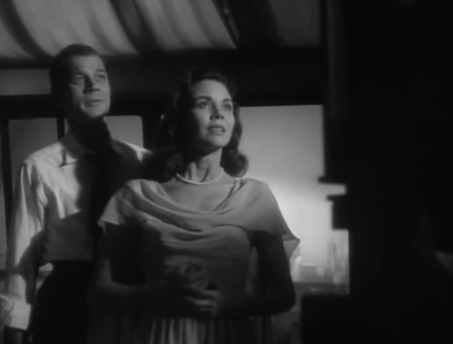 But it’s a chance encounter with a young girl named Jennie (Jennifer Jones) that gives Eben the type of inspiration that every artist dreams of because it’s precisely this spontaneous spark of joyous energy he needs to add something vibrant to his own life. In her constantly evolving role, Jennifer Jones exudes an effervescence, a certain radiance in body and spirit that lights up the screen in embodying this apparition of a girl.
She meets Adams first near a park bench, then doing whirly-birds on the ice rink. They continue to have these little moments together made up of chance encounters and pieces of fate. Although the film hardly gets to explore the idea, Portrait of Jennie plays with time for the sake of love. And it conveniently allows its two characters to meet each other at very different reference points in life. For him, it’s only a few days. For her she’s no longer a young girl, now blossoming into a mature young woman. And that is part of the tantalizing charm. Their chemistry flourishes. It becomes evident that much of romance is made up out of memories, these little fleeting moments of joy in being together.
It’s fantasy aspects make it a fine companion piece to the Ghost and Mrs. Muir as well. Light, passionate, moving, all those things. Yes, its conclusions on love are more than soppy, but a little soppiness does wonders in this cynical world we find ourselves in presently.
Out of context, it sounds ludicrous that Adams pilots a boat out into a New England gale for no reason except that it is the last place Jennie was seen. But interestingly enough, this conclusion hardly feels out of the ordinary since we intuitively know that Eben is going where he needs to, or at least where the film suggests he needs to go. And it’s not terrifying in all its technicolor glory because those apprehensive feelings easily give way to the raw majesty of it all — the pure awesomeness of the crashing waves — the churning forces of natures.
In these moments the film reaches its crescendo of love while also coming full circle to its opening prologue. But there’s something inside of me that feels unfulfilled with this ending. There’s a hollowness. Eben and Jennie had something together but what is it exactly, is difficult to comprehend completely. Eternal, no. Immortal, no. It’s only a moment. That is all.
 I find that despite his pedigree Joseph Cotten still comes off as an underrated actor and with each film I see him, I enjoy him immensely. Maybe for those very qualities. He’s not altogether handsome but he has a pleasant face. His voice isn’t the most formidable or debonair but it does have character. The supporting players lend some Irish flair to the cast and it’s striking that everyone from Ethel Barrymore to Lilian Gish glows with a certain hope. There is no obvious antagonistic force in this film. Eben Adams found his inspiration — the muse of a lifetime — and that passion is enough to lay the foundations of a film.
In some ways, I am discontent with the actual portrait of Jennie. The film acts as a better portrait of who she was as we continually get small swatches of her personality and glimpses into her character. In comparison, that painting seems little more than an austere shell. It lacks the same joyous vibrancy of the woman it was hoping to capture. That is to Jones’ own credit but to the detriment of the story. The painting lacks the same aura of the film.
3.5/5 Stars
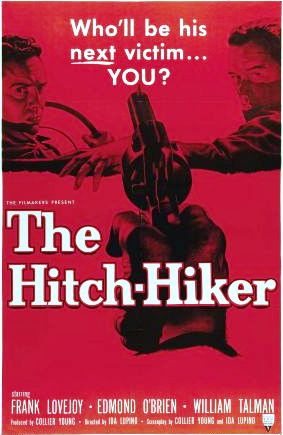 Part of the harrowing allure of the Hitch-Hiker is that it’s actually based on a true incident that occurred only a year before the events shown. It’s not as if someone took artistic license with some murderers and made it into a horror spectacle. Hitchcock’s Psycho especially comes to mind.
 It disappoints me that I was not more taken with the material than I was but despite not being wholly engaged, there are still some fascinating aspects to Panic in the Streets. Though a somewhat simple picture, it seems possible that I might just need to give it a second viewing soon. Let’s begin with the reality.

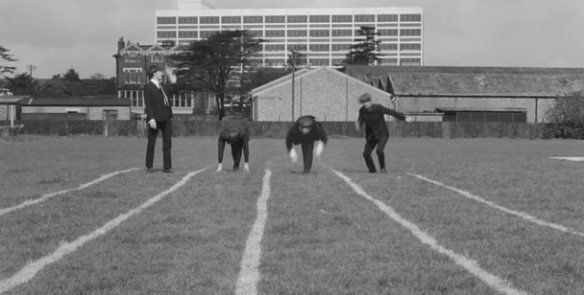
 Are you a mod or a rocker? ~ reporter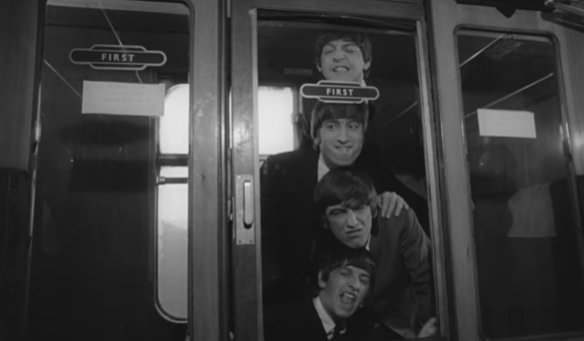
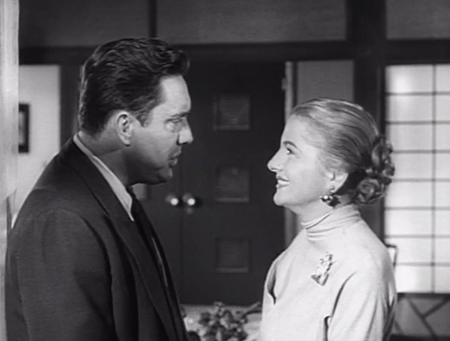 I despise you and I pity you. ~ Edmund Gwenn as Mr. Jordan
 Except at first what Harry does, does not seem like infidelity. In one integral scene Harry takes one of those bus tours to see the stars because, after all, Beverly Hills is that land of movie stars and their extravagant lifestyles. Jimmy Stewart, Jack Benny, Oscar Levant, Barbara Stanwyck, and Jane Wyman are all given a nod. There are even a few playful in-jokes to the always genial Edmund Gwenn who turns up as the adoption agent. All of this is essentially fluff but it’s on that same ride where he meets someone — a woman named Phyllis Martin (Ida Lupino).
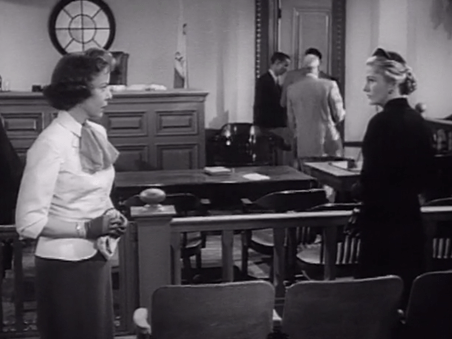 It strikes me how it’s often the small, tiny, unassuming pictures that impact me the most and this film did wrench my heart over the course of only a very few minutes. The final court sequence sums up the reasons quite well because it ends the film on a moral note setting up a rather convicting paradigm.
 Soldiers returning home from war is a recurring theme in films such as The Best Years of Our Lives and Act of Violence and given the circumstances it makes sense. This was the reality. Men returning home from war as heroes. But even heroes have to re-acclimate to the world they left behind.
 With Dashiell Hammett’s The Maltese Falcon making a splash just the year before and giving a big leg up to its star Humphrey Bogart as well as its director John Huston, it’s no surprise that another such film would be in the works to capitalize on the success. This time it was based on Hammett’s novel The Glass Key and it would actually be a remake of a previous film from the 30s starring George Raft.
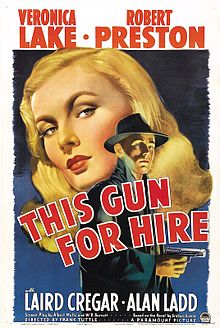 Alan Ladd and Veronica Lake found themselves partnered together on numerous occasions partially out of convenience (at 5’6 and 4’11 they were a perfect height match) but also there’s a genuine chemistry between them. And it all came into being with This Gun for Hire an economical film-noir where Ladd wasn’t even one of the top-billed stars.
 4 Star Films