Never Give a Sucker an Even Break (1941): W.C. Fields and Gloria Jean

Screenshot 2020-07-07 at 9.13.35 PM

“Do you think he drinks?”

“He didn’t get that nose from playing ping pong.”

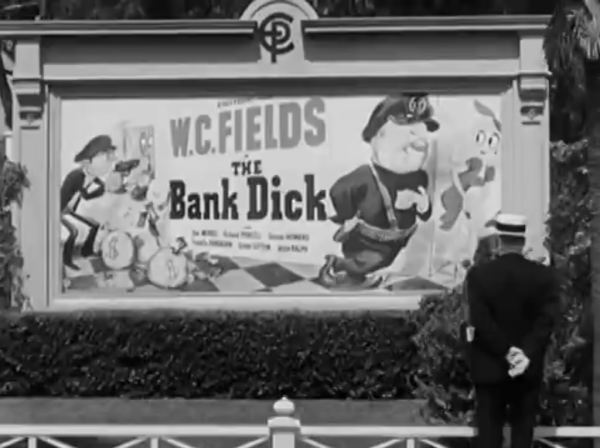
Self-reflexive metanarratives have the capacity of dissecting celebrity and playing with personas. Such a context is ripe with possibility and so when we find ourselves on a studio lot with W.C. Fields eyeing the a big billboard for The Bank Dick, we know we just might be in for something. It came out the year prior, a critical darling and a commercial flop. He’s looking to pitch the follow-up to his producer.

He is under employment at Esoteric Pictures. His niece in the picture, real-life songstress Gloria Jean, plays a young ingenue out of the cut of Garland or Durbin. They are the film’s affable nucleus.

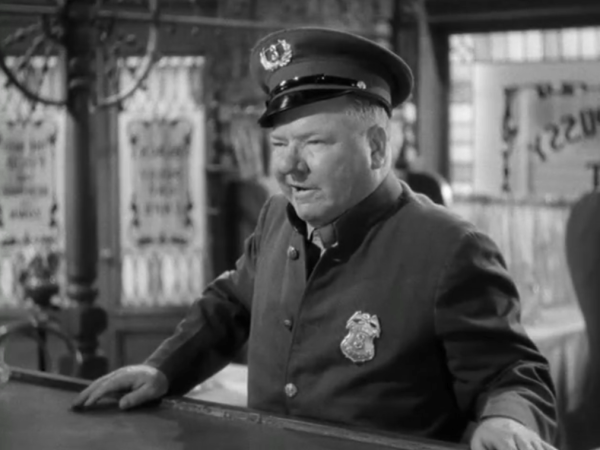
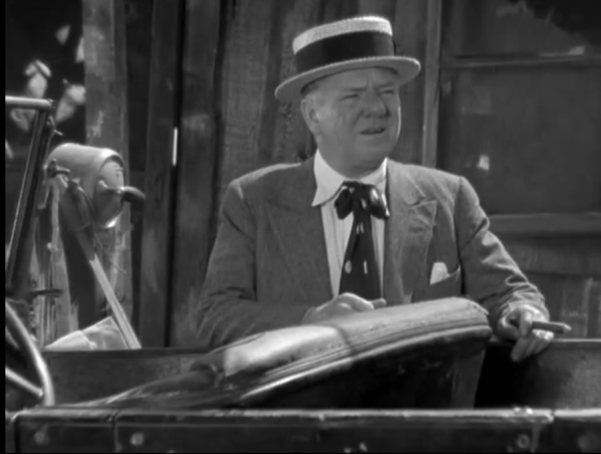
W.C. Fields is a picture of his usual self with his protruding proboscis and that straw hat of his as battered as ever. There’s the way he casually mumbles away at dialogue. It falls offhand and unrehearsed. You can almost lose it. Some of the garbled gook he gets out only makes it to your ears after he’s said it, and your mind has time enough to catch up.

Meanwhile, a typically huffy Franklin Pangborn with his stringy hair tries to command the unremittent chaos of the studio sets to get Gloria Jean to perfect her latest song, one of those high-pitched operatic numbers out of yesteryear. He’s already in a unstable mood when Fields pays him a call.

The script Fields is pitching becomes the premise for the movie itself as he darts in and out of scenes that might as well have no relation to one another aside from featuring Fields and Gloria Jean.

They start on an airplane together to some unknown destination. They might as well be waiting for Godot. He goes free-falling through space in pursuit of a bottle of spirits only to end up trampolining into the stratosphere of a pretty maiden from an oblivious world. Margaret Dumont is her imperious mother Mrs. Hemoglobin leading a great dane by the leash like some bleak Amazonian woman.

Fields, who penned the script under one of his many aliases, pushes the boundaries farther than he’s ever gone before, and it’s spectacular and surreal if this is what creative control looks like. It’s not as out and out funny as some other Fields movies, but it’s giving itself over in its totality to this absurd rhythm which is quite extraordinary to watch. He throws himself over a cliff in a basket only for Pangborn to loudly protest. The story lacks continuity! It’s an insult to human intelligence!

Is it too obvious to read it as a commentary on a career of movies and studios and such? I think not. Because W.C. Fields films were never the most tensely plotted, tightly constructed gems. He built his career out of ad-libs and performance, not so much the written word. Not that he didn’t come alive with verbal wit of his own accord and this was his gift.

never give a sucker an even break bank dick billboard

But he was never made for the strictures of the industry, and so it’s fascinating to watch him when the restraints come flying off, and he’s got his run of the candy store so to speak. In fact, he rebels against conventional plot to the point of totally pulling it apart in front of us and tossing it away as collateral damage.

There is absolutely no pretense here. It’s even less about fast and free gags and bits being assembled together. It’s given itself over fully to surrealist feats of cinematic fancy. It might leave some befuddled now as it did then, but one can gather some sense of the performer. It suggest so much about him implicitly that still needs to be parsed through.

With the real-life context, it shows the decline of W.C. Fields who was quietly ditched for other more agreeable talent, especially because Never Give a Sucker… was hardly going to woo the audiences. Not in 1941. It was of that rarefied breed we often far too easily label “Ahead of its Time.” Here it seems pertinent.

The final set piece is an eye-popping death defying car chase to the maternity hospital. It feels like a flashback to the heyday of Keaton or Lloyd. It’s the most purely comedic slapdash moment in the picture, and does it fit with the rest of the movie? Not by a long shot, but somehow it remains a capstone for something that is totally of its own form and function. It’s almost obligatory. Here the career of W.C. Fields quietly came to an end. This was his final opus to hang his reputation on for future generations.

Doing a bit of perfunctory research, Fields was game to make another such picture with Gloria Jean and some of his favorite stock players. The studio wasn’t about to have it, and his own health was at the detriment of his drinking habit, lampooned as it might have been. W.C. Fields is one of the more irascible classic comedians to be able to pin down. But his comedy at its core does seem to get at a central human longing. It was always him against the world. He took it as well as dishing it out.

gloria jean

Maybe it’s only a small reward and too little too late, but I think even Fields understood the significance of Gloria Jean being in his corner unreservedly. Yes, it’s mawkish in the kind of Hollywood tripe sort of way, but secretly it also feels like a healing balm to the Fields character.

At last he can have some kind of peace. At last there is someone who will accept him unconditionally for who he is. My hope is that Fields experienced some of that in life as he did in his final major screen role. That’s not for me to know. All I know is that we all crave love; we all crave relief.

Fields wanted the film to be titled “The Great Man.” We can read it as jest or a bit of self-congratulatory pomp. But I think this is inside all of us veiled by insecurities. For people to see past our flaws. We want kids to look up to us and see us as what we aspire to be and not as the damaged goods we actually are. Gloria Jean extends her uncle such an honor as she smiles into the camera one last time. He is known and loved. To her he is a great man.

3.5/5 Stars

The Bank Dick (1940): Egbert Sousé and Lompoc, California

Screenshot 2020-07-08 at 4.50.58 PM

When W.C. Fields goes and names his protagonist Egbert Sousé it doesn’t take a brain surgeon to get the joke, although he does spend much of the movie explaining the correct pronunciation. The other half he spends drinking at his favorite bar: The Black Pussy Cat Cafe.

His hometown is none other than Lompoc, California. Aside from being a memorable name in its own right, the town had the illustrious title of being a dry zone with a long history of temperance. What better way for W.C. Fields to thumb his nose at them, than by setting up shop right in their fair city, albeit in his own made-up cinematic universe?

If it’s not becoming obvious already, I think the reason The Bank Dick is often touted as the finest example of his style is because it totally digs into his stereotypical persona whole hog. He’s an irreparable drunkard, a lier, and a braggart prone to any number of human vices. There’s no attempt to varnish them either. He’s a bona fide reprobate.

Nor is he particularly fond of his wife, daughter, mother-in-law, or the little kid who shows up in the bank. His daughter is bent on throwing rocks at him, and he about strangles a little boy who’s armed with a toy pistol. Does it even need to be said? He’s never a likable figure.

However, beyond mere character flaws, it is Field’s delivery that sets him apart from the crowd — the way he mumbles or draws out a line of dialogue. Again, it’s like an afterthought. He’s saying all the unfiltered comments he would say if he thought no one else is listening. Either he’s too dumb to know he’s being overheard or he plainly doesn’t care. At least that’s part of the shtick.

If he has anything close to a friend, it would probably be his bartender (Shemp Howard). He would follow the man to the end of the earth and back again, mostly because the man spells booze. It’s not all bad though since he makes another acquaintance over drinks.

After reminiscing about the good ol’ days giving a passing mention to Mack Sennett, Chaplin, Keaton, and Fatty Arbuckle — all the lads — he finds himself being pulled onto a 36-hour movie set in desperate need of a stabilizing force.

Souse’s tall tales nab him the job, and he certainly acts the part: Dishing out stage directions and convening with the script girl, between trips of being carried around like ancient royalty on a litter. His family’s far from impressed by his hamming.

What’s more, we drop this scenario almost as soon as it begins. It’s like Fields was bored with the narrative strands and decided to table it until his next go around. He has other priorities. His film, after all, is called The Bank Dick and so there has to be some scenario for this to come into being.

So, a bank robbery happens. He’s going to the saloon (where else would he go?). Alas, it’s closed, but sitting on a bench, with his nose in his paper, he ends up in the right place at the right time and gladly takes the mantle of a hero as a criminal is apprehended — no thanks to him.

As recompense, he’s bestowed a low-grade job as a bank dick that’s somehow tied to his home, which they might foreclose on if he doesn’t keep the position. It’s a dubious scenario, but also the kind of underhanded deal Fields probably more than deserves if we can say it. Tit for tat as they say. After all, it’s only a movie and this obliviousness underscores his very identity.

Next, he’s talking his future son-in-law into buying some useless mining stock, and pretty soon they’re embezzling from the bank for a dead-end deal. So of course the bank examiner, a snooty Franklin Pangborn, has to show up right on cue to throw a perilous wrench into their plans.

All Fields’ attempts at cordiality and voluntary sabotage fail, but the entertainment comes with each and every one of his ploys. I won’t try and spoil them here, but Pangborn was born to be his hapless target and Fields obliges with all sorts of shenanigans. Again, to no avail.

the bank dick

Of course, none of this matters. Not the embezzlement. Not the bank robbery. Not any of it. Because their mine is actually a bountiful lode, and they strike it rich as only W.C. Fields can. It’s an instantaneous, convenient reversal of fortune, but then again, Fields’ pictures always defy conventional logic. It’s in their very nature to shirk the normal rhythm for whatever behooves them at any given moment.

In this way, The Bank Dick synthesizes many of his prevailing themes — some of those mentioned already — capped off by an outrageously decadent happy ending. It also joins the ranks of Never Give a Sucker… in his line of raucous car chases, and it’s not a coincidence he’s working with Cline who partnered with Keaton on Sherlock Jr. Similar stunts abound here. It’s a bit of comic nostalgia even in 1940.

W.C. Fields isn’t for everyone. The Bank Dick is not always entertaining. But you come to appreciate his personal penchant for comedy as each performer of the era cultivated a very particular image. He’s little different and seeing as he wrote this number as well as starred in it, he’s giving himself over to the comedy and doing it the way he sees fit. If nothing else, it probably most closely aligns with his proclivities as an entertainer.

His films were never meant to be cohesive. They were never even really meant to be films at all. As with many comedians, it feels like the best dashes of serendipity occur in those suspended spaces in between. Where there’s a throwaway gag, an off-handed zinger, or just something resolutely out of left field.

Every person is different as are their audiences. They don’t always carry our interest every waking second. Sometimes all they have to do is bless us with little bits and pieces of time. It’s often enough for us to remember them so that they remain in the cultural consciousness. This is how I feel about Fields. He is an indelible figure for the persona he built, straw hat, big nose, flaws and all.

3.5/5 Stars

It’s a Gift (1934): “California, Here I Come!”

Screenshot 2020-07-07 at 8.04.46 PM

It’s a Gift is built out of the framework of the domestic lifestyle. This is where it gets its comedy. Take for exhibit A an early sequence. Harold Bissonette (pronounced bis-on-ay) tries to shave with a straight edge despite the interference of his daughter. It leads him to resort to using the reflection of a can and then a mirror suspended from the ceiling dangling around the room.

He follows it around taking intermittent swipes at his gullet covered with shaving cream quite unsuccessfully. It’s a wordless sequence that’s a wonderful escalation of utter absurdity. Because it bubbles with human invention and though Fields takes it further than seems necessary, that’s part of the fun — watching him keep it going.

For any of this comedy to function, there must be a suffocating bulwark around Fields in the form of his family. He has a perfectly henpecked, windbag of a wife (Kathleen Howard) berating him incessantly. His cackling kid’s either gliding around on his roller skates or leaving them lying around so they can be tripped over. His daughter is simply boy-crazy.

Put them together and it’s a perfect combustion engine for his comedic shtick. He has dreams of leaving his corner drugstore for an orange grove in California. If his uncle keels over like he’s supposed to maybe he’ll be left some inheritance.

For the time being, he has the daily grind, which isn’t much better than his home life. A huffy man demanding kumquats. There’s a blind and deaf fellow with an ear horn who’s a walking booby trap. The stock of light bulbs never had a chance. Even his oafish shop hand is hopeless; riding his bicycle indoors, falling asleep, failing to keep a wayward baby from spreading molasses all over the shop floor. You name it. It happens to him.

W.C. Fields becomes a vehicle of antagonism and all the ires of the world seem to be directed at him. This is the source of giddy delight in the comedy strung out over the progression of loosely connected scenes. Could it be he can never catch a break or maybe he’s just enough of a doddering fool to never warrant one?

Normally the image of the comedian is sculpted as a hater of mutts and tykes. It’s true this ornery image makes him all the more human. Here in this movie, it feels strikingly different because he’s effectively accosted on all sides even as he’s just lying around minding his own business. He’s allowed no peace.

One of the ripest gags is set out on the back porch one morning. Fields is trying rather unsuccessfully to get some shuteye, thwarted by an uncooperative couch, a milkman rattling his morning stock of “sleigh bells,” and about anything else you might possibly imagine. Don’t forget a rolling coconut exuding 10 times its decibel level — it’s practically a bowling ball as it thunks down the steps. Likewise, babies are infernal creatures out to get him and wage war against his comforts, no fault of his own.

It’s also one of the most visibly cinematic scenes in which we get this stratified sense of comedy as if it’s from the old two-reeler days of the silent era.  Though, here, the sound is such a vital element. That’s what sets it apart.

Then, the needle drops on “California Here I Come” to send the move in motion again. He’s gone and put his money into his dream. He done and bought an orange grove on a whim, loading up the jalopy and taking the wife and kids out west.

With it comes camping and sprawling West coast estates with rolling greens and statues. In fact, a witty passing gag has Fields crashing into the lawn ornament while his wife exclaims, “It’s the Venus de Milo” now in mint condition having been decapitated a la real life.

They make themselves at home on the private land. Their ensuing picnic is replete with sandwiches and meats wrapped in paper, feather pillows, feisty dogs, and sprinkler systems. By the time they leave the premises, it looks a bit like a ravaged water park gone awry. It’s an example of incremental chaos all conjoining into this culminating mayhem.

In the end, Bissonette is duped with what looks to be a precursor to Green Acres‘ Haney Place. In the immortal words of Bette Davis, “What a dump.” It’s a shack falling apart at the seams. His wife is indignant, ready to walk out on him, and he’s left to sit on the front stoop. What a dismal place to be in if this is truly the end. We only have minutes left after all.

But the cinematic world of W.C. Fields is an absurd space where only moments later all his miseries are turned on their head. Soon he’s sitting on the veranda pulling Oranges straight off the tree to squeeze into his own juice. It’s an outrageous joke scenario and a lampooning of idealized California culture, but in the face of The Grapes of Wrath and other such images, it’s a welcomed relief. If only every Tom, DIck, and Harry who took his family plunking out to the west coast struck it rich like this. It really is a comedy…That is until he sees the property taxes he owes.

3.5/5 Stars

Million Dollar Legs (1932): Klopstokia and The 1932 Olympics

Screenshot 2020-07-06 at 8.25.11 PM

“All the women here are named Angela. And all the men are named George.”
“Why?
“Why not?” – Jack Okey and Susan Fleming

This kind of laissez-faire, anything-goes mentality is one of the obvious strengths of Million Dollar Legs‘ comic tableau. There need not be a given rationale behind what it does and with this brand of laxity, there is an empowerment to do anything it so desires.

Thus, the narrative opens in a far-off Eastern European land called Klopstokia. Their chief exports, imports, and inhabitants are goats and nuts! If it’s not evident already the movie looks like it might be an equally oddball companion piece to Duck Soup.

It’s hard not to see its shared space and that’s mostly on a perfunctory level (and because of the fact Susan Fleming married Harpo Marx). One must also note it came first to precede the L.A. Olympics, though it’s not too hard to believe the Mankiewicz brothers did conceive the movie as a vehicle for the crown princes of anarchy.

Since this is not the case, Million Dollar Legs is ripe for rediscovery propping up some other stars who are sometimes less remembered. They didn’t get them, but Herman and Joseph working with director Edward F. Cline wrangled together an absurdist universe for the likes of Jack Okey. He might be most famous to modern audiences for parodying Mussolini in Chaplin’s The Great Dictator.

Here he’s front and center, an itinerant brush salesman, who happens upon the nation on business only to fall head over heels for the country and its people — one person in particular — her name is, of course, Angela (Susan Marx). They brush each other off rather seductively as her kid brother (Dickie Moore), a begrudging and silent cupid, does his best to keep them apart.

But she also has a connection to the country’s fearless leader. Her father is the President (and also W.C. Fields) with his hat and a dictaphone perfect for bad-mouthing his subordinates on his daily carriage ride to the office. He’s the broadest, most formidable name in the movie.

He makes a daily show of his brawn arm-wrestling his sneezing cabinet including such hoodwinked bumblers as Hugh Herbert and Billy Gilbert. The President is oblivious to their conspiratorial endeavors because frankly, even with their secret cache of spies, they hardly seem likely to hurt a fly. One of their spies out in the field, no less, is a pantomiming, cross-eyed man in black portrayed by Ben Turpin.

However, despite their impotence, they agree to call upon the woman who men can’t resist — the ultimate vamp and a caricature of the Dietrich archetype — Mata Macree (Lyda Roberti). What are her plans? To seduce the entire Klopstokia Olympic team in their bid for the 1932 Olympics! It has no import aside from meeting narrative expectations.

So everyone piles onto the ocean liner, including the President, Migg, and his best girl Angela. The movie’s apex might come when W.C. Fields on one side and his cabinet on the other start yanking the wall back and forth as Okey tries to woo his girl with the gibberish national anthem. It’s delightfully absurd both in the immediate visuals and the auditory accompaniment.

The Olympics aren’t much different with the Klopstokian contingent in a shambles before Angela rallies them jumping from the high dive to have it out with the duplicitous mata hari once and for all. Then, her father shows off his feats of strength in the weightlifting competition against his rival cabinet member. All pretense of logic is gone. Just go with it. Take it for what it is.

The final baton is taken up by the speedy Major-Domo who zips past the competition as a last-second entry coming from behind on the urging of Angela on a motorbike.  Truthfully, I’m still trying to figure out who owned the pair of million-dollar legs. For my money, it’s the galloping Major-Domo

What’s not up for contention is Million Dollar Legs as an intriguing vessel of comedy functioning as a kind of cultural time capsule. Not only does it help chart the famed Mankiewicz brothers before the heights of their future successes, it’s also a contemporary commemoration of the L.A. Olympics. Marx Brothers or not, it might just be worth a look as a historical curio.

3.5/ Stars

Bill Forsyth’s Films: Gregory’s Girl, Local Hero, Etc.

Bill Forsyth is a director who has flown under my radar, and yet only after a week’s time and a handful of films, he’s quietly become a new favorite. Now I heartily understand why he’s one of Scotland’s most beloved directors. Part of his appeal is because he wrote and directed his own projects, but it also comes down to how he imbues his films with a certain sensibility that’s thoroughly disarming.

That Sinking Feeling (1979)

That Sinking Feeling was his debut, a microbudget caper about a pack of eccentric Glasgow youth who alight on a plan to make a buck stealing sinks. It follows the beats of a heist while straining them through a very specific experience.

What Forsyth brings out of his youthful troupe of actors are the lovely idiosyncrasies his films are all utterly replete with. It’s the kind of humor that feels honest in its truth and the good nature behind it. Many of the faces that show up throughout would crop up in some of his later works as well.

Comfort and Joy (1984)

For some, Comfort and Joy might be a new Christmas tradition. It’s a low-key movie finding its footing by focusing on a disc jockey (Bill Patterson) who’s a kind of local celebrity thanks to his good humor, jingles, and the fact he’s in people’s homes just about every day.

There’s a curious streak to the movie as Dicky becomes a kind of mediator between two rival families in the local ice cream racket. I’m not sure where these premonitions come from, but the way Dicky gets caught up in the late-night escapades in the feud between ice cream vendors, I couldn’t help but think of the milieu of After Hours. It’s probably because the situation escalates into this quirky absurdity with a touch of doom.

It has a few fanciful dreams and feels like it could be a sick nightmare. Still, Forsyth never allows any of this to totality derail the prevailing good nature of his characters.

Housekeeping (1987)

In 1987, he alighted on another journey, writing and directing an adaptation of Marilynn Robinson’s Housekeeping. Although it was his first American production, it also brought him together again with his fellow countryman, producer David Putnam.

It’s a film rather reminiscent of Jonathan Demme’s Swing Shift and it’s not simply due to the inclusion of Christina Lathi. It’s the way Forsyth hones in on a story of keenly observed moments and distinct characters rather than a fierce adherence to form and structure. Yet again, there’s a clear-eyed authenticity to it that feels far from being fabricated. It maintains this ethos, and time and time again succumbs to these quietly profound moments that are all too easy to disregard.

I’d like to take the rest of my time to highlight Forsyth’s two most noteworthy films because they all but embody my newfound appreciation for the director.

Gregory’s Girl (1980)

The opening tag immediately feels like the opening moment in any number of cringe coming-of-age films. A group of prepubescent peeping toms gape at a beautiful woman hidden behind glass. Gregory’s Girl looks destined to join the trashy, smutty cadre of ’80s locker room movies. And yet around every turn as I kept expecting the worst, here is a film that constantly surprised and left the dorkiest, most curious, and strangely poignant impressions.

Gregory (John Gordon Sinclair) is one of those iconic coming-of-age protagonists, meaning he’s a spindly dork with the most atrocious head of hair imaginable, and we’re already talking about the ’80s. Still, in a word that could easily be harsh and unfeeling, he makes it genial and a tad innocent.

He doesn’t have a killer instinct out on the football pitch. He loses his coveted striker spot only to bump his best friend, another loser named Andy, out of goal. They hardly seem to mind. Because they’ve made way for the school’s latest talent: the athletic blonde Dorothy (Dee Hepburn).

Again, this brings with it all sorts of potential problems. The male population is quick to rally around her — cheering her on ardently — though it could be a lot worse. It suggests girls can excel in many facets. However, it does run the danger of turning her into a regressive object where the girl is a trophy to be won.

On more than one occasion, it bends away from the expected gauntlet of crude jokes giving us something lighter, more agreeable. It comes with how it conceives of a very particular version of adolescence: small-town Scotland outside the urban decay of the big city. It feels quieter and more hopeful, even if the world itself and the time in life is incredibly transient.

Gregory’s Girl is nothing like what I expected. It was far better. Yes, it’s a slight film, but this plays to its strengths because it gives us these characters and these moments — observations we can appreciate — and then we get to leave them with a wealth of affection. It’s easy to see my estimation of this one rising after future viewings. Even as I ruminate on the title Gregory’s Girl, it has new meaning, and it makes me smile. It’s a pleasure to have expectations subverted and then exceeded.

4/5 Stars

Local Hero (1983)

Local Hero is bolstered by a simple premise being subverted. A colossal American oil company looks to gobble up land in and around an idyllic Scottish village. However, there’s no malevolent corruption and their eccentric benefactor, Mr. Happer (Burt Lancaster), would much rather chart the stars than deal with any amount of oil refineries.

Likewise, it’s never a story of the little guys trying to hold out against progress. The locals are delirious about the money coming their way. Instead, we come to appreciate what this kind of life has to offer as does our stand-in Mac (Peter Riegert).

It hearkens back to an era — the days that made my parents fall in love with the U.K. –where there were still pockets of the world seemingly untouched by modernity and true western influence. The Texas businessman and his Scottish sidekick (Peter Capaldi), pay a visit to the small town and set up shop in the B&B. The local pub is where the whole town pools their funds to make change for an intercontinental phone call.

At first they look rather out of place: two suits walking across the beaches with their briefcases. But then we get a passing sense of who they are as people. They are romantics even friends of passing rabbits. We come to like them. The same might be said of the town and why not? Wow, is the countryside breathtaking. I miss it so.

This is never a movie about board rooms or business, but the bits of business happening in a community. There are all sorts of people, and the quaint elements prove utterly charming.

What a lovely connection between Star Wars and Local Hero to have Wedge Antilles be the town’s main accountant and hotelkeeper prepared to cut a deal with the man from America. Though any amount of haggling or conflict never materializes and they quickly become best buds.

If there was any conflict, it all but evaporates and what is left is warm humor and the forming of lasting relationships. There are the cultural differences, the manifold eccentricities, but there’s also the congeniality. It’s part of what makes this unassuming movie such a pleasure.  Local Hero is gentle cinema, and it’s exactly what we need.

4/5 Stars

Touch of Evil (1958): The Mad Genius Orson Welles and Janet Leigh in Hotel Rooms

On even a cursory level Touch of Evil has all the ready hallmarks of Orson Welles the auteur. Working in tandem with veteran Universal cinematographer Russell Metty (they had collaborated before on The Stranger), they develop the director’s preferred mise en scene from claustrophobic Dutch angles to deep focus photography.

It’s no minor coincidence that these all feel like a holdover from his days of Citizen Kane and The Magnificent Ambersons with the late Gregg Toland. Of course, in that time the industry had certainly changed and with it Welles’s place within the establishment.

His most recent film before Evil was the globe-trotting European crime picture Mr. Arkadin and besides the tinges of noir, and an earlier appearance by Akim Tamiroff, it feels closer to the template Welles would have to vie for in the future.

Because Touch of Evil was his last opportunity to make a purely Hollywood picture and he had A-List talent like Charlton Heston and Janet Leigh, and the studio’s technicians, albeit with B-level material. What’s more, he was initially given artistic control over the production which in Welles’s case felt like an utter necessity.

What happened after principal photography was a different story and remains a part of cinema lore up there with the long saga involving the likes of The Magnificent Ambersons director’s cut and the completion of The Other Side of the Wind.

Touch of Evil was altered by the studio and released in 1958. About 40 years later an in-depth memo written by Welles was rediscovered and used to create a cut that purportedly more closely aligned to his artistic vision. Thankfully, we get to see that today. And yet Welles would never work through traditional studio means again.

He would scrounge up joint funding across Europe where his name carried a cachet and in spite of lower budgets, he was able to make a handful of uncompromising films like The Trial and Chimes At Midnight that showcased his skills and gravitas. Touch of Evil is often put up as a convenient sign post to mark the waning of classic film noir. It would also spell a kind of end for Welles also.

Taken in the context of all the Brobdingnagian and Shakespearian heavyweights he played across his career, it’s remarkable to observe what confidence Welles seems to have in himself as a performer. Certainly we marvel at how he could embody Charles Foster Kane at the age of 25 — a man beyond his years — or capture the devilish and brash bravado of Harry Lime in The Third Man.

But Hank Quinlan is yet another iteration of his performative legacy in front of the camera. The man is portly and haggard with Welles taking on ample padding and prosthetics anticipating his future girth. The camera is perfectly angled to make his look all the less appealing, augmenting his size on the screen as he dwarfs the frame.

However, more crucial than that, he is a cruel, racist, and vindictive man in power who feels a need to tip the scales in his favor. In other words, Welles is not squeamish about looking terribly flawed and Quinlan is an iconic example as he looks to plant evidence, frame, and murder all in the name of his perverted sense of truth and justice.

I am always intrigued by this idea that as modern audiences we should come into contact with older cultural texts because they can somehow speak into our present moment and our cultural blind spots. However, we also have the benefit of seeing where our predecessors may have missed something.

Touch of Evil has become more complicated and muddied by its show of inadvertent racism, which was commonplace at the time. It begins with Charlton Heston who plays a stalwart and conscientious Mexican narcotics agent named Miguel Vargas who has married a lovely American woman (Janet Leigh).

The white actor’s complexion and hair are darkened, and he wears a pencil mustache. Meanwhile his wife while no wilting wallflower is slightly patronizing and culturally inept when she comes in contact with anyone else within the Mexican community. One wonders how she fell in love with this man if she doesn’t speak any of his native language and lacks sensitivity. Was he just a pretty face?

Unwittingly it hearkens back to the earliest precedence of the Production Codes forbidding any kind of miscegenation or romance between the races onscreen. Because Leigh and Heston are both white, it proves less disconcerting to a majority white audience. And while Vargas is a harbinger of justice, all the Latino actors who round out the world are characterized as stereotypical thugs and reprobates.

This is not so much a criticism as it is a reality worth noting. Because it potentially clouds the fact Welles fundamentally changed the crux of the source material. By changing Heston’s character from a white lawman and moving the milieu right on the border, his intent is clear. His direct aim is to tackle racism and interracial relationships and tension head on. It creates the soil for much richer thematic ideas and more pointed drama.

Also, the headlining relationship feels less landmark compared to something contemporary like Island in The Sun or The Crimson Kimono; there are also secondary characters who function similarly although they have far less screen time.

Marcia (Joanna Cooke Moore) is the daughter of a local businessman who is killed with his mistress in a car bombing that opens the film so spectacularly. It comes out that she was in the company of a Mexican shoe clerk (Victor Millan) who Quinlan quickly pegs as his primary suspect.

This whole sequence is one of the crucial inflection points of the movie as Vargas recognizes the character of this man he’s dealing with. Because he is meant to be an observer of American tactics — a nation prided on its sense of moral uprightness and democracy in defense of the little guy.

What he sees instead is a man blinded by contempt and prejudice for the Mexican minorities. It’s a terrifying and powerless place to be in as Quinlan’s all but ready to railroad the man. He’s not merely paternalistic or a big brother trying to impart his ideals; he’s unequivocally xenophobic and distrustful.

Behind the scenes the corrupt detective begins sowing lies about Vargas as well using his influence to fabricate his involvement in the local dope racket. Where he goes next is even more incorrigible, but in his own twisted sense of justice he feels completely justified.

One aspect of the film I failed to appreciate before is how it exhibits a precursor to the Bates Motel in Alfred Hitchcock’s Psycho. Leigh’s part is fairly peripheral as she spends the majority of the picture stuck in a half-empty room at the Mirador Motel.

Dennis Weaver behind the desk shows up as a jumpy eccentric — not a prototype for Norman Bates per se — but he has his own paranoia about women. He doesn’t want to be caught making the bed anywhere near her, and he’s easily intimidated.

He’s the least of her worries as some local thugs led by “Pancho” (Val de Vargas) take over the lobby desk and pile into the room next to hers with a certain foreboding. She is alone and isolated as her husband continues with his work; it leaves Mrs. Vargas vulnerable. What ultimately happens to her isn’t as shocking as Psycho, but the danger is palpable as she is ambushed and set-up as part of a broader conspiracy.

The films opening sequence, filmed in Venice, California, is the one for the textbooks, and it rightfully gets its plaudits. There’s an ostentatious bravura around the unbroken 3 minute take that still exemplifies a converging of artfulness and narrative storytelling.

However, this time around I was taken with how Welles’s films his showdown with Akim Tamiroff slimy local crime boss. Not to belabor the comparisons because it’s nothing like the shower sequence, but so much is done through the the impression of images cut together with music, and this juxtaposition between everything in the scene compounding into a stylized and still egregiously violent end.

It galvanizes a drunken, tottering Quinlan as a premeditated embodiment of evil. Opposite Welles the movie has some fairly unexpected cameos from the likes of Zsa Zsa Gabor, Mercedes McCambridge and certainly Marlene Dietrich who plays a prominent role in the picture as a raven-haired Mexican gypsy no less.

Joseph Cotten’s even featured as a misanthropic coroner; I kept on missing him because there’s no vanity to the role. Momentarily I even mistook him and Mort Mills since they both wear glasses, and I misplaced the timber of his voice. No one sound quite like Cotten.

There’s no great substantive thing I can say about all these folks creatively except how evident it is what a vast network of friends and admirers Welles cultivated. True, he had such an inertia around him, drawing other people into his orbit, but as confounding as he was as a person and a maestro, it shows a love of creative people who in turn loved him back.

I’d like to believe this to be true, and I’ll always return to the postscript of The Trial where he lists off all his players as if they’re in a close-knit theater troupe. That’s the energy you get from it.

If I’m to be honest Welles is always larger than life and given the misgivings there are about Heston and Leigh, Joseph Calleia has the most compelling and unsung role in the picture. I don’t recall seeing him this way before and he’s a bit older; he’s not exactly senile, but he’s obviously deferential to others, especially Quinlan.

He likes to be associated with him, to be seen with a man who always gets his mark and who has such a stirling record. Thus, he would never wish to take him down or believe there was any foul play involved.

Still, as much as any of Vargas’s revelations break his heart, he’s not callous or unfeeling. The worst that can be said of him is that he’s pitiful, weak even, and when he’s asked to implicate Quinlan, he’s forced to make a moral judgment.

The corpulent cop goes out as merciless as ever espousing his vitriol against  guardian angels and starry-eyed idealists, who wind up being worse than crooks. At least you can always do something with crooks like put them away to rot in jail.

To the very end he shows his distaste for real democracy, not ruled by fear and white supremacy but rather governed by justice for all and due process of law. One imagines that there are whole treatises here pertaining to the unscrupulous tactics of J. Edgar Hoover and the red scare hysteria during the Cold War, but I’m not the one to write it.

Every time I watch a creative endeavor by Orson Welles his stamp is all over it and whether for good or for ill, his work is inimitable. Try as they might, no studio and no one could take that away from him — at least not in its entirety. The singular, mad genius always bleeds through even when tampered with. He was one for the ages.

4/5 Stars
Orson Welles: Mr. Arkadin (1955) and Compulsion (1959)

Mr. Arkadin (also known as Confidential Report) has the abundance of canted angles and striking visual flourishes one usually attributes to the films of Orson Welles. It also boasts his ever more disorienting sense of space and shot-reverse-shot even as the international cast, financing, and locales outside the prying eyes of Hollywood map his labyrinthian journey to continue making movies.

His entry into this particular story is a small-time smuggler, Guy Van Stratten. There’s something abrasive and unplaceable about Robert Arden. It’s rather like when non-English-speaking filmmakers will cast an American, and it sounds tone-deaf in a picture that otherwise feels normal. Regardless, he receives a tip-off from a dying man, and it sends him in search of something…

Arkadin, an aristocratic Russian, as played by Welles, is really another version of Harry Lime from The Third Man with everyone talking about him and wanting to meet him as he remains just out of reach and hidden behind a mask at a masquerade party.

Stratten has ambitions to get in with the daughter of the enigmatic Arkadin. Welles casts his wife Paola Mori to play his carefree young daughter (albeit dubbed). In the end, the gruff answer-seeker winds up globetrotting after Arkadin, hired by the man himself to see if he can dig up any dirt on him. It feels like the ultimate act of paranoia if in fact a double-cross isn’t in order.

While his accomplice Mily (Patricia Medina) is out on her own, he crosses paths with the likes of Michael Redgrave, an eccentric pawnbroker providing some leads, and then Akim Tamiroff who is also somehow implicated in a web of conspiracy.

Plot notwithstanding, Mr. Arkadin feels increasingly emblematic of what Welles’s cinema became after his earlier successes. He was scrounging around for funding, cobbling together films all across Europe with a cadre of international talent, and increasingly drastic creative choices.

It’s evident in a picture like The Other Side of the Wind generations later, which historically took years to be completed long after Welles’s death. It does feel like every subsequent picture after Kane continued to be a monumental struggle, and it’s some small marvel that each one got made for any number of reasons. Add Mr. Arkadin to the list.

It’s not explicitly Shakespearian, but it has a certain gravitas blended with the cheap smuttiness of noir street corners and pulp novels. We are treated to a Wellesian Christmas party. The focal point is a rather perturbing visual carousel full of jocund gaiety and lurking menace capped off by a band playing “Silent Night.”

Ask me to say exactly what we’ve watched with all the various plot details, and I don’t dare try. But it bears the markers of Welles, full of flourishes and at one time both mystifying and inexorable. It’s easy to criticize the flaws, but Orson Welles hardly makes mediocre pictures. There’s always a gloriously messy vision behind them. It’s the same with Mr. Arkadin.

3.5/5 Stars

Compulsion (1959)

I never thought about it much until his passing but there’s something about Dean Stockwell in his young adult years and even his later roles that’s reminiscent of James Dean. He’s not emotive in the same way as the method actors; he’s a button-upped clean-cut version with his own neuroses.

They have some facial similarities, true, but it comes down to something more difficult to pin down when it comes to actors, whether eccentricities or the bits of business that draw in your gaze so you can’t help but watch them at work. With Stockwell, it’s something he was able to draw upon later in his career when he had a reemergence and a renaissance; acting seemed fun again.

In 1959, James Dean was gone for a few years already and Stockwell was still closer to the beginning of his career than the end. He plays one two young men who have read too much about Nietzsche’s superman believing themselves to be above the law.

Bradford Gilman is his counterpart a disingenuous sociopath who knows how to throw his charisma and influence around. Both Arthur and Judd are different than normal college students, but Arthur knows how to play the game. Then, when they’re alone in each other’s company he’s able to dominate the other boy as they play out their sick fantasies.

In one moment, stirred by his accomplice Judd takes a girl to observe some birds — it happens to be near where a boy was killed — the bird calls in the distance play against the increasingly uncomfortable conversation. He plans to force himself on her, and though he tries he cannot bring himself to go through with it. There’s a sliver of decency still left inside of him.

Soon enough he and Artie are brought in for questioning by E.G. Marshall, a calm and collected beacon of authority. I’ve never seen The Defenders, but I could see him carrying it off with a level of pragmatic stability. Artie’s the one who walks in the room and tries to flip all the power dynamics. He pointedly stays standing as Marshall questions him sitting down. He’s confident enough not to be thrown off his game though he implicates them soon enough. They must vie for their lives in the courtroom.

Jonathan Wilk shows up sooner or later. Orson Welles hardly needs a great deal of time to put his mark on the picture. His haggard magnetism holds its own against anyone as he takes in this most harrowing case defending two privileged boys who were unquestionably implicated in murder.

The ensuing case comes with a myriad of perplexing caveats. Judd was coerced into trying to attack the girl, Ruth Evans. She later takes the stand in his defense. Martin Milner is an up-and-coming newshound who at one time was classmates with the boys and soon desires to watch them hang. His feelings toward Ruth are very protective.

Wilk is a bit of a moral cypher: He’s atheist who has the KKK showing up on his lawn blazing a cross as an act of intimidation. He also flips the case on its head with a rather unorthodox and risky decision.

He looks to appeal to the so-called Christian community of the court reminding them that cruelty breeds cruelty, and charity and love are what they have devoted their lives to. When he admits to a lifetime of doubt and questioning, it doesn’t necessarily mean he’s reached any final conclusions. It makes me appreciate him more for his moral transparency

Given the fact Welles was probably playing his version of Williams Jennings Bryant, a man who was also featured in Inherit The Wind portrayed by Spencer Tracy, it’s hard not to connect the two pictures. Their subject matter is very different and yet they both dwell on these ideas of religious beliefs and how narrow-minded societies can use them to stubbornly maintain their agendas. However, they can also be exploited.

For this reason, Compulsion is a fairly perplexing courtroom drama for the 1950s; between the performances of Stockwell and others it offers up something persistently interesting.

3.5/5 Stars

The Clay Pigeon (1949) and The Japanese-American Experience

The Clay Pigeon is a film that I have spent several years trying to track down, and I’ve finally been able to see it. From the outside, it feels like fairly run-of-the-mill post-war noir fare. It’s directed by an up-and-coming workhorse in Richard Fleischer and stars real-life couple Barbara Hale and Bill Williams.

It’s one of those amnesia plots steeped in the residual post-traumatic stress of WWII reminiscent of Somewhere in The Night, Act of Violence or even a later entry like Time Limit. It’s this kind of narrative device that injects instant ambiguity into our story since G.I. Jim Fletcher (Williams) doesn’t know why he is currently in a hospital, and he seems to be implicated in some far more dubious crimes. Richard Quine also turns up, and he still has a couple years to go before his prolific career behind the camera.

Williams feels like a bit of an innocuous leading man without the gravelly charisma of a Van Heflin though he works in a pinch. Barbara Hale is a fond friend from Perry Mason so it’s easy enough to take her even if she transforms fairly quickly from victimized hostage to loyal female companion.

Because during the war her deceased husband was compatriots with Williams and Quine in a notorious Japanese prisoner of war camp. This clouded mystery of how their buddy was snitched on drives the movie with dubious implications in their own backyard.

Screenwriter Carl Foreman (known for High Noon) spins a swift tale that incorporates some real-life history that’s too farfetched to be fiction. It came out of an incident where a former POW walked into a department store only to see the unmistakable face of his former tormentor, a notorious prison guard nicknamed “The Meatball.” What a nightmare scenario.

Tomoya Kawaita was an American-born Japanese, going to Japan for university, but he got stuck overseas as the war heated up and ultimately became a notorious prison guard who would speak to his captors in English. After the war, he returned to States to attend USC. He was ultimately tried for treason and eventually got deported, spending the remainder of his days in Japan living in obscurity.

We usually think of the idyllic serenity of returning home from war albeit with growing pains. Warzones and  home are mutually exclusive spaces. But here these scenes collide. The movie ties all of these details into a widespread conspiracy with broader implications and still it pales in comparison to the facts.

Richard Loo becomes “The Weasel” and the fateful encounter happens at a Chinese restaurant called “The White Lotus.” It’s possible that the movie conflates the Japanese and Chinese cultures, but regardless, it’s rather striking to even have this space acknowledged at all.

Loo purportedly relished the opportunity to put the Japanese in such a bad light, and he was often called upon to play such demented roles for WWII propaganda. The Clay Pigeon was no different in how it called on his wartime persona. It’s a bit of a holdover of the earlier sentiments.

However, there is one obvious difference. The movie does actually provide some nuance or at least an alternate depiction of the Japanese. This is the other reason I’ve searched so earnestly for this otherwise unassuming movie.

During a chase where Fletcher’s trying to flee his pursuers and clear his name with the Naval authorities, he rushes into an open door seeking asylum. The woman (Marya Marco) calmly doing her laundry looks him over and allows him to hide as she answers the door.

Once the danger passes, they share another moment. It’s an interaction that the tiny film, barely over an hour long, didn’t require, but whether it was screenwriter Carl Foreman or someone else, he takes time to honor this lady and her people. You see she has a young son, but also her husband was a Nisei who died during the war. His commendation and photo are displayed proudly for all to see.

When Fletcher sees it, it changes his whole demeanor because the 442nd carries a certain cachet. They paid for it with their lives and through their bravery. That’s something that anyone fighting in the armed forces can accept. It’s a badge of honor.

The movie rumbles to its inevitable conclusion, and it’s a nice bit of meta narrative to watch Hale and Williams embrace right outside the doors with all the loose ends wrapped up neat and tidy and our hero vindicated.

But for me, I already got what I came for with this one solitary interaction as an emblematic remembrance memorialized for all time. In the face of so much discrimination and wartime paranoia, the Japanese-Americans proved themselves to be fearless, fiercely loyal, and just as profoundly American as anyone else.

3/5 Stars

La Otra (1946): Dolores Del Rio and Her Doppelganger

Recently some coworkers were waxing about what they would do if they won the power ball. How they would spend the money, where they would go, and also the drawbacks that come in the wake of what seems like a purely golden opportunity.

I’ve never much thought about it, but I do admit for those who are trapped in life (or at least with active imaginations), it’s easy to make the mental leap. I couldn’t get these conversations out of my head while watching Roberto Gavaldón’s La Otra.

It is a movie about a manicurist. Her work is menial and she takes no joy in it, doting over cosseted businessmen with lecherous intentions. It’s a way to survive though her prospects feel like a dead-end apart from her burgeoning romance with an earnest policeman. All throughout the workday before she runs off to spend an evening with her man (José Baviera), the garish lights above her workspace blare with the National lottery: 5 million! Almost as if to taunt her.

La Otra is built out of a premise not unfamiliar to noir. If you read production notes, it sounds like the picture was potentially slated for an English-language release with Bette Davis, though it was deemed too similar to one of her other recent projects. She would end up remaking it a generation later as Dead Ringers.

Because La Otra actually opens with a funeral. María Méndez rushes onto the scene late, and public perception is one of contempt. How improper of her to show up late to a funeral while her twin sister, Magdalena mourns the death of her husband. Although the widow is masked by her veil, we learn soon enough, Dolores Del Rio stars in both roles. Hence, La Otra.

The doppelganger is not a new phenomenon used in all sorts of mistaken identity comedies and certainly in melodrama. Here it feels like it serves a utility to the story, but there’s also something else. The movie plays with the dichotomy and preconceived notions between Mary, the Madonna, and Mary Magdalene, a sinful woman. The movie casts Del Rio in both of these rolls, and they continually shift and evolve over this muddied canvas of morality.

Tension (1949) with Richard Basehart worked the doppelganger angle thanks to hard contact lenses and Del Rio pulls it off by wearing glasses to play her manicurist self. Still, these are only the visual features. It does not consider personality changes.

Meanwhile, we realize in the wake of her husband’s death, Magdalena has come into a great sum of money. She chides her sister while she walks into her lavish closet, “You haven’t learned to face the world with the same weapons it uses.” Namely, cunning, cynicism, hypocrisy…crime.

Soon enough, María does learn what it takes to get ahead in noir, although she must also live with the consequences. Passages of the film feel quite literally like a silent movie, and then with dialogue the scenes come alive played against the otherworldly whirring modulations of the theremin.

La Otra hits its stride with its first twist cut against the chaotic pinata-infused celebration in the city square. María has the opportunity to take over her sister’s life and commandeers it using all the aforementioned weapons at her disposal. Going so far as to scald herself so her signature won’t be disputed.

Still, she is trapped in a life she was not expecting. Because her rash decision only considered the upside — not the tragedy hanging over her head. Instantly, she gains wealth and repute, leaving her life of destitution behind, but she also must give up her man lest she implicate herself in the new life she takes up in its stead.

But also a dashing suitor (Víctor Junco) slinks back into her life — a mysterious man from her sister’s own shrouded past. She’s more implicated than even she realized, and the film is imbued with this sense of Catholic penance. We watched men like James Cagney be sent to the electric chair for their sins, and this woman is resigned to her own fate…

What’s fascinating to me is how this film could have been made in Hollywood — with Bette Davis no less. However, it was made in Mexico and as a result Dolores Del Rio was given unadulterated star treatment. The way she’s dressed, lit, and given full reign over the movie, augments her regality but also her abilities as a screen personality. She owns the movie both in its moments of drama and pathos.

And although it was shot below the border in Mexico City with many actors we aren’t aware of, it functions like a stunning system in parallel with Hollywood. There’s a technical prowess and a commitment to classical storytelling. There’s gorgeous light and shadow, a commitment to the semiotic nature of visual narrative, and also a daring sense of invention.

It feels alive and emotive like all the greatest classic melodramas. Analogous endings could be cropped out of other movies, but as a dutiful policeman, now disaffected in his duties, wanders off into the night, the woman stares back at him through the bars confining her. Her face settles in such a way, first, we see the luminous contours of her eyes before she drops down and they are enveloped in an abyss of shadow.

These are the kind of moments that not necessary for telling a story, and yet somehow it feels elegant and imperative because this final image articulates so much of the journey of this movie and so much of the duality in many of these great melodramas of old. I never tire of them, and it’s always a pleasure to find a new addition to the canon regardless of where it originates from.

4/5 Stars

Peter Lorre: Stranger on The Third Floor, Mask of Dimitrios, The Verdict

Stranger on The Third Floor (1940)

Although it’s not a highly touted picture, Stranger on The Third Floor feels like an important enough footnote to aficionados of film noir because it embodies a few of the earliest definable features of the movement. It’s not an entirely new concept per se, but it feels like it’s reaching a new market taking the influences of European Émigré cinema to the American public.

The influence of German Expressionism on ensuing generations cannot be underappreciated, and there’s this very practical suffusing of these techniques into Hollywood because many of these writers and technicians were physically transplanted to the west coast thanks to the scourge of Hitler. He unwittingly injected American cinema with some of its foremost talents.

Although he was an immigrant from Italy, Nicholas Musuraca would soon prove himself to be one of the foremost figures in noir cinematography thanks to his run at RKO Studios, which hardly had the budget and personnel to pull off the lavish A-list productions of MGM and other bigger studios. This necessitated a different niche and an ongoing visual ingenuity.

It becomes evident early on in the film thanks to severe shadows and a patchwork of light and dark. The story itself is incredibly contrived but the movie is saturated in voiceover and fatalistic dread thanks to a man (John McGuire) being sent up for murder.

The tenets of what would become noir are plainly evident. Still, there’s something organic about it. This is not premeditated; it simply happened with the confluence of talents and a bit of happenstance.

It’s fitting that while The Maltese Falcon feels like the most high profile distillation of noir as an American breed, Stranger on The Third Floor uses two of its primary culprits. By this I’m referring first to Peter Lorre.  He’s called upon to do an import of his psychotic killer in M complete with his gaunt hand crawling up an apartment door frame. He’s hardly as slimy and therefore as conflicted and interesting as Joel Cairo; it’s his slinking foreignness that conjures up menace in the eye of the viewer.

However, there’s also Elisha Cook Jr. who plays one of his more reticent types a bit different than his blustering henchman Wilmer. However, they would both become integral figures to the movement even if it were only for their association with that individual film.

Although the movie’s a quickie, it still finds time for mini flashbacks as the inevitable noose of noir gets tied ever tighter around our hapless hero’s neck. The finest moments are when he’s overtaken by the nightmare of his conscience with men in bowlers chomping cigars start to cross examine him, and he falls apart inside his own head. As such, it’s probably more intriguing for its place in film history than as an undisputed piece of art.

3/5 Stars

The Mask of Dimitrios (1944)

The Mask of Dimitrios feels like an old world adventure story centered around a phantom figure who becomes the picture’s version of a MacGuffin. Zachary Scott turns up mostly in people’s recollections as a precursor to Harry Lime, the man everyone wants to find.

Although the movies could hardly be made today, there’s something about Warner Bros. and it’s aesthetic and stable of actors that was made for transporting western audiences all over map. The movie literally globetrots around the world.

It’s a pleasure to have Peter Lorre offered a bigger piece of the film’s pie at this point in his Hollywood career.  He’s allowed to be a far more genial and charismatic figure, a writer of detective fiction and a seeker of this great mystery because he has time for such whims and frivolities if only they pique his interest.

Then, Sidney Greenstreet turns up ominously both a friend and a foe. They form a tenuous alliance after the fat man all but ransacks the other man’s room. Greenstreet and Lorre feel like unlikely cinematic bedfellows as it were, and yet they feel inextricably linked for all posterity. They feel a bit like the Laurel & Hardy duo of Warner Bros. crime pictures based on physical characteristics and also their palpable rapport.

Here there’s no Bogart in the limelight and Scott, while a headliner, is mostly the enigmatic engine behind the picture so they are allowed to anchor the story. Thus, what makes the movie are the same cloak and dagger elements that make a romp out of The Maltese Falcon where characters have motives and unseemly sides, but it feels more like unadulterated fun rather than totally depressing drama. This is a testament mostly to our two worthy protagonists.

The Verdict (1946)

The Verdict feels totally indicative of the evolution of Don Siegel’s career, a road paved with many well-remembered films, and it all began right here. We’re met with a foggy London frequented by Sidney Greenstreet with every constable and upstanding gentlemen bidding him good evening. It’s a long way from Dirty Harry although the picture is equally indebted to the criminal justice system.

This comes in part because Greenstreet made a lapse in judgment by sending an innocent man to the gallows. Instead of feeling altogether remorseful, he’s seems more intent in proving the incompetence of his supercilious successor.

It feels like a chatty picture once Peter Lorre and the rest get involved, drinking and quibbling about politics and social reform. There’s a rather vindictive pretense as the two men despise one another.

Lorre, now with a bigger billing, is allowed a broader portrayal of gravitas and jocularity. He’s the picture’s most welcomed source of inspiration. He’s found casually wondering in on murder scenes and eavesdropping in closets as it seems he has nothing better to do. What’s more, he makes it look like a grand old time as everyone else is hustled and harried going through the paces of the drama.

Because there is a murder, a murder queued off by the raging score before we’re even aware that anything has happened. The newly enlisted police chief at Scotland Yard is called to solve the mystery right quick. He proceeds to question his suspects, distrusting everyone, and keeping them all under surveillance, including a nosy housekeeper and a spirited night hall singer.

The whip pans over the faces when the verdict is made feels like a dose of Don Siegel, and the kind of visual octane he would give his movies for generations to come. Although there’s a danger with all the Victorian exteriors, the picture might easily feel stuffy. However, there’s enough noir and a surprising amount of wit sprinkled throughout to give the film a shelf life.

It somehow manages to play on both Greenstreet and Lorre’s reputation as shifty villains by first casting them as our protagonists and then making us second guess their motives again and again. It’s a perplexing picture with a dose of mystery and some twists. The fact that it’s ludicrous seems beside the point because it’s the wild ride of the experience offering the most impact.

3.5/5 Stars